




What's new

How can we replace usury-based banking system?

I believe leather handbag is evil because you are killing an animal for a stupid bag. There are other ways to make bags. So, Christianity is not wrong there.

Your question was what makes interest evil. Here's my answer:

Interest is evil because it increases the gap between rich and poor. Rich gets richer and poor gets poorer. A wealthy person can stop working and just live off interests.

Problem with that scenario is, those interests have to come from other sources because there is limited supplies of money. As interests keep on adding up, rich gets richer and money shortage takes place. Banks then have to print out more money and it eventually causes inflation. This cycle keeps on repeating.

Interest is a great thing for rich people as they can keep on getting richer without working. But, it is like a vampire for regular folks. It is why Abrahamic religions prohibit it. Islam promotes distribution of wealth and encourages charity.

Some would say killing an animal to eat it is evil. Morality evolves.

How about if a poor person gets a business startup loan and uses it to become rich? Is that evil?

I fully intend to stop working and live off the interest of my pension. Am I evil?
 
Some would say killing an animal to eat it is evil. Morality evolves.

How about if a poor person gets a business startup loan and uses it to become rich? Is that evil?

I fully intend to stop working and live off the interest of my pension. Am I evil?
Eating is an absolute necessity. Handbag is not. You can make handbag without killing an animal.

Where's the guarantee that the poor person would make money? What if he fails? He would dig his hole even deeper. Interest would bury him.

You are not evil but the system is. The system was created by a bunch of elite psychopaths. The interest you would receive has to come from other sources. Please read my last post:

Problem with that scenario is, those interests have to come from other sources because there is limited supplies of money. As interests keep on adding up, rich gets richer and money shortage takes place. Banks then have to print out more money and it eventually causes inflation. This cycle keeps on repeating.
 
Last edited:
If you think different kinds of financial securities that are created due to market demand is not economic efficiency, it is best that I exit this thread now.

Economic efficiency can't be maximized with debt. It has to be done through equity and other sustainable means.

Debt is like junk food. It looks delicious but it is a slow poison. Look at US debt. They now have $22-trillion and they can't seem to get out.
 
Eating is an absolute necessity. Handbag is not. You can make handbag without killing an animal.

Where's the guarantee that the poor person would make money? What if he fails? He would dig his hole even deeper. Interest would bury him.

You are not evil but the system is. The system was created by a bunch of elite psychopaths. The interest you would receive has to come from other sources. Please read my last post:

You can eat without killing an animal.

If he fails, then he gets a salaried job again and works to pay off his business loan. At least he will have tried to run his own business.

Inflation isn’t a problem for ordinary people as long as salaries rise with it.

The lenders are not inherently evil, rather they are amoral. Then must be constrained by government to limit inequality. There are alternatives which don’t work. Communism has been tried and always failed. The Islamic states all failed too.
 
You do not understand modern finance.

There may be an investor who doesn't want to share the risk. Who would be such an investor? Could be someone in their 60s who are looking to live out the rest of their lives in moderate comfort.

There may be an entrepreneur who believes that the market doesn't understand the value of his project (imperfect information) so is willing to sell only debt and not equity (as equity will be underpriced by the market).

Bringing this investor and entrepreneur together in a debt contract is economically efficient.

"you are given a loan with an interest clause which you have to pay, even if your project goes bankrupt". The Europeans solved this obstacle to efficient contracts over 500 years ago when they invented "limited liability".

I was not explaining modern finance rather what is allowed or prohibited in Islamic Financing. It has no bearing on how the global financial system works.

My intention was not to debate which is better or efficient, just to bring a point of view across.
 
I can see why modern Hindus/Indians defend usury-based system. It is because modern Hindus are not very religious. Their religion used to prohibit usury too.

If usury was such a lovely concept, world religions wouldn't have prohibited it. Only reason one supports it is because he/she is driven by greed and selfishness.
 
You can eat without killing an animal.

If he fails, then he gets a salaried job again and works to pay off his business loan. At least he will have tried to run his own business.

Inflation isn’t a problem for ordinary people as long as salaries rise with it.

The lenders are not inherently evil, rather they are amoral. Then must be constrained by government to limit inequality. There are alternatives which don’t work. Communism has been tried and always failed. The Islamic states all failed too.

If salaries rise, cost will rise too.

Minimum wage of my province increased recently and guess what? Prices of products increased also.

Inflation is a slow poison. Ask the Zimbabweans how it feels.

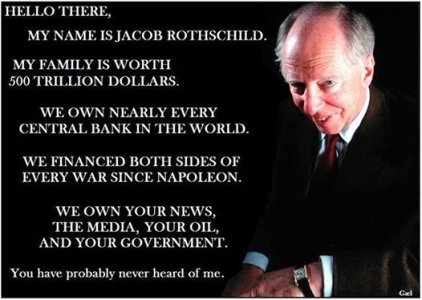
Now tell me, do you think central banks and Rothschild family are lovely people? Do you think they have good intention for humanity?
 
Last edited:
Ah, now after having slandered Hindus, you move to to anti-semitic conspiracy theories popular with the Neo Nazis. You have almost all bases covered :))

I am sure you believe there is no deep state. I doubt you even understand what it is.

BTW, check out this video:

 
no one is compelled to borrow money at interest, as no one is compelled to lend money at without interest.

the reason the system exists is because it works, leverage makes sense to catalyse an economically sound proposal, if people are unable to comprehend the financial commitments they are making that is not a problem of the system.

Islamic finance in its modern form is just interest based finance by another name.

fundamentally human population has increased, productivity has increased, and economic output has increased. a fiat money supply which increases in line with total productivity is essential to avoid hoarding of currencies.

the system is exploited, which means it must be improved, not swapped a system which, in its true form, in spirit and word, is barely workable in a modern economy.
 
Or not...

Since you don't want to watch (either you are lazy or you don't want to change your view), here is a brief summary:

1) The interview is from a guy named Ronald Bernard. He was an ex-banker who is now a whistle-blower. He got tortured and he was threatened after he decided to leave.

2) There is a secretive worldwide cabal and at the top of it there are about 8000-8500 people. These folks control media, governments, central banks etc. They are the so called "Illuminati" or Elites. These people are Luciferians and they are involved in literal child abuses and child sacrifices. Their end goal is to bring in a new world order. They emphasize heavily on occult rituals and symbolism.

3) The elites give instructions to BIS (Bank of International Settlements) which in turn gives instructions to IMF (International Monetary Fund). From IMF, instructions go to central banks and eventually regular banks. The whole system is there to ensure countries go in deep debt and they can't pay back the debts. They enslave the countries and the people with the help of debt and interest.

4) Secret services are pretty much terrorist organizations and they stop at nothing.

There are more stuffs but those are not relevant to this thread.
 
Since you don't want to watch (either you are lazy or you don't want to change your view), here is a brief summary:

1) The interview is from a guy named Ronald Bernard. He was an ex-banker who is now a whistle-blower. He got tortured and he was threatened after he decided to leave.

2) There is a secretive worldwide cabal and at the top of it there are about 8000-8500 people. These folks control media, governments, central banks etc. They are the so called "Illuminati" or Elites. These people are Luciferians and they are involved in literal child abuses and child sacrifices. Their end goal is to bring in a new world order. They emphasize heavily on occult rituals and symbolism.

3) The elites give instructions to BIS (Bank of International Settlements) which in turn gives instructions to IMF (International Monetary Fund). From IMF, instructions go to central banks and eventually regular banks. The whole system is there to ensure countries go in deep debt and they can't pay back the debts. They enslave the countries and the people with the help of debt and interest.

4) Secret services are pretty much terrorist organizations and they stop at nothing.

There are more stuffs but those are not relevant to this thread.

You do realize that you killed your own thread with conspiracy theories?

People aren't unaware of conspiracy theories here. Rather it has been discussed so much to death people get irked when they see one.
 
The current financial system has shortcomings and requires fine-tuning through political and regulatory changes. I don't see the justification to replace it with another system. The proposed system in this thread was suitable for a simpler economy with lower complexity in financial transactions.
 
You do realize that you killed your own thread with conspiracy theories?

People aren't unaware of conspiracy theories here. Rather it has been discussed so much to death people get irked when they see one.

This thread is incomplete without mentioning Rothschild and central banks. They are not fictional entities. They are real and they are parts and parcels of modern banking system. Some may say they are the head of the snake.

Also, these so called conspiracy theories are related to this thread as these are about debt and interest.
 
The current financial system has shortcomings and requires fine-tuning through political and regulatory changes. I don't see the justification to replace it with another system. The proposed system in this thread was suitable for a simpler economy with lower complexity in financial transactions.

Agreed. The proposed system only works in an isolated environment where there's only liquidity. More in the tune of an improvement towards barter system with some added benefits. But once liquidity becomes only a part of the economy, it will fail to keep up with changing aspects.
 
Since you don't want to watch (either you are lazy or you don't want to change your view), here is a brief summary:

1) The interview is from a guy named Ronald Bernard. He was an ex-banker who is now a whistle-blower. He got tortured and he was threatened after he decided to leave.

2) There is a secretive worldwide cabal and at the top of it there are about 8000-8500 people. These folks control media, governments, central banks etc. They are the so called "Illuminati" or Elites. These people are Luciferians and they are involved in literal child abuses and child sacrifices. Their end goal is to bring in a new world order. They emphasize heavily on occult rituals and symbolism.

3) The elites give instructions to BIS (Bank of International Settlements) which in turn gives instructions to IMF (International Monetary Fund). From IMF, instructions go to central banks and eventually regular banks. The whole system is there to ensure countries go in deep debt and they can't pay back the debts. They enslave the countries and the people with the help of debt and interest.

4) Secret services are pretty much terrorist organizations and they stop at nothing.

There are more stuffs but those are not relevant to this thread.

I am sorry, but as a member I have a duty to the secretive worldwide cabal to inform that you have penetrated our operations. Expect a black helicopter to be land in your yard tonight...
 
This thread is incomplete without mentioning Rothschild and central banks. They are not fictional entities. They are real and they are parts and parcels of modern banking system. Some may say they are the head of the snake.

Also, these so called conspiracy theories are related to this thread as these are about debt and interest.

If you can understand urdu/hindi this is immense

https://www.youtube.com/watch?v=DrLBL9AclZ8&t=901s
 

That's a communism manifesto.

It's an irony that the article claims of stagnant growth in capitalist Russia yet, fails to mention why it was there in the first place. Why soviet was broken? Why Ukraine along with other countries wanted to be free?

The economic crisis in Ukraine, is it because capitalism or because political instability?
 

Banking Sector Reforms in India​


Banking Sector Reforms in India have been a continuous process in order to ensure a robust financial system and support sustainable growth. These reforms have made significant transformations in the banking system. This article aims to study in detail the Banking Sector Reforms in India, key measures taken, their impacts and other related concepts.

  • Banking Sector Reforms in India refer to the series of changes implemented to modernize and strengthen the Indian banking system.
  • These reforms were initiated in the early 1990s as part of India’s overall economic liberalization and has been ongoing since then.
  • Most of these reforms have been carried out in the Public Sector Banks (PSBs), though some of them have also been applicable for Private Sector Banks.

Banking Sector Reforms in India were needed for the following reasons:

  • Public Sector Banks (PSBs) account for 80% of the overall NPAs of the Banking sector.
  • PSBs also suffer from slower credit Growth of hardly around 4% in comparison to 15-30% registered by New private Banks (NPBs).
  • The PSBs also face higher losses of around ₹66,000 crores.
  • PSBs account for 93% of total frauds, leading to loss of Taxpayers’ money.

The challenges faced by the Public Sector Banks (PSBs) that necessitated the Banking Sector Reforms in India can be seen as follows:

  • PSBs enjoy less strategic and operating freedom because of majority government ownership.
  • Government exercises significant control over all aspects of PSBs operations ranging from recruitment policies, pay to investments, financing and bank governance including board and top management appointments.
  • Implicit promise of bailout of bank liabilities which is an implicit cost to the taxpayer.
  • PSB Officers are wary of taking risks in lending or renegotiating bad debt, because of fears of harassment under the guise of vigilance investigations.
  • High operating costs.
  • Recruitment processes of PSBs hinder them from campus hiring.
Some of the key measures taken towards Banking Sector Reforms in India have been explained in the sections that follow.

  • Privatisation of Public Sector Banks (PSBs) in India has been in consideration as a potential solution to enhancing efficiency in the Indian Banking System.
  • Privatization of PSBs simply means less active and direct participation of the Central Government in the day-to-day activities of the Public Sector Banks (PSBs).
Read our detailed article on the Privatisation of Public Sector Banks in India.

  • Merger of Public Sector Banks (PSBs) is being done in order to create a more robust, efficient and competitive Banking System in India.
  • Also known as the Consolidation of Public Sector Banks, it refers to the process of combining smaller and weaker banks with larger and stronger ones to create more robust, efficient, and competitive banking entities.
Read our detailed article on the Merger of Public Sector Banks (PSBs) in India.

  • Governance Reforms in Banks in India have been an important part of Banking Sector Reforms in India.
  • Over the years, the Indian banking sector has witnessed significant changes in its governance structure in order to ensure the stability, efficiency, and integrity of the financial system.
  • Some of the key initiatives taken for Governance Reforms in Banks in India include:
    • Establishment of a Bank Board Bureau (BBB).
    • EASE Reform Agenda, etc

  • In order to ensure survival and efficient functioning in the era of digital banking, banks and financial institutions in India are being upgraded technologically.
  • The following initiatives have been taken for making rapid strides in adoption of digital technology:

  • The Society for Worldwide Interbank Financial Telecommunication (SWIFT) provides a network to enable financial institutions all over the world receive and send information about financial transactions in a standardized, secure, and reliable environment.
  • It was established in 1973.
  • It makes use of a standardized proprietary communications platform to facilitate the transmission of information.
  • It neither manages external client accounts nor holds funds on its own.
  • The headquarter of SWIFT is in Belgium.
  • Prior to SWIFT, Telex was the only reliable means of communication regarding transfer of international funds. However, Telex was discontinued due to various issues such as security concerns, low speed, and a free message format.

  • e-Kuber was introduced as part of Banking Sector Reforms in India in 2012 as the Core Banking Solution (CBS) of the Reserve Bank of India (RBI).
  • Core Banking Solutions (CBS) means a solution that enables banks to offer a multiple customer-centric services from a single location on a 24×7 basis, thus enabling support to corporate as well as retail banking activities.
  • Using a Core Banking Solution (CBS), customers can access their accounts from anywhere and from any branch (irrespective of branch where their accounts was opened).
  • Thus, it aims to create a “one-stop” solution for financial services.
  • Almost all the branches of Commercial Banks, including the Regional Rural Banks, are brought into the fold of core-banking.
  • The e-kuber system can be accessed either through Internet or INFINET.

Banking Sector Reforms in India have played a crucial role in shaping an efficient and robust banking system. While significant progress has been made, continuous efforts are required to address new emerging challenges. The journey of banking sector reforms in India must persist to build a resilient banking sector that can support India’s ambitious economic growth aspirations.


Source:


@Devadwal @straighttalk @RexRex @globetrotter - India banking industry really needs a reford, so many dodgy loopholes, how can I help you to solve this issue???
 
Back
Top