What's new

India overtakes Japan to become world’s fourth largest economy

You been coping since forever repeating the same adnauseam. Just because you believe it, does not make it true.

As for India's GDP... Bah. Cant trust any Indian figures, they have perfect the art of gaming numbers.


Pakistan gone forever, 😢 😞.
 
You been coping since forever repeating the same adnauseam. Just because you believe it, does not make it true.

As for India's GDP... Bah. Cant trust any Indian figures, they have perfect the art of gaming numbers.

Hotmail co-founder Sabeer Bhatia questions $5 trillion economy push

LOL, that's what the link is about. You call Sabeer Bhatia questioning Indian economy numbers as some kind of credible evidence? :ROFLMAO::ROFLMAO:🤡🤡
 
Hotmail co-founder Sabeer Bhatia questions $5 trillion economy push

LOL, that's what the link is about. You call Sabeer Bhatia questioning Indian economy numbers as some kind of credible evidence? :ROFLMAO::ROFLMAO:🤡🤡

You can't expect them to think rationally here, they are Pakistanis afterall, all they know decade after decade is disaster, the whole country has been a diabolical mess since creation and will remain so till the end of time. They do not understand economy, democracy, nation building etc. Just sit back and feel bad for them, pray for them also and hope they see the light one day...
 
You can't expect them to think rationally here, they are Pakistanis afterall, all they know decade after decade is disaster, the whole country has been a diabolical mess since creation and will remain so till the end of time. They do not understand economy, democracy, nation building etc. Just sit back and feel bad for them, pray for them also and hope they see the light one day...
Very poor post bro...
 
Typical barbaric - typical india:

News from 2024 May.. hopefully it’s not alzheimer's bro..unless you are going through archive of Times of India and that is fine too..
 
News from 2024 May.. hopefully it’s not alzheimer's bro..unless you are going through archive of Times of India and that is fine too..
does it matter its from 2024, this constantly occurs in india - the most developed country in the world
 

India's small-caps to face another tough year on earnings-valuations mismatch​


Dec 9 (Reuters) - The underperformance of India's small-cap firms relative to large- and mid-caps this year, after two years of strong gains, is likely to persist into 2026 as stretched valuations, moderate earnings and thin liquidity continue to weigh, analysts said.
India groups listed firms by market value, with companies ranking below 251 classified as small-caps. The market rebound through 2025 has remained narrow, leaving smaller companies unable to participate meaningfully.

The Nifty small-cap index (.NIFSMCP100), opens new tab has fallen 9% in 2025, its first lag behind the Nifty 50 (.NSEI), opens new tab and Nifty mid-cap (.NIFMDCP100), opens new tab in three years, even as the two benchmarks touched record highs in November after 14 months on stronger earnings, policy support and firm domestic inflows.
India's small-cap index underperforms large-caps and mid-caps in 2025

India's small-cap index underperforms large-caps and mid-caps in 2025
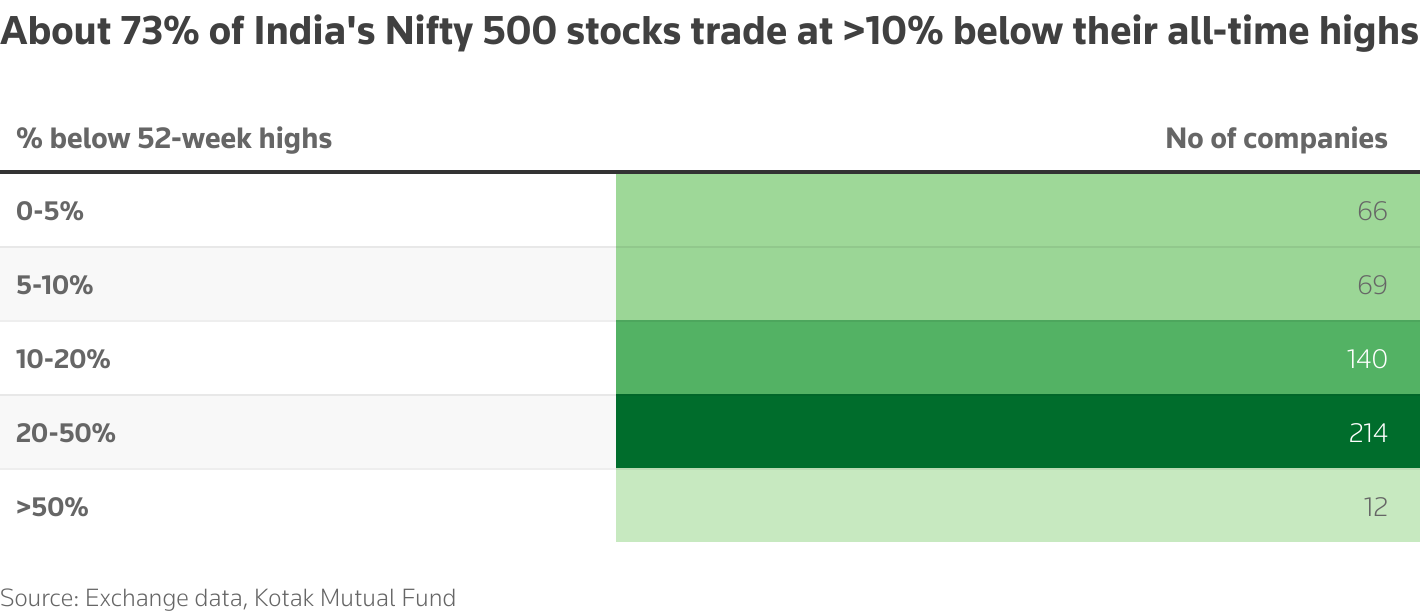
The headline gains conceal deeper market strain. Nearly 73% of Nifty 500 stocks (.NIFTY500), opens new tab remain more than 10% below their record highs.
About 73% of India's Nifty 500 stocks trade at >10% below their all-time highs

About 73% of India's Nifty 500 stocks trade at >10% below their all-time highs
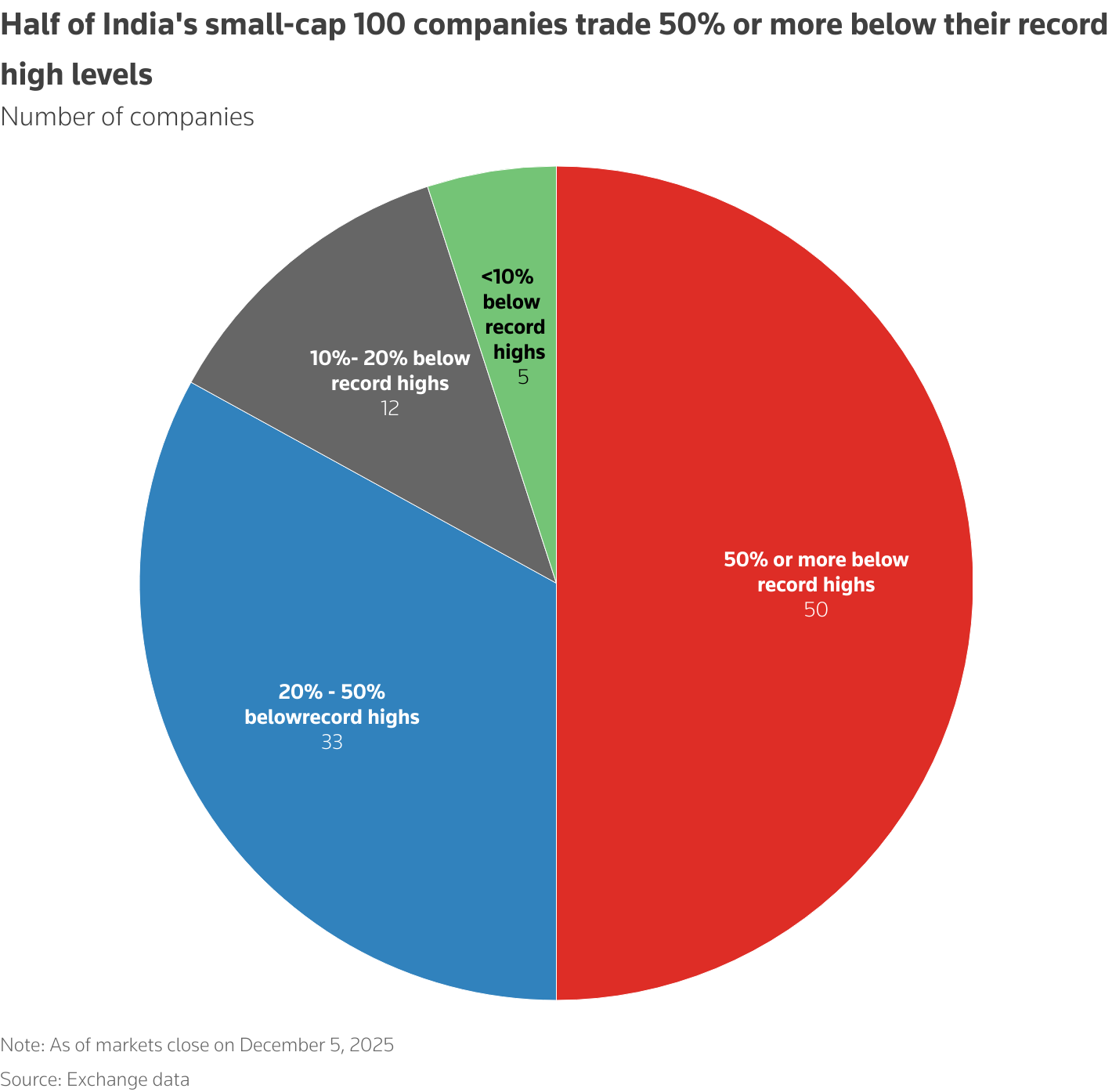
Small-caps, particularly, have struggled to recover after confirming a bear market earlier this year. The index is 13% below the record highs hit in 2024, and nearly half the stocks in the index are still trading more than 50% below their all-time highs.

Half of India's small-cap 100 companies trade 50% or more below their record high levels

Half of India's small-cap 100 companies trade 50% or more below their record high levels
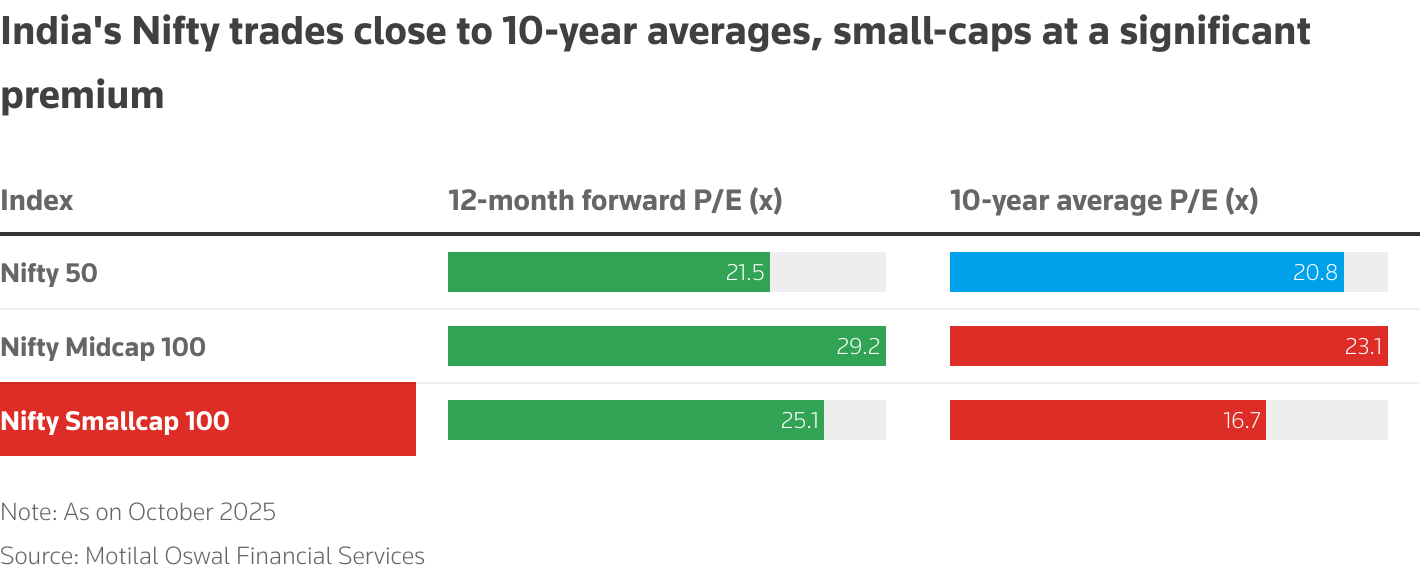
A broad-based recovery is distant, analysts say, largely because valuations are still elevated. While the Nifty 50 trades near its 10-year average price-to-earnings (P/E), mid-caps and small-caps command 12-month forward P/E multiples of 29.2x and 25.1x — well above the long-term averages of 23.1x and 16.7x.
"Either valuations must correct further, meaning more pain for small-caps, or earnings in the second half must rebound so sharply that they start outperforming mid- and large-caps. Neither looks likely," said Harsha Upadhyaya, chief investment officer at Kotak Mahindra Asset Management Company.
India's Nifty trades close to 10-year averages, small-caps at a significant premium

India's Nifty trades close to 10-year averages, small-caps at a significant premium
The weakness has hit retail investors the hardest. They account for about 35% of the NSE cash market activity and own 8.6% of NSE-listed companies, with high exposure to small- and mid-caps.
"Volatility and illiquidity premia in small-caps are hugely underpriced right now," said Dhananjay Sinha, chief executive and co-head of institutional equities at Systematix Corporate Services.

00:16Market Talk: US economy 'won't justify' more than one Fed cut in 2026


.
Illiquidity premia refers to the extra return investors expect from small-cap stocks as they trade at lower volumes and have fewer buyers compared to large-caps.
Several fund houses have already halted or restricted inflows into small- and mid-cap schemes, a cautionary signal, even as retail investors continue chasing higher returns, Sinha said.
Valuations had become "priced for perfection" after strong gains in 2023 and 2024, when the small-cap index surged 93%.
"When quarterly results in small-caps don't match those valuations, the market is punishing them," said Rishabh Nahar, partner and fund manager at Qode Advisors.
A risk-off global environment and a busy initial public offering pipeline have further diverted liquidity toward safer large-caps, Nahar added.


Funny above happened and yet indian companies always use fake numbers
 

Internet Mocks Indian Woman For Comparing India To Life Abroad​


ONLY TOOK HER 2 DAYS TO REALISE JAPAN FAAAAAAAAAAAAAAAAAAAAAAAAAAAAAR BETTER THAN INDIAN
 

India may be the world’s 4th largest economy in total size, but that figure mainly reflects its massive population rather than high living standards. When you look at GDP per capita India actually falls behind Bangladesh, which has achieved better average earnings despite having a much smaller economy. India is only slightly ahead of Pakistan on this measure. This shows that while India produces a lot overall, the wealth is spread across so many people that the average citizen does not experience the benefits of a “large economy.” In practical terms, India is economically big, but not rich on a per-person basis, and its development outcomes are closer to its regional peers than to developed countries in the west. in short india is still a 3rd world country not really up there with the big boys.
 
India may be the world’s 4th largest economy in total size, but that figure mainly reflects its massive population rather than high living standards. When you look at GDP per capita India actually falls behind Bangladesh, which has achieved better average earnings despite having a much smaller economy. India is only slightly ahead of Pakistan on this measure. This shows that while India produces a lot overall, the wealth is spread across so many people that the average citizen does not experience the benefits of a “large economy.” In practical terms, India is economically big, but not rich on a per-person basis, and its development outcomes are closer to its regional peers than to developed countries in the west. in short india is still a 3rd world country not really up there with the big boys.
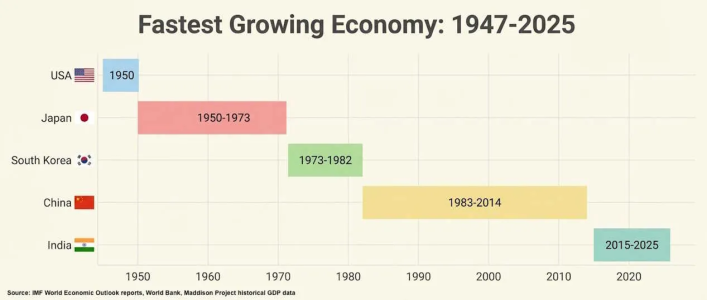
That's a very good point. While India has been the fastest growing economy for a while, a lot of that growth came from India's population growing while China was starting to shrik.
1766419372858.png

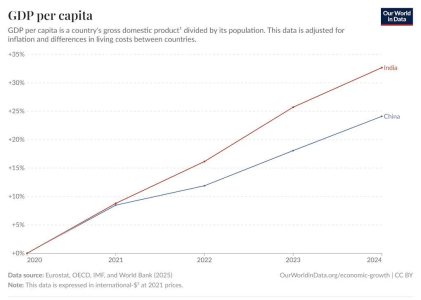
Over the last few years though, India has been showing clear growth in Per Capita terms as well. It's promising but we'll have to see if we can keep it up especially against headwinds like an increasingly protectionist world economy, increasing job automation, social upheaval etc. We'll need a minimum of 15 more such years to get to middle-income status.
1766419517497.png
 
India may be the world’s 4th largest economy in total size, but that figure mainly reflects its massive population rather than high living standards. When you look at GDP per capita India actually falls behind Bangladesh, which has achieved better average earnings despite having a much smaller economy. India is only slightly ahead of Pakistan on this measure. This shows that while India produces a lot overall, the wealth is spread across so many people that the average citizen does not experience the benefits of a “large economy.” In practical terms, India is economically big, but not rich on a per-person basis, and its development outcomes are closer to its regional peers than to developed countries in the west. in short india is still a 3rd world country not really up there with the big boys.

You’re only 10-15 years late with your arguement.

Firstly India’s GDP per capita is slightly higher than Bangladesh but that’s not even the point. Bangladesh is the size of one of our states and we have 7-8 states with GDP per capita much higher.

The biggest thing here is genuine visible and sustainable development. India has developed in all directions whereas Bangladesh has only milked the Garment exports market to the maximum and is already declining from the peaks it reached. They’re not even growing as fast they were doing under Haseena.

India is making steel, semi conductors, pharmaceuticals, iphones, fighter jets and all.

Bigger nations actually have greater challenge maintaining growth rates and India’s consistently hitting the upper circuit among major nations.
 
That's a very good point. While India has been the fastest growing economy for a while, a lot of that growth came from India's population growing while China was starting to shrik.
View attachment 160193

Over the last few years though, India has been showing clear growth in Per Capita terms as well. It's promising but we'll have to see if we can keep it up especially against headwinds like an increasingly protectionist world economy, increasing job automation, social upheaval etc. We'll need a minimum of 15 more such years to get to middle-income status.
View attachment 160194


There’s no doubt India has made visible progress over the last 20 years, and much of that growth has accelerated under Modi’s leadership. However, boasting about being the world’s fourth-largest economy and implying that India is comparable to countries like Switzerland is misleading. Economic size doesn’t equal prosperity. When measured by income per person, India still lags behind countries such as Bangladesh, which highlights the gap between headline GDP figures and the everyday reality for citizens.
 
When you look at GDP per capita India actually falls behind Bangladesh, which has achieved better average earnings despite having a much smaller economy. India is only slightly ahead of Pakistan on this measure.
I don't know what data you are referring to but GDP percapita according to world bank in 2024

India = $2695
Bangladesh = $2593
Pakistan = $1479

In 2025, we should be close to or crossing $3000 and will be 2X of Pakistan and thats not slightly better by any means.


India is ahead of Bangladesh and ~2X of Pakistan.
This shows that while India produces a lot overall, the wealth is spread across so many people that the average citizen does not experience the benefits of a “large economy.”
India is quite large and when we move to Northern states like Bihar where Percapita income is <$1000 but in Southern states, almost all the major 5 states has ~>$5000 percapita. So, average citizen in the South is very different from the North but fortunately, that solves the humanitarian crisis issues like health care etc as they are pretty much covered.
its development outcomes are closer to its regional peers than to developed countries in the west. in short india is still a 3rd world country not really up there with the big boys.
In IMF / World bank, >4500$ percapita is considered as upper middle income countries while <1135$ is considered as lower income and 1135-4500$ is lower middle income countries.


India’s development outcomes are closer to its regional peers like Srilanka, Indonesia but not with Pakistan which is close to low-income nation category. Its not a satire but reality. And no South Asian nation is closer to West, not even China.
 
There’s no doubt India has made visible progress over the last 20 years, and much of that growth has accelerated under Modi’s leadership. However, boasting about being the world’s fourth-largest economy and implying that India is comparable to countries like Switzerland is misleading. Economic size doesn’t equal prosperity. When measured by income per person, India still lags behind countries such as Bangladesh, which highlights the gap between headline GDP figures and the everyday reality for citizens.

I disagree with you.
A nation is an entity itself.
Its people collectively are another entity.

India might not have a Switzerland’s per capita and quality of life but its economic size means it holds far greater geopolitical clout.

You cannot disregard how economic progress elevates a nation geopolitically. India’s recent ascendency in global forums is directly because of the size of its collectively economy.

Yes, ideally the per capita purchasing power must match the clout, it’s an imbalance but once that’s also reducing at a record pace. Indians are richer than ever, travelling more than ever before, the signs are there. In time, it will improve further and it will happen quicker than most people here think.

The way the geopolitics works, either things remain stagnant for decades or they change very rapidly and in case of India, the rising phase has clearly arrived.
 
Over the last few years though, India has been showing clear growth in Per Capita terms as well. It's promising but we'll have to see if we can keep it up especially against headwinds like an increasingly protectionist world economy, increasing job automation, social upheaval etc. We'll need a minimum of 15 more such years to get to middle-income status.
True that!
We need a good 15 years of consistent 8-9% growth to reach $8-9k percapita.
Economists often consider US$2000 and US$5000 as inflection points for robust economic growth as it drives consumption. This is one of the most discussed topic in CFA forums too.

Even China experienced that crossing 5000$ percapita. If you see the Southern states, there is a rapid growth in real-estate, high rise buildings, retail consumption etc because their consumption patterns change. Thankfully, India manufacturing and services sector is getting diversified. There is a lot of untapped potential in core industrial goods such as Steel, Mining and metal industries which will offer solid growth in future. India doesn't need much efforts to grow at 6% given the current scenario but to grow at 8-10%, we require solid reforms like GST reforms we’ve seen recently. In 5 years or so, our Auto industry and real-estate are some industries I am betting on drawing parallels to China.
 
I disagree with you.
A nation is an entity itself.
Its people collectively are another entity.

India might not have a Switzerland’s per capita and quality of life but its economic size means it holds far greater geopolitical clout.

You cannot disregard how economic progress elevates a nation geopolitically. India’s recent ascendency in global forums is directly because of the size of its collectively economy.

Yes, ideally the per capita purchasing power must match the clout, it’s an imbalance but once that’s also reducing at a record pace. Indians are richer than ever, travelling more than ever before, the signs are there. In time, it will improve further and it will happen quicker than most people here think.

The way the geopolitics works, either things remain stagnant for decades or they change very rapidly and in case of India, the rising phase has clearly arrived.
I don't know what data you are referring to but GDP percapita according to world bank in 2024

India = $2695
Bangladesh = $2593
Pakistan = $1479

In 2025, we should be close to or crossing $3000 and will be 2X of Pakistan and thats not slightly better by any means.


India is ahead of Bangladesh and ~2X of Pakistan.

India is quite large and when we move to Northern states like Bihar where Percapita income is <$1000 but in Southern states, almost all the major 5 states has ~>$5000 percapita. So, average citizen in the South is very different from the North but fortunately, that solves the humanitarian crisis issues like health care etc as they are pretty much covered.

In IMF / World bank, >4500$ percapita is considered as upper middle income countries while <1135$ is considered as lower income and 1135-4500$ is lower middle income countries.


India’s development outcomes are closer to its regional peers like Srilanka, Indonesia but not with Pakistan which is close to low-income nation category. Its not a satire but reality. And no South Asian nation is closer to West, not even China.

Yeah, it’s still not a developed country like you’re making it out to be. Having a big economy on paper doesn’t magically change real life for people there. That’s just what happens when you have a huge population.


For most people, things still look very third-world, low incomes, weak public services, crowded hospitals, patchy education, and poor infrastructure. You can’t just ignore all that and shout “4th biggest economy” like it means everything.


So no, it’s not developed, and it’s definitely not the 4th best country in the world. That’s just hype, not reality.
 
Yeah, it’s still not a developed country like you’re making it out to be. Having a big economy on paper doesn’t magically change real life for people there. That’s just what happens when you have a huge population.


For most people, things still look very third-world, low incomes, weak public services, crowded hospitals, patchy education, and poor infrastructure. You can’t just ignore all that and shout “4th biggest economy” like it means everything.


So no, it’s not developed, and it’s definitely not the 4th best country in the world. That’s just hype, not reality.
I dont know if you misread or cant comprehend but it states that India is 4rth largest economy. Nowhere did I mention that India is a developed nation nor its the 4rth best country.

But there is a world if difference between a growing country like India vs Pakistan. You tried to make a point that India is like Pakistan but neither the economic indicators nor microeconomic factors indicate that.
 
First of all, I do not trust any data coming from India. They fabricate things a lot. I wouldn't be surprised if their real rank is outside of top 5.

Secondly, Japan is miles ahead of India when it comes to living standard. There is absolutely no comparison. :inti

India is all about quantity over quality.
 
India's real GDP is allegedly $2.5-trillion. Not $4-trillion as they present. :inti

That would make them far from being #4.

Check this video:

 
India's real GDP is allegedly $2.5-trillion. Not $4-trillion as they present. :inti

That would make them far from being #4.

Check this video:


Here is a summary of the video:

1) Opening question: “Has the BJP government done a good job?”​


  • Guest argues Modi’s major promises weren’t fulfilled, especially around:
    • Black money
    • Counterfeit currency
    • Terror financing
  • Host highlights a contradiction:
    • India is celebrated as a $4T economy / 4th largest
    • Yet 800 million depend on subsidized food
    • Unemployment feels extremely high


2) Core framework: India has “two economies”​


Organized vs Unorganized​


  • Organized sector
    • ~6% of workforce
    • ~55% of output
    • Has measurable data (corporate balance sheets)
  • Unorganized sector
    • ~94% of workforce
    • Includes:
      • Agriculture (~46%)
      • Non-agriculture (~48%)
    • Poorly measured in GDP estimates

Key claim​


  • GDP growth looks strong because the data mostly reflects the organized sector
  • Guest claims actual growth is closer to ~1.5–2.5%, not 6–7%
  • Guest claims India is not truly ~$3.8T, but closer to ~$2.5T


3) Why the official GDP picture is misleading (guest’s argument)​


  • Quarterly GDP relies heavily on a small slice of the economy:
    • Data from only hundreds/thousands of corporate firms
    • But India has:
      • ~70 million micro units
      • ~500k small/medium units
      • few thousand large units (only a fraction actively tracked)
  • So a small tracked group ends up “representing” everyone.


4) “Four shocks” that hit the unorganized sector​


Guest says the unorganized sector has been damaged by repeated shocks:


  1. Demonetization
    • Cash crunch froze markets for months
    • Evidence cited: rotting crops, falling sales, shutdowns
  2. Faulty GST implementation
    • Increased compliance complexity
    • Shifted advantage to organized sector
  3. NBFC crisis
    • Small/unorganized businesses rely on NBFC lending
    • Lending disruption hurt them badly
  4. COVID + lockdown
    • Mass reverse migration
    • Production and demand collapse, especially informal work

Result: ongoing weakness → unemployment and low incomes persist.


5) Unemployment: “4 kinds,” not 1​


Guest claims government stats capture only one kind.


  1. Open unemployment: looking for work, not finding it
  2. Underemployment: in market all day, only a few hours of work
  3. Disguised unemployment: extra people “employed” but not productive
  4. Discouraged workers: stopped looking (many women and youth)

Guest’s claim:


  • ~320 million have proper work
  • ~280 million don’t have proper work


6) AI makes it worse (guest’s warning)​


  • Unlike earlier tech that displaced physical labor,
  • AI may displace mental/white-collar work, including:
    • call centers/BPO
    • coding
    • parts of professional services (law, accounting, medicine)


7) GST: why it “benefits organized sector”​


Main mechanism: Input Tax Credit (ITC)​


  • Organized firms (GST-registered) can claim ITC → lower effective cost
  • Unorganized sellers (outside GST) pay GST on inputs but can’t claim ITC
  • Result: organized players become more competitive; demand shifts toward them

Host’s simplified example​


  • Chain tea brand can reclaim GST on inputs
  • Street chaiwala cannot reclaim it → gets squeezed on margin

Guest’s view​


  • GST “reform” needed, not just rate cuts
  • Suggested reform: tax final product at MRP and reduce multi-stage complexity


8) Agriculture & MSP: debate and proposal​


Host concern​


  • If MSP is guaranteed, government may be forced to buy unlimited supply
  • Storage limits + demand/supply distortion

Guest response​


  • Current distortion exists because only a few crops effectively get MSP (esp. wheat/paddy)
  • Proposal:
    • Make all crops fairly profitable via MSP based on full cost
    • Cropping pattern becomes environmentally and economically rational
    • Procurement happens only when market price falls below MSP (not unlimited)


9) What would actually reduce poverty and raise demand?​


Guest argues growth must come from the bottom-up:


  • Increase incomes of the 94% workforce
  • That raises demand → then organized sector also benefits

How to generate jobs​


  • Not through FDI alone (mostly organized sector, fewer jobs)
  • Focus on micro + small units (not “MSME” as a lump category)
    • “Medium can take care of itself”
  • Promote cooperatives (like Amul model)
    • credit access
    • marketing support
    • technology support


10) Black economy: what it is and why demonetization failed​


Core claim​


  • Black wealth is a portfolio, cash is only a small part (guest says ~1%)
  • Demonetization was based on the wrong premise: “black = cash”
  • Also, most cash returned to the system → limited impact

“Triad” behind black economy​


  • Corrupt businessman
  • Corrupt politician
  • Corrupt executive (bureaucracy + police + judiciary)

Solution proposed​


  • Break the triad through accountability
  • Strengthen tools like:
    • RTI
    • whistleblower protection
  • Guest argues the current system restricts accountability.


11) Closing summary (what the conversation concludes)​


  • India’s headline growth is shaped by organized-sector data
  • The unorganized sector (where most people work) is weak/declining
  • Shocks + policy design created unemployment and inequality
  • Fix requires:
    • reforming how growth is measured
    • strengthening micro/small sector
    • rational agriculture pricing (MSP approach)
    • accountability to reduce black economy
 
Back
Top