






Bhaijaan
Hall of Famer
- Joined
- Jan 10, 2011
- Runs
- 73,278
- Post of the Week
- 1
A thread purely for aviation enthusiasts with a curious eye on development of upcoming next gen fighterjets.
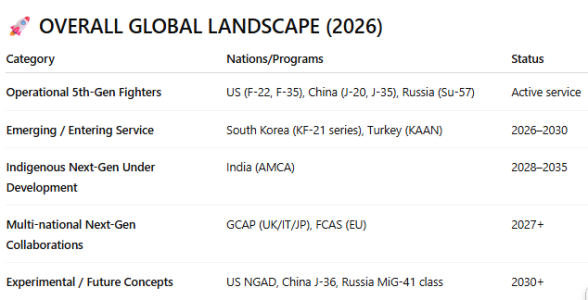
Below is a concise, authoritative briefing on every major fifth-generation (5th-gen) or next-generation (5th+/6th-gen) stealth fighter program worldwide. Each section emphasizes current development status, near-term milestones, and the most likely timeline to hit those milestones.
United States
Status (now): Mature operational fleet (F-22, F-35) with continuous upgrades; advanced next-gen work focused on the NGAD family of systems (manned fighter + loyal wingmen, sensors, software).
Near-term milestones (likely): NGAD demonstrators and prototype systems will continue classified flight tests through 2027–2030; limited fielding of loyal-wingman drones to pair with legacy/manned jets by ~2028–2032.
China
Status (now): Operational 5th-gen types in PLA service (Chengdu J-20 and Shenyang J-35/FC-31 family). Active R&D on even more advanced prototypes reported (6th-gen concepts).
Near-term milestones (likely): Continued ramp of J-20 production through 2026–2028; introduction of carrier-capable J-35 naval variants and further prototype flights of advanced concepts across 2026–2032.
Russia
Status (now): Su-57 in low-rate production and limited operational use; other concepts (lightweight stealth, MiG-41 class ideas) remain at concept/prototype stages.
Near-term milestones (likely): Gradual increases in Su-57 sortie and squadron numbers over 2026–2030 if industrial and funding constraints permit; other new types remain speculative and long-term (post-2030).
South Korea
Status (now): KF-21 Block I serial production underway; Block II (and later Block III/KF-21EX with enhanced low observable features) in development. Deliveries to ROKAF scheduled to begin in 2026.
Near-term milestones (likely):
India
Status (now): Prototype development approved and underway; design and engineering models publicly demonstrated; DRDO/ADA planning a phased prototype rollout.
Near-term milestones (most likely timeline):
Turkey
Status (now): Prototype flew (first flight achieved); serial-production plans tied to domestic engine maturity and industrial schedule. Turkey has stated serial production aims around 2028 while continuing to buy interim foreign aircraft as needed.
Near-term milestones (likely):
Global Combat Air Programme
Status (now): Active multinational next-gen programme with demonstrator and technology roadmap; governance and funding progressing more smoothly than FCAS. Demonstrator flight aims and formal development phases are planned.
Near-term milestones (likely):
Future Combat Air System
Status (now): Severely unsettled. Deep disagreements over leadership, industrial roles, and technical requirements have stalled progress; observers warn the fighter element may be split or restructured.
Near-term milestones (likely outcomes):
Below is a concise, authoritative briefing on every major fifth-generation (5th-gen) or next-generation (5th+/6th-gen) stealth fighter program worldwide. Each section emphasizes current development status, near-term milestones, and the most likely timeline to hit those milestones.
United States 
Status (now): Mature operational fleet (F-22, F-35) with continuous upgrades; advanced next-gen work focused on the NGAD family of systems (manned fighter + loyal wingmen, sensors, software).
Near-term milestones (likely): NGAD demonstrators and prototype systems will continue classified flight tests through 2027–2030; limited fielding of loyal-wingman drones to pair with legacy/manned jets by ~2028–2032.
China 
Status (now): Operational 5th-gen types in PLA service (Chengdu J-20 and Shenyang J-35/FC-31 family). Active R&D on even more advanced prototypes reported (6th-gen concepts).
Near-term milestones (likely): Continued ramp of J-20 production through 2026–2028; introduction of carrier-capable J-35 naval variants and further prototype flights of advanced concepts across 2026–2032.
Russia 
Status (now): Su-57 in low-rate production and limited operational use; other concepts (lightweight stealth, MiG-41 class ideas) remain at concept/prototype stages.
Near-term milestones (likely): Gradual increases in Su-57 sortie and squadron numbers over 2026–2030 if industrial and funding constraints permit; other new types remain speculative and long-term (post-2030).
South Korea 
Status (now): KF-21 Block I serial production underway; Block II (and later Block III/KF-21EX with enhanced low observable features) in development. Deliveries to ROKAF scheduled to begin in 2026.
Near-term milestones (likely):
- 2026: Initial operational deliveries (Block I) to ROKAF.
- 2027–2028: Block II maturity (improved A2G capability) and continuing production; Block III development through late-2020s targeting internal weapons bays / stealth upgrades.
India 
Status (now): Prototype development approved and underway; design and engineering models publicly demonstrated; DRDO/ADA planning a phased prototype rollout.
Near-term milestones (most likely timeline):
- Late 2026–2027: Prototype rollout window (engineering/prototype build sequence).
- Late 2028: First flight currently targeted (subject to schedule risk).
- Early-to-mid 2030s: Certification and induction (2032–2035 range is plausible under optimistic funding/engine-development assumptions). Risks: indigenous engine maturity, supply-chain and production partner choices could push timelines later.
Turkey 
Status (now): Prototype flew (first flight achieved); serial-production plans tied to domestic engine maturity and industrial schedule. Turkey has stated serial production aims around 2028 while continuing to buy interim foreign aircraft as needed.
Near-term milestones (likely):
- 2026–2028: Engine qualification and transition to serial production; deliveries in the 2028–2030 window if no major technical setbacks occur.
Global Combat Air Programme 
Status (now): Active multinational next-gen programme with demonstrator and technology roadmap; governance and funding progressing more smoothly than FCAS. Demonstrator flight aims and formal development phases are planned.
Near-term milestones (likely):
- By 2027: Demonstrator flights planned (technology demonstrators, sensor and systems integration).
- By ~2035: Initial production/service entry for baseline capability (full generation fielding likely mid-2030s). Timelines depend on partner funding and industrial alignment; potential for Germany to join could change scope/timing.
Future Combat Air System
Status (now): Severely unsettled. Deep disagreements over leadership, industrial roles, and technical requirements have stalled progress; observers warn the fighter element may be split or restructured.
Near-term milestones (likely outcomes):
- Short term (2026): Political/industrial negotiations — outcome options include (a) restructured programme focused on shared combat cloud/drones while each nation pursues separate fighters, (b) split two-fighter approach, or (c) prolonged delay/cancellation of a single Europe-wide fighter. Given current statements, a fully unified FCAS fighter by 2040 is increasingly uncertain.
OTHER PROGRAMS & CONCEPTS (brief)
- Russia — light stealth / Su-75 / future concepts: Concepts exist but operational impact and timelines beyond Su-57 remain speculative; expect incremental advances 2026–2035.
- Iran — HESA claims: Domestic claims of stealth designs remain unverified and unlikely to produce true 5th-gen capability in the near term.
- Unmanned “loyal wingman” programs: Multiple nations (US, UK, Australia, Turkey, China) are operationalizing or testing autonomous combat drones to work with manned fighters; these will accelerate fielding of networked combat systems through 2028–2032.
TIMELINES
- Operational now (2025–2026): United States, China, and Russia operate 5th-gen fighters today (F-35/F-22; J-20/J-35; Su-57).
- Near-term entrants (2026–2030): Expect KF-21 deliveries (South Korea) and KAAN serial production ramp if engines clear tests; AMCA aims first flight in 2028 but production is 2030s.
- Mid-term next-gen (2030–2038): GCAP partners target demonstrators in the late-2020s and service entry by the mid-2030s; US NGAD and China’s advanced prototypes may field advanced capabilities in similar windows.
- Wildcards: FCAS political/industrial fracture could remove a pan-European stealth fighter option; conversely, Germany joining GCAP could reallocate European capabilities into that programme.
RISKS, DRIVERS & CONSTRAINTS
- Engines and sensors remain the technical bottlenecks for many programs (AMCA, KAAN).
- Industrial politics (national requirements, industrial leadership) are the dominant schedule risk in Europe (FCAS vs GCAP).
- Budget & export politics influence partner choices and timelines (e.g., interim foreign purchases while domestic jets mature).


 What’s already done
 What’s happening now (2026)
 What comes next

