



What's new

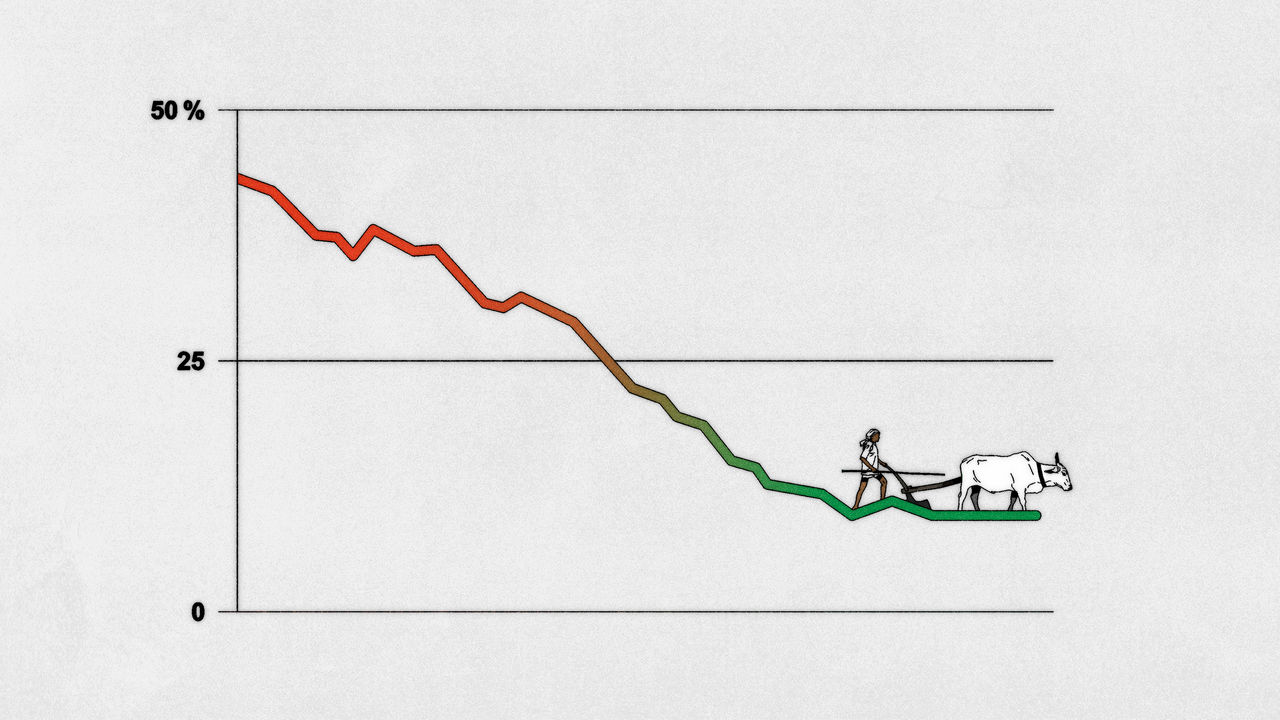
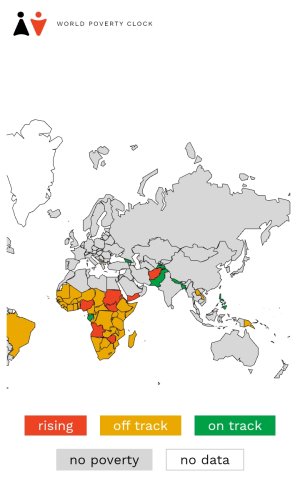
Extreme poverty in India has dropped to negligible levels!

Devadwal

T20I Captain
Joined
Dec 15, 2020
Runs
42,542

This is a wonderful achievement. It is even more impressive because the country managed it without an industrial miracle.

now we need to work harder and smarter to eliminated completely.

====

New research suggests that the extreme poverty rate in India has dropped to ‘negligible’ levels, with rates below 5% in 2024, with rural poverty at 4.86% and urban at 4.09% as per recent reports.

The notion that development in populous, low-income countries is inherently slow seems to be wrong if we look at the recent reporting. It was and still is often cited due to the complexities of scaling interventions and the scale of poverty.

Let’s have a look into the findings, and keep in mind there are debates around the measurement of poverty.

1 Current Poverty Rate Levels in India
2 Poverty Rate in India – Historical Trends and Comparisons
3 Policy and Economic Drivers
4 Debates around the Measurement of Poverty

Current Poverty Rate Levels in India

Recent data from the State Bank of India (SBI) report, based on the 2023-24 Household Consumption Expenditure Survey (HCES), estimates that the national poverty rate has fallen below 5%, specifically between 4-4.5%. This is broken down as follows:

Region FY24 Poverty Rate (%) FY23 Poverty Rate (%) FY12 Poverty Rate (%)
Rural 4.86 7.2 25.7
Urban 4.09 4.6 13.7

These figures do indeed represent a sharp decline, with rural poverty dropping from 25.7% in FY12 to 4.86% in FY24, and urban poverty decreasing from 13.7% in FY12 to 4.09% in FY24. The poverty line for 2023-24 was set at Rs1,632 for rural areas and Rs1,944 for urban areas, adjusted for inflation based on the recommendations of the Suresh Tendulkar committee from 2011-12.

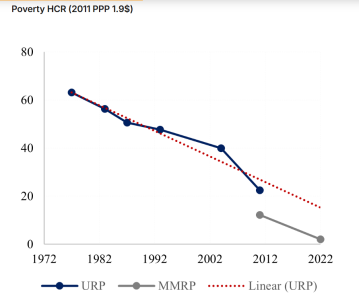
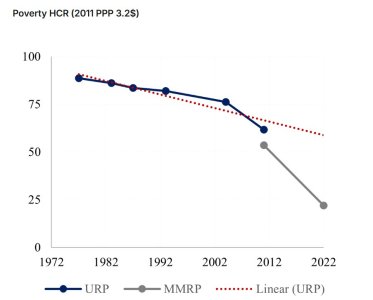
Further, a Brookings article provides additional insight using international poverty lines, noting that the Headcount Poverty Ratio (HCR) for the PPP$ 1.9 poverty line (a common measure of extreme poverty) declined from 12.2% in 2011-12 to 2% in 2022-23, equating to an annual reduction of 0.93 percentage points. For the PPP$ 3.2 poverty line, the HCR dropped from 53.6% to 20.8% over the same period, as shown in the table below:

Poverty Line 2011-12 HCR (%) 2022-23 HCR (%) Annual Reduction (ppt)
PPP$ 1.9 12.2 2 0.93
PPP$ 3.2 53.6 20.8 ~3

These statistics show the near elimination of extreme poverty in India, with the 2% HCR for PPP$ 1.9 in 2022-23 being particularly striking, suggesting that only a small fraction of the population remains below this threshold.
 
Last edited by a moderator:
India has released its official consumption expenditure data for 2022-23, providing the first survey-based poverty estimates in over a decade. This update significantly reduces uncertainty in global poverty estimates.

India uses two methods for estimating consumption expenditure:
Uniform Recall Period (URP): Measures all expenditures over a 30-day period.
Modified Mixed Recall Period (MMRP): More accurate method measuring perishables over 7 days, durable goods over 365 days, and all others over 30 days.

Since 2022-23, India has officially adopted the MMRP method, aligning with global standards. The new data offers comparable poverty estimates from 2011-12 to 2022-23 for two key poverty lines:
PPP $1.9 (extreme poverty)
PPP $3.2 (recommended for lower-middle-income countries)

Key Findings from the Data:
Real per capita consumption growth was 2.9 percent annually since 2011-12.
Rural growth (3.1 percent) was higher than urban growth (2.6 percent).
Significant reduction in inequality in both urban and rural areas.

Decline in Inequality:
Urban Gini coefficient fell from 36.7 to 31.9.
Rural Gini coefficient fell from 28.7 to 27.0.
Such a steep decline in inequality alongside high growth is unprecedented in economic history.

Poverty Reduction:
Extreme poverty (PPP $1.9) has been nearly eliminated, declining from 12.2 percent in 2011-12 to just 2 percent in 2022-23.
Rural poverty is 2.5 percent, urban poverty is 1 percent.
PPP $3.2 poverty rate declined from 53.6 percent to 20.8 percent, a nearly 3 percentage point drop per year.

Importantly, these estimates do not account for:
Free food distribution (covering two-thirds of the population).
Public healthcare and education benefits.
If included, poverty levels would be even lower.

The new estimates show far fewer poor in India than previous World Bank estimates, which relied on private survey data with known methodological flaws.

Why has poverty fallen so sharply?

Strong rural development policies, including: Universal electrification and access to clean cooking fuel.
Massive expansion of piped water supply (from 16.8 percent in 2019 to 74.7 percent today).
The Aspirational Districts Program, targeting the least developed areas for improvement.

The new data highlights India’s progress in lifting millions out of poverty. With extreme poverty nearly eradicated.

PM MODI success in reducing poverty at an accelerated pace has significant global implications. The data reinforces India's position as a key driver of poverty reduction worldwide.

:kp1000011932.png1000011933.jpg
 
In 20 years, from half the population to only 2 percent. Bharat has exceeded my expectations.
 
The thing with India is they have an extremely large population. So, even a "negligible" percentage of poor people means a lot of people.

For example, 5% extreme poverty in India means there are still around 79-million poor people (5% of 1.4-billion).

If India's economy is so great, why are Indians leaving India? Some are even leaving illegally. There are over 700,000 illegal Indians in USA alone. :inti
 
The thing with India is they have an extremely large population. So, even a "negligible" percentage of poor people means a lot of people.

For example, 5% extreme poverty in India means there are still around 79-million poor people (5% of 1.4-billion).

If India's economy is so great, why are Indians leaving India? Some are even leaving illegally. There are over 700,000 illegal Indians in USA alone. :inti
No one is going to bangladesh or failed State but ofcourse USA is World alone superpower so people's always choose to go there.

approximately 310,000 people leaving China per year. Additionally, wealthy individuals are also leaving, with 13,800 high-net-worth individuals departing in 2023, a significant increase from 2022.

So crying in other thread . This is most important global development in the world let alone in india.

And only 2% peoples are living in extreme poverty instead your claim about 5%.

:kp
 
No one is going to bangladesh or failed State but ofcourse USA is World alone superpower so people's always choose to go there.

approximately 310,000 people leaving China per year. Additionally, wealthy individuals are also leaving, with 13,800 high-net-worth individuals departing in 2023, a significant increase from 2022.

So crying in other thread . This is most important global development in the world let alone in india.

And only 2% peoples are living in extreme poverty instead your claim about 5%.

:kp

But Indians are leaving India in substantial numbers. And the U.S is not the only destination, Europe and the Gulf is also a prime destinations for Indians to flock from their country
 
But Indians are leaving India in substantial numbers. And the U.S is not the only destination, Europe and the Gulf is also a prime destinations for Indians to flock from their country
Because Indian are most skilled people's so they are going For job unlike Pakistan who are mostly going for begging in middle East Country's

Is this your problem? :kp
 

Attachments

  • 1000011936.jpg
    1000011936.jpg
    36.7 KB · Views: 6
India and Indians are progressing in every department so obviously usual suspect are crying about it. They are hurting to see india progress :kp
 
The thing with India is they have an extremely large population. So, even a "negligible" percentage of poor people means a lot of people.

For example, 5% extreme poverty in India means there are still around 79-million poor people (5% of 1.4-billion).

If India's economy is so great, why are Indians leaving India? Some are even leaving illegally. There are over 700,000 illegal Indians in USA alone. :inti

Brother if someone is earning a decent salary to be able to afford rent in a metro city and food, drinks etc, going to IPL matches. But is living away from his parents. That person is also living a life of poverty. Modern day corporate slavery needs to be acknowledged.
 
Because Indian are most skilled people's so they are going For job unlike Pakistan who are mostly going for begging in middle East Country's

Is this your problem? :kp
Aise maza nahi aayega. Give us the stats. Also, tell us how many people from India are going to Middle Eastern countries. :yk :inti
 
@Devadwal i see poverty rate was decreasing at 1 percent per year from 72 to 82 after the famous garibi hatao slogan.from 82 to 92 , poverty rate is almost stagnant and nothing happened. This is where the issue for 91 economic crisis happened i believe. No progress in any thing and Rajiv is still considered as a God despite his failures in all fronts.i see 2 decades of nothing even after China started economic liberation in 76 is all the root cause of the mess which must have cleared a long back.
 
Good job India. Next step is to make your country clean and create equal opportunities for everyone in society.
 
These are great wins however India's main problem will always be its population. Mother nature just won't be able to sustain this increase in numbers unfortunately...
 
These are great wins however India's main problem will always be its population. Mother nature just won't be able to sustain this increase in numbers unfortunately...
As people are lifted from poverty and have more economic opportunities they tend to have less kids. It will take time but on some metrics India is on a very good track.
 
This is great but not enough. We need to reach middle income nation fast to keep up with rapid advancements.
 
Population will hardly be a concern in coming decades, 2050 and beyond should be a vastly improved Bharat.
 
As long as the population remains high, I don't see much hope for India.
Extreme poverty results in higher population. When population reaches a critical mass of working class percentage, it would automatically drop. The focus should be on educating and providing employment opportunities for the all strata of people.
 
Report stating 800m indians living in poverty:


thats is crazy amount - europe total population is just above 500m
Try bumping with better articles for your echo chamber buddies ,I know you love old Indian archives but here from the same article:

“We have to set our aspirations high because 800 million Indians get free ration. That means 800 million Indians are in poverty”…


Friendly advice: Start reading books instead of youtube videos, other than it’s upto you, and carry on with trolling..
 
Try bumping with better articles for your echo chamber buddies ,I know you love old Indian archives but here from the same article:

“We have to set our aspirations high because 800 million Indians get free ration. That means 800 million Indians are in poverty”…


Friendly advice: Start reading books instead of youtube videos, other than it’s upto you, and carry on with trolling..
above link wason my phone media news list.

its not old news - just last yr 16-12-24, not like many of those 800m have came out - considering your economist =


here in the west if you cant eat, your in poverty - you must had a weird understanding of poverty
 
🇮🇳 India has lifted nearly 270 million to 302 million people out of poverty in the last 10 years as per world bank report

Homeless People Across the World

1. 🇵🇰 Pakistan → 8,000,000
2. 🇧🇩 Bangladesh → 5,000,000
3. 🇦🇫 Afghanistan → 4,660,000
4. 🇳🇬 Nigeria → 4,500,000
5. 🇵🇭 Philippines → 4,500,000
6. 🇾🇪 Yemen → 3,858,000
7. 🇸🇴 Somalia → 2,968,000
8. 🇸🇩 Sudan → 2,730,000
9. 🇨🇳 China → 2,579,000
10. 🇪🇬 Egypt → 2,000,000

I think These figures also included floods effected people's.

:kp
 
Dirt poor people have definitely disappeared, but there are still millions of poor people especially in cities that live in miserable conditions with no skills and very few opportunities waiting to be exploited.
 

Top 10 hungriest countries in the world in 2025: India falls under ‘serious’ category​


Top 10 hungriest countries in the world in 2025 list: The Global Hunger Index 2025 shows that a number of nations still fall into the categories of ‘alarming’ or ‘serious’ hunger, with scores ranging from 31 to 42.6.​


Global Hunger Index 2025: Even in 2025, when technology and agriculture have advanced like never before, hunger remains one of the world’s most persistent challenges. According to the latest Global Hunger Index 2025, about one in every 10 people across the planet still do not get enough to eat. That is nearly 673 million people living with chronic hunger—a heartbreaking reminder that progress in food production does not always mean equal access to food.

Several factors continue to fuel this crisis—poverty, war, economic instability, climate change, and weak governance. In many parts of Africa and Asia, these challenges combine to create severe food shortages. Countries affected by conflict, droughts, and displacement often struggle the most, as people lose not only access to food but also the means to grow or buy it.

The Global Hunger Index 2025 shows that a number of nations still fall into the categories of “alarming” or “serious” hunger, with scores ranging from 31 to 42.6. Among the most affected are Somalia, South Sudan, Madagascar, the Democratic Republic of the Congo, and Haiti, which continue to face devastating hunger levels due to ongoing crises.

In Somalia, decades of conflict, recurring droughts, and mass displacement have left millions struggling to find food and clean water. Weak infrastructure and repeated natural disasters make farming and food delivery extremely difficult. As a result, Somalia remains one of the hardest-hit countries in the world when it comes to hunger.

South Sudan follows closely behind. The nation continues to battle widespread food insecurity caused by flooding, violence, and civil unrest. Broken supply chains and damaged roads make it nearly impossible for people in rural areas to access markets or food aid. With a Global Hunger Index score of 37.5, South Sudan ranks among the top countries facing severe hunger, and millions depend on humanitarian assistance to survive.

The Democratic Republic of the Congo (DRC) shares the same score of 37.5. Despite the country being rich in natural resources and having fertile land, DRC’s long history of violence, poor infrastructure, and underdeveloped rural areas have created a deep food crisis. Farmers often abandon their land due to conflict, and trade routes remain unsafe, cutting off food supplies for large parts of the population.

Haiti, with a score of 35.7, also continues to suffer from extreme hunger. The country’s long struggle with poverty, coupled with natural disasters like hurricanes and earthquakes, has destroyed crops, homes, and infrastructure time and again. Political instability and economic hardship make recovery even harder, leaving millions without secure access to food.

Several other countries in Africa and Asia also record distressing hunger levels. Ongoing wars, forced displacement, and unstable economies continue to trap people in cycles of poverty and food insecurity.

India’s rank in Global Hunger Index 2025

India, one of the largest food producers in the world, also faces significant hunger challenges. Ranked 102nd on the Global Hunger Index 2025 with a score of 25.8, India falls into the “serious” category. Despite its agricultural strength, challenges like poverty, child malnutrition, unequal food distribution, and poor sanitation persist. High rates of stunting and wasting among children, poor maternal health, and a lack of dietary diversity remain major concerns. Rapid population growth and regional inequalities further strain the system, making hunger a complex problem that goes beyond food production.
Let’s take a look at the top 10 countries with the highest hunger rates in the world.

Top 10 hungriest countries in the world in 2025

[td width="75.2083px"]Rank[/td] [td width="185.667px"]Country[/td] [td width="189.583px"]Global Hunger Index (Score Range)[/td] [td width="75.2083px"]1.[/td] [td width="185.667px"]Somalia[/td] [td width="189.583px"]42.6[/td] [td width="75.2083px"]2.[/td] [td width="185.667px"]South Sudan[/td] [td width="189.583px"]37.5[/td] [td width="75.2083px"]3.[/td] [td width="185.667px"]Democratic Republic of the Congo[/td] [td width="189.583px"]37.5[/td] [td width="75.2083px"]4.[/td] [td width="185.667px"]Madagascar[/td] [td width="189.583px"]35.8[/td] [td width="75.2083px"]5.[/td] [td width="185.667px"]Haiti[/td] [td width="189.583px"]35.7[/td] [td width="75.2083px"]6.[/td] [td width="185.667px"]Chad[/td] [td width="189.583px"]34.8[/td] [td width="75.2083px"]7.[/td] [td width="185.667px"]Niger[/td] [td width="189.583px"]33.9[/td] [td width="75.2083px"]8.[/td] [td width="185.667px"]Central African Republic[/td] [td width="189.583px"]33.4[/td] [td width="75.2083px"]9.[/td] [td width="185.667px"]Nigeria[/td] [td width="189.583px"]32.8[/td] [td width="75.2083px"]10.[/td] [td width="185.667px"]Papua New Guinea[/td] [td width="189.583px"]31.0[/td] [td width="75.2083px"][/td] [td width="185.667px"][/td] [td width="189.583px"][/td]


Source:
 

Top 10 dirtiest city in India 2025: Bengaluru, Chennai among the worst as smaller towns outshine metros​


Top 10 dirtiest city in India 2025 list: Bengaluru, Ranchi, Chennai, Ludhiana, and Madurai feature among India’s dirtiest cities in the Swachh Survekshan 2025 rankings, while smaller towns outperform major metros in cleanliness and civic upkeep​


Top 10 dirtiest city in India 2025
Delhi too finds itself among the bottom performers, ranking tenth on the list
Make us preferred source on Google


Top 10 dirtiest city in India 2025: India’s cities are full of contrasts — glittering skylines stand beside narrow, crowded lanes; shiny shopping malls rise next to overflowing garbage dumps; and amid the buzz around “Smart Cities,” the dream of truly clean urban spaces remains elusive.

For years, the government’s Swachh Bharat Mission and the annual Swachh Survekshan survey have assessed how cities manage cleanliness, sanitation, and waste. While some cities have celebrated steady progress, others continue to grapple with poor civic infrastructure, unplanned growth, and inefficient waste management.

The newly released Swachh Survekshan 2025 report paints a familiar picture of both progress and persistent problems. While several towns have improved their waste collection and public hygiene, others continue to struggle with garbage disposal, clogged drains, and poor sanitation. Notably, many smaller towns have outperformed India’s biggest metros this year — proving that resources alone do not ensure cleanliness.

Bengaluru, often celebrated as India’s “Silicon Valley,” has drawn attention for all the wrong reasons. The city ranked as the fifth dirtiest urban centre in India (in the over-one-million population category), underlining how unchecked growth and lax civic discipline have taken a toll on its cleanliness.

Joining Bengaluru on the list of poorly performing cities are Ranchi, Chennai, Ludhiana, and Madurai — all of which feature among the dirtiest in 2025. Meanwhile, cities such as Ahmedabad, Bhopal, Lucknow, Raipur, and Jabalpur have emerged as strong performers, securing places among the cleanest cities in the country.

Delhi too finds itself among the bottom performers, ranking tenth on the list of India’s dirtiest cities. However, metros such as Indore, Surat, and Navi Mumbai continue to shine, earning recognition in the new “Super Swachh League” for their sustained commitment to urban cleanliness.

This year’s rankings highlight how unplanned expansion, inefficient waste disposal, and civic negligence continue to challenge India’s biggest cities. From industrial hubs struggling with pollution to heritage towns burdened by waste, the list serves as a reminder that India’s journey towards a clean, sustainable urban future still has a long way to go.

Top 10 dirtiest city in India 2025:

[td width="74.7708px"]Rank[/td] [td width="124.427px"]City[/td] [td width="77.5833px"]Score[/td] [td width="74.7708px"]1.[/td] [td width="124.427px"]Madurai[/td] [td width="77.5833px"]4823[/td] [td width="74.7708px"]2.[/td] [td width="124.427px"]Ludhiana[/td] [td width="77.5833px"]5272[/td] [td width="74.7708px"]3.[/td] [td width="124.427px"]Chennai[/td] [td width="77.5833px"]6822[/td] [td width="74.7708px"]4.[/td] [td width="124.427px"]Ranchi[/td] [td width="77.5833px"]6835[/td] [td width="74.7708px"]5.[/td] [td width="124.427px"]Bengaluru[/td] [td width="77.5833px"]6842[/td] [td width="74.7708px"]6.[/td] [td width="124.427px"]Dhanbad[/td] [td width="77.5833px"]7196[/td] [td width="74.7708px"]7.[/td] [td width="124.427px"]Faridabad[/td] [td width="77.5833px"]7329[/td] [td width="74.7708px"]8.[/td] [td width="124.427px"]Greater Mumbai[/td] [td width="77.5833px"]7419[/td] [td width="74.7708px"]9.[/td] [td width="124.427px"]Srinagar[/td] [td width="77.5833px"]7488[/td] [td width="74.7708px"]10.[/td] [td width="124.427px"]Delhi[/td] [td width="77.5833px"]7920[/td]


Source:


Indians, do agree or disagree with that ranking:

@Rajdeep @cricketjoshila @Champ_Pal @Devadwal @uppercut @straighttalk @Bhaijaan @Vikram1989 @Romali_rotti @Cover Drive Six @RexRex @rpant_gabba, @kron @globetrotter @Hitman @jnaveen1980 @Local.Dada @CrIc_Mystique @Van_Sri @nish_mate @SportsWarrior @kaayal @saimayubera @JaDed @Prince of Dorne @Cryin Out Loud @just a fan @deltexas @Ramsay @Hikaru @Bhimja turtle @GoogleToggle @big_gamer007 @IndoorCricket @Hellion @Theanonymousone @Mesozoic @cricket.mad @OldWarHorse @BreadPakoda
 
Back
Top