






Bhaijaan
Hall of Famer
- Joined
- Jan 10, 2011
- Runs
- 73,031
- Post of the Week
- 1
Requesting informed military perspectives on something that’s been quietly baffling, and frankly entertaining, observers across the world.
Recent conflicts in 2025–2026 largely followed the expected script: superior military power asserts dominance, outcomes fall into place, and the balance of force dictates the narrative.
Except… not always. Two conflicts in particular refused to play by those rules:
Iran vs USA + Israel + GCC
Prediction: A swift and overwhelming victory for the US-led bloc.
Outcome: Nearly a month in, Iran continues to hold its ground. Its adversaries have incurred significant losses without securing clear strategic objectives. Tehran shows no urgency to negotiate, continues striking US bases across the region, and has effectively choked the Strait of Hormuz. A growing number of international analysts are now framing this as a strategic win for Iran.
Pakistan vs India
Prediction: India to maintain clear upper hand.
Outcome: Within the opening phase, the Indian Air Force reportedly suffered heavy losses, including multiple frontline fighter jets. Pakistan established aerial pressure using coordinated drone saturation tactics, targeted high-value defense assets like S-400 systems, and escalated to the brink of strategic strikes. The situation de-escalated following urgent diplomatic intervention, culminating in what many interpret as a decisive Pakistani advantage and the elevation of Asim Munir to Field Marshal status.
So what’s going on here?
Iran, isolated for decades under sanctions, somehow developed capabilities that allow it to stand toe-to-toe with a coalition far superior on paper. Not just survive—but dictate tempo.
And India, with its larger economy, deeper defense budgets, and numerical advantages, finds itself outmaneuvered by a country often portrayed as financially constrained.
This is where it gets fascinating. How do some nations bend the arc of expected outcomes and punch far above their weight And conversely, how do larger, wealthier powers—with every apparent advantage—end up being outplayed so decisively? For defense watchers, this isn’t just surprising. It’s a complete rewrite of the rulebook.
@Major @Slim @KingKhanWC @Suleiman @Rana @HalBass9 @shaz619 @RedwoodOriginal @DeadlyVenom @Cpt. Rishwat @ElRaja @Markhor @KB @IAJ @emranabbas @Bilal7 @Bewal Express @Rajdeep @Nikhil_cric @cricketjoshila @RexRex @Devadwal @Romali_rotti @Hitman @straighttalk @jeeteshssaxena @Kaptan @uppercut @MP2011 @Vikram1989 @LongHorn @Stewie @globetrotter @Sachin fan @jnaveen1980 @nish_mate @LordJames @Josh @the Great Khan
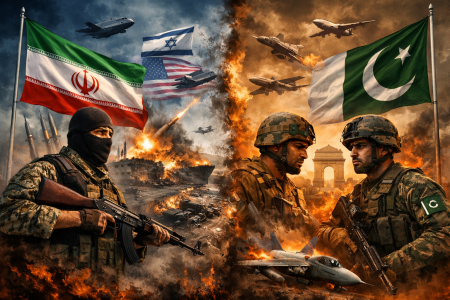
Recent conflicts in 2025–2026 largely followed the expected script: superior military power asserts dominance, outcomes fall into place, and the balance of force dictates the narrative.
Except… not always. Two conflicts in particular refused to play by those rules:
Iran vs USA + Israel + GCC
Prediction: A swift and overwhelming victory for the US-led bloc.
Outcome: Nearly a month in, Iran continues to hold its ground. Its adversaries have incurred significant losses without securing clear strategic objectives. Tehran shows no urgency to negotiate, continues striking US bases across the region, and has effectively choked the Strait of Hormuz. A growing number of international analysts are now framing this as a strategic win for Iran.
Pakistan vs India
Prediction: India to maintain clear upper hand.
Outcome: Within the opening phase, the Indian Air Force reportedly suffered heavy losses, including multiple frontline fighter jets. Pakistan established aerial pressure using coordinated drone saturation tactics, targeted high-value defense assets like S-400 systems, and escalated to the brink of strategic strikes. The situation de-escalated following urgent diplomatic intervention, culminating in what many interpret as a decisive Pakistani advantage and the elevation of Asim Munir to Field Marshal status.
So what’s going on here?
Iran, isolated for decades under sanctions, somehow developed capabilities that allow it to stand toe-to-toe with a coalition far superior on paper. Not just survive—but dictate tempo.
And India, with its larger economy, deeper defense budgets, and numerical advantages, finds itself outmaneuvered by a country often portrayed as financially constrained.
This is where it gets fascinating. How do some nations bend the arc of expected outcomes and punch far above their weight And conversely, how do larger, wealthier powers—with every apparent advantage—end up being outplayed so decisively? For defense watchers, this isn’t just surprising. It’s a complete rewrite of the rulebook.
@Major @Slim @KingKhanWC @Suleiman @Rana @HalBass9 @shaz619 @RedwoodOriginal @DeadlyVenom @Cpt. Rishwat @ElRaja @Markhor @KB @IAJ @emranabbas @Bilal7 @Bewal Express @Rajdeep @Nikhil_cric @cricketjoshila @RexRex @Devadwal @Romali_rotti @Hitman @straighttalk @jeeteshssaxena @Kaptan @uppercut @MP2011 @Vikram1989 @LongHorn @Stewie @globetrotter @Sachin fan @jnaveen1980 @nish_mate @LordJames @Josh @the Great Khan


