




- Joined
- Aug 29, 2023
- Runs
- 44,626
India’s Big AI Moment Starts on Chaotic Note
India’s biggest business summit in years descended into chaos this week after hundreds of delegates were left stranded without food or water during a sudden security lockdown, a black eye for a marquee gathering that was supposed to trumpet the country’s AI ascendancy.
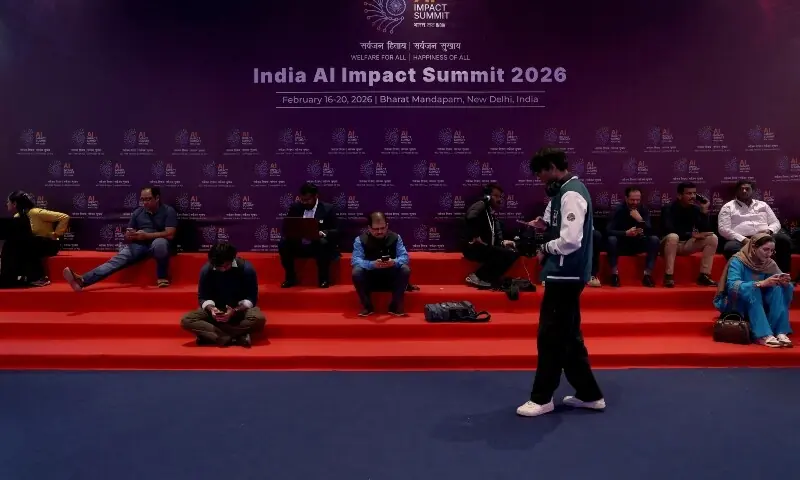
The chaos that gripped day one of the India AI Summit gave way to a steadier rhythm on Tuesday as attendees moved between the halls of Bharat Mandapam, a vast exhibition complex in New Delhi.
Coffee lines were shorter than the previous day, and golf carts ferrying delegates moved easily from one end of the venue to the other. A group of students from a local engineering school walked purposefully toward an exhibition hall where tech companies — from Nvidia Corp. and Dell Technologies Inc. to Deloitte LLP — showcased their latest offerings at kiosks.
For Moses Thiga, a speaker from Kenya, the scale of the summit is “mind-blowing,” and he is struck by the “significant presence” of multinational companies. He had no complaints about the frenzy that unfolded on the opening day, when hundreds of attendees found themselves either locked in or locked out of the venue for hours.
Thiga said everything was running smoothly until Prime Minister Narendra Modi showed up. The security detail accompanying him sealed the entire complex, restricting access. Many attendees said they remained indoors for hours without food or water until Modi departed.
“Coming from Kenya, I know what ‘the government is coming’ means. It means everything is shut down,” Thiga said.
The summit drew more than 250,000 registrations, prompting authorities to implement traffic management and heightened security measures. Armed security personnel were stationed throughout the complex. Two hospital ambulances and a fire truck stood parked near kiosks for Starbucks, Taco Bell and Pizza Hut.
Young tech entrepreneurs could be seen taking coffee breaks near the stalls. Sheena Kohli, legal and investment head at US-based NodeOps, said she hopes to draw attention to the company’s decentralized AI execution platform.
“AI always boils down to compute, and we’re here to show that it’s not always necessary to rely on big players and face huge bills from day one. There are cost-effective options,” Kohli said.
She added that the disruption caused by Modi’s visit should not overshadow the event. Kohli said she did not face difficulties and sees operations settling as attendees grow more familiar with the venue and its security protocols.
Inside one exhibition hall, where companies demonstrated AI features embedded in their software and hardware, Elisabeth L’Orange, an equity partner at Deloitte, networked with Indian peers.
She had planned to fly to Mumbai on Tuesday but extended her stay by a day after being unable to explore the summit during Monday’s security lockdown. Part of a government delegation representing Hamburg, Germany, Lorange said they are looking at India because of its population scale, software industry and track record of producing global tech leaders.
“Many engineers come from India, including to Germany. There’s also significant offshoring, and we do a great deal of development work with India. Given how much technology and talent is coming out of the country, it’s something we’re keen to look at more closely,” she said.
Layered onto this is a broader geopolitical unease. The shift in global order under US President Donald Trump — and the unpredictability it introduced into transatlantic ties — echoes among some European delegates.
Philippe Wieczorek of an AI research institute at Université Grenoble Alpes, said he’s looking at India as a potential partner when it comes to AI and sovereignty. Under Trump’s presidency, he said the US is not a reliable partner when it comes to data sharing.
“On the AI side, the concern is that AI consumes a lot of data. With American companies, we provide them with data, and there’s skepticism — even fear — about how that data is used and whether it could be lost or misused,” he said.
“Coming to India is not just about visiting and making contacts. It’s about building long-term collaborations and partnerships.”
India’s biggest business summit in years descended into chaos this week after hundreds of delegates were left stranded without food or water during a sudden security lockdown, a black eye for a marquee gathering that was supposed to trumpet the country’s AI ascendancy.
The chaos that gripped day one of the India AI Summit gave way to a steadier rhythm on Tuesday as attendees moved between the halls of Bharat Mandapam, a vast exhibition complex in New Delhi.
Coffee lines were shorter than the previous day, and golf carts ferrying delegates moved easily from one end of the venue to the other. A group of students from a local engineering school walked purposefully toward an exhibition hall where tech companies — from Nvidia Corp. and Dell Technologies Inc. to Deloitte LLP — showcased their latest offerings at kiosks.
For Moses Thiga, a speaker from Kenya, the scale of the summit is “mind-blowing,” and he is struck by the “significant presence” of multinational companies. He had no complaints about the frenzy that unfolded on the opening day, when hundreds of attendees found themselves either locked in or locked out of the venue for hours.
Thiga said everything was running smoothly until Prime Minister Narendra Modi showed up. The security detail accompanying him sealed the entire complex, restricting access. Many attendees said they remained indoors for hours without food or water until Modi departed.
“Coming from Kenya, I know what ‘the government is coming’ means. It means everything is shut down,” Thiga said.
The summit drew more than 250,000 registrations, prompting authorities to implement traffic management and heightened security measures. Armed security personnel were stationed throughout the complex. Two hospital ambulances and a fire truck stood parked near kiosks for Starbucks, Taco Bell and Pizza Hut.
Young tech entrepreneurs could be seen taking coffee breaks near the stalls. Sheena Kohli, legal and investment head at US-based NodeOps, said she hopes to draw attention to the company’s decentralized AI execution platform.
“AI always boils down to compute, and we’re here to show that it’s not always necessary to rely on big players and face huge bills from day one. There are cost-effective options,” Kohli said.
She added that the disruption caused by Modi’s visit should not overshadow the event. Kohli said she did not face difficulties and sees operations settling as attendees grow more familiar with the venue and its security protocols.
Inside one exhibition hall, where companies demonstrated AI features embedded in their software and hardware, Elisabeth L’Orange, an equity partner at Deloitte, networked with Indian peers.
She had planned to fly to Mumbai on Tuesday but extended her stay by a day after being unable to explore the summit during Monday’s security lockdown. Part of a government delegation representing Hamburg, Germany, Lorange said they are looking at India because of its population scale, software industry and track record of producing global tech leaders.
“Many engineers come from India, including to Germany. There’s also significant offshoring, and we do a great deal of development work with India. Given how much technology and talent is coming out of the country, it’s something we’re keen to look at more closely,” she said.
Layered onto this is a broader geopolitical unease. The shift in global order under US President Donald Trump — and the unpredictability it introduced into transatlantic ties — echoes among some European delegates.
Philippe Wieczorek of an AI research institute at Université Grenoble Alpes, said he’s looking at India as a potential partner when it comes to AI and sovereignty. Under Trump’s presidency, he said the US is not a reliable partner when it comes to data sharing.
“On the AI side, the concern is that AI consumes a lot of data. With American companies, we provide them with data, and there’s skepticism — even fear — about how that data is used and whether it could be lost or misused,” he said.
“Coming to India is not just about visiting and making contacts. It’s about building long-term collaborations and partnerships.”