What's new

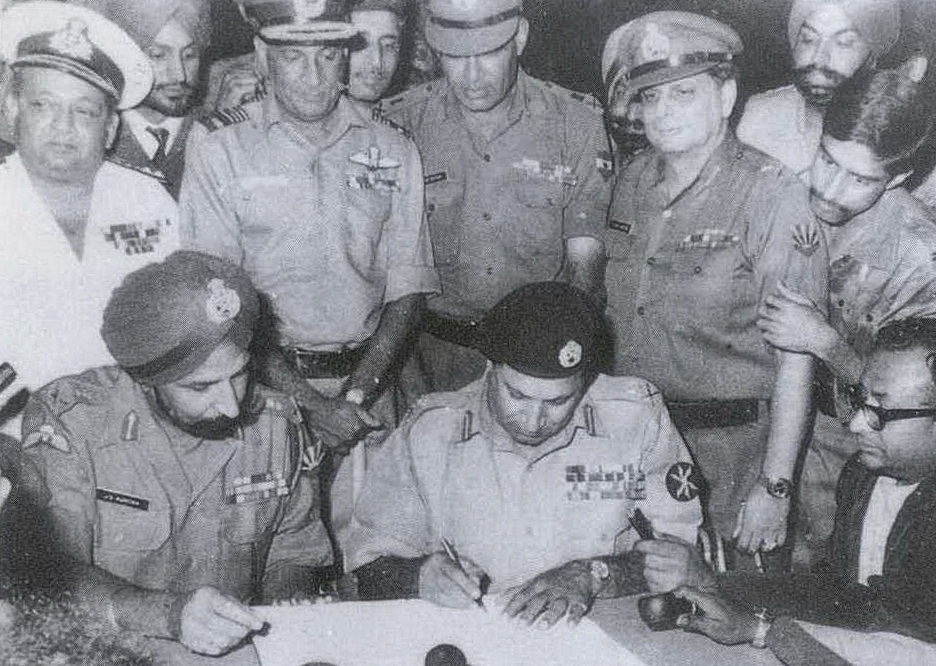
16th December, 1971 : Lieutenant-General A. A. K. Niazi signs the instrument of surrender in Dhaka

MenInG

PakPassion Administrator
Staff member
Joined
Oct 2, 2004
Runs
218,140
One of the saddest days for Pakistan.

Tough to understand as a kid in those days but criminal in the way this was allowed to happen.


1971_Instrument_of_Surrender.jpg
 
Last edited:
A Day when every Muslim would hang down his head in shame.

The Niazi and his men should have fought till death than this meek surrender.
 
A Day when every Muslim would hang down his head in shame.

The Niazi and his men should have fought till death than this meek surrender.

Easy for us to say that but then what about the politicians and others in the Army who put Niazi in this position?
 
The greatest criminal act was the way the Bangladeshis were murdered, raped and pillaged. Pakistanis lost a bit of land. It was the Bangladeshis who lost the most.
 
A Day when every Muslim would hang down his head in shame.

The Niazi and his men should have fought till death than this meek surrender.

why do you have to classify people base don their religion??


Anyways, Yahyah Khan's own mistake cost us East Pakistan.

The Bhola Cyclone in 1970 was the final nail in the coffin. Had he done something back then, this wouldn't had happened. Mujeeb came up with his 6 points, which were ridiculous for west paksitan... But theree was a reason behind those 6 points
 
Last edited:
A Day when every Muslim would hang down his head in shame.

The Niazi and his men should have fought till death than this meek surrender.

180mn or so Bangladeshis look upon this day with great pride.Most of them are muslims.This was a political issue nit a religious one.
 
The greatest criminal act was the way the Bangladeshis were murdered, raped and pillaged. Pakistanis lost a bit of land. It was the Bangladeshis who lost the most.

Stole the words out of my mouth. What happened to those Bengali people will remain a blot on humanity. And before someone reminds me of the Gujarat riots, that was horrendous as well.
 
A Day when every Muslim would hang down his head in shame.

The Niazi and his men should have fought till death than this meek surrender.

What a ridiculous post. Weren't those Bengali people who were slaughtered Muslims? Isn't Bangladesh a Muslim country that celebrates this day?
 
Day of pride and conviction for Bangladesh and India, at the same time the shocks and horrors of the period before this liberation will never be forgotten by the Bangladeshi people.
 
The day is commemorated as Victory Day, a national holiday in Bangladesh; and as Vijay Diwas on the Indian military calendar.

In the above picture Lieutenant-General A A K Niazi, Martial Law Administrator of East Pakistan, surrendered to Lieutenant General Jagjit Singh Aurora, Joint Commander of Indian and Bangladesh Forces.
 
Think its very simplistic for our Indian friends to think that the lot of the Bengalis was India's only concern here.

Yes, West Pakistan did provide a good reason, but the fact is that Indira Gandhi was looking for an excuse to dismember Pakistan and they found it.

Mukti Bahini in any analysis of this should also be called to account for excesses as should the Pakistan Army in East Pakistan.

Black and White is the easiest route in this but we should all be mature enough to look at the whole picture.
 
Think its very simplistic for our Indian friends to think that the lot of the Bengalis was India's only concern here.

Yes, West Pakistan did provide a good reason, but the fact is that Indira Gandhi was looking for an excuse to dismember Pakistan and they found it.

Mukti Bahini in any analysis of this should also be called to account for excesses as should the Pakistan Army in East Pakistan.

Black and White is the easiest route in this but we should all be mature enough to look at the whole picture.

Absolutely. I don't think any knowledgeable Indian would deny it.
 
Day of pride and conviction for Bangladesh and India, at the same time the shocks and horrors of the period before this liberation will never be forgotten by the Bangladeshi people.

How can anyone be proud to be part of killing of innocents. Neither India nor Pakistan of that era are innocent of killing of thousands of innocent people.
 
How can anyone be proud to be part of killing of innocents. Neither India nor Pakistan of that era are innocent of killing of thousands of innocent people.

It was Pakistani Army who was on killing spree in Bangladesh leading to death of millions and 10 Million refugees coming to India, the 1971 Pakistani army defeat and Indian-Bangladeshi victory will always be a thing to be proud of.

This day is commemorated as Victory Day, a national holiday in Bangladesh; and as Vijay Diwas on the Indian military calendar.
 
The Niazi and his men should have fought till death than this meek surrender.

Maybe they shouldn’t have killed millions of civilians. It’s surprising that India accepted their surrender. Some other nations might not have allowed Niazi and his men to get out alive after what they had done.
 
Being a Pakistani, I don't feel any shame about the surrender from Pakistan army on this day. As a matter of fact, there is nothing but happiness that Bangladesh got what it had asked for and regret that Pakistan did a terrible job towards it's own people.

The fact is, if there were events involving Pakistani army that involved raping women and murdering innocents, they should be investigated and corrective actions should be taken and justice should be served.

I do not understand why regimes have to result to brutality to control the wishes of people. Let it be Kashmir or Balochistan, Nagaland or Sindhudesh - freedom and liberty for people should be considered a basic fundamental right.
 
It was Pakistani Army who was on killing spree in Bangladesh leading to death of millions and 10 Million refugees coming to India, the 1971 Pakistani army defeat and Indian-Bangladeshi victory will always be a thing to be proud of.

This day is commemorated as Victory Day, a national holiday in Bangladesh; and as Vijay Diwas on the Indian military calendar.

It was both Indian and Pakistan government which caused the deaths of innocents.
 
This surrender involved 90,000 Pakistan Army servicemen taken as Prisoners of War to Indian forces. Can there ever be a bigger shame in a country's history?

It took Z.A Bhutto to negotiate a deal and bring those soldiers back to their families. The same Bhutto who they hanged not less than a decade later...
 
This surrender involved 90,000 Pakistan Army servicemen taken as Prisoners of War to Indian forces. Can there ever be a bigger shame in a country's history?

It took Z.A Bhutto to negotiate a deal and bring those soldiers back to their families. The same Bhutto who they hanged not less than a decade later...


800 ISIS fighters manage to defeat 30,000 Iraqi army personnel taking their military hardware.

Can you give me the proportion of Indian army troops and military hardware available compared to Pakistan?
 
I find it shocking that this tragedy is being used as an opportunity to chest thumb and victim blame.

There is no pride when the loss of life is this great.

We should all learn from these events and vow to never let them happen again.
 
It’s surprising that India accepted their surrender. Some other nations might not have allowed Niazi and his men to get out alive after what they had done.

Killing thousands of prisoners would have been a violation of Geneva convention and India would have turned into a pariah state.
 
This surrender involved 90,000 Pakistan Army servicemen taken as Prisoners of War to Indian forces. Can there ever be a bigger shame in a country's history?

It took Z.A Bhutto to negotiate a deal and bring those soldiers back to their families. The same Bhutto who they hanged not less than a decade later...

Beocs' it was bhutto, who refused to acknowledge and accept election results from 1970 which started the whole fiasco pak.
 
This surrender involved 90,000 Pakistan Army servicemen taken as Prisoners of War to Indian forces. Can there ever be a bigger shame in a country's history?
.

Children dying due to lack of food, when world has excess food, is a bigger shame for entire world.

Army, country etc is just a temporary thing and it changes every century.
 
There is usually more than one person involved in treason against the state, the numbers don't change the crime. But yes I agree if such a large amount of people (we don't know the exact percentange btw) want a change then they must be heard but when these people join with the ultimate enemy, they no longer deserve a hearing. Pakistan should have used other means to punish them but as I said they lost East Pakistan which is Bangladesh , hardly the most rich nation in terms of resources in the world. These people would have continued to cause trouble and it really wasn't worth the effort, it should never have been part of Pakistan in the first place.

Sour grapes? Currently the BD economy is growing faster than Pak's -- and expected to overtake Pak in a few years time.
 
My grandmother and father tells me that my grand father who was a very unemotional individual in general but this day was the only time in his life where he broke down profusely.
 
My dad who travels a lot for work mentioned that in one of his international flights he was seated next to an ex millitary official who had served in East Pakistan and was a POW. The guy was full of scorn and hatred for General Niazi and apparently he used to start the day by asking the soldiers "How many women have you raped today?".

Shocking stuff and indeed a moment of our history where we need to hang our heads in shame and grief.
 
This surrender involved 90,000 Pakistan Army servicemen taken as Prisoners of War to Indian forces. Can there ever be a bigger shame in a country's history?

It took Z.A Bhutto to negotiate a deal and bring those soldiers back to their families. The same Bhutto who they hanged not less than a decade later...

I strongly disliked the Nationalization policies of Bhutto which totally wrecked our economy and our institutions. But a lot of Pakistani's at the time are very grateful and indebted to Bhutto for raising the morale of the nation and the fact that from 1972 to 1977 we had so many international leaders, dignitaries coming and visiting Pakistan was nothing short of miracle.
 
Killing thousands of prisoners would have been a violation of Geneva convention and India would have turned into a pariah state.

Geneva convention applies only if they were accepted as POWs.India could have refused the surrender.

India also handed over each of the 90k POWs back.They werent tried for war crimes.
 
Some very insensitive stuff being rolled out here.

Remember we are discussing an event behind which there are deaths of Bangladeshis, Pakistanis and Indians too.
 
Maybe they shouldn’t have killed millions of civilians. It’s surprising that India accepted their surrender. Some other nations might not have allowed Niazi and his men to get out alive after what they had done.

Historically and till this day, India suffers from Prithviraj Chauhan syndrome. It is costing us everyday, increasingly.

I am hoping the only reason we did not go for the kill was because of USA else it proves to be a suicidal blunder.
 
Historically and till this day, India suffers from Prithviraj Chauhan syndrome. It is costing us everyday, increasingly.

I am hoping the only reason we did not go for the kill was because of USA else it proves to be a suicidal blunder.

would have been the reason for more wars later on.
 
Historically and till this day, India suffers from Prithviraj Chauhan syndrome. It is costing us everyday, increasingly.

I am hoping the only reason we did not go for the kill was because of USA else it proves to be a suicidal blunder.


After going for the kill you would have had a Pakistan which is equivalent to Syria or Afghanistan and having such a neighbour would have been catastrophic for India.. Both india and Pakistan should have realised somewhere in last 70 years that it’s better to forget about Kashmir and better to work together and grow into a USA-Canada type relation and give their respective populace the best standard of living they can afford..

Unfortunately both sides have had plenty of elements who share hatred to the other side and hence the current situation..
 
After going for the kill you would have had a Pakistan which is equivalent to Syria or Afghanistan and having such a neighbour would have been catastrophic for India.. Both india and Pakistan should have realised somewhere in last 70 years that it’s better to forget about Kashmir and better to work together and grow into a USA-Canada type relation and give their respective populace the best standard of living they can afford..

Unfortunately both sides have had plenty of elements who share hatred to the other side and hence the current situation..

I will take a Syria or Afghanistan over nuclear Pakistan or N Korea. Terrorism could then be responded with guns rather than dossiers. As usual our politicians screwed up + Pakistan milked the American cow (and now the Chinese) admirably well.
 
would have been the reason for more wars later on.
So what happened (and has been happening) without that? The wars would have been less and less frequent. Ofcourse, Pakistan the country would have been messier than what it is now or more friendly towards us.
 
So what happened (and has been happening) without that? The wars would have been less and less frequent. Ofcourse, Pakistan the country would have been messier than what it is now or more friendly towards us.

Obviously (for whatever reason) are looking at it from a pov which looks at annihilation of Pakistan. Thankfully, the world has moved on.

Massacring troops would have brought in reaction from Turkey and Iran at that time and goodwill to India would have been reduced.
 
I will take a Syria or Afghanistan over nuclear Pakistan or N Korea. Terrorism could then be responded with guns rather than dossiers. As usual our politicians screwed up + Pakistan milked the American cow (and now the Chinese) admirably well.

The frequency of terrorist attacks would increase a lot and remember we have a sizeable Muslim population so if Pakistan turned out to be like Syria or Afghanistan and started an ideology like taliban or ISIS it will be very dangerous..

Atleast with current day Pakistan all we get is threats from either side but with a pariah state with nothing to lose we would have have weekly attacks on innocent civilians in India.. Think about it currently the risk of your family dying due to a nuclear attack by Pakistan is probably let’s assume 1% however if we had a neighbour like Afghanistan/Syria that probability would become 10% would you want that ever?
 
Obviously (for whatever reason) are looking at it from a pov which looks at annihilation of Pakistan. Thankfully, the world has moved on.

Massacring troops would have brought in reaction from Turkey and Iran at that time and goodwill to India would have been reduced.

not to mention the fact that more people would have been killed!
 
not to mention the fact that more people would have been killed!

Exactly.

People talk about such events as if they are video games or movies. Innocent people, most of whom, are so poor that they barely have enough to live off are/will be annihilated. And for what? So for the powerful to continue to exploit? So that people unaffected can chest thump about military conquest and superiority?

Thoroughly disheartening.
 
I dont mind an open discussion but people posting in such threads need to be sensitive to all sides.
 
The frequency of terrorist attacks would increase a lot and remember we have a sizeable Muslim population so if Pakistan turned out to be like Syria or Afghanistan and started an ideology like taliban or ISIS it will be very dangerous..

Atleast with current day Pakistan all we get is threats from either side but with a pariah state with nothing to lose we would have have weekly attacks on innocent civilians in India.. Think about it currently the risk of your family dying due to a nuclear attack by Pakistan is probably let’s assume 1% however if we had a neighbour like Afghanistan/Syria that probability would become 10% would you want that ever?
You are assuming a tactic employed by the US in the late 80's would've gained traction a decade before? There;s also the Soviet Union which was the other world power till the late 80's so no such attacks like we've sen in the 80/90/2k decade would not have been common place back then.

Also the only reason Pak could even try these backhanded tactics was the nukes, no nukes & no threat on both sides of the border, the other being China obviously.
 
Seems like india let pak of the hook.
Is that the truth?
No actually it's the US that let you off the hook, without Nixon threatening to nuke India there would be no Pak today. Of course Pak being thankless to the US, for that, is something everyone knows but fails to acknowledge, especially if they're from Pak.
 
Last edited:
No actually it's the US that let you off the hook, without Nixon threatening to nuke India there would be no Pak today. Of course Pak being thankless to the US, for that, is something everyone knows but fails to acknowledge, especially if they're from Pak.

Another insensitive post.

The US did not threaten anyone. India took its own decisions.

And we are not thankless to USA. We served them very well in their failed venture in Afghanistan.

Really need to be careful what you write here.
 
Another insensitive post.

The US did not threaten anyone. India took its own decisions.

And we are not thankless to USA. We served them very well in their failed venture in Afghanistan.

Really need to be careful what you write here.
So you're saying Kissinger/Nixon didn't threaten India with nukes, for which the Soviets sent a fleet halfway across the world?

You did it for your own selfish reason as well, not to mention the US turned as blind eye towards the Pak nuke program at that time.
 
So you're saying Kissinger/Nixon didn't threaten India with nukes, for which the Soviets sent a fleet halfway across the world?

You did it for your own selfish reason as well, not to mention the US turned as blind eye towards the Pak nuke program at that time.

I would be grateful if you could put a link to the above statement about a nuclear ultimatum delivered to the Indian Govt by USA.

Also not sure why you have come with all guns blazing about Pakistan's role in Afghanistan etc - all ok with you?
 
Was General Niazi any relation to Imran Khan Niazi?
 
I would be grateful if you could put a link to the above statement about a nuclear ultimatum delivered to the Indian Govt by USA.

Also not sure why you have come with all guns blazing about Pakistan's role in Afghanistan etc - all ok with you?
How do you deliver a nuke threat to another nation, via speed post?

https://www.newyorker.com/magazine/2013/09/23/unholy-alliances-3
https://medium.com/war-is-boring/in...ught-the-soviets-over-bangladesh-c65489bc72c0
https://en.wikipedia.org/wiki/Task_Force_74
www.hindustantimes.com/delhi-news/r...-with-nukes/story-SqSsw5gGV2z4Fwg5JVxnKI.html
https://www.rbth.com/articles/2011/12/20/1971_war_how_russia_sank_nixons_gunboat_diplomacy_14041

Are you, OK? Your circular line of thinking reasons that India has a choice in 1971 war, they didn't. Pak did have a choice, & space, before the 1971 crisis as well as what happened in Afghanistan. Though tbf to Pak, the Agra 2004 Summit was the (missed) bus of the century. If we did reconcile our differences, this century could've been so much better for all of us!
 
Last edited:
How do you deliver a nuke threat to another nation, via speed post?

https://www.newyorker.com/magazine/2013/09/23/unholy-alliances-3
https://medium.com/war-is-boring/in...ught-the-soviets-over-bangladesh-c65489bc72c0
https://en.wikipedia.org/wiki/Task_Force_74
www.hindustantimes.com/delhi-news/r...-with-nukes/story-SqSsw5gGV2z4Fwg5JVxnKI.html
https://www.rbth.com/articles/2011/12/20/1971_war_how_russia_sank_nixons_gunboat_diplomacy_14041

Are you, OK? Your circular line of thinking reasons that India has a choice in 1971 war, they didn't. Pak did have a choice, & space, before the 1971 crisis as well as what happened in Afghanistan. Though tbf to Pak, the Agra 2004 Summit was the (missed) bus of the century. If we did, this century could've been so much better for all of us!


Unless you were in the Whitehouse at that time, I see no threat being made to INDIA about a nuclear strike.

India had a choice to do what it wanted but didnt do it because of some US threat is what you wish us to believe. I think you believe that so its fine for me. Means nothing to me.

I have no idea about the rest of your statement
 
Unless you were in the Whitehouse at that time, I see no threat being made to INDIA about a nuclear strike.

India had a choice to do what it wanted but didnt do it because of some US threat is what you wish us to believe. I think you believe that so its fine for me. Means nothing to me.

I have no idea about the rest of your statement
Yeah your opinion doesn't change history either.

It means that the very idea of Pak failed in both these instances, even in this very thread some posters are claiming they feel no remorse for Bangladesh because it was not rich in resources? So Pak was not supposed to be a homeland for all Mulsims, rich & poor? Why did you do what you did in Afghanistan, doesn't that shred to pieces all those emotional speeches Jinnah made for a separate state before independence?

Like I said, Pak had the luxury of time & (political) space & yet the choices you made were very wrong, at multiple instances of time. If you cannot acknowledge that then you're condemned to repeat the mistakes of the past!
 
A day of shame for all three countries involved. Pakistan for showing that a country based on religion was a false ideal. Bangladesh the same. India most of all for showing that they were always prepared to accept the division of their country by signing papers rather than restore what was ripped from them by us, the magnificent Brits.
 
A day of shame for all three countries involved. Pakistan for showing that a country based on religion was a false ideal. Bangladesh the same. India most of all for showing that they were always prepared to accept the division of their country by signing papers rather than restore what was ripped from them by us, the magnificent Brits.
For certain, not this day of course but the one earlier in 1947. The then leaders of India, Congress & Nehru in particular, are to be blamed for the mess that engulfs nearly 1.8 billion people of South Asia.
 
For certain, not this day of course but the one earlier in 1947. The then leaders of India, Congress & Nehru in particular, are to be blamed for the mess that engulfs nearly 1.8 billion people of South Asia.

This reply only hammers home the true nature of Indian defeatism. Still trying to take pride from a day of "victory" in 1971 without realising you were signing nothing more than confirmation of our majestic British legacy. They might as well have made a film about this peace deal called Jab We Met.
 
This reply only hammers home the true nature of Indian defeatism. Still trying to take pride from a day of "victory" in 1971 without realising you were signing nothing more than confirmation of our majestic British legacy. They might as well have made a film about this peace deal called Jab We Met.
I'm not sure why the Brexited UKers are feeling pride in reminiscing about the horrors inflicted upon by the empire, in the past 2 centuries? Most of us, in India, feel that 1971 was unavoidable, though 1947 was certainly not unavoidable & large part of the blame has to go to Congress!
 
Funny how Indians take pride on this day but the Bangladeshis hate them more than they hate Pakistanis.

The creation of Bangladesh was inevitable if it didn't happen in 71 it would have happened a few years later. A country cannot survive with thousands of miles of hostile territory separating it and the population of one wing considering the other wing to be inferior.
 
Yeah your opinion doesn't change history either.

It means that the very idea of Pak failed in both these instances, even in this very thread some posters are claiming they feel no remorse for Bangladesh because it was not rich in resources? So Pak was not supposed to be a homeland for all Mulsims, rich & poor? Why did you do what you did in Afghanistan, doesn't that shred to pieces all those emotional speeches Jinnah made for a separate state before independence?

Like I said, Pak had the luxury of time & (political) space & yet the choices you made were very wrong, at multiple instances of time. If you cannot acknowledge that then you're condemned to repeat the mistakes of the past!

On this forum, we address Mr. Mohammad Ali Jinnah as exactly that or the Quaid-e-Azam - are we clear about that?
 
I'm not sure why the Brexited UKers are feeling pride in reminiscing about the horrors inflicted upon by the empire, in the past 2 centuries? Most of us, in India, feel that 1971 was unavoidable, though 1947 was certainly not unavoidable & large part of the blame has to go to Congress!

Britain is an island, look on any world map and you will see the reasons why Brexit may have been destiny all along. My dear friend, I am not trying to gloss over any "horrors inflicted by empire" merely showing you that your pride in 1971 merely rubber stamps Britain's glorious legacy. A true Indian would feel nothing but shame, alas I fear there are no real true Indians left.
 
You are assuming a tactic employed by the US in the late 80's would've gained traction a decade before? There;s also the Soviet Union which was the other world power till the late 80's so no such attacks like we've sen in the 80/90/2k decade would not have been common place back then.

Also the only reason Pak could even try these backhanded tactics was the nukes, no nukes & no threat on both sides of the border, the other being China obviously.


I am not talking about terrorist attacks in 1970’s I meant if we had destroyed or crippled Pakistan back in 1971 then they would have turned into something like Afghanistan or Syria and not into a democracy or a saveable economy they have today which will give rise to egotistical revengeful leaders who would want to get revenge on India and only way they would have achieved that is by spreading terrorism... it’s all in retrospective and hypothetical since for all we know it would have been better for India and Pakistan but just saying there would have been a possibility of a neighbour which is bad for us compared to the current nuclear armed Pakistan..

Whether anyone believes it or not but truth is religion plays a huge role in sub continent and there might have been sympathisers in India if we destroyed Pakistan.. Again it’s all speculation..

P.S. not to mention the loss of innocent lives on either side which is a bigger deal than anything else we are commenting on..
 
No actually it's the US that let you off the hook, without Nixon threatening to nuke India there would be no Pak today. Of course Pak being thankless to the US, for that, is something everyone knows but fails to acknowledge, especially if they're from Pak.

More garbage :))

The Western front, according to an Indian defence review website, incase I am being accused of being biased:

The major Indian gains claimed in terms of area were about 3,200 square kilometres in the Ladakh region under Lt Gen Sartaj Singh and 1,200 square kilometres. under Lt Gen G G Bewoor in the Rajasthan Desert. In both regions these gains lay in farflung, desolate, uninhabited and difficult areas of negligible economic, strategic and political value which could hurt the rulers of Pakistan only in their prestige.

The major Indian gains claimed in terms of area were about 3,200 square kilometres in the Ladakh region under Lt Gen Sartaj Singh and 1,200 square kilometres. under Lt Gen G G Bewoor in the Rajasthan Desert.
On the other hand, Sartaj Singh lost the area of Chhamb, where the aftermath of the refugee problem still haunts the Jammu and Kashmir administration. The loss of the Kasowala bulge, the Hussainiwala enclave and the Fazilka agricultural belt in Punjab could not be equated with marginal gains in the Sehjra bulge and the Mamdot enclave in economic, military or political terms. The Indian occupation of the major portion of the Shakargarh bulge was somewhat embarrassing to the Bhutto government in view of the restive refugee population, but this in no way impaired the Pakistani economy or upset its military tactical balance. In short, this war failed to achieve a decision, although the Indian public was misled by articulate propaganda and impressive statistics. It is therefore imperative that the public should be educated to judge the country’s military achievement on merit.


http://www.indiandefencereview.com/s...estern-sector/

I am not surprised our army got a thrashing in East Pakistan, any army would have. Heavily outnumbered, with no airforce, no reinforcements and facing a full rebellion. But Western Pakistan held on perfectly fine, much much better than 1965. Pakistan's ''destruction'' was never even the question. So I am unsure why Indians are acting as if they were on the verge of occupying our entire country and the only reason we exist is due to their mercy.
 
Imagine handing over half of Kashmir and magnificent cities like Karachi and Lahore and calling it victory. No wonder the Sikhs cry for Punjab.
 
Imagine handing over half of Kashmir and magnificent cities like Karachi and Lahore and calling it victory. No wonder the Sikhs cry for Punjab.

We learn something new everyday. I always knew we lost Bangladesh, now apparently we were on the verge of a fantastical destruction and we only exist now is because of India's mercy.
 
Geneva convention applies only if they were accepted as POWs.India could have refused the surrender.

India also handed over each of the 90k POWs back.They werent tried for war crimes.

Refusing the surrender would have resulted in more killings and many of those 90K were civilians.
 
67,000 out of those were not soldiers.

Thanks. I didn't know the exact numbers, but it's so huge that surrender was simply a sane option for all sides. Indians not accepting surrender would have been a horrible option for India as well.
 
Beocs' it was bhutto, who refused to acknowledge and accept election results from 1970 which started the whole fiasco pak.

Bhutto's double games and incendiary statements antagonised the Bengalis but to ignore the military's role would be denying historical fact. Before the 1970 election, Yahya introduced the Legal Framework Order which gave him power to veto any constitution prepared by an elected assembly. Brigadier A.R. Siddiqi, the head of the ISPR, wrote "the right of a provincial party to frame the Constitution and run the national government for the next five years was not acceptable to the military high command."

Whilst the talks between Mujib and Bhutto were deadlocked, the talks never broke down as per the common view but unilaterally abandoned on the orders of Yahya and his hawks in the NSC with their military action. The tragedy is that Mujib's conception of a free Bengali nation was not incompatible with something less than an independent, sovereign state. The Six Points asked for complete autonomy within a federal arrangement in the spirit of the Lahore resolution. Awami League sent proposals even as late as March 1971 for a Confederation of Pakistan, allowing PPP to govern West Pakistan.

But the idea of the centre being beholden to the federating units was anathema to a military establishment insistent on a strong centre. Ultimately, Yahya had decided on military action months before and behaved like his British predecessors in playing a game of divide and rule - pitting the PPP and the Awami League against each other whilst plans to roll in the tanks were drawn up. It was drunkard Yahya who postponed the National Assembly session for 3rd March 1971 and didn't announce an alternative date resulting in violent protests in the East. Bhutto obviously inflamed the situation by boycotting the NA session leading to an impression of collusion and that he was stalling at Yahya's behest.

There were honourable exceptions within the military - the governor of East Pakistan Admiral Ahsan and General Sahibzada Yaqub Khan, commander of the eastern forces, resigned as they saw no good in abandoning political dialogue and pursuing the military course.

Secession was not inevitable, even with the distance between the two wings. It was the West Pakistani elite's treatment of East Pakistan as a vast colonial possession, as "kaala aadmi", and a failure to distinguish between legitimate calls for autonomy and outright secession that drove the Bengalis away.
 
Thanks. I didn't know the exact numbers, but it's so huge that surrender was simply a sane option for all sides. Indians not accepting surrender would have been a horrible option for India as well.


More:

While it is correct that the total number of Pakistani PoWs held by India after December 16, 1971, was about 90,000 plus, about 55,000 of these PoWs were civilians from West Pakistan, both official and non-official, and included families, businessmen and others, who were not armed and did not enter into combat with Indian troops.
The fact is that the total strength of the Pakistan army troops posted in East Pakistan as of December 16, 1971, was only about 34,000. With the addition of Rangers, scouts, militia and civil police, the total strength of personnel deployed to defend East Pakistan was only 45,000.

Source DAWN:

https://www.dawn.com/news/773291

Also in the A History of the Pakistan Army: Wars and Insurrections By Brian Cloughley, it states that A lot of them para-military (around 18,000), and some which were marines or from the airforce. The rest were officers or non-combatant military personnel.
 
Thanks. I didn't know the exact numbers, but it's so huge that surrender was simply a sane option for all sides. Indians not accepting surrender would have been a horrible option for India as well.

To their credit, the Indian Army officer allowed Pakistanis to bear small arms so they could defend themselves if the Mukhti Bhannis retaliated after the war ended.
 
Far from being inevitable, the secession of Bangladesh was a culmination of the consistent marginalisation of East Pakistani interests. There are five important milestones which led to 16 December 1971.

First, the language riots in Dhaka in 1952. The death of four students in confrontations with the police provided the first martyrs for Bengali separatism. 21st of February in East Bengal would be an annual day of mourning in remembrance of those that died. The second milestone was the dismissal of the United Front provincial government in East Bengal in 1954. The United Front had gathered 65.6 per cent of the vote (winning 223 of the 309 seats) and had campaigned on the basis of regional autonomy in a 21 point manifesto. Its dismissal by the Governor-General (Ghulam Muhammad) three months after the elections, only served to further alienate and radicalise those seeking greater provincial sovereignty. Third, the military coup in 1958, effectively confirmed the disenfranchisement of East Pakistanis. During the Ayub years, power resided with the army and bureaucracy, the two institutions where Bengalis were severely underrepresented. This not only contributed to alienation in East Pakistan, but meant the West Pakistani elite were distanced from Bengali interests, becoming dangerously out of touch with the ground reality. Economically, interregional disparity between West and East Pakistan had increased under military rule. Fourth, there was the inability of the Awami League and the Pakistan People’s Party to arrive at a power sharing arrangement following the 1970-71 elections. Where the blame ultimately lies is subject to a contentious historical argument, with some accusing the military of divide and rule, and others pointing to Bhutto’s lust for power. Finally, and most fatefully, the decision to initiate military action on 25 March - a decision in which Yahya Khan must accept ultimate responsibility for - was catastrophic. The military had given up on political negotiation and bargaining and instead had opted for the iron fist of might. “The golden hues of eastern Bengal's lush green landscape” wrote Ayesha Jalal, “had been turned red with the steely might of oppression.”
 
After going for the kill you would have had a Pakistan which is equivalent to Syria or Afghanistan and having such a neighbour would have been catastrophic for India.. Both india and Pakistan should have realised somewhere in last 70 years that it’s better to forget about Kashmir and better to work together and grow into a USA-Canada type relation and give their respective populace the best standard of living they can afford..

Unfortunately both sides have had plenty of elements who share hatred to the other side and hence the current situation..

The hatred and animosity has always been a one sided affair from the Pakistan side. India if you look at history has never cast the first stone but reacts with force when forced too. If anything Pakistan continues to be misguided in the false narrative by the politician /army that India is a threat to their sovereignty when it couldn't be further from the truth.
 
Sour grapes? Currently the BD economy is growing faster than Pak's -- and expected to overtake Pak in a few years time.

I live in England and it has no relevance to me personally what the economy of Pakistan or Bangladesh is doing. I was talking from a strategic and asset point of view. Bangladesh has little to give being part of Pakistan but would create a lot of problems.
 
What were Mujib's Six points in 1971?


Below is the list of those six points, that Bhutto refused to sign on. I am not sure if that list is accurate, maybe somebody can confirm the list.


The six points are noted as being:

The Constitution should provide for a Federation of Pakistan in its true sense based on the Lahore Resolution, and the parliamentary form of government with supremacy of a Legislature directly elected on the basis of universal adult franchise.[1]
The federal government should deal with only two subjects: Defence and Foreign Affairs, and all other residual subjects should be vested in the federating states.[1]
Two separate, but freely convertible currencies for two wings should be introduced; or if this is not feasible, there should be one currency for the whole country, but effective constitutional provisions should be introduced to stop the flight of capital from East to West Pakistan. Furthermore, a separate Banking Reserve should be established and separate fiscal and monetary policy be adopted for East Pakistan.[1]
The power of taxation and revenue collection should be vested in the federating units and the federal centre would have no such power. The federation would be entitled to a share in the state taxes to meet its expenditures.[1]
There should be two separate accounts for the foreign exchange earnings of the two wings; the foreign exchange requirements of the federal government should be met by the two wings equally or in a ratio to be fixed; indigenous products should move free of duty between the two wings, and the constitution should empower the units to establish trade links with foreign countries.[1]
East Pakistan should have a separate military or paramilitary force, and Navy headquarters should be in East Pakistan.[1]

Ref: https://en.wikipedia.org/wiki/Six_point_movement

Assuming these were the accurate list. Can you blame Bhutto for not accepting these demands. This is effectively demand for independence anyway. If you build country on those lines, if will be seperated soon or later, more so sooner though...

Was it Bhutto or Decade of Military rule of Ayub??

Right wing keep on pressing the point that Bhutto was the main culprit, which is far from reality. If Bhutto has agreed to those demands, people would have been blaming him for accepting such demands :(

Reality is lack of democracy and Military rule decade ago, which was dominated by West Pakistan, was the main culprit. Bangalis were not allowed to be in Military because of their physique. There was very little power sharing with them.
 

Assuming these were the accurate list. Can you blame Bhutto for not accepting these demands.


I don't understand this bit. Why does Bhutto's opinion matter after he lost the 1970 election ? Mujibur Rahman was the rightful new PM of Pakistan. You can't refuse to transfer power to a newly elected leader just because you didn't like his party's manifesto.. that was the whole point of an election - voters get to decide and not Bhutto ? :13:
 
I don't understand this bit. Why does Bhutto's opinion matter after he lost the 1970 election ? Mujibur Rahman was the rightful new PM of Pakistan. You can't refuse to transfer power to a newly elected leader just because you didn't like his party's manifesto.. that was the whole point of an election - voters get to decide and not Bhutto ? :13:

1970s elections are considered most fare election in Pakistan history, ironically they were most divisive election not just in Pakistan's history but probably in history of democracy. PPP won overwhelming numbers of seat in West Pakistan, not a single seat in East Pakistan, they hardly had any candidate in East, same was true for Mujib's Party. Mujib ran election campaign on very nationalist (aka that 6 point agenda) and Bhutto ran the opposite.

You are right people did spoke, unfortunately two very different voices. 1970 election results showed a very divided Pakistan, you just cannot blame Bhutto and put everything else under the rug. Bhutto largely did what he promised in campaign so was the case with Mujib, they both stood to their view point on which they won election by land slide... Seed of power reside in West Pakistan for 25 years(before 1971), that's why Bhutto was in position to take a stand, I don't know that exact number but entire top leadership of Army was from West too if not majority of soldiers, where as East had bigger population. Army stood with their own one(aka West Pakistani), for a reason. If I am not mistaken Mujib was more interested in being CM of East Pakistan than PM of Pakistan, which you can see from his campaign and 6 point agenda... This division would have happened anyway if those 6 points would have implemented.

The seed of divide was planted long ago. Bangalis did not wanted to live with Pakistan, that was very clear in 1970s election. Lot of that has to do with how Pakistan was run in those 25 years, Ayub 10 years rule, made it clear to Bangalis they will have hard time. They were not welcome into the most prestigious institution of Country aka Army, not just welcomed, they were discriminated, since they were not broad and tall enough. This is just one example, they wanted to keep their language and culture intact and wanted fair share of power and economy...

Reality is East and West Pakistan was one of the most unnatural country, they had nothing in common, it was hard to keep them together. They were not physically connect, had no common culture, language, even currency, top that with the fact that your main enemy is between the two parts of the country. Which other country was/is built like that??
 
I live in England and it has no relevance to me personally what the economy of Pakistan or Bangladesh is doing. I was talking from a strategic and asset point of view. Bangladesh has little to give being part of Pakistan but would create a lot of problems.

I'm always amused by British-Pakistanis when they assume either the British or Pakistani identity depending on where the thread is going. :) You brought up the BD topic, I only told you that BD is not as bad as you're making it out to be (at least in relation to Pak). So now you're the aloof Brit! Nice.

There is another guy on this thread going around talking about how "we British" manipulated you all South Asians. LOL.

Guys, accept it -- this thread is about South Asians talking about 1971 event; your current passport (be it India, Pak, BD, UK, US, Canada, ...) doesn't matter!! Original Brits don't spend their time talking about 1971 India-Pak war!!!

Too funny!
 
I'm always amused by British-Pakistanis when they assume either the British or Pakistani identity depending on where the thread is going. :) You brought up the BD topic, I only told you that BD is not as bad as you're making it out to be (at least in relation to Pak). So now you're the aloof Brit! Nice.

There is another guy on this thread going around talking about how "we British" manipulated you all South Asians. LOL.

Guys, accept it -- this thread is about South Asians talking about 1971 event; your current passport (be it India, Pak, BD, UK, US, Canada, ...) doesn't matter!! Original Brits don't spend their time talking about 1971 India-Pak war!!!

Too funny!

That's because they aren't of Indian heritage. Duh. Obviously my observations hit home because our Indian members have thankfully restrained themselves from treating the 1971 accord as some sort of victory so pat yourselves on the back for that.

Where are you living by the way, with a name like English August I'm assuming Britain?
 
The sad truth is that people talk about Bangalis being the victims of Pakistan Army’s aggression in the pre-independence time but what I don’t understand is that why people don’t treat Mukti Bahini as a terrorist organisation because of what they did to the minority Urdu speaking populations. Mukti Bahini was equally guilty of committing mass murders, rape and genocide in the name of freedom fight. My own family lost 3 civilians just because their fault was that they were over 18 and were not Bangali, at least not by birth. Similarly, there were many Urdu speaking families with many such harrowing tales.
I personally don’t think that there is any point in cursing any party in any war because truth is the first casualty of a war.
 
Far from being inevitable, the secession of Bangladesh was a culmination of the consistent marginalisation of East Pakistani interests. There are five important milestones which led to 16 December 1971.

First, the language riots in Dhaka in 1952. The death of four students in confrontations with the police provided the first martyrs for Bengali separatism. 21st of February in East Bengal would be an annual day of mourning in remembrance of those that died. The second milestone was the dismissal of the United Front provincial government in East Bengal in 1954. The United Front had gathered 65.6 per cent of the vote (winning 223 of the 309 seats) and had campaigned on the basis of regional autonomy in a 21 point manifesto. Its dismissal by the Governor-General (Ghulam Muhammad) three months after the elections, only served to further alienate and radicalise those seeking greater provincial sovereignty. Third, the military coup in 1958, effectively confirmed the disenfranchisement of East Pakistanis. During the Ayub years, power resided with the army and bureaucracy, the two institutions where Bengalis were severely underrepresented. This not only contributed to alienation in East Pakistan, but meant the West Pakistani elite were distanced from Bengali interests, becoming dangerously out of touch with the ground reality. Economically, interregional disparity between West and East Pakistan had increased under military rule. Fourth, there was the inability of the Awami League and the Pakistan People’s Party to arrive at a power sharing arrangement following the 1970-71 elections. Where the blame ultimately lies is subject to a contentious historical argument, with some accusing the military of divide and rule, and others pointing to Bhutto’s lust for power. Finally, and most fatefully, the decision to initiate military action on 25 March - a decision in which Yahya Khan must accept ultimate responsibility for - was catastrophic. The military had given up on political negotiation and bargaining and instead had opted for the iron fist of might. “The golden hues of eastern Bengal's lush green landscape” wrote Ayesha Jalal, “had been turned red with the steely might of oppression.”

Lovely summary - thanks
 
Back
Top