





The republic’s supreme leader has plotted an exit route out of Tehran should his forces fail to quell dissent, an intelligence report reveals
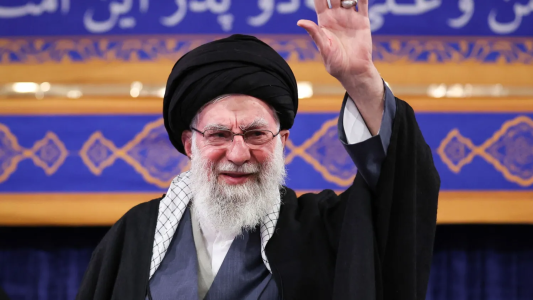
Ayatollah Ali Khamenei greeting a crowd during a ceremony in Tehran on Saturday
IRAN’S SUPREME LEADER OFFICE/EPA
Iran’s Ayatollah Ali Khamenei has a back-up plan to flee the country should his security forces fail to suppress protests or desert, according to an intelligence report shared with The Times.
Khamenei, 86, plans to escape Tehran with a close circle of up to 20 aides and family, should he see that the army and security called on to quell the unrest are deserting, defecting or failing to follow orders.
“The ‘plan B’ is for Khamenei and his very close circle of associates and family, including his son and nominated heir apparent, Mojtaba,” an intelligence source told The Times.
Beni Sabti, who served for decades in Israeli intelligence after fleeing the regime eight years after the Islamic revolution, told The Times that Khamenei would flee to Moscow as “there is no other place for him”.
• Inside Iran protests that threaten regime: ‘This is the final battle’
Khamenei also “admires Putin, while the Iranian culture is more similar to the Russian culture”.
The getaway plan is based on the escape of his ally, the fallen Syrian leader Bashar al-Assad who fled Damascus aboard a plane to Moscow to join his family before opposition forces stormed the capital in December 2024.
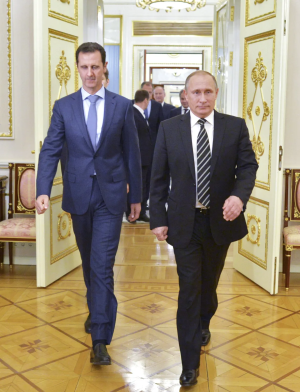
“They have plotted an exit route out of Tehran should they feel the need to escape,” which includes “gathering assets, properties abroad and cash to facilitate their safe passage”, the source said.
Khamenei is known to hold a major network of assets, some under one of the most powerful organisations in Iran, Setad — part of a system of semi-state charitable foundations known for their financial obfuscation. Estimates put the total holdings at $95 billion, according to a Reuters investigation in 2013, including properties and companies, all held and controlled by Khamenei.
Many of his closest aides, including the secretary of Iran’s supreme national security council, Ali Larijani — who warned President Trump to stay out of Tehran’s affairs — have family members already living abroad, including in the US, Canada and Dubai.
Nationwide protests triggered by economic hardships have gripped cities across Iran, including in the holy city of Qom, over the last week.
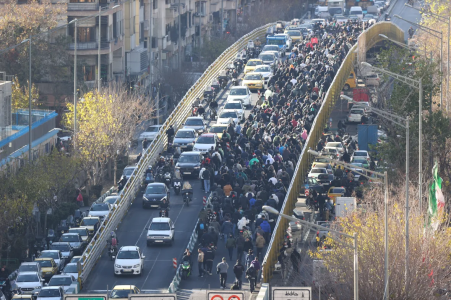
Protesters accuse anti-riot forces — made up of the Islamic Revolutionary Guard Corps (IRGC), the Basij militia, the police and the army — of using violent means including live fire, tear gas and water cannons to suppress the demonstrations.
The forces are under the total command of Khameini, who is the supreme source of power in the Islamic republic, overruling the army, courts and media. He relies on the IRGC to enforce his bidding as a central source of power.
The escape plan will be activated should Khamenei feel his security forces are not following orders. Desertion and defection are not easily undertaken, with Khamenei protecting loyalists, controlling key appointments and their safety, according to a psychological profile of the leader done by a western intelligence agency and seen by The Times.
But the same assessment said Khamenei was “weaker, both mentally and physically” since last year’s 12-day war with Israel. He has barely been seen in public and, notably, has not been seen or heard from during the last several days of protests. For the duration of war, Khamenei holed up in a bunker, avoiding the fate of several other high-level IRGC officials and feeding his “obsession with survival”.
The assessment calls him a “paranoid” leader, a trait that shaped his plan to leave Iran should his forces desert him. “On one hand, he is very ideologically motivated, but on the other he is pragmatic in what he sees: he sees tactical compromise for long-term greater cause. He is a long-term thinker,” the assessment read.
Khamenei was born in Mashhad in 1939 to a family of religious clerics, from Azeri-Turkish origins. When he was young, he was interested in poetry, Persian and Western music, and literature, reading classics including by Tolstoy and Steinbeck.
Under the rule of Iran’s last shah, Mohammad Reza Pahlavi, Khamenei joined the opposition. He was arrested several times and tortured by the Savak secret police, and in 1981 survived an assassination attempt that resulted in the loss of the use of one of his hands.
According to the assessment, the assassination attempt solidified a sense of “divine mission” to lead Iran in its mission to oppose Israel and the west, and preserve the regime above all else. After the revolution, he became deputy defence minister and member of council before becoming president. When the former supreme leader Ruhollah Khomeini died, Khamenei rose to power — despite not having the necessary chain of learned liturgical credentials to be leader.
He sees himself as the leader of Shi’ite Muslims worldwide, justifying his investments in the so-called axis of resistance — Hezbollah in Lebanon, Hamas in Gaza, and Shi’ite movements and militias in Iraq, Syria and Yemen.
The decapitation of those fronts in the war with Israel has led Iranians to question the investment in external forces instead of his own people, who have been left with record inflation and deteriorating living conditions. One chant heard on the streets of Iran sounded out: “No to Gaza, no to Lebanon, I’d give my life for Iran only.”

 www.thetimes.com
Ayatollah Ali Khamenei greeting a crowd during a ceremony in Tehran on Saturday
IRAN’S SUPREME LEADER OFFICE/EPA
Iran’s Ayatollah Ali Khamenei has a back-up plan to flee the country should his security forces fail to suppress protests or desert, according to an intelligence report shared with The Times.
Khamenei, 86, plans to escape Tehran with a close circle of up to 20 aides and family, should he see that the army and security called on to quell the unrest are deserting, defecting or failing to follow orders.
“The ‘plan B’ is for Khamenei and his very close circle of associates and family, including his son and nominated heir apparent, Mojtaba,” an intelligence source told The Times.
Beni Sabti, who served for decades in Israeli intelligence after fleeing the regime eight years after the Islamic revolution, told The Times that Khamenei would flee to Moscow as “there is no other place for him”.
• Inside Iran protests that threaten regime: ‘This is the final battle’
Khamenei also “admires Putin, while the Iranian culture is more similar to the Russian culture”.
The getaway plan is based on the escape of his ally, the fallen Syrian leader Bashar al-Assad who fled Damascus aboard a plane to Moscow to join his family before opposition forces stormed the capital in December 2024.
“They have plotted an exit route out of Tehran should they feel the need to escape,” which includes “gathering assets, properties abroad and cash to facilitate their safe passage”, the source said.
Khamenei is known to hold a major network of assets, some under one of the most powerful organisations in Iran, Setad — part of a system of semi-state charitable foundations known for their financial obfuscation. Estimates put the total holdings at $95 billion, according to a Reuters investigation in 2013, including properties and companies, all held and controlled by Khamenei.
Many of his closest aides, including the secretary of Iran’s supreme national security council, Ali Larijani — who warned President Trump to stay out of Tehran’s affairs — have family members already living abroad, including in the US, Canada and Dubai.
Nationwide protests triggered by economic hardships have gripped cities across Iran, including in the holy city of Qom, over the last week.
Protesters accuse anti-riot forces — made up of the Islamic Revolutionary Guard Corps (IRGC), the Basij militia, the police and the army — of using violent means including live fire, tear gas and water cannons to suppress the demonstrations.
The forces are under the total command of Khameini, who is the supreme source of power in the Islamic republic, overruling the army, courts and media. He relies on the IRGC to enforce his bidding as a central source of power.
The escape plan will be activated should Khamenei feel his security forces are not following orders. Desertion and defection are not easily undertaken, with Khamenei protecting loyalists, controlling key appointments and their safety, according to a psychological profile of the leader done by a western intelligence agency and seen by The Times.
But the same assessment said Khamenei was “weaker, both mentally and physically” since last year’s 12-day war with Israel. He has barely been seen in public and, notably, has not been seen or heard from during the last several days of protests. For the duration of war, Khamenei holed up in a bunker, avoiding the fate of several other high-level IRGC officials and feeding his “obsession with survival”.
The assessment calls him a “paranoid” leader, a trait that shaped his plan to leave Iran should his forces desert him. “On one hand, he is very ideologically motivated, but on the other he is pragmatic in what he sees: he sees tactical compromise for long-term greater cause. He is a long-term thinker,” the assessment read.
Khamenei was born in Mashhad in 1939 to a family of religious clerics, from Azeri-Turkish origins. When he was young, he was interested in poetry, Persian and Western music, and literature, reading classics including by Tolstoy and Steinbeck.
Under the rule of Iran’s last shah, Mohammad Reza Pahlavi, Khamenei joined the opposition. He was arrested several times and tortured by the Savak secret police, and in 1981 survived an assassination attempt that resulted in the loss of the use of one of his hands.
According to the assessment, the assassination attempt solidified a sense of “divine mission” to lead Iran in its mission to oppose Israel and the west, and preserve the regime above all else. After the revolution, he became deputy defence minister and member of council before becoming president. When the former supreme leader Ruhollah Khomeini died, Khamenei rose to power — despite not having the necessary chain of learned liturgical credentials to be leader.
He sees himself as the leader of Shi’ite Muslims worldwide, justifying his investments in the so-called axis of resistance — Hezbollah in Lebanon, Hamas in Gaza, and Shi’ite movements and militias in Iraq, Syria and Yemen.
The decapitation of those fronts in the war with Israel has led Iranians to question the investment in external forces instead of his own people, who have been left with record inflation and deteriorating living conditions. One chant heard on the streets of Iran sounded out: “No to Gaza, no to Lebanon, I’d give my life for Iran only.”
Ayatollah Khamenei plans to flee to Moscow if Iran unrest intensifies
The republic’s supreme leader has plotted an exit route out of Tehran should his forces fail to quell dissent, an intelligence report reveals
www.thetimes.com







 sure he would rather prefer to be oppressed under Hindutva India than live high on the happiness index in Islamic Pakistan. I can guarantee that there will be more life threats to him in Pak (not just from USA etc but local maulanas) than in India where also he does have some following among a certain group of Muslims.


