What's new

British Pakistanis: Discussion Thread

theres tonnes of british pakistanis outside cricket, esp in boxing, hamzah sheeraz is #16 pound for pound on boxrecs rankings, and theres pbly 10 or 15 other guys behind him who havnt made it to the world level yet. loads in cricket obviously. a few in the lower leagues in football but not close to world level. but a a decent output for abt a million people, a boxing world champ and a few cricket world cup winners. more than any other asian ethnic group id reckon.
Cricket is not played in US, US competitive sports are much tougher to break into.. probably equivalent to getting into top 10 EPL teams..

Desis tend to go for Cricket outside as well so it isn’t 1:1.

@KingKhanWC

Pakistani Americans are 0.18 ish % of the demographics,
Pakistani Brits are around 2.7%..

that’s a massive difference…
 
p
Cricket is not played in US, US competitive sports are much tougher to break into.. probably equivalent to getting into top 10 EPL teams..

Desis tend to go for Cricket outside as well so it isn’t 1:1.

@KingKhanWC

Pakistani Americans are 0.18 ish % of the demographics,
Pakistani Brits are around 2.7%..

that’s a massive difference…

My point is British Pakistanis are more prevalent in society than their American counterparts. Of course there’s different factors.

Top 10 of PL teams is very tough to get into . Football is more competitive than American football worldwide . The whole world competes to play in the PL
 
Cricket is not played in US, US competitive sports are much tougher to break into.. probably equivalent to getting into top 10 EPL teams..

Desis tend to go for Cricket outside as well so it isn’t 1:1.

@KingKhanWC

Pakistani Americans are 0.18 ish % of the demographics,
Pakistani Brits are around 2.7%..

that’s a massive difference…
what proof is there that american sports are harder to break into, sheeraz is a top 20 pound for pound boxer, that is an exponentially harder achievement than breaking into an american sports team. the reality is that every sport is extremely tough to get to the top level, it doesnt matter what sport, your just nitpicking because you dont want to admit that british pakistanis have good representation in cricket and boxing, way better than other asian groups.
 
what proof is there that american sports are harder to break into, sheeraz is a top 20 pound for pound boxer, that is an exponentially harder achievement than breaking into an american sports team. the reality is that every sport is extremely tough to get to the top level, it doesnt matter what sport, your just nitpicking because you dont want to admit that british pakistanis have good representation in cricket and boxing, way better than other asian groups.
My comparison was only on British Pakistanis and American ones..

In UK Indian groups have done as well Nasser Hussain to Rishi Sunak.. to that gambler dude Michael Chopra but that’s not the context.

Pakistani Americans are just too small number in America compared to Pakistani Brits in Britain
 
My comparison was only on British Pakistanis and American ones..

In UK Indian groups have done as well Nasser Hussain to Rishi Sunak.. to that gambler dude Michael Chopra but that’s not the context.

Pakistani Americans are just too small number in America compared to Pakistani Brits in Britain
so then why only use the small number to negate postiive comparisons, like i said earlier in this thread, the pakistani community in america is too small and disassociated to have a unique identity, that reduces a lot of group wide social phenomena, so its not fair to compare british pakistanis with american pakistanis cos they are fundamentally very different groups, britpaks have greater sporting, media and political represenation, and for better or worse, a unique identity, american pakistanis have higher salaries, it is what it is.

i cant be bothered to check, but im pretty sure white americans have a higher living standard than white brits too, america as a whole has done signficnatly better over the last 15 odd years.
 
My comparison was only on British Pakistanis and American ones..

In UK Indian groups have done as well Nasser Hussain to Rishi Sunak.. to that gambler dude Michael Chopra but that’s not the context.

Pakistani Americans are just too small number in America compared to Pakistani Brits in Britain
There’s probably more Pakistanis in the US considering the size of it
We have family /second cousins in pakistan
One is the daughter in the law of the former pm of Kashmir
One of the other sisters lives in Chicago and is married to a doctor I think , I don’t really get to speak to them but I remember stories of how she was innocently shot in the streets there in the 90s
 
1. I never indulged in any personal attacks, if you think I did maybe just quote one example and I will address it.
2. I have not assumed any role of British Pakistani king. This is totally your own invention so not sure how to even respond.
3. I did not deny any government source data.
4. I commented on your username - so what? It's a meme for trolling in the UK, you can do a google search for it if you want.
5. I asked you to quote me on my posts because you were inferring something different to what I wrote. See #2 here as an example.
6. See above.
7. I was being sarcastic. I already gave the reason why. I understand that Americans don't really get sarcasm, it's a British trait.

If you don't want to dwell on my pond level contributions then stop quoting me, I already suggested that I would prefer to engage other posters rather than indulge in this personal crap which seems to be your forte.

He writes like British Pakistanis are looking for validation/approval from him. Why does he think he is some type of judge? LOL. :qdkcheeky
 
1. I never indulged in any personal attacks, if you think I did maybe just quote one example and I will address it.
2. I have not assumed any role of British Pakistani king. This is totally your own invention so not sure how to even respond.
3. I did not deny any government source data.
4. I commented on your username - so what? It's a meme for trolling in the UK, you can do a google search for it if you want.
5. I asked you to quote me on my posts because you were inferring something different to what I wrote. See #2 here as an example.
6. See above.
7. I was being sarcastic. I already gave the reason why. I understand that Americans don't really get sarcasm, it's a British trait.

If you don't want to dwell on my pond level contributions then stop quoting me, I already suggested that I would prefer to engage other posters rather than indulge in this personal crap which seems to be your forte.
You actually have done #1, #2, #3 - proof is in this very thread. Go read. You do have the ability to read English, especially your own words, I assume?

  1. Irrelevant comment about background when it has no bearing whatsoever especially calling a Pakistani Muslim as an Indian or Israeli without any relevant context is personal attack.
  2. Irrelevant comment about user name when it has no context to thread topic is personal attack. How can you not know that despite languishing here for 16+ years? Basic forum etiquette? Should I call you sleazeball from now on, based on your username?
  3. You did say I should not send my sympathy/pity to British Pakistanis. Who are you to assume what I should or should not do to other British Pakistanis? Who died and made you the king of British Pakistanis to assume this role? I have already called you out multiple times and you are just blind to your own post and claiming you never did that.
  4. I have quoted all of your posts multiple times but you just seem hell bent on gaslighting.
  5. Being sarcastic is true if you have accepted the fact at least once and you made your purported sarcastic comment ONCE. But you never accepted the fact that British Pakistanis lag Pakistani Americans and Afghan Americans in HDI metrics even once so far but have denied it twice. This is not sarcasm but it is denial.

I do want to stop quoting your nonsense but I am compelled to speak up if you go around making false claims that I "backed down" from your great intellect when fact of the matter is I do not want to engage with posts akin to "village idiots" or your forte of "he said she said" housewife drama.

You proved my point yet again by only making a post on the same drama BS without sticking to the thread topic because this is all you know - housewife level drama.

I challenge you - make your next post only relevant to thread topic and contribute in a meaningful way instead of your drama BS. Can you? I asked you if you were man enough to stick the topic in my prior post and you have not done that.
 
He writes like British Pakistanis are looking for validation/approval from him. Why does he think he is some type of judge? LOL. :qdkcheeky
Oh, just right on time. Insects coming out of the woods with irrelevant crap. Insects that are not even Pakistani.

Who even said British Pakistanis need validation from others? They are a strong community with accomplishments in their own sense over the years but you are too dense to understand those nuances.

Maybe go to BangPassion.net and post there instead of PakPassion.net?
 
So here it is, I have taken a stab at the conclusion/inference/reasonings or whatever else you may call for British Pakistanis lagging behind Pakistani Americans and Afghan Americans in key metrics. I took time to research this and as mentioned multiple times before - this is not a criticism by any means. The British Pakistani community has made positive strides in certain areas while lagging in others. This is my stab at the laggard metrics.

Please feel free to add anything I have missed or misrepresented, provided you can provide reference links for your assertions. I'm happy to change my opinion and stand corrected. I would be eager to learn new things if you do correct me with proper references and valid points. But please - NO PERSONAL ATTACKS ON ME!

My thanks to positive contributions to this discourse from @DeadlyVenom @ghalib kichlu @aboveandbeyond @KingKhanWC @RizwanT20Champ @jaspa888 @SpiritOf1903 @finalfantasy7 @The Bald Eagle @ElRaja @Kroll

1. The Talent Is Not in Question — The System Is

Before any data is put on the table, something must be said clearly: the British Pakistani community is not short on talent. The names are too numerous to be dismissed. Sadiq Khan has served as Mayor of London longer than any predecessor. Humza Yousaf became the first Muslim leader of a European government when he took office as Scotland's First Minister in 2023. Sajid Javid served simultaneously as Home Secretary and Chancellor of the Exchequer in the same government — a first in modern British history. These are not footnotes. They are the output of a community that has real capability at its highest levels.

In arts and culture, Riz Ahmed became the first person of Pakistani heritage to be nominated for an Academy Award for Best Actor. Zayn Malik broke global streaming records. In sport, Amir Khan competed at the Olympic Games and held multiple world championship belts. Adil Rashid became England's leading spin bowler. These achievements matter, not as deflection, but as proof that the raw material exists.

So why, despite this talent, does the macroeconomic picture look the way it does? The data is not an accusation. It is a structural diagnosis. And until the community engages with it honestly — rather than pointing to individual successes as proof that everything is fine — the gap will persist. The question is not whether British Pakistanis can achieve. The question is why the aggregate numbers still tell a different story after multiple generations.

2. The HDI Comparison — Fresh Numbers, Old Problem

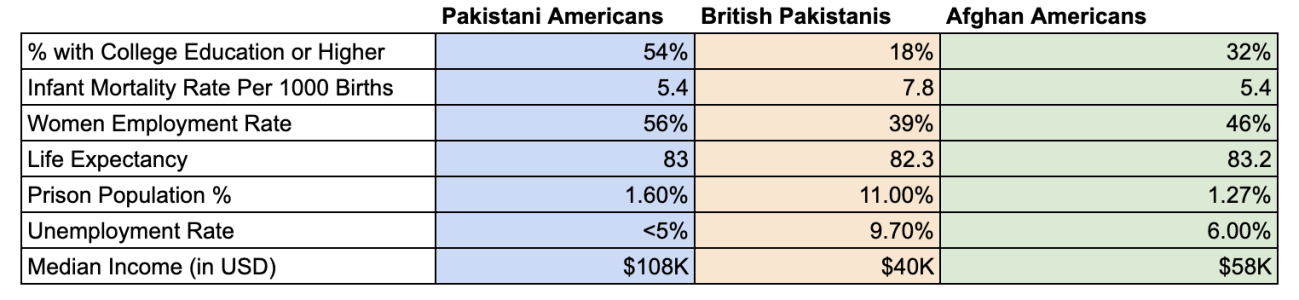
The numbers below are drawn from government datasets, the ONS, the IFS Deaton Review, and US Census Bureau data. They are not cherry-picked. They are the current picture.

1771815195593.png

What makes this data particularly striking is what LSE research released in January 2026 found: while White British and Indian ethnic groups saw substantial increases in median wealth between 2012 and 2024, Pakistani household wealth actually declined in real terms over the same period. The Pakistani community has been in the UK for four generations, and its median wealth is moving in the wrong direction. The Indian community, starting from comparable disadvantage, is now within touching distance of White British wealth. These are not random outcomes. They reflect accumulated decisions, structures, and processes.

One of the sharpest data points from the IFS Deaton Review is that Pakistani and Bangladeshi graduates still earn 22% less than White British graduates with equivalent qualifications. Not 22% less before university — 22% less after it. This means that even when individuals do everything right — study hard, attend university, get a degree — the structural return on that investment is lower. The post-education penalty is real, and it is a critical piece of context. But it cannot be the explanation for everything. Education rates among British Pakistanis remain far below the national average, and the penalty applies to a group that is already underrepresented in higher education.


3. The Welfare Trap and the Ambition Ceiling

The UK welfare state was built for good reasons, and no community should be ashamed of using the safety net it was designed to provide. But data consistently shows that Pakistani and Bangladeshi families are the highest recipients of income-related benefits among all ethnic groups in the UK. Forty-seven percent of Pakistani households are in the two lowest income quintiles. Pakistani families receive Child Tax Credit and Working Tax Credit at nearly three times the rate of White British families. These statistics are not cited to stigmatise. They are cited because the British Pakistani community currently has a higher dependency on state support than almost any comparable diaspora group — including Afghan Americans who arrived with nothing, in a system that offers far fewer safety nets.

The relevant comparison here is instructive. Afghan Americans resettled under Operation Allies Welcome faced no free healthcare, no housing benefit, no council tax reduction, no working tax credit. Within a year of arrival, over 80% were employed. This is not a moral argument against welfare. It is a structural observation: systems that make inactivity viable will produce inactivity. The UK system is more generous than the US system, and that generosity — while humane — creates different incentive structures. The absence of urgency is a luxury that can calcify into a permanent economic position across generations.

The data from Trust for London shows that 39.5% of working-age Londoners of Pakistani or Bangladeshi heritage are not in paid work — the highest rate of any ethnic group in the capital. In 2013, that figure was 48.5%. Progress has been made. But progress at this rate will not close the gap within any meaningful timeframe. The ambition ceiling — the informal community norm about what kinds of work are appropriate, what constitutes success, and what expectations are set for children — needs examination.

Consider this specific data point: one in seven Pakistani men in the UK work in taxi, chauffeur, or related driving businesses. One in 100 White British men do. Driving is honourable work. The point is about the concentration of ambition in a narrow band of low-growth sectors, and what that signals about the professional aspirations being transmitted to the next generation.

4. The Afghan American Control Experiment — Why It Matters

Some defenders of the status quo will argue that Afghan Americans are not a fair comparison — that they are selected for education, that they came as professionals, that they had advantages British Pakistanis did not. The facts do not support this argument.

The Migration Policy Institute's data on Afghan immigrants in the US is unambiguous: compared to other US immigrants, Afghan arrivals were less likely to be proficient in English, had lower educational attainment, and lower labour force participation on arrival. The majority arrived through humanitarian parole or Special Immigrant Visas, with no guaranteed pathway to permanent legal status. They came from a country with an HDI of 0.478, ranked 182nd in the world. A significant proportion arrived without degrees, without savings, without professional networks, into a country with minimal safety nets for new arrivals.

Yet research from American University's Immigration Lab found that 87% of Afghan interviewees in the Washington D.C. area had at least a bachelor's degree — a cohort rapidly rebuilding their credentials. And the ORR surveys show that within 12 months of arrival, employment rates reached over 80%. Afghan American households in established communities now show college attendance rates around 32% — significantly higher than the 18% rate among British Pakistanis who are entering their third and fourth generation in the UK.

The gap between Afghan Americans and British Pakistanis is not a gap in starting conditions. It is a gap in trajectory. The Afghan community arrived more recently, with objectively worse starting conditions, in a country that offered less institutional support — and their trajectory is steeper. That differential is a signal about internal community process that cannot be argued away.

5. The Education Paradox — Gaining Access, Losing Return

There is something genuinely positive happening in British Pakistani educational attainment at the school level. The data from the Department for Education for the 2024-25 academic year shows Pakistani pupils achieving an Attainment 8 score of 46.5 at GCSE level — slightly above the national average of 46.0, and ahead of White British pupils at 44.4. This is not a small thing. A community that began in post-war industrial labour has produced children who outperform the ethnic majority at secondary school level.

But the paradox is what happens next. IFS data shows that Pakistani students are 19 percentage points more likely to attend some form of higher education than White British students. And yet Pakistani and Bangladeshi graduates earn 22% less than equivalent White British graduates. The Social Mobility Commission confirms the picture: young people from Pakistani and Bangladeshi backgrounds consistently earn less than other groups with the same qualifications and socioeconomic background.
Two things are happening simultaneously. First, discrimination in the labour market is real — adjusted pay gap studies consistently find an unexplained residual penalty even after controlling for occupation, education, geography, and firm. This is an external problem and it demands external solutions. But second, British Pakistani graduates are disproportionately concentrated in lower-return subject areas. The IFS notes that subject choice is a major driver of graduate earnings differentials. The data consistently shows Pakistani graduates over-represented in public services, healthcare support roles, and lower-return humanities subjects — and under-represented in finance, engineering, technology, and law. These are choices that can change. The external penalty cannot be eliminated by individual action. The internal concentration of ambition in lower-return fields can.

6. The Women's Participation Gap — The Single Largest Lever

No single metric has more explanatory power for the aggregate British Pakistani income deficit than the women's labour participation rate. At approximately 39%, it is the lowest of any demographic group in the UK. In January-March 2020, around 57% of Pakistani and Bangladeshi women were economically inactive — compared to 26% among Black and Indian women, and 22% among White women. One in three Pakistani women not in work reported their reason as looking after the family or home. This compares to one in five for all other groups combined.

This is not primarily an external problem. British Indian women, who face comparable cultural pressures, comparable discrimination in the labour market, and comparable religious expectations, participate at rates of 76%. Pakistani American women — from within the same cultural and religious tradition — participate at 56%. The 17-percentage-point gap between British Pakistani women and Pakistani American women exists within the same diaspora culture, in different structural environments. The American environment demands more economic participation. The British environment permits less of it.

The economic mathematics are straightforward. A household where only one partner works has, by definition, half the earning capacity of a household where both work. Multiply this across a community of 1.6 million people, with women constituting roughly half the working-age population, and you are looking at the suppression of potentially hundreds of thousands of wage incomes from the UK economy. Women are also the primary transmitters of educational aspiration to children. Research consistently shows that maternal employment and maternal educational attainment are the two strongest predictors of children's own educational and economic outcomes. Depressing the economic participation of British Pakistani women does not just affect household income in the current generation. It shapes the aspirational context into which the next generation is born.

7. Consanguinity — The Conversation the Community Keeps Avoiding

The Born in Bradford study — one of the most comprehensive long-term birth cohort studies in UK medical history — tracked over 13,500 babies born between 2007 and 2011. Its findings on consanguineous marriage are not the result of anti-Pakistani bias. They are peer-reviewed, replicated data. Among Pakistani-origin families in Bradford, over 60% of marriages were consanguineous. Children of first-cousin marriages faced nearly double the risk of congenital anomalies compared to the general population — rising from a background rate of approximately 3% to 6%. The study estimated this accounted for around 30% of all congenital anomalies and 25% of infant mortality in Bradford.

The UK House of Lords debate in January 2025 placed this data on the parliamentary record: Pakistanis account for 3.4% of births nationwide but 30% of recessive gene disorders. The NHS employs dedicated staff in Bradford and similar cities specifically to manage the caseload of consanguinity-related genetic conditions. This is not a hypothetical public health issue. It has a measurable cost in NHS resources, in infant mortality, and in the healthcare demands placed on families managing children with complex genetic conditions — demands that take time, emotional energy, and financial resources away from education and economic advancement.

The rate is declining. Parliamentary testimony confirmed that Bradford's first-cousin marriage rate fell by 27% between 2010 and 2019 as awareness of genetic risks increased. That is genuine progress, driven by community education and the trusted voices of healthcare workers. The point is not to criminalise a cultural practice but to be honest about its costs. A community that is simultaneously trying to improve its health outcomes, reduce infant mortality, decrease NHS burden, and increase family resources for education cannot afford to treat this data as taboo.

8. The Global Pakistani Test — Comparing Across Diasporas

The global Pakistani diaspora provides a broader natural experiment that rarely gets discussed. There are approximately 9 million Pakistanis living outside Pakistan. The vast majority — over 4.7 million — are in the Gulf States. About 1.6 million are in the UK. Approximately 500,000 are in the United States. Significant communities exist in Canada, Australia, and Norway.
The remittance data alone tells a story. Pakistan received over $26 billion in remittances in fiscal year 2022-23. Saudi Arabia sent $4.4 billion. The UAE sent $3.1 billion. The UK — with 1.6 million Pakistanis compared to Saudi Arabia's 2.6 million — sent $2.7 billion. These are comparable absolute figures for a substantially smaller community, which is a positive signal about British Pakistani earning capacity at some levels. But it also reveals that the Gulf communities, composed largely of blue-collar labour migrants, are remitting comparable amounts per capita to a community that has been settled and established in a high-wage western economy for four generations.

The Norwegian Pakistani experience is worth examining separately. The Pakistani community in Norway grew from 3,770 people in 1975 to approximately 38,000 by 2017 — a similar trajectory to the UK. Norwegian-born Pakistani women have higher rates of university education than their UK counterparts. The Norwegian welfare system is even more generous than the British one. Yet the outcome gap with the native Norwegian population is narrowing faster in Norway than the equivalent gap is narrowing in the UK. Research points to Norway's strong emphasis on language integration, earlier and more intensive labour market activation programmes, and less spatial concentration of Pakistani communities — meaning less geographic enclave effect — as factors in that difference.

The Pakistani American diaspora is the most often-cited comparison. OPEN Silicon Valley alone counts over 10,000 people across 3,000 Bay Area households — including Fortune 1000 CEOs, founders behind billion-dollar exits, and senior leaders at Fortune 10 companies. Pakistani American Shahid Khan sits in the Forbes 400. Ashar Aziz founded FireEye, which IPO'd in 2013 backed by Goldman Sachs and Sequoia Capital. The OPEN network spans 15 cities globally. These are not isolated cases — they represent the product of a selection filter that the UK did not apply, drawing professionals from Karachi, Lahore, and Islamabad through the 1965 Hart-Celler Act's merit criteria.

But here is where the honest analysis gets difficult. The British Pakistani community was not given that filter. They were recruited as industrial labour. That historical injustice is real. The problem is that three and four generations later, the filter no longer governs who British Pakistanis are. A community this large, this established, with this level of political representation and cultural footprint, has the internal capacity to shift its own trajectory. The question is whether it chooses to.

9. The Denial Architecture — Why the Gap Persists

There is a specific social mechanism that explains why the data does not translate into community reform more quickly. It can be called the denial architecture: a set of rhetorical defences that, when deployed, make honest internal conversation impossible.

The first defence is historical grievance. The argument that the community was brought here as industrial labour, treated badly, and cannot be held responsible for the consequences. This has genuine historical validity for the first generation. It has declining validity for the second generation. It has essentially no validity for the third and fourth generation, who were born, educated, and have spent their entire lives in the UK.

The second defence is discrimination. The argument that racism explains the gap. Discrimination is real, documented, and should be challenged through policy. But it cannot explain the gap between British Pakistanis and British Indians, who face comparable discrimination. It cannot explain the gap between British Pakistanis and Pakistani Americans in the US, where anti-Muslim discrimination after 9/11 was severe and sustained. The discrimination explanation is a partial truth that gets deployed as a complete one.

The third defence is cultural pride. The claim that community achievements in politics, sport, and arts demonstrate that everything is fine. This confuses elite-level individual success with aggregate community outcomes. The British Pakistani community has produced a Mayor of London, a First Minister of Scotland, an Oscar nominee, and a world boxing champion. It has also produced a community where 72% of households are in the two lowest income quintiles. Both things are true simultaneously. The first does not negate the second.

The fourth defence is that the data is biased, that comparisons are unfair, that the metrics do not capture the full picture. This defence is the most corrosive because it immunises the community against the very evidence needed to understand and address the problem. When presented with the Born in Bradford genetic data, community members have said the data is anti-Pakistani. When presented with income gap data, they have said the metrics are Western and inappropriate. When presented with the Afghan American comparison, they have said it is unfair. These are all responses that protect the ego and wound the community.

10. A Roadmap That Actually Requires Something

Generic calls for 'investment in education' or 'tackling discrimination' are not a roadmap. They are platitudes. What follows are specific, evidence-grounded actions.

10.1 Prioritize Women's Professional Education as a Community Obligation
The mosques, the community organisations, the biraderi networks — all of the institutions that shape social norms in British Pakistani communities — need to publicly and explicitly champion women's entry into law, medicine, engineering, finance, and technology. Not as tolerance for women who choose it, but as a communal expectation. Norwegian Pakistani communities have demonstrated that this shift is possible within an Islamic cultural framework. The British Pakistani community has no excuse for not replicating it.

10.2 Target Subject Choice in Higher Education
University attendance rates are high. Earnings after university are low. The gap lives in subject choice. Community mentorship programmes, school engagement initiatives, and STEM-focused scholarship funds should be explicitly directed at redirecting capable students from lower-return subjects toward higher-return fields. The model already exists in the Pakistani American community through organisations like OPEN — it needs replication at the community level in the UK.

10.3 Move from Survival Entrepreneurship to Scalable Enterprise
The British Pakistani economy is concentrated in taxis, restaurants, corner shops, and takeaways. These are not bad businesses. But they are low-margin, high-labour, non-scalable, and do not build transferable wealth. The shift toward professional services firms, technology businesses, franchise models, and investment vehicles is not about abandoning a cultural tradition of entrepreneurship — it is about evolving it. Pakistani American entrepreneurs have done this in Silicon Valley. The talent exists in the UK community to replicate it.

10.4 Address Consanguinity Through Trusted Internal Voices
The decline in first-cousin marriage rates in Bradford from 2010 to 2019 was not driven by government campaigns or parliamentary pressure. It was driven by community health workers, GPs, religious leaders, and trusted figures within the community who communicated the genetic risks in culturally appropriate ways. That model works. It needs to be expanded, funded, and supported — not to ban a practice, but to ensure that families making this decision do so with full information about the health consequences for their children.

10.5 Break the Enclave Effect Deliberately
Geographic concentration in Bradford, Luton, Birmingham, and East London correlates directly with worse educational and economic outcomes. The spatial stigma attached to postcodes associated with high Pakistani populations produces measurable hiring penalties. Internal community mobility — deliberately encouraging younger generations to build lives and careers outside the traditional enclaves — is not cultural betrayal. It is strategic advancement. The Pakistani American community has no equivalent of Bradford. Its dispersal across multiple US cities is one of the structural reasons for its stronger aggregate performance.

11. Conclusion — Own the Data

The British Pakistani community has produced four generations in the United Kingdom. It has given this country political leaders, world-class athletes, Oscar-nominated artists, and decorated public servants. It has built cultural institutions, maintained extraordinary community solidarity under difficult conditions, and made this country genuinely more interesting.
None of that changes what the data says. Forty-seven percent poverty rates. Seventy-two percent concentrated in the two lowest income quintiles. Median wealth declining in real terms while the Indian community's wealth rises. Women's labour participation at the bottom of all ethnic groups. A consanguinity-related genetic disorder burden that accounts for 30% of a condition that affects 3.4% of the birth population.

These are not numbers that can be deflected into silence. They are not the product of a biased measurement framework. They are the product of specific, identifiable processes — historical, cultural, structural — that can be changed. The precondition for changing them is owning them.

The Afghan American who arrived three years ago with nothing and is now employed and rebuilding their professional credentials is not doing it because Americans are better people or because America is a fairer country. They are doing it because the environment demands a different process — and they have responded to that demand. The British Pakistani community has every resource it needs to demand a different process from itself. It has the political power, the cultural influence, the community infrastructure, and the individual talent. What it needs is the honesty to read its own data without flinching.


References and Data Sources

The following sources underpin the data, analysis, and comparisons in this report. Readers are encouraged to consult primary sources directly.

UK Government and Institutional Sources
  1. https://www.ethnicity-facts-figures...ncome/people-in-low-income-households/latest/
  2. https://www.ethnicity-facts-figures...ts/pay-and-income/income-distribution/latest/
  3. https://www.ons.gov.uk/employmentan...les/ethnicitypaygapsingreatbritain/2012to2022
  4. https://www.ethnicity-facts-figures...y-and-benefits/benefits/state-support/latest/
  5. https://commonslibrary.parliament.uk/income-inequality-by-ethnic-group/
  6. https://commonslibrary.parliament.uk/research-briefings/cbp-9195/
  7. https://social-mobility.data.gov.uk..._29_years)/income_returns_to_education/latest
  8. https://hansard.parliament.uk/lords...2-49CB-BFC3-747F1D9CC219/First-CousinMarriage
  9. https://trustforlondon.org.uk/data/worklessness-ethnicity/
  10. https://en.wikipedia.org/wiki/British_Pakistanis

Academic and Research Sources
  1. https://www.lse.ac.uk/news/uk-ethnic-wealth-gap-has-widened-over-last-decade
  2. https://ifs.org.uk/inequality/press...in-education-but-wages-and-wealth-lag-behind/
  3. https://www.runnymedetrust.org/publications/the-colour-of-money
  4. https://www.economicsobservatory.com/what-explains-the-uks-racial-wealth-gap
  5. https://www.equalityhumanrights.com...research-report-108-the-ethnicity-pay-gap.pdf
  6. https://academic.oup.com/ooec/article/3/Supplement_1/i684/7708075
  7. https://www.tandfonline.com/doi/full/10.1080/15562948.2025.2514163?af=R
  8. https://academic.oup.com/oxrep/article/40/3/556/7907284
  9. https://journals.sagepub.com/doi/pdf/10.1177/0950017012445095

Health and Genetics Research
  1. https://borninbradford.nhs.uk/our-i...ital-anomalies-in-a-multiethnic-birth-cohort/
  2. https://pmc.ncbi.nlm.nih.gov/articles/PMC4567984/
  3. https://pmc.ncbi.nlm.nih.gov/articles/PMC12634778/
  4. https://pmc.ncbi.nlm.nih.gov/articles/PMC12120418/
  5. https://www.ibtimes.co.uk/nhs-battl...s-mull-banning-first-cousin-marriages-1729486
US and Afghan American Sources
  1. https://www.migrationpolicy.org/article/afghan-immigrants-united-states-2022
  2. https://acf.gov/archive/blog/2023/1...-surveys-reflect-high-employment-needs-remain
  3. https://aulablog.net/2023/10/02/a-p...refugees-in-the-washington-metropolitan-area/
  4. https://www.tandfonline.com/doi/full/10.1080/1369183X.2020.1724420
  5. https://www.migrationpolicy.org/sites/default/files/publications/RAD-Pakistan.pdf
  6. https://www.opensv.org/
  7. https://americankahani.com/business...re-among-the-forbes-400-wealthiest-americans/
  8. https://www.globalvillagespace.com/...pakistani-visionaries-shaping-silicon-valley/

Global Diaspora Data
  1. https://en.wikipedia.org/wiki/Pakistani_diaspora
  2. https://southasiajournal.net/the-transformative-role-of-the-pakistani-diaspora/
  3. https://en.wikipedia.org/wiki/Pakistanis_in_the_United_Arab_Emirates
  4. https://www.gids.org.pk/wp-content/uploads/2024/08/The-Pakistani-Diaspora-Complete.pdf
  5. https://file.pide.org.pk/pdfpideresearch/kb-112-pakistans-emigration-trends-and-insights.pdf
  6. https://www.ons.gov.uk/peoplepopula...hbyethnicitygreatbritain/april2016tomarch2018
  7. https://en.wikipedia.org/wiki/Cousin_marriage
  8. https://eprints.lse.ac.uk/119885/1/III_Working_Paper_97_Karagiannaki.pdf
 
so then why only use the small number to negate postiive comparisons, like i said earlier in this thread, the pakistani community in america is too small and disassociated to have a unique identity, that reduces a lot of group wide social phenomena, so its not fair to compare british pakistanis with american pakistanis cos they are fundamentally very different groups, britpaks have greater sporting, media and political represenation, and for better or worse, a unique identity, american pakistanis have higher salaries, it is what it is.

i cant be bothered to check, but im pretty sure white americans have a higher living standard than white brits too, america as a whole has done signficnatly better over the last 15 odd years.
I was only defending Pakistani Americans not attacking Pakistani Brits due to direct comparison.
 
So here it is, I have taken a stab at the conclusion/inference/reasonings or whatever else you may call for British Pakistanis lagging behind Pakistani Americans and Afghan Americans in key metrics. I took time to research this and as mentioned multiple times before - this is not a criticism by any means. The British Pakistani community has made positive strides in certain areas while lagging in others. This is my stab at the laggard metrics.

Please feel free to add anything I have missed or misrepresented, provided you can provide reference links for your assertions. I'm happy to change my opinion and stand corrected. I would be eager to learn new things if you do correct me with proper references and valid points. But please - NO PERSONAL ATTACKS ON ME!

My thanks to positive contributions to this discourse from @DeadlyVenom @ghalib kichlu @aboveandbeyond @KingKhanWC @RizwanT20Champ @jaspa888 @SpiritOf1903 @finalfantasy7 @The Bald Eagle @ElRaja @Kroll

1. The Talent Is Not in Question — The System Is

Before any data is put on the table, something must be said clearly: the British Pakistani community is not short on talent. The names are too numerous to be dismissed. Sadiq Khan has served as Mayor of London longer than any predecessor. Humza Yousaf became the first Muslim leader of a European government when he took office as Scotland's First Minister in 2023. Sajid Javid served simultaneously as Home Secretary and Chancellor of the Exchequer in the same government — a first in modern British history. These are not footnotes. They are the output of a community that has real capability at its highest levels.

In arts and culture, Riz Ahmed became the first person of Pakistani heritage to be nominated for an Academy Award for Best Actor. Zayn Malik broke global streaming records. In sport, Amir Khan competed at the Olympic Games and held multiple world championship belts. Adil Rashid became England's leading spin bowler. These achievements matter, not as deflection, but as proof that the raw material exists.

So why, despite this talent, does the macroeconomic picture look the way it does? The data is not an accusation. It is a structural diagnosis. And until the community engages with it honestly — rather than pointing to individual successes as proof that everything is fine — the gap will persist. The question is not whether British Pakistanis can achieve. The question is why the aggregate numbers still tell a different story after multiple generations.

2. The HDI Comparison — Fresh Numbers, Old Problem

The numbers below are drawn from government datasets, the ONS, the IFS Deaton Review, and US Census Bureau data. They are not cherry-picked. They are the current picture.

View attachment 162016

What makes this data particularly striking is what LSE research released in January 2026 found: while White British and Indian ethnic groups saw substantial increases in median wealth between 2012 and 2024, Pakistani household wealth actually declined in real terms over the same period. The Pakistani community has been in the UK for four generations, and its median wealth is moving in the wrong direction. The Indian community, starting from comparable disadvantage, is now within touching distance of White British wealth. These are not random outcomes. They reflect accumulated decisions, structures, and processes.

One of the sharpest data points from the IFS Deaton Review is that Pakistani and Bangladeshi graduates still earn 22% less than White British graduates with equivalent qualifications. Not 22% less before university — 22% less after it. This means that even when individuals do everything right — study hard, attend university, get a degree — the structural return on that investment is lower. The post-education penalty is real, and it is a critical piece of context. But it cannot be the explanation for everything. Education rates among British Pakistanis remain far below the national average, and the penalty applies to a group that is already underrepresented in higher education.


3. The Welfare Trap and the Ambition Ceiling

The UK welfare state was built for good reasons, and no community should be ashamed of using the safety net it was designed to provide. But data consistently shows that Pakistani and Bangladeshi families are the highest recipients of income-related benefits among all ethnic groups in the UK. Forty-seven percent of Pakistani households are in the two lowest income quintiles. Pakistani families receive Child Tax Credit and Working Tax Credit at nearly three times the rate of White British families. These statistics are not cited to stigmatise. They are cited because the British Pakistani community currently has a higher dependency on state support than almost any comparable diaspora group — including Afghan Americans who arrived with nothing, in a system that offers far fewer safety nets.

The relevant comparison here is instructive. Afghan Americans resettled under Operation Allies Welcome faced no free healthcare, no housing benefit, no council tax reduction, no working tax credit. Within a year of arrival, over 80% were employed. This is not a moral argument against welfare. It is a structural observation: systems that make inactivity viable will produce inactivity. The UK system is more generous than the US system, and that generosity — while humane — creates different incentive structures. The absence of urgency is a luxury that can calcify into a permanent economic position across generations.

The data from Trust for London shows that 39.5% of working-age Londoners of Pakistani or Bangladeshi heritage are not in paid work — the highest rate of any ethnic group in the capital. In 2013, that figure was 48.5%. Progress has been made. But progress at this rate will not close the gap within any meaningful timeframe. The ambition ceiling — the informal community norm about what kinds of work are appropriate, what constitutes success, and what expectations are set for children — needs examination.

Consider this specific data point: one in seven Pakistani men in the UK work in taxi, chauffeur, or related driving businesses. One in 100 White British men do. Driving is honourable work. The point is about the concentration of ambition in a narrow band of low-growth sectors, and what that signals about the professional aspirations being transmitted to the next generation.

4. The Afghan American Control Experiment — Why It Matters

Some defenders of the status quo will argue that Afghan Americans are not a fair comparison — that they are selected for education, that they came as professionals, that they had advantages British Pakistanis did not. The facts do not support this argument.

The Migration Policy Institute's data on Afghan immigrants in the US is unambiguous: compared to other US immigrants, Afghan arrivals were less likely to be proficient in English, had lower educational attainment, and lower labour force participation on arrival. The majority arrived through humanitarian parole or Special Immigrant Visas, with no guaranteed pathway to permanent legal status. They came from a country with an HDI of 0.478, ranked 182nd in the world. A significant proportion arrived without degrees, without savings, without professional networks, into a country with minimal safety nets for new arrivals.

Yet research from American University's Immigration Lab found that 87% of Afghan interviewees in the Washington D.C. area had at least a bachelor's degree — a cohort rapidly rebuilding their credentials. And the ORR surveys show that within 12 months of arrival, employment rates reached over 80%. Afghan American households in established communities now show college attendance rates around 32% — significantly higher than the 18% rate among British Pakistanis who are entering their third and fourth generation in the UK.

The gap between Afghan Americans and British Pakistanis is not a gap in starting conditions. It is a gap in trajectory. The Afghan community arrived more recently, with objectively worse starting conditions, in a country that offered less institutional support — and their trajectory is steeper. That differential is a signal about internal community process that cannot be argued away.

5. The Education Paradox — Gaining Access, Losing Return

There is something genuinely positive happening in British Pakistani educational attainment at the school level. The data from the Department for Education for the 2024-25 academic year shows Pakistani pupils achieving an Attainment 8 score of 46.5 at GCSE level — slightly above the national average of 46.0, and ahead of White British pupils at 44.4. This is not a small thing. A community that began in post-war industrial labour has produced children who outperform the ethnic majority at secondary school level.

But the paradox is what happens next. IFS data shows that Pakistani students are 19 percentage points more likely to attend some form of higher education than White British students. And yet Pakistani and Bangladeshi graduates earn 22% less than equivalent White British graduates. The Social Mobility Commission confirms the picture: young people from Pakistani and Bangladeshi backgrounds consistently earn less than other groups with the same qualifications and socioeconomic background.
Two things are happening simultaneously. First, discrimination in the labour market is real — adjusted pay gap studies consistently find an unexplained residual penalty even after controlling for occupation, education, geography, and firm. This is an external problem and it demands external solutions. But second, British Pakistani graduates are disproportionately concentrated in lower-return subject areas. The IFS notes that subject choice is a major driver of graduate earnings differentials. The data consistently shows Pakistani graduates over-represented in public services, healthcare support roles, and lower-return humanities subjects — and under-represented in finance, engineering, technology, and law. These are choices that can change. The external penalty cannot be eliminated by individual action. The internal concentration of ambition in lower-return fields can.

6. The Women's Participation Gap — The Single Largest Lever

No single metric has more explanatory power for the aggregate British Pakistani income deficit than the women's labour participation rate. At approximately 39%, it is the lowest of any demographic group in the UK. In January-March 2020, around 57% of Pakistani and Bangladeshi women were economically inactive — compared to 26% among Black and Indian women, and 22% among White women. One in three Pakistani women not in work reported their reason as looking after the family or home. This compares to one in five for all other groups combined.

This is not primarily an external problem. British Indian women, who face comparable cultural pressures, comparable discrimination in the labour market, and comparable religious expectations, participate at rates of 76%. Pakistani American women — from within the same cultural and religious tradition — participate at 56%. The 17-percentage-point gap between British Pakistani women and Pakistani American women exists within the same diaspora culture, in different structural environments. The American environment demands more economic participation. The British environment permits less of it.

The economic mathematics are straightforward. A household where only one partner works has, by definition, half the earning capacity of a household where both work. Multiply this across a community of 1.6 million people, with women constituting roughly half the working-age population, and you are looking at the suppression of potentially hundreds of thousands of wage incomes from the UK economy. Women are also the primary transmitters of educational aspiration to children. Research consistently shows that maternal employment and maternal educational attainment are the two strongest predictors of children's own educational and economic outcomes. Depressing the economic participation of British Pakistani women does not just affect household income in the current generation. It shapes the aspirational context into which the next generation is born.

7. Consanguinity — The Conversation the Community Keeps Avoiding

The Born in Bradford study — one of the most comprehensive long-term birth cohort studies in UK medical history — tracked over 13,500 babies born between 2007 and 2011. Its findings on consanguineous marriage are not the result of anti-Pakistani bias. They are peer-reviewed, replicated data. Among Pakistani-origin families in Bradford, over 60% of marriages were consanguineous. Children of first-cousin marriages faced nearly double the risk of congenital anomalies compared to the general population — rising from a background rate of approximately 3% to 6%. The study estimated this accounted for around 30% of all congenital anomalies and 25% of infant mortality in Bradford.

The UK House of Lords debate in January 2025 placed this data on the parliamentary record: Pakistanis account for 3.4% of births nationwide but 30% of recessive gene disorders. The NHS employs dedicated staff in Bradford and similar cities specifically to manage the caseload of consanguinity-related genetic conditions. This is not a hypothetical public health issue. It has a measurable cost in NHS resources, in infant mortality, and in the healthcare demands placed on families managing children with complex genetic conditions — demands that take time, emotional energy, and financial resources away from education and economic advancement.

The rate is declining. Parliamentary testimony confirmed that Bradford's first-cousin marriage rate fell by 27% between 2010 and 2019 as awareness of genetic risks increased. That is genuine progress, driven by community education and the trusted voices of healthcare workers. The point is not to criminalise a cultural practice but to be honest about its costs. A community that is simultaneously trying to improve its health outcomes, reduce infant mortality, decrease NHS burden, and increase family resources for education cannot afford to treat this data as taboo.

8. The Global Pakistani Test — Comparing Across Diasporas

The global Pakistani diaspora provides a broader natural experiment that rarely gets discussed. There are approximately 9 million Pakistanis living outside Pakistan. The vast majority — over 4.7 million — are in the Gulf States. About 1.6 million are in the UK. Approximately 500,000 are in the United States. Significant communities exist in Canada, Australia, and Norway.
The remittance data alone tells a story. Pakistan received over $26 billion in remittances in fiscal year 2022-23. Saudi Arabia sent $4.4 billion. The UAE sent $3.1 billion. The UK — with 1.6 million Pakistanis compared to Saudi Arabia's 2.6 million — sent $2.7 billion. These are comparable absolute figures for a substantially smaller community, which is a positive signal about British Pakistani earning capacity at some levels. But it also reveals that the Gulf communities, composed largely of blue-collar labour migrants, are remitting comparable amounts per capita to a community that has been settled and established in a high-wage western economy for four generations.

The Norwegian Pakistani experience is worth examining separately. The Pakistani community in Norway grew from 3,770 people in 1975 to approximately 38,000 by 2017 — a similar trajectory to the UK. Norwegian-born Pakistani women have higher rates of university education than their UK counterparts. The Norwegian welfare system is even more generous than the British one. Yet the outcome gap with the native Norwegian population is narrowing faster in Norway than the equivalent gap is narrowing in the UK. Research points to Norway's strong emphasis on language integration, earlier and more intensive labour market activation programmes, and less spatial concentration of Pakistani communities — meaning less geographic enclave effect — as factors in that difference.

The Pakistani American diaspora is the most often-cited comparison. OPEN Silicon Valley alone counts over 10,000 people across 3,000 Bay Area households — including Fortune 1000 CEOs, founders behind billion-dollar exits, and senior leaders at Fortune 10 companies. Pakistani American Shahid Khan sits in the Forbes 400. Ashar Aziz founded FireEye, which IPO'd in 2013 backed by Goldman Sachs and Sequoia Capital. The OPEN network spans 15 cities globally. These are not isolated cases — they represent the product of a selection filter that the UK did not apply, drawing professionals from Karachi, Lahore, and Islamabad through the 1965 Hart-Celler Act's merit criteria.

But here is where the honest analysis gets difficult. The British Pakistani community was not given that filter. They were recruited as industrial labour. That historical injustice is real. The problem is that three and four generations later, the filter no longer governs who British Pakistanis are. A community this large, this established, with this level of political representation and cultural footprint, has the internal capacity to shift its own trajectory. The question is whether it chooses to.

9. The Denial Architecture — Why the Gap Persists

There is a specific social mechanism that explains why the data does not translate into community reform more quickly. It can be called the denial architecture: a set of rhetorical defences that, when deployed, make honest internal conversation impossible.

The first defence is historical grievance. The argument that the community was brought here as industrial labour, treated badly, and cannot be held responsible for the consequences. This has genuine historical validity for the first generation. It has declining validity for the second generation. It has essentially no validity for the third and fourth generation, who were born, educated, and have spent their entire lives in the UK.

The second defence is discrimination. The argument that racism explains the gap. Discrimination is real, documented, and should be challenged through policy. But it cannot explain the gap between British Pakistanis and British Indians, who face comparable discrimination. It cannot explain the gap between British Pakistanis and Pakistani Americans in the US, where anti-Muslim discrimination after 9/11 was severe and sustained. The discrimination explanation is a partial truth that gets deployed as a complete one.

The third defence is cultural pride. The claim that community achievements in politics, sport, and arts demonstrate that everything is fine. This confuses elite-level individual success with aggregate community outcomes. The British Pakistani community has produced a Mayor of London, a First Minister of Scotland, an Oscar nominee, and a world boxing champion. It has also produced a community where 72% of households are in the two lowest income quintiles. Both things are true simultaneously. The first does not negate the second.

The fourth defence is that the data is biased, that comparisons are unfair, that the metrics do not capture the full picture. This defence is the most corrosive because it immunises the community against the very evidence needed to understand and address the problem. When presented with the Born in Bradford genetic data, community members have said the data is anti-Pakistani. When presented with income gap data, they have said the metrics are Western and inappropriate. When presented with the Afghan American comparison, they have said it is unfair. These are all responses that protect the ego and wound the community.

10. A Roadmap That Actually Requires Something

Generic calls for 'investment in education' or 'tackling discrimination' are not a roadmap. They are platitudes. What follows are specific, evidence-grounded actions.

10.1 Prioritize Women's Professional Education as a Community Obligation
The mosques, the community organisations, the biraderi networks — all of the institutions that shape social norms in British Pakistani communities — need to publicly and explicitly champion women's entry into law, medicine, engineering, finance, and technology. Not as tolerance for women who choose it, but as a communal expectation. Norwegian Pakistani communities have demonstrated that this shift is possible within an Islamic cultural framework. The British Pakistani community has no excuse for not replicating it.

10.2 Target Subject Choice in Higher Education
University attendance rates are high. Earnings after university are low. The gap lives in subject choice. Community mentorship programmes, school engagement initiatives, and STEM-focused scholarship funds should be explicitly directed at redirecting capable students from lower-return subjects toward higher-return fields. The model already exists in the Pakistani American community through organisations like OPEN — it needs replication at the community level in the UK.

10.3 Move from Survival Entrepreneurship to Scalable Enterprise
The British Pakistani economy is concentrated in taxis, restaurants, corner shops, and takeaways. These are not bad businesses. But they are low-margin, high-labour, non-scalable, and do not build transferable wealth. The shift toward professional services firms, technology businesses, franchise models, and investment vehicles is not about abandoning a cultural tradition of entrepreneurship — it is about evolving it. Pakistani American entrepreneurs have done this in Silicon Valley. The talent exists in the UK community to replicate it.

10.4 Address Consanguinity Through Trusted Internal Voices
The decline in first-cousin marriage rates in Bradford from 2010 to 2019 was not driven by government campaigns or parliamentary pressure. It was driven by community health workers, GPs, religious leaders, and trusted figures within the community who communicated the genetic risks in culturally appropriate ways. That model works. It needs to be expanded, funded, and supported — not to ban a practice, but to ensure that families making this decision do so with full information about the health consequences for their children.

10.5 Break the Enclave Effect Deliberately
Geographic concentration in Bradford, Luton, Birmingham, and East London correlates directly with worse educational and economic outcomes. The spatial stigma attached to postcodes associated with high Pakistani populations produces measurable hiring penalties. Internal community mobility — deliberately encouraging younger generations to build lives and careers outside the traditional enclaves — is not cultural betrayal. It is strategic advancement. The Pakistani American community has no equivalent of Bradford. Its dispersal across multiple US cities is one of the structural reasons for its stronger aggregate performance.

11. Conclusion — Own the Data

The British Pakistani community has produced four generations in the United Kingdom. It has given this country political leaders, world-class athletes, Oscar-nominated artists, and decorated public servants. It has built cultural institutions, maintained extraordinary community solidarity under difficult conditions, and made this country genuinely more interesting.
None of that changes what the data says. Forty-seven percent poverty rates. Seventy-two percent concentrated in the two lowest income quintiles. Median wealth declining in real terms while the Indian community's wealth rises. Women's labour participation at the bottom of all ethnic groups. A consanguinity-related genetic disorder burden that accounts for 30% of a condition that affects 3.4% of the birth population.

These are not numbers that can be deflected into silence. They are not the product of a biased measurement framework. They are the product of specific, identifiable processes — historical, cultural, structural — that can be changed. The precondition for changing them is owning them.

The Afghan American who arrived three years ago with nothing and is now employed and rebuilding their professional credentials is not doing it because Americans are better people or because America is a fairer country. They are doing it because the environment demands a different process — and they have responded to that demand. The British Pakistani community has every resource it needs to demand a different process from itself. It has the political power, the cultural influence, the community infrastructure, and the individual talent. What it needs is the honesty to read its own data without flinching.


References and Data Sources

The following sources underpin the data, analysis, and comparisons in this report. Readers are encouraged to consult primary sources directly.

UK Government and Institutional Sources
  1. https://www.ethnicity-facts-figures...ncome/people-in-low-income-households/latest/
  2. https://www.ethnicity-facts-figures...ts/pay-and-income/income-distribution/latest/
  3. https://www.ons.gov.uk/employmentan...les/ethnicitypaygapsingreatbritain/2012to2022
  4. https://www.ethnicity-facts-figures...y-and-benefits/benefits/state-support/latest/
  5. https://commonslibrary.parliament.uk/income-inequality-by-ethnic-group/
  6. https://commonslibrary.parliament.uk/research-briefings/cbp-9195/
  7. https://social-mobility.data.gov.uk..._29_years)/income_returns_to_education/latest
  8. https://hansard.parliament.uk/lords...2-49CB-BFC3-747F1D9CC219/First-CousinMarriage
  9. https://trustforlondon.org.uk/data/worklessness-ethnicity/
  10. https://en.wikipedia.org/wiki/British_Pakistanis

Academic and Research Sources
  1. https://www.lse.ac.uk/news/uk-ethnic-wealth-gap-has-widened-over-last-decade
  2. https://ifs.org.uk/inequality/press...in-education-but-wages-and-wealth-lag-behind/
  3. https://www.runnymedetrust.org/publications/the-colour-of-money
  4. https://www.economicsobservatory.com/what-explains-the-uks-racial-wealth-gap
  5. https://www.equalityhumanrights.com...research-report-108-the-ethnicity-pay-gap.pdf
  6. https://academic.oup.com/ooec/article/3/Supplement_1/i684/7708075
  7. https://www.tandfonline.com/doi/full/10.1080/15562948.2025.2514163?af=R
  8. https://academic.oup.com/oxrep/article/40/3/556/7907284
  9. https://journals.sagepub.com/doi/pdf/10.1177/0950017012445095

Health and Genetics Research
  1. https://borninbradford.nhs.uk/our-i...ital-anomalies-in-a-multiethnic-birth-cohort/
  2. https://pmc.ncbi.nlm.nih.gov/articles/PMC4567984/
  3. https://pmc.ncbi.nlm.nih.gov/articles/PMC12634778/
  4. https://pmc.ncbi.nlm.nih.gov/articles/PMC12120418/
  5. https://www.ibtimes.co.uk/nhs-battl...s-mull-banning-first-cousin-marriages-1729486
US and Afghan American Sources
  1. https://www.migrationpolicy.org/article/afghan-immigrants-united-states-2022
  2. https://acf.gov/archive/blog/2023/1...-surveys-reflect-high-employment-needs-remain
  3. https://aulablog.net/2023/10/02/a-p...refugees-in-the-washington-metropolitan-area/
  4. https://www.tandfonline.com/doi/full/10.1080/1369183X.2020.1724420
  5. https://www.migrationpolicy.org/sites/default/files/publications/RAD-Pakistan.pdf
  6. https://www.opensv.org/
  7. https://americankahani.com/business...re-among-the-forbes-400-wealthiest-americans/
  8. https://www.globalvillagespace.com/...pakistani-visionaries-shaping-silicon-valley/

Global Diaspora Data
  1. https://en.wikipedia.org/wiki/Pakistani_diaspora
  2. https://southasiajournal.net/the-transformative-role-of-the-pakistani-diaspora/
  3. https://en.wikipedia.org/wiki/Pakistanis_in_the_United_Arab_Emirates
  4. https://www.gids.org.pk/wp-content/uploads/2024/08/The-Pakistani-Diaspora-Complete.pdf
  5. https://file.pide.org.pk/pdfpideresearch/kb-112-pakistans-emigration-trends-and-insights.pdf
  6. https://www.ons.gov.uk/peoplepopula...hbyethnicitygreatbritain/april2016tomarch2018
  7. https://en.wikipedia.org/wiki/Cousin_marriage
  8. https://eprints.lse.ac.uk/119885/1/III_Working_Paper_97_Karagiannaki.pdf

What are your thoughts on the Swedish school models and goves failed plan at implementing their success into British schools
The criticisms of it have varied from its inequalities and its for profit system in sweden
It has worked really well in Sweden but this has not really transpired over to the uk, why do you think this is ?

To conclude your post

In Simple Terms​

British Pakistanis have higher poverty rates mainly because:

  • They started as working-class migrants
  • They are concentrated in poorer regions
  • Deindustrialisation hit their communities hard
  • Larger households stretch income
  • Labour market barriers exist
It’s largely about economic starting point + regional inequality + structural factors, rather than culture alone.
 
Amreekan Pakistanis really scraping the barrel here.

No one can blame them. Amreeka is a former colony of Great Britain anyway, and this is a key difference. Pakistanis in the UK are seen as relics of the British Empire, whereas as Pakistanis in Amreeka, are seen as victims of the British Empire (within a former colony itself). (Just as with the Cult).

And we all know what happens when one feels a victim - they flock and vent their insecurities in an attempt to big themselves up for the loses they will never recover.
 
2. The HDI Comparison — Fresh Numbers, Old Problem

The numbers below are drawn from government datasets, the ONS, the IFS Deaton Review, and US Census Bureau data. They are not cherry-picked. They are the current picture.

View attachment 162016

What makes this data particularly striking is what LSE research released in January 2026 found: while White British and Indian ethnic groups saw substantial increases in median wealth between 2012 and 2024, Pakistani household wealth actually declined in real terms over the same period. The Pakistani community has been in the UK for four generations, and its median wealth is moving in the wrong direction. The Indian community, starting from comparable disadvantage, is now within touching distance of White British wealth. These are not random outcomes. They reflect accumulated decisions, structures, and processes.

One of the sharpest data points from the IFS Deaton Review is that Pakistani and Bangladeshi graduates still earn 22% less than White British graduates with equivalent qualifications. Not 22% less before university — 22% less after it. This means that even when individuals do everything right — study hard, attend university, get a degree — the structural return on that investment is lower. The post-education penalty is real, and it is a critical piece of context. But it cannot be the explanation for everything. Education rates among British Pakistanis remain far below the national average, and the penalty applies to a group that is already underrepresented in higher education.
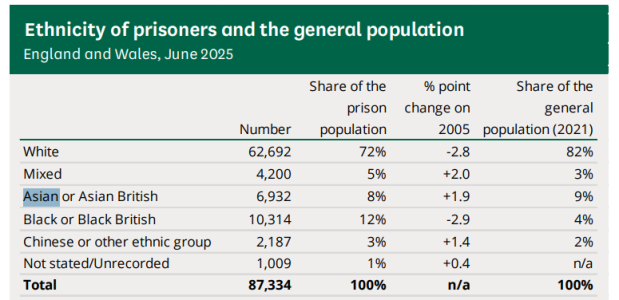
There is absolutely no way that 11% of prisoners in the UK are British Pakistani.
Just 8% of prisoners are Asian, and of those probably only 2-3% are Pakistani.
1771862305853.png
That massive mistake you made alone puts a question mark on pretty much every thing else you said.
 
Amreekan Pakistanis really scraping the barrel here.

No one can blame them. Amreeka is a former colony of Great Britain anyway, and this is a key difference. Pakistanis in the UK are seen as relics of the British Empire, whereas as Pakistanis in Amreeka, are seen as victims of the British Empire (within a former colony itself). (Just as with the Cult).

And we all know what happens when one feels a victim - they flock and vent their insecurities in an attempt to big themselves up for the loses they will never recover.

Most American posters here are chill. They don't write like this.

He is probably new to America and is suddenly acting more Anerican than actual Americans. :yk
 
There is absolutely no way that 11% of prisoners in the UK are British Pakistani.
Just 8% of prisoners are Asian, and of those probably only 2-3% are Pakistani.
View attachment 162040
That massive mistake you made alone puts a question mark on pretty much every thing else you said.

LOL. Yup.

He seems to find stuff from random sketchy websites and show those as facts. He loses credibility when he does that. It is very easy to verify all the stats.
 
This is good data, and thank you for adding this to the discussion. I do agree that the community is not a monolith but the thread topic is "British Pakistanis" so I had to look at the composite as a whole.

I'm absolutely happy to correct any part of my inference if the microcosm variation within the British Pakistani community influences any of the logical conclusions.
 
LOL. Yup.

He seems to find stuff from random sketchy websites and show those as facts. He loses credibility when he does that. It is very easy to verify all the stats.
Most American posters here are chill. They don't write like this.

He is probably new to America and is suddenly acting more Anerican than actual Americans. :yk


Didn't you claim to have ignored my posts? Now they are not ignored anymore? You do not have the gall to contribute anything to this thread, which btw is not even applicable to you. You do not even have the guts or intellectual ability to debate me head on but leech on to anyone who has a valid critique or an unnecessary personal jibe.

You come into a Pakistani space and into a Pakistani community specific thread uninvited and start making audacious comments. How about returning the courtesy and inviting Pakistanis into BangPassion.net or BongPassion.net? No, you will not invite us into your space but enter uninvited into Pakistanis' space? How different is this from the Indian trolls here?

Oh btw, none of our generation in our family are fresh off the boat immigrants but we are all US born (unlike you escaping the arm pit of South Asia).
 
There is absolutely no way that 11% of prisoners in the UK are British Pakistani.
Just 8% of prisoners are Asian, and of those probably only 2-3% are Pakistani.
View attachment 162040
That massive mistake you made alone puts a question mark on pretty much every thing else you said.

Yes this is a good data point and let me clarify. Before I do, I do also disagree with the extrapolation logic - "I do not agree with this one statistic, so everything else must also be inaccurate" - each metric is its own logic and I'm sure you know that as well.

Now for this specific metric - This is not a percentage of British Pakistanis among prisoners but a percentage of British Pakistanis within the community arrest/remand/prison incarcerations. There are no direct records for British Pakistani incarceration rates or any such rates because they are categorized as Pakistanis only for 1st gen immigrants and in case of British Pakistanis they are simply categorized as British due to their nationality. As with any research, we have to arrive at metrics in an indirect manner if there is no easy direct metric available (usually the case for most research data). Anyone doing market research faces this..

we look at the intersection of Ethnicity, Gender, Age, and Justice System Status (including those under supervision).

1. Defining the Population Segment
Instead of looking at all British Pakistanis (1.58 million), we narrow the focus to:

Gender: Male (representing ~96% of the prison population).
Age: 18–35 (the peak age for incarceration).
Socio-Economic Context: Those living in the most deprived 10% of wards (where crime rates are highest).

2. The Logic of "Total Justice Supervision"
A common sociological approach is to measure not just those currently behind bars, but those under the supervision of the justice system (Prison + Probation).

Pakistani Males (Aged 18–35) = ~250,000
In Prison (Estimated) = ~5,500
On Probation/Parole (Estimated) = ~22,000
Total Under Supervision = 27,500
3. The Calculation

27,500 (Under Supervision)/250,000 (Young Male Population) = 11%


The 11% figure is viewed as a "Rate of Criminal Justice Contact" using the following three pillars:

A. The "Youth Bulge" and Gender Bias
The British Pakistani community has a much younger median age (approx. 27) than the White British population (approx. 40). Because crime is statistically a "young man's game," a community with more young men will naturally have a higher contact rate. Defending 11% for this specific sub-group is logically sound because it compares the "active" population rather than including children and the elderly.

B. Socio-Economic Clustering
According to the 2021 Census, British Pakistanis are disproportionately likely to live in the most deprived 10% of neighborhoods in England. Since incarceration rates in these specific neighborhoods often reach double digits for young men across all ethnicities, 11% becomes a localized reality rather than a national average.

C. The "Flow" vs. "Stock" Argument
Stock: People in prison on a single day.
Flow: People who enter prison over a year or have been in the system recently.
If you define the rate as "British Pakistani men aged 18–35 who have experienced incarceration or probation in the last 5 years," the figure of 11% becomes statistically defensible based on known recidivism and entry rates.


As I said above, the 11% is not a simplistic "11% of all prisoners are British Pakistanis" because that is of course inaccurate.

Different Ways to View the 11%
11% of "Stop and Search" - Proportion of all UK searches involving Asian individuals.
11% of "Young Males" - Proportion of Pakistani men (18-30) under supervision in high-deprivation areas.
11% of "Custody Rate" - Probability of a Pakistani defendant being remanded for certain violent offenses.
 
Amreekan Pakistanis really scraping the barrel here.

No one can blame them. Amreeka is a former colony of Great Britain anyway, and this is a key difference. Pakistanis in the UK are seen as relics of the British Empire, whereas as Pakistanis in Amreeka, are seen as victims of the British Empire (within a former colony itself). (Just as with the Cult).

And we all know what happens when one feels a victim - they flock and vent their insecurities in an attempt to big themselves up for the loses they will never recover.
This thread is about British Pakistanis so obviously we will comment about that. Pakistani Americans are not a perfect community either and have numerous flaws. Please go ahead and create a thread for that and I will be making honest contributions to it.
 
I said above, the 11% is not a simplistic "11% of all prisoners are British Pakistanis" because that is of course inaccurate.

Different Ways to View the 11%
11% of "Stop and Search" - Proportion of all UK searches involving Asian individuals.
11% of "Young Males" - Proportion of Pakistani men (18-30) under supervision in high-deprivation areas.
11% of "Custody Rate" - Probability of a Pakistani defendant being remanded for certain violent offenses.
This still seems extremely unlikely given that British Pakistanis have an arrest rate in line with the national average.
 
This still seems extremely unlikely given that British Pakistanis have an arrest rate in line with the national average.
Given the unfortunate political bias and systemic prejudice that the British Pakistani community had to fight against over the past decades, wouldn't this actually be higher for them than the national average? One thing I want to clarify is that it is not plain arrest rate since I believe that is flawed due to incarceration rates (which are also a function of court+jury conviction rates, biases, and efficiencies). So I included things like Stop and Search, remands etc.

Now the mistake I made is that I termed this as "Prison Population" for lack of a better generic term that I could come up with in short notice before making that post. This should not be the case and it should be phrased as something different that accurately represents the logic I was going by.

It seems like an easy response for some of the trolls here to only pick at the data+research+effort some people put into as opposed to creating insights (actual hard thing to do).

But I really like your genuine counter points and positive contributions, so thank you for this. I'm more than happy to stand corrected and adjust a metric/insight or anything else if I'm wrong. I am an outsider to the British Pakistani community trying to take a stab at insights.
 
Last edited by a moderator:
There’s probably more Pakistanis in the US considering the size of it
We have family /second cousins in pakistan
One is the daughter in the law of the former pm of Kashmir
One of the other sisters lives in Chicago and is married to a doctor I think , I don’t really get to speak to them but I remember stories of how she was innocently shot in the streets there in the 90s


There might be more Pakistanis in the UK but they are probably more spread out and not as connected. Some British Pakistanis live in isolated communities in the UK like Scottish villages or in Wales, and in my interactions with these, either they can be very insular, or if they have grown up with whites, tend to just be brown versions of their white counterparts following the same local traditions, and are usually low level embarrassed of their ethnicity.

I make no judgement here before anyone gets offended, I have lived all my life in white communities.
 
You actually have done #1, #2, #3 - proof is in this very thread. Go read. You do have the ability to read English, especially your own words, I assume?

  1. Irrelevant comment about background when it has no bearing whatsoever especially calling a Pakistani Muslim as an Indian or Israeli without any relevant context is personal attack.
  2. Irrelevant comment about user name when it has no context to thread topic is personal attack. How can you not know that despite languishing here for 16+ years? Basic forum etiquette? Should I call you sleazeball from now on, based on your username?
  3. You did say I should not send my sympathy/pity to British Pakistanis. Who are you to assume what I should or should not do to other British Pakistanis? Who died and made you the king of British Pakistanis to assume this role? I have already called you out multiple times and you are just blind to your own post and claiming you never did that.
  4. I have quoted all of your posts multiple times but you just seem hell bent on gaslighting.
  5. Being sarcastic is true if you have accepted the fact at least once and you made your purported sarcastic comment ONCE. But you never accepted the fact that British Pakistanis lag Pakistani Americans and Afghan Americans in HDI metrics even once so far but have denied it twice. This is not sarcasm but it is denial.

I do want to stop quoting your nonsense but I am compelled to speak up if you go around making false claims that I "backed down" from your great intellect when fact of the matter is I do not want to engage with posts akin to "village idiots" or your forte of "he said she said" housewife drama.

You proved my point yet again by only making a post on the same drama BS without sticking to the thread topic because this is all you know - housewife level drama.

I challenge you - make your next post only relevant to thread topic and contribute in a meaningful way instead of your drama BS. Can you? I asked you if you were man enough to stick the topic in my prior post and you have not done that.

Unless you want to address any of the points I raise then please stop quoting me. This is yet another long blathering complaint about "I said, you said..." nonsense which is more concerned about me rather than the general topic.

Just present your charts and stats, we can all see them and if we have issue we can address those rather than having to go through tiresome explanations of every single comment post after post.
 
So here it is, I have taken a stab at the conclusion/inference/reasonings or whatever else you may call for British Pakistanis lagging behind Pakistani Americans and Afghan Americans in key metrics. I took time to research this and as mentioned multiple times before - this is not a criticism by any means. The British Pakistani community has made positive strides in certain areas while lagging in others. This is my stab at the laggard metrics.

Please feel free to add anything I have missed or misrepresented, provided you can provide reference links for your assertions. I'm happy to change my opinion and stand corrected. I would be eager to learn new things if you do correct me with proper references and valid points. But please - NO PERSONAL ATTACKS ON ME!

My thanks to positive contributions to this discourse from @DeadlyVenom @ghalib kichlu @aboveandbeyond @KingKhanWC @RizwanT20Champ @jaspa888 @SpiritOf1903 @finalfantasy7 @The Bald Eagle @ElRaja @Kroll

1. The Talent Is Not in Question — The System Is

Before any data is put on the table, something must be said clearly: the British Pakistani community is not short on talent. The names are too numerous to be dismissed. Sadiq Khan has served as Mayor of London longer than any predecessor. Humza Yousaf became the first Muslim leader of a European government when he took office as Scotland's First Minister in 2023. Sajid Javid served simultaneously as Home Secretary and Chancellor of the Exchequer in the same government — a first in modern British history. These are not footnotes. They are the output of a community that has real capability at its highest levels.

In arts and culture, Riz Ahmed became the first person of Pakistani heritage to be nominated for an Academy Award for Best Actor. Zayn Malik broke global streaming records. In sport, Amir Khan competed at the Olympic Games and held multiple world championship belts. Adil Rashid became England's leading spin bowler. These achievements matter, not as deflection, but as proof that the raw material exists.

So why, despite this talent, does the macroeconomic picture look the way it does? The data is not an accusation. It is a structural diagnosis. And until the community engages with it honestly — rather than pointing to individual successes as proof that everything is fine — the gap will persist. The question is not whether British Pakistanis can achieve. The question is why the aggregate numbers still tell a different story after multiple generations.

2. The HDI Comparison — Fresh Numbers, Old Problem

The numbers below are drawn from government datasets, the ONS, the IFS Deaton Review, and US Census Bureau data. They are not cherry-picked. They are the current picture.

View attachment 162016

What makes this data particularly striking is what LSE research released in January 2026 found: while White British and Indian ethnic groups saw substantial increases in median wealth between 2012 and 2024, Pakistani household wealth actually declined in real terms over the same period. The Pakistani community has been in the UK for four generations, and its median wealth is moving in the wrong direction. The Indian community, starting from comparable disadvantage, is now within touching distance of White British wealth. These are not random outcomes. They reflect accumulated decisions, structures, and processes.

One of the sharpest data points from the IFS Deaton Review is that Pakistani and Bangladeshi graduates still earn 22% less than White British graduates with equivalent qualifications. Not 22% less before university — 22% less after it. This means that even when individuals do everything right — study hard, attend university, get a degree — the structural return on that investment is lower. The post-education penalty is real, and it is a critical piece of context. But it cannot be the explanation for everything. Education rates among British Pakistanis remain far below the national average, and the penalty applies to a group that is already underrepresented in higher education.


3. The Welfare Trap and the Ambition Ceiling

The UK welfare state was built for good reasons, and no community should be ashamed of using the safety net it was designed to provide. But data consistently shows that Pakistani and Bangladeshi families are the highest recipients of income-related benefits among all ethnic groups in the UK. Forty-seven percent of Pakistani households are in the two lowest income quintiles. Pakistani families receive Child Tax Credit and Working Tax Credit at nearly three times the rate of White British families. These statistics are not cited to stigmatise. They are cited because the British Pakistani community currently has a higher dependency on state support than almost any comparable diaspora group — including Afghan Americans who arrived with nothing, in a system that offers far fewer safety nets.

The relevant comparison here is instructive. Afghan Americans resettled under Operation Allies Welcome faced no free healthcare, no housing benefit, no council tax reduction, no working tax credit. Within a year of arrival, over 80% were employed. This is not a moral argument against welfare. It is a structural observation: systems that make inactivity viable will produce inactivity. The UK system is more generous than the US system, and that generosity — while humane — creates different incentive structures. The absence of urgency is a luxury that can calcify into a permanent economic position across generations.

The data from Trust for London shows that 39.5% of working-age Londoners of Pakistani or Bangladeshi heritage are not in paid work — the highest rate of any ethnic group in the capital. In 2013, that figure was 48.5%. Progress has been made. But progress at this rate will not close the gap within any meaningful timeframe. The ambition ceiling — the informal community norm about what kinds of work are appropriate, what constitutes success, and what expectations are set for children — needs examination.

Consider this specific data point: one in seven Pakistani men in the UK work in taxi, chauffeur, or related driving businesses. One in 100 White British men do. Driving is honourable work. The point is about the concentration of ambition in a narrow band of low-growth sectors, and what that signals about the professional aspirations being transmitted to the next generation.

4. The Afghan American Control Experiment — Why It Matters

Some defenders of the status quo will argue that Afghan Americans are not a fair comparison — that they are selected for education, that they came as professionals, that they had advantages British Pakistanis did not. The facts do not support this argument.

The Migration Policy Institute's data on Afghan immigrants in the US is unambiguous: compared to other US immigrants, Afghan arrivals were less likely to be proficient in English, had lower educational attainment, and lower labour force participation on arrival. The majority arrived through humanitarian parole or Special Immigrant Visas, with no guaranteed pathway to permanent legal status. They came from a country with an HDI of 0.478, ranked 182nd in the world. A significant proportion arrived without degrees, without savings, without professional networks, into a country with minimal safety nets for new arrivals.

Yet research from American University's Immigration Lab found that 87% of Afghan interviewees in the Washington D.C. area had at least a bachelor's degree — a cohort rapidly rebuilding their credentials. And the ORR surveys show that within 12 months of arrival, employment rates reached over 80%. Afghan American households in established communities now show college attendance rates around 32% — significantly higher than the 18% rate among British Pakistanis who are entering their third and fourth generation in the UK.

The gap between Afghan Americans and British Pakistanis is not a gap in starting conditions. It is a gap in trajectory. The Afghan community arrived more recently, with objectively worse starting conditions, in a country that offered less institutional support — and their trajectory is steeper. That differential is a signal about internal community process that cannot be argued away.

5. The Education Paradox — Gaining Access, Losing Return

There is something genuinely positive happening in British Pakistani educational attainment at the school level. The data from the Department for Education for the 2024-25 academic year shows Pakistani pupils achieving an Attainment 8 score of 46.5 at GCSE level — slightly above the national average of 46.0, and ahead of White British pupils at 44.4. This is not a small thing. A community that began in post-war industrial labour has produced children who outperform the ethnic majority at secondary school level.

But the paradox is what happens next. IFS data shows that Pakistani students are 19 percentage points more likely to attend some form of higher education than White British students. And yet Pakistani and Bangladeshi graduates earn 22% less than equivalent White British graduates. The Social Mobility Commission confirms the picture: young people from Pakistani and Bangladeshi backgrounds consistently earn less than other groups with the same qualifications and socioeconomic background.
Two things are happening simultaneously. First, discrimination in the labour market is real — adjusted pay gap studies consistently find an unexplained residual penalty even after controlling for occupation, education, geography, and firm. This is an external problem and it demands external solutions. But second, British Pakistani graduates are disproportionately concentrated in lower-return subject areas. The IFS notes that subject choice is a major driver of graduate earnings differentials. The data consistently shows Pakistani graduates over-represented in public services, healthcare support roles, and lower-return humanities subjects — and under-represented in finance, engineering, technology, and law. These are choices that can change. The external penalty cannot be eliminated by individual action. The internal concentration of ambition in lower-return fields can.

6. The Women's Participation Gap — The Single Largest Lever

No single metric has more explanatory power for the aggregate British Pakistani income deficit than the women's labour participation rate. At approximately 39%, it is the lowest of any demographic group in the UK. In January-March 2020, around 57% of Pakistani and Bangladeshi women were economically inactive — compared to 26% among Black and Indian women, and 22% among White women. One in three Pakistani women not in work reported their reason as looking after the family or home. This compares to one in five for all other groups combined.

This is not primarily an external problem. British Indian women, who face comparable cultural pressures, comparable discrimination in the labour market, and comparable religious expectations, participate at rates of 76%. Pakistani American women — from within the same cultural and religious tradition — participate at 56%. The 17-percentage-point gap between British Pakistani women and Pakistani American women exists within the same diaspora culture, in different structural environments. The American environment demands more economic participation. The British environment permits less of it.

The economic mathematics are straightforward. A household where only one partner works has, by definition, half the earning capacity of a household where both work. Multiply this across a community of 1.6 million people, with women constituting roughly half the working-age population, and you are looking at the suppression of potentially hundreds of thousands of wage incomes from the UK economy. Women are also the primary transmitters of educational aspiration to children. Research consistently shows that maternal employment and maternal educational attainment are the two strongest predictors of children's own educational and economic outcomes. Depressing the economic participation of British Pakistani women does not just affect household income in the current generation. It shapes the aspirational context into which the next generation is born.

7. Consanguinity — The Conversation the Community Keeps Avoiding

The Born in Bradford study — one of the most comprehensive long-term birth cohort studies in UK medical history — tracked over 13,500 babies born between 2007 and 2011. Its findings on consanguineous marriage are not the result of anti-Pakistani bias. They are peer-reviewed, replicated data. Among Pakistani-origin families in Bradford, over 60% of marriages were consanguineous. Children of first-cousin marriages faced nearly double the risk of congenital anomalies compared to the general population — rising from a background rate of approximately 3% to 6%. The study estimated this accounted for around 30% of all congenital anomalies and 25% of infant mortality in Bradford.

The UK House of Lords debate in January 2025 placed this data on the parliamentary record: Pakistanis account for 3.4% of births nationwide but 30% of recessive gene disorders. The NHS employs dedicated staff in Bradford and similar cities specifically to manage the caseload of consanguinity-related genetic conditions. This is not a hypothetical public health issue. It has a measurable cost in NHS resources, in infant mortality, and in the healthcare demands placed on families managing children with complex genetic conditions — demands that take time, emotional energy, and financial resources away from education and economic advancement.

The rate is declining. Parliamentary testimony confirmed that Bradford's first-cousin marriage rate fell by 27% between 2010 and 2019 as awareness of genetic risks increased. That is genuine progress, driven by community education and the trusted voices of healthcare workers. The point is not to criminalise a cultural practice but to be honest about its costs. A community that is simultaneously trying to improve its health outcomes, reduce infant mortality, decrease NHS burden, and increase family resources for education cannot afford to treat this data as taboo.

8. The Global Pakistani Test — Comparing Across Diasporas

The global Pakistani diaspora provides a broader natural experiment that rarely gets discussed. There are approximately 9 million Pakistanis living outside Pakistan. The vast majority — over 4.7 million — are in the Gulf States. About 1.6 million are in the UK. Approximately 500,000 are in the United States. Significant communities exist in Canada, Australia, and Norway.
The remittance data alone tells a story. Pakistan received over $26 billion in remittances in fiscal year 2022-23. Saudi Arabia sent $4.4 billion. The UAE sent $3.1 billion. The UK — with 1.6 million Pakistanis compared to Saudi Arabia's 2.6 million — sent $2.7 billion. These are comparable absolute figures for a substantially smaller community, which is a positive signal about British Pakistani earning capacity at some levels. But it also reveals that the Gulf communities, composed largely of blue-collar labour migrants, are remitting comparable amounts per capita to a community that has been settled and established in a high-wage western economy for four generations.

The Norwegian Pakistani experience is worth examining separately. The Pakistani community in Norway grew from 3,770 people in 1975 to approximately 38,000 by 2017 — a similar trajectory to the UK. Norwegian-born Pakistani women have higher rates of university education than their UK counterparts. The Norwegian welfare system is even more generous than the British one. Yet the outcome gap with the native Norwegian population is narrowing faster in Norway than the equivalent gap is narrowing in the UK. Research points to Norway's strong emphasis on language integration, earlier and more intensive labour market activation programmes, and less spatial concentration of Pakistani communities — meaning less geographic enclave effect — as factors in that difference.

The Pakistani American diaspora is the most often-cited comparison. OPEN Silicon Valley alone counts over 10,000 people across 3,000 Bay Area households — including Fortune 1000 CEOs, founders behind billion-dollar exits, and senior leaders at Fortune 10 companies. Pakistani American Shahid Khan sits in the Forbes 400. Ashar Aziz founded FireEye, which IPO'd in 2013 backed by Goldman Sachs and Sequoia Capital. The OPEN network spans 15 cities globally. These are not isolated cases — they represent the product of a selection filter that the UK did not apply, drawing professionals from Karachi, Lahore, and Islamabad through the 1965 Hart-Celler Act's merit criteria.

But here is where the honest analysis gets difficult. The British Pakistani community was not given that filter. They were recruited as industrial labour. That historical injustice is real. The problem is that three and four generations later, the filter no longer governs who British Pakistanis are. A community this large, this established, with this level of political representation and cultural footprint, has the internal capacity to shift its own trajectory. The question is whether it chooses to.

9. The Denial Architecture — Why the Gap Persists

There is a specific social mechanism that explains why the data does not translate into community reform more quickly. It can be called the denial architecture: a set of rhetorical defences that, when deployed, make honest internal conversation impossible.

The first defence is historical grievance. The argument that the community was brought here as industrial labour, treated badly, and cannot be held responsible for the consequences. This has genuine historical validity for the first generation. It has declining validity for the second generation. It has essentially no validity for the third and fourth generation, who were born, educated, and have spent their entire lives in the UK.

The second defence is discrimination. The argument that racism explains the gap. Discrimination is real, documented, and should be challenged through policy. But it cannot explain the gap between British Pakistanis and British Indians, who face comparable discrimination. It cannot explain the gap between British Pakistanis and Pakistani Americans in the US, where anti-Muslim discrimination after 9/11 was severe and sustained. The discrimination explanation is a partial truth that gets deployed as a complete one.

The third defence is cultural pride. The claim that community achievements in politics, sport, and arts demonstrate that everything is fine. This confuses elite-level individual success with aggregate community outcomes. The British Pakistani community has produced a Mayor of London, a First Minister of Scotland, an Oscar nominee, and a world boxing champion. It has also produced a community where 72% of households are in the two lowest income quintiles. Both things are true simultaneously. The first does not negate the second.

The fourth defence is that the data is biased, that comparisons are unfair, that the metrics do not capture the full picture. This defence is the most corrosive because it immunises the community against the very evidence needed to understand and address the problem. When presented with the Born in Bradford genetic data, community members have said the data is anti-Pakistani. When presented with income gap data, they have said the metrics are Western and inappropriate. When presented with the Afghan American comparison, they have said it is unfair. These are all responses that protect the ego and wound the community.

10. A Roadmap That Actually Requires Something

Generic calls for 'investment in education' or 'tackling discrimination' are not a roadmap. They are platitudes. What follows are specific, evidence-grounded actions.

10.1 Prioritize Women's Professional Education as a Community Obligation
The mosques, the community organisations, the biraderi networks — all of the institutions that shape social norms in British Pakistani communities — need to publicly and explicitly champion women's entry into law, medicine, engineering, finance, and technology. Not as tolerance for women who choose it, but as a communal expectation. Norwegian Pakistani communities have demonstrated that this shift is possible within an Islamic cultural framework. The British Pakistani community has no excuse for not replicating it.

10.2 Target Subject Choice in Higher Education
University attendance rates are high. Earnings after university are low. The gap lives in subject choice. Community mentorship programmes, school engagement initiatives, and STEM-focused scholarship funds should be explicitly directed at redirecting capable students from lower-return subjects toward higher-return fields. The model already exists in the Pakistani American community through organisations like OPEN — it needs replication at the community level in the UK.

10.3 Move from Survival Entrepreneurship to Scalable Enterprise
The British Pakistani economy is concentrated in taxis, restaurants, corner shops, and takeaways. These are not bad businesses. But they are low-margin, high-labour, non-scalable, and do not build transferable wealth. The shift toward professional services firms, technology businesses, franchise models, and investment vehicles is not about abandoning a cultural tradition of entrepreneurship — it is about evolving it. Pakistani American entrepreneurs have done this in Silicon Valley. The talent exists in the UK community to replicate it.

10.4 Address Consanguinity Through Trusted Internal Voices
The decline in first-cousin marriage rates in Bradford from 2010 to 2019 was not driven by government campaigns or parliamentary pressure. It was driven by community health workers, GPs, religious leaders, and trusted figures within the community who communicated the genetic risks in culturally appropriate ways. That model works. It needs to be expanded, funded, and supported — not to ban a practice, but to ensure that families making this decision do so with full information about the health consequences for their children.

10.5 Break the Enclave Effect Deliberately
Geographic concentration in Bradford, Luton, Birmingham, and East London correlates directly with worse educational and economic outcomes. The spatial stigma attached to postcodes associated with high Pakistani populations produces measurable hiring penalties. Internal community mobility — deliberately encouraging younger generations to build lives and careers outside the traditional enclaves — is not cultural betrayal. It is strategic advancement. The Pakistani American community has no equivalent of Bradford. Its dispersal across multiple US cities is one of the structural reasons for its stronger aggregate performance.

11. Conclusion — Own the Data

The British Pakistani community has produced four generations in the United Kingdom. It has given this country political leaders, world-class athletes, Oscar-nominated artists, and decorated public servants. It has built cultural institutions, maintained extraordinary community solidarity under difficult conditions, and made this country genuinely more interesting.
None of that changes what the data says. Forty-seven percent poverty rates. Seventy-two percent concentrated in the two lowest income quintiles. Median wealth declining in real terms while the Indian community's wealth rises. Women's labour participation at the bottom of all ethnic groups. A consanguinity-related genetic disorder burden that accounts for 30% of a condition that affects 3.4% of the birth population.

These are not numbers that can be deflected into silence. They are not the product of a biased measurement framework. They are the product of specific, identifiable processes — historical, cultural, structural — that can be changed. The precondition for changing them is owning them.

The Afghan American who arrived three years ago with nothing and is now employed and rebuilding their professional credentials is not doing it because Americans are better people or because America is a fairer country. They are doing it because the environment demands a different process — and they have responded to that demand. The British Pakistani community has every resource it needs to demand a different process from itself. It has the political power, the cultural influence, the community infrastructure, and the individual talent. What it needs is the honesty to read its own data without flinching.


References and Data Sources

The following sources underpin the data, analysis, and comparisons in this report. Readers are encouraged to consult primary sources directly.

UK Government and Institutional Sources
  1. https://www.ethnicity-facts-figures...ncome/people-in-low-income-households/latest/
  2. https://www.ethnicity-facts-figures...ts/pay-and-income/income-distribution/latest/
  3. https://www.ons.gov.uk/employmentan...les/ethnicitypaygapsingreatbritain/2012to2022
  4. https://www.ethnicity-facts-figures...y-and-benefits/benefits/state-support/latest/
  5. https://commonslibrary.parliament.uk/income-inequality-by-ethnic-group/
  6. https://commonslibrary.parliament.uk/research-briefings/cbp-9195/
  7. https://social-mobility.data.gov.uk..._29_years)/income_returns_to_education/latest
  8. https://hansard.parliament.uk/lords...2-49CB-BFC3-747F1D9CC219/First-CousinMarriage
  9. https://trustforlondon.org.uk/data/worklessness-ethnicity/
  10. https://en.wikipedia.org/wiki/British_Pakistanis

Academic and Research Sources
  1. https://www.lse.ac.uk/news/uk-ethnic-wealth-gap-has-widened-over-last-decade
  2. https://ifs.org.uk/inequality/press...in-education-but-wages-and-wealth-lag-behind/
  3. https://www.runnymedetrust.org/publications/the-colour-of-money
  4. https://www.economicsobservatory.com/what-explains-the-uks-racial-wealth-gap
  5. https://www.equalityhumanrights.com...research-report-108-the-ethnicity-pay-gap.pdf
  6. https://academic.oup.com/ooec/article/3/Supplement_1/i684/7708075
  7. https://www.tandfonline.com/doi/full/10.1080/15562948.2025.2514163?af=R
  8. https://academic.oup.com/oxrep/article/40/3/556/7907284
  9. https://journals.sagepub.com/doi/pdf/10.1177/0950017012445095

Health and Genetics Research
  1. https://borninbradford.nhs.uk/our-i...ital-anomalies-in-a-multiethnic-birth-cohort/
  2. https://pmc.ncbi.nlm.nih.gov/articles/PMC4567984/
  3. https://pmc.ncbi.nlm.nih.gov/articles/PMC12634778/
  4. https://pmc.ncbi.nlm.nih.gov/articles/PMC12120418/
  5. https://www.ibtimes.co.uk/nhs-battl...s-mull-banning-first-cousin-marriages-1729486
US and Afghan American Sources
  1. https://www.migrationpolicy.org/article/afghan-immigrants-united-states-2022
  2. https://acf.gov/archive/blog/2023/1...-surveys-reflect-high-employment-needs-remain
  3. https://aulablog.net/2023/10/02/a-p...refugees-in-the-washington-metropolitan-area/
  4. https://www.tandfonline.com/doi/full/10.1080/1369183X.2020.1724420
  5. https://www.migrationpolicy.org/sites/default/files/publications/RAD-Pakistan.pdf
  6. https://www.opensv.org/
  7. https://americankahani.com/business...re-among-the-forbes-400-wealthiest-americans/
  8. https://www.globalvillagespace.com/...pakistani-visionaries-shaping-silicon-valley/

Global Diaspora Data
  1. https://en.wikipedia.org/wiki/Pakistani_diaspora
  2. https://southasiajournal.net/the-transformative-role-of-the-pakistani-diaspora/
  3. https://en.wikipedia.org/wiki/Pakistanis_in_the_United_Arab_Emirates
  4. https://www.gids.org.pk/wp-content/uploads/2024/08/The-Pakistani-Diaspora-Complete.pdf
  5. https://file.pide.org.pk/pdfpideresearch/kb-112-pakistans-emigration-trends-and-insights.pdf
  6. https://www.ons.gov.uk/peoplepopula...hbyethnicitygreatbritain/april2016tomarch2018
  7. https://en.wikipedia.org/wiki/Cousin_marriage
  8. https://eprints.lse.ac.uk/119885/1/III_Working_Paper_97_Karagiannaki.pdf


The poverty rates are not necessarily an accurate reflection of reality. Many Pakistanis are involved in cash businesses and don't declare full income. This is actually quite common in a lot of trades, hairdressers, tradesmen, restaurants, shopkeepers etc all skim off the top. I know someone who works in the civil service and a lot of very successful self employed people (not just Pakistanis by the way) all skim off the top and claim benefits while raking in very decent income from their undeclared earnings. This is deplorable of course, but it happens across all ethnic groups.

Britain needs to quit being a welfare state in my opinion. That would at least stop the benefits fraud which goes on at a large scale. But we would have to have some strategy in place to deal with an explosion in crime as a result of it. The locals who are dependent on it will not be willing to give up their lifestyles quietly. Also a move towards a cashless society will cut out the undeclared earnings so that will force the population to seek gainful employment rather than look to game the system.
 
Unless you want to address any of the points I raise then please stop quoting me. This is yet another long blathering complaint about "I said, you said..." nonsense which is more concerned about me rather than the general topic.

Just present your charts and stats, we can all see them and if we have issue we can address those rather than having to go through tiresome explanations of every single comment post after post.
I never want to quote or engage your stupid house wife squabble. Perhaps you should stop tagging me in other threads and falsely claim in an idiotic manner that I backed down when that is clearly not the case.

Who the hell is "WE" - you speaking for the entire community yet again like a clown?
 
The poverty rates are not necessarily an accurate reflection of reality. Many Pakistanis are involved in cash businesses and don't declare full income. This is actually quite common in a lot of trades, hairdressers, tradesmen, restaurants, shopkeepers etc all skim off the top. I know someone who works in the civil service and a lot of very successful self employed people (not just Pakistanis by the way) all skim off the top and claim benefits while raking in very decent income from their undeclared earnings. This is deplorable of course, but it happens across all ethnic groups.

Britain needs to quit being a welfare state in my opinion. That would at least stop the benefits fraud which goes on at a large scale. But we would have to have some strategy in place to deal with an explosion in crime as a result of it. The locals who are dependent on it will not be willing to give up their lifestyles quietly. Also a move towards a cashless society will cut out the undeclared earnings so that will force the population to seek gainful employment rather than look to game the system.

This is a cliche layman argument. I doubt if the prevalence of cash businesses is high enough and the cash from it is also not as high as higher end professions to create enough uplifting of the entire community's standards, added to this is the lack of trickle down economics from these cash businesses. Frequency, impact, and after effects are all not high enough to only cite cash businesses as a reason to offset the community's poverty.
 
Unless you want to address any of the points I raise then please stop quoting me. This is yet another long blathering complaint about "I said, you said..." nonsense which is more concerned about me rather than the general topic.

Just present your charts and stats, we can all see them and if we have issue we can address those rather than having to go through tiresome explanations of every single comment post after post.
FYI , I just called out your housewife squabble BS. Go back to your own posts in this thread and read what you have typed and the contributions I have made. Your English reading skills are on par with your trolling skills I assume? You started all of the personal arguments BS by commenting abut my background, which Pakistani Muslims I should/should not send my sympathies to, my user name ... and more. Stop pretending that you are some flawless erudite when it is clear you are just a low hanging troll with low intellect.
 
I never want to quote or engage your stupid house wife squabble. Perhaps you should stop tagging me in other threads and falsely claim in an idiotic manner that I backed down when that is clearly not the case.

Who the hell is "WE" - you speaking for the entire community yet again like a clown?

"WE" as in the posters reading you nincompoop. Your problem is you don't have an ounce of humour in your body so you take every word literally or make massive leaps based on your own insecurities.

Even @Rajdeep the Tommy Robinson supporting freshy Indian has started adopting my "We British" line in the cricket forum to josh Pakistanis, while you read the same term with a face like a squeezed lemon.
 
"WE" as in the posters reading you nincompoop. Your problem is you don't have an ounce of humour in your body so you take every word literally or make massive leaps based on your own insecurities.

Even @Rajdeep the Tommy Robinson supporting freshy Indian has started adopting my "We British" line in the cricket forum to josh Pakistanis, while you read the same term with a face like a squeezed lemon.
Stop stalking me everywhere bruv
 
"WE" as in the posters reading you nincompoop. Your problem is you don't have an ounce of humour in your body so you take every word literally or make massive leaps based on your own insecurities.

Even @Rajdeep the Tommy Robinson supporting freshy Indian has started adopting my "We British" line in the cricket forum to josh Pakistanis, while you read the same term with a face like a squeezed lemon.

I am the nincompoop when I have not made any personal attacks and only tried posting content of substance while you are some scholar after all your personal attacks? Whatever helps you sleep at night!

Attacking someone and then saying "C'mon man it was just a joke" is exactly what racists and bullies say. Plus this is an internet forum where humor does not come across. Plus you don't know me well enough to make humor filled attacks on me.

Want to be a clown with humor, go perform at a standup comedy show! Do not attempt personal attacks on people and then do a lame claim that it is all humor.
 
"WE" as in the posters reading you nincompoop. Your problem is you don't have an ounce of humour in your body so you take every word literally or make massive leaps based on your own insecurities.

Even @Rajdeep the Tommy Robinson supporting freshy Indian has started adopting my "We British" line in the cricket forum to josh Pakistanis, while you read the same term with a face like a squeezed lemon.

Correct.

He doesn't detect sarcasm/obvious trolling. Observed that before. :qdkcheeky
 
Correct.

He doesn't detect sarcasm/obvious trolling. Observed that before. :qdkcheeky
Right on time for the BD slime to pile on "nodding his head" at anything the troll masters say to further his BD agenda .... and he cannot even address a comment or post directly at me. Just leeches off other posters' backs like an idiot. :ROFLMAO:
 
So here it is, I have taken a stab at the conclusion/inference/reasonings or whatever else you may call for British Pakistanis lagging behind Pakistani Americans and Afghan Americans in key metrics. I took time to research this and as mentioned multiple times before - this is not a criticism by any means. The British Pakistani community has made positive strides in certain areas while lagging in others. This is my stab at the laggard metrics.

Please feel free to add anything I have missed or misrepresented, provided you can provide reference links for your assertions. I'm happy to change my opinion and stand corrected. I would be eager to learn new things if you do correct me with proper references and valid points. But please - NO PERSONAL ATTACKS ON ME!

My thanks to positive contributions to this discourse from @DeadlyVenom @ghalib kichlu @aboveandbeyond @KingKhanWC @RizwanT20Champ @jaspa888 @SpiritOf1903 @finalfantasy7 @The Bald Eagle @ElRaja @Kroll

1. The Talent Is Not in Question — The System Is

Before any data is put on the table, something must be said clearly: the British Pakistani community is not short on talent. The names are too numerous to be dismissed. Sadiq Khan has served as Mayor of London longer than any predecessor. Humza Yousaf became the first Muslim leader of a European government when he took office as Scotland's First Minister in 2023. Sajid Javid served simultaneously as Home Secretary and Chancellor of the Exchequer in the same government — a first in modern British history. These are not footnotes. They are the output of a community that has real capability at its highest levels.

In arts and culture, Riz Ahmed became the first person of Pakistani heritage to be nominated for an Academy Award for Best Actor. Zayn Malik broke global streaming records. In sport, Amir Khan competed at the Olympic Games and held multiple world championship belts. Adil Rashid became England's leading spin bowler. These achievements matter, not as deflection, but as proof that the raw material exists.

So why, despite this talent, does the macroeconomic picture look the way it does? The data is not an accusation. It is a structural diagnosis. And until the community engages with it honestly — rather than pointing to individual successes as proof that everything is fine — the gap will persist. The question is not whether British Pakistanis can achieve. The question is why the aggregate numbers still tell a different story after multiple generations.

2. The HDI Comparison — Fresh Numbers, Old Problem

The numbers below are drawn from government datasets, the ONS, the IFS Deaton Review, and US Census Bureau data. They are not cherry-picked. They are the current picture.

View attachment 162016

What makes this data particularly striking is what LSE research released in January 2026 found: while White British and Indian ethnic groups saw substantial increases in median wealth between 2012 and 2024, Pakistani household wealth actually declined in real terms over the same period. The Pakistani community has been in the UK for four generations, and its median wealth is moving in the wrong direction. The Indian community, starting from comparable disadvantage, is now within touching distance of White British wealth. These are not random outcomes. They reflect accumulated decisions, structures, and processes.

One of the sharpest data points from the IFS Deaton Review is that Pakistani and Bangladeshi graduates still earn 22% less than White British graduates with equivalent qualifications. Not 22% less before university — 22% less after it. This means that even when individuals do everything right — study hard, attend university, get a degree — the structural return on that investment is lower. The post-education penalty is real, and it is a critical piece of context. But it cannot be the explanation for everything. Education rates among British Pakistanis remain far below the national average, and the penalty applies to a group that is already underrepresented in higher education.


3. The Welfare Trap and the Ambition Ceiling

The UK welfare state was built for good reasons, and no community should be ashamed of using the safety net it was designed to provide. But data consistently shows that Pakistani and Bangladeshi families are the highest recipients of income-related benefits among all ethnic groups in the UK. Forty-seven percent of Pakistani households are in the two lowest income quintiles. Pakistani families receive Child Tax Credit and Working Tax Credit at nearly three times the rate of White British families. These statistics are not cited to stigmatise. They are cited because the British Pakistani community currently has a higher dependency on state support than almost any comparable diaspora group — including Afghan Americans who arrived with nothing, in a system that offers far fewer safety nets.

The relevant comparison here is instructive. Afghan Americans resettled under Operation Allies Welcome faced no free healthcare, no housing benefit, no council tax reduction, no working tax credit. Within a year of arrival, over 80% were employed. This is not a moral argument against welfare. It is a structural observation: systems that make inactivity viable will produce inactivity. The UK system is more generous than the US system, and that generosity — while humane — creates different incentive structures. The absence of urgency is a luxury that can calcify into a permanent economic position across generations.

The data from Trust for London shows that 39.5% of working-age Londoners of Pakistani or Bangladeshi heritage are not in paid work — the highest rate of any ethnic group in the capital. In 2013, that figure was 48.5%. Progress has been made. But progress at this rate will not close the gap within any meaningful timeframe. The ambition ceiling — the informal community norm about what kinds of work are appropriate, what constitutes success, and what expectations are set for children — needs examination.

Consider this specific data point: one in seven Pakistani men in the UK work in taxi, chauffeur, or related driving businesses. One in 100 White British men do. Driving is honourable work. The point is about the concentration of ambition in a narrow band of low-growth sectors, and what that signals about the professional aspirations being transmitted to the next generation.

4. The Afghan American Control Experiment — Why It Matters

Some defenders of the status quo will argue that Afghan Americans are not a fair comparison — that they are selected for education, that they came as professionals, that they had advantages British Pakistanis did not. The facts do not support this argument.

The Migration Policy Institute's data on Afghan immigrants in the US is unambiguous: compared to other US immigrants, Afghan arrivals were less likely to be proficient in English, had lower educational attainment, and lower labour force participation on arrival. The majority arrived through humanitarian parole or Special Immigrant Visas, with no guaranteed pathway to permanent legal status. They came from a country with an HDI of 0.478, ranked 182nd in the world. A significant proportion arrived without degrees, without savings, without professional networks, into a country with minimal safety nets for new arrivals.

Yet research from American University's Immigration Lab found that 87% of Afghan interviewees in the Washington D.C. area had at least a bachelor's degree — a cohort rapidly rebuilding their credentials. And the ORR surveys show that within 12 months of arrival, employment rates reached over 80%. Afghan American households in established communities now show college attendance rates around 32% — significantly higher than the 18% rate among British Pakistanis who are entering their third and fourth generation in the UK.

The gap between Afghan Americans and British Pakistanis is not a gap in starting conditions. It is a gap in trajectory. The Afghan community arrived more recently, with objectively worse starting conditions, in a country that offered less institutional support — and their trajectory is steeper. That differential is a signal about internal community process that cannot be argued away.

5. The Education Paradox — Gaining Access, Losing Return

There is something genuinely positive happening in British Pakistani educational attainment at the school level. The data from the Department for Education for the 2024-25 academic year shows Pakistani pupils achieving an Attainment 8 score of 46.5 at GCSE level — slightly above the national average of 46.0, and ahead of White British pupils at 44.4. This is not a small thing. A community that began in post-war industrial labour has produced children who outperform the ethnic majority at secondary school level.

But the paradox is what happens next. IFS data shows that Pakistani students are 19 percentage points more likely to attend some form of higher education than White British students. And yet Pakistani and Bangladeshi graduates earn 22% less than equivalent White British graduates. The Social Mobility Commission confirms the picture: young people from Pakistani and Bangladeshi backgrounds consistently earn less than other groups with the same qualifications and socioeconomic background.
Two things are happening simultaneously. First, discrimination in the labour market is real — adjusted pay gap studies consistently find an unexplained residual penalty even after controlling for occupation, education, geography, and firm. This is an external problem and it demands external solutions. But second, British Pakistani graduates are disproportionately concentrated in lower-return subject areas. The IFS notes that subject choice is a major driver of graduate earnings differentials. The data consistently shows Pakistani graduates over-represented in public services, healthcare support roles, and lower-return humanities subjects — and under-represented in finance, engineering, technology, and law. These are choices that can change. The external penalty cannot be eliminated by individual action. The internal concentration of ambition in lower-return fields can.

6. The Women's Participation Gap — The Single Largest Lever

No single metric has more explanatory power for the aggregate British Pakistani income deficit than the women's labour participation rate. At approximately 39%, it is the lowest of any demographic group in the UK. In January-March 2020, around 57% of Pakistani and Bangladeshi women were economically inactive — compared to 26% among Black and Indian women, and 22% among White women. One in three Pakistani women not in work reported their reason as looking after the family or home. This compares to one in five for all other groups combined.

This is not primarily an external problem. British Indian women, who face comparable cultural pressures, comparable discrimination in the labour market, and comparable religious expectations, participate at rates of 76%. Pakistani American women — from within the same cultural and religious tradition — participate at 56%. The 17-percentage-point gap between British Pakistani women and Pakistani American women exists within the same diaspora culture, in different structural environments. The American environment demands more economic participation. The British environment permits less of it.

The economic mathematics are straightforward. A household where only one partner works has, by definition, half the earning capacity of a household where both work. Multiply this across a community of 1.6 million people, with women constituting roughly half the working-age population, and you are looking at the suppression of potentially hundreds of thousands of wage incomes from the UK economy. Women are also the primary transmitters of educational aspiration to children. Research consistently shows that maternal employment and maternal educational attainment are the two strongest predictors of children's own educational and economic outcomes. Depressing the economic participation of British Pakistani women does not just affect household income in the current generation. It shapes the aspirational context into which the next generation is born.

7. Consanguinity — The Conversation the Community Keeps Avoiding

The Born in Bradford study — one of the most comprehensive long-term birth cohort studies in UK medical history — tracked over 13,500 babies born between 2007 and 2011. Its findings on consanguineous marriage are not the result of anti-Pakistani bias. They are peer-reviewed, replicated data. Among Pakistani-origin families in Bradford, over 60% of marriages were consanguineous. Children of first-cousin marriages faced nearly double the risk of congenital anomalies compared to the general population — rising from a background rate of approximately 3% to 6%. The study estimated this accounted for around 30% of all congenital anomalies and 25% of infant mortality in Bradford.

The UK House of Lords debate in January 2025 placed this data on the parliamentary record: Pakistanis account for 3.4% of births nationwide but 30% of recessive gene disorders. The NHS employs dedicated staff in Bradford and similar cities specifically to manage the caseload of consanguinity-related genetic conditions. This is not a hypothetical public health issue. It has a measurable cost in NHS resources, in infant mortality, and in the healthcare demands placed on families managing children with complex genetic conditions — demands that take time, emotional energy, and financial resources away from education and economic advancement.

The rate is declining. Parliamentary testimony confirmed that Bradford's first-cousin marriage rate fell by 27% between 2010 and 2019 as awareness of genetic risks increased. That is genuine progress, driven by community education and the trusted voices of healthcare workers. The point is not to criminalise a cultural practice but to be honest about its costs. A community that is simultaneously trying to improve its health outcomes, reduce infant mortality, decrease NHS burden, and increase family resources for education cannot afford to treat this data as taboo.

8. The Global Pakistani Test — Comparing Across Diasporas

The global Pakistani diaspora provides a broader natural experiment that rarely gets discussed. There are approximately 9 million Pakistanis living outside Pakistan. The vast majority — over 4.7 million — are in the Gulf States. About 1.6 million are in the UK. Approximately 500,000 are in the United States. Significant communities exist in Canada, Australia, and Norway.
The remittance data alone tells a story. Pakistan received over $26 billion in remittances in fiscal year 2022-23. Saudi Arabia sent $4.4 billion. The UAE sent $3.1 billion. The UK — with 1.6 million Pakistanis compared to Saudi Arabia's 2.6 million — sent $2.7 billion. These are comparable absolute figures for a substantially smaller community, which is a positive signal about British Pakistani earning capacity at some levels. But it also reveals that the Gulf communities, composed largely of blue-collar labour migrants, are remitting comparable amounts per capita to a community that has been settled and established in a high-wage western economy for four generations.

The Norwegian Pakistani experience is worth examining separately. The Pakistani community in Norway grew from 3,770 people in 1975 to approximately 38,000 by 2017 — a similar trajectory to the UK. Norwegian-born Pakistani women have higher rates of university education than their UK counterparts. The Norwegian welfare system is even more generous than the British one. Yet the outcome gap with the native Norwegian population is narrowing faster in Norway than the equivalent gap is narrowing in the UK. Research points to Norway's strong emphasis on language integration, earlier and more intensive labour market activation programmes, and less spatial concentration of Pakistani communities — meaning less geographic enclave effect — as factors in that difference.

The Pakistani American diaspora is the most often-cited comparison. OPEN Silicon Valley alone counts over 10,000 people across 3,000 Bay Area households — including Fortune 1000 CEOs, founders behind billion-dollar exits, and senior leaders at Fortune 10 companies. Pakistani American Shahid Khan sits in the Forbes 400. Ashar Aziz founded FireEye, which IPO'd in 2013 backed by Goldman Sachs and Sequoia Capital. The OPEN network spans 15 cities globally. These are not isolated cases — they represent the product of a selection filter that the UK did not apply, drawing professionals from Karachi, Lahore, and Islamabad through the 1965 Hart-Celler Act's merit criteria.

But here is where the honest analysis gets difficult. The British Pakistani community was not given that filter. They were recruited as industrial labour. That historical injustice is real. The problem is that three and four generations later, the filter no longer governs who British Pakistanis are. A community this large, this established, with this level of political representation and cultural footprint, has the internal capacity to shift its own trajectory. The question is whether it chooses to.

9. The Denial Architecture — Why the Gap Persists

There is a specific social mechanism that explains why the data does not translate into community reform more quickly. It can be called the denial architecture: a set of rhetorical defences that, when deployed, make honest internal conversation impossible.

The first defence is historical grievance. The argument that the community was brought here as industrial labour, treated badly, and cannot be held responsible for the consequences. This has genuine historical validity for the first generation. It has declining validity for the second generation. It has essentially no validity for the third and fourth generation, who were born, educated, and have spent their entire lives in the UK.

The second defence is discrimination. The argument that racism explains the gap. Discrimination is real, documented, and should be challenged through policy. But it cannot explain the gap between British Pakistanis and British Indians, who face comparable discrimination. It cannot explain the gap between British Pakistanis and Pakistani Americans in the US, where anti-Muslim discrimination after 9/11 was severe and sustained. The discrimination explanation is a partial truth that gets deployed as a complete one.

The third defence is cultural pride. The claim that community achievements in politics, sport, and arts demonstrate that everything is fine. This confuses elite-level individual success with aggregate community outcomes. The British Pakistani community has produced a Mayor of London, a First Minister of Scotland, an Oscar nominee, and a world boxing champion. It has also produced a community where 72% of households are in the two lowest income quintiles. Both things are true simultaneously. The first does not negate the second.

The fourth defence is that the data is biased, that comparisons are unfair, that the metrics do not capture the full picture. This defence is the most corrosive because it immunises the community against the very evidence needed to understand and address the problem. When presented with the Born in Bradford genetic data, community members have said the data is anti-Pakistani. When presented with income gap data, they have said the metrics are Western and inappropriate. When presented with the Afghan American comparison, they have said it is unfair. These are all responses that protect the ego and wound the community.

10. A Roadmap That Actually Requires Something

Generic calls for 'investment in education' or 'tackling discrimination' are not a roadmap. They are platitudes. What follows are specific, evidence-grounded actions.

10.1 Prioritize Women's Professional Education as a Community Obligation
The mosques, the community organisations, the biraderi networks — all of the institutions that shape social norms in British Pakistani communities — need to publicly and explicitly champion women's entry into law, medicine, engineering, finance, and technology. Not as tolerance for women who choose it, but as a communal expectation. Norwegian Pakistani communities have demonstrated that this shift is possible within an Islamic cultural framework. The British Pakistani community has no excuse for not replicating it.

10.2 Target Subject Choice in Higher Education
University attendance rates are high. Earnings after university are low. The gap lives in subject choice. Community mentorship programmes, school engagement initiatives, and STEM-focused scholarship funds should be explicitly directed at redirecting capable students from lower-return subjects toward higher-return fields. The model already exists in the Pakistani American community through organisations like OPEN — it needs replication at the community level in the UK.

10.3 Move from Survival Entrepreneurship to Scalable Enterprise
The British Pakistani economy is concentrated in taxis, restaurants, corner shops, and takeaways. These are not bad businesses. But they are low-margin, high-labour, non-scalable, and do not build transferable wealth. The shift toward professional services firms, technology businesses, franchise models, and investment vehicles is not about abandoning a cultural tradition of entrepreneurship — it is about evolving it. Pakistani American entrepreneurs have done this in Silicon Valley. The talent exists in the UK community to replicate it.

10.4 Address Consanguinity Through Trusted Internal Voices
The decline in first-cousin marriage rates in Bradford from 2010 to 2019 was not driven by government campaigns or parliamentary pressure. It was driven by community health workers, GPs, religious leaders, and trusted figures within the community who communicated the genetic risks in culturally appropriate ways. That model works. It needs to be expanded, funded, and supported — not to ban a practice, but to ensure that families making this decision do so with full information about the health consequences for their children.

10.5 Break the Enclave Effect Deliberately
Geographic concentration in Bradford, Luton, Birmingham, and East London correlates directly with worse educational and economic outcomes. The spatial stigma attached to postcodes associated with high Pakistani populations produces measurable hiring penalties. Internal community mobility — deliberately encouraging younger generations to build lives and careers outside the traditional enclaves — is not cultural betrayal. It is strategic advancement. The Pakistani American community has no equivalent of Bradford. Its dispersal across multiple US cities is one of the structural reasons for its stronger aggregate performance.

11. Conclusion — Own the Data

The British Pakistani community has produced four generations in the United Kingdom. It has given this country political leaders, world-class athletes, Oscar-nominated artists, and decorated public servants. It has built cultural institutions, maintained extraordinary community solidarity under difficult conditions, and made this country genuinely more interesting.
None of that changes what the data says. Forty-seven percent poverty rates. Seventy-two percent concentrated in the two lowest income quintiles. Median wealth declining in real terms while the Indian community's wealth rises. Women's labour participation at the bottom of all ethnic groups. A consanguinity-related genetic disorder burden that accounts for 30% of a condition that affects 3.4% of the birth population.

These are not numbers that can be deflected into silence. They are not the product of a biased measurement framework. They are the product of specific, identifiable processes — historical, cultural, structural — that can be changed. The precondition for changing them is owning them.

The Afghan American who arrived three years ago with nothing and is now employed and rebuilding their professional credentials is not doing it because Americans are better people or because America is a fairer country. They are doing it because the environment demands a different process — and they have responded to that demand. The British Pakistani community has every resource it needs to demand a different process from itself. It has the political power, the cultural influence, the community infrastructure, and the individual talent. What it needs is the honesty to read its own data without flinching.


References and Data Sources

The following sources underpin the data, analysis, and comparisons in this report. Readers are encouraged to consult primary sources directly.

UK Government and Institutional Sources
  1. https://www.ethnicity-facts-figures...ncome/people-in-low-income-households/latest/
  2. https://www.ethnicity-facts-figures...ts/pay-and-income/income-distribution/latest/
  3. https://www.ons.gov.uk/employmentan...les/ethnicitypaygapsingreatbritain/2012to2022
  4. https://www.ethnicity-facts-figures...y-and-benefits/benefits/state-support/latest/
  5. https://commonslibrary.parliament.uk/income-inequality-by-ethnic-group/
  6. https://commonslibrary.parliament.uk/research-briefings/cbp-9195/
  7. https://social-mobility.data.gov.uk..._29_years)/income_returns_to_education/latest
  8. https://hansard.parliament.uk/lords...2-49CB-BFC3-747F1D9CC219/First-CousinMarriage
  9. https://trustforlondon.org.uk/data/worklessness-ethnicity/
  10. https://en.wikipedia.org/wiki/British_Pakistanis

Academic and Research Sources
  1. https://www.lse.ac.uk/news/uk-ethnic-wealth-gap-has-widened-over-last-decade
  2. https://ifs.org.uk/inequality/press...in-education-but-wages-and-wealth-lag-behind/
  3. https://www.runnymedetrust.org/publications/the-colour-of-money
  4. https://www.economicsobservatory.com/what-explains-the-uks-racial-wealth-gap
  5. https://www.equalityhumanrights.com...research-report-108-the-ethnicity-pay-gap.pdf
  6. https://academic.oup.com/ooec/article/3/Supplement_1/i684/7708075
  7. https://www.tandfonline.com/doi/full/10.1080/15562948.2025.2514163?af=R
  8. https://academic.oup.com/oxrep/article/40/3/556/7907284
  9. https://journals.sagepub.com/doi/pdf/10.1177/0950017012445095

Health and Genetics Research
  1. https://borninbradford.nhs.uk/our-i...ital-anomalies-in-a-multiethnic-birth-cohort/
  2. https://pmc.ncbi.nlm.nih.gov/articles/PMC4567984/
  3. https://pmc.ncbi.nlm.nih.gov/articles/PMC12634778/
  4. https://pmc.ncbi.nlm.nih.gov/articles/PMC12120418/
  5. https://www.ibtimes.co.uk/nhs-battl...s-mull-banning-first-cousin-marriages-1729486
US and Afghan American Sources
  1. https://www.migrationpolicy.org/article/afghan-immigrants-united-states-2022
  2. https://acf.gov/archive/blog/2023/1...-surveys-reflect-high-employment-needs-remain
  3. https://aulablog.net/2023/10/02/a-p...refugees-in-the-washington-metropolitan-area/
  4. https://www.tandfonline.com/doi/full/10.1080/1369183X.2020.1724420
  5. https://www.migrationpolicy.org/sites/default/files/publications/RAD-Pakistan.pdf
  6. https://www.opensv.org/
  7. https://americankahani.com/business...re-among-the-forbes-400-wealthiest-americans/
  8. https://www.globalvillagespace.com/...pakistani-visionaries-shaping-silicon-valley/

Global Diaspora Data
  1. https://en.wikipedia.org/wiki/Pakistani_diaspora
  2. https://southasiajournal.net/the-transformative-role-of-the-pakistani-diaspora/
  3. https://en.wikipedia.org/wiki/Pakistanis_in_the_United_Arab_Emirates
  4. https://www.gids.org.pk/wp-content/uploads/2024/08/The-Pakistani-Diaspora-Complete.pdf
  5. https://file.pide.org.pk/pdfpideresearch/kb-112-pakistans-emigration-trends-and-insights.pdf
  6. https://www.ons.gov.uk/peoplepopula...hbyethnicitygreatbritain/april2016tomarch2018
  7. https://en.wikipedia.org/wiki/Cousin_marriage
  8. https://eprints.lse.ac.uk/119885/1/III_Working_Paper_97_Karagiannaki.pdf

This is a highly flawed conclusion based on this data most of it from wiki .

4th generation or 4 generation is your claims but the majority of people in the uk with a Pakistani background aren’t 4th generation , maybe not even 3rd are a majority. When new immigrants arrive they start from a council house , it takes years to save up for a mortgage.

You also mention child benefit , as an American you may not realise this is a right for pretty much everyone who has children . In some European countries they give you a nice lump sum .


It’s up to people if they want to earn or improve their conditions. It’s not a metric to measure an immigrant community success . Chinese have more money than any community but are invisible . British Pakistanis are arguably the most successful immigrant community in the world , in terms of influence and relevance in society and culture.
 
Right on time for the BD slime to pile on "nodding his head" at anything the troll masters say to further his BD agenda .... and he cannot even address a comment or post directly at me. Just leeches off other posters' backs like an idiot. :ROFLMAO:

You yourself are giving a nod of affirmation to my head nodding references. Good to see that you have at least been paying attention.
 
You yourself are giving a nod of affirmation to my head nodding references. Good to see that you have at least been paying attention.
No clue whatever this means and I do not want to indulge in loser comments or arguments. This is pretty much all you can do.

You ask me not to quote you, yet here you are - quoting my response to someone else in yet another feeble attempt to troll. So you expect others not to quote you while you can do it? Ever heard of walking your talk first?

I don't want to indulge in loser comments that are typical from "village idiots" and your housewife squabbles. You super keen to be a squabbling house wife in this forum since 2010? Go sell your stale Koolaid somewhere else, I ain't buying it!
 
This is a highly flawed conclusion based on this data most of it from wiki .

4th generation or 4 generation is your claims but the majority of people in the uk with a Pakistani background aren’t 4th generation , maybe not even 3rd are a majority. When new immigrants arrive they start from a council house , it takes years to save up for a mortgage.

You also mention child benefit , as an American you may not realise this is a right for pretty much everyone who has children . In some European countries they give you a nice lump sum .


It’s up to people if they want to earn or improve their conditions. It’s not a metric to measure an immigrant community success . Chinese have more money than any community but are invisible . British Pakistanis are arguably the most successful immigrant community in the world , in terms of influence and relevance in society and culture.

Well first of all, thank you for a good productive input to the discussion. You bring up multiple good points.

Please do understand that the core of my conclusion is not about British Pakistanis lacking potential but British Pakistanis not being moving up despite the potential due to systemic headwinds (big difference!). None of this is a dig on the community (your community). But it is a dig on the British political/socio-economic system which despite its welfare benefits seems to somehow nudge the behavior/preferences of a community away from progress.

"this data most of it from wiki ." -- Not mostly from Wiki, which is also why I painstakingly compiled and listed my references.

"4th generation or 4 generation is your claims" -- I never contend that majority of British Pakistanis or 4th generation. If you see that in the report, please let me know that I have mistyped and I will happily correct that. The earliest are 4th generation and the population median skews somewhere between 2 and 2.5 generations if I remember from the top of my head. Matter of fact I have alluded to this multiple times in this thread prior to my conclusion report post.

"When new immigrants arrive they start from a council house , it takes years to save up for a mortgage." -- How does council housing work? Is it free? Do all immigrants regardless of their financial status avail this or are there asset/income restrictions for who can avail council housing?

Child support as a right in the UK - Absolutely and the report I added is not questioning the receiving of child welfare benefit. We are looking at the statistical fact of such welfare benefits and assessing the ROI (return on investment). Mind you from a governmental pod, ROI is not financial but HDI metrics regarding community well being.

Personal anecdote on child welfare - Pretty much most Americans are envious of the amazing good welfare systems that UK has (our kleptocratic political cabal have all the money in the world to bomb innocents in Islamic lands or for Israel committing genocides but none for actual welfare of Americans). My wife and I had nannies for help 7 days a week despite very high labor rates in California and are thankful to be able to afford that. But for most Americans the system is not set up for working parents to also easily raise kids. I will give a simple example - Most schools here end by 2 PM or maybe 3PM. You must pick up your kids by then or pay extra for after school day care until 5 PM - which costs in $1K-$2K per kid per month just for those 2-3 hours, 5 days a week. As we know, all offices and work end by 5 PM at the earliest (if not later).

For many American parents (immigrant or otherwise) who cannot afford expensive nannies, they have to run a rat race hustle for that critical window between 2 PM and 5 PM to find a way to take care of their kid, pick up kid from school etc. Sometimes it means sacrificing current job to live with less income, sometimes it means one parent working a second job later in the night to afford that after school care. Forget support by government system, our (US) system is actually rigged against us succeeding. This was my point when poor Afghan Americans (with immigrant parents) having comparable education as British Pakistanis still seem to have better HDI metrics despite having a crappy US system. So, somewhere beneath the layers of UK's welfare system, something seems broken and this is what I was trying to get to, not some surface level dig against your community. I think it was @ElRaja or someone else who touched on one of the reasons behind systemic oppressions. We (Pakistani American and other South Asian communities) are not a visible minority so we generally fly more under the radar and avoid in your face daily verbal/physical racism incidents. My lack of "lived in knowledge" prevents me from extrapolating how this critical difference translates into differences in metrics.

"It’s up to people if they want to earn or improve their conditions. It’s not a metric to measure an immigrant community success. Chinese have more money than any community but are invisible . " -- Money is not everything and we all know that. I never contend that money is the only measure. This is precisely why I showed non-monetary metrics. My own family (wife, myself, kids) can retire in our mid-late 40s with wealth going into our kids' generations and a comfortable life in one of the world's most expensive region. But I still do not consider my family as "successful" because we have multiple non-monetary metrics for us to hit as a family. So believe me, I walk the talk when I say money is not everything.
 
You yourself are giving a nod of affirmation to my head nodding references. Good to see that you have at least been paying attention.

Someone is wasting his Ramadan in dissing British Pakistanis.

You have to feel sorry for these people. They are incredibly salty inside.
:inti
 
Someone is wasting his Ramadan in dissing British Pakistanis.

You have to feel sorry for these people. They are incredibly salty inside.
:inti
Salty about what, not being born in Bangladesh aka the "greatest" country in the world? If you have something to say to me then be a man and respond directly. Don't be a coward and hide behind responses to others. Or is cowardice and betrayal the only thing Bangladeshis know since your infamous 1971 betrayal of Pakistanis?
 
There might be more Pakistanis in the UK but they are probably more spread out and not as connected. Some British Pakistanis live in isolated communities in the UK like Scottish villages or in Wales, and in my interactions with these, either they can be very insular, or if they have grown up with whites, tend to just be brown versions of their white counterparts following the same local traditions, and are usually low level embarrassed of their ethnicity.

I make no judgement here before anyone gets offended, I have lived all my life in white communities.
I have been to Welsh villages and you’re right , the only Asians you tend to see shop in co-op like everyone else and mainly either work in farms or market stalls
Some of them are very domesticated and only really wag their tail when they see someone that looks like them
 
Didn't you claim to have ignored my posts? Now they are not ignored anymore? You do not have the gall to contribute anything to this thread, which btw is not even applicable to you. You do not even have the guts or intellectual ability to debate me head on but leech on to anyone who has a valid critique or an unnecessary personal jibe.

You come into a Pakistani space and into a Pakistani community specific thread uninvited and start making audacious comments. How about returning the courtesy and inviting Pakistanis into BangPassion.net or BongPassion.net? No, you will not invite us into your space but enter uninvited into Pakistanis' space? How different is this from the Indian trolls here?

Oh btw, none of our generation in our family are fresh off the boat immigrants but we are all US born (unlike you escaping the arm pit of South Asia).

Was going to let this slide but I feel this is uncalled for. @sweep_shot lives by the code of Muslim brotherhood, he does not troll Pakistanis on here, he is mostly respectful, and only engages in combative mode when attacked for his religion by the hindutva trolls you have referenced here.

You may not believe in Ummah brotherhood as is evident by your signature, but Pakistan is only held together by this concept in my opinion. Whether religion should play a prominent role in politics is another matter and not one to be discussed here, but just witnessing the hatred for Afghans and Bangladeshis which your signature implies is enough evidence that Ummah concept is still valuable to smooth the edges of racism which result without it.
 
Well first of all, thank you for a good productive input to the discussion. You bring up multiple good points.

Please do understand that the core of my conclusion is not about British Pakistanis lacking potential but British Pakistanis not being moving up despite the potential due to systemic headwinds (big difference!). None of this is a dig on the community (your community). But it is a dig on the British political/socio-economic system which despite its welfare benefits seems to somehow nudge the behavior/preferences of a community away from progress.

"this data most of it from wiki ." -- Not mostly from Wiki, which is also why I painstakingly compiled and listed my references.

"4th generation or 4 generation is your claims" -- I never contend that majority of British Pakistanis or 4th generation. If you see that in the report, please let me know that I have mistyped and I will happily correct that. The earliest are 4th generation and the population median skews somewhere between 2 and 2.5 generations if I remember from the top of my head. Matter of fact I have alluded to this multiple times in this thread prior to my conclusion report post.

"When new immigrants arrive they start from a council house , it takes years to save up for a mortgage." -- How does council housing work? Is it free? Do all immigrants regardless of their financial status avail this or are there asset/income restrictions for who can avail council housing?

Child support as a right in the UK - Absolutely and the report I added is not questioning the receiving of child welfare benefit. We are looking at the statistical fact of such welfare benefits and assessing the ROI (return on investment). Mind you from a governmental pod, ROI is not financial but HDI metrics regarding community well being.

Personal anecdote on child welfare - Pretty much most Americans are envious of the amazing good welfare systems that UK has (our kleptocratic political cabal have all the money in the world to bomb innocents in Islamic lands or for Israel committing genocides but none for actual welfare of Americans). My wife and I had nannies for help 7 days a week despite very high labor rates in California and are thankful to be able to afford that. But for most Americans the system is not set up for working parents to also easily raise kids. I will give a simple example - Most schools here end by 2 PM or maybe 3PM. You must pick up your kids by then or pay extra for after school day care until 5 PM - which costs in $1K-$2K per kid per month just for those 2-3 hours, 5 days a week. As we know, all offices and work end by 5 PM at the earliest (if not later).

For many American parents (immigrant or otherwise) who cannot afford expensive nannies, they have to run a rat race hustle for that critical window between 2 PM and 5 PM to find a way to take care of their kid, pick up kid from school etc. Sometimes it means sacrificing current job to live with less income, sometimes it means one parent working a second job later in the night to afford that after school care. Forget support by government system, our (US) system is actually rigged against us succeeding. This was my point when poor Afghan Americans (with immigrant parents) having comparable education as British Pakistanis still seem to have better HDI metrics despite having a crappy US system. So, somewhere beneath the layers of UK's welfare system, something seems broken and this is what I was trying to get to, not some surface level dig against your community. I think it was @ElRaja or someone else who touched on one of the reasons behind systemic oppressions. We (Pakistani American and other South Asian communities) are not a visible minority so we generally fly more under the radar and avoid in your face daily verbal/physical racism incidents. My lack of "lived in knowledge" prevents me from extrapolating how this critical difference translates into differences in metrics.

"It’s up to people if they want to earn or improve their conditions. It’s not a metric to measure an immigrant community success. Chinese have more money than any community but are invisible . " -- Money is not everything and we all know that. I never contend that money is the only measure. This is precisely why I showed non-monetary metrics. My own family (wife, myself, kids) can retire in our mid-late 40s with wealth going into our kids' generations and a comfortable life in one of the world's most expensive region. But I still do not consider my family as "successful" because we have multiple non-monetary metrics for us to hit as a family. So believe me, I walk the talk when I say money is not everything.

British Pakistanis have progressed in all aspects of society more than Americans. You don’t need to write reports or give data which is flawed . Just show how Americans are progressing more in these areas?

1. Politics
2. Media
3. Sport
4. Entertainment
5. Business
6. Keeping tradition and faith
 
Was going to let this slide but I feel this is uncalled for. @sweep_shot lives by the code of Muslim brotherhood, he does not troll Pakistanis on here, he is mostly respectful, and only engages in combative mode when attacked for his religion by the hindutva trolls you have referenced here.

You may not believe in Ummah brotherhood as is evident by your signature, but Pakistan is only held together by this concept in my opinion. Whether religion should play a prominent role in politics is another matter and not one to be discussed here, but just witnessing the hatred for Afghans and Bangladeshis which your signature implies is enough evidence that Ummah concept is still valuable to smooth the edges of racism which result without it.

Agree. Thanks.

I was simply calling out his attack on British Pakistanis. It seems more like a rant than actual point.
 
British Pakistanis have progressed in all aspects of society more than Americans. You don’t need to write reports or give data which is flawed . Just show how Americans are progressing more in these areas?

1. Politics
2. Media
3. Sport
4. Entertainment
5. Business
6. Keeping tradition and faith

I don't think this guy is a representative of American Pakistanis. There are quite a few America-based Pakistani posters here. They don't write like this.

It is quite possible he is new to America or doesn't live in America at all. :yk

I don't understand his point. British are British. Americans are Americans. Two different cultures. What's the point of nitpicking?
 
British Pakistanis have progressed in all aspects of society more than Americans. You don’t need to write reports or give data which is flawed . Just show how Americans are progressing more in these areas?

1. Politics
2. Media
3. Sport
4. Entertainment
5. Business
6. Keeping tradition and faith
Not sure how the reports are flawed when I have cited sources and data?

Pakistani American community has its own flaws and progresses as well. I'm happy to contribute in a thread for that. Not sure why you are asking me to talk about Pakistani American community in a thread about British Pakistanis?

My report does not contravene the progresses made by British Pakistanis in politics, media, sport, entertainment, keeping the faith etc. It does show data about HDI metrics that do not have progress, reasons for which I was alluding to.
 
Was going to let this slide but I feel this is uncalled for. @sweep_shot lives by the code of Muslim brotherhood, he does not troll Pakistanis on here, he is mostly respectful, and only engages in combative mode when attacked for his religion by the hindutva trolls you have referenced here.

You may not believe in Ummah brotherhood as is evident by your signature, but Pakistan is only held together by this concept in my opinion. Whether religion should play a prominent role in politics is another matter and not one to be discussed here, but just witnessing the hatred for Afghans and Bangladeshis which your signature implies is enough evidence that Ummah concept is still valuable to smooth the edges of racism which result without it.
No clue whatever this means and I do not want to indulge in loser comments or arguments. This is pretty much all you can do.

You ask me not to quote you, yet here you are - quoting my response to someone else in yet another feeble attempt to troll. So you expect others not to quote you while you can do it? Ever heard of walking your talk first?

I don't want to indulge in loser comments that are typical from "village idiots" and your housewife squabbles. You super keen to be a squabbling house wife in this forum since 2010? Go sell your stale Koolaid somewhere else, I ain't buying it!

You asked me not to quote you, I obliged but you are doing the same to me. @sweep_shot can speak for himself without you having to transgress your own standards you are trying to impose on me.
 
I don't think this guy is a representative of American Pakistanis. There are quite a few America-based Pakistani posters here. They don't write like this.

It is quite possible he is new to America or doesn't live in America at all. :yk

I don't understand his point. British are British. Americans are Americans. Two different cultures. What's the point of nitpicking?

Wrong on both accounts. Born and grew up in the US unlike you. Not sure why you are cowardly about not directly responding to me but talking about me indirectly in this manner.

Were you one of those weak bullies in school that did not have the muscle to be a bully himself so latched onto other bullies to torment other kids? Your behavior here seems exactly that. No reasonable contribution to this thread, not even direct trolling but cowardly behind the screen trolling BS.
 
Not sure how the reports are flawed when I have cited sources and data?

Pakistani American community has its own flaws and progresses as well. I'm happy to contribute in a thread for that. Not sure why you are asking me to talk about Pakistani American community in a thread about British Pakistanis?

My report does not contravene the progresses made by British Pakistanis in politics, media, sport, entertainment, keeping the faith etc. It does show data about HDI metrics that do not have progress, reasons for which I was alluding to.

You’ve been comparing for the last month lol

If you can refute my post please go ahead , short brief points please . If not , I’ll stick to my point . Brit paks are far more relevant in society compared to the yanks .

We can add debating too .
 
You’ve been comparing for the last month lol

If you can refute my post please go ahead , short brief points please . If not , I’ll stick to my point . Brit paks are far more relevant in society compared to the yanks .

We can add debating too .
and people have been denying for the past month too and personally attacking me for the past month too despite data proof shown to them. British Pakistanis definitely wield more political power than Pakistani Americans (we are a non-entity on that front).
 
Was going to let this slide but I feel this is uncalled for. @sweep_shot lives by the code of Muslim brotherhood, he does not troll Pakistanis on here, he is mostly respectful, and only engages in combative mode when attacked for his religion by the hindutva trolls you have referenced here.

You may not believe in Ummah brotherhood as is evident by your signature, but Pakistan is only held together by this concept in my opinion. Whether religion should play a prominent role in politics is another matter and not one to be discussed here, but just witnessing the hatred for Afghans and Bangladeshis which your signature implies is enough evidence that Ummah concept is still valuable to smooth the edges of racism which result without it.

Absolutely disagree about the Ummah brotherhood being a benefit for Pakistan. I do not want to hijack this thread about this, I'm happy to add my thoughts in a dedicated thread about that because I do believe it is a hot issue for Pakistan.
 
You’ve been comparing for the last month lol

If you can refute my post please go ahead , short brief points please . If not , I’ll stick to my point . Brit paks are far more relevant in society compared to the yanks .

We can add debating too .

I do not WANT to be just a good debater, I hope you or anyone else can understand this.

Seems like the culture of this forum is just people arguing back and forth and some people holding onto their jazba (I am hoping I am wrong). If something a person says does not fit with the narrative facade a person has built over the years then people resort to arguments or personal attacks probably because they tie a certain level of their identity to messages here.

I do not want to be just a good debater. Being a "good debater" simply means I have fragile ego, I am entrenched in my opinion, and close my mind to other contrarian thoughts (which eventually means learning and growing our mind is limited). I am happy to "lose a debate" to you or anyone else here. I am happy to correct my stance on anything if people can show compelling data with reference to back their counter-point. I've been saying this from the get go in this thread.
 
I do not WANT to be just a good debater, I hope you or anyone else can understand this.

Seems like the culture of this forum is just people arguing back and forth and some people holding onto their jazba (I am hoping I am wrong). If something a person says does not fit with the narrative facade a person has built over the years then people resort to arguments or personal attacks probably because they tie a certain level of their identity to messages here.

I do not want to be just a good debater. Being a "good debater" simply means I have fragile ego, I am entrenched in my opinion, and close my mind to other contrarian thoughts (which eventually means learning and growing our mind is limited). I am happy to "lose a debate" to you or anyone else here. I am happy to correct my stance on anything if people can show compelling data with reference to back their counter-point. I've been saying this from the get go in this thread.

No offence but you write a lot but there’s no substance bro .

You are American born with a Pakistani background. Please detail which state , your experience of local Pakistani culture, community etc . Far more interesting and we can compare to those living in uk .


Atm you’re coming across as a hybrid of Nigel Farage and Stephen Hawking .
 
No offence but you write a lot but there’s no substance bro .

You are American born with a Pakistani background. Please detail which state , your experience of local Pakistani culture, community etc . Far more interesting and we can compare to those living in uk .


Atm you’re coming across as a hybrid of Nigel Farage and Stephen Hawking .

I would contend my posts in this thread have the most substance but again, we are now stepping into personal comments territory as opposed to discussing the subject at hand.

My background, my state of residence, my experience of local Pakistani community are just MY subjective anecdotal data points. How are they even relevant when discussing one community versus another? I have shared more than enough on my personal front in this thread. This is also exactly why I shared HDI metrics data as a source of comparison instead of me saying "my cousin's friend's neighbor is doing XYZ, so all Pakistani Americans are ABC" type logic.

I do not want to debate you or anyone else here. My ego is not tied to the "digital persona" of this forum. I'm more than happy to be proven wrong multiple times over by data that contravenes my assertions.

Atm you’re coming across as a hybrid of Nigel Farage and Stephen Hawking . - I have been the most outspoken against idiots like Trump (Farage equivalent) since they are heavily anti-muslim while many British Pakistanis were cheering for Trump. Please dig up that for reference.
 
I would contend my posts in this thread have the most substance but again, we are now stepping into personal comments territory as opposed to discussing the subject at hand.

My background, my state of residence, my experience of local Pakistani community are just MY subjective anecdotal data points. How are they even relevant when discussing one community versus another? I have shared more than enough on my personal front in this thread. This is also exactly why I shared HDI metrics data as a source of comparison instead of me saying "my cousin's friend's neighbor is doing XYZ, so all Pakistani Americans are ABC" type logic.

I do not want to debate you or anyone else here. My ego is not tied to the "digital persona" of this forum. I'm more than happy to be proven wrong multiple times over by data that contravenes my assertions.

Atm you’re coming across as a hybrid of Nigel Farage and Stephen Hawking . - I have been the most outspoken against idiots like Trump (Farage equivalent) since they are heavily anti-muslim while many British Pakistanis were cheering for Trump. Please dig up that for reference.

You should visit the uk , in the summer , watch some cricket .
 
Absolutely disagree about the Ummah brotherhood being a benefit for Pakistan. I do not want to hijack this thread about this, I'm happy to add my thoughts in a dedicated thread about that because I do believe it is a hot issue for Pakistan.


Raised a new thread, you can contribute there.

 
He wouldn't get to see Pakistanis playing cricket since Indian franchises have bought a large chunk of the T20 teams and are shadow banning Pakistani cricketers. :vk2
You should visit the uk , in the summer , watch some cricket .

I really want to watch live cricket in England and in Australia. Never had the chance to do that.

I absolutely HATE the destruction of cricket by just one board's (BCCI) dominance. My fear is that this sport will devolve+decline over the years due to that.

For context - Americans who grew up in tough school environments in the US South imbibe the culture of the American South. We do not back down from any personal attacks (and become hyper aggressive), but we are also super friendly and extra courteous to those who are nice to us.

I'm personally always highly analytical and data driven (function of being in high end finance) which also means being ok about being wrong in the face of data. Verbal attacks on me, attacks on Pakistan, attacks on Islam get me to react aggressively.
 
Back
Top