I makes me wonder how the British were able to maintain their rule over such a large land as sub-continent for 200 years?
I might be wrong but the sub-continent is atleast 10 times larger than Britain both as land and population wise.
British rule in colonial India rested on three foundations: force, collaboration, and ideology.
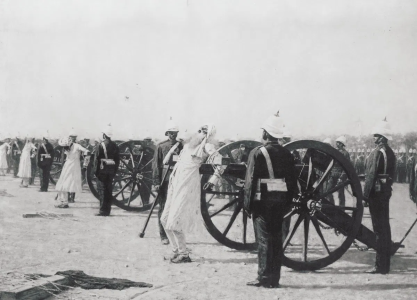
On force: while the French in Indo-China and the Dutch in the East Indies were even more violent, when required Britain too could resort to ferocious measures. The actions in the aftermath of the Indian mutiny and the Jallianwallah Bagh massacre are obvious examples. Lesser known, but illustrative, was the suppression of the ‘Kooka outbreak’ in 1872, when 65 Sikh were blown away from the mouths of artillery guns. Here is an an arresting picture of the event:
Draconian laws like the Rowlatt Act in 1919, gave a sense of the colonial heavy hand. In
The Insecurity State, Mark Condos argues that far from the British in India representing a confident juggernaut, they were in fact chronically anxious, and acutely aware of being outnumbered and conscious of the fragility of their rule - especially after the 1857 Indian Rebellion. In this framework, colonial repression was not merely a product of a sense of superiority and power, rather it was often a preemptive reaction driven by the fear of being overthrown. This was in the context of the minuscule presence of the British in India: the census of 1921 reported a population of 247 million in British India. The European population was just under 157,000.
But British rule also rested on alliances with Indian intermediaries, and so here we move to the second pillar. The East India Company in the eighteenth century relied on Indian agents obtaining commodities, on Indian merchants and bankers providing loans and capital, and on Indian soldiers to fill the ranks of its armies. Some historians have even suggested that Britain was sometimes drawn into territorial control at the invitation of wealthy Indian merchants. The support of Indian bankers – in particular the Benares bankers - was crucial in ensuring the army was paid. Company officials also relied on local agents: Bengali banians of Calcutta, Tamil dubashes of Madras and Parsee brokers in Bombay. These men acted as interpreters and translators, as secretaries and supervisors, as moneylenders and intermediaries between 'native' Indians and Company personnel.
By the twentieth century British presence was more firmly entrenched but they continued to rely on a network of alliances. The imperial state depended on alliances with princely rulers and other key groups such as landed magnates. Britain distributed land, chairs at darbars, certifications of appreciation written in gold or silver lettering, lunghis, guns and swords. In return, landlords ensured order, collected revenue, helped provide manpower for the army, assisted with the capture of criminals and were involved in arranging a workforce to work on roads and canals.
The final element was more subtle. Claims to sovereignty rest not only on the instruments of force and intricate bureaucracy but also on a more transcendent claim to power. Mithi Mukherjee (
India in the Shadows of Empire) argues that Britain deployed an imperial model of justice. After the 1857 rebellion, the British Crown took direct control of India and needed a new justification for its rule that was not just based on raw conquest. The core idea was, justice as equity rooted in the "conscience of the monarch." It framed the British sovereign as a benevolent, impartial, and compassionate mediator. The British argued that India was a fundamentally fragmented society made up of inherently antagonistic communities (based on religion, caste, etc.). Therefore, India supposedly
needed an outside, neutral force to stand above the fray and deliver fair, equitable justice to all.
Mukherjee notes that the early, moderate Indian National Congress - largely made up of lawyers - actually accepted this framework. Instead of demanding outright independence, they used the language of the British courts to demand "fairness" and "equity"
within the empire, essentially asking the British to live up to their own stated ideals.