What's new

Donald Trump's 21-point plan to end Gaza war

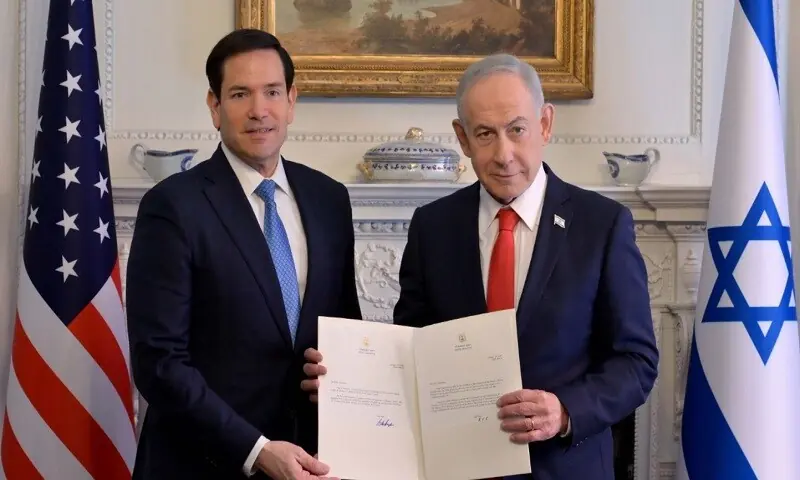
Rubio warns against West Bank annexation after Israel's parliament advances move

The US Secretary of State has said that a move by Israel's parliament towards annexation of the occupied West Bank would threaten Washington's plan to end the conflict in Gaza.

"That's not something we can be supportive of right now," Marco Rubio said before leaving for Israel as part of US efforts to shore up a fragile ceasefire deal.

In an apparent attempt to embarrass Israel's Prime Minister Benjamin Netanyahu, far-right politicians took the symbolic step of giving preliminary approval to a bill granting Israel authority to annex the West Bank.

The Palestinians claim the West Bank - occupied by Israel since 1967 - as part of a hoped-for independent state.

Last year, the International Court of Justice - the UN's top court - said Israel's occupation was illegal.

Netanyahu has previously spoken in support of annexing West Bank land but has not advanced this due to the risk of alienating the US - Israel's most important ally - and Arab countries which have built relations with Israel after decades of enmity.

Ultra-nationalists in Netanyahu's governing coalition have repeatedly called for Israel to annex the West Bank outright, though the bill was put forward by MPs outside the government.

The bill passed in a 25-24 vote. It is unclear whether it has support to win a majority in the 120-seat Knesset (parliament), and there are ways the prime minister can delay or defeat it.

The Palestinian foreign ministry condemned the Knesset's move, saying Israel would have no sovereignty over Palestinian land.

Israel has built about 160 settlements housing 700,000 Jews during its occupation of the West Bank and East Jerusalem. An estimated 3.3 million Palestinians live alongside them.

The settlements are illegal under international law - a position supported by an advisory opinion of the International Court of Justice last year.

As he boarded the plane to Israel, Rubio said annexation would be "counterproductive" and "threatening" for the peace deal - reiterating US opposition to annexation.

His visit on Thursday comes hot on the heels of trips by US Vice-President JD Vance and two special envoys, as the Trump administration attempts to push for the start of talks on the second critical phase of his 20-point Gaza peace plan.

The first phase - which includes a ceasefire, the partial withdrawal of Israeli forces and an influx of aid - came into effect earlier this month.

Both Israel and Hamas have accused each other of breaching the agreement over deadly incidents, but it has so far held.

Rubio voiced similar optimism to that of Vance for preserving the ceasefire.

"Every day there'll be threats to it, but I actually think we're ahead of schedule in terms of bringing it together, and the fact that we made it through this weekend is a good sign," he said.

The second phase of the peace plan would involve setting up an interim government in Gaza, deploying an international stabilisation force, the withdrawal of Israeli troops, and the disarmament of Hamas.

The war in Gaza began with the Hamas-led attack on southern Israel on 7 October 2023, in which around 1,200 people were killed and 251 taken hostage.

In the ensuing conflict, more than 68,000 Palestinians have been killed in Gaza, according to the territory's Hamas-run health ministry, whose figures are seen by the UN as reliable.

BBC
 
Gaza doctors struggle to investigate 'signs of torture' on unnamed dead returned by Israel

Out of a single room, with no DNA testing facilities or cold storage units of its own, the forensics team at Gaza's Nasser hospital face the challenges brought by peace.

Over the past eleven days, 195 bodies have been returned to Gaza by Israeli authorities, in exchange for the bodies of 13 Israeli hostages, under the terms of Donald Trump's ceasefire deal.

Photographs released by Gaza's medical authorities show some of the bodies badly decomposed, and arriving in civilian clothes or naked except for underwear, some with multiple signs of injury. Many have their wrists tied behind their backs, and doctors say some bodies arrived blindfolded or with cloth roped around their necks.

The forensic team at Nasser hospital are working with almost no resources to answer vast questions about torture, mistreatment and identity.

The head of the unit, Dr Ahmed Dheir, said one of their biggest limitations is a lack of cold storage space. The bodies arrive in Gaza thoroughly frozen and can take several days to thaw out, ruling out even basic identification methods like dental history, let alone any deeper investigation or post-mortem (autopsy).

"The situation is extremely challenging," he said. "If we wait for the bodies to thaw, rapid decomposition begins almost immediately, putting us in an impossible position [because] we lose the ability to examine the remains properly. So the most viable method is to take samples and document the state of the bodies as they are."

The BBC has viewed dozens of photographs of the bodies, many of them shared by Gaza's health authorities, others taken by colleagues on the ground.

We spoke to several of those involved in examining the bodies in Gaza, as well as families of the missing, human rights groups, and Israeli military and prison authorities.

We also spoke to three forensic experts outside the region, including one specialising in torture, to educate ourselves about the medical processes involved in this kind of investigation – all agreed that there were questions that were difficult to answer without post-mortems.

Dr Alaa al-Astal, one of the forensic team at Nasser hospital, said some of the bodies arriving there showed "signs of torture", such as bruises and marks from binding on the wrists and ankles.

"There were extremely horrific cases, where the restraint was so tight that blood circulation to the hands was cut off, leading to tissue damage and clear signs of pressure around the wrists and ankles," he said.

"Even around the eyes, when the blindfolds were removed, you could see deep grooves - imagine how much force that took. The pressure left actual marks where the blindfold had been tied."

Dr Astal also mentioned the loose cloths tied around the necks of some bodies as needing further investigation.

"In one case, there was a groove around the neck," he said. "To determine whether the death was due to hanging or strangulation, we needed to perform a post-mortem, but because the body was frozen, it was not dissected."

Sameh Yassin Hamad, a member of the Hamas-run government committee responsible for receiving the bodies, said there were signs of bruising and blood infiltration indicating that the bodies had been severely beaten before death. He also said there were stab wounds on the chest or face of some of them.

Some of the images we saw from the unit clearly show deep indentations or tightly-fastened cable-ties on the wrists and arms and ankles. One photograph appears to show the bruising and abrasion that would confirm that ties had been used while the person was still alive.

Other bodies showed only deep indentation marks, meaning a post-mortem would be needed to determine whether the ties had been used before or after death. Cable-ties are sometimes used when transporting bodies in Israel.

When we asked Israel's military about the evidence we gathered, it said it operates strictly in accordance with international law.

We showed the photographs we were given to the outside forensic experts. The images represent a fraction of the bodies transferred to Gaza by the Red Cross.

All three experts said that some of the markings raised questions about what had happened, but that it was difficult to reach concrete conclusions about abuse or torture without post-mortems.

"What is happening in Gaza is an international forensic emergency," said Michael Pollanen, a forensic pathologist and professor at the University of Toronto. "Based upon images like this, there is an imperative for complete medical autopsies. We need to know the truth behind how deaths occurred, and the only way to know the truth is to do autopsies."

But even with limited forensic data, doctors at Nasser hospital say the routine cuffing of wrists behind the body rather than in front, along with the marks observed on the limbs, points to torture.

"When a person is naked, with their hands tied behind their back, and visible restraint marks on their wrists and ankles, it indicates that they died in that position," Dr Dheir told us. "This is a violation of international law."

And there is strong evidence to suggest widespread abuse of detainees - including civilians - in Israeli custody in the months after the war began in October 2023, particularly in the military facility of Sde Teiman.

"At least in the first eight months of the war, the detainees from Gaza were cuffed behind their backs, and had their eyes covered, 24 hrs, 7 days a week, for months," said Naji Abbas, head of the Prisoners and Detainees Programme at the Israeli human rights organisation, Physicians for Human Rights (PHRI).

"We know that people developed serious infections on their skin, hands and legs because of the cuffs."

We have spoken to several people who worked at Sde Teiman over the past two years, who confirm that detainees were cuffed hand and foot – even while undergoing medical treatments, including surgery.

One medic who worked there said he had campaigned to loosen the cuffs, and that the treatment of detainees there was "dehumanisation".

But many of those detained during the Gaza war are held as unlawful combatants, without charge.

One complication for doctors at Nasser Hospital now is determining which of the returned bodies are Hamas fighters killed in combat, which are civilians and which are detainees who died in Israeli custody.

Some of the bodies returned by Israel are still wearing Hamas headbands or military boots, but doctors say most are either naked or in civilian clothing, making it difficult to distinguish their role, interpret their injuries, and assess human rights violations.

Photographs seen by the BBC show mostly naked or decomposed bodies. One dressed in civilian clothing and trainers has what officials say are two small bullet wounds in his back.

Sameh Yassin Hamad, from Gaza's Forensics Committee, said that Israel had sent back identification with only six of the 195 bodies it had returned – and that five of those names turned out to be wrong.

"Since these bodies were held by the Israeli authorities, they will have full data about them," said Dr Dheir. "But they haven't shared that information with us through the Red Cross. We were sent DNA profiles for around half the total number of dead, but have not received any details about the dates or circumstances of death, or the time or place of detention."

We asked Israel's army about the details in this report, including striking allegations by Gaza's forensic team that Israel had removed single fingers and toes from the bodies for DNA testing.

Israel's military said "all bodies returned so far are combatants within the Gaza Strip." It denied tying any bodies prior to their release.

A spokeswoman for the Israeli Prime Minister's Office, Shosh Bedrosian, on Wednesday described the reports from Gaza as "just more efforts to demonise Israel" and suggested the media focus instead on the experience of Israeli hostages.

As families of those missing gather at the hospital gates, Dr Dheir and his staff are under intense pressure to identify the dead and provide answers about what happened to them.

So far, only some 50 bodies have been positively identified – mostly through basic details like height, age and obvious previous injuries. Another 54 have been buried, unidentified and unclaimed, because of intense pressure on space at the unit.

Many families of the missing attended the burial of the unnamed dead this week, just in case one of them was theirs.

"Honestly, it's hard to bury a body when you don't know whether it's the right one or not," said Rami al-Faraa, still searching for his cousin.

"If there was [DNA] testing, we'd know where he is – yes or no," said Houwaida Hamad, searching for her nephew. "My sister would know if the one we're burying is really her son or not."

Donald Trump's ceasefire deal has brought some relief for Gaza, but little closure for the families of most of those missing, left burying a body in place of a brother, husband or son.

BBC
 
Ceasefire politics stall aid as Gaza’s people fight hunger, cold, and despair

Gaza’s Fragile Calm Tested by Scarcity and Political Gridlock


As the fragile ceasefire enters another uncertain phase, Israel-Palestine war live updates reveal a deepening humanitarian catastrophe in Gaza. Palestinians returning to northern Gaza describe life as a “daily struggle for survival,” navigating through shattered neighbourhoods with no power, clean water, or food. Thousands remain displaced, unable to go home due to Israeli military presence and structural collapse risks.

Humanitarian agencies say the situation is far worse than anticipated. The World Health Organization has urged Israel to open “all border crossings” to allow aid and medical evacuations, stressing that thousands in urgent need of treatment cannot wait any longer. “If all corridors opened, it would be a game-changer,” said Rik Peeperkorn, WHO’s representative for the Palestinian territories.

Global Reactions and Political Tensions Build​


According to Israel-Palestine war live updates, the ceasefire’s second phase has become a flashpoint for global politics. The U.S.-brokered plan envisions an international stabilisation force to secure Gaza, yet Israel has firmly opposed Turkiye’s participation. Israeli analyst Akiva Eldar explains that historic mistrust and political rivalry between Prime Minister Netanyahu and President Erdogan make Ankara’s involvement “unacceptable” for Israel. Instead, alternative nations like India or Pakistan might be considered—though the core question remains: who will disarm Hamas?

Meanwhile, Spain’s High Court has opened a rare investigation against steelmaker Sidenor for allegedly breaching a weapons sales ban to Israel, marking one of the first potential legal consequences of Madrid’s 2024 embargo. Rights groups hailed the move as a step toward accountability for corporate complicity in the conflict.

UNRWA’s Role, U.S. Influence, and Ongoing Uncertainty​


In Israel-Palestine war live updates, the United Nations Relief and Works Agency (UNRWA) has reaffirmed that “no organisation can replace its role” in Gaza, countering U.S. claims linking it to Hamas. Washington’s top diplomat, Marco Rubio, has insisted that Gaza will be demilitarised and that Hamas will have no role in future governance. Analysts say such statements highlight the U.S.’s growing control over Israel’s wartime decisions, including restrictions on airstrikes and post-war strategy.

For Gaza’s civilians, however, politics offer little relief. With aid convoys still blocked and shelters collapsing under rain and cold, the truce feels less like peace—and more like a pause in a war that never truly stopped.
 
Gaza risks ‘lost generation’ due to ruined schools: UN official

With Gaza’s education system shattered by two years of gruelling war, UNICEF’s regional director says he fears for a “lost generation” of children wandering ruined streets with nothing to do.

“This is the third year that there has been no school,” Edouard Beigbeder, the UN agency’s regional director for the Middle East and North Africa, told the AFP news agency in Jerusalem after returning from the Palestinian territory.

“If we don’t start a real transition for all children in February, we will enter a fourth year. And then we can talk about a lost generation.”

A US-brokered ceasefire, which came into effect earlier in October, has allowed UNICEF and other education partners to get about one-sixth of children who should be in school into temporary “learning centres”, Beigbeder told AFP.

“They have three days of learning in reading, mathematics and writing, but this is far from a formal education as we know it,” he added.

Beigbeder said that such learning centres, often located in schools or near displacement camps, consisted of metal structures covered with plastic sheeting or of tents. He said there were sometimes chairs, cardboard boxes or wooden planks serving as tables, and that children would write on salvaged slates or plastic boards.

Source: Al Jazeera
 
Gaza children dying as they wait for Israel to enable evacuations

So many lives in Gaza still hang in the balance.

In different wards of Nasser Hospital lie two 10-year-old boys, one shot by Israeli fire and paralysed from the neck down, another with a brain tumour.

Now that a fragile ceasefire is in place, they are among some 15,000 patients who the World Health Organization (WHO) says are in need of urgent medical evacuations.

Ola Abu Said sits gently stroking the hair of her son Amar. His family says he was in their tent in southern Gaza when he was hit by a stray bullet fired by an Israeli drone. It is lodged between two of his vertebrae, leaving him paralysed.

"He needs surgery urgently," Ola says, "but it's complicated. Doctors told us it could cause his death, a stroke or brain hemorrhage. He needs surgery in a well-equipped place."

Right now, Gaza is anything but that. After two years of war, its hospitals have been left in a critical state.

Sitting by the bedside of her younger brother, Ahmed al-Jadd, his sister Shahd says her brother was a constant comfort to her through two years of war and displacement.

"He's only 10 and when our situation got so bad, he used to go out and sell water to help bring some money for us," she says. A few months ago, he showed the first signs of ill health.

"Ahmad's mouth started drooping to one side," Shahd explains. "One time he kept telling me: "Shahd my head hurts" and we just gave him paracetamol, but later, his right hand stopped moving."

The one-time university student is desperate for her brother to travel abroad to have his tumour removed.

"We can't lose him. We already lost our father, our home and our dreams," Shahd says. "When the ceasefire happened it gave us a bit of a hope that maybe there was a 1% chance that Ahmed could travel and get treated."

On Wednesday, the WHO coordinated the first medical convoy to exit Gaza since the fragile ceasefire began on 10 October. It took 41 patients and 145 carers to hospitals abroad via Israel's Kerem Shalom crossing, with ambulances and buses taking the group on to Jordan. Some have stayed for care there.

The UN agency has called for numbers of medical evacuations to be rapidly increased to deal with the thousands of cases of sick and wounded. It wants to be able to bring out patients through Gaza's Rafah border crossing with Egypt as it has done previously.

However, Israel has said it is keeping the crossing closed until Hamas "fulfils" its commitments under the terms of the Gaza ceasefire deal by returning the bodies of deceased hostages. Israel has kept the Gaza side of the Egyptian border closed since May 2024 when it took control during the war.

Speaking at a news conference on Thursday, the head of the WHO, Dr Tedros Adhanom Ghebreyesus, said "the most impactful measure" would be if Israel could allow Gazan patients to be treated in the occupied West Bank, including East Jerusalem, as happened before the war.

Top EU officials and foreign ministers of more than 20 countries - including the UK - have previously called for this, offering "financial contributions, provision of medical staff or equipment needed."

"Hundreds of patients could be treated easily and efficiently in a short time if this route reopened to the East Jerusalem Hospital Network and the hospitals in the West Bank," says Dr Fadi Atrash, CEO of the Augusta Victoria Hospital on the Mount of Olives.

"We can at least treat 50 patients per day for chemotherapy and radiation and even more than that. Other hospitals can do a lot of surgeries," the doctor tells me.

"Referring them to East Jerusalem is the shortest distance, the most efficient way, because we have the mechanism. We speak the same language, we're the same culture, in many cases we have medical files for Gazan patients. They've been receiving treatment in East Jerusalem hospitals for more than a decade before the war."

The BBC asked Cogat, the Israeli defence body which controls Gaza's crossings, why the medical route was not being approved. Cogat said it was a decision by the political echelon and referred queries to the Prime Minister's Office which did not offer further explanation.

After the Hamas-led attacks of 7 October 2023, Israel cited security reasons for not allowing Gazan patients in other Palestinian territories. It also pointed out that its main crossing point for people at Erez had been targeted by Hamas fighters during the assault.

The Hamas-run health ministry in Gaza says that in the year to August 2025, at least 740 people, including nearly 140 children, died while on waiting lists.

At Nasser hospital, the director of paediatrics and maternity, Dr Ahmed al-Farra, expresses his frustration.

"It's the most difficult feeling for a doctor to be present, able to diagnose a condition but unable to carry out essential tests and lacking the necessary treatments," Dr al-Farra says. "This has happened in so many cases, and unfortunately, there's daily loss of life due to our lack of capabilities."

Since the ceasefire, hope has run out for more of his patients.

In the past week in the hospital grounds, a funeral took place for Saadi Abu Taha, aged eight, who died from intestinal cancer.

A day later three-year old Zain Tafesh and Luay Dweik, aged eight, died from hepatitis.

Without action, there are many more Gazans who will not have a chance to live in peace.

BBC
 

The liar tyrants​

===

Israel says its forces carried out strike in central Gaza’s Nuseirat​

The Israeli military says its forces have targeted a member of the Palestinian Islamic Jihad group with “a precise strike” carried out “a short while ago” in the Nuseirat area of central Gaza.

The army statement claimed without providing any evidence that the person was planning to carry out “an imminent terrorist attack” against Israeli troops.

Source: Al Jazeera
 

Ceasefire Shadows: Israel's Violence on Gaza Continues Amid Expanding Raids​


Despite a declared ceasefire, Israel's violence on Gaza and the occupied West Bank has intensified, leaving Palestinians grappling with loss, fear, and displacement. In the last 48 hours, Gaza’s Health Ministry confirmed at least eight more Palestinians killed and 13 injured in fresh Israeli strikes — pushing the overall toll to over 68,500 dead and 170,000 wounded since October 2023.

The truce, intended to allow humanitarian recovery, has been overshadowed by relentless attacks and raids. Israeli forces demolished two homes in the villages of Furush Beit Dajan and Funduq under the pretext of lacking permits, displacing families who had already endured years of uncertainty. In Furush Beit Dajan alone, village officials report that more than 90 percent of homes face demolition notices.

Meanwhile, Gaza’s Civil Defence teams in Khan Younis have been preparing mass burials for 50 unidentified Palestinians returned from Israel. Many bodies, showing signs of torture and mutilation, were unrecognizable. Families continue searching for their loved ones among the dead, their grief deepened by the impossibility of proper identification or farewell.

Expanding Crackdown in the West Bank and Schools Under Fire​


In parallel with Israel’s violence on Gaza, Israeli forces conducted sweeping overnight raids across the occupied West Bank, detaining 40 Palestinians, including minors. Students in al-Khader, south of Bethlehem, were also targeted as soldiers fired live ammunition, stun grenades, and tear gas, leaving several children suffering from gas inhalation.

Farmers, too, face mounting hardship as Israeli troops and settlers obstruct the olive harvest season. In Sinjil, north of Ramallah, soldiers forced farmers off their lands, contributing to what Palestinian monitors describe as over 150 incidents of violence and harassment against olive growers in recent weeks.

As Gaza families dig through rubble with bare hands to recover missing relatives, the disparity in global empathy has become glaring. While machinery has entered the enclave to retrieve the remains of Israeli captives, Palestinian families still await similar assistance for their thousands of missing loved ones — a haunting reminder of the unequal value placed on human lives amid Israel's violence on Gaza and the West Bank.
 
Why the apartheid regime has issue with it?
===
Israel says it won’t ‘let’ Turkiye send armed forces to Gaza

Israel’s Foreign Minister Gideon Saar has said Israel is opposed to Turkiye contributing to an international force in Gaza due to Turkish President Recep Tayyip Erdogan’s “hostile approach” to Israel.

“Countries that want or are ready to send armed forces should be at least fair to Israel,” Saar said at a news conference in Budapest.

“Turkey, led by Erdogan, led a hostile approach against Israel … So it is not reasonable for us to let their armed forces enter the Gaza Strip, and we will not agree to that and we said it to our American friends.”

While the Trump administration has ruled out sending US soldiers into Gaza, it has been speaking to Indonesia, the United Arab Emirates, Egypt, Qatar, Turkiye and Azerbaijan to contribute to the multinational force.

Turkiye’s Erdogan has been one of Israel’s fiercest critics since the Gaza war started, even calling Israel a “terror
state”.

Source: Al Jazeera
 
Bl*ody criminal back stabs again
===
Netanyahu orders attacks on Gaza in response to alleged truce violation

Israeli Prime Minister Netanyahu says he has instructed the military to immediately carry out powerful strikes on Gaza.

It is unclear when and where they are going to take place.

But the Israeli government says this is in response to what they are calling Hamas’s ceasefire violations by not handing over the bodies of the remaining 13 captives that are still inside Gaza.

Hamas has said for some time that it needs assistance on the ground in the form of specialised teams and heavy machinery.

Israel has allowed those in the last couple of days, but still they have not exhumed all of the bodies.

At the end of the day, mediators – as well as Israeli and US officials, including Trump – knew that it was going to be a difficult task to exhume all of the captives’ bodies that are buried under millions of tonnes of rubble across Gaza.

Source: Al Jazeera
 
Israel to launch massive strikes in Gaza. Israel PM’s Office says, “Following the security consultations, Prime Minister Netanyahu instructed the military echelon to carry out immediate and powerful strikes in the Gaza Strip.” Decision after Hamas violated ceasefire

:kp
 
Fresh Israel strikes kill 33 in Gaza..... reports BBC.

It clearly shows before ceasefire, Trump failed to take consideration of Israel and Gaza. Therefore this ceasefire is made between Trump and other Muslim nations who wanted to hide their failures to provide military assistants to palestenes
 
It seems that Israel's killing of 31 palestenese doesn't bother to any Muslim nations as well as posters here
 
Absolutely embarrassing for Muslims.

Shame on Pakistani government for their shameless praise of Trump.
Firstly it's not a government, it's a dictatorship.

Secondly, I doubt anyone here expected Israel to stop the genocide... the Trump play was only backed here in jest due to the many Indians here who were doing early Diwali celebrating Trumps victory and the hike in tariffs which would somehow elevate India to a different level in terms of tech and manufacturing.... we saw how that backfired and then how the same Indians here changed tact...
 
Israeli strikes in Gaza kill 50, rescuers say, after Hamas accused of killing Israeli soldier

At least 50 Palestinians were killed in a wave of Israeli strikes in Gaza on Tuesday night, the Hamas-run Civil Defence agency and hospitals say.

Israel carried out the strikes in response to what it said were violations by Hamas of the US-brokered ceasefire deal.

Israel's defence minister accused Hamas of an attack in southern Gaza that killed an Israeli soldier on Tuesday, and of breaching the terms on returning deceased hostages' bodies. Hamas claimed it had "no connection" to the attack and insisted it was committed to the ceasefire deal.

US President Donald Trump maintained "nothing" would jeopardise the ceasefire, but added that Israel should "hit back" when its soldiers were targeted.

The Israeli strikes hit homes, schools and residential blocks in Gaza City and Beit Lahia in the north of Gaza, Bureij and Nuseirat in the centre, and Khan Younis in the south.

A Civil Defence spokesman told AFP news agency that at least 50 people were killed, including 22 children, and around 200 others were injured.

In Gaza City, witnesses described seeing "pillars of fire and smoke" rising into the air as explosions shook several residential areas.

Three women and a man who were pulled from the rubble of the al-Banna family's home in the southern Sabra neighbourhood, the Civil Defence said.

In the urban Bureij refugee camp, five members of the Abu Sharar family were killed in a strike on their home in the Block 7 area, it added.

And in Khan Younis, another five people were killed when aircraft targeted a vehicle on a road north-west of the city, according to the agency.

The Civil Defence said its rescue teams were "working amid extremely difficult conditions" and that it feared the death toll would rise because some missing people were believed to trapped under rubble.

A brief statement put out by Israeli Prime Minister Benjamin Netanyahu's office on Tuesday evening said he had ordered the military to carry out "forceful strikes" in Gaza but did not specify his reasons.

However, his defence minister said Hamas had crossed "a bright red line" by launching an attack on Israeli soldiers in Gaza on Tuesday.

"Hamas will pay many times over for attacking the soldiers and for violating the agreement to return the fallen hostages," Israel Katz warned.

On Wednesday morning, the Israeli military announced a reservist soldier, Master Sergeant Yona Efraim Feldbaum, was killed.

A military source said the attack took place in the southern city of Rafah "east of the Yellow Line", which demarcates Israeli-controlled territory inside Gaza under the ceasefire deal.

Sgt Feldbaum was killed when one of the vehicles of a military engineering team that was dismantling an underground tunnel route in the southern city of Rafah was hit by fire from "terrorists in the area", according to the source.

"A few minutes later, several anti-tank missiles were fired at another armoured vehicle belonging to the troops in the area. No injuries were reported," they added.

Hamas issued a statement denying that its fighters had attacked Israeli troops and condemning the Israeli strikes.

"Hamas affirms that it has no connection to the shooting incident in Rafah and affirms its commitment to the ceasefire agreement," it said.

"The criminal bombardment carried out by the fascist occupation [Israeli] army on areas of the Gaza Strip represents a blatant violation of the ceasefire agreement."

The group's military wing meanwhile said it would postpone the return of a hostage's body it had recovered on Tuesday due to what it called Israeli "violations".

The US played down concerns that all-out hostilities could resume.

On board Air Force One, President Trump told reporters: "As I understand it, they took out, they killed an Israeli soldier. So the Israelis hit back and they should hit back."

"Nothing is going to jeopardise" the ceasefire, he said. "You have to understand Hamas is a very small part of peace in the Middle East, and they have to behave."

US Vice-President JD Vance earlier said that the ceasefire was "holding" despite what he described as "little skirmishes" between the two sides.

On Tuesday afternoon, Israel's prime minister had pledged to take unspecified "steps" against Hamas after the group handed over the previous day a coffin containing human remains that did not belong to one of the 13 deceased hostages still in Gaza.

Netanyahu's office said forensic tests showed they belonged to Ofir Tzarfati, an Israeli hostage whose body was recovered by Israeli forces in Gaza in late 2023, and that this constituted a "clear violation" of the ceasefire deal.

The Israeli military also released footage from a drone that it said showed Hamas operatives "removing body remains from a structure that had been prepared in advance and burying them nearby" in eastern Gaza City on Monday.

"Shortly afterwards," it added, the operatives "summoned representatives of the Red Cross and staged a false display of discovering a deceased hostage's body."

Hamas rejected what it called the "baseless allegations" and accused Israel of "seeking to fabricate false pretexts in preparation for taking new aggressive steps".

The International Committee of the Red Cross (ICRC) later condemned what it called the "fake recovery", saying it had attended the scene "at the request of Hamas" and "in good faith".

It went on: "The ICRC team at this location were not aware that a deceased person had been placed there prior to their arrival, as seen in the footage – in general, our role as neutral intermediary does not include unearthing of the bodies of the deceased.

"Our team only observed what appeared to be the recovery of remains without prior knowledge of the circumstances leading up to it.

"It is unacceptable that a fake recovery was staged, when so much depends on this agreement being upheld and when so many families are still anxiously awaiting news of their loved ones."

The ceasefire agreement brokered by the US, Egypt, Qatar and Turkey is supposed to implement the first stage of Trump's 20-point Gaza peace plan.

It said Hamas would return its 48 living and deceased hostages within 72 hours of the ceasefire taking effect on 10 October.

All 20 living Israeli hostages were released on 13 October in exchange for 250 Palestinian prisoners and 1,718 detainees from Gaza.

Israel has also handed over the bodies of 195 Palestinians in exchange for the bodies of the 13 Israeli hostages so far returned by Hamas, along with those of two foreign hostages - one of them Thai and the other Nepalese.

Eleven of the dead hostages still in Gaza are Israelis, one is Tanzanian, and one is Thai.

On Saturday, Hamas's chief negotiator Khalil al-Hayya said the group was facing challenges because Israeli forces had "altered the terrain of Gaza". He also said that "some of those who buried the bodies have been martyred or no longer remember where they buried them".

However, the Israeli government insists Hamas knows the locations of all the bodies.

All but one of the dead hostages still in Gaza were among the 251 people abducted during the Hamas-led attack on southern Israel on 7 October 2023, during which about 1,200 other people were killed.

Israel responded by launching a military campaign in Gaza, during which more than 68,530 people have been killed, according to the territory's Hamas-run health ministry.

BBC
 
Firstly it's not a government, it's a dictatorship.

Secondly, I doubt anyone here expected Israel to stop the genocide... the Trump play was only backed here in jest due to the many Indians here who were doing early Diwali celebrating Trumps victory and the hike in tariffs which would somehow elevate India to a different level in terms of tech and manufacturing.... we saw how that backfired and then how the same Indians here changed tact...
India has nothing to do with it bro...you are unnecessarily blaming them. If anything, they stood strong against tyranny of Trump and didn't back down from his tariff threats unlike your PM/COAS who were drooling over to give him noble peace prize. If anything, Pak must learn from India what a khudgarz and self respecting nation looks like and how strong Prime Minister acts.
 
Funerals Across Gaza as Israel Violates Truce, Kills 104 Palestinians

Israel’s overnight air strikes on Gaza have killed at least 104 Palestinians, including 46 children, in what has become the deadliest episode since the U.S.-brokered ceasefire took effect three weeks ago. The attacks devastated residential areas and evacuation centres, leaving civilians trapped under rubble as Gaza’s hospitals struggle with a lack of supplies. Civil defence officials called the bombardment “a disgrace to humanity,” urging international intervention amid ongoing humanitarian collapse.

Israel claimed the strikes were a response to the killing of an Israeli soldier in Rafah, an act U.S. President Donald Trump said prompted Israel to “hit back” but insisted would not “jeopardise” the ceasefire. Analysts say the assault, coordinated with Washington, reflects Prime Minister Benjamin Netanyahu’s attempt to project strength amid domestic criticism and looming elections. Despite widespread destruction, Israeli public sentiment reportedly backs his hardline approach toward Hamas.

Global reactions have been sharp: Qatar urged all sides to preserve the truce, while Britain, Germany, and the EU voiced “deep concern” and called for restraint. Human rights groups and aid agencies, including Save the Children, condemned the renewed violence, warning of “unforgivable moral failure” as hospitals overflow with wounded civilians suffering shrapnel and blast injuries.

Meanwhile, Israel’s Defence Minister Israel Katz barred Red Cross visits to Palestinian prisoners, drawing further international criticism. In the occupied West Bank, settlers destroyed olive trees and attacked farmers. As Gaza buries its dead, fears mount that the fragile ceasefire could collapse entirely, with analysts warning that continued attacks—backed by silence from major powers—risk plunging the region into renewed chaos.
 
Satanic forces hell bent on bloodbath of innocent Palestinians
===
Death toll rises in Gaza after Israel attacks to 109, including 52 children

Gaza’s Government Media Office says 109 people have been killed in Israeli attacks in the past 12 hours, including 52 children, 23 women, four elderly persons, and seven people with disabilities.

In a statement, the office said Israel is continuing its “systematic campaign of misinformation, forgery, and lies aimed at distorting the truth and covering up its ongoing crimes against civilians in the Gaza Strip”.

“The occupation published a list containing 26 names, including 21 photos, claiming they belonged to people killed during its brutal recent aggression that occurred over the past 24 hours,” it said.

“Upon careful examination, it was found the list contains three incorrect names that are not Arabic and are not recorded in the official Palestinian records, in addition to fictitious names that do not exist in reality, some of which intentionally had no photos attached.”

Israel is conducting attacks on Gaza in “flagrant and deliberate violation of the principles of proportionality and distinction”, repeatedly targeting residential neighbourhoods, hospitals and shelters, the Government Media Office said.

Source: Al Jazeera
 

But still the apartheid idiots won't cling to their pacts​

====

Israel says it has received captives’ bodies from Red Cross​

Netanyahu’s office says the bodies have been handed over to the Israeli army and Shin Bet and will be brought into Israel.

The remains will then be transferred to Israel’s national forensic institute for identification.

“The effort to return our abductees continues continuously and will not stop until the last abductee is returned,” the Israeli prime minister’s office added.

As we’ve been reporting, Hamas’s armed wing released two Israeli captives’ bodies in Gaza a short while ago.

Source: Al Jazeera
 
The apartheid idiots proving the global community wrong again and again
====
Israel blocks vast majority of Gaza aid agreed under ceasefire deal

Israel continues to block the majority of aid trucks from entering Gaza, only allowing 24 percent of the number agreed under the ceasefire deal into the Strip since the truce took effect on October 10, Gaza’s Government Media Office says.

The Israeli military has attacked the Gaza Strip for a fifth day, killing at least five people in another test of the fragile US-brokered ceasefire.
The Red Cross says it transferred the unidentified bodies of three people to Israel after they were handed over by Hamas. Israeli media reports the remains were not of captives taken to Gaza.

Gaza residents say they fear a return to Israel’s full-scale bombing as they struggle to find food, water and medicine during the US-brokered truce.
Israel’s war on Gaza has killed at least 68,858 people and wounded 170,664 since it began in October 2023. A total of 1,139 people were killed in Israel during the October 7, 2023, Hamas-led attacks and about 200 taken captive.

Source: Al Jazeera
 
Israel says three bodies returned from Gaza are not those of hostages held by Hamas

The remains of three people Hamas handed over to the Red Cross in Gaza are not those of hostages, Israel has said, in the latest setback to the US-brokered ceasefire in the Israel-Hamas war.

The handover followed Israel's return on Friday of the bodies of 30 Palestinians to Gaza, which completed an exchange after militants turned over remains of two hostages earlier in the week.

Israeli Prime Minister Benjamin Netanyahu's office said on Saturday that the remains of the three people did not belong to the hostages.

It was unclear who the remains belonged to.

Hamas's armed wing said it had offered to hand over samples on Friday of unidentified bodies, but Israel refused and asked for the remains for examination.

"We handed the bodies over to stop the claims of Israel," the statement said.

Health officials in Gaza have struggled to identify bodies without access to DNA kits.

Ceasefire under strain

Since the ceasefire took effect on October 10, Palestinian militants have released the remains of 17 hostages. Eleven remain in Gaza.

Militants have released one or two bodies every few days. Israel has urged faster progress. Hamas has said the work was complicated by widespread devastation and Israeli military presence in some areas.

Israel has been releasing the unidentified remains of 15 Palestinians for the remains of each Israeli hostage. The number of Palestinian bodies returned by Israel since the ceasefire began now stands at 225. Only 75 have been identified by families, according to Gaza's Health Ministry.

It is unclear if those returned were killed in Israel during the Hamas-led October 7, 2023, attack on southern Israel that sparked the war, died in Israeli custody as detainees or were recovered from Gaza by troops during the war.

The fragile truce faced its biggest challenge this week when Israel carried out strikes across Gaza that killed more than 100 people, following the killing of an Israeli soldier in Rafah, Gaza's southernmost city.

Questions around security

Jordan's foreign minister warned on Saturday that Israel maintaining a military presence in Gaza puts the ceasefire at risk.

Speaking at the Manama Dialogue security summit, Ayman Safadi added it was "imperative" to have a Palestinian police force maintaining security, supported by an international stabilisation force with a UN Security Council mandate.

"With Israel staying in Gaza, I think security is going to be a challenge," Mr Safadi said.

"Israel cannot stay in 53 per cent of Gaza and then expect security to be achieved."

The 20-point US peace plan includes the formation and deployment of a temporary international stabilisation force of Arab and other partners that would work with Egypt and Jordan on securing Gaza's borders and ensuring the ceasefire is respected. The US has ruled out American soldiers in Gaza.

The visiting chairman of the Joint Chiefs of Staff, General Dan Caine, met with Israeli officials on Saturday.

Multiple nations have shown interest in taking part in a peacekeeping force, but have called for a clear UN mandate before committing troops.

Other difficult questions include Hamas's disarmament and the governance of a postwar Gaza, as well as when and how humanitarian aid will be increased.

Indonesia could be part of a peacekeeping force

Indonesia, the world's most populous Muslim nation, has offered thousands of troops for Gaza.

"But details, or the term of reference for that matter, remain unclear," Indonesia's Foreign Minister Sugiono, who like many Indonesians uses a single name, said earlier in the week.

"There has to be a mandate from the UNSC, which we hope will be issued. There has been no discussions so far, and we're far from settling any details," he added.

Indonesian officials have also called for an independent Palestinian state but underscored the need to "recognise and guarantee the safety and security of Israel".

War's toll

The deadliest and most destructive war ever fought between Israel and Hamas began with the Hamas-led 2023 attack that killed about 1,200 people and took 251 others hostage.

Israel's military offensive has killed more than 68,600 Palestinians in Gaza, according to Gaza's Health Ministry, which doesn't distinguish between civilians and combatants.

The ministry, part of the Hamas-run government and staffed by medical professionals, maintains detailed records viewed as generally reliable by independent experts.

Israel, which has denied accusations by a UN commission of inquiry and others of committing genocide in Gaza, has disputed the ministry's figures without providing a contradicting toll.


Erdogan slams Israel’s ‘poor’ ceasefire record as more than 200 killed since agreement​

Turkish President Recep Tayyip Erdogan says Hamas appears more determined than Israel to comply with the ceasefire in Gaza.

“We all see that Israel’s record on this matter is very poor,” Erdogan said in remarks carried by the Turkish state-run Anadolu news agency.

“We are facing an administration that has massacred over 200 innocent people since the ceasefire agreement and continues its occupation and attacks on the West Bank,” he said.

“We cannot allow the annexation of the West Bank, the changing of Jerusalem’s status or attempts to damage the sanctity of the Al-Aqsa Mosque.”

Source: Al Jazeera
 
The lunacy continues unabated
===
Israel plans to build 356 new settlement units

Israel’s Ministry of Construction and Housing has published two tenders this week for the construction of 356 new housing units in a settlement southeast of the Palestinian city of Ramallah.

The plan is to build 342 units across five compounds as well as 14 homes for reservists’ families in Geva Binyamin (Adam), according to Israel’s Peace Now movement, which added that tenders were issued in August for 4,030 housing units in the settlements of Ma’ale Adumim and Ariel.

So far this year, tenders have been published for 5,667 settlement housing units, which is by far the highest annual total ever recorded. If all these homes are built, another 25,000 settlers could live in the occupied West Bank, Peace Now said.

The group, which backs a two-state solution, said that the Netanyahu government “is exploiting every moment in power to destroy Israel’s chances for a future of peace and prosperity”.

“The American president may have declared that there will be no annexation, but the Israeli government is doing everything it can to realise the annexation on the ground and turn Israel into an apartheid state,” it said

Source: Al Jazeera
 

Gaza death toll tops 69,000 as Israel and militants again exchange remains​


More than 69,000 Palestinians have been killed in the Israel-Hamas war so far, Gaza health officials said Saturday, as both sides completed the latest exchange of bodies under the terms of the tenuous ceasefire.

The latest jump in deaths occurred as more bodies are recovered from the rubble in the devastated Gaza Strip since the ceasefire began on Oct. 10, and as previously unidentified bodies are identified. The toll also includes Palestinians killed by strikes since the truce took hold, which Israel says target remaining militants.

Israel on Saturday returned the remains of another 15 Palestinians to Gaza, according to hospital officials in the territory, a day after militants returned the remains of a hostage to Israel. He was identified as Lior Rudaeff, according to Israeli Prime Minister Benjamin Netanyahu ’s office. The Hostages and Missing Families Forum said that Rudaeff was born in Argentina.

The exchanges are the central part of the ceasefire’s initial phase, which requires that Hamas return all hostage remains as quickly as possible. For each Israeli hostage returned, Israel has been releasing the remains of 15 Palestinians.

Source: AP News
 
Turkey now issued arrest warrants against Israel PM Benjamin Netanyahu.... how funny... when the war was in full swing and Palestinians were getting killed at that time Turkey won't show any guts to take on Israel. Now after so-called ceasefire they are trying to show Muslim world that they have guts
 
Israel Confirms Hamas Returns Body of Soldier Amid Ongoing Gaza Strikes


Israel says Hamas has handed over the remains of soldier Hadar Goldin, who was killed in 2014, while Israeli forces continue strikes across Gaza despite a fragile ceasefire, killing civilians in multiple areas. Aid deliveries remain far below agreed levels, with only a third of promised trucks entering the Strip, and medical evacuations are slow and restricted.

Meanwhile, education efforts show resilience as a centuries-old school in Gaza reopens for children, although more than 660,000 remain out of school due to widespread damage. Diplomatic efforts continue, with Egypt and Qatar discussing ceasefire developments and calls growing for improved humanitarian access.

 
Kushner Arrives in Israel Amid Ceasefire Challenges

US presidential adviser Jared Kushner has arrived in Israel to meet with leaders and address disputes related to the five-week-old ceasefire. Meanwhile, tensions persist as Israeli settlers reportedly establish a new outpost on Palestinian land in Anata, east of occupied East Jerusalem, according to the Bedouin rights group Al-Baidar.
 

child among 2 killed as Israeli air raids, drones target Gaza.....​


Al Jazeera

Those who were dancing at Trump's gala have really read clauses of ceasefire?
 
The bloodshed continues as unleashed hounds continue hunt
====
Gaza’s Civil Defence says 51 bodies recovered from Gaza City neighbourhood

Gaza’s Civil Defence says its crews have so far recovered 51 bodies from a mass grave in the courtyard of the Sheikh Radwan clinic in western Gaza City.

In a statement, the agency said efforts are still underway to retrieve more bodies and transport them to Al-Shifa Hospital, where work will be done to attempt to confirm their identities.

The recovery operation has been ongoing since this morning, it added.

The bodies of more than 10,000 Palestinians remain trapped under the rubble across the bombarded Gaza Strip, according to local authorities. Civil defence teams say they have been struggling to recover them due to a lack of adequate equipment and machinery caused by Israel’s ongoing blockade.

Source: Al Jazeera
 
Israel confirms identity of hostage body returned by Hamas as Meny Godard

Israel has identified the hostage body returned by Hamas on Thursday as that of Meny Godard, who was 73 when he was killed in the 7 October attacks.

Red Cross vehicles collected his body hours after Hamas issued a joint statement with the Palestinian Islamic Jihad saying it had been located in the Khan Younis area of southern Gaza.

The Israeli prime minister's office said forensic testing confirmed the body belonged to Godard, who was killed along with his wife, Ayelet, during Hamas's raid on kibbutz Be'eri on 7 October 2023.

Three out of 28 deceased hostages remain in Gaza, with the first phase of the current ceasefire deal which forms part of a US plan to end the Gaza war.

Under the ceasefire deal, Hamas agreed to return the 20 living and 28 dead hostages it was still holding.

All the living Israeli hostages were released on 13 October in exchange for 250 Palestinian prisoners and 1,718 detainees from Gaza.

For each dead Israeli hostage returned, Israel has agreed to hand over the remains of 15 Palestinians. But with no DNA testing available in Gaza, it is hard to identify them.

Hamas seized 251 hostages when it launched the deadly attack in southern Israel on 7 October 2023 during which it killed 1,200 people.

More than 69,000 Palestinians have been killed in Israel's retaliatory response, according to the Hamas-run health ministry in Gaza, whose figures the UN considers reliable.

Of the three bodies still in Gaza, two are Israeli and one is Thai.

Israel has accused Hamas of deliberately delaying the recovery of the hostages' bodies, but Hamas has said it is struggling to find them under rubble.

The slow progress has meant there has been no advance on the second phase of US President Donald Trump's Gaza peace plan.

This includes plans for the governance of Gaza, the withdrawal of Israeli troops, the disarmament of Hamas, and reconstruction of the Gaza Strip.

BBC
 
Record settler attacks in West Bank opening up rifts within Israel

The marks of the attack on Hamida Mosque, near Deir Istiya in the occupied West Bank, are still scattered on the ground outside.

Charred furniture, lecterns and smoky curls of carpet are piled around the entrance - its guts emptied, and debris cleared, in time for Friday prayers.

Dozens of men arrived for the prayers in a show of defiance - their backs turned towards the scorched and blackened wall.

The imam here, Ahmad Salman, told the BBC the attack on Thursday was a message from Jewish settlers, amid a wave of settler violence across the West Bank.

"The message they want to send is that they can reach anywhere - into cities, into villages, that they can kill civilians and burn houses and mosques."

"I feel it in my soul," he said. "It's not right to touch places of prayer, wherever they are."

But there was a message here, too, for Israel's regional military chief - scrawled in Hebrew on the mosque's exterior wall: "We're not afraid of you, Avi Bluth."

Spiralling settler attacks here over the past six weeks have triggered tough warnings from army leaders, along with a handful of arrests and investigations.

But hardline expansionist settlers enjoy government support, which some believe is pushing the West Bank towards a dangerous confrontation.

The annual olive harvest, when Palestinians try to access their farmland, often marks a spike in violence, but the attacks this year have broken UN records.

The UN Office for Humanitarian Affairs registered more than 260 settler attacks resulting in Palestinian casualties or damage to property in October alone - the highest monthly count since they began monitoring in 2006.

Human rights groups say that settler aggression towards Palestinians has risen since the Gaza War began in 2023 after the 7 October Hamas attacks. UN figures suggest that more than 3,200 Palestinians have been forcibly displaced by settler violence and restrictions since then.

In the past few days, there have been several attacks across the West Bank, including an assault by a large crowd of masked men on an industrial estate and Bedouin buildings near Beit Lid. Security cameras filmed them running across the hillside and through the factory gates, where they torched several trucks. The army said they later attacked Israeli soldiers operating nearby.

The Israel police spokesman said four suspects had been arrested. Three have reportedly since been released.

Last week, in the olive groves around Beita, a Reuters journalist, Raneen Sawafta, was beaten by a settler with a club as she was covering the olive harvest - a deep dent in her helmet clearly showing the force of the blows.

Hamad al-Jagoub abu Rabia, a volunteer with the Red Crescent in Beita, was also injured after going to help her - hit in the head with a rock and later taken to hospital.

"I never imagined a human being created by God would do this," he said. "If they had an iota of humanity, they would have never done this to a woman. If it wasn't for her helmet, she could have died."

Less than three weeks earlier, 55-year-old Afaf Abu Alia was badly beaten with a club as she lay cowering on the ground during a settler attack, after picking olives on farmland she rents near the village of Abu Falah. The video of her assault drew international condemnation.

"One of [the settlers] attacked me and started beating me - hitting my head, my arms and legs, and kicking my legs with their boots," she told the BBC. "I fell down. I wasn't aware of what was happening, my mind went blank - I was only feeling the pain. I felt like my soul was leaving my body. The only thing I thought about was my children."

Now recovering at home, Afaf said she was still in pain, with 20 stitches in her head, and bruises on her arms and legs that left her unable to sleep.

She said the family had been blocked from its own farmland by settlers, and that they had been renting land elsewhere to grow olives this year.

"I'd return there today if I could, I'm not afraid of them," Afaf said. But she also acknowledged the situation was becoming riskier.

"They weren't like this at the start of the war," she said. "In this one year, they've escalated more than in all the years before."

One man has been arrested in connection with her assault. Arrests like this are rare, and convictions rarer still. The Israeli human rights organisation Yesh Din found that, over the past two decades, more than 93% of police investigations into Israeli offences against Palestinians in the West Bank were closed with no charges filed.

Israeli forces have long been criticised by human rights groups for standing idly by during settler attacks - or even taking part in them.

This week, Israel's chief of staff said he strongly condemned the recent violence by Israeli settlers, calling it "a red line" and promising to "act decisively".

The head of the army's central command, Maj Gen Avi Bluth - the man addressed in the graffiti on Hamida Mosque - said violent acts by what he called "anarchist fringe youth" were "unacceptable and extremely serious" and must be dealt with firmly.

Some hardline settlers see these comments as a betrayal.

Amichai Luria, a long-time settler from Ma'ale Levona and manager of a winery in the nearby settlement of Shiloh, told me the current focus on settler violence was overblown.

"It's amazing to me how people talk about these rare occasions [when] people misbehave," he said. "Oh, some people were trying to pick olives and some Jews came and bothered them. Give me a break. There are more muggings on the main street in London than there [are] here."

I asked him about the severe beating of women and the near-daily reports of incidents in surrounding areas. He dismissed them as an "attempt to make the Jews look bad".

"Most of the Arabs, if they could, would follow Hamas or Hezbollah. Very, very, very few want to coexist or live in peace, and at the first opportunity they have, they're going to wipe us out," he said.

"The future is very simple. Hopefully the army will wake up, hopefully people will understand that we have to prepare ourselves, that they're coming for us."

The UN's Office of Humanitarian Affairs says that, of the 1,000 Palestinians killed in the West Bank since the Gaza War began, between 20 and 32 were killed by Israeli settlers. During the same period, it says, Palestinians killed 19 Israeli civilians.

The decision of military leaders to order action on settler violence will test discipline in an army where settlers make up a growing proportion of troops.

It also risks exposing dangerous divisions between Israel's military and political leaders.

Extremist settlers say their claim to the land comes from the Bible - but their growing confidence comes from government support.

Since the Hamas attacks on 7 October 2023 and the Gaza War that followed, Israel's far-right National Security Minister, Itamar Ben-Gvir, has handed out more than 100,000 weapons to civilian security squads, including in West Bank settlements, and has urged Israel to formally annex the West Bank.

The government has authorised a sharp expansion of settlements, and legalised some unauthorised outposts. Israeli settlements in the West Bank are illegal under international law, though Israel disputes this.

And the Defence Minister, Israel Katz, last year banned the use of administrative detention for Jewish settlers in the West Bank - reportedly against the advice of Israel's national security agency.

Israel's army is now asking Katz to reinstate that power to help curb settler violence. Administrative detention, which allows suspects to be held for renewable six month periods without charge, is still widely used for Palestinians.

"I don't trust the army like I used to," Amichai Lurai told me. "A lot of people in the army are anti-Israel from top to bottom. Trust me, the army is not unified."

Israel's army is currently embroiled in a legal and political scandal around leaked video footage allegedly showing the abuse of Palestinian detainees - a case that has pitted ultranationalist politicians against the country's security forces.

As worshippers left the Hamida Mosque after Friday prayers, Israeli activists arrived on a visit to show solidarity. Martin Goldberg, originally from London, was one of them.

I asked him about Israeli claims that attacks by settlers were overblown.

"They're very minor attacks, when it's not happening to you," he said. "These attacks are not minor, they're extremely major. Everyone's trying to belittle it, [saying] oh it's just the 'weeds in the field' but it's not. And they're being supported by the government. Local councils are 100% behind them, financing them."

The view from Amichai Luria's winery

Many local councils provide backing and support to outposts, but have publicly condemned the violence of some settlers there. The chairman of the West Bank Settler Council this week issued a statement supporting the Israeli army in arresting the "anarchists" who harmed soldiers and civilians.

"Europe, the United States, everyone in the whole world is watching the West Bank," said Wadi abu Awad, a civil engineer who lives in the nearby village of Turmus Aya, which has seen repeated attacks.

"We are not in a fight with the Israelis. We don't kill Israeli soldiers, we don't have any hostages. And they [settlers] are pushing us towards the corner. You know, if the cat is pushed the corner, he might become a tiger."

BBC
 
Questions loom over UN vote as initial Gaza truce phase nears end

The UN Security Council on Monday is expected to vote on a US proposal for a UN mandate for an international military force in Gaza despite opposition from Russia, China, and some Arab countries.

The first stage of the ceasefire agreement is nearing its end. The next and even more challenging stage calls for the implementation of a governing body for Gaza, and the deployment of an international stabilization force.

Then there’s the proposed disarming of Hamas. It is not clear what happens next.

For Palestinians in the war-ravaged territory, a return to massive Israeli bombardment is terrifying. Israel’s genocidal war on Gaza has killed at least 69,100 Palestinians – mostly women and children – since October 2023, according to Gaza’s Health Ministry.

Source: Al Jazeera
 

UN Security Council backs Trump plan for Gaza​

The UN Security Council has voted in favour of Donald Trump's peace plan for Gaza, which includes deployment of international troops.

The move authorises the second phase of the US president's 20-point plan - including setting up an International Stabilisation Force (ISF) to demilitarise the territory and decommissioning weapons held by Hamas.

The resolution was backed by 13 countries on the Council - including the UK, France and Somalia - with none voting against the proposal.

Two countries - Russia and China - abstained from the vote.


WFP warns Gaza families face another brutal winter exposed​

The UN World Food Programme (WFP) says many families in Gaza are bracing for another winter spent without proper shelter, as heavy rain floods their tents and damages what little food supplies they have left.

In a post on X, WFP shared images of soaked tents and warned that plunging temperatures will worsen conditions for displaced families living outdoors.

The agency said its cash assistance programme remains a vital lifeline for the most vulnerable households as winter approaches, and that it is working to expand support to those most at risk.

Source: Al Jazeera
 

Hounds on charge again against innocent civilians​

===

Israel forces cross ceasefire ‘yellow line’ scattering returned residents​

Israel continues to occupy more than 50 percent of the Gaza Strip under the ceasefire agreement with the “yellow line” demarcation separating areas under army deployment from those inhabited by Palestinians.

However, Israeli forces continue to fire and increasingly launch ground incursions across the yellow line as truce violations continue.

Northern Gaza resident Saed Mushtaha attempted to return to his destroyed home in Tuffah on Friday, but said he was unable to because Israeli forces fired at anything that moved.

Israeli bulldozers levelled what remained of homes in the adjacent neighbourhood, said Mushtaha.

“We returned after the ceasefire and repaired some heavily damaged rooms, but the [Israeli] occupation quickly displaced us again and took control of the area.”

Source: Al Jazeera
 
A spate of Israeli attacks across Gaza has claimed dozens of lives and left many more wounded, highlighting that the six-week-old US-brokered ceasefire remains fragile. In just the past 24 hours, strikes during busy hours in Gaza City killed at least 22 Palestinians, including children, targeting vehicles, homes, and shelters, while drone and missile attacks hit Nuseirat and Deir el-Balah, leaving multiple civilians dead. Earlier, Israeli forces also raided West Bank towns such as Dura, wounding two and arresting another, while settler violence in Hebron continued against Palestinian farmers.

In southern Lebanon, an Israeli airstrike killed one person, and in Rafah, Israel claimed to have killed three Palestinian fighters trapped in tunnels. Human rights experts warn the attacks are causing long-lasting ecological damage, decimating Gaza’s agricultural land and infrastructure. The so-called “yellow line” ceasefire boundary has done little to protect civilians, as Israeli forces continue to open fire on those crossing into areas under their control, showing that the war and its humanitarian toll persist despite formal agreements.
 
Death to the oppressors
===
Deadly Israeli attacks ‘flagrant breach of international humanitarian law’

Gaza authorities have denounced a day of deadly Israeli attacks that killed two dozen Palestinians, including children.

“We condemn in the strongest terms the continued serious and systematic violations of the ceasefire agreement by the Israeli occupation authorities,” said the Government Media Office.

As of Saturday, 497 Israeli violations of the truce have been recorded since the US-brokered ceasefire came into force on October 10, it said.

“These violations constitute a flagrant breach of international humanitarian law and the humanitarian protocol attached to the agreement. Among these violations, 27 occurred today, Saturday, resulting in 24 martyrs and 87 wounded,” the press office said in a statement.

Source: Al Jazeera
 
Israeli strikes across Gaza kill 22 Palestinians, medical and civil defence officials say

At least 22 Palestinians have been killed in a series of Israeli air strikes across northern and central Gaza, Hamas medical and civil defence officials have said.

They said five sites had been hit, including residential homes. A senior Hamas commander was among the dead, according to local sources.

The Israeli military said it had struck targets in Gaza in response to an incident earlier on Saturday, when it said an "armed terrorist" had fired at soldiers after crossing the Strip's so-called "yellow line" designating areas under full Israeli control. Hamas denied this.

Both sides have accused each other of violating the ceasefire deal agreed on six weeks ago.

More than 310 Palestinians have been killed in Israeli strikes since the ceasefire came into force, according to Gaza's health ministry.

The territory's civil defence said Saturday's strikes by Israel targeted Gaza City in the north, as well as Deir al-Balah and Nuseirat camp in central Gaza.

The Hamas officials said five people had been killed at the Abbas junction in the densely populated Rimal area of Gaza City. Witnesses said an Israeli strike set a car on fire.

In addition, three people were killed near a mosque in Deir al-Balah, the officials said.

Two houses were targeted in Israeli strikes in Nuseirat, they added, with three killed after the home of the Abu Amouneh family was hit. Seven others were killed in another strike targeting the house of the Abu Shawish family.

Three more people were killed later on Saturday when a house in western Gaza City was hit, officials reported.

The office of Prime Minister Benjamin Netanyahu said in a later statement: "Today, Hamas violated the ceasefire again, sending a terrorist into Israel held territory to attack IDF soldiers. In response, Israel eliminated five senior Hamas terrorists."

The statement also called on mediators to "insist that Hamas fulfil its side of the ceasefire".

Following the strikes, Hamas said the army's westward push of the yellow line and continued bombardment of eastern Gaza amounted to a "blatant breach" of the agreement.

The group called on mediators and the US to intervene urgently, warning that Israel was attempting to impose "new facts on the ground" and undermine the ceasefire.

The Israeli military launched an offensive in Gaza in response to the Hamas-led attack on southern Israel on 7 October 2023, in which about 1,200 people were killed and 251 others were taken hostage.

At least 69,500 people have been killed in Israeli attacks in Gaza since then, including 280 during the ceasefire, according to the territory's health ministry.

BBC
 
Fresh Israeli Strikes in Gaza and Lebanon Deepen Fears of Wider Regional Escalation

Ongoing Israeli operations across Gaza continued despite the ceasefire, with multiple strikes reported in northern and southern areas, drone fire killing civilians, and further destruction in neighbourhoods east of Gaza City. Medical sources confirmed several new deaths, while Israeli forces also carried out overnight raids in the occupied West Bank, where more arrests and another fatality were reported. Meanwhile, Hamas teams — accompanied by the Red Cross and Egyptian officials — continued searching in Nuseirat refugee camp for the body of an Israeli captive.

In Lebanon, tensions escalated after an Israeli air strike in Beirut’s southern suburbs killed senior Hezbollah commander Haytham Ali Tabatabai and several others, prompting warnings from analysts that the group is in a weakened position and unlikely to risk a large-scale retaliation. Israel has justified the attack by claiming Hezbollah was rearming, while Washington signalled continued support for Israeli operations. As the Israeli army launched new military exercises in the occupied Golan Heights, concerns mounted over the possibility of broader conflict, with analysts noting shifting US policy and growing pressure on Lebanon amid preparations for an upcoming visit by Pope Leo XIV.

 
Controversial US-backed Gaza Humanitarian Foundation ends aid operations

The controversial, US and Israel-backed Gaza Humanitarian Foundation (GHF) says it is winding down its aid operations in the Palestinian territory, after almost six months.

The organisation had already suspended its three food distribution sites in Gaza after the ceasefire between Hamas and Israel took effect six weeks ago.

The GHF aimed to bypass the UN as the main supplier of aid to Gaza's population. UN and other aid agencies refused to co-operate with its system, saying it was unethical and unsafe.

Hundreds of Palestinians were killed while seeking food amid chaotic scenes near GHF's sites, mostly by Israeli fire, according to the UN. Israel said its troops fired warning shots.

The GHF said on Monday that it was winding down operations now because of the "successful completion of its emergency mission", with a total of three million packages containing the equivalent of more than 187 million meals delivered to Palestinians.

The GHF's executive director, Jon Acree, also said the US-led Civil-Military Coordination Centre (CMCC) - which has been set up to help implement US President Donald Trump's Gaza peace plan - would be "adopting and expanding the model GHF piloted".

US state department spokesperson Tommy Piggott wrote on X: "GHF's model, in which Hamas could no longer loot and profit from stealing aid, played a huge role in getting Hamas to the table and achieving a ceasefire."

Hamas - which denies stealing aid - welcomed the closure of the GHF, Reuters reported. A spokesman for said GHF should be held accountable for the harm it caused to Palestinians.

"We call upon all international human rights organisations to ensure that it does not escape accountability after causing the death and injury of thousands of Gazans and covering up the starvation policy practised by the (Israeli) government," Hazem Qassem wrote on his Telegram channel.

The GHF began operations in Gaza on 26 May, a week after Israel had partially eased a total blockade on aid and commercial deliveries to Gaza that lasted 11 weeks and caused severe shortages of essential supplies. Three months later, a famine was declared in Gaza City.

The GHF's food distribution sites in southern and central Gaza were operated by US private security contractors and located inside Israeli military zones.

The UN and its partners said the system contravened the fundamental humanitarian principles of neutrality, impartiality and independence, and that channelling desperate people into militarised zones was inherently unsafe.

The UN's human rights office said it recorded the killing of at least 859 Palestinians seeking food in the vicinity of GHF sites between 26 May and 31 July. Another 514 people were killed near the routes of UN and other aid convoys, it added. Most of them were killed by the Israeli military, according to the office.

The Israeli military said its troops had fired warning shots at people who approached them in a "threatening" manner.

The GHF said there were no shootings at the aid sites and accused the UN of using "false and misleading" statistics from Gaza's Hamas-run health ministry.

The GHF's future had been uncertain since Hamas and Israel agreed a ceasefire deal to implement the first phase of Trump's peace plan.

It said aid distribution would take place "without interference from the two parties through the United Nations and its agencies, and the Red Crescent, in addition to other international institutions not associated in any manner" with Hamas and Israel.

UN spokesperson Stephane Dujarric said on Monday that the GHF's shutdown would have "no impact" on its operations "because we never worked with them".

He also said that while more aid was getting into Gaza since the ceasefire took effect on 10 October, it was "not enough to meet all the needs" of the 2.1 million population.

BBC
 

Stuck in Gaza’s limbo: Palestinians struggle to live amid Israel’s attacks​


“I survived by a miracle. I had just crossed the street,” he told Al Jazeera. The Palestinian described his shock – and his fear that it was his house that had been hit by the Israeli attack.

That wasn’t the case, and as he ran back towards the scene, he found his family, physically unharmed. But his three young daughters shook with fear, worried that Israel’s genocidal war on Gaza – which was supposed to have been suspended after the introduction of a ceasefire in October – had returned.

Israel has repeatedly attacked Gaza since that ceasefire began, accusing the Palestinian group Hamas of ceasefire violations. Hamas denies that, and Palestinians point out that it is Israel that has used overwhelming force since the ceasefire began, violating it 500 times, and killing more than 342 civilians, including 67 children.

The five killed in Gaza City’s al-Abbas area, where Faiq lives, were among 24 killed on Saturday across the Gaza Strip by Israel.

“This is a nightmare, not a ceasefire,” Faiq said. “In a single moment after some calm, life turns as if it’s a war again.”

“You see body parts, smoke, shattered glass, killed people, ambulances. Scenes we still haven’t healed from and that haven’t left our memories.”

Source: Al Jazeera
 
Israeli troops kill two Palestinians after they appear to surrender

Video has emerged showing Israeli security forces shooting dead two Palestinians who appeared to have surrendered in the occupied West Bank.

The incident happened during an ongoing Israeli military operation in the city of Jenin.

The Palestinian Authority (PA) accused Israeli forces of committing a "war crime" and described the killings as "brutal" field executions.

The Israeli military and police say the men were wanted men "affiliated with a terror network" and the incident is under review.

Israel's far-right national security minister Itamar Ben Gvir has given his full backing to the officers involved, adding that "terrorists must die".

The video shows two Palestinian men come out of a building with their hands up. They are surrounded by a number of Israeli border guards. They then kneel on the ground. One of them lifts his t-shirt, apparently to show that he is not armed.

After a short period, they move back into the building. Border police then open fire, killing them.

A joint statement from the IDF and police said forces had been trying to apprehend wanted individuals who had carried out "terror activities", including throwing explosives and firing at security forces.

"The forces entered the area, enclosed the structure in which the suspects were located, and initiated a surrender procedure that lasted several hours," the statement said.

"Following the use of engineering tools on the structure, the two suspects exited. Following their exit, fire was directed toward the suspects."

Writing on X, Ben-Gvir said "the fighters acted exactly as expected of them".

The raid in Jenin is the latest in a months-long Israeli campaign in cities in the northern West Bank, which Israel says is necessary to tackle Palestinian armed groups it says were responsible for attacks on Israeli soldiers and Jewish settlers. On Wednesday the Israeli military launched an operation in the nearby city of Tubas.

Violence in the West Bank has spiked since the Hamas attack on southern Israel in October 2023, which led to a devastating Israeli military campaign in Gaza.

Israeli troops or settlers have killed more than 1,000 Palestinians, including members of armed groups and civilians, in the West Bank since then, the UN says. At least 44 Israelis, including soldiers and civilians, have been killed in Palestinian attacks or during Israeli military operations, Israel says.

BBC
 
Still underreported deaths...that's how these idiots hounds have been let free
====
Palestinian death toll has surpassed 70,000 since the Israel-Hamas war began, Gaza ministry says

Gaza's Health Ministry says the Palestinian death toll has surpassed 70,000 since the Israel-Hamas war began

DEIR AL-BALAH, Gaza Strip The Palestinian death toll has surpassed 70,000 since the Israel-Hamas war began, Gaza's Health Ministry said Saturday, while a hospital said that Israeli fire killed two Palestinian children in the territory's south.

The toll has continued to rise after the latest ceasefire took effect on Oct. 10. Israel still carries out strikes in response to what it has called violations of the truce, and bodies from earlier in the war are being recovered from the rubble.

Source: Al Jazeera
 

Mad dog syndrome continues​

===

Gaza death toll rises as Israel intensifies West Bank attacks​


  • Three more Palestinians have been killed by Israeli attacks on Gaza, raising the death toll to 356 since the ceasefire went into effect, the enclave’s Health Ministry says.
  • Israeli forces have launched a campaign of arrests at dawn during an incursion into the village of Mas’ha in the occupied West Bank, and intensified drone operations over Jenin.
  • The Organisation of Islamic Cooperation strongly condemned the assault by Israeli forces in the Damascus countryside two days ago that killed 13 people.
  • Israel’s genocidal war on Gaza has killed at least 70,100 Palestinians and wounded 170,965 since October 2023. A total of 1,139 people were killed in Israel during the October 7, 2023 attacks, and about 200 were taken captive.
Source: Al Jazeera
 
UK criticises Gaza aid delays as tents take year to arrive

The UK government has criticised delays in aid being allowed into Gaza after a consignment of more than 1,100 tents it sent to the strip took more than a year to arrive.

The foreign secretary has also raised concerns that other UK-funded aid had been unable to reach residents, despite the ceasefire between Hamas and Israel.

Yvette Cooper said the situation in Gaza remains "dire" as the United Nations warned that 1.5 million people are in need of urgent shelter amid worsening rains and plummeting temperatures ahead of winter.

The BBC has asked the Israeli government for a response.

The tents - each capable of housing a family of five - reached Gaza on Monday, with more expected to arrive this week.

Government sources said the tents will provide shelter to as many as 12,000 people over the winter months.

Cooper said the delay in getting aid into the strip could not be allowed to continue and that all crossings into the territory should be opened to allow unhindered humanitarian access.

She said: "The situation in Gaza remains dire, with worsening weather conditions compounding the critical issues caused by damaged infrastructure and over two years of conflict.

"Parents have been trying to shelter their children under broken roofs and open skies.

"These tents will provide a lifeline to thousands of people needing shelter, protecting them from the cold winds and relentless rain turning rubble into mud."

About 1.9 million people in Gaza, nearly 90% of the population, have been displaced since the Israel-Hamas conflict began in October 2023, according to the UN.

Cooper said the arrival of the aid was welcome but only a step towards the major reconstruction that is "badly needed" and she was frustrated to see "yet another consignment of aid stuck at the border" earlier this year.

"This cannot be allowed to continue," she said.

"The arrival of these tents shows the scale of potential impact when our aid gets in, and we will continue to do all we can to urge unhindered humanitarian access, the opening of all the crossings, the implementation of the peace plan, and a path to peace."

Unicef Special Representative to the State of Palestine Jonathan Veitch said the arrival of the tents "represents months of ongoing work by the international community to push for greater aid access".

"The situation in Gaza is devastating as cold, and heavy rains continue to affect families living in extremely difficult conditions.

"Even with the ceasefire, daily life remains incredibly challenging for children in the Gaza Strip.

"UK aid–supported tents have now entered Gaza and will provide urgently needed shelter to help families face the harsh winter. Much more is needed."

https://www.bbc.co.uk/news/articles/crre8re5xj4o
BBC
 

We should be pushing the parties to stage two very, very soon: Qatar​

We now have more lines from Qatar’s Foreign Ministry spokesperson, who said, “We should be pushing the parties to stage two very, very soon.”

“That includes, of course, the issues that are complicating the situation, like the fighters in the tunnels behind the Yellow Line, like the incidents that take place every couple of days,” Majed al-Ansari said.

All but the bodies of two captives remain in Gaza, but Israel has accused the Palestinian groups of dragging their feet on handing over the remains.

Hamas has said the process of retrieving the bodies has been slow because the bodies have been under the vast piles of rubble left by two years of war.

“As we have always said, the logistical situation in Gaza would certainly make it difficult to reach this result,” Ansari said, referring to the return of the bodies. He added that the return of the remains should not be a hindrance to reaching stage two.

Source: Al Jazeera
 

MSF coordinator says ‘really huge’ need for Gaza medical evacuations​

Hani Isleem, coordinator for medical evacuations from Gaza for Doctors Without Borders, also known by its French acronym MSF, says the need for more medical evacuations is “really huge”.

Isleem told AFP news agency that the number of evacuees taken in by countries so far remains “just a drop in the ocean”.

The WHO estimates that more than 8,000 patients have been evacuated out of Gaza since the start of the war in October 2023. But Isleem said that number was based only on patients registered for medical evacuation, and the actual figure was higher.

“Our estimate is that it is three to four times that number,” he said.

So far, more than 30 countries have accepted patients, but a smaller number, including Egypt and the United Arab Emirates, have received large numbers. Italy has taken more than 200 patients, compared with France, which had 27 by the end of October, and Germany, which took in none.

“Countries are taking a long time to decide or allocate the budget for these patients, but [they cannot] wait for this discussion to happen,” Isleem said.

Source: Al Jazeera
 
Five killed in Israeli air strikes on tents near Khan Younis, medics say

Five Palestinians were killed, including two children, and several wounded when Israeli aircraft struck tents for displaced people west of Khan Younis, according to medics at the Kuwait Field Hospital.

The strikes hit Gaza's coastal al-Mawasi area.

Medical teams said the dead were two women aged 46 and 30, a 36-year-old man, and two boys, aged eight and 10.

Some 32 injured people were treated in hospital, the medics said.

Rescue workers told the BBC they recovered the bodies from al-Najaat camp, a cluster of tents that has housed hundreds of displaced people in recent months.

The Israeli military said it had "struck a Hamas terrorist" after five of its soldiers were wounded earlier on Wednesday.

"The Hamas terrorist organization carried out a blatant violation of the ceasefire agreement, during which terrorists attacked IDF troops deployed in the Rafah area," the Israel Defense Forces said in a statement.

Israeli Prime Minister Benjamin Netanyahu had vowed to "respond accordingly".

Witnesses said the initial strike had targeted a tent inside the al-Mawasi displacement area, followed by blasts near the Kuwait hospital, prompting panic among families sheltering nearby.

Hamas called Israel's action barbaric, indiscriminate and a violation of the ceasefire which began on 10 October.

The Israeli military launched its offensive in Gaza in response to the Hamas-led attack on southern Israel on 7 October 2023, in which about 1,200 people were killed and 251 others were taken hostage.

More than 70,100 Palestinians have since been killed as a result of Israel's campaign, according to the territory's Hamas-run health ministry.

BBC
 

The apartheid regime trying to unleash hell on others, while neglecting their own fate​

===

Nearly 100% of Gaza’s tree cropland destroyed since 2023​

An analysis of the impact of Israel’s genocidal war on Gaza’s agricultural landscape has found about 98 percent of all tree cropland has been destroyed since October 2023.

“Now, after 2 years, we see that most of the greenhouses are gone and the remaining tree cover is largely gone,” Mazin Qumsiyeh, a biologist at Bethlehem University and a researcher on the project, told the science magazine Eos.

He Yin, a geographer and remote sensing researcher at Kent State University in Ohio, said the scale of destruction of Gaza’s agricultural lands has few parallels in modern history, including other conflicts he has studied such as Syria and Chechnya.

“This is unprecedented damage,” said Yin, the lead researcher on the project. “I have never seen anything like this.”

Agriculture made up about 32 percent of land use in Gaza before the war, and played a central role in the besieged enclave’s economy, along with an important part of Palestinian cultural identity.


Hamas and Israel move towards phase two of US-backed Gaza plan​


As Israel and Hamas prepare to move towards phase two of a United States-led blueprint to end Israel’s genocidal war on Gaza, disagreements loom over the as-yet undefined role of an international stabilisation force in the besieged Palestinian enclave.

Senior Hamas official Basem Naim said on Sunday that the US draft required “a lot of clarifications”. While the group was ready to discuss “freezing or storing” weapons during the ongoing truce, he said it would not accept that an international stabilisation force take charge of disarmament.

“We are welcoming a [United Nations] force to be near the borders, supervising the ceasefire agreement, reporting about violations, preventing any kind of escalations,” he said, adding that Hamas would not accept the force having “any kind of mandates” on Palestinian territory.

His comments came after Israeli Prime Minister Benjamin Netanyahu said earlier in the day that he would meet with Donald Trump to discuss entering a new phase of the US president’s plan at the end of the month. The focus of the meeting, he said, would be on ending Hamas governance in Gaza and ensuring it fulfilled its “commitment” to the plan, which calls for demilitarisation of the enclave.

“We have a second phase, no less daunting, and that is to achieve the disarmament of Hamas and the demilitarisation of Gaza,” Netanyahu said during a news conference with visiting German Chancellor Friedrich Merz.

It was not clear whether Naim’s comments on the group freezing or storing arms would satisfy Israel’s demands for full disarmament. The Hamas official said the group retained its “right to resist”, adding that laying down arms could happen as part of a process leading to a Palestinian state, with a potential long-term truce lasting five to 10 years.

The US-drafted plan for Gaza leaves the door open to Palestinian independence, but Netanyahu has long rejected this, asserting that creating a Palestinian state would reward Hamas.

Source: Al Jazeera
 
Israel's PM says second phase of Gaza peace plan is close

Israel's Prime Minister Benjamin Netanyahu has said a second phase of the US-brokered plan to end the war in Gaza is close - but that key issues still need to be resolved.

Under the second phase of President Donald Trump's plan, Israel should withdraw its troops further from Gaza as a transitional authority is set up and an international security force is deployed. Hamas is meant to disarm and reconstruction to begin.

With questions outstanding over Hamas disarmament, one senior official has suggested the group is ready to consider "freezing or storing" its remaining weapons.

The US and other mediators have been applying pressure on both sides to advance to the next stages of Trump's plan.


Tony Blair dropped from Trump’s proposed “peace council” for Gaza after regional objections​


Arab and Muslim countries objected to a role for former UK prime minister Tony Blair, leading to his removal from the proposed “peace council” intended to help administer Gaza. He is now expected to join a small executive committee instead.

According to the Hebrew newspaper Yedioth Ahronoth, Blair is no longer being considered for membership of the council proposed by US president Donald Trump, based on information from people familiar with the discussions.

Blair had been the only publicly linked figure when Trump announced his 20-point plan for Gaza’s post-war administration. At the time, Trump described Blair as a strong candidate and expressed admiration for him. Blair also signalled that he was willing to serve on the council, which Trump intends to chair.

Last Saturday, the state-run Israeli channel Kan reported that Israeli prime minister Benjamin Netanyahu held a secret meeting with Blair about a week earlier, as part of talks on “the day after” arrangements in Gaza. According to the channel, sources said the meeting formed part of wider moves related to planning for the day after in the territory.

Source: MEMO
 

Idiot savages just waiting for the last whip​

====

UN chief condemns Israeli raid of UNRWA compound​

Antonio Guterres has weighed in on an Israeli raid of the UNRWA compound in occupied East Jerusalem yesterday.

“I strongly condemn the unauthorized entry into the UN Sheikh Jarrah compound held by UNRWA in occupied East Jerusalem by Israeli authorities,” Guterres said in a post on X.

“This compound is inviolable & immune from any other form of interference,” he said. “I urge Israel to immediately take all necessary steps to restore, preserve & uphold the inviolability of UNRWA premises & to refrain from taking any further action with regard to these premises.”

Israeli forces took items from the compound and replaced the UN flag with an Israeli flag during the raid. UNRWA has not used the compound since the beginning of the year, when Israeli authorities ordered it to cease all operations in Israeli-occupied territory.

Source: Al Jazeera
 

The perverted lot​

====

How many times has Israel violated the Gaza ceasefire?​

Israel has violated the ceasefire agreement at least 738 times between October 10 and December 9, the Government Media Office in Gaza reports.
The office said Israel shot at civilians 205 times, raided residential areas beyond the “yellow line” 37 times, bombed and shelled Gaza 358 times, and demolished people’s properties on 138 occasions.
It added that Israel had also detained 43 Palestinians from Gaza over the past month.
INTERACTIVE-GAZA CEASEFIRE-Dec 10, 2025_Death toll tracker-1763722065

[Al Jazeera]
 
Palestinians ‘face another layer of misery’ amid Gaza storm

The head of the UN Relief and Works Agency for Palestine Refugees (UNRWA) has warned that “Storm Byron has Gaza in its grip”.

Philippe Lazzarini said in a social media post that displaced Palestinian families face “more hardship” in makeshift shelters as heavy rainfall brings “floods, damage & additional health threats”.

For months, UNRWA has been calling on Israel to allow unimpeded humanitarian aid deliveries to Gaza. That includes shelter supplies that the UN and other groups say are critical, as most of the Palestinian enclave has been destroyed in Israel’s military assault.

Source: Al Jazeera
 
Ceasefire lol this must be the worst administration US ever had making a fool out of everyone.

So much obfuscation on every topic.
 
At Least 12 Killed as Storm Byron Batters Gaza’s Fragile Shelters

At least 12 people have died in the past 24 hours as Storm Byron tears through the Gaza Strip, overwhelming the war-shattered enclave with torrential rain, fierce winds and widespread flooding. Among the dead are three children who succumbed to hypothermia after their makeshift tents collapsed or filled with icy water, according to Al Jazeera Arabic.

Already devastated by Israel’s months-long military campaign, Gaza’s battered homes, tents and temporary shelters have been unable to withstand the storm’s force. Civil Defence teams, operating with minimal equipment and limited fuel, reported receiving more than 4,300 distress calls as houses weakened by previous bombardment gave way under the pressure of heavy rain.

Several neighbourhoods, including Sheikh Radwan and al-Karama in Gaza City, witnessed homes collapsing without warning. Rescue teams recovered bodies from beneath the rubble, while dozens remain missing. In Beit Lahiya, the collapse of a family home killed five people, prompting frantic efforts by residents and rescue workers to dig through debris with basic tools.

The Government Media Office in Gaza warned of “dangerous developments”, saying more than 27,000 tents had been flooded, torn apart or swept away. With 1.5 million displaced people living in flimsy shelters, officials fear the death toll could rise as temperatures drop and water levels climb.

Humanitarian agencies say their ability to respond remains severely restricted. The UN agency for Palestinian refugees (UNRWA) said Israel continues to block essential shelter materials, including mobile homes and 300,000 urgently needed tents from entering Gaza. “People who have nothing need everything,” UNRWA spokesperson Jonathan Fowler said, describing the storm’s impact as “a political choice” compounded by access restrictions.

As families stand ankle-deep in freezing water, many are left holding tent poles to prevent their shelters from collapsing entirely — a desperate attempt to survive yet another catastrophe in an already unlivable landscape.

 
Hamas slams Israeli decision to legalise 19 settlements in West Bank

In a statement on Telegram, the Palestinian group condemned Finance Minister Bezalel Smotrich’s proposed plan on legalising 19 Israeli settlements in the occupied West Bank, which was approved by the Israeli cabinet today.

Hamas said the move “constitutes a dangerous escalation in the annexation and Judaisation project” of the Palestinian territory.

The statement added: “It reflects the extremist nature of the government, which treats Palestinian land as colonial spoils and desperately seeks to entrench a settlement reality, ultimately aiming for complete control over the West Bank.”

The group called the decision a “blatant violation of international law and Security Council resolutions”, and called upon the international community, the United Nations, and human rights organisations “to assume their responsibilities in the face of this unchecked colonial behaviour” of Israel.

Source: Al Jazeera
 

Israel targets senior Hamas official in deadly Gaza strike​


Israel said it killed a senior Hamas commander on Saturday in a strike on a vehicle inside Gaza.

In a statement, the Israeli military said it had "struck a key Hamas terrorist" in Gaza City.

The Hamas-run Civil Defence spokesman, Mahmoud Basal, told the BBC that four people were killed in the strike. He said multiple passers-by were also injured by the blast.

Local sources said the strike may have targeted Raed Saad, a senior commander in Hamas's armed wing, the Qassam Brigades.

The BBC is prevented by Israel from reporting independently from inside Gaza and is unable to verify details of the incident.

Saad is believed to be a member of the newly formed five-member leadership military council established since a ceasefire took hold in October.

He is regarded as one of the most prominent Qassam commanders and led several brigades during Hamas's 7 October attacks on Israeli communities east of Gaza City.

Israel has attempted to kill him on multiple occasions.

One of the most notable attempts was during a surprise Israeli operation in Gaza City in March 2024, when Israeli forces reportedly sought to arrest or kill him. Sources at the time said Saad had been inside the targeted complex but managed to escape moments before the raid.

He has long been considered one of Israel's most wanted Hamas figures, with Israeli attempts to kill him spanning more than two decades.

Saturday's attack happened on the Palestinian-controlled side of the so-called Yellow Line which has divided Gaza since an unstable US-led ceasefire came into effect on 10 October.

Israeli forces control the area to the east of the line, which includes just over half of the Gaza Strip.

The first phase of US president Donald Trump's 20-point plan for peace in the region required the return of all 20 living and 28 dead hostages taken in the Hamas-led attack on southern Israel on 7 October 2023.

About 1,200 people were killed in the attack and more than 250 people were taken hostage.

All have been returned except for the remains of an Israeli police officer, Ran Gvili, 24, who is believed to have been killed while fighting Hamas gunmen in Kibbutz Alumim.

Since then, according to Gaza's Hamas-run health ministry more than 70,000 Palestinians have been killed by Israeli military action.

The diplomatic focus is now shifting to the next stage of President Trump's plan which would require the disarmament of Hamas as part of what it calls the de-radicalisation and redevelopment of Gaza.

It envisages Gaza being run by the "temporary transitional governance of a technocratic, apolitical Palestinian committee," overseen by a "Board of Peace" chaired by Trump.

Security would be provided by an International Stabilisation Force although its make up remains unclear.

The eventual aim is for a reformed Palestinian Authority to take control of the territory, and for Israeli forces to withdraw, after which "the conditions may finally be in place for a credible pathway to Palestinian self-determination and statehood".

Many aspects of the plan are controversial in Israel where prime minister Benjamin Netanyahu has repeatedly rejected calls for the establishment of a Palestinian state.

Trump is due to meet Netanyahu to discuss the plan in the US on 29 December.


Apartheid idiots unleashed, and no one reigning in their terrorist pet​

===

How many times has Israel violated the Gaza ceasefire agreement?

Israel has been carrying out near-daily ceasefire violations in Gaza since the US-brokered agreement came into effect in October.
  • Hamas leader Ghazi Hamas said yesterday that Israel had committed more than 813 ceasefire violations.
  • Between October 10 and December 12, Israel violated the ceasefire at least 738 times, the Gaza government media office said.
  • It said Israel shot at civilians 205 times, raided residential areas beyond the “yellow line” 37 times, bombed and shelled Gaza 358 times and demolished people’s properties on 138 occasions.
  • The Palestinian Health Ministry says at least 394 Palestinians have been killed in Israeli attacks since October 11, the first full day of the ceasefire. Another 1,075 people have been wounded.
INTERACTIVE-GAZA CEASEFIRE-DEC 15, 2025_Attacks on Gaza calendar copy-1765555296

Israel has carried out near-daily attacks on Gaza since the ceasefire began [Al Jazeera]
 

Ex-aide says Netanyahu tasked him with making a plan to evade responsibility for Oct. 7 attack​


A former close aide to Prime Minister Benjamin Netanyahu says that immediately following the October 2023 Hamas attack that triggered Israel’s two-year war in Gaza, the Israeli leader instructed him to figure out how the premier could evade responsibility for the security breach.

Former Netanyahu spokesperson Eli Feldstein, who faces trial for allegedly leaking classified information to the press, made the explosive accusation during an extensive interview with Israel’s Kan news channel Monday night.

Critics have repeatedly accused Netanyahu of refusing to accept blame for the deadliest attack in Israel’s history. But little is known about Netanyahu’s behavior in the days immediately following the attack, while the premier has consistently resisted an independent state inquiry.

Speaking to Kan, Feldstein said “the first task” he received from Netanyahu after Oct. 7, 2023, was to stifle calls for accountability.

“He asked me, ‘What are they talking about in the news? Are they still talking about responsibility?’” Feldstein said. “He wanted me to think of something that could be said that would offset the media storm surrounding the question of whether the prime minister had taken responsibility or not.”

He added that Netanyahu looked “panicked” when he made the request. Feldstein said he was later told by people in Netanyahu's close circle to omit the word “responsibility” from all statements.

On Oct. 7, 2023, Hamas-led militants killed some 1,200 people in southern Israel and took 251 hostages back to Gaza. Israel then launched a devastating war in Gaza that has killed nearly 71,000 Palestinians in Gaza, according to Gaza’s Health Ministry, which does not differentiate between civilians and combatants but says around half the deaths were women and children.

Netanyahu’s office called the interview a “long series of mendacious and recycled allegations made by a man with clear personal interests who is trying to deflect responsibility from himself,” Hebrew media reported.

Feldstein’s statements come after his indictment in a case where he is accused of leaking classified military information to a German tabloid to improve public perception of the prime minister following the killing of six hostages in Gaza in August of last year.

Feldstein is also a suspect in the “Qatargate” scandal, one of two close aides to Netanyahu accused of accepting money from Qatar while also working for the prime minister.


Israel will never fully withdraw from Gaza, defence minister says​


Israeli Defence Minister Israel Katz has said the Israeli military will never fully withdraw from the Gaza Strip and that an army unit will be established inside the Palestinian enclave.

Speaking on Tuesday, Katz said Israeli forces would remain deployed throughout Gaza, despite a United States-backed peace plan signed by Israel and Hamas in October that calls for a full Israeli military withdrawal and rules out the re-establishment of Israeli civilian settlements in the territory.

“We are located deep inside Gaza, and we will never leave all of Gaza,” Katz said. “We are there to protect.”

“In due course, we will establish Nahal [an Israeli infantry brigade] outposts in northern Gaza in place of the settlements that were uprooted,” Katz added, according to Israeli media.

Hours later, he issued a statement in English to the Reuters news agency, saying Nahal units would be stationed in Gaza “only for security reasons”. The Israeli media reported that US officials were displeased with Katz’s initial comments and demanded clarification.

Nahal units are military formations that combine civilian service with army enlistment and have historically played a role in the creation of Israeli communities.

Katz was speaking at a ceremony in the occupied West Bank marking the approval of 1,200 housing units in the illegal Israeli settlement of Beit El.

Addressing settlement expansion in the West Bank, Katz said: “Netanyahu’s government is a settlements government … it strives for action. If we can get sovereignty, we will bring about sovereignty. We are in the practical sovereignty era.”

“There are opportunities here that haven’t been here for a long time,” he added.

Israel is expected to head into an election year in 2026, with illegal settlement expansion a key political issue. Far-right and ultranationalist members of Prime Minister Benjamin Netanyahu’s coalition have repeatedly said they intend to reoccupy Gaza and expand illegal settlements in the West Bank.

Under international law, all Israeli settlements in the occupied West Bank are illegal. The transfer of an occupying power’s civilian population into occupied territory is considered a war crime under the Rome Statute of the International Criminal Court.

Meanwhile, violence by Israeli forces and settlers has continued across the West Bank, while killings continue in Gaza despite the ceasefire. Palestinian officials say more than 1,100 Palestinians have been killed, about 11,000 wounded and more than 21,000 arrested.

The Palestinian Ministry of Health said that since a ceasefire began on October 11, at least 406 Palestinians have been killed and 1,118 injured. Since the start of Israel’s war on October 7, 2023, the ministry said, 70,942 Palestinians have been killed and 171,195 wounded.

Source: Al Jazeera
 
Israel says it will respond to Hamas 'violation' of Gaza truce, Hamas denies

Prime Minister Benjamin Netanyahu said on Wednesday that Israel would retaliate after a military officer was wounded by a blast in Gaza, while Hamas denied responsibility, suggesting the explosive device had been left over from the conflict.

In a speech at a graduation ceremony for Air Force pilots, Netanyahu mentioned the incident in Rafah, part of Gaza where Israeli forces still operate, and said Hamas had made clear it had no plan to disarm as foreseen under the October truce deal.

"Israel will respond accordingly," he said.

The Israeli military earlier said that an explosive device had detonated against a military vehicle in the Rafah area and that one officer had been lightly injured.

Hamas said the incident had taken place in an area where the Israeli military was in full control and that it had warned that explosives remained in the area and elsewhere since the war, reiterating its commitment to the October 10 ceasefire.

Hamas official Mahmoud Merdawi said in an earlier post on X that mediators had been informed about the issue.

ISRAELI DELEGATION MEETING OFFICIALS IN CAIRO

A 20-point plan issued by U.S. President Donald Trump in September calls for an initial truce followed by steps towards a wider peace. So far, only the first phase has taken effect, including a ceasefire, release of hostages and prisoners, and a partial Israeli withdrawal.

An Israeli delegation met officials from mediating countries in Cairo on Wednesday to discuss efforts to return the remains of the last Israeli hostage, police officer Ran Gvili, from Gaza, Netanyahu's office said later on Wednesday.

The delegation included officials from the Israeli military, the Shin Bet domestic intelligence service and the Mossad intelligence service.

Trump's plan ultimately calls for Hamas to disarm and have no governing role in Gaza, and for Israel to pull out. Hamas has said it will hand over arms only once a Palestinian state is established, which Israel says it will never allow.

Violence has subsided but not stopped since the Gaza truce took effect, with the sides regularly accusing each other of violations. Gaza's health ministry says Israel has killed more than 400 people in the territory while Israel says three soldiers have been killed in militant attacks.

Hamas "openly declares it has no intention of disarming, in complete contradiction to President Trump's 20-point plan," Netanyahu said.

NETANYAHU ALSO WARNS LEBANESE HEZBOLLAH

Netanyahu said Hezbollah in Lebanon, which Israel severely weakened in strikes last year that also ended in a U.S.-brokered truce, also had no intention to disarm "and we are addressing that as well".

Israel still needs to settle accounts with Iran-backed Houthis in Yemen as well as Iran itself, he added.

"As these old threats change form, new threats arise morning and evening. We do not seek confrontations, but our eyes are open to every possible danger," Netanyahu said.

Netanyahu is set to meet with Trump next week, mainly to discuss the next phase of the U.S. president's Gaza plan.

Hamas said in a statement later on Wednesday that a delegation led by its chief negotiator Khalil al-Hayya had discussed Gaza with Turkey's foreign minister in Ankara.

Al-Hayya warned against what he described as the continuation of Israeli violations of the ceasefire, saying they were aimed at hindering the move to the next phase of the ceasefire deal.

 
European nations, Canada decry Israel’s new, illegal West Bank settlements

Fourteen countries, including Britain, Canada, Denmark and France, have condemned Israel’s approval of 19 new ⁠settlements in the occupied West Bank, saying the move was illegal and jeopardised the Gaza ceasefire and “long-term peace and security across the region”.

The countries said Israel’s actions “violate international law” and risked undermining the fragile truce in Gaza as mediators work to implement the second phase of the ceasefire in a war that has seen Israeli forces kill almost 71,000 Palestinians.

“We, States of Belgium, Canada, Denmark, France, Germany, Italy, Iceland, Ireland, Japan, Malta, the Netherlands, Norway, Spain and the United Kingdom condemn the approval by the Israeli security cabinet of 19 new settlements in the occupied West Bank,” according to a joint statement.

“We recall our clear opposition to any form of annexation and to the expansion of settlement policies,” the countries said, adding: “We call on Israel to reverse this decision, as well as the expansion of settlements.”

“We are resolute in our support of Palestinians’ right of self-determination. We reaffirm our unwavering commitment to a comprehensive, just and lasting peace based on the Two-State solution.”

Israel hit back on Thursday, calling the criticism discriminatory. “Foreign governments will not restrict the right of Jews to live in the Land of Israel, and any such call is morally wrong and discriminatory against Jews,” Foreign Minister Gideon Saar said.

On Sunday, Israel’s far-right-wing Finance Minister Bezalel Smotrich announced that authorities had greenlit the settlements plan, explicitly saying that the decision was aimed at preventing the establishment of a future Palestinian state.

“We are stopping the establishment of a Palestinian terrorist state on the ground,” Smotrich said in announcing the plan. “We will continue to develop, build and settle in the land of our ancestors,” he said, according to The Times of Israel.

Smotrich also said the Israeli government “has approved for construction or retroactively legalised 69 new settlements since it took office at the end of 2022,” The Times of Israel reported.

Earlier this month, the United Nations said the expansion of Israeli settlements in the occupied Palestinian territory – all of which are illegal under international law – had reached its highest level since at least 2017.

The UN considers Israel’s settlement expansion in the occupied West Bank a major obstacle to a peace agreement between Israelis and Palestinians, as the illegal constructions leave little contiguous territory for Palestinians and a future independent Palestinian state under a two-state solution.

Al Jazeera’s correspondent Nour Odeh said the decision by the Israeli government was changing the reality on the ground for Palestinians, as many of the settlement outposts formalised in the latest decision are concentrated in the northeastern part of the West Bank, which had traditionally seen very little settlement activity.

“While these government decisions may seem bureaucratic, they are in fact strategic in nature,” Odeh wrote earlier this month.

“They support the more ideological and often more violent settlers entrenching their presence and taking over yet more Palestinian land, and becoming more brazen in their attacks against Palestinians, which are unprecedented in scope and effect,” she said.

 
Trump hopes to reach phase two of Gaza ceasefire 'very quickly'

Donald Trump said he hoped to reach phase two of the Gaza peace plan "very quickly", as he warned Hamas would have "hell to pay" if it did not disarm quickly.

The US president, whose 20-point peace plan requires the militant group to disarm, made the comments as he met Israeli Prime Minister Benjamin Netanyahu in Florida for talks on Monday.

During a press conference with Netanyahu after their meeting, Trump said Israel had "lived up to the plan 100%", despite continuing attacks by its military in Gaza.

The US president also said his country could support another major strike on Iran were it to resume rebuilding its ballistic missile or nuclear weapons programmes.

In response to Trump's threat, Iran's supreme leader's top political adviser, Ali Shamkhani, said on X that any aggression towards Iran would be met with an "immediate harsh response".

Asked how quickly Hamas and Israel should move to phase two of the peace plan, Trump said: "As quickly as we can. But there has to be disarmament."

Speaking about Hamas, he said: "If they don't disarm as, as they agreed to do, they agreed to it, and then there will be hell to pay for them.

"They have to disarm in a fairly short period of time".

Trump also said reconstruction in Gaza could "begin pretty soon".

The Gaza peace plan came into effect in October. Under the second phase, a technocratic government would be established in the devastated territory, Hamas would disarm and Israeli troops would withdraw. The reconstruction of Gaza would then begin.

But critics have suggested Netanyahu could seek to delay the process of the plan and instead push for Hamas to disarm before Israeli troops withdraw.

The Israeli prime minister has been accused of not wanting to engage seriously with the issue of a political future for Palestinians.

Hamas officials have said a full disarmament should take place alongside progress towards an independent Palestinian state.

Asked if he was concerned Israel was not moving quickly enough to phase two of the plan, Trump said it had "lived up to the plan".

"I'm not concerned about anything that Israel's doing, I'm concerned about what other people are doing or maybe aren't doing," he added.

The Israeli military, which controls more than half of Gaza, has said it has only opened fire in response to ceasefire violations. It has blamed Hamas for the killings of three Israeli soldiers over the same period.

During the press briefing, Trump also warned that the US would launch further attacks on Iran if it was found to be using different sites to develop nuclear weapons.

In June, Trump claimed US air and missile strikes "obliterated" Iran's nuclear facilities. Iran has denied seeking to develop nuclear weapons.

"I hope they're not trying to build up again, because if they are we're going to have no choice but to eradicate that build up," he said.

Trump said he "had been reading" that the country was using "possibly different sites" to those targeted in summer.

Iran, which fought a 12-day war with Israel in June, on Monday denounced the reports as a "psychological operation" against Tehran.

It said it was fully prepared to defend itself, and warned renewed aggression would "result in harsher consequences" for Israel.

Trump and Netanyahu's talks also focused on other regional tension points, including Syria and the Hezbollah militant group in Lebanon.

Netanyahu said on Monday that Israel was keen to ensure a peaceful border with Syria, and Trump said he hoped Israel would get along with President Ahmed al-Sharaa, who took power after longtime strongman Bashar al-Assad was deposed last year.

Israel has been suspicious of the new leader, who was once a member of al-Qaeda, and bombed government buildings in Damascus in July.

"Well, I hope he's [Netanyahu] going to get along with Syria because the new president of Syria is working very hard to do a good job," Trump said.

"He really is. I know he's a tough cookie. And, you know, you're not going to get a choir boy to lead Syria."

Trump signed an executive order in June to end US sanctions against Syria.

BBC
 
A SECOND PHASE IN GAZA?

Trump said he wanted to move to the second phase of the ceasefire deal between Israel and the Palestinian militant group Hamas reached in October after two years of fighting in Gaza, a progression that entails international peacekeeping forces deployed in the Palestinian enclave.

Israel and Hamas accuse each other of major breaches of the deal and look no closer to accepting the much more difficult steps envisaged for the next phase. Hamas, which has refused to disarm, has been reasserting its control as Israeli troops remain entrenched in about half the territory.

Israel has indicated that if Hamas is not disarmed peacefully, it will resume military action to make it do so.

During his Monday comments, Trump heaped the blame on the militant group for not disarming more promptly, arguing that Israel had lived up to its side of the deal and warning that Hamas was inviting grave consequences.

"There will be hell to pay," Trump warned when asked what he will do if Hamas does not lay down its arms. He has made similar statements at previous intervals during the fighting.

Netanyahu said this month that Trump had invited him for the talks, as Washington pushes to establish transitional governance for the Palestinian enclave amid Israeli reluctance to move forward.

The deployment of the international security force was mandated by a November 17 U.N. Security Council resolution.

 
Israel to ban Medecins Sans Frontieres, aid groups from Gaza in 2026 over new vetting rules

Critics condemn the vague new requirements as arbitrary hurdles that endanger staff, dismissing Israel’s claims of regulatory non-compliance

Displaced Palestinians gather for food at a charity kitchen in central Gaza on December 20. Israel will suspend over two dozen aid groups for not meeting new vetting rules in Gaza.

Israel on Tuesday said it will suspend over two dozen humanitarian organisations, including Medecins Sans Frontieres, for failing to meet its new rules to vet international organisations working in Gaza. The Ministry of Diaspora Affairs said the organisations that will be banned on January 1 did not meet new requirements for sharing staff, funding and operations information. It accused Medecins Sans Frontieres, one of the largest health organisations operating in Gaza, of failing to clarify the roles of some staff that Israel accused of cooperation with Hamas and other militant groups. International organisations have said Israel’s rules are arbitrary and could endanger staff. The ministry said around 25 organisations, or 15 per cent, of the NGOs working in Gaza did not have their permits renewed.

 
1767608999809.png

Israel has killed at least 71,386 Palestinians and injured at least 171,264 in its ongoing genocide in Gaza.
 
Rabid forces continue unabated atrocities unaware of their final destiny
====
Hamas: Israel Intensifies Violations of Gaza Ceasefire

The Palestinian Resistance Movement Hamas said in a statement that Israeli occupiers have intensified their deliberate policy of undermining the ceasefire agreement in Gaza, accusing the regime of pursuing forced relocation of residents from the strip.

Hamas warned that Israel’s continuous evasion of its commitments undermines any real opportunity to halt aggression, urging the international community to assume its legal and humanitarian responsibilities and not remain silent in the face of crimes against civilians in Gaza.

The statement said Israel is not adhering to any of its obligations under the ceasefire, continuing policies of killing and starving the Palestinian people. Hamas noted that violations have expanded with escalated civilian casualties and the destruction of the yellow line in Khan Younis.

It added that Israel persists in closing the Rafah crossing and obstructing the entry of humanitarian aid, constituting a breach of the agreement to halt the war. Hamas described these aggressions as a deliberate policy aimed at sabotaging an accord signed by all parties.

The movement called on mediators, guarantor countries, and participants of the Sharm el‑Sheikh talks to exert pressure on Israel to stop its aggressions and violations of the ceasefire.

Source: ABNA
 
Children in Gaza return to school after years without formal education

In Gaza City, the sound of children learning can be heard once again.

The tents that now serve as classrooms are noisy and a little chaotic but lively. Some teachers point to boards covered in English letters; others invite pupils to come forward and write basic Arabic words.

It is nowhere near a normal school day. But after the Israel-Hamas ceasefire in October, it's a start.

After two years of war, the hum of lessons and chatter of classmates resonates around the ruins of what was once Lulwa Abdel Wahab al-Qatami School, in the Tel al-Hawa neighbourhood in the south-western part of Gaza City.

It was hit in January 2024, and for months afterwards, its grounds served as a shelter for displaced families. Today, it is again a place of learning - albeit in a more basic form.

Walking in a straight line, their small arms resting on each other's shoulders, pupils smile as they head into the makeshift classrooms.

For many, this is the first return to routine and education since the war began.

According to Unicef, more than 97% of schools in Gaza were damaged or destroyed during the war. The IDF has made repeated claims that Hamas uses civilian infrastructure including schools to carry out operations but has rarely provided solid evidence.

Of the Strip's 658,000 school-aged children, most have had no formal education for nearly two years. During that time, many learned first-hand how hunger, displacement and death can shape their young lives. Now, something rare is emerging: a fragile glimpse of the childhoods they once knew.

Fourteen-year-old Naeem al-Asmaar used to attend this school before it was destroyed. He lost his mother in an Israeli air strike during the war.

"It was the hardest thing I've ever been through," he says quietly.

Although he was displaced for months, Naeem's home in Gaza City survived. After the ceasefire, he returned with his family.

"I missed being in school a lot," Naeem said adding that the difference is stark.

"Before the war, school was in real classrooms,"

"Now it's tents. We only study four subjects. There isn't enough space. The education is not the same - but being here matters. School fills all my time and I really needed that."

Rital Alaa Harb, a ninth-grade student who once studied here too, wants to become a dentist.

"Displacement affected my education completely," she says. "There was no time to study. No schools. I missed my friends so much - and I miss my old school."

The makeshift school is run by Unicef and brings together children from the original Lulwa school and others displaced by the war.

It does not teach the full Palestinian curriculum - only the basics: Arabic, English, mathematics and science.

The principal, Dr Mohammed Saeed Schheiber, has worked in education for 24 years. He took over management of the site in mid-November.

"We started with determination," he said, "to compensate students for what they lost."

The school currently serves 1,100 boys and girls, operating in three shifts a day - with boys attending on alternating days from girls. There are just 24 teachers.

"Before the war," Dr Schheiber says, "our students learned in fully equipped schools - science labs, computer labs, internet access, educational resources. All of that is gone."

There is no electricity here. No internet. And many children are struggling with trauma.

More than 100 students at the school lost one or both parents, had their homes destroyed, or witnessed killings during the war. In total, Dr Schheiber says, every student has been affected - directly or indirectly.

A counsellor now runs psychological support sessions, trying to help children process what they have endured.

Despite the effort, demand far exceeds capacity.

"We have more than a thousand students here already," Dr Schheiber says. "But only six classrooms per shift. There is a large displacement camp next to the school - families from northern and eastern Gaza. Many children want to enrol. We simply cannot take them."

Many parents say their children have lost years of education

For parents, the return to school brings relief as well as anxiety.

Huda Bassam al-Dasouki, a mother of five displaced from southern Rimal, says education has become an overwhelming challenge.

"It's not that education doesn't exist," she says. "It's that it's extremely difficult."

Even before the war, schools struggled with shortages, she says. Now, basic supplies are unaffordable or unavailable.

"A notebook that cost one shekel ($0.31; £0.23) before the war now costs five," she says. "I have five children."

Some children, she says, have fallen four years behind, including time lost during the Covid pandemic.

"My son can't read. He can't write. He doesn't know how to copy from the board," she says.

Unicef says the situation is made worse by restrictions on aid supplies entering Gaza.

Standing outside one of the school tents, Jonathan Crickx, a Unicef spokesman, points to what is missing.

"Paper, notebooks, pens, erasers, rulers... we've been asking for a long time that these supplies can enter the Gaza Strip and they haven't been allowed in. It's the same for mental health and psychosocial recreative kits - toy kits that can be used to do mental health activities and recreational activities with the children," he says.

An Israeli security official referred us to the prime minister's office, which did not respond to the BBC's questions.

Israel says it is meeting its obligations under the ceasefire deal with Hamas and facilitating increased aid deliveries. The UN and multiple aid agencies dispute that, accusing Israel of continuing to restrict access to essential supplies.

Despite the ceasefire, Israel's bombardment of Gaza continues - with almost daily strikes - in response to what it says are Hamas violations of the deal. Still, the children keep coming.

For Kholoud Habib, a teacher at the school, that determination is telling.

"Education is our foundation," she says. "As Palestinians, it is our capital.

"We lose homes. We lose money. We lose everything," she adds. "But knowledge - knowledge is the one investment we can still give our children."

BBC
 
Back
Top