What's new

Donald Trump's 21-point plan to end Gaza war

I do not want Bangladesh to get involved in this.

It can end badly because Israel cannot be trusted based on their track records.
 
Very gracious of Bangladesh to offer to assist and try to bring this genocide to a close.

Recently the Bangladeshi troops were martyred in Sudan too while helping to maintain peace.

Bangladesh regularly contributes to humanitarian issues despite being a poor country itself.

There are strong murmurings of Bangladesh being able to join the Pak-Saudia defence treaty. If Turkey joins I am confident Bangladesh announcement will be made public soon.
 
US launches phase two of Gaza peace plan with new technocratic government

US envoy Steve Witkoff has announced the start of phase two of President Donald Trump's plan to end the war in Gaza, with a technocratic Palestinian government established in the territory.

Under phase one, Hamas and Israel agreed a ceasefire in October, as well as a hostage-prisoner exchange, a partial Israeli withdrawal, and an aid surge.

Witkoff said phase two would also see the reconstruction and full demilitarisation of Gaza, including the disarmament of Hamas and other Palestinian groups.

"The US expects Hamas to comply fully with its obligations," he warned, noting these include the return of the body of the last dead Israeli hostage. "Failure to do so will bring serious consequences."

However, two key points of phase two could be problematic.

Hamas has previously refused to give up its weapons without the creation of an independent Palestinian state, and Israel has not committed to fully withdrawing from Gaza.

The ceasefire is also fragile at best, with both sides accusing each other of repeated violations. Almost 450 Palestinians have been killed in Israeli strikes since it came into force, according to Gaza's Hamas-run health ministry.

And humanitarian conditions in the territory remain dire, according to the UN, which has stressed the need for the unrestricted flow of critical supplies.

In his statement, Witkoff declared that with the launch of phase two of Trump's 20-point peace plan on Wednesday, Gaza was "moving from ceasefire to demilitarisation, technocratic governance, and reconstruction".

"Phase Two establishes a transitional technocratic Palestinian administration in Gaza, the National Committee for the Administration of Gaza (NCAG), and begins the full demilitarization and reconstruction of Gaza, primarily the disarmament of all unauthorized personnel," he said.

Following the announcement, regional mediators Egypt, Qatar and Turkey welcomed the formation of what they called the "Palestinian Technocratic Committee to Administer the Gaza Strip", saying it would contribute to "efforts aimed at consolidating stability and improving the humanitarian situation".

They also revealed that the 15-member committee would be headed by Ali Shaath, a former deputy planning minister in the Palestinian Authority (PA), which governs parts of the occupied West Bank not under Israeli control.

Gaza's transitional administration will operate under the supervision of a "Board of Peace", which will be chaired by Trump, according to the 20-point plan he unveiled three months ago.

Announcements related to the board are expected in the coming days, including when the president visits the World Economic Forum in Davos next week.

Nickolay Mladenov, a Bulgarian politician and former UN Middle East envoy, is set to be the board's representative on the ground in Gaza.

Trump's plan says an International Stabilisation Force (ISF) will also be deployed to Gaza to train and support vetted Palestinian police forces.

Earlier on Wednesday, Hamas and its ally Palestinian Islamic Jihad (PIJ) said in a joint statement that they had agreed to support the efforts to form the technocratic Palestinian government "while providing the appropriate environment" for it to begin work.

The PA - which is dominated by Fatah, Hamas's rival - also expressed support.

Vice-President Hussein al-Sheikh said Trump's leadership urged all Palestinian factions, institutions and segments of society to "ensure the success of this critical transitional phase". He also stressed the importance of linking institutions in the West Bank and Gaza in order to uphold "the principle of one system, one law, and one legitimate weapon".

According to Trump's plan, the PA will take over governing Gaza once it has completed reforms and can do so "securely and effectively".

Israeli Prime Minister Benjamin Netanyahu's office said he had spoken on Wednesday evening with the parents of Ran Gvili, the last dead hostage in Gaza.

He made it clear to Itzik and Talik Gvili that "Ran's return is a top priority and that the declaratory move regarding the establishment of a technocratic committee will not affect the efforts to return Ran for a Jewish burial", the office added.

The Hostages and Missing Families Forum insisted: "There is no phase 2 while Ran Gvili in Gaza. Phase Rani must come first."

The Israeli government had accused Hamas of deliberately delaying the recovery of the 24-year-old police officer's remains and said it will not reopen the Rafah border crossing between Gaza and Egypt – one of its obligations under phase one - until they are handed over.

Gvili was among the 251 people abducted during the Hamas-led attack on southern Israel on 7 October 2023, when about 1,200 other people were killed.

Israel responded to the attack by launching a military campaign in Gaza, during which more than 71,430 people have been killed, according to the territory's health ministry.

BBC
 

Gaza plan phase two: US to discuss Hamas disarmament, Israeli withdrawal​


Hamas leaders and representatives of other Palestinian factions in Gaza are in the Egyptian capital Cairo for talks on the second phase of the United States-led Gaza ceasefire deal, amid a teetering ceasefire that Israel has repeatedly violated as its genocidal war continues.

The Palestinian group on Thursday welcomed the establishment of a 15-member Palestinian technocratic committee that would operate under the overall supervision of a so-called “Board of Peace”, to be chaired by US President Donald Trump.

“The formation of the committee is a step in the right direction,” said Bassem Naim, a senior Hamas leader.

“This is crucial for consolidating the ceasefire, preventing a return to war, addressing the catastrophic humanitarian crisis and preparing for comprehensive reconstruction.”

Deep uncertainty remains over the next steps involving the disarmament of Palestinian armed groups in the Strip, rebuilding and daily governance.

An adviser to the head of Hamas’s political bureau told Al Jazeera that discussions in Cairo are focusing on reopening the Rafah crossings, ensuring the entry of aid currently stockpiled on the Egyptian side of the border and securing an Israeli withdrawal.

Taher al-Nunu said Hamas “must work with mediators and the international community to achieve calm and a return to normalcy in Gaza” and praised the “great efforts” being made to implement what was agreed upon.

Al-Nunu also accused Israel of attempting to derail the ceasefire and said Hamas was “working with mediators to open the crossings, allow aid in and secure the withdrawal of occupation forces from the Gaza Strip”.

However, the Israeli Public Broadcasting Corporation, known as Kan, reported that Israeli officials consider the so-called yellow line – a buffer zone in eastern Gaza – as a strategic area that will remain under Israeli control.

Israel’s current military occupation of Gaza is more than 50 percent of the besieged enclave.

The leaders of Palestinian armed groups were also scheduled to meet Bulgarian diplomat and politician Nickolay Mladenov, who will likely head the Board of Peace. Trump is expected to announce the 15 members of the technocratic committee in the coming days.

Palestinian Vice President Hussein al-Sheikh welcomed efforts to move ‌ahead with the Gaza plan and argued that institutions in Gaza should be linked to those run by the Palestinian Authority (PA) in the West Bank, “upholding the principle of one system, one law and one legitimate weapon”.

In a joint statement, the other mediators of the ceasefire deal – Egypt, Turkiye and Qatar – called the announcement an “important development aimed at consolidating stability and improving the humanitarian situation in the Gaza Strip”.

They welcomed the establishment of the Palestinian technocratic committee and said it would be led by Ali Shaath, a former deputy minister in the PA.

The administrative body will be tasked with providing public services to the more than two million Palestinians in Gaza, but it faces towering challenges and unanswered questions, including about its operations and financing.

The United Nations has estimated that reconstruction will cost more than $50bn. The process is expected to take years, and little money has been pledged so far.

Shaath told local broadcaster Basma Radio on Thursday that the National Committee for the Administration of Gaza (NCAG) will be fully integrated with the PA under a “one homeland, one system” framework and that no foreign members will be included.

Its jurisdiction will expand to cover the entire Gaza Strip as Israeli forces withdraw, Shaath said in the interview, and there will be no contact between its members and Palestinian armed groups.

Additionally, reconstruction efforts will be financed via a dedicated World Bank fund supported by Arab and international donors, with debris used to build artificial islands through marine land reclamation or recycled for road construction.

Complete debris removal is estimated to take nearly three years under the proposed strategy, he said.

Shaath added that shelters for displaced Palestinians would be established within the first six months, and that the repair of desalination plants to obtain potable water and the rehabilitation of schools and other
academic institutions would be a top priority.

Source: Al Jazeera
 
Mad hounds never relent
====
Israel keeps attacking Gaza, kills two minors, elderly woman

  • At least three Palestinians have been killed in Israeli attacks across Gaza since dawn, including a 10-year-old girl, a 16-year-old boy and an elderly woman.
  • Israeli forces have continued deadly attacks across Gaza despite a United States announcement about the launch of the second phase of the Gaza ceasefire agreement.
  • At least 463 Palestinians have been reported killed since the ceasefire took effect in October last year.
  • Trump has announced he will chair what’s being called a “Board of Peace” to govern Gaza.
  • At least 71,455 people have been killed and 171,347 wounded by Israeli forces across Gaza since October 2023. A total of 1,139 people were killed in Israel during the October 7, 2023, attacks, and about 200 were taken captive.
Source: Al Jazeera
 
Mad hounds never relent
====
Israel keeps attacking Gaza, kills two minors, elderly woman

  • At least three Palestinians have been killed in Israeli attacks across Gaza since dawn, including a 10-year-old girl, a 16-year-old boy and an elderly woman.
  • Israeli forces have continued deadly attacks across Gaza despite a United States announcement about the launch of the second phase of the Gaza ceasefire agreement.
  • At least 463 Palestinians have been reported killed since the ceasefire took effect in October last year.
  • Trump has announced he will chair what’s being called a “Board of Peace” to govern Gaza.
  • At least 71,455 people have been killed and 171,347 wounded by Israeli forces across Gaza since October 2023. A total of 1,139 people were killed in Israel during the October 7, 2023, attacks, and about 200 were taken captive.
Source: Al Jazeera
typical israel for you,
 

Death and displacement of Palestinians continue months into Gaza ceasefire​


A pity and moment of immense shame for all so called Muslim leaders, no doubt these oppressors will be dealt 100x the punishment when the righteous ppl will reconquer the land and wipe it from all such criminals
 
Blair and Rubio among names on Gaza 'Board of Peace'

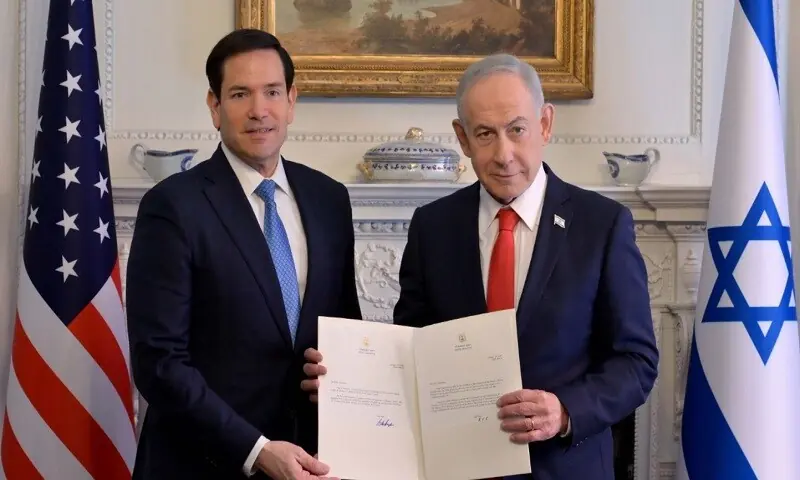
The Trump administration has named US Secretary of State Marco Rubio and former UK prime minister Sir Tony Blair as two of the founding members of its "Board of Peace" for Gaza.

Trump's Middle East envoy Steve Witkoff and the president's son-in-law Jared Kushner will also sit on the "founding executive board", the White House said in a statement on Friday.

Trump will act as chairman of the board, which forms part of his 20-point plan to end the war between Israel and Hamas.

It is expected to temporarily oversee the running of Gaza and manage its reconstruction.

Also on the founding executive board are Marc Rowan, the head of a private equity firm, World Bank chief Ajay Banga and a US national security adviser, Robert Gabriel.

Each member would have a portfolio "critical to Gaza's stabilisation and long-term success", the White House statement said.

Trump had said on Thursday that the board had been formed, calling it the "Greatest and Most Prestigious Board ever assembled at any time, any place".

Further members of the board would be named in the coming weeks, the White House said.

Sir Tony was UK prime minister from 1997 to 2007 and took the UK into the Iraq War in 2003. After leaving office, he served as Middle East envoy for the Quartet of international powers (the US, EU, Russia and the UN).

In this role, he focused on bringing economic development to Palestine and creating the conditions to move towards a two state-solution.

Sir Tony had already been a part of high-level talks about Gaza's future with the US and other parties. In August, he joined a White House meeting with Trump to discuss plans for the territory, which Witkoff described as "very comprehensive".

In September, Health Secretary Wes Streeting told the BBC that involving Sir Tony in such talks, given his record on the Iraq War, would "raise some eyebrows".

But Streeting also noted the former prime minister's role in brokering the 1998 Good Friday Agreement to end Northern Ireland's Troubles.

"If he can bring those considerable skills there, in both diplomacy and state craft," Streeting told the BBC, "that can only be a good thing".

It comes after the announcement of a separate 15-member Palestinian technocratic committee, the National Committee for the Administration of Gaza (NCAG), charged with managing the day-to-day governance of post-war Gaza.

Ali Shaath, a former deputy minister in the Palestinian Authority (PA) which governs parts of the occupied West Bank not under Israeli control, will head that new committee.

The statement also said that Nickolay Mladenov, a Bulgarian politician and former UN Middle East envoy, would be the board's representative on the ground in Gaza working with the NCAG.

Trump's plan says an International Stabilisation Force (ISF) will also be deployed to Gaza to train and support vetted Palestinian police forces and the White House statement said that US Major General Jasper Jeffers would head this force to "establish security, preserve peace, and establish a durable terror-free environment".

The White House said that a separate "Gaza executive board" was being formed that would help support governance and includes some of the same names as the founding executive board as well as further appointees.

The US peace plan came into force in October and has since entered its second phase, but there remains a lack of clarity about the future of Gaza and the 2.1 million Palestinians who live there.

Under phase one, Hamas and Israel agreed a ceasefire in October, as well as a hostage-prisoner exchange, a partial Israeli withdrawal, and an aid surge.

Earlier this week Witkoff said phase two would see the reconstruction and full demilitarisation of Gaza, including the disarmament of Hamas and other Palestinian groups.

"The US expects Hamas to comply fully with its obligations," he warned, noting these include the return of the body of the last dead Israeli hostage. "Failure to do so will bring serious consequences."

However the ceasefire is fragile, with both sides accusing each other of repeated violations.

Almost 450 Palestinians have been killed in Israeli strikes since it came into force, according to Gaza's Hamas-run health ministry, while the Israeli military says three of its soldiers have been killed in attacks by Palestinian groups during the same period.

Humanitarian conditions in the territory remain dire, according to the UN, which has stressed the need for the unrestricted flow of critical supplies.

The war in Gaza was triggered by the Hamas-led attack on southern Israel on 7 October 2023, in which about 1,200 people were killed and 251 others were taken hostage.

More than 71,260 people have been killed in Israeli attacks in Gaza since then, according to the territory's Hamas-run health ministry.

BBC
 

Trump invites more global leaders to join Gaza 'Board of Peace'​


United States President Donald Trump's so-called "Board of Peace" for postconflict Gaza began to take shape on Saturday, with the leaders of Egypt, Turkiye, Argentina and Canada asked to join.

The board is set to supervise the temporary governance of Gaza, which has been under a fragile ceasefire since October and lies in rubble after two-plus years of relentless Israeli bombardment.

The White House said the Board of Peace will take on issues such as "governance capacity-building, regional relations, reconstruction, investment attraction, large-scale funding and capital mobilisation".

Trump, a real-estate developer, has previously mused about turning devastated Gaza into a Riviera-style area of resorts, although he has backed away from calls to forcibly displace the population.

The other members of the board are World Bank President Ajay Banga, an Indian-born American businessman; billionaire US financier Marc Rowan; and Robert Gabriel, a loyal Trump aide who serves on the National Security Council.

Israel's military said on Friday it had again hit the Gaza Strip in response to a "blatant violation" of the ceasefire declared in October.

The strikes come despite Washington announcing that the Gaza plan had gone on to a second phase — from implementing the ceasefire to disarming Hamas, whose October 2023 attack on Israel prompted the massive Israeli offensive.

Trump also named US Major General Jasper Jeffers a day ago to head the International Stabilisation Force, which will be tasked with providing security in Gaza and training a new police force to succeed Hamas.

Jeffers, from special operations in US Central Command, in late 2024 was put in charge of monitoring a ceasefire between Lebanon and Israel, which has continued periodic strikes aimed at Hezbollah militants.

The US has been searching the world for countries to contribute to the force, with Indonesia an early volunteer.

But diplomats expect challenges in seeing countries send troops so long as Hamas does not agree to disarm fully.

Gaza native and former Palestinian Authority deputy minister Ali Shaath was earlier tapped to head the governing committee.

The committee's meeting in Cairo also included Bulgarian diplomat Nickolay Mladenov, who was given the role of high representative liaising between the new governing body and Trump's Board of Peace.

Committee members are scheduled to meet again today, one of them told AFP on condition of anonymity.

"We hope to go to Gaza next week or the week after; our work is there, and we need to be there," he said.

Trump also named a second "executive board" that appears designed to have a more advisory role.

Blair, Witkoff and Mladenov will serve on it, as well as Turkish Foreign Minister Hakan Fidan.

Israel has refused a Turkish role in the security force, owing to President Erdogan's fiery denunciations of Israel's actions in Gaza.

The board will also include senior figures from mediators Egypt and Qatar, and the United Arab Emirates, which normalised ties with Israel in 2020.

Trump also named to the board Sigrid Kaag, the UN humanitarian coordinator for Gaza, despite his administration's efforts to sideline the world body.

Source: Reuters
 
Seven more countries agree to join Trump's Board of Peace

Seven countries including Saudi Arabia, Turkey and Egypt say they will join US president Donald Trump's Board of Peace, according to a joint statement.

They will join Israel, which also publicly confirmed its participation earlier.

On Wednesday evening Trump said Vladimir Putin had also agreed to join - but the Russian president said his country was still studying the invitation.

The board was originally thought to be aimed at helping end the two-year war between Israel and Hamas in Gaza and oversee reconstruction. But its proposed charter does not mention the Palestinian territory and appears to be designed to supplant functions of the UN.


Saaar free Palestine, saarr death to Israel. But but Pakistan PM is sitting Along with Israel PM just because uncle Sam ordered.

Isko bolte hai humiliation.

:klopp :ko
 

Israel accused of extracting billions from Gaza through wartime trade controls​


Israeli occupation authorities have intensified economic measures against the Gaza Strip during the ongoing war, imposing what Palestinian sources describe as “forced arrangements” that have enabled Israel to extract vast sums from Gaza’s economy while deepening humanitarian suffering.

According to information obtained by Arabi21 from informed sources, Israeli forces have effectively turned Gaza’s markets and commercial sector into a new arena of pressure, using trade restrictions and financial controls as tools to punish the population and exhaust its remaining resources. The sources said these measures have contributed to financing part of the cost of the war from the pockets of Gaza’s residents themselves.

The sources explained that Israeli authorities have restricted the import of goods into Gaza to a very limited number of merchants, allowing only 10 traders to bring in commercial supplies. These arrangements, they said, are carried out through opaque procedures that are not subject to Palestinian oversight and do not involve the Gaza Chamber of Commerce.

As a result, the sources noted, a black market has flourished, monopolies have emerged, and the cost of goods has soared due to the imposition of high fees on imports and the concentration of commercial activity in the hands of a small group of approved traders.

The same sources indicated that at least one of the merchants granted permission to import goods is linked to the so-called Gaza Humanitarian Foundation, which was established by Washington in coordination with Israel. The foundation has been widely criticised and has been associated, according to Palestinian accounts, with incidents in which large numbers of Palestinians were killed while attempting to access aid at its distribution points before those centres were later dismantled.

Palestinian observers say these economic measures form part of a broader strategy aimed at creating unbearable living conditions in Gaza, with the objective of encouraging what they describe as “soft displacement” after military means failed to achieve that outcome.

Source: Middle East Monitor
 
The only people who should disarm are the zionest extremists!

They just butchered their over 30 thousand kids , all innocent. Many still buried under rubble , yet they have the audacity to send more troops to call it a great moment for Gazans ? Even nations that support Israel spoke out apart from extremist Jews and extremist Hindus . Both are cowardly and can never take on anyone their size
 
It’s a dark day for Pakistan . This will be remember in history. Pakistan rulers have sold out , prob soon will be bending over to Zionism as India has done since the late 90s

Brother, Unc Shebby is pragmatic. He always made it clear that beggars cannot be choosers. That’s why he got flak from Immy Khan who said that it’s not the Pakistani awaam which was beggar but him (Shebby unc and his corrupt family).
 
Brother, Unc Shebby is pragmatic. He always made it clear that beggars cannot be choosers. That’s why he got flak from Immy Khan who said that it’s not the Pakistani awaam which was beggar but him (Shebby unc and his corrupt family).

You have no idea brother lol see below
 
If only this man was a leader of a Muslim nation

He's not doing it for Muslims, he's doing it because Trump is forcing this new 'board' as a UN replacement. An organisation where only the US will have power. It's also why the UK, France and China have not joined it, why would they when they have huge power in the UNSC? If everyone joined it the UN, as dire as it is, will be totally finished. Even with the other UNSC members not joining it, if most of the globe joins this organisation then UN is finished. If it was not already but now the pretense will be over. No major power wants to join an organisation run by the US.

Putin is not Palestine's friend, the Iranians themselves many times have said in communiques that Putin refuses to sell them anything worthwhile due to his relationship with Israel. Just like Syria where Israel pounded Syria with agreements from the Russians. I have read many books, many things on Israel and Russia and how Israel learnt from the USSR (how terrified the USSR made it) and have since kept every super power from US, China and Russia on its side to stop them from arming Israel's enemies in any meaningful way and how far Israel has gone in this regard when it comes to Russia, even hugely angering the US many times. Israel itself has a huge (if not the dominant) populace from ex Soviet states with Russian being its major language after Hebrew. Putin himself lovingly calls Israel little Russia and has in the past many times said to diplomats he feels the same affinity for them as he does for ethnic Russians in other ex Soviet states.

Putin has, just like Tate before with his fake conversion which now everyone can see for what it was, said statements to get Muslims praising the Russians when on the actual field it's just meaningless words. The real issue is on Security Countil power wants to join this organisation where instead of the UN it's just the US as the dominant power. Imagine if the Security Council just had the US in it, this is what this new board of peace nonsense is.

I agree with almost everything you say but not here I am afraid bro :D
 
He's not doing it for Muslims, he's doing it because Trump is forcing this new 'board' as a UN replacement. An organisation where only the US will have power. It's also why the UK, France and China have not joined it, why would they when they have huge power in the UNSC? If everyone joined it the UN, as dire as it is, will be totally finished. Even with the other UNSC members not joining it, if most of the globe joins this organisation then UN is finished. If it was not already but now the pretense will be over. No major power wants to join an organisation run by the US.

Putin is not Palestine's friend, the Iranians themselves many times have said in communiques that Putin refuses to sell them anything worthwhile due to his relationship with Israel. Just like Syria where Israel pounded Syria with agreements from the Russians. I have read many books, many things on Israel and Russia and how Israel learnt from the USSR (how terrified the USSR made it) and have since kept every super power from US, China and Russia on its side to stop them from arming Israel's enemies in any meaningful way and how far Israel has gone in this regard when it comes to Russia, even hugely angering the US many times. Israel itself has a huge (if not the dominant) populace from ex Soviet states with Russian being its major language after Hebrew. Putin himself lovingly calls Israel little Russia and has in the past many times said to diplomats he feels the same affinity for them as he does for ethnic Russians in other ex Soviet states.

Putin has, just like Tate before with his fake conversion which now everyone can see for what it was, said statements to get Muslims praising the Russians when on the actual field it's just meaningless words. The real issue is on Security Countil power wants to join this organisation where instead of the UN it's just the US as the dominant power. Imagine if the Security Council just had the US in it, this is what this new board of peace nonsense is.

I agree with almost everything you say but not here I am afraid bro :D
Thats fine bro , we are always respectful in disagreeing.

I would say in response two points .

1. Russia today is not the Soviets . Putin himself used to hide and pray as Christianity and faith in general was not approved of in the open . Putin changed the future of the Russian lands and people. Russians were eating out of pots cold soup , driving ladas around . In less than 30 years hes transformed the federation, Moscow is better than American city , looking forward to visiting soon .

2. Israel was too scared , backed out of attacking Iran because no nation on the planet had hit Israel as Iran did in the 12 day war . Not sure what you’ve read but even Houthis have hypersonic missiles, given by Iran , given to them by Russia.
See below Zionists are admitting they are scared.
 
Anyone who believes Donald Trump in 2026, the guy who lies more than he breathes and makes a u turn every day, needs to get their brain checked for entropy.
 
Rabid settlers following the footsteps of their politicians
===

Israeli settlers set fire to three villages in occupied West Bank​

Armed Israeli settlers have set fire to three Palestinian villages in Masafer Yatta in the occupied West Bank.

The settlers then blocked ambulances and medics from helping those injured, with Palestinian families left watching their homes burn down.

According to the UN, more than 1,800 settler attacks – about five per day – were documented in 2025, resulting in casualties or property damage in about 280 communities across the West Bank, and beating the previous year’s record of settler attacks by more than 350.

Source: Al Jazeera
 

Israel accepts Gaza’s 70,000 death toll: A record of denialism, lies​


After more than two years of bombarding Gaza, Israel’s military appears to have accepted the death toll in the enclave that the Palestinian Ministry of Health in Gaza has been compiling, painstakingly and against the odds.

Since the start of its genocidal war on Gaza on October 7, 2023, Israel has repeatedly dismissed, denied or downplayed the scale of death and devastation in the territory documented by journalists, Palestinians and Gaza’s authorities. It has at times issued its own statistics on people killed, then changed them, while accusing Palestinians and Gaza officials of exaggerating the death toll, especially of civilians.

But on Thursday, an Israeli army official told journalists in the country that the army accepted that about 70,000 people had been killed in Gaza during the war.

The Gaza Health Ministry estimates that as of January 27 this year, at least 71,662 people have been killed since the start of the war on October 7, 2023. Of those, 488 people have been killed since the declaration of a ceasefire in the Gaza Strip on October 10, 2025.

Thousands more are missing and believed to be buried under rubble. According to the National Committee for Missing Persons, that figure could exceed 10,000. Meanwhile, the Health Ministry has said that at least 440 people died of starvation during the war.

The senior Israeli military official did not acknowledge that a vast majority of those killed in Gaza are civilians – most are children and women – or that hundreds have starved to death and that thousands more are buried under rubble in Gaza
.
Still, the acceptance of the Gaza Health Ministry’s death toll marks a break from Israel’s past claims.

At the same time, it follows a pattern: during its war on Gaza, and well before, Israel has frequently denied narratives of killings its forces have perpetrated, despite evidence to the contrary, only to later grudgingly acknowledge what happened – often when the facts became impossible to deny.

So what’s behind Israel’s sudden acceptance of the Gaza death toll – and its history of denialism?

What do we know about the real number of dead and injured in Gaza?​

Since Israel’s war on Gaza began in October 2023, the Palestinian Health Ministry in Gaza has been counting the number of dead bodies by recording their names and keeping a track of ID numbers.

The Health Ministry has also recorded the number of people injured and the number of people who have starved to death as a result of Israel cutting off vital aid supplies to Gaza during the war.

As of January 27, the ministry said that at least 171,428 people were injured in the war and 1,350 more have been injured since the ceasefire.
The United Nations and human rights groups have also backed the Health Ministry’s figures.

Human rights organisations have also accused Israeli forces of deliberately targeting civilians.

In particular, between May and July 2025, more than 1,000 Palestinian people were killed by the Israeli military at United States-led food distribution sites, according to the Euro-Med Human Rights Monitor and a retired US special forces officer, Anthony Aguilar

Aguilar was formerly employed by the Gaza Humanitarian Foundation (GHF), a nonprofit backed by the US and Israel to provide those distribution sites, after Israel accused the United Nations Palestinian refugee authority, UNRWA, of aiding Hamas.

“Without question, I witnessed war crimes by the [Israeli military],” Aguilar told the BBC in an exclusive interview in 2025.

Source: Al Jazeera
 
New Zealand a much smaller nation has more guts to say no to USA than Pakistan which despite being an Islamic nation sold itself to Zionist forces just so that the illegal regime of corrupt leaders and military dictators could stay in power and continue looting the majestic nation of Pakistan for many more years.


Israel reopens Gaza's key Rafah border crossing with Egypt​


Palestinians have started to enter the Rafah border crossing between the Gaza Strip and Egypt after it reopened for the movement of people.

The crossing has largely been closed since May 2024, when the Gazan side was captured by Israeli forces.

The reopening was supposed to happen during the first phase of US President Donald Trump's ceasefire plan between Israel and Hamas, which began in October. But Israel blocked it until the return of the body of the last Israeli hostage in Gaza, which happened last week.

It will come as a relief to many Palestinians who see it as a lifeline to the world, although there is frustration that only small numbers of people and no goods will be allowed through.

Around 20,000 sick and wounded Palestinians are waiting to leave Gaza for treatment, according to local hospitals and the World Health Organization (WHO).

Israeli reports say only 50 patients - accompanied by one or two relatives - will be allowed to exit each day, and that 50 people who left Gaza during the war will be allowed to return.

The crossing will be run by supervisors from the European Union and local Palestinian staff, while Israel will carry out remote security checks.

On Monday morning, an Israeli security official said the Rafah crossing had "now opened to the movement of residents, for both entry and exit" following the arrival of teams from the European Union Border Assistance Mission (EUBAM).

Al Qahera News TV, which is close to Egyptian intelligence, meanwhile said the crossing had "received the first batch of Palestinians returning from Egypt to the Gaza Strip". It added that the move came "as part of Egyptian efforts to facilitate movement through the crossing".

A Palestinian mother, Sabrine al-Da'ma, told the BBC she was hoping to travel abroad with her 16-year-old daughter, Rawa, who suffers from kidney disease. She plans to donate Rawa one of her kidneys.

"She used to be treated through monitoring, ultrasound imaging and tests to check the condition of her kidneys. Since the war started, because of food shortages, hunger, and the food she was forced to eat, she began dialysis," Da'ma said.

"We hope they will speed up our referral so that we can travel quickly, because she is getting exhausted. I am also 45 years old, and they may tell me that as I get older, I won't be able to donate anymore. That's why we're rushing."

On Sunday, Israeli authorities said a trial opening of the crossing was carried out and completed.

One Palestinian official familiar with the arrangements for the trial told the BBC that around 30 Palestinian staff members had arrived at the Egyptian side of the crossing, ahead of the initial operational phase.

The WHO will oversee the transfer of patients from territory under Hamas control, transporting them by bus to the crossing over the so-called "Yellow Line" and into territory controlled by the Israeli military, the BBC understands.

Trump's 20-point Gaza peace plan says the reopening of the Rafah crossing in both directions will be subject to the same mechanism implemented under a previous ceasefire deal in January last year.

Before being seized by Israel in 2024, the crossing was the main exit point for Palestinians allowed to leave during the war and a key entry point for humanitarian aid. Now, aid that enters from Egypt is routed via Israel's Kerem Shalom crossing point.

In December, the Israeli government said the Rafah crossing would open to allow Palestinians to leave Gaza. But Egypt said the crossing would only be opened if movement was allowed in both directions.

More than 30,000 Gazans have registered with the Palestinian embassy in Cairo to be allowed to return to Gaza.

The crossing's opening was delayed due to the Israeli government making it conditional on Hamas handing over the body of the last dead Israeli hostage in Gaza.

Last week, the Israeli military said its troops had retrieved the remains of police officer Master Sgt Ran Gvili at a cemetery in northern Gaza.

He was one of the 251 people abducted by Hamas and its allies during their attack on Israel on 7 October 2023, which killed around 1,200 people.

Israel's military campaign in Gaza, launched in response to the attack, has killed more than 71,790 Palestinians, according to the territory's Hamas-run health ministry.


Bloody forces operating unabated 😡

===

Israeli army shells multiple Gaza areas, kills Palestinian man despite ceasefire​


A Palestinian was killed by Israeli gunfire in Gaza City’s Shujaeya neighbourhood on Saturday as Israeli forces shelled areas across Gaza and carried out demolitions east of Khan Younis, despite the ceasefire deal.

A medical source told Anadolu that the Palestinian, Faraj Ibrahim Salem, 30, was killed by Israeli fire in the Shujaeya neighbourhood east of Gaza City.

Eyewitnesses said that Salem was shot dead in an area located outside the zones of Israeli army deployment and control under the agreement.

Earlier Saturday, Israeli artillery shelled various areas east of Gaza City and east of the town of Jabalia in northern Gaza, while the army carried out demolition operations east of Khan Younis in the south of the enclave, according to eyewitnesses.

The attacks came as part of Israel’s daily violations of the ceasefire agreement in force since October 10.

Israeli naval vessels also opened fire toward the coasts of Rafah and Khan Younis, while an Israeli helicopter fired shots over Rafah.

Ceasefire violations

Israel has continued to violate the ceasefire deal despite a January announcement by the US administration that the second phase of the agreement had begun.

That phase includes additional Israeli withdrawals from Gaza and the launch of reconstruction efforts, which the United Nations estimates will cost about 70 billion dollars.

The ceasefire halted an Israeli offensive that began in October 2023, killing nearly 72,000 Palestinians and wounding more than 171,000 others, while destroying about 90 percent of Gaza’s infrastructure.

Despite the ceasefire agreement, the Israeli army has continued to violate it, killing 574 Palestinians and wounding 1,518 others, according to Gaza’s Health Ministry.

TRT World
 
Israel security cabinet approves rules to increase control over West Bank

Israel’s security cabinet has approved new rules aimed at strengthening Israeli control over the occupied West Bank, according to local media reports, drawing condemnation from Palestinian authorities.

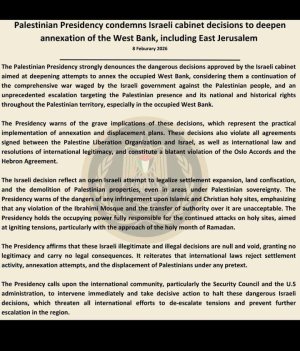
The Palestinian presidency, in a statement on Sunday, called the decision “dangerous” and an “open Israeli attempt to legalize settlement expansion” and land confiscation. The office of President Mahmoud Abbas called for the United States and the United Nations Security Council to intervene immediately.

Jordan’s Ministry of Foreign Affairs also condemned the decision, which it said was “aimed at imposing illegal Israeli sovereignty” and entrenching settlements.

The Hamas group called on Palestinians in the West Bank to “intensify the confrontation with the occupation and its settlers.”

The rules will make it easier for Israeli settlers to buy land in the occupied West Bank and give Israeli officials stronger powers to enforce laws on Palestinians in the area, Israeli media reported.

The West Bank is among the areas that Palestinians seek for a future independent state, along with Gaza and occupied East Jerusalem. Much of the West Bank is under direct Israeli military control, with extremely limited Palestinian self-rule in some areas, governed by the Western-backed Palestinian Authority (PA).

According to the Israeli news outlets Ynet and Haaretz, the new steps include removing rules that stopped private Jewish individuals from buying land in the occupied West Bank.

The measures also include allowing Israeli authorities to take charge of managing some religious sites, and increasing Israeli supervision and enforcement in areas run by the PA, according to the media reports.


Israel security cabinet approves rules to increase control over West Bank

Israel’s security cabinet has approved new rules aimed at strengthening Israeli control over the occupied West Bank, according to local media reports, drawing condemnation from Palestinian authorities.

The Palestinian presidency, in a statement on Sunday, called the decision “dangerous” and an “open Israeli attempt to legalize settlement expansion” and land confiscation. The office of President Mahmoud Abbas called for the United States and the United Nations Security Council to intervene immediately.

Jordan’s Ministry of Foreign Affairs also condemned the decision, which it said was “aimed at imposing illegal Israeli sovereignty” and entrenching settlements.

The Hamas group called on Palestinians in the West Bank to “intensify the confrontation with the occupation and its settlers.”

The rules will make it easier for Israeli settlers to buy land in the occupied West Bank and give Israeli officials stronger powers to enforce laws on Palestinians in the area, Israeli media reported.

The West Bank is among the areas that Palestinians seek for a future independent state, along with Gaza and occupied East Jerusalem. Much of the West Bank is under direct Israeli military control, with extremely limited Palestinian self-rule in some areas, governed by the Western-backed Palestinian Authority (PA).

According to the Israeli news outlets Ynet and Haaretz, the new steps include removing rules that stopped private Jewish individuals from buying land in the occupied West Bank.

The measures also include allowing Israeli authorities to take charge of managing some religious sites, and increasing Israeli supervision and enforcement in areas run by the PA, according to the media reports.


IMG-20260209-WA0017.jpg
 
What do the die hard " noon fans" think of their Puppet Governments decision to join the so called " Gazans Peace Force"

No that $ Netanyahu and his clan have also joined the ranks.

 
Last edited by a moderator:

Explosions in Gaza, 54 wounded in West Bank settler attacks​


At least 54 Palestinians have been wounded in attacks by Israeli settlers under the protection of Israeli forces across the occupied West Bank today.

China says a lasting ceasefire in Gaza could pave the way for full de-escalation in the Red Sea and stressed that regional stability is closely interconnected.

Britain’s High Court has ruled that the government’s decision to outlaw the protest group Palestine Action as a terrorist organisation was unlawful.

Israel’s genocidal war on Gaza has killed at least 72,045 people and wounded 171,686 since October 2023. An estimated 1,139 people were killed in Israel during the October 7, 2023, attacks, and about 250 were taken captive.

Source: Al Jazeera
 
'We are not protected' says Hebron mayor as Israel expands West Bank control

A Palestinian official in the occupied West Bank has described Israel's latest expansion of control there as "the end of the road" for negotiations between Israelis and Palestinians.

Asma al-Sharabati, acting mayor of Hebron, said new legal changes recently announced by Israeli cabinet ministers would leave Palestinian authorities shut out of decisions on urban planning and development, even in areas under Palestinian control.

Hebron is a regular flashpoint in the West Bank - a divided city, where soldiers guard hundreds of Israeli settlers living alongside Palestinians in an Israeli military garrison.

On Sunday, the Israeli security cabinet passed major changes to the established division of powers in the West Bank, set up three decades ago under the US-backed Oslo Accords, signed by both Israeli and Palestinian leaders.

They include expanding Israeli control beyond its military occupation, into the provision of municipal services in Palestinian-run areas, as well as broad powers to take over so-called "heritage sites" across the West Bank – to protect water, environmental and archaeological resources, they say.

Israel also says it will take over planning authority at the Cave of the Patriarchs in Hebron, one of the holiest sites in Judaism, which sits inside the city's Ibrahimi Mosque.

"Now they can simply put their hands on any building and declare it is ancient, and the Palestinian authorities are not part of any decision on urban planning or development of the area," said al-Sharabati.

She told us she had not received any formal notification of Israel's plans, and was picking up the details from Israeli news.

A few metres from Hebron's bustling vegetable market, through the grey steel gates of the Israeli checkpoint, is a tense and deserted landscape, where Palestinian shops are shuttered, and streets closed off to protect Israeli settlers.

Issa Amro, a Palestinian activist, lives inside that volatile divided area, known as H2. The long and winding route to his house takes us through the back gardens of Palestinian homes, and along stony pathways, to a hill overlooking the neighbourhood.

When we arrive, an ultra-Orthodox Jewish couple are picnicking under the trees outside. A local settler appears from a neighbouring house and follows us a little way down the path.

Inside Issa's house, a plaque reads "Free Palestine". Through his window, a vast Israeli flag can be seen fluttering over the streets below.

He points out the Palestinian buildings nearby, emptied of residents after years of tension and expanding Israeli control.

But Issa says these new changes are different.

"They were expanding a lot without any legal basis," he said. "Now they [will be] the law. They are changing the status from Occupied Territories to a legal dispute. It's part of Israel now without any rights for me. It's annexation of the land without me, as a Palestinian."

Israel plans to start providing municipal services to Jewish settlers in Hebron, and open up land ownership across the West Bank to private Israeli citizens. Palestinians are banned from selling property to non-Palestinians under both Jordanian and Palestinian law.

Some of those who sold covertly to Israelis in the past now face real risks from Israel's planned publication of classified land registry there.

The social taboo of selling to the Israeli occupier runs deep.

Jibril Moragh lives next to Hebron's Ibrahimi Mosque. He told me that he had refused an offer from a group of Israelis to buy his house 18 years ago.

"One of them offered me 25 million shekels [$8m], but I refused," Jibril told me. "The man said he would pay whatever I wanted, and that I could keep living here for as long as I liked. But you don't sell to the occupation [Israel]."

More than 700,000 Israeli settlers live in the occupied West Bank and Israeli-annexed East Jerusalem, territories captured by Israel from Jordan in the 1967 Middle East War. Those lands are wanted by Palestinians for their hoped-for independent state along with the Gaza Strip.

The settlements are illegal under international law.

'Burying' Palestinian statehood

The opening up of property rights, and the sweeping transfer of civilian powers in Palestinian-run areas, marks a significant shift in Israel's long expansion of control over the West Bank, which has escalated after the 7 October 2023 Hamas attacks on Israel, and the war in Gaza.

"We are deepening our roots in all parts of the land of Israel," said Finance Minister, Bezalel Smotrich, who has responsibility for settlement policies, when he announced the new measures. "And burying the idea of a Palestinian state."

"Judea and Samaria is the Jewish homeland of the people of Israel," said Zvi Sukkot, a lawmaker in Smotrich's far-right Religious Zionism party. "I expect there to be full Israeli sovereignty here, but in the meantime at least we can supervise, so there will be no environmental harm, and we won't harm the heritage of the people of Israel, even if it's in Palestinian-run areas."

But these latest legal changes not only demolish the agreements Israel signed decades ago, they also drive a hole through the remaining powers of the Palestinian Authority, which has been earmarked in Donald Trump's peace plan to eventually take over power from Hamas.

"We are living the ugly truth that we are not protected," said Hebron mayor, al-Sharabati. "Institutions are not protecting us. And the world is seeing the Gaza Strip and the massacres, and talking about them, but no more than that."

Palestinian President Mahmoud Abbas has called for a "firm response" from the US government, saying Israel's decision disrupts Donald Trump's efforts in the region and violates international law.

So far, President Trump has said little beyond reiterating his opposition to Israel's formal annexation of the West Bank.

Several countries, including the UK, last year recognised a Palestinian State. Now that Israel has given itself civilian powers in Palestinian-controlled territory, we asked the UK government what it would do in response.

Hamish Falconer, the Under-Secretary of State for the Middle East, told us that people could expect to hear more from the UK government in the coming days.

"We strongly condemn the decision and expect to see it reversed," he said. "Almost all of Israel's friends are saying this is a terrible, terrible mistake."

The expansion of Israeli presence and control across the West Bank has continued while international focus remains on Gaza.

But Trump's plan for Gaza depends on the support of Arab countries, many of whom are demanding progress towards a Palestinian state.

What happens in Hebron – and the rest of the West Bank - could still threaten Trump's vision for Gaza, and his plan for wider Middle East peace.

BBC
 

A Hypocrite always remain an ally of another hypocrite​

===

Over 80 international artists condemn Berlin Festival’s silence on Israel’s Gaza war​

More than 80 actors and directors have sent an open letter to the organisers of the Berlin International Film Festival, urging them to take a clear stance against the mass killings of Palestinians.

Indian novelist Arundhati Roy announced her withdrawal from the festival in protest at the organisers’ failure to adopt a firm position against Israel’s actions and the ongoing war in Gaza.

The letter criticised the festival’s silence on Israeli crimes against the Palestinian people.

The letter signatories included well-known names from the film industry, such as Spanish actor Javier Bardem, British actress Tilda Swinton, and directors Adam McKay, Fernando Meirelles, and Mike Leigh, as well as French artists Blanche Gardin and Adèle Haenel.

Coordinated by the group Film Workers for Palestine, the letter stated that the signatories were “appalled by the continued involvement of the Berlin Festival in silencing artists who oppose the ongoing massacre of Palestinians in Gaza,” and called on the festival to “ fulfil its moral duty and clearly state its opposition to Israel’s genocide, crimes against humanity and war crimes against Palestinians,” and completely end its involvement in shielding Israel from criticism and calls for accountability.”

Source: MEMO
 
Hamas is reasserting control in Gaza despite its heavy losses fighting Israel

When a US-imposed ceasefire halted the Gaza War last October, Hamas's war for survival against Israel switched into a battle for control at home.

The war had left the group's disciplined military units shattered into guerrilla forces, and most of its leaders killed; Gaza's buildings and infrastructure were largely destroyed, its population displaced, and its economic life in ruins. More than 72,000 Gazans were killed by Israeli attacks during the conflict, the Hamas-run health ministry says.

Four months on, Gazans say Hamas is again extending its control over security, tax revenue, and government services, raising questions about its long-term strategy, and whether it is prepared to give up its weapons and authority, as now required under the second stage of Donald Trump's peace plan.

"Hamas regained control of more than 90% of the areas where it is present," said Mohammed Diab, an activist in Gaza.

"Its police and security agencies have returned, and are now present in the streets, controlling crime and pursuing those it labels as collaborators and people with opinions. Citizens must go to the Hamas authorities for identity cards or health procedures, and it is also reasserting control over the judiciary and courts."

At markets across Gaza, stallholders describe regular police patrols – and a renewed iron grip on official fees and taxes.

"The markets are quiet, but the municipality keeps pursuing us for rent," one stallholder said. All those we spoke to there about Hamas control in Gaza asked that we hide their identity.

"Every single day they come to us aggressively, with the same demands and the same determination, saying if we don't pay they'll throw us and our goods into the street. They're asking for 700 shekels ($225; £167) – none of us can afford that."

EPA

Gaza is now in ruins, and is grappling with severe shortages of shelter, education and basic services

The stallholder, who spoke to our colleague in Gaza City, said he and his family of 12 had been displaced from Shujaiya to the east of the city, where he used to run a shop. Shujaiya today is a flat wasteland of rubble.

"Every day, the municipality comes," said another man selling cigarettes nearby. "Let them count the stock and the sales, cigarette by cigarette, and tell me: should I pay them, or feed my children?"

Since the ceasefire, food and some other basic goods are flowing into Gaza more freely. The few key traders with a licence to bring them in from Israel say Hamas have reimposed strict control over taxing the imports.

One trader, who agreed to share details anonymously, told us force was used against those who refused to pay.

"The taxes imposed by Hamas depend on the type and quantity of goods, but prices start at 20,000 shekels and above," he said. "If a trader refuses to pay, force is used and in some cases he is kidnapped or threatened. No one can avoid paying taxes on goods."

He told us that traders used a code-word for Hamas when discussing tax payments, so that Israel wouldn't learn that money was being siphoned off to the group.

"Hamas now has a database of all the traders who import goods into the Gaza Strip," said the activist Mohammed Diab. "The trader pays in cash, not through bank transfers, so that the flow of funds cannot be traced. It is gradually restoring the system that was in place in the past, but away from the spotlight so it can't be monitored."

A Hamas spokesman, Hazem Qassem, said the Gaza Strip was in a state of emergency and that "exceptional measures" were required.

"Some traders maintain links with the [Israeli] occupation and attempt to generate excessive profits, so administrative bodies sometimes need to act firmly with traders who refuse to cooperate or meet required obligations," he said. "This is purely a governmental matter and has no relation to Hamas."

Gaza's government has been run by Hamas since 2007. Money is crucial to the group's grip on power: to pay salaries – and, the Israeli army alleges, for its ultimate goal of rebuilding its war machine.

"Hamas looks at the ceasefire as a time to regroup, to fight against us," said Lt Col Nadav Shoshani, spokesman for the Israel Defence Forces (IDF). "This is why it's crucial to see them disarmed because they've made it clear that if they have weapons, they will use them sometime in the future."

The Israeli army says there are daily attacks against its forces by Hamas. Four Israeli soldiers have been killed since the ceasefire began.

Hamas, in turn, points to repeated Israeli attacks, which Gaza's Health Ministry says have killed 603 Palestinians.

The IDF recently released grainy footage of several figures running through Gaza's debris, who it identified as "armed terrorists" approaching troops in the area of Gaza temporarily controlled by Israel under Trump's peace plan.

Asked whether two years of intense military conflict had failed to achieve the destruction of Hamas's military capabilities - a key Israeli war goal – Lt Col Shoshani said the group had been heavily diminished, but was now trying to rebuild.

"This war is not done until Hamas is disarmed," he said. "There is an agreement now in place [and] we expect that to happen. If not, there are a lot of tools on the table to make sure that does happen."

Trump's new Board of Peace, comprising the heads of state from many countries with a stake in Gaza's future, will hold its first meeting in Washington on Thursday.

The next stage of Trump's plan for Gaza – including its reconstruction – hinges on Hamas disarmament, but negotiators are still inching through the detail of what the handover of weapons would mean in practice – who would Hamas hand weapons over to, which weapons would they hand over, and how would that be verified.

"I believe we are capable of addressing the issue of weapons in a way that removes the Occupation's pretext to renew the war and is also compatible with President Trump's plan," Hamas spokesman Hazem Qassem told the BBC.

But Hamas, ideologically committed to fighting Israel, has a deeply-rooted and well-armed membership across the Gaza Strip. Verifying its full disarmament will be difficult, and some in the group have reportedly demanded they be allowed to keep personal weapons to defend themselves against enemies at home.

When the fighting with Israel stopped in October, Hamas immediately turned its guns on rival clans who had begun to take advantage of the chaos to extend their power in Gaza City, Rafah and elsewhere.

Footage of the crackdown, including summary executions of blindfolded rivals in the streets, was released to the public.

Israel's leaders have rejected the idea of Hamas keeping personal arms, and have applied pressure on the group to disarm by threatening a return to war.

In the meantime, an International Stabilisation Force to take over security in Gaza remains in limbo, and the new Palestinian technocratic council meant to take over the running of Gaza's civilian affairs is waiting in Egypt.

Earlier this month Hamas said it was ready to "transfer authority and governance in all fields" to the new technocratic council.

But the Gaza activist, Mohammed Diab, said there were few signs that Hamas was preparing to hand over power.

"On the contrary," he said, "we heard last week that Hamas carried out large-scale appointments to vacant positions in the government sector, and announced them on social media and official platforms."

Hazem Qassem denied any new government recruitment, saying that any appointments would have been technical, low-level positions that did not interfere with the handover of power.

Critics have questioned whether they are an attempt to retain influence inside any future Gaza administration.

The recent transfer of medical cases out of Gaza through the newly-reopened Rafah Crossing also signalled the intention of Hamas to remain in control, despite the new process being designed without the group's involvement.

One of those present at an evacuation point run by international aid organisations near Nasser Hospital reported that Hamas ministry officials had shown up on the second day of evacuations to help supervise.

This is now the make-or-break moment for Trump's plan, which has so far kept on track by relentlessly pushing forward, past hiccups and delays.

Despite repeated threats of a return to renewed fighting if Hamas does not fully disarm, some in Israel believe the most effective pressure on Hamas leadership might actually come from moving forward with the plan without them.

Ground has already been cleared in Israeli-held areas around Rafah, ahead of a reported US plan to build new housing facilities for some 200,000 Gazans, with the promise of food, water and medical support to tempt people across the yellow line from Hamas-controlled areas.

Crossing into the large swathe of Israeli-held territory around Gaza's perimeter is seen by many in Gaza as siding with the enemy, and very few have so far made the journey.

But Gaza's population is a key source of Hamas's revenue and control. After two years fighting Israel for control of the land, the battle for Gaza's people might just be starting.

BBC
 

Another hollow claim by apartheid regime's patron in chief​

===

Trump says war in Gaza ‘over’ despite Israeli attacks​

  • United States President Donald Trump hosted the inaugural meeting of his so-called “Board of Peace” today, at which countries promised $7bn for Gaza’s reconstruction, and six countries pledged troops for an eventual 20,000-strong International Stabilization Force.
  • Trump has been criticised for offering seats on the board to Israel’s Prime Minister Benjamin Netanyahu and Russia’s President Vladimir Putin, both leaders wanted for alleged war crimes by the International Criminal Court.
  • A United Nations report has raised “concerns” over ethnic cleansing in Gaza and the occupied West Bank. Israel’s deadly attacks have continued across Gaza while its forces and settlers have carried out more raids and land grabbing in the occupied West Bank.
  • Israel’s genocidal war on Gaza has killed at least 72,069 people and wounded 171,728 since October 2023. An estimated 1,139 people were killed in Israel during the October 7, 2023, attacks and about 250 were taken captive.
 
Palestinian Authority in dire straits as Israel's hold on West Bank deepens

With Israeli settler violence surging in the occupied West Bank, al-Mughayyir, north-east of Ramallah, has found itself on the frontline. It faces regular incursions by the Israeli army and has seen farmland seized by settlers who have built new outposts.

Marzoq Abu Naim from the village council says the settlers aim to force out Palestinians. "They're doing it silently, not openly, it's true. But this is annexation. We can't reach our lands."

Sitting among green rolling hills, studded with olive groves, most homes in al-Mughayir are in an area where Israel's military controls security, but the internationally backed Palestinian Authority (PA) should provide basic services. Increasingly though, it cannot – it is mired in a deep economic crisis.

"When I go to them, they can't give me the support I need," Abu Naim says. "The Authority has no money!"

After the deadly 7 October Hamas-led attacks on Israel, some 100,000 Palestinians lost permits to work in Israel. On top of that, Israel is withholding tax transfers that it collects for the PA because of an ongoing dispute about Palestinian school texts and stipends to the families of those jailed or killed by Israel, including attackers.

The PA says it is now owed more than $4bn (£3bn; 3.4bn euros). It has been paying most public sector workers – including doctors, police officers and teachers – just 60% of their salaries. Its schools – where more than 600,000 children study – open just three days a week.

"It's truly hard," a mother-of-eight in al-Mughayyir tells me, explaining that the schools there also close when settlers or soldiers are nearby because of fears for the children.

"There is so much disruption that some children have reached fourth grade and still can't read. We put them in private lessons with a teacher in the village. She starts with the alphabet so that they can learn to read from scratch."

Driving away from al-Mughayyir, there are Israeli military gates used to close off Palestinian villages from each other and restrict movement. I also see Israeli bulldozers transforming the landscape, widening roads to connect settlements and give settlers quicker access to Jerusalem. Settlements – illegal under international law – are growing at a record rate.

This all adds to pressure on the PA. When it was set up more than 30 years ago, following on from a breakthrough peace deal with Israel, the Oslo Accords, Palestinians hoped it would quickly become a full government for a Palestinian state in the West Bank and Gaza Strip with East Jerusalem as its capital. The PA was committed to negotiations – non-violent means – to achieve its goal.

The direct talks with Israel that underpinned a peace process finally broke down over a decade ago. Now, the PA's failure to prevent Israel's expansion into the West Bank, let alone deliver statehood, is underscoring its weakness and deepening its unpopularity with Palestinians already dismayed by corruption scandals, political stagnation and continued security coordination with Israel.

I turn to join a line of traffic queuing to pass an Israeli army checkpoint and enter Ramallah – the sprawling administrative capital of the PA. There are Palestinian police on the streets. This is a pocket of the West Bank where the PA retains full control.

But increasingly here, there are warnings that the governing body is close to collapse.

"It is a turning point in our lives," says Sabri Saidam, a former PA minister and deputy chairman of the president's political party.

"Palestinian statehood, Palestinian identity, Palestinian existence on this very territory of their ancestors is being now compromised by Israel, and the existence of the Palestinian Authority at large is also questionable."

This month, new steps by Israel's government are tightening its hold on the West Bank. A top UN official has warned that these amount to "gradual, de facto annexation."

A contentious new land registration process could allow Israel to claim large swathes of the territory as Israeli state land, open to future Israeli development. Israeli enforcement of environmental and archaeological regulations is being expanded into parts of the West Bank under PA civil control.

Israel's far-right finance minister, Bezalel Smotrich, who has responsibility for settlement policies, has said his aim is "to kill" the idea of a Palestinian state. A settler himself, he claims ideological and biblical rights to the land.

At a conference in a settlement near Ramallah on Tuesday, Smotrich pledged to go further if he remains in the Israeli government after elections due this year, saying he would "officially and practically cancel the damn Oslo agreements," and so dismantle the PA. Referring to Palestinians as "the enemy" he promised to promote their emigration.

More than 80 UN member states, along with the EU and the Arab League, have strongly condemned "unilateral Israeli decisions and measures" and called for them to be reversed. However, the US has only reiterated that it opposes West Bank annexation.

Many Palestinians are frustrated and worried. International studies professor, Ghassan Khatib, calls for global pressure on Israel and financial aid to ensure the survival of the PA.

"This should be a wake-up call," he tells me. "The outside world invested a lot politically and financially in the idea of a two-state solution, but these new Israeli measures are aimed at killing the future of a two-state solution."

The devastating war in Gaza has precipitated the decline of the PA. Already it had lost control of the territory back in 2007, a year after Hamas won the last parliamentary election. But it was slow to condemn the deadly Hamas attacks on Israel which triggered the conflict and is now being largely excluded from immediate post-war governance, in line with Israeli demands.

Unlike Israel, the PA does not sit on the US-led Board of Peace. However, it is expected to oversee some 5,000 police officers in Gaza. President Trump's peace plan also foresees the PA eventually taking control of the territory after completing an unspecified "reform programme," and nods to a future when "the conditions may finally be in place for a credible pathway to Palestinian self-determination and statehood."

Israeli leaders have dismissed suggestions that the PA could soon collapse, forcing Israel to take direct responsibility for some 2.7 million Palestinians living in the West Bank as the occupying power.

An Israeli government official tells the BBC: "The Palestinian Authority is a corrupt and morally bankrupt entity which has seen considerable resources siphoned off instead of rightfully going to its own people."

Back in al-Mughayyir, settlers have already pushed Bedouin shepherds off their land nearby. They are grazing their flocks near new encampments they have set up on the edge of the village.

Across the valley, we watch Israeli soldiers park their military jeep and head out on patrol. Soon, they fire tear gas. It has been one month since a 14-year-old Palestinian boy was shot dead by an Israeli soldier here. The army says he threw a rock. On this occasion, the military says stones were thrown at its troops and that they detained the suspects.

While little world attention is being paid to daily realities in the West Bank, locals say the risk of widespread unrest is rising. The danger is that the PA's growing impotence will encourage Palestinians to look to those who offer a less moderate approach.

BBC
 
Israeli soldiers shot a Palestinian boy and stood around as he bled to death, video shows

Last November, a 14-year-old Palestinian boy named Jad Jadallah was shot at close range by Israeli soldiers in a refugee camp in the occupied West Bank.

As Jad lay collapsed in an alley, the soldiers created a cordon around him and blocked two Palestinian ambulances from reaching him.

According to video footage and eyewitness testimony, the soldiers – 14 in total – then stood around Jad casually for at least 45 minutes while he bled from one or more gunshot wounds.

All Israeli soldiers receive training in trauma treatment, and any Israeli combat unit should contain a specifically trained medic, but none of the soldiers appeared to give Jad life-saving medical aid. At points, they appeared to ignore repeated attempts from Jad to get their attention.

The Israel Defence Forces (IDF) told the BBC that soldiers had provided "initial medical treatment", but a spokesperson refused to give any details about the nature or timing of the treatment.

The IDF has also accused Jad of throwing a rock, which, under their rules of engagement, can permit soldiers to use lethal force.

But the footage of the incident shows an IDF soldier dropping an object next to Jad after he was shot, then taking a photograph of it – an action Jad's family and a leading human rights group say appears to be an attempt to frame him.

The soldiers eventually loaded Jad into the back of an Israeli military vehicle, but at some point, either before or after they did, he died. It is still unclear where on his body or how many times he was shot, because the Israeli military has refused to return his body to the family and declined to answer any questions about his injuries.

Jad was born and raised in al-Far'a, a refugee camp in the West Bank that is home to about 10,000 Palestinians. Along with other similar camps in the occupied territories, it is subject to frequent Israeli military raids, which Israel says are necessary to counter armed groups operating there.

In many respects, Jad's death was not unusual. According to the UN, 55 children were killed by Israeli forces in the West Bank last year and 227 have been killed there since the 7 October 2023 Hamas attack on Israel.

But two things stand out about this case. The first is that Jad lay on the ground untreated for so long, with so many soldiers around him, while he died. The second is the emergence of a significant amount of video footage of the incident, which the BBC has verified.

The exact moment of the shooting was captured by a CCTV camera in the camp. The footage shows three boys standing on the corner of an alley. First they peek to their right, where, according to eyewitnesses, Israeli military vehicles had moments earlier driven away towards the exit of the camp.

One of the two friends with Jad at that moment told the BBC the boys had gone outside after a post on a messaging group for the camp said the Israeli units were leaving, and the boys were peeking around the corner to check.

Unknown to Jad and his friends, a group of four Israeli soldiers had waited behind and were standing just metres away, to their left, tucked behind the wall. Jad's friends spotted the soldiers first and ran away up the alley. Jad either didn't see them or saw them too late.

The CCTV footage shows the lead soldier enter the frame less than three metres from Jad, then appear to raise his rifle and open fire. Jad makes a movement that suggests this is the moment he is hit. In the camp, bullet holes can be found raking the wall in this exact spot.

Jad, likely already wounded, then runs up the alley and the Israeli soldier appears to turn, arcing his or her rifle after Jad. The CCTV footage shows dust being kicked up in the alley ahead, suggesting that the IDF soldier kept firing at Jad from behind as he ran away.

A young boy from al-Far'a camp stands in front of bullet holes, raking the wall at the place Jad was shot by an Israeli soldier

In the footage, you see Jad collapse after just a few metres, disappearing out of the frame as he falls. Shortly after, bystander footage, discreetly filmed by a camp resident, picks up from the other direction to the CCTV. This footage would capture some of the final moments of Jad's life.

It shows the teenager appear to make repeated attempts to get the soldiers' attention, by waving his arms and throwing his hat towards them. The soldiers appear to ignore his efforts and kick the hat back.

Alerted to the shooting, Jad's mother attempted to reach him on foot but was blocked by the Israeli soldiers, she and other eyewitnesses said. Another resident made an emergency call and an ambulance was dispatched immediately, arriving at the scene eight minutes later, according to call logs provided to the BBC by the Palestinian Red Crescent.

The lead paramedic, Hassan Fouqha, said his team was stopped by Israeli soldiers at gunpoint and prevented from reaching Jad, who was just a hundred yards or so away, in their sight.

Fouqha and his ambulance crew were then forced to watch on helplessly as Jad lay bleeding from his wounds. The paramedic said they watched for at least 35 minutes, unable to do anything. Fouqha called a second ambulance to come from a different direction, but it was also stopped by the soldiers.

"We tried to advance several times, tried signalling to them to let us reach the child, but we were completely blocked," Fouqha said. "We could have reached him and provided medical aid but we were prevented. The purpose of this, we do not know, but this is what happened."

The IDF told the BBC that it had provided "initial medical treatment" to Jad after verifying that he was not wearing a hidden explosive device. Footage of the incident, as well as separate close-up CCTV footage of Jad leaving home beforehand, shows that he was wearing only a T-shirt and jeans.

Asked to explain what wounds Jad sustained and what medical treatment was provided, the IDF declined to answer.

Accused of planting a rock

The IDF has said that Jad threw a rock and was a "terrorist" who "attempted to attack the force".

But Jad's family has accused the soldiers of trying to frame her son, after footage emerged showing one of the soldiers entering the scene from out of shot, dropping a heavy object next to Jad, then taking a picture of the object next to him.

"They dropped a stone next to him so they could frame him, and make it look like he threw stones at them," Jad's mother, Safa, said. "You can see it in the video," she said. "Anyone who watches the video will see."

Human rights groups say that Israeli soldiers in the West Bank operate with a permissive "open fire" policy under which they frequently shoot people who do not pose an immediate threat to their lives, including children who throw stones in their direction.

Shai Parnes, from the Israeli human rights group B'Tselem, told the BBC that the footage of Jad appeared to show a soldier planting a rock next to him in order to justify the shooting.

"It is hard to determine for certain what we're seeing – whether it's a rock and whether they are trying to frame him with it," Parnes said. "But I think anyone who watches it with an open mind will probably come to that conclusion."

Such an action would be "abysmal", Parnes added. "But we have found other cases where Israeli forces, in one way or another, tried after the action to frame a Palestinian. It would not be the first time we've seen that on camera."

When asked specifically about the allegation that the soldier had planted a rock next to Jad, the IDF ignored the question.

A large poster of Jad hangs from the ceiling of his family home in the camp

Many of the exact circumstances of Jad's death, including how many times he was shot and when and where he died, remain unclear, because the IDF has refused to return the body and to answer detailed questions about the incident.

It is not uncommon for Israel to refuse to return the bodies of people killed by the IDF – Israeli authorities are reportedly currently withholding the bodies of 776 Palestinians or other nationals accused or suspected of committing attacks.

When asked by the BBC, the IDF declined to say why it was withholding Jad's body. Jad's mother, Safa, said the force was either trying to hide something, or simply exercising a form of deliberate cruelty.

"Maybe it is only to provoke our nerves, to exhaust us, to kill our patience," she said. "But we are patient, and we have hope, and we will keep waiting. Today, tomorrow, or after a hundred years, we will get him back. God willing, we will get him back."

BBC
 
Back
Top