What's new

Honour Killings

GB Awami Action Committee leader, woman killed ‘in name of honour’

The Vice Chairman of GB Awami Action Committee, Javed Iqbal, commonly known as Javed Naji, and a married woman were shot dead in the name of honour on Thursday in Gilgit-Baltistan’s Tangir area, the home constituency of Chief Minister Gulbar Khan.

This was the second such honour killing incident in the Tangir district within a week

According to FIR registered with Jaglot Police Station, Javed Iqbal, his wife and children were washing clothes on a river near their home when two men, Afsar Khan and Dar Khan, reached there and allegedly shot Javed Iqbal dead.

The two accused, after killing Javed Iqbal, also killed a married woman in the name of honour.

In the same area on July 21, a man Bareem from Frori village, allegedly shot dead his wife, the mother of four children, and another man in the name of honour.

The incident sparked protest over social media by rights and civil society activists.

Local community leaders and activists of political parties also condemned these killings and called for immediate, transparent investigation into these incidents. They also demanded effective measures to prevent further honour-related killing in GB.

In a statement issued here, the Human Rights Commission of Pakistan strongly condemned the brutal ‘honour’ killing of Awami Action Committee vice chairman Javed Iqbal and a married woman in the area.

The HRCP said that Javed Iqbal was murdered in the presence of his mother and wife which also shows the barbarity of the act.

“This marks the second such incident in Tangir within a week in which two women and two men were killed in the name of honour.

“We demand an immediate and transparent investigation, swift prosecution of the perpetrators and urgent action to dismantle the culture of impunity surrounding honour-based violence in Gilgit-Baltistan,” the HRCP said.

DAWN NEWS
 
Woman, man killed for honour in Torghar

A woman, who had come from Lahore to participate in a wedding ceremony, was killed along with a young man for honour in Torghar district on Friday, the police said.

“The bodies have been shifted to a health facility for autopsy and other legal formalities,” a police official told reporters.

Residents of the Gaturangian area of Judbah, where the incident took place, said a local opened fire after allegedly finding his sister-in-law, who had come from Lahore, in the fields with a man, killing them on the spot.

The deceased man, a resident of Battagram, was working as a labourer at a local hospital, the police said.

The police lodged FIR, and started an investigation.

DAWN NEWS
 
Couple shot dead over ‘honour’ in Karachi’s Machar Colony

A couple who married with mutual consent was allegedly gunned down by the woman’s father in Machar Colony on Wednesday, in what the police described as a so-called ‘honour killing’


Docks police, in a statement, said that the male victim was gunned down while his wife was shot and injured by her father inside a home near Ayesha Masjid in Machar Colony.

The body and the injured woman were shifted to Civil Hospital Karachi, and further investigation is underway, the statement added. However, the woman passed away during treatment, said Police surgeon Dr Summaiya Syed.

South-DIG Syed Asad Raza told Dawn that the couple had married of their own free will and had a four-month-old daughter. They had been living in a rented house in Machar Colony for the last five months.

During the initial probe, it emerged that the deceased woman had phoned her father three days ago, Raza said. The father was living with her.

The couple was asleep when the suspect gunned down his son-in-law and injured his daughter and then fled the scene.

The police collected four spent bullet casings from the crime scene, the DIG said.

Earlier in December, a woman and her teenage daughter were stabbed to death over “honour” in the Gizri area of Karachi.

In Pakistan, ‘honour’ killings continued to claim the lives of women throughout 2024, perpetuated by deeply ingrained societal beliefs about family dignity and shame.

Data from the Human Rights Commission of Pakistan (HRCP) shows that in 2024, ‘honour’ killings continued to be a serious issue across Pakistan, with particularly high figures in Sindh and Punjab. From January to November, a total of 346 people fell victim to ‘honour’ crimes in the country.


Minister says ‘honour’ killing accused will face punishment as per law​


Thimmapur meets members of victim family at Inam Veerapur village


Minister R.B. Thimmapur visited Inam Veerapur village in Dharwad district on Tuesday and met the victims of a recent “honour” killing.


Honor killing is still high in india:


@Rajdeep @cricketjoshila @Champ_Pal @JaDed @Devadwal @uppercut @Theanonymousone @straighttalk @Vikram1989 @Varun @Romali_rotti @Bhaijaan @Cover Drive Six @rickroll @rpant_gabba, @Romali_rotti @kron @globetrotter @Hitman @jnaveen1980


#FreeMinoritiesOfIndiaFromHindus

#SaveAllIndianMinorities

#FreeIndiaFromHinduExtremism

#SanctionIndia

 

In between honor, rebellion and patriarchy: Honor killings in India​


Introduction​

Recently the sight of a 20 year old young girl from rural India who was killed brutally by her family members for eloping with a boy from the neighborhood village raised several concerns for those campaigning for human rights for women. The concept of ‘honor’ in its traditional meaning is closely related to the reputation vested in male control over female sexual behavior and gender roles: typically female virginity and chastity. When a woman transgresses these gender expectations (e.g. the girl eloping), the honor of her male family members is perceived as being threatened, so the family resort to killing her in order to restore their honor-reputation and confirm male supremacy.

The limited and scarce data on honor killings shows that nearly 5,000 women and girls are annually killed for honor worldwide and almost one-third of them are from India and Pakistan. Furthermore, it is important to consider here that these numbers are highly under-reported; as a result, some reports even estimate that the number of honor killings that happen worldwide annually is actually around 20,000. Several reports again highlight the recent hike in honor killings in several countries like India, Iran and Jordan.

Considering the heinous nature of gender based violence, concerns related to gender-based violence have been widely debated as a major issue for human rights violations like gender equality, right to freedom, right to life etc. However, regardless of the constant spike and its brutal nature, honor based violence and killings have not received much attention at the policy level in major calls against ending gender-based violence. One of the reasons being, honor based violence and killings are considered some ethnic forms of domestic violence prevalent only in certain communities and parts of the world. However, research shows that honor killings occur among women from different ages, religion, social status or location. From the killing of Noor Almaleki in Phoenix, USA to the Manoj and Babli case in India, honor killings have continued to occur in myriad cultures, religions and communities around the world.

In the context of its omnipresence across the world, it further becomes crucial to examine honor-based violence and killings. Another factor that guides lack of data available on honor-based killings is because of its incontestable social acceptability within several communities like Jats in India. For instance, research shows how honor-based killings are often not considered as criminal acts within the communities but are rather seen as ‘heroic deeds’. Whereby, the perpetrators of honor-based killings are seen proudly displaying their actions and receiving considerable respect within their community.

In order to highlight the existing challenges and ramifications of crossing honor boundaries, in this essay I examine the plight of honor-based violence and killings in India.

Honor-based killings in India​

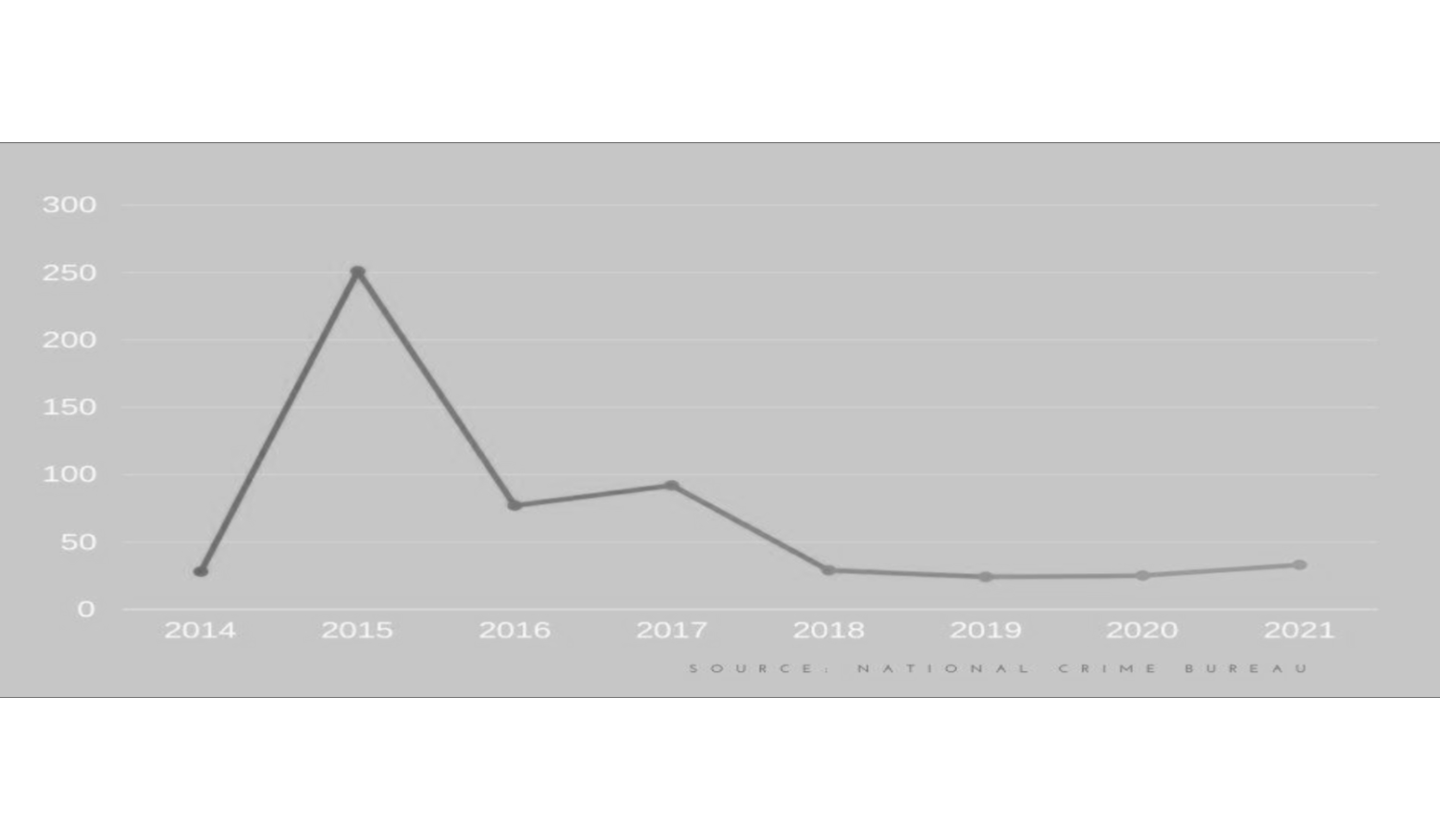
One one hand over the years India has seen huge growth in terms of economic empowerment, on the other hand Indian society is still plagued by social evils like honor killings. According to a recent report by National Crime Record Bureau (2020) revealed that nearly 25 cases of honor killings were reported in the preceding year. While we all know how these numbers are highly underreported, another study highlights a spike in the cases of honor killings in India, especially when the couple involved intercaste relationships.

a graph showing statistics of honor killings in India
*Statistics showing Honor killings in India

Feminists and human rights campaigners have long criticized the use of the term “honor killing” to describe the homicides of women perpetrated by men purportedly for bringing shame upon or dishonoring their families. While many scholars have propagated that there is “no honor in honor killings”, many others have attempted to stigmatize the word for its inherently patriarchal nature.
Honor-based crimes are often committed to deter those who dare to trangress the gendered social boundaries set by the society. In order to constantly control women’s sexualities and bodies, honor most often takes several forms and meanings. For instance, media reports highlights how a girl was killed for talking to someone from the opposite sex over the phone; wearing western clothing; and in other cases women are killed because they fall in love with someone outside the community or even within the same clan (which is considered incest in many communities).

Ostracizing those who dare to transgress: violating basic human rights​

The ever changing meanings and forms of honor further allow the persistent blaming of women (by the community) who dare to transgress honor boundaries. Women who tend to rebel against the honor codes are often ostracized by the society, are married off early, constantly vilified in the society and even are killed in many cases. Transgression of honor boundaries can have serious human rights concerns not only for those who transgress the social boundaries but also for those who are associated with them. For instance, the infamous Manoj and Babli honor killing case from India, the couple who were brutally killed in public even when they were accompanied by five police officers highlights violation of several human rights that pre and proceed the murder. In an interview at a famous television serial in India, Manoj’s (the victim) sister narrated how Manoj’s whole family have to face social ostracization and threats whereby they were ostracized by the entire village, constant threats of raping Manoj’s sister, cutting off basic human needs like electricity and groceries.

Locked in four walls: The inhabitable conditions of safe houses in India​

Within the ambit of a society built on honor-based social boundaries, having any sexual desires, having any kind of romantic relationship or sometimes even friendship with the opposite sex is wholly impossible. Thus, to be a “good daughter”, one has to refrain from developing romantic interests prior to marriage arranged by the family. As a result, those who transgress these social boundaries of honor have no option but to elope from their homes. Previous research has shown how couples are compelled to leave their homes due to severe parental opposition to their ‘self-arranged’ relationship/marriage and subsequent threats of violence or even killing. In addition, there is increased opposition if the couple belonged to caste, class, religion, same sex or same gotra.

Alarmed by the hike in honor killings in several parts of the country, several states in India set up safe houses for run-away, interfaith, intercaste couples to safeguard them from familial and community horror/ brutality. However, the inhabitable conditions within these safe houses further violated the basic human needs and rights of these couples. Reports highlight how due to the fear of getting killed these couples could move out of these safe houses to work. Hence most couples who choose trangress honor codes further suffer from extreme financial crisis. For instance, in a recent media report a couple staying in one of these safe houses in India shares that “we have already spent ₹40,000 (~500$) since when we ran from home. Exacerbating matters, Sukhjit ( the boy) cannot return to work until he is sure that Tina’s (the victim girl) family will not harm them”. Furthermore, these safe houses are often overcrowded, making them inhabitable spaces to live in. Such extreme financial knot, psycho-socio fear of being killed further takes away the basic human rights like right to privacy, gender equality and even right to live from these couples.

Conclusion​

The essay highlights how victims of honor-based violence and killings are trapped within the nexus of honor, rebellion and patriarchy. While reports have shown how solutions to protect the victims of honor-based violence (i.e, Safe houses, police protection etc.) have not been the most effective ways, it is important to critically examine the social embeddedness of such crimes within various patriarchal communities. Research on honor-based killings in India most often limits honor-based killings as a statistical variable, by further questioning the inadequacy of data due to lack of reporting. The vast research based on content analysis of news reports further makes the situation worse by again seeing honor as dangerous and countable only when someone is killed. While, under-reporting is again not only a statistical concern but involves negation, acceptance even by the police and lack of protection and trust within the protection institutions and systems. The lack of ethnographic research and the sustained emphasis on honor-based abuse as only honor-based killing make the plight of a rebellion in the patriarchal honor-based society invisible. This calls for attention to the need for more anecdotes about the existing honor-based violence. Not only to narrate the rare horror stories like Manoj and Babli, but also to highlight the stories of resistance, resilience, and struggle. What happens when a girl tries to rebel against the powerful honor-based abuse in society? Moving beyond killing, what happens to those who stay in society to fight against the patriarchal society for their love? Thinking in this line will allow us to deeply interrogate the social context in order to look for further solutions.


@Rajdeep @cricketjoshila @Champ_Pal @JaDed @Devadwal @uppercut @Theanonymousone @straighttalk @Vikram1989 @Varun @Romali_rotti @Bhaijaan @Cover Drive Six @rickroll @rpant_gabba, @Romali_rotti @kron @globetrotter @Hitman @jnaveen1980


#FreeMinoritiesOfIndiaFromHindus

#SaveAllIndianMinorities

#FreeIndiaFromHinduExtremism

#SanctionIndia

 

Brutal Honour Killing In Maharashtra As Family Opposes Inter-Caste Love​


A 20-year-old man was beaten up, shot and his head was crushed with a stone in Maharashtra's Nanded. At his funeral, his girlfriend applied vermillion on her forehead and vowed to live in his house as a daughter-in-law.Aanchal met Saksham Tate through her brothers and grew closer over frequent visits to his home. Their three-year-old relationship recently began facing pressure from her family, who opposed their union over a difference in their castes. Aanchal continued their relationship with Tate despite numerous threats.When Aanchal's brothers and father learned that she was going to marry Tate, they beat him up on Thursday, shot him in the head and crushed his head with a stone.


@Rajdeep @cricketjoshila @Champ_Pal @JaDed @Devadwal @uppercut @Theanonymousone @straighttalk @Vikram1989 @Varun @Romali_rotti @Bhaijaan @Cover Drive Six @rickroll @rpant_gabba, @Romali_rotti @kron @globetrotter @Hitman @jnaveen1980


#FreeMinoritiesOfIndiaFromHindus

#SaveAllIndianMinorities

#FreeIndiaFromHinduExtremism

#SanctionIndia

 

BJP Scheduled Castes Morcha protests Dharwad honour killing, seeks action​


Stating that the gruesome incident has exposed the failure of the govt. to protect inter-caste couples, it demands the arrest of all the accused


Members of the district unit of the BJP Scheduled Castes Morcha staging protest at Sardar Vallabhbhai Patel Chowk in Kalaburagi on Monday. | Photo Credit: ARUN KULKARNI
Condemning the honour killing of 19-year-old Manya V. Doddamani by her own family members at Inam Veerapur village in Dharwad district on December 21, 2025, the Kalaburagi district unit of the BJP Scheduled Castes Morcha staged a protest at Sardar Vallabhbhai Patel Chowk here on Monday.


Addressing the protesters, BJP Scheduled Castes Morcha State vice-president Ambaraya Ashtagi said that the gruesome incident has exposed the failure of the State government to protect inter-caste couples.


Honour killing still biig in India:, below sanghis, why is this so common in India?

@Rajdeep @cricketjoshila @Champ_Pal @Devadwal @uppercut @straighttalk @Vikram1989 @Varun @Romali_rotti @Bhaijaan @Cover Drive Six @rickroll @RexRex @rpant_gabba, @Romali_rotti @kron @globetrotter @Hitman @jnaveen1980 @Local.Dada @CrIc_Mystique @Van_Sri @nish_mate @SportsWarrior @kaayal
 
'Never imagined this': Indian village grapples with interfaith couple's killing

The murder of an interfaith couple and the arrest of the woman's brothers by the police for the alleged crime has shocked a small village in India's northern Uttar Pradesh state where residents have lived in harmony for years.

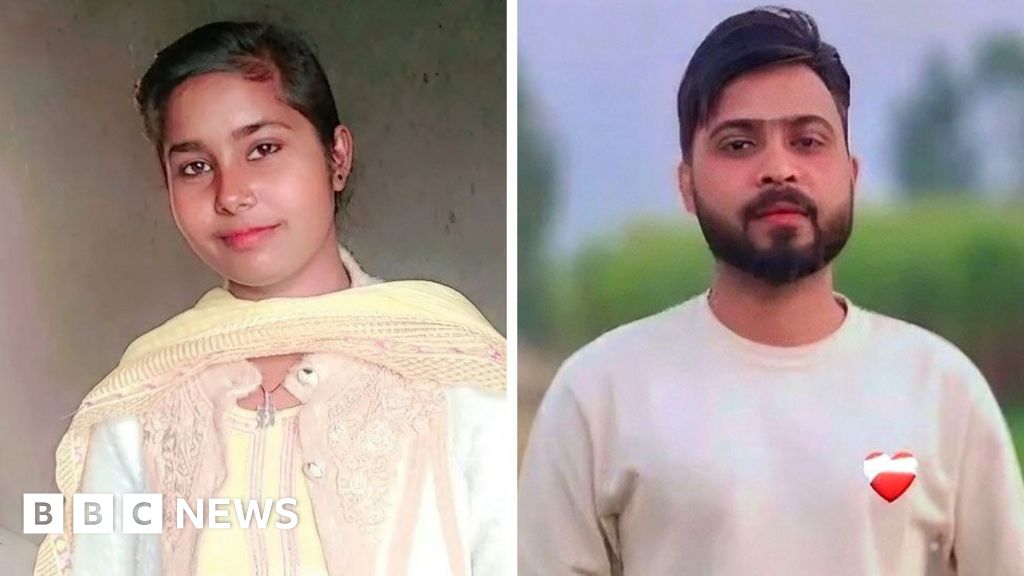
The bodies of 19-year-old Kajal, a Hindu, and 27-year-old Mohammad Arman, a Muslim, were found buried near a riverbank on the outskirts of Umri village on 21 January.

Police said they were beaten to death with a spade two days earlier, allegedly by Kajal's three brothers, who have been arrested. They are in custody and have not commented on the killings.

The murders have left an uneasy quiet hanging over Umri, 182km (113 miles) from India's capital Delhi. The village is home to about 400 families - from both Hindu and Muslim communities - and several resident told the BBC that they have shared a warm relationship without any history of religious disputes.

Deputy inspector general of state police Muniraj G told the BBC that police believe it to be a case of "honour killing" - murder by relatives or community members to punish women for falling in love or marrying outside of their caste or religion.

India's National Crime Records Bureau began recording honour killings in 2014, when it listed 18 cases nationwide. Its latest annual report recorded 38 such cases in 2023.

Activists, however, say the numbers are significantly higher - in hundreds every year - as many cases are recorded simply as homicide.

Umri is in Uttar Pradesh's Moradabad district, which is known for its metal craft industries. The region is largely rural, where strong social hierarchies continue to influence everyday life. Kajal's brothers worked as masons in Moradabad town.

Kajal and Arman's relationship "was the first case [of an interfaith relationship]" in their village, says resident Mahipal Saini.

Residents of Umri who spoke to the BBC on condition of anonymity said Kajal and Arman were neighbours who lived hardly 200m from each other. They described them as introverts who did not have many friends.


'Never imagined this': Indian village grapples with interfaith couple's killing

The murder of an interfaith couple and the arrest of the woman's brothers by the police for the alleged crime has shocked a small village in India's northern Uttar Pradesh state where residents have lived in harmony for years.

The bodies of 19-year-old Kajal, a Hindu, and 27-year-old Mohammad Arman, a Muslim, were found buried near a riverbank on the outskirts of Umri village on 21 January.

Police said they were beaten to death with a spade two days earlier, allegedly by Kajal's three brothers, who have been arrested. They are in custody and have not commented on the killings.

The murders have left an uneasy quiet hanging over Umri, 182km (113 miles) from India's capital Delhi. The village is home to about 400 families - from both Hindu and Muslim communities - and several resident told the BBC that they have shared a warm relationship without any history of religious disputes.

Deputy inspector general of state police Muniraj G told the BBC that police believe it to be a case of "honour killing" - murder by relatives or community members to punish women for falling in love or marrying outside of their caste or religion.

India's National Crime Records Bureau began recording honour killings in 2014, when it listed 18 cases nationwide. Its latest annual report recorded 38 such cases in 2023.

Activists, however, say the numbers are significantly higher - in hundreds every year - as many cases are recorded simply as homicide.

Umri is in Uttar Pradesh's Moradabad district, which is known for its metal craft industries. The region is largely rural, where strong social hierarchies continue to influence everyday life. Kajal's brothers worked as masons in Moradabad town.

Kajal and Arman's relationship "was the first case [of an interfaith relationship]" in their village, says resident Mahipal Saini.

Residents of Umri who spoke to the BBC on condition of anonymity said Kajal and Arman were neighbours who lived hardly 200m from each other. They described them as introverts who did not have many friends.


devastating news


@Rajdeep @cricketjoshila @Champ_Pal @Devadwal @uppercut @straighttalk @Vikram1989 @Varun @Romali_rotti @Bhaijaan @Cover Drive Six @rickroll @RexRex @rpant_gabba, @Romali_rotti @kron @globetrotter @Hitman @jnaveen1980 @Local.Dada @CrIc_Mystique @Van_Sri @nish_mate @SportsWarrior @kaayal @saimayubera
 
Back
Top