



What's new

IMF board approves $7bn loan programme for Pakistan [Post Updated #474]

Abdullah719

T20I Captain
Joined
Apr 16, 2013
Runs
44,824
IMF Reaches Staff-Level Agreement on Economic Policies with Pakistan for a Three-Year Extended Fund Facility

  • The Extended Fund Facility arrangement aims to support the authorities’ strategy for stronger and more inclusive growth by reducing domestic and external imbalances, removing impediments to growth, increasing transparency, and strengthening social spending.
  • An ambitious structural reform agenda will supplement economic policies to rekindle economic growth and improve living standards.
  • Financing support from Pakistan’s international partners will be critical to support the authorities’ adjustment efforts and ensure that the medium-term program objectives can be achieved.

In response to a request by the Pakistani authorities, an International Monetary Fund (IMF) mission led by Mr. Ernesto Ramirez Rigo visited Islamabad, Pakistan from April 29 to May 11 to discuss IMF support for the authorities’ economic reform program. At the end of the visit, Mr. Ramirez Rigo made the following statement:

“The Pakistani authorities and the IMF team have reached a staff level agreement on economic policies that could be supported by a 39-month Extended Fund Arrangement (EFF) for about US$6 billion. This agreement is subject to IMF management approval and to approval by the Executive Board, subject to the timely implementation of prior actions and confirmation of international partners’ financial commitments. The program aims to support the authorities’ strategy for stronger and more balanced growth by reducing domestic and external imbalances, improving the business environment, strengthening institutions, increasing transparency, and protecting social spending.

“Pakistan is facing a challenging economic environment, with lackluster growth, elevated inflation, high indebtedness, and a weak external position. This reflects the legacy of uneven and procyclical economic policies in recent years aiming to boost growth, but at the expense of rising vulnerabilities and lingering structural and institutional weaknesses. The authorities recognize the need to address these challenges, as well as to tackle the large informality in the economy, the low spending in human capital, and poverty. In this regard, the government has already initiated a difficult, but necessary, adjustment to stabilize the economy, including thorough support from the State Bank of Pakistan. These efforts need to be strengthened. Decisive policies and reforms, together with significant external financing are necessary to reduce vulnerabilities faster, increase confidence, and put the economy back on a sustainable growth path, with stronger private sector activity and job creation.

“The EFF aims to support the authorities’ ambitious macroeconomic and structural reform agenda during the next three years. This includes improving public finances and reducing public debt through tax policy and administrative reforms to strengthen revenue mobilization and ensure a more equal and transparent distribution of the tax burden. At the same time, a comprehensive plan for cost-recovery in the energy sectors and state-owned enterprises will help eliminate or reduce the quasi-fiscal deficit that drains scarce government resources. These efforts will create fiscal space for a substantial increase in social spending to strengthen social protection as well as in infrastructure and human capital development. The modernization of the public finance management framework will increase transparency and spending efficiency. Provinces are committed to contribute to these efforts by better aligning their fiscal objectives with those of the federal government.

“The forthcoming budget for FY2019/20 is a first critical step in the authorities’ fiscal strategy. The budget will aim for a primary deficit of 0.6 percent of GDP supported by tax policy revenue mobilization measures to eliminate exemptions, curtail special treatments, and improve tax administration. This will be accompanied by prudent spending growth aimed at preserving essential development spending, scaling up the Benazir Income Support Program and improve targeted subsidies, with the goal of protecting the most vulnerable segments of society.

“The State Bank of Pakistan will focus on reducing inflation, which disproportionately affects the poor, and safeguarding financial stability. A market-determined exchange rate will help the functioning of the financial sector and contribute to a better resource allocation in the economy. The authorities are committed to strengthening the State Bank of Pakistan’s operational independence and mandate.

“An ambitious structural reform agenda will supplement economic policies to rekindle economic growth and improve living standards. Priority areas include improving the management of public enterprises, strengthening institutions and governance, continuing anti-money laundering and combating the financing of terrorism efforts, creating a more favorable business environment, and facilitating trade. To improve fiscal management the authorities will engage provincial governments on exploring options to rebalance current arrangements in the context of the forthcoming National Financial Commission.

“The IMF team is grateful to the Pakistani authorities for open and constructive discussions and their hospitality.”

https://www.imf.org/en/News/Article...c-Policies-with-Pakistan-for-a-Three-Year-EFF
 
Pakistan reaches agreement with IMF, to receive $6 billion over 3 years

The technical teams of the government and the International Monetary Fund (IMF) have reached an agreement on a bailout package for Pakistan, Adviser to Prime Minister on Finance, Revenue and Economic Affairs Dr Abdul Hafeez Shaikh announced on Sunday.

"After months of discussions and negotiations, a staff-level agreement has been reached between Pakistan and the IMF," he said while speaking on state-run PTV News.

Dr Shaikh revealed that Pakistan would receive $6 billion worth of assistance under the IMF programme over a period of three years.

He said the staff-level agreement, which must still be approved by the IMF board of directors in Washington, would show that effective reforms were underway in Pakistan.

“The Pakistani authorities and the IMF team have reached a staff level agreement on economic policies that could be supported by a 39-month Extended Fund Arrangement (EFF) for about US $6 billion," an IMF press release quoted IMF Mission Chief for Pakistan Ernesto Ramirez Rigo as saying.

Dr Shaikh said IMF is an international institution whose primary job is to assist member countries who are in an "economic difficulty". He said the government could not have bridged the financing gap of $12 billion on its own that he said was created by a weak economy.

Besides the IMF assistance, Pakistan will also receive additional funds worth nearly $2-3 billion from institutions like the World Bank and Asian Development Bank, the adviser revealed.

Asked to share the conditions that Pakistan has agreed to as part of the agreement, Dr Shaikh said there were many things desired by the Fund that the government already saw as being in the country's interest; they include aligning expenditure with resources, improve the functioning of loss-making state-owned enterprises, curtail the subsidies available to the wealthy classes and tax the rich segments.

"These structural changes are in our interest if we want to take our people in the direction of prosperity and improve their quality of life," the adviser said.

He said because the government wants to send "a signal of financial discipline" and resolve fiscal challenges, the programme would entail raising prices in some areas in order to recover the costs.

"However [...] the government is focused on not putting too much burden on the common man," Dr Shaikh said. Explaining his point, he said that if power tariff is increased under the IMF programme, it will not affect consumers utilising less than 300 units, "and this includes 75pc of electricity consumers". For the same reason, the government is allocating an additional Rs50 billion for an electricity subsidy in the upcoming budget.

Under the programme, the government is also allocating an additional Rs80 billion for social safety programmes like Ehsaas and the Benazir Income Support Programme in order to minimise the burden on the common man, the adviser said.

Asked whether this would be Pakistan's last IMF programme, Dr Shaikh said: "It depends on how successfully we as a country implement this programme and approach it as a reform or structural change programme instead of a mere revenue-earning programme."

https://www.dawn.com/news/1481849/p...nt-with-imf-to-receive-6-billion-over-3-years
 
“Pakistan is facing a challenging economic environment, with lackluster growth, elevated inflation, high indebtedness, and a weak external position. This reflects the legacy of uneven and procyclical economic policies in recent years aiming to boost growth, but at the expense of rising vulnerabilities and lingering structural and institutional weaknesses. The authorities recognize the need to address these challenges, as well as to tackle the large informality in the economy, the low spending in human capital, and poverty. In this regard, the government has already initiated a difficult, but necessary, adjustment to stabilize the economy, including thorough support from the State Bank of Pakistan. These efforts need to be strengthened. Decisive policies and reforms, together with significant external financing are necessary to reduce vulnerabilities faster, increase confidence, and put the economy back on a sustainable growth path, with stronger private sector activity and job creation.

This paragraph from the IMF. Fascinating.

Are the IMF suggesting that the 'corrupt but competent' past governments did not show interest in taking these measures for the betterment of the economy?
 
This paragraph from the IMF. Fascinating.

Are the IMF suggesting that the 'corrupt but competent' past governments did not show interest in taking these measures for the betterment of the economy?
[MENTION=131701]Mamoon[/MENTION] can give us a better answer or maybe IMF is Insafian by heart that's why they are seeing PTI's difficult steps as positive and necessary to stabilize the economy while criticizing previous govts for not being serious and competent.
 
This paragraph from the IMF. Fascinating.

Are the IMF suggesting that the 'corrupt but competent' past governments did not show interest in taking these measures for the betterment of the economy?

Any government in any third world ‘democracy’, will be the same.

There is no incentive for a government to carry out long term structural change when the average voter is too thick to recognise it. Better to waste money on showpiece gimmicks and handouts and get re-elected.
 
Just like "Misaq-e-Jamooriyat". All parties should come forward and sign a "Misaq-e-Economy, Water and National Security" in order to have an understanding to keep consistent and effective policies to steady the ship. They can bicker with each other for other reasons but i think economy, water and national security should be mutually agreed and kept the same no matter what the government.
 
Just like "Misaq-e-Jamooriyat". All parties should come forward and sign a "Misaq-e-Economy, Water and National Security" in order to have an understanding to keep consistent and effective policies to steady the ship. They can bicker with each other for other reasons but i think economy, water and national security should be mutually agreed and kept the same no matter what the government.

Not going to happen. Do you really think that when the Nooras and the PPP made their disastrous decisions they could care less about PK future. All the difficult decisions have been left to IK And obviously they are desperate for power they will make hay because the average voter has no idea how the borrowed and stolen 60bn is impacting on the current.
 
[MENTION=131701]Mamoon[/MENTION] can give us a better answer or maybe IMF is Insafian by heart that's why they are seeing PTI's difficult steps as positive and necessary to stabilize the economy while criticizing previous govts for not being serious and competent.

No he ain't coming on here. His competent people have left an economic disaster behind for IK to sort- And IA he will but it takes time
 
MULTAN: We were not willing to get financial assistance from IMF but we sought their help as we were helpless. Anti-Pakistan and anti-CPEC forces are behind the latest terrorism incidents, said Foreign Minister Shah Mehmood Qureshi while talking to the media on a range of issues here on Sunday.

Read: Pakistan reaches agreement with IMF, to receive $6 billion over 3 years

Painting a grim economic scenario, he said, “The country is facing a shortage of investment. Financial deficit and unemployment are at their peak. The situation is worsening every day.”

Piling the blame on previous set-ups, he said, “Previous governments were dependent on direct taxes, import volume was high as compared to export volume, the national kitty was empty and the circular debt of last five months was Rs806 billion,” he said.

Acknowledging that help extended by friendly countries wasn’t enough to bail the country out, he said, “Friendly countries did extend their complete support to us but we had to go to the IMF.

Anti-CPEC forces are behind terrorism incidents, claims FM

“Negotiation process with IMF became lengthy as our government was trying its best that IMF relax its conditions to facilitate the masses.”

Regarding the attack on a five-star hotel in Gwadar and other terrorism incidents, he said, “Anti-Pakistan and anti-CPEC forces are behind terrorism incidents. Some forces do not want stability in ******tan and others don’t want to see the CPEC project moving forward.” He said that unlike others Pakistan does not issue irresponsible statements. “We have to think that why all this is happening. We do not want to say anything without investigation that’s why we are not levelling allegations against India,” he said.

“India held Pakistan responsible for the Pulwama attack but failed to prove it. We will chase them if RAW [Indian Intelligence Agency] or NDS [Afghan Intelligence Agency] are involved in incidents of terrorism in the country,” he said.

About the ongoing polls in India, he said: “Election results in India will be announced on May 23, however, whoever comes into power will not have a soft corner for Pakistan.

“But the new Indian government would have no other option but to sit on the negotiation table with Pakistan.”

Regarding the creation of South Punjab province, he said, “Rs680 million is being allocated for the establishment of South Punjab secretariat which will be made functional from the incoming fiscal year onwards.

https://www.dawn.com/news/1481989/imf-approached-for-help-as-last-resort-qureshi
 
ISLAMABAD/KARACHI: Opposition parties cried foul as the federal government and the International Monetary Fund (IMF) reached a new agreement securing a $6 billion bailout for the cash-strapped country, following months of negotiations between the two sides.

Pakistan Muslim League-Nawaz and Pakistan Peoples Party leaders slammed the bailout agreement, voicing concerns over an almost certain possibility of higher inflation and slowed economic growth in the coming months as the country implements the loan conditions imposed by the global lender.

Reacting to the agreement, PML-N spokesperson Marriyum Aurangzeb said it was better for Prime Minister Imran Khan "to have committed suicide [making good on his promise] than to have agreed to the $6 billion deal" with the IMF.

Taking to Twitter, Aurangzeb addressed the premier directly. "Imran sahab, your incompetence and ineptitude have made the country a collateral for the IMF. You have handed over the country to the IMF for only $6 billion.

"Pakistan's deal with the IMF is now successful and an 'inflation bomb' has been dropped on the people [of Pakistan]. All the relief for the poor has ended and the prices of gas, electricity, and food items are up," she wrote.

Vehemently opposing the new deal, she mentioned positive changes for the country made by former prime minister Nawaz Sharif, who, she said, "brought into the country Rs60 billion worth of development projects and stabilised the economy".

Aurangzeb further talked about the new conditions put forth by the IMF, according to which, "there will be inflation in the country, an increase in poverty, and a scary rise in unemployment.

"Additional taxes worth Rs1,000bn will be levied and the [Pakistani] rupee will depreciate further."

Miftah Ismail, who served as Federal Minister of Finance, Revenue and Economic Affairs under the previous government, shared his concern over the implications of the loan agreement in a series of tweets.

The agreement marks Pakistan´s 22nd bailout with the IMF, as the country struggles to stave off a looming balance-of-payments crisis while its economy teeters due to low growth, soaring inflation, and mounting debt.

"The programme aims to support the authorities´ strategy for stronger and more balanced growth by reducing domestic and external imbalances, improving the business environment, strengthening institutions, increasing transparency, and protecting social spending," said Ramirez Rigo, head of the IMF delegation, in a statement released late Sunday.

According to Pakistan´s finance adviser Abdul Hafeez Sheikh, the country is set to receive $6 billion from the IMF in addition to $2 to $3 billion from the World Bank and Asian Development Bank over the next three years.

"We have a $12 billion gap in our annual payments and we don´t have the capacity to pay them," Sheik said in a televised address as he announced the new agreement with the fund.

https://www.geo.tv/latest/237123-pml-n-ppp-leaders-slam-imf-deal-voice-inflation-concerns
 
Why is the opposition crying? First they were criticizing the govt for not coming up with a deal and borrowing loans from countries, something the PTI govt is damage controlling due to the actions of govt in the last 10 years. Then the opposition is crying foul for coming up with a deal with imf. How pathetic can an opposition get?
 
Why is the opposition crying? First they were criticizing the govt for not coming up with a deal and borrowing loans from countries, something the PTI govt is damage controlling due to the actions of govt in the last 10 years. Then the opposition is crying foul for coming up with a deal with imf. How pathetic can an opposition get?

Ignore the "opposition". they have nothing to offer but complaints about mehngahi and IMF..they are completely finished as a force in the short term. The country has been shattered by ten years of war and economic destruction. it will take a generation for us to see any major benefits. IK will provide us with structural reform that will help the country move forward but understand you are in the fight of your lives. The nation's very existence is under direct threat.

Dar is lucky he isnt hanging at the end of a rope. After feb 27th and now th recent spate of terror attacks things are getting put into focus for the PM and his team. They are not messing around anymore..ab vo NRO mazaak khutum ho gaya hay. Zardari is going down hard, and the sharifs are also..Bilawal is a lame duck and can only mouth off hoping to ensure he becomes the PM next time..
 
Last edited by a moderator:
Any government in any third world ‘democracy’, will be the same.

There is no incentive for a government to carry out long term structural change when the average voter is too thick to recognise it. Better to waste money on showpiece gimmicks and handouts and get re-elected.

Exactly . The problem is not Govt alone .
 
The IMF has agreed to break Pakistan’s fall. Again

FAMILIARITY, THEY say, breeds contempt. Few countries are as familiar with the IMF as Pakistan. The over-indebted country of 200m people has obtained 21 loans from the fund, as many as Argentina. On May 12th this familiarity deepened further. The country’s government, led by Imran Khan, a former cricket star who heads the Pakistan Tehreek-e-Insaf party, said it had reached a deal with the IMF’s staff to borrow another $6bn over three years. The agreement now awaits formal approval from the fund’s bosses in Washington, and the support of other international lenders, including the World Bank and the Asian Development Bank.

The loan will relieve Pakistan’s dollar shortage but do little to improve the IMF’s standing in the country. In return for its money, the fund expects the government to raise tax revenues and utility prices—and to let the currency fall, if need be. That will help narrow Pakistan’s wide trade and budget deficits. But it will also curb growth and increase inflation in the short term.

The full agreement has not yet been published. But some details have been released and others leaked to the local press. Pakistan must cut its budget deficit (before debt service) to 0.6% of GDP next fiscal year (which starts in July) from the deficit of over 1.7% that the IMF expects for this year. To meet this goal, the government has reportedly promised to remove tax breaks worth about 350bn rupees ($2.5bn or 1% of GDP) next year and to raise the price of gas and electricity. It has pledged to give the central bank, the State Bank of Pakistan, more autonomy in its fight against inflation (which has increased sharply to over 8%). It will also let market forces dictate the rupee’s exchange rate, which has been devalued by over 18% against the dollar in the past year.

https://www.economist.com/finance-a...-imf-has-agreed-to-break-pakistans-fall-again
 
This paragraph from the IMF. Fascinating.

Are the IMF suggesting that the 'corrupt but competent' past governments did not show interest in taking these measures for the betterment of the economy?

[MENTION=131701]Mamoon[/MENTION] can give us a better answer or maybe IMF is Insafian by heart that's why they are seeing PTI's difficult steps as positive and necessary to stabilize the economy while criticizing previous govts for not being serious and competent.

No he ain't coming on here. His competent people have left an economic disaster behind for IK to sort- And IA he will but it takes time

Can you explain the wisdom and the logic behind Imran’s decision of appointing a PPP finance minister as his financial advisor?

Is the appointment of Hafeez Shaikh the “difficult step” Imran has taken to stabilize the economy?

Both PTI and IMF agree that the incompetence of PPP and PMLN have left Pakistan’s economy in a disastrous state, so then how do PTI and IMF explain and justify the appointment of a PPP finance minister as advisor?

What competency and expertise does Imran hope to extract from a man who contributed to the ruin of our economy?
 
Can you explain the wisdom and the logic behind Imran’s decision of appointing a PPP finance minister as his financial advisor?

Is the appointment of Hafeez Shaikh the “difficult step” Imran has taken to stabilize the economy?

Both PTI and IMF agree that the incompetence of PPP and PMLN have left Pakistan’s economy in a disastrous state, so then how do PTI and IMF explain and justify the appointment of a PPP finance minister as advisor?

What competency and expertise does Imran hope to extract from a man who contributed to the ruin of our economy?

There is a thing called giving free hand to someone so he can do his job comfortably. Explain to me how same Hafeez Shaikh was able to deliver under Mush and failed badly under Zardari?
 
Can you explain the wisdom and the logic behind Imran’s decision of appointing a PPP finance minister as his financial advisor?

Is the appointment of Hafeez Shaikh the “difficult step” Imran has taken to stabilize the economy?

Both PTI and IMF agree that the incompetence of PPP and PMLN have left Pakistan’s economy in a disastrous state, so then how do PTI and IMF explain and justify the appointment of a PPP finance minister as advisor?

What competency and expertise does Imran hope to extract from a man who contributed to the ruin of our economy?

It may be due to the fact that HS is the only guy the IMF trust to structurally reform the economy and he had a good track record. Under Mush, although under AZ he got caught up in the mediocrity. The damage by the crooks will take a decade or more to correct, and there is a lot more pain to come.
 
There is a thing called giving free hand to someone so he can do his job comfortably. Explain to me how same Hafeez Shaikh was able to deliver under Mush and failed badly under Zardari?

It may be due to the fact that HS is the only guy the IMF trust to structurally reform the economy and he had a good track record. Under Mush, although under AZ he got caught up in the mediocrity. The damage by the crooks will take a decade or more to correct, and there is a lot more pain to come.

Incredible, so now the new narrative is that Hafeez Shaikh did well under Mush because he gave him a free hand, but he failed under Zardari because was not allowed to do his job comfortably and got caught up in mediocrity. :))

PTI supporters never fail to amaze. The straws that they will clutch to defend their party.

I agree that there is more pain to come, but only for PTI supporters. They were vehemently arguing that Asad Umar is the man to drive our economy toward and it will take time before we see the results, but Imran ended up removing him in 8 months, and PTI supporters were left in a pickle where they couldn’t openly criticize Imran and nor could they openly criticize Asad Umar’s performance.

Hafeez Shaikh has succeeded and failed, so his track-record is mixed. Hence, appointing him is a risk because it could go either way, and considering the state of our economy, we are not in a position where we can take risks with a man who contributed to our economic downfall during PPP’s reign.

Why then did Imran sack Asad Umar? For years, he championed him as the man who will drive our economy forward, but it took him only 8 months to remove him.

What hope do we have from a leader whose judgment is so cloudy, irrational and impulsive?

The excuse is that there was too much pressure and criticism from the opposition, so in that case, what hope do we have from a leader who cannot withstand any pressure and criticism?

No matter how hard PTI supporters try and the mental gymnastics they perform, they cannot get away with this without making Imran and PTI look incompetent.

Instead of making excuses and justifications, PTI supporters need to accept that Imran has no idea what he is doing and his government is turning into a circus.

However, one can hope that his haphazard decision making will eventually come good and since he is throwing enough mud at the wall, some of it might stick.
 
Incredible, so now the new narrative is that Hafeez Shaikh did well under Mush because he gave him a free hand, but he failed under Zardari because was not allowed to do his job comfortably and got caught up in mediocrity. :))

PTI supporters never fail to amaze. The straws that they will clutch to defend their party.

I agree that there is more pain to come, but only for PTI supporters. They were vehemently arguing that Asad Umar is the man to drive our economy toward and it will take time before we see the results, but Imran ended up removing him in 8 months, and PTI supporters were left in a pickle where they couldn’t openly criticize Imran and nor could they openly criticize Asad Umar’s performance.

Hafeez Shaikh has succeeded and failed, so his track-record is mixed. Hence, appointing him is a risk because it could go either way, and considering the state of our economy, we are not in a position where we can take risks with a man who contributed to our economic downfall during PPP’s reign.

Why then did Imran sack Asad Umar? For years, he championed him as the man who will drive our economy forward, but it took him only 8 months to remove him.

What hope do we have from a leader whose judgment is so cloudy, irrational and impulsive?

The excuse is that there was too much pressure and criticism from the opposition, so in that case, what hope do we have from a leader who cannot withstand any pressure and criticism?

No matter how hard PTI supporters try and the mental gymnastics they perform, they cannot get away with this without making Imran and PTI look incompetent.

Instead of making excuses and justifications, PTI supporters need to accept that Imran has no idea what he is doing and his government is turning into a circus.

However, one can hope that his haphazard decision making will eventually come good and since he is throwing enough mud at the wall, some of it might stick.

Well Mamoon you also never fail to amaze when you come up with justifications like "corrupt but competent" for face saving to indirectly defend the corrupt leaders in in PPP/PMLN and in our bureaucracy (specially in FBR).
 
Incredible, so now the new narrative is that Hafeez Shaikh did well under Mush because he gave him a free hand, but he failed under Zardari because was not allowed to do his job comfortably and got caught up in mediocrity. :))

PTI supporters never fail to amaze. The straws that they will clutch to defend their party.

I agree that there is more pain to come, but only for PTI supporters. They were vehemently arguing that Asad Umar is the man to drive our economy toward and it will take time before we see the results, but Imran ended up removing him in 8 months, and PTI supporters were left in a pickle where they couldn’t openly criticize Imran and nor could they openly criticize Asad Umar’s performance.

Hafeez Shaikh has succeeded and failed, so his track-record is mixed. Hence, appointing him is a risk because it could go either way, and considering the state of our economy, we are not in a position where we can take risks with a man who contributed to our economic downfall during PPP’s reign.

Why then did Imran sack Asad Umar? For years, he championed him as the man who will drive our economy forward, but it took him only 8 months to remove him.

What hope do we have from a leader whose judgment is so cloudy, irrational and impulsive?

The excuse is that there was too much pressure and criticism from the opposition, so in that case, what hope do we have from a leader who cannot withstand any pressure and criticism?

No matter how hard PTI supporters try and the mental gymnastics they perform, they cannot get away with this without making Imran and PTI look incompetent.

Instead of making excuses and justifications, PTI supporters need to accept that Imran has no idea what he is doing and his government is turning into a circus.

However, one can hope that his haphazard decision making will eventually come good and since he is throwing enough mud at the wall, some of it might stick.

Well it's a not a narrative, it's a fact that he did well under Mush. I like your narrative that you expect IK to solve all the problems of PK in less than a year when the Crooks that have stolen the countries future are called competent and apparently deserve your vote. Whatever you do will always be vwrong in some eyes and IK has made his decision and if things don't work out then he won't get the votes. The problems won't go away because of how much has been borrowed and looted. If Mush had stayed in power our national debt would have risen to around $55bn, high but not unmanageable,today it stands double that with interest in top.
 
Sad state of affairs, all thanks to 10 years of democracy.... keep in mind Mush left an economy growing at 6-8%. The annual PSDP was nearing Rs. 1 trillion. The ruppee vs dollar was 65 odd.


Then democracy took over and as we all know "democracy is the best revenge"
 
Sad state of affairs, all thanks to 10 years of democracy.... keep in mind Mush left an economy growing at 6-8%. The annual PSDP was nearing Rs. 1 trillion. The ruppee vs dollar was 65 odd.


Then democracy took over and as we all know "democracy is the best revenge"

I hate Mushy for his betrayal. He let these crooks back in and destroyed the countries future.
 
I keep on reading here that Mushy did a good job with the economy and how democracy ruined it. However this is not supported by world bank data. For the entirety of Musharafs tenure Pakistan lagged behind the regional growth rates. Compare Pakistan with south Asian growth rates.

https://data.worldbank.org/indicato...nd=2007&locations=PK-8S&start=2000&view=chart

Also note that 2004-7 the world growth picked up too. The incoming democratic government after 2007 had to deal with the financial crisis of 2008 which dragged down the world growth for the next few years.
 
I will be very frank and honest, people like Mamoon are the real problem of this country. People like Mamoon go all out to support crooks like the PPP and PMLN when they are in power and ruthlessly become active against the PTI. No wonder no honest person wants to enter politics and ends up leaving the country.

I have seen my parents my entire life. They left a very high paying job in the Middle East where they were both earning in USD and were living a very luxurious life in the 80's. But they missed living in Pakistan and with family and they still felt under valued as second class citizens in Saudia Arabia. They eventually fell to the patriotic feeling that as doctors we should do something for our country so they decided to move back and my word the first 5-6 years were hard, the bulk of our savings had been invested in the construction of our house and the a good portion was also used up to support the living expenses to support the expensive day to day living costs because starting salaries in Pakistan were horrible.

Eventually they both rose to the top of the ladder and achieved a respectable income but my dad still had to do a lot of international assignments outside of his employer to earn significantly. Now in 2018, we have all as a family left Pakistan and my parents who used to sing the patriotic tune of always love your country, no place like your own country, serve your country, for them to be like "the system in Pakistan is so rotten, you need a political reference for even a peon's job, everything is now extremely expensive" is very depressing.

I am just bitter and upset that if i had to live in Canada now, then i should have lived here and done all my primary schooling here from the very beginning, life would have been easier. Coming to live here at a very late stage and then to completely unlearn one's Pakistani habits is a huge challenge
 
Incredible, so now the new narrative is that Hafeez Shaikh did well under Mush because he gave him a free hand, but he failed under Zardari because was not allowed to do his job comfortably and got caught up in mediocrity. :))

PTI supporters never fail to amaze. The straws that they will clutch to defend their party.

I agree that there is more pain to come, but only for PTI supporters. They were vehemently arguing that Asad Umar is the man to drive our economy toward and it will take time before we see the results, but Imran ended up removing him in 8 months, and PTI supporters were left in a pickle where they couldn’t openly criticize Imran and nor could they openly criticize Asad Umar’s performance.

Hafeez Shaikh has succeeded and failed, so his track-record is mixed. Hence, appointing him is a risk because it could go either way, and considering the state of our economy, we are not in a position where we can take risks with a man who contributed to our economic downfall during PPP’s reign.

Why then did Imran sack Asad Umar? For years, he championed him as the man who will drive our economy forward, but it took him only 8 months to remove him.

What hope do we have from a leader whose judgment is so cloudy, irrational and impulsive?

The excuse is that there was too much pressure and criticism from the opposition, so in that case, what hope do we have from a leader who cannot withstand any pressure and criticism?

No matter how hard PTI supporters try and the mental gymnastics they perform, they cannot get away with this without making Imran and PTI look incompetent.

Instead of making excuses and justifications, PTI supporters need to accept that Imran has no idea what he is doing and his government is turning into a circus.

However, one can hope that his haphazard decision making will eventually come good and since he is throwing enough mud at the wall, some of it might stick.

Didn't PPP change their finance minister 4 times? These beghairat parties don't care about perception or criticism because of carrying the confidence that they will get opportunities to come to power in the future given their mafia hold on the system.
 
Didn't PPP change their finance minister 4 times? These beghairat parties don't care about perception or criticism because of carrying the confidence that they will get opportunities to come to power in the future given their mafia hold on the system.

No they are competent even they changed the Finance Minister 4 times. The PPP went to the IMF 7 times and that is also a sign of competence-BB alone went 3 times to the IMF.
 
This cult is a curse for Pakistan. Now they are defending worst economic performance of first 9 months with a selective IMF statement. I mean they would go to any stretch to put all blame of there corrupt incompetent leadership and there senseless policies and actions on preveious governments.


Lagarde Calls on Pakistan to Build on Progress and Seize Opportunity to Complete Economic Transformation


October 25, 2016


Managing Director concludes visit to Pakistan


Ms Lagarde congratulates the country on successfully completing its IMF-supported economic program
Ms Lagarde says this is Pakistan’s moment of opportunity to forcefully address remaining economic challenges


Ms. Christine Lagarde, Managing Director of the International Monetary Fund (IMF), issued the following statement today at the conclusion of her visit to Pakistan:

“I would like to start by offering my condolences to the Pakistani people for the tragic loss of lives at the Quetta attack overnight. We are deeply sorry for the families of those who lost their lives in this horrific attack.

“I wish to thank Prime Minister Nawaz Sharif, Finance Minister Ishaq Dar, Central Bank Governor Ashraf Wathra, and other senior government officials for their productive exchange of views and their warm hospitality during my visit to Islamabad.

“I congratulate Pakistan on having successfully completed its IMF-supported economic reform program. Improved macroeconomic stability as well as strengthened external buffers and public finances will provide a solid foundation for the economy. Many tax exemptions and concessions have been removed, and higher tax revenue has allowed for greater public investment and social spending. About 1.5 million more poor households are benefiting from targeted social assistance than three years ago. Power outages have gradually decreased and the financial performance of the power sector is strengthening. A country-wide strategy to improve the business climate is being implemented.

“Much has been achieved and much more remains to be done, so this is Pakistan’s moment of opportunity to forcefully address remaining economic challenges and lay the foundation for more private sector job creation and higher living standards for all segments of society.

“In my discussions, I emphasized the need to continue strengthening resilience by building fiscal and external cushions to be adequately prepared for future economic shocks. Achieving higher and more sustainable growth will also require completing important structural reforms in the energy sector, and tax policy and administration; ending losses in public enterprises; and making a sustained effort to improve governance and foster a dynamic and export-oriented private sector. In parallel, added focus on strengthening health, education, closing the gender gap and providing social protection can ensure that gains in living standards are widely shared.

“My visit also gave me an opportunity to meet with students, women leaders, and representatives of the business community and civil society. I am grateful for the perspectives they shared with me about Pakistan’s opportunities and challenges. Pakistan’s economic transformation cannot happen without the country’s youth—who comprise about 60 percent of the population—and women, of whom only one in four participate in the labor force.

“While the IMF-supported program has been completed, Pakistan’s partnership with the IMF continues through our ongoing close policy dialogue and capacity building engagement. I would like to reiterate the IMF’s strong support for Pakistan as the country moves forward to address its economic challenges and realize its vast economic potential.”


https://www.imf.org/en/News/Article...portunity-to-Complete-Economic-Transformation


5.8 GDP, lowest inflation of last 40 years, Record 24 billion $ foreign exchange reserves, record FBR tax collections doubling in 5 years, record Stock Exchane 100 index reaching upto 54000, record infrastructure development, record addition of 11000 megawatts in national grid achieved by PML N in 5 years


IMF boss praises Pakistan as emerging market

October 25 , 2016


ISLAMABAD: Managing Director International Monitory Fund Christine Lagarde said Pakistan has graduated with success from a frontier market to an emerging market during the last three years.

Talking to Finance Minister Ishaq Dar in Islamabad, she said inclusion of Pakistan in the Morgan Stanley Index is a signal from the global financial markets that Pakistan can be placed amongst the world’s emerging economies.

Briefing the IMF MD about economic reforms of the government, Ishaq Dar said fiscal consolidation has given fiscal space to the government to increase development spending from 300 billion rupees to 800 billion rupees.

The Finance Minister said government is now focusing on further expansion of the revenue base, improving export competitiveness and business climate and ensuring skill based education for the youth of the country. –SAMAA/APP


https://www.samaa.tv/economy/2016/10/imf-boss-praises-pakistan-as-emerging-market/


[UTUBE]W7HO56vlsGA[/UTUBE]


Watch 15:46 to 16:12 as to what Christine Lagarde had to say about PML N government on successful completion of IMF program.
 
This cult is a curse for Pakistan. Now they are defending worst economic performance of first 9 months with a selective IMF statement. I mean they would go to any stretch to put all blame of there corrupt incompetent leadership and there senseless policies and actions on preveious governments.


Lagarde Calls on Pakistan to Build on Progress and Seize Opportunity to Complete Economic Transformation


October 25, 2016


Managing Director concludes visit to Pakistan


Ms Lagarde congratulates the country on successfully completing its IMF-supported economic program
Ms Lagarde says this is Pakistan’s moment of opportunity to forcefully address remaining economic challenges


Ms. Christine Lagarde, Managing Director of the International Monetary Fund (IMF), issued the following statement today at the conclusion of her visit to Pakistan:

“I would like to start by offering my condolences to the Pakistani people for the tragic loss of lives at the Quetta attack overnight. We are deeply sorry for the families of those who lost their lives in this horrific attack.

“I wish to thank Prime Minister Nawaz Sharif, Finance Minister Ishaq Dar, Central Bank Governor Ashraf Wathra, and other senior government officials for their productive exchange of views and their warm hospitality during my visit to Islamabad.

“I congratulate Pakistan on having successfully completed its IMF-supported economic reform program. Improved macroeconomic stability as well as strengthened external buffers and public finances will provide a solid foundation for the economy. Many tax exemptions and concessions have been removed, and higher tax revenue has allowed for greater public investment and social spending. About 1.5 million more poor households are benefiting from targeted social assistance than three years ago. Power outages have gradually decreased and the financial performance of the power sector is strengthening. A country-wide strategy to improve the business climate is being implemented.

“Much has been achieved and much more remains to be done, so this is Pakistan’s moment of opportunity to forcefully address remaining economic challenges and lay the foundation for more private sector job creation and higher living standards for all segments of society.

“In my discussions, I emphasized the need to continue strengthening resilience by building fiscal and external cushions to be adequately prepared for future economic shocks. Achieving higher and more sustainable growth will also require completing important structural reforms in the energy sector, and tax policy and administration; ending losses in public enterprises; and making a sustained effort to improve governance and foster a dynamic and export-oriented private sector. In parallel, added focus on strengthening health, education, closing the gender gap and providing social protection can ensure that gains in living standards are widely shared.

“My visit also gave me an opportunity to meet with students, women leaders, and representatives of the business community and civil society. I am grateful for the perspectives they shared with me about Pakistan’s opportunities and challenges. Pakistan’s economic transformation cannot happen without the country’s youth—who comprise about 60 percent of the population—and women, of whom only one in four participate in the labor force.

“While the IMF-supported program has been completed, Pakistan’s partnership with the IMF continues through our ongoing close policy dialogue and capacity building engagement. I would like to reiterate the IMF’s strong support for Pakistan as the country moves forward to address its economic challenges and realize its vast economic potential.”


https://www.imf.org/en/News/Article...portunity-to-Complete-Economic-Transformation


5.8 GDP, lowest inflation of last 40 years, Record 24 billion $ foreign exchange reserves, record FBR tax collections doubling in 5 years, record Stock Exchane 100 index reaching upto 54000, record infrastructure development, record addition of 11000 megawatts in national grid achieved by PML N in 5 years


IMF boss praises Pakistan as emerging market

October 25 , 2016


ISLAMABAD: Managing Director International Monitory Fund Christine Lagarde said Pakistan has graduated with success from a frontier market to an emerging market during the last three years.

Talking to Finance Minister Ishaq Dar in Islamabad, she said inclusion of Pakistan in the Morgan Stanley Index is a signal from the global financial markets that Pakistan can be placed amongst the world’s emerging economies.

Briefing the IMF MD about economic reforms of the government, Ishaq Dar said fiscal consolidation has given fiscal space to the government to increase development spending from 300 billion rupees to 800 billion rupees.

The Finance Minister said government is now focusing on further expansion of the revenue base, improving export competitiveness and business climate and ensuring skill based education for the youth of the country. –SAMAA/APP


https://www.samaa.tv/economy/2016/10/imf-boss-praises-pakistan-as-emerging-market/


[UTUBE]W7HO56vlsGA[/UTUBE]


Watch 15:46 to 16:12 as to what Christine Lagarde had to say about PML N government on successful completion of IMF program.

“Pakistan is facing a challenging economic environment, with lackluster growth, elevated inflation, high indebtedness, and a weak external position. This reflects the legacy of uneven and procyclical economic policies in recent years aiming to boost growth, but at the expense of rising vulnerabilities and lingering structural and institutional weaknesses. The authorities recognize the need to address these challenges, as well as to tackle the large informality in the economy, the low spending in human capital, and poverty. In this regard, the government has already initiated a difficult, but necessary, adjustment to stabilize the economy, including thorough support from the State Bank of Pakistan. These efforts need to be strengthened. Decisive policies and reforms, together with significant external financing are necessary to reduce vulnerabilities faster, increase confidence, and put the economy back on a sustainable growth path, with stronger private sector activity and job creation.
 
I will be very frank and honest, people like Mamoon are the real problem of this country. People like Mamoon go all out to support crooks like the PPP and PMLN when they are in power and ruthlessly become active against the PTI. No wonder no honest person wants to enter politics and ends up leaving the country.

Agreed. You cannot reason with someone who supports corruption as said people change their views and allegiances based on the size of brown envelopes they receive.

The fact his repeated comebacks include - Corruption is better the incompetence, and why did IK appoint a PPP finance minister, speaks volumes. Clearly the idea of hiring the right person for the job (opposed to hiring a narrative for the job) is lost on said people.
 
Agreed. You cannot reason with someone who supports corruption as said people change their views and allegiances based on the size of brown envelopes they receive.

The fact his repeated comebacks include - Corruption is better the incompetence, and why did IK appoint a PPP finance minister, speaks volumes. Clearly the idea of hiring the right person for the job (opposed to hiring a narrative for the job) is lost on said people.

Lol when you ask him about the PPP changing its finance minister 4 times, his comeback will be forget the PPP and PML-N, the PTI made bold claims outside office, they have to be held to a higher standard.
 
With this latest trench of borrowing, Pakistan has joined Argentina as the two country that have borrowed the most from IMF.

What the two previous government did with the borrowed money is high crime and misdemeanor and if PTI fails to bring them to justice for that, they would be just as guilty.
 
With this latest trench of borrowing, Pakistan has joined Argentina as the two country that have borrowed the most from IMF.

What the two previous government did with the borrowed money is high crime and misdemeanor and if PTI fails to bring them to justice for that, they would be just as guilty.

This is nothing. Borrowing from the IMF is not as bad as it sounds.

When a government sells Bonds, it is also borrowing from other nations/investors.

In other words, all nations borrow money.

USA and UK have borrowed so much (in the TRILLIONS) that if the Bond holders call in their debt, USA and UK would be bankrupt. This is why QE is used to suppress bond yields, so the amount paid in interest, is keep low as possible.
 
I will be very frank and honest, people like Mamoon are the real problem of this country. People like Mamoon go all out to support crooks like the PPP and PMLN when they are in power and ruthlessly become active against the PTI. No wonder no honest person wants to enter politics and ends up leaving the country.

Its either intellectual dishonesty and moral decrepitude or that he is actually stupid (but it is exceptionally sad coming from someone as intelligent as him). But then it also makes perfect sense for the beneficiaries of a rotten system to not want it to ever end. And that is where the real problem lies. Pakistan's woes have more to do with its social structure than anything else. A handful of people (and that handful includes politicians, bureaucrats, top brass of the forces and business elite) whose futures aren't dependent on that of Pakistan driving the country into deeper and deeper trouble with the sole purpose of maximizing their own returns.

Your point about your parents is one of the greatest issues of this country and one which will only get worse with time: the death of the Pakistani middle class. The class that is invariably the engine of growth of any economy is getting crushed by the corruption of the landed elites and for abiding by the laws of the country. Inadequately represented and disproportionately burdened, the middle class is either slipping into poverty or like your parents choosing the wiser option of leaving the country.

I am no fan of Imran Khan and to be honest feel very disillusioned by a lot things he has done (I did vote for him) but I will still not hesitate to vote for him again if the other names on the ballot paper are that of Nawaz or Zardari. The former is an egotistic incompetent fool who thinks he owns the country and the latter is a kleptomaniac who personifies everything that is wrong with not just Pakistani leadership but with the human race in general.
 
Every time that Pakistan has went to IMF the government has promised to carry out structural reforms however after receiving the money they have refused to do so, and the next government had to go back to the IMF, and so on. If Pakistan has to go to IMF again you can blame Imran Khan, however for now PML N is completely responsible for the mess.
 
Any government in any third world ‘democracy’, will be the same.

There is no incentive for a government to carry out long term structural change when the average voter is too thick to recognise it. Better to waste money on showpiece gimmicks and handouts and get re-elected.

PTI has already done some unpopular moves. They let the rupee depreciate, they have reduced the subsidy on gas and Haj, they have raised some taxes. However a lot more has to be done such as privatization of state run companies.

To stop the average voter from voting them out in 2023 is the reason that Imran Khan is blaming everything on PML N, and PPP. Thats the only way to make these difficult decisions, and avoid electoral disaster.
 
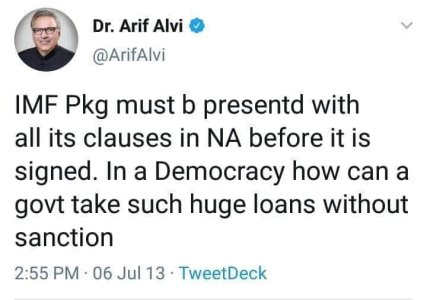
"In a Democracy how can a govt take such huge loans without sanction?"

The real question should be, in a Democracy how can a government steal huge sums without punishment?

That's right folks, when people support corruption and are at the receiving end of corruption, they let their government steal huge sums = because like their corrupt leaders, they to are beneficiaries of ill-gotten gains.
 
WASHINGTON: The International Monetary Fund (IMF) has asked Pakistan to address its longstanding issues through structural reforms and strengthening of institutions through legal framework to help economy be competitive.

The government was also advised to strengthen cooperation at the federal and provincial levels for greater fiscal and economic calibration, said IMF’s Middle East and Central Asia Region Director Jihad Azour responding to a Dawn question at a news conference.

An important track for the country was “the structural reforms that will allow Pakistan economy to be more competitive by addressing some of the longstanding issues related to the weaknesses”, he said.

Mr Azour did not directly respond to a question on the timing of the bond launch. He was asked if in his view the current zero-interest rate environment in the capital markets provided an opportunity to Pakistan to go for $3 billion to $4bn bonds, both Islamic and Eurobond.

He said Pakistan should “address some of the legacies of the past like, for example, in the energy sector and also strengthen institutions providing the right legal framework for the Central Bank for the power sector as well as other entities”.

Mr Azour said the reform agenda currently in place in Pakistan, supported by the IMF programme, was the right recipe for the country to improve macroeconomic stability, address some of the imbalances that the country saw in the past few years, allow the economy to be more competitive, and improve its creditworthiness.

He said an IMF mission would go to Islamabad by the end of the month for the first review. “So far, the progress that has been achieved goes in the right direction. It’s too early to give a full assessment. We need to wait for the mission to go there and do due diligence work on the ground,” he remarked.

“We have now a couple of months — three months almost since the beginning of the programme — it looks like things are moving in the right direction.”

The IMF director said the reform journey under this programme had two important tracks. “One is Macro-stabilisation for which there are a number of steps taken by the central bank on financial and monetary side and also by finance ministry on the fiscal side. The other and more important is the Structural Reforms to allow economy to be more competitive.”

Mr Azour said this reform agenda was important for Pakistan as this would help accelerate growth and provide the right framework for the private sector to operate.

Meanwhile, a Pakistani delegation led by Adviser to the Prime Minister on Finance Dr Hafeez Sheikh and State Bank Governor Dr Reza Baqir told investors and creditors that Pakistan reform agenda was bearing fruits.

Dr Sheikh told US-Pakistan Business Council that Pakistan’s economy was on the right path to stabilisation and the US businesses should benefit from investment opportunities available in the country.

While talking to US-Pakistan Business Council (USPBC) members at a luncheon roundtable, the finance adviser highlighted Pakistan government’s focus on improving the ease-of-doing-business and encouraged the US companies to expand their footprint in Pakistan.

The roundtable was attended by senior executives of the USPBC member-companies including S&P Global, PepsiCo, Motorola Solutions Inc, Citi, Google, ExxonMobil and others.

AIIB offers to increase funding Later, the finance adviser along with other members of the Pakistani delegation met Asian Infrastructure Investment Bank (AIIB) President Jin Liqun. They discussed the AIIB portfolio in Pakistan and potential areas of project financing by the bank.

Supporting Pakistan’s development agenda, the AIIB president said the AIIB was ready to increase funding for the country’s priority development sectors. He said investment in infrastructure projects had a long-term positive impact on growth. Dr Shaikh then invited the AIIB president to visit Pakistan that the latter accepted.

Dr Shaikh and his team also met Islamic Development Bank (IDB) President Dr Bandar M.H. Hajjar and briefed him on the country’s economic situation. For providing IDB’s technical and financial support to Pakistan, the finance adviser thanked Dr Hajjar who informed him that Pakistan had been identified as one of the first countries to be supported by the bank for strengthening market competitiveness in its core sectors. For this purpose, an IDB mission is likely to visit Pakistan soon.

Meanwhile, a delegation of International Finance Corporation, a sister organisation of the World Bank and member of World Bank Group as well as the largest global development institution focused on the private sector in developing countries, met the finance adviser and his team.

IFC vice president Nena Stoiljkovic and her delegation briefed Dr Shaikh about IFC’s projects in Pakistan, particularly in the wind and solar sectors, and expressed interest in providing advisory services to the country for structuring public-private partnership transactions.

The Pakistan delegation also attended the annual plenary of the IMF and World Bank Group, which was addressed by WB President David Malpass and IMF Managing Director Kristalina Georgieva.

Source: https://www.dawn.com/news/1512051/imf-asks-govt-to-carry-out-long-delayed-structural-reforms.
 
ISLAMABAD: Pakistan’s top tax machinery has linked approval of a fixed tax regime for small to medium traders with prior approval of the International Monetary Fund’s review mission, which is scheduled to arrive here on Sunday.

On Oct 28, the IMF mission — headed by Ernesto Ramirez Rigo — will start review of Pakistan’s first quarter (July-September) performance as part of the $6 billion Extended Fund Facility (EFF).

It will complete the exercise in two weeks.

An official source in the finance division told Dawn that during the review, the Fund officials would hold meetings with all stakeholders, including the Federal Board of Revenue, State Bank of Pakistan, those in the power sector, to assess the country’s performance against the benchmark set for the first quarter.

According to the source, Adviser to Prime Minister on Finance Dr Hafeez Shaikh and FBR Chairman Shabbar Zaidi will hold meetings on the sideline with the IMF officials to convince them that a scheme for traders was needed. “We will try to convince them to get some favourable scheme for traders,” the official said.

The traders have demanded a fixed tax regime, carrying an exemption from sales tax and withholding tax, with a threshold of Rs150 million sales per annum. They have also demanded a minimum tax rate as fixed tax rate.

According to the official, these are the demands of traders. “We can’t commit on these demands,” he said, adding the demands would be taken up with the Fund officials. “We will do advocacy for it as being under the Fund’s programme,” he said, adding some close-level understanding might be achieved.

FBR Chairman Shabbar Zaidi told Dawn that his team was in talks with traders. “We have already reached an understanding with traders on the fixed tax rates,” he said. However, he added, the FBR wanted fixed tax regime on an area basis, while traders demanded it on the basis of turnover.

The chairman said the FBR had no issue even on a turnover basis that could be introduced for small to medium traders only, but “we have to take up this issue with donor agencies”.

Mr Zaidi said traders in the tier-1 would remain on the point of sales position. “We have not finalised anything so far,” he said, adding that an attempt would be made to finalise the deal before the countrywide traders’ protest scheduled for Oct 29 and 30.

Broadening of Tax Base
The FBR chairman also gave briefing to Prime Minister Khan on Friday on broadening of tax base while using National Database and Registration Authority (Nadra) data.

According to an official statement issued after the meeting, the premier said broadening of tax net is very important for enhancing the government’s capacity to provide better facilities to the masses. Nadra chairman Usman Yousaf Mobin also attended the meeting.

He said broadening of tax net would not only lessen the burden on existing taxpayers, but would also enable the government to ensure provision of education, health and other facilities in remote areas, too.

He said the government was striving to bring in transparency in tax system so that every citizen could play their role in country’s progress and development. “The payment of tax is a national obligation, yet the restoration of taxpayers’ confidence in this respect is very important,” the premier said.

Growth in tax returns
FBR Chairman Shabbar Zaidi said that FBR received income tax return of 918,027 from taxpayers up to October 25 as against 585,209 returns received over the corresponding period of last year, showing an increase of 332,818 returns or 56.87pc.

On average, more than 20,000 returns were filed on a daily basis, he said.

Taking to Twitter, the FBR chairman said that from Nov 1, 2019 strict action would be taken against unauthorised interaction between FBR staff and business community. “Business community is suggested to report to FBR if any person contact through any manner without proper authorisation,” he said. “No harassment,” he added.

According to him, the FBR will soon issue very strict instructions to all officers, employees and staff of all formations of the FBR not to interact with businessmen through personal visits, telephone calls, cell phone messages or emails. Automated / authorised system would be only manner to interact, he said.

On the sideline of the press conference on ease-of-doing business, Special Assistant to Prime Minister on Information Dr Firdous Ashiq said Mr Khan held meeting with the relevant stakeholders on anti-smuggling to assess revenue gains and losses.

She elaborated that a comprehensive strategy would soon be finalised in this regard. One of the major components of the policy would be sharing of online information, she said. Besides, she said, the premier would hold a monthly meeting to evaluate anti-smuggling strategy.

FATF grey list
On the issue of Financial Action Task Force (FATF), Federal Minister for Aviation Ghulam Sarwar Khan said the government would check Jamiat Ulema-i-Islam-Fazl’s (JUI-F) baton-wielding force at the district level. “We will not allow them to reach the federal capital,” the minister warned.

He said JUI-F chief Fazlur Rehman gave a wrong message to the Paris-based FATF meeting as his baton-wielding force was projected on social media. By doing so, he projected a very negative image of Pakistan abroad, the minister said.

Only last week FATF decided that Pakistan would remain on grey list until February 2020 with a warning to further improve implementation of the 27 actions of the International Cooperation Review Group.

Source: https://www.dawn.com/news/1512970/govt-to-ask-imf-about-fixed-tax-regime-for-traders.
 
ISLAMABAD: The government on Tuesday said it was trying to absolve existing taxpayers from any additional burden as a visiting staff mission of the International Monetary Fund (IMF) planned to brief a joint session of the standing committees of both parliament houses about the status of its $6 billion support package on November 6.

Speaking informally to journalists here after a meeting with the IMF mission, Finance Adviser Dr Abdul Hafeez Shaikh said the national economy was witnessing stability following corrective measures introduced by the government to address key challenges.

The meeting was led by Mission Chief to Pakistan Ramirez Rigo Ernesto and attended by State Bank of Pakistan Governor Dr Reza Baqir, Secretary Finance Naveed Kamran Baloch and Federal Board of Revenue Chairman Shabbar Zaidi besides other senior officials.

He said the IMF delegation was currently reviewing quarterly economic performance and had expressed confidence over the government’s economic policies, including increase in revenues and reduced expenditures.

According to him, the two sides discussed tax collection and the government was taking steps for improvement of infrastructure and trying to ensure that taxpayers do not face further tax burden.

Responding to a question, Shaikh said the government had made remarkable progress in ease of doing of business that had been recognised by global institutions and had also extended an incentive package to the export sector to revive it.

Separately, the Senate Standing Committee on Finance led by PPP Senator Farooq H Naik was told that IMF had allocated about one-hour interaction with its members and those of national assembly’s body on finance and revenue on Nov 6.

This will be perhaps be the first time that IMF mission would hold a joint engagement with finance committees of both the houses. Previously, its interaction had been limited to National Assembly’s Committee on Finance or selective members of the two houses.

A statement issued by the Ministry of Finance said IMF mission was assured by Shaikh that the government was focused on implementation of its programme. “The containment of current and fiscal deficits and stabilisation of exchange rate are indicative of the success of government efforts to put the economy on the long-term growth track,” he said while talking to the mission team.

The adviser said Pakistan valued IMF support and financial assistance and the prime minister was personally overseeing and monitoring the progress achieved in various sectors of the economy.

The statement quoted Ernesto as appreciating the positive results produced by policies and strategies put in place by the government to remove economic imbalances. He said the volatility in exchange rate had been reduced while successes had also been achieved in other areas, especially on the fiscal front, which indicated the government was moving in the right direction.

The mission chief said IMF was looking forward to have a meaningful and productive review by aiming at a forward-looking approach with focus on the adjustments required till March, especially in the power sector and funding from various bilateral and multilateral sources for boosting Pakistan foreign exchange.

Source: https://www.dawn.com/news/1513736/no-additional-burden-on-existing-taxpayers-hafeez.
 
ISLAMABAD: Pakistan has asked the International Monetary Fund (IMF) to relax conditionalities under the $6 billion Extended Fund Facility (EFF) relating to the Financial Action Task Force (FATF) and issuance of sovereign guarantees to help raise over $4bn from domestic and international markets.

Pakistan has budgeted about $3bn bonds (about Rs450bn) — Islamic Sukuk and Eurobond — to be launched in the international capital markets during the current fiscal year to meet targets under the EFF for foreign inflows. Separately, the government has planned to raise about Rs200bn from domestic Islamic banks for the power sector to scale down circular debt.

“We are dying to complete these transactions at the earliest,” a senior official told Dawn, adding that the capital market conditions were never as conducive as at present. He said the return on bonds had plummeted to almost zero in the international capital markets and investors were finding it hard to secure profits on secured papers. “This provides an ideal opportunity for Pakistan to tap international capital markets to secure sovereign bonds at a minimal interest rate,” the official said.

Pakistan had last tapped the international capital markets in 2016 at about 8.25 per cent mark-up when average yield hovered between 3pc and 5pc for other countries.

Likewise, the government had negotiated Islamic financing worth around Rs200bn for the power sector from domestic banks in recent months on top of another Rs200bn secured earlier this year.

But all these transactions are handicapped by the IMF conditionalities as part of the 39-month EFF. One of the structural benchmarks under the IMF programme is for Pakistan to “adopt measures to strengthen the effectiveness of AML/CFT (anti-money laundering/combating the financing of terrorism) framework to support the country’s efforts to exit the FATF list of jurisdictions with serious deficiencies” by the end of October 2019.

Likewise, one of the six performance criteria under the IMF programme for Pakistan is to have a “ceiling on the amount of government guarantees” to the extent of Rs1.6 trillion throughout the current year i.e. until end-June 2020.

The official said the finance ministry had already taken up the matter of separating the FATF from the IMF-supported economic programme on the sidelines of recent IMF/World Bank meetings in Washington. The Pakistani delegation, led by Adviser to the Prime Minister on Finance and Revenue Dr Hafeez Shaikh and comprising State Bank Governor Dr Reza Baqir and Finance Secretary Naveed Kamran Baloch, had also met the management and governors of the IMF.

Officials said the authorities had argued that the FATF had a very wide scope, at times of geo-political nature, having no direct link to the economic support package which should be dealt purely on the basis of financial and monetary policies.

Another official said Pakistan was considering launching at least one of the two bonds — Islamic Sukuk or Eurobond — before the end of December this year and complete the budgeted $3bn target before June next year.

A senior official said Pakistan had achieved almost all the targets for the first quarterly review and achieved about Rs9bn saving in current expenditures of the government. The size of sovereign guarantees stood at Rs1.6tr as of end-June 2019 against Rs1.3tr at the end of December 2018.

Under the IMF programme, the guarantees should remain frozen at Rs1.6tr as performance criteria until December and remain so as indicative target until end-June 2020.

Pakistan now wants this limit to be removed so as to go for the launch of domestic and international bonds which are not possible without sovereign guarantees.

Sources said the IMF was also insisting on further electricity tariff adjustments to the extent of 10pc in two phases — in January and March next year — and the National Electric Power Regulatory Authority was being asked to do the needful at the earliest.

An IMF team led by Mission Chief to Pakistan Ernesto Ramirez-Rigo is currently in Pakistan for first review under the $6bn bailout package and will wind up the visit by Nov 7. The successful completion of the review would enable Pakistan to draw another $453 million from the Fund in the first part of December this year, taking the total amount to almost $1.44bn.

The IMF had in July this year made an upfront disbursement of $991m on completion of all prior-actions committed by Pakistan before signing the Fund programme.

Source: https://www.dawn.com/news/1513966/pakistan-wants-imf-to-separate-fatf-from-programme.
 
ISLAMABAD: Amid ongoing review meetings with the International Monetary Fund (IMF), the country’s revenue shortfall continued to expand rather dramatically in October as the government extended the deadline for filing of tax returns for another month.

Senior officials at the Federal Board of Revenue (FBR) said the provisional revenue collection in first four months of this year amounted to Rs1.28 trillion, as against a target of Rs1.447tr.

This took the 4-month shortfall to about Rs167bn, from Rs113bn at September end. The gap was slightly brought down to Rs162bn after book adjustments of about Rs5bn. Net collections were put at Rs1.284tr, higher by 16 per cent year-on-year, over Rs1.104tr in same period of 2018.

According to the officials, revenue collection in October stood at Rs320bn versus monthly target of Rs376bn, leaving a shortfall of about Rs55bn. However, the proceeds were about 15pc higher than same month last year.

The officials said a total of about Rs34bn was refunded to the taxpayers, including Rs4bn in October.

FBR Chairman Syed Shabbar Zaidi tweeted “Alhumdullilah, FBR has collected Rs 320 billion during the month October 2019 and has maintained overall increase over last year of 16 percent and domestic tax over 25 percent. This is after taking into account negative aspect of import contraction of around Rs 50 billion”

Giving details of the collection, officials said the biggest chunk of Rs566bn was achieved through sales tax in four months, followed by about Rs468bn through income and about Rs109bn in customs. The remaining Rs137bn came were collected via other taxes including Rs71bn in federal excise duty.

The government has set a revenue target of Rs5.555tr for this fiscal year as part of $6bn Extended Fund Facility with IMF, whose mission is currently in town for review of first quarter performance.

Meanwhile, FBR extended the deadline for filing of income tax returns of individuals and associations of persons for TY19 until November 30. “The date of filing of Total Income/Statements of final taxation for Individuals and Associations of Persons for the Tax Year 2019 which were due on September 30, 2019 and extended upto October 31, 2019 is hereby further extended upto November 30, 2019”, said an FBR notification.

It said the deadline was extended und Section 214A of the Income Tax Ordinance, 2001 in respect of those companies who have paid 95pc of the admitted tax liability on or before Sept 30.

The FBR had earlier announced to charge Rs40,000 fine to persons for failing to submit their returns by Oct 31 but did not go ahead with it. The sources said the Pakistan Tax Bar Association had warned the FBR against any fine saying the revenue body was more to be blamed for fewer returns than filed last fiscal year.

The association had told the FBR in writing that total returns by Oct 31 deadline were close to one million compared to 1.6m filings of t he last year. It informed that the relevant SRO951 and revised return form was issued by FBR in the last week of August and uploaded on IRIS website in the first week of September.

This meant about two months had already been wasted by FBR for which tax payers should be punished. The association had demanded extension in deadline until Dec 31.

Source: https://www.dawn.com/news/1514156/revenue-shortfall-rises-to-rs162bn-in-july-oct.
 
IMF asks Pakistan to spend more on development

The International Monetary Fund (IMF) on Friday urged Pakistan to spend more on development as the combined spending by federal and provincial governments in the first quarter remained less than one-tenth of the annual allocations.

The lower spending on development than the allocated budget during the July-September quarter has also undermined the economic growth prospects in this fiscal year.

The savings by the four provincial governments were more than the amount they spent on development in the first quarter.
IMF Mission Chief Ramirez Rigo Ernesto held meetings with the federal and provincial authorities aimed at aligning fiscal and taxation policies of the Centre and the four federating units.

Adviser to the PM on Finance Dr Abdul Hafeez Shaikh chaired a meeting to review the implementation of the fiscal policies in the provinces under the IMF Programme, according to the finance ministry.

The IMF mission chief, Punjab Finance Minister Hashim Jawan Bakht, Khyber-Pakhtunkhwa Finance Minister Taimur Saleem Khan Jhagra and Balochistan Finance Minister Zahoor Ahmed Buledi attended the meeting. Ernesto separately met with Federal Planning Minister Khusro Bakhtiar.

Ernesto stressed the need for fully using the development budget to achieve development goals, the finance ministry said.

During the first quarter, the federal and provincial governments spent around Rs140 billion on development against their annual total allocations of Rs1.6 trillion.

The federal and the provincial governments have massively slowed down development spending to meet the overall fiscal commitments made under the IMF programme.

The IMF has allowed a primary deficit of only 0.6% of the GDP or Rs272 billion in this fiscal year as against Rs1.3 trillion or 3.3% of the GDP in the last fiscal year.

This has adversely affected the ability of the governments to spend on development.

During the first quarter, the overall budget deficit remained less than 1% of the GDP or below Rs400 billion on the back of around Rs150 billion provincial cash surpluses, according to the finance ministry officials. The IMF programme encourages fiscal discipline in federal and provincial governments but at the same time it also seeks spending on development.

However, if the government allows development spending, it will either have to impose more taxes on the people or cut the defence budget to meet the primary deficit target given by the IMF.

Both these options are costly in the given overall economic and political environment of Pakistan, according to sources.

During his meeting with the federal planning minister, Ernesto said the primary deficit target should not be achieved at the expense of cutting down development spending, said an official who attended the meeting.

However, the planning minister was of the view that his ministry was timely releasing funds for development projects, but the finance ministry was not allowing the spending to meet its targets, the official said.

The planning ministry has so far given approval to release around 34% of the annual budget, the IMF was informed.

Ernesto is also said to have urged the government to work to end the fear among investors that the government might reverse its economic policies.

The planning minister thanked the IMF mission chief for reinforcing the need for higher public sector development spending in providing stimulus to economic growth, according to a planning ministry handout. The minister highlighted the contours of the development budget and mentioned that the focus of the uplift outlay was early the completion of ongoing projects.

During the meeting with the federal and provincial finance heads, the IMF official discussed the alignment of taxation policies, provincial cash surpluses and distortions in the system that created hurdles in these alignments.

Ernesto said he was impressed by what he described as “good financial and fiscal management” and “maintenance of expenditure within the budget”, according to the finance ministry.

He also emphasised on the harmonisation in the tax system and the creation of a single tax base as it directly impacted the ease of doing business and went a long way in creating an enabling business environment and boosting the confidence of the investors and businessmen.

Prime Minister Imran Khan has approved a deadline of June 2020 for the creation for the Pakistan Revenue Authority and harmonisation of the federal and provincial sales tax on goods and services.

But so far the provincial governments are reluctant to hand over their authority to collect sales tax on services to the Federal Board of Revenue (FBR).

The finance adviser said the federal and the provincial governments were engaged in continuous talks to improve coordination and create harmony on issues related to fiscal and budget management, multiplicity of tax rates and reconciliation of input adjustment.

Shaikh also pointed out that the harmonisation of taxation and other fiscal issues within the constitutional framework was a challenging process.

He said a continuous dialogue and coordination between the centre and the provinces and between the provinces themselves had resulted in better budget and expenditure management while definitional issues related to what constituted a service and what rate of tax applied to it in different regions were also being resolved in a spirit of mutual understanding and accommodation.

Ernesto said Pakistan had a continental size economy, much like western Europe where everybody had the same definition of the tax rate and services, and the same could be achieved in Pakistan through uniform tax rates and a single tax administration instead of two or three tax authorities in each province.

He appreciated the current level of understanding between the centre and provinces and hoped such efforts would continue to build consensus and bring about greater harmony through a mechanism.

The provincial ministers from Punjab, Khyber Pakhtunkhwa and Balochistan shared their experiences and briefed the IMF mission chief about various measures and strategies put in place in their respective provinces to achieve better fiscal and budget management.

The K-P finance minister told the participants of the meeting that his province had saved Rs1 billion by enhancing bureaucrats’ retirement age from 60 to 63 years.

The planning minister said despite budget constraints, the incumbent government was allocating additional resources for the socio-economic uplift of underdeveloped areas through a regional equalisation programme. He said focus was being paid on enhancing productivity by investing more in knowledge economy, education and water resources and correcting transmission lags.
https://tribune.com.pk/story/2091908/2-imf-asks-pakistan-spend-development/
 
ISLAMABAD: The parliamentarians on Wednesday opposed government’s proposed move to centralise sales tax on services on the grounds of it being against the constitution and asked the International Monetary Fund (IMF) to relax economic targets set under the $6 billion extended fund facility that was adversely affecting the country’s businesses and the people.

The IMF mission, however, showed its satisfaction over government’s macroeconomic policies including taxation, exchange and interest rates to steer the country out of challenges.

This was the crux of a joint meeting of Standing Committees of the Senate and the National Assembly on Finance and Revenue with a visiting staff mission of the IMF led by Ernesto Ramirez-Rigo.

Secretary Finance Naveed Kamran Baloch led the government side in the absence of PM’s Adviser on Finance Dr Abdul Hafeez Shaikh.

The members of both houses called for rationalising the pace of stabilisation and adjustment to minimise shocks to the people, businesses, industry and the economy and reduce interest rates to help job creation and revenue generation.

They also called for relaxing the revenue collection target for the year while suggesting the interest rates and reform process should be gradual.

PML-N MNA Aysha Ghaus Pasha said the delegation listened to their demands but committed nothing.

Soon after the meeting, Senate Standing Committee on Finance Chairman Farooq H. Naik said the IMF delegation repeatedly clarified that it was not IMF’s programme but government’s own programme which was currently being implemented.

“Therefore, we should not blame the IMF much; we have to deal with the government”.

He said the most important thing now being introduced was the centralisation of sales tax on services.

He said the collection of sales tax on services is a provincial domain under the constitution after the 18th amendment but as part of the proposed Pakistan Revenue Authority (PRA), they are trying to centralise it so that provinces will have to be dependent on the federation.

“If this is done, or the IMF gives it a priority and presses for it or the government accepts, it will be a violation of the constitution and it will undermine the rights of the provinces”, he told the meeting.

The sales tax on services was a provincial or state subject in other countries and likewise the provinces in Pakistan had also introduced tax laws, he added. “You cannot abolish these laws and if you try to do this it will be a violation of relevant entries in the federal legislative list of the constitution.”

Naik said that it was also explained to the delegation that with the existing level of high interest rates and inflation, no investment could be made, no business could be run and hence no employment could be created and that is exactly is happening in the country at present.

He said the people were losing jobs, gas and electricity rates had been increased by 60-70 per cent and essential eatables had become dearer by 15-20pc and middle class was being eliminated.

A PML-N MNA Qaiser Shaikh said the IMF team was satisfied with government’s performance and its economic policies and believed everything was going smoothly.

He said the members complained about high interest rates that were affecting the businesses and industry and other policies that were taking a heavy toll on the condition of the common man.

He said the mission was told that the government was taking credit for contraction in the current account deficit but it was no achievement given the maximum reduction was done by squeezing imports that had in fact jammed the industry and business.

The success would have been laudable if the current account deficit was achieved through export growth to ensure non-debt creating inflows.

Also, he said, the mission was told that the revenue target of Rs5.550 trillion was unrealistic to begin with given the negligible economic growth. Hence, the target should be reduced by at least Rs500-600bn.

“But they were satisfied with everything and believed the plan was moving ahead as envisioned”, said Shaikh.

PPP MNA Sherry Rahman said that while listening to IMF’s answers on how growth would be achieved, debt can be reduced and inflation controlled, she received an impression that the entire film was being screened somewhere else.

She said it should not be expected from the IMF to show its non-satisfaction at this early stage but then the government was answerable to the people and not the IMF.

She said every section of the society was suffering due to prevailing economic policies while adding that interest rates, inflation, taxes, energy prices and exchange rates had made the lives of farmers, labourers and daily wage earners miserable as their buying power had drastically been compromised.

Source: https://www.dawn.com/news/1515409/l...ents-oppose-centralisation-of-tax-on-services.
 
ISLAMABAD: Concluding the first quarterly review on a successful note, the International Monetary Fund (IMF) has asked the government to definitely achieve the revenue target, keep a cap on issuing new guarantees and put into effective implementation the circular debt reduction strategy.

“The talks with the visiting mission have been highly successful,” a senior government official told Dawn adding the “government did not ask for a waiver, it was not required.”

IMF’s country representative in Islamabad Teresa Daban Sanchez declined to comment when approached.

According to the official, the mission also appreciated State Bank’s policy direction and wanted its continuation in the short- to medium-term period. On top of that, it wanted the government to play a more proactive role in ensuring independence of the central bank through legal instruments.

Responding to a question, he said IMF called upon the government to avoid any tax exemptions and take decisive steps towards ‘harmonisation of taxes and removal of distortions’ at federal and provincial levels. He said neither the tax target was revised nor waivers sought or required.

The Fund also wanted further progress on implementation of Public Finance Management Law and noted that there were still public funds outside the single treasury account which should be phased out at the earliest. This will further add to the fiscal cushion as all public funds would remain in single account, providing greater maneuverability to the government.

The official said the talks had been completed even though a formal winding up session with Finance Adviser Dr Hafeez Shaikh would be held on Friday before the mission’s departure. He continued that the mission appreciated progress on the implementation of the programme so far but emphasised that there was no room for complacency in any of the key areas going forward.

He said IMF also called for a strict adherence to Rs1.6 trillion worth of government guarantee limit and discussed various options with the ministries of finance and power regarding tariff issues. The fine print of these options would be part of the staff report and may be made public as part of concluding statements due on Friday.

The mission also reportedly insisted not to lose sight of the fiscal discipline that had delivered dividends in the first quarter of this year as fiscal deficit came down to 0.7 per cent of GDP when compared to 1.4pc of same quarter last year. Some ideas were also discussed on readjustment of regulatory duties on various import items. There will be some increases in duties on non-essential imports and reduction on those relating to raw materials and industrial requirement in priority areas.

He said better non-tax revenues as against lower than targeted FBR revenues and the reserve money set aside from SBP last fiscal year had helped primary account to remain in surplus close to about Rs290 billion in first quarter of this fiscal year.

The authorities are expecting disbursement of second tranche of about $453 million in December this year as a result of completion of the first quarterly review. Pakistan had already received about $995m in July out of total $6bn programme on completion of all prior actions committed by the country before signing the fund programme.

The government was advised to strengthen coordination at the federal and provincial levels for greater fiscal and economic calibration and taxation harmonisation.

Under the fund programme, the government is required to deliver on six performance criteria including those relating to net international reserves, net assets of the central bank, SBP’s stock of net foreign currency swaps and forward position, primary budget deficit, no government borrowing from central bank and a ban on government guarantees.

In addition, there are two continuous performance criteria including zero new credit to the government by SBP and on accumulation of external public payment arrears. On top of that, the authorities’ performance is also reviewed on five indicative targets including disbursements under Benazir Income Support Programme, government spending on health and education, tax collections, payment of tax refunds and a freeze on power sector’s circular debt.

Source: https://www.dawn.com/news/1515599/no-relaxation-no-waivers-as-imf-concludes-review.
 
AS anticipated, Pakistan has successfully completed its first-quarterly review with the International Monetary Fund (IMF) under the $6 billion Extended Fund Facility (EFF) finalised in May this year, and reached a staff-level agreement last weekend.

The staff agreement is subject to approval by the IMF management and executive board of directors, a formality provided a couple of minor inadequacies are addressed over the next couple of weeks.

The approval will lead to the disbursement of a second tranche amounting $450 million (equivalent to around 328m IMF special drawing rights) in early December. The IMF expects this to unlock significant funding from bilateral and multilateral partners.

A positive note from the IMF is expected to help Pakistan when it goes to the international capital market, which is currently offering lucratively lower interest rates. Pakistan has set a target of generating about $3bn bonds from the global market during the current fiscal year ending June 2020. The first launch could be as early as December.

IMF directors and senior officials have appreciated the robust take-off on the programme commitments by the authorities led by Dr Abdul Hafeez Shaikh as part of tough prior actions and their ownership by Prime Minister Imran Khan.

That stance was reinforced by the staff mission: “The Pakistani authorities and IMF staff have reached a staff-level agreement on policies and reforms needed to complete the first review under the EFF,” said a concluding statement of the fund mission indicating some quick actions required before a meeting of IMF executive board of directors is arranged for approving the disbursement.

Both sides chose not to hold a joint news conference, which is customary at the end of successful completion of a review under the IMF culture of engagements with member countries.

In another departure from the past practice, the government’s side decided not to issue a formal statement at the conclusion of the review by the staff mission or engage with the media. Open question-and-answer sessions sometimes create dicey situations and both sides opted to go with the written word by one party — the IMF.

The mission, on the other hand, issued a carefully drafted statement with half-yes, half-no description of the overall situation.

For example, it began by saying: “Despite a difficult environment, program implementation has been good, and all performance criteria for end-September were met with comfortable margins. Work continues towards completing the remaining structural benchmarks for end-September.”

This is manifestation of the IMF’s willingness not to go public with adverse commentary at the early stage of the programme, but it is tough enough to put on record that “work continues” to bridge end-September slippage on structural benchmarks before the management takes the case to the executive board.

These “structural benchmarks” include the issuance of licences for a track-and-trace system for excises on cigarettes and a set of measures on the electricity front.

Despite successive power tariff increases, the latest being the 85 paise per unit in the first week of October on account the 2018-19 fiscal year, similar more increases are also needed for the 2019-20 fiscal year besides some steps relating to a circular-debt capping and reduction plan that was only agreed to almost at the fag end of the review mission visit. This has to be approved by the cabinet at the earliest.

Without mincing words, the IMF highlighted that “advancing the strategy for electricity sector reforms, agreed with international partners, is important to put the sector on a sound footing, and remove recurrent arrears and accumulation of debt”.

The outstanding task against the end-September deadline involved developing a strategy to address circular debt in the power sector in consultation with lending agencies as structural benchmark with quarterly targets for losses, collection and accumulation of arrears (flow) by the distribution companies.

Elements of this plan will include: a monitoring and incentive framework for strengthening the sector’s performance, including bill collection and distribution losses; improving distribution companies’ governance; reducing or eliminating implicit government subsidies to particular economic sectors; assessing investment needs in the sector and designing an investment plan; and addressing the stock of circular debt to service the interest on accumulated power sector debt.

This will in fact be used as a blueprint for future reforms in the power sector. Also, the government must ensure regular and timely notifications for end-consumer tariffs in the electricity sector. More importantly, the government is required to introduce automaticity of quarterly tariff adjustments. The next IMF review will be held in the first week of January.

In the latest review, the IMF expects government’s policies to bear fruit soon and help “reverse the build-up of vulnerabilities and restore economic stability”.

“The external and fiscal deficits are narrowing, inflation is expected to decline, and growth, although slow, remains positive,” the IMF statement said. But this came with a disclaimer: “Sustaining sound policies and advancing structural reforms remain key priorities to enhance resilience and pave the way for stronger and sustainable growth.”

On the macroeconomic front, the IMF said that “signs that economic stability is gradually taking hold are steadily emerging. The external position is strengthening, underpinned by an orderly transition to a flexible, market-determined exchange rate by the State Bank of Pakistan (SBP) and a higher-than-expected increase in SBP’s net international reserves.

“The near-term macroeconomic outlook is broadly unchanged from the time of the program approval, with gradually strengthening activity and average inflation expected to decelerate to 11.8 per cent in FY2020. However, domestic and international risks remain, and structural economic challenges persist.”

The Fund warned that “fiscal prudence needs to be maintained to reduce fiscal vulnerabilities, including by carefully executing the FY20 budget, implementing the new Public Finance Management legislation, and continuing to broaden the tax base by removing preferential tax treatments and exemptions”.

Source: https://www.dawn.com/news/1516015/a-thumping-vote.
 
ISLAMABAD: The government has decided to introduce another electricity tariff hike before the management and executive directors of the International Monetary Fund (IMF) take up for approval a recently concluded agreement between the Fund mission and Pakistani authorities to pave the way for disbursement of about $450 million.

Under the decision, 10 distribution companies (Discos) of ex-Wapda have sought Rs17.2 billion additional revenue generation through an average price increase of about 18 paisa per unit. Once cleared by the National Electric Power Regulatory Authority (Nepra) later this month, the average electricity tariff would increase to about Rs13.69 per unit, excluding general sales tax and some other taxes and duties, from the current rate of Rs13.51 per unit.

The increase in power tariff was one of the remaining agenda items between the IMF staff and Pakistani authorities on reaching the agreement on the first quarter review last week. “Work continues towards completing the remaining structural benchmarks for end-September,” the IMF reported last week.

The increase in electricity tariff has been proposed for the first quarter of the current fiscal (July-Sept 2019). The power companies said they had to pay additional amounts on account of adjustments to capacity purchase prices, higher system losses and variation in operation and maintenance costs during the quarter than previously allowed under their estimated revenue requirements.

As per breakup, the power companies have demanded [the highest increase of] Rs11.2bn on account of transmission and distribution losses, Rs3.5bn over higher fuel costs and Rs3.46bn for operation and maintenance charges. The Discos have reported cumulative saving of about Rs1.5bn on account of capacity purchase price during the quarter.

The additional expenses of eight power companies are reported to have gone higher than they were originally estimated, while the expenses of two Discos (Faisalabad and Tribal Electric) have been reported on the lower side during the quarter. These two companies have proposed a benefit of Rs946 million and Rs991m, respectively, to be passed on to the consumers because of their lower than estimated expenses.

According to tariff petitions, Lahore Electric has demanded the highest additional recovery of Rs5.05bn, followed by Rs3.7bn by Peshawar Electric and Rs2.5bn by Hyderabad Electric. Multan Electric has proposed Rs2.5bn additional cost to consumers, followed by Rs1.536bn by Gujranwala Electric and Rs1.529bn by Quetta Electric. Islamabad Electric and Sukkur Electric have demanded recovery of about Rs1.445bn and Rs1.2bn, respectively, in additional funds from their consumers.

The government has in recent months increased power tariff by about Rs2.33per unit on account of quarterly adjustments for the last fiscal year (2017-18).

The current notified uniform weighted average electricity tariff stands at Rs13.51 per unit for all consumers, as reported by the government to the IMF. This includes weighted average tariff of Rs11.95 per unit, inter-Disco tariff rationalisation of Rs1.03 per unit, debt servicing surcharge of 43 paisa per unit and Neelum-Jhelum surcharge of 10 paisa per unit. In addition, the government also charges electricity duty, PTV fee, 17pc GST, fuel price adjustment, etc.

As prior action to secure IMF bailout, the PTI government has for the first time introduced a quarterly automatic tariff adjustment mechanism in the electricity sector. Under this mechanism, it increased power tariff by 10pc to generate Rs150bn before the close of the last fiscal. The remaining quarterly adjustment cost increase of about 85 paisa per unit was allowed in October.

Going forward, the government has committed with the IMF to notify the FY2020 electricity tariff schedule, as determined by the regulator, by end-September 2019, and develop a strategy to address the issue of circular debt that stood at about Rs1.6bn as of March 2019, including a fresh flow of Rs762bn and old stock of Rs807bn.

As committed with the IMF, the government has now finalised circular debt reduction plan in consultation with the Fund, World Bank and Asian Development Bank with quarterly targets for loses, collection and accumulation of arrears [flow] by Discos.

The government has also given an undertaking to the IMF to ensure “regular and timely notifications for end-consumer tariffs in the electricity sector” through an automatic mechanism. For this, the government is required to “submit to parliament by end-December 2019 changes to the NEPRA Act to ensure full automaticity of the quarterly tariff adjustments and eliminate the gap between the regular annual tariff determination and notification by the government’’.

Source: https://www.dawn.com/news/1516835/govt-goes-for-another-power-tariff-hike-to-secure-imf-tranche.
 
OVER a dozen IMF programmes that Pakistan has entered into in the last 30 years have followed a familiar pattern: an economic crisis; turning to the IMF for relief; much cheering as initial measures lead to some improvement; premature boasts of never returning to the IMF and claims that the ‘begging bowl’ is broken forever; as stabilisation measures bite and public outcry grows, political will to continue stabilisation weakens; reforms are postponed and, in many cases, goodbye IMF; a swift return to imprudent economic policies; hello, IMF it is us again!

After some economic improvements in the first four months of the current IMF programme, we are now at the stage of ‘congratulations’ all around and strong ‘turnaround’ claims buoyed by the positive buzz at the recent Washington IMF/World Bank meeting: ‘Pakistan has turned the corner — well done IMF and Pakistan economic team’. While there is little doubt that the strong policy measures adopted under the IMF programme (and indeed in the nine months before) have borne positive results, the claims at this stage of a ‘turnaround’ are certainly premature, as there is still considerable ground to cover.

If credit is indeed due for this improvement, it is to the people of Pakistan who have resolutely withstood the considerable hardship these measures have entailed — high inflation, falling real incomes, loss of employment, lack of new job opportunities and crushing poverty. The people have borne these ill effects stoically, at least so far, because they have given the benefit of the doubt to the current government’s claim that these measures were unavoidable to clear the mess left by the last government and to achieve sustainable growth.

OVER a dozen IMF programmes that Pakistan has entered into in the last 30 years have followed a familiar pattern: an economic crisis; turning to the IMF for relief; much cheering as initial measures lead to some improvement; premature boasts of never returning to the IMF and claims that the ‘begging bowl’ is broken forever; as stabilisation measures bite and public outcry grows, political will to continue stabilisation weakens; reforms are postponed and, in many cases, goodbye IMF; a swift return to imprudent economic policies; hello, IMF it is us again!

After some economic improvements in the first four months of the current IMF programme, we are now at the stage of ‘congratulations’ all around and strong ‘turnaround’ claims buoyed by the positive buzz at the recent Washington IMF/World Bank meeting: ‘Pakistan has turned the corner — well done IMF and Pakistan economic team’. While there is little doubt that the strong policy measures adopted under the IMF programme (and indeed in the nine months before) have borne positive results, the claims at this stage of a ‘turnaround’ are certainly premature, as there is still considerable ground to cover.

If credit is indeed due for this improvement, it is to the people of Pakistan who have resolutely withstood the considerable hardship these measures have entailed — high inflation, falling real incomes, loss of employment, lack of new job opportunities and crushing poverty. The people have borne these ill effects stoically, at least so far, because they have given the benefit of the doubt to the current government’s claim that these measures were unavoidable to clear the mess left by the last government and to achieve sustainable growth.

Source: https://www.dawn.com/news/1517022/need-for-course-correction.
 
Govt, IMF agree to put on hold $6bn programme

ISLAMABAD: With $1.4 billion upfront breathing space, Pakistan and the Int*ernational Monetary Fund (IMF) have agreed to put on hold the existing $6bn Extended Fund Facility (EFF) and revise it after the Covid-19 pandemic is over as the macroeconomic indicators deteriorate.

“The Rapid Financing Instrument (RFI) is the appropriate instrument to support Pakistan at this juncture as the severity of the shock and the uncertainty about the outlook make it difficult to recalibrate the existing EFF to ensure that it remains on track to meet its objectives,” said a staff report released by the IMF on Friday after its executive board approved $1.4bn fresh support to Islamabad.

“The Rapid Financing Instrument is disbursed in one tranche, at once, upon approval,” said Teresa Dabán Sanchez, the IMF’s resident representative in Islamabad.

The IMF staff believed the RFI would catalyse additional donor financing as it estimated $2bn gap this year and $1.6bn next fiscal year, including the RFI.

The Fund anticipated ‘significant’ near term impact of Covid-19 and said the forecasts were subject to higher than usual uncertainty, but economic activity could contract for the first time since the 1950s.

Real GDP is projected to decline by -1.5pc in FY2020 as a result of severe contraction in output during the last quarter of the current fiscal year. The growth is to remain tepid in the first half of FY2021, depending on the success of efforts to contain the spread of the pandemic in Pakistan and worldwide, and to return gradually to faster growth in the second half of the next fiscal year in line with the expected global recovery.

“Cumulatively, real GDP growth has been revised down by 5 percentage points over FY2020-21. Manu*fac*turing, especially textiles, transportation and services are expected to be the sectors more severely impacted. Private sector credit is likely to weaken further due to the heightened uncertainty,” the IMF staff said.

The IMF baseline estima*tes assume a gradual lifting of containment measures and normalisation of economic activity both domestically and internationally in FY2021, but a deeper slowdown cannot be ruled out if these assumptions do not materialise.

The Fund said public finances were expected to come under a significant pressure and primary deficit was now expected to deteriorate to 2.9pc of GDP in FY2020 (from 0.8pc expected earlier) due to a 1.8 percentage point decline in tax revenue relative to the pre-virus baseline, and the needed higher spending to support the health response, social safety nets for the very poor, and employment.

The IMF also anticipated the debt-to-GDP ratio deteriorating to 90pc this year against 85pc prior to the Covid-19 shock. But this showed even the pre-virus debt situation was also worse than debt-to-GDP ratio that stood at 75.3pc and the Fund estimated it reaching 80.5pc in FY2020. The IMF staff concedes this, saying the “public debt is higher than projected at the time of programme approval and the first review but continues to be on a clear downward path”.

The Fund said the Covid-19 shock had given rise to an urgent balance of payments needs even though oil prices and weaker import demand provided some support to the current account. This will be because of a likely halt to export growth due to fall in external demand, $5bn drop in remittances in FY2020 and FY2021 owing to setbacks in the Gulf and outflow of portfolio funds.

This scenario will result in new external financing needs of about $2bn — 0.8pc of GDP — in the last quarter of FY2020. These urgent financing needs will be met through $1.4bn RFI and fresh resources of around $250 million committed by multilateral partners and maintaining SBP reserves at $12bn (2.7 months of imports) by the end of FY2020, a level similar to the one prior to the Covid-19 shock.

Moreover, a potential financing gap of around $1.6bn could emerge in FY2021, which would be filled through the use of reserve assets, additional support from multilateral partners, and, if needed, additional policy adjustments.

The IMF that noted the package for the construction sector would address acute employment needs generated by the lockdown, which included a special tax regime and no wealth declaration for projects launched during a short window until the end of 2020.

To ensure the quality of emergency spending in the health sector, the Fund said, the authorities had committed to subject the procurement of urgently needed medical supplies to an ex-post audit by the Auditor General of Pakistan, the results of which would be published on the website of the Ministry of Finance. “This measure will help limit vulnerabilities to corruption,” it added.

The IMF warned that with growth remaining below potential, risks associated with policy slippages and resistance to reforms, including from vested interest groups, loomed large. This, together with weak implementation capacity, may jeopardise the programme objectives and availability of external financing.

The Fund said it was encouraged by the authorities’ commitment to resuming the EFF, as soon as possible, to implement the agreed reform agenda to support growth and strengthen resilience. “In this regard, the Ministry of Finance and the SBP have committed to update the existing memorandum of understanding that clarifies the responsibilities for timely servicing of the obligations to the Fund,” it added.
https://www.dawn.com/news/1550121/govt-imf-agree-to-put-on-hold-6bn-programme
 
US offers to Pakistan on fighting COVID-19

The United States has offered its support to Pakistan in aiding the fight against the country's coronavirus outbreak, promising to provide ventilators and unspecified help "in the economic arena", a Pakistani statement released after a telephone conversation between US President Donald Trump and Pakistani Prime Minister Imran Khan says.

"Prime Minister Imran Khan also highlighted Pakistan’s efforts to contain the spread of the virus. He emphasized that Pakistan was facing a dual challenge of overcoming the pandemic and saving people, particularly the most vulnerable segments of the population, from hunger due to lockdown," said the statement from Khan's office.

Khan, alongside other leaders from the developing world, has been calling for developed nations to offer debt relief to developing countries in the wake of a global economic slowdown due to the coronavirus.

On Thursday, he will launch a $595 million appeal to fund Pakistan's Preparedness and Response plan to COVID-19, mainly targeting international financial institutions and world powers.
 
Expenditure freeze, revenue target of Rs4.95tr agreed with IMF

ISLAMABAD: An agreement seems to have been reached to freeze the size and expenditures of the federal government in budget 2021, which is set to be announced on June 12. The decision has been made to keep the International Monetary Fund (IMF) programme on track.

Informed sources told Dawn that the government’s economic team held a final round of discussions with the IMF late on Tuesday night to fine tune the broad contours of the upcoming budget. Austerity and belt tightening remain the focus of the upcoming budget for which every section and arm at the federal and provincial level would be required to contribute and sacrifice.

Sources said the government would give a strong message to the world through the 2020-21 budget that it is “fiscally responsible despite severe challenges” and will prudently utilise whatever fiscal space becomes available through international flows.

Therefore, the government would announce in the budget that expenditures of the Prime Minister’s Office and President House would remain frozen at the current year level and would be even slightly rationalised. Based on discussions, there are 90 per cent chances that salaries and pensions would not be increased across the board.

For this, the provincial governments have also been brought in the loop to remove wide disparities among salaries, pensions and other expenditures of the governments at all tiers. The IMF had in fact demanded rationalisation of the salary and pension bills. The two sides have also agreed on FBR revenue target of about Rs4.95 trillion for next year under which the defense allocations would be kept under Rs1.3tr. The federal development programme would go beyond Rs650 billion to support growth prospects.

As a solution, the proposal is to slightly increase the secretariat allowance of the federal government employees while the salaries of all others who were already getting special treatments and allowances would be kept unchanged. This would mean that organisations like National Accountability Bureau, Federal Board of Revenue, regulatory bodies, autonomous bodies and corporations, PM Office, Intelligence Bureau and so on will not increase their salary bills.

The salaries, allowances and perks of the provincial employees are currently higher than their federal cousins but once the federal government allows an across the board salary increase, the provincial governments also follow suit. The IMF also had a strong position on increasing non-development budgets of the provincial governments and wanted this to be addressed.

Prime Minister Imran Khan has already asked all the institutions and the provinces to remove disparities in the salaries of their employees and told them this budget should be a clear signal of belt tightening. In case of an economic recovery, the case for salary increase could be taken up with IMF by September 2020.

Besides a tight lid on civil expenditures, subsidies would be targeted and reduced, debt would be smartly structured and cash disbursements for relief and stimulus would be linked to the availability of fiscal space to rein runaway fiscal pressure. Fiscal deficit is being targeted around 9pc of the GDP.

No fresh posts would be created during the year and utmost care would be taken in filling unavoidable posts. Generally, vacant posts for over six and nine months would be considered for abolition.

Similarly, the posts and ministries of devolved subjects would be actually transferred to the provinces including higher education and major hospitals in major cities.
https://www.dawn.com/news/1562527/expenditure-freeze-revenue-target-of-rs495tr-agreed-with-imf
 
'Good news' soon for markets about restarting IMF programme: SBP governor

Pakistan is in talks with the International Monetary Fund (IMF) to put the fiscal support programme back on track, State Bank of Pakistan Governor Dr Reza Baqir said on Monday, adding that he was optimistic about the economic outlook despite the fallout from the coronavirus pandemic.

With dwindling foreign exchange reserves and a struggling economy, Pakistan entered a three-year $6 billion IMF bailout programme in 2019, but is yet to have its second review approved, which has been pending since early last year.

“We hope to have good news for the market and the world that we are putting the programme back on track,” Baqir said in an interview on Monday at the Reuters Next conference.

Last year, staff from the IMF and Pakistani authorities reached an agreement to pave the way for a disbursement of $450 million in IMF funds pending approval from the global lender's executive board, which is yet to take place.

Baqir said there was no disagreement on the end goal between the two sides, and that Pakistan needs to increase its low tax-to-GDP ratio.

Pakistan and the IMF have been working to implement IMF-supported economic reforms, in particular tax collection, aimed at stabilising the economy and shoring up a yawning fiscal deficit.

Though the bailout programme is still pending, Pakistan received $1.4 billion in emergency financing from the IMF to allow it to fund targeted and temporary spending increases aimed at containing the pandemic and mitigating its economic impact.

Authorities are counting on the IMF bailout package to bolster Pakistan's fiscal position and increase global confidence in its economy.

“Pakistani authorities and the IMF team remain closely engaged, discussions are going on, both teams are working very hard and non-stop to bring the programme review to positive conclusion," IMF's Resident Representative to Pakistan, Teresa Dabn Sanchez, told Reuters.

https://www.dawn.com/news/1600944/g...s-about-restarting-imf-programme-sbp-governor
 
The International Monetary Fund (IMF) and Pakistan on Tuesday reached a staff-level agreement over reforms that will lead to the release of around $500 million in funds, the IMF and the country's finance ministry said.

The package strikes an appropriate balance between supporting the economy, ensuring debt sustainability and advancing structural reform, the fund said in a statement.

"Pending approval of the Executive Board, the reviews' completion would release around US$500 million," the IMF said.

Finance Minister Dr Abdul Hafeez Shaikh also confirmed the agreement on Twitter, saying that "overcoming the challenges created by the pandemic has required concerted effort".

"This is a good development for Pakistan," he added.

In a statement, IMF said that Pakistan's progress under the Extended Fund Facility (EFF) had been temporarily disrupted by the shock of the pandemic.

"The Pakistani authorities remain committed to ambitious policy actions and structural reforms to strengthen economic resilience, advance sustainable growth, and achieve the EFF’s medium-term objectives," the statement noted.

Reacting to the development, Minister for Industries and Production Hammad Azhar said that Pakistan's economy has "successfully gone through a stabilisation phase, fared better than most countries during the Covid-19 shock and is now entering the growth period".

The agreement with the IMF would "provide certainty and buffers to the economy", he said.

Last month, State Bank of Pakistan Governor Dr Reza Baqir had said that Pakistan was in talks with the IMF to put the fiscal support programme back on track.

"We hope to have good news for the market and the world that we are putting the programme back on track," Baqir had said.

Last year, staff from the IMF and Pakistani authorities reached an agreement to pave the way for a disbursement of $450m in IMF funds pending approval from the global lender's executive board.

Pakistan and the IMF have been working to implement IMF-supported economic reforms, in particular tax collection, aimed at stabilising the economy and shoring up a yawning fiscal deficit.

Though the bailout programme was still pending, Pakistan received $1.4 billion in emergency financing from the IMF to allow it to fund targeted and temporary spending increases aimed at containing the pandemic and mitigating its economic impact.

Authorities are counting on the IMF bailout package to bolster Pakistan's fiscal position and increase global confidence in its economy.

Pakistan entered a $6 billion IMF programme in 2019.

DAWN
 
The International Monetary Fund (IMF) and Pakistan on Tuesday reached a staff-level agreement over reforms that will lead to the release of around $500 million in funds, the IMF and the country's finance ministry said.

The package strikes an appropriate balance between supporting the economy, ensuring debt sustainability and advancing structural reform, the fund said in a statement.

"Pending approval of the Executive Board, the reviews' completion would release around US$500 million," the IMF said.

Finance Minister Dr Abdul Hafeez Shaikh also confirmed the agreement on Twitter, saying that "overcoming the challenges created by the pandemic has required concerted effort".

"This is a good development for Pakistan," he added.

In a statement, IMF said that Pakistan's progress under the Extended Fund Facility (EFF) had been temporarily disrupted by the shock of the pandemic.

"The Pakistani authorities remain committed to ambitious policy actions and structural reforms to strengthen economic resilience, advance sustainable growth, and achieve the EFF’s medium-term objectives," the statement noted.

Reacting to the development, Minister for Industries and Production Hammad Azhar said that Pakistan's economy has "successfully gone through a stabilisation phase, fared better than most countries during the Covid-19 shock and is now entering the growth period".

The agreement with the IMF would "provide certainty and buffers to the economy", he said.

Last month, State Bank of Pakistan Governor Dr Reza Baqir had said that Pakistan was in talks with the IMF to put the fiscal support programme back on track.

"We hope to have good news for the market and the world that we are putting the programme back on track," Baqir had said.

Last year, staff from the IMF and Pakistani authorities reached an agreement to pave the way for a disbursement of $450m in IMF funds pending approval from the global lender's executive board.

Pakistan and the IMF have been working to implement IMF-supported economic reforms, in particular tax collection, aimed at stabilising the economy and shoring up a yawning fiscal deficit.

Though the bailout programme was still pending, Pakistan received $1.4 billion in emergency financing from the IMF to allow it to fund targeted and temporary spending increases aimed at containing the pandemic and mitigating its economic impact.

Authorities are counting on the IMF bailout package to bolster Pakistan's fiscal position and increase global confidence in its economy.

Pakistan entered a $6 billion IMF programme in 2019.

DAWN

it seems that oil price will go up at the end of this month.
 
ISLAMABAD: In a serious move to fulfill the IMF conditions for securing release of $500 million tranche, the government has decided to implement the withdrawal of corporate tax exemptions and putting in place a mechanism for automatic electricity power tariff increases of about Rs5.36 per unit (34 per cent) over the next 27 months through presidential ordinances.

The IMF executive board meeting is scheduled for March 24. The board can only approve the tranche when Islamabad puts in place the legislations as per agreed deadline, which is now only possible through ordinances.

The immediate promulgation of an ordinance for the automatic electricity power tariff increases was felt so crucial that a bill had already been cleared by the National Assembly’s Standing Committee on Power on March 11 and is just awaiting a formal passage by the National Assembly.

Ordinances readied to implement power tariff hikes, end corporate tax breaks

“In order to show the resolve of the federal government regarding the implementation of the Circular Debt Management Plan (CDMP), and streamlining the tariff determination process, it will be essential to introduce the amendments to the amendments… as early as possible. It is, therefore, proposed that said amendments may be introduced through an ordinance,” said a hurriedly moved summary by the Power Division to the Federal Cabinet for approval.

The ordinance will be called “Ordinance to Further Amend the Regulation of Generation, Transmission and Distribution of Electric Power Act 1997”. The summary said the ordinance would put in place a system for transparent and judicious regulation of the country’s electric power sector based on sound commercial principles and socio-economic policies of the government.

It said a bill had been cleared by the NA committee for “introduction of automaticity in the notification of such tariffs determined by Nepra” and to “enable the GOP to impose surcharges on electricity consumers” and to “streamline the process of determination of uniform tariff”. The bill will now be sent to the National Assembly for consideration and approval and subsequently to the Senate for its process.

The summary said both houses of parliament were not in session while the federal cabinet had approved circular debt management plan for the next two years on March 16. “The said plan assumes that the principle of automaticity will have taken effect by the end of the instant month”, said the summary.

Well-placed sources in the Finance Division told Dawn on Friday that the Federal Board of Revenue (FBR) submitted a proposed bill in the National Assembly with a delay of two days when the lower house was already prorogued. The IMF, however, was not willing to accept this excuse and asked Islamabad to promulgate the proposed measures through a presidential ordinance. “We have already completed the formalities for the promulgation of the ordinance,” the sources said. Sources further said that the ordinance is only meant for compliance with the March 20 deadline as agreed with the IMF. However, the Fund has linked the approval of the tranche with the piece of legislation as assurance that Islamabad will not backtrack from its commitment.

Corporate tax reforms
The corporate income tax reforms are in line with recommendations of the IMF, which estimates it will generate revenue of Rs140bn annually.

It was agreed that Islamabad will put in place the legislation in parliament before March 20 with an agreement that it will come into effect from July 1.

The ordinance can be issued anytime in the next 24 hours to meet the deadline. With the introduction of the ordinance, the decisions will come into effect immediately, which were earlier agreed to be effective from July 1. The revenue implication as per ordinance will be for three months and 10 days of the tax year 2021.

According to the sources, the implementation of the tax exemptions implication from July 1 might not be an issue with the Fund.

Power tariff increases
Under the CDMP endorsed by the federal cabinet, the base electricity tariff across the country are planned to be further increased by a cumulative Rs5.36 per unit (more than 34pc) in at least three phases over the next two years.

The CDMP envisaged average uniform rate would gradually go up to Rs21.04 per unit (excluding taxes, duties, surcharges and other add-ons in the bill) that stands currently at about Rs15.68 per unit. This would be achieved through an increase of Rs1.39 per unit in tariff rebasing in June to curtail flow to existing circular debt by Rs13bn within this year, followed by Rs126bn next fiscal year and Rs136bn the year after, with a cumulative impact of Rs276bn in two years.

This will be followed by another Rs2.21 per unit increase in rates through another tariff rebasing in July 2021, involving revenue impact of Rs199bn next year and Rs215bn in FY23. The cumulative impact of this rebasing in July 2021 has been worked out at Rs414bn.

Yet another Rs1.76 per unit increase would be made through tariff rebasing again in July 2022 to generate additional Rs176bn.

Published in Dawn, March 20th, 2021
 
The International Monetary Fund (IMF) on Wednesday approved four pending reviews of Pakistan’s economy and the release of the next loan tranche of around $500 million, reviving the $6 billion programme after it remained derailed for over a year.

In order to put the programme back on track, Prime Minister Imran Khan took some tough political decisions despite prevailing political uncertainty. These measures, which were also the prior conditions, included significantly increasing electricity prices, imposition of Rs140 billion taxes and agreeing to an unparalleled autonomy for the central bank.

The Executive Board of the IMF endorsed the staff level agreement, reached between the government of Pakistan and the IMF team last month, a top government functionary told The Express Tribune after the board approval.

The board’s approval has paved the way for the release of $500 million third loan tranche. Out of the $6 billion, the IMF has already disbursed $1.45 billion in two tranches, bringing the total disbursements to $2 billion.

Sources said that it will be very challenging to keep the reinstated programme on track, particularly due to heavy taxation of over Rs700 billion and cut in expenditures in the next budget.

Pakistan’s economy has started gradually recovering from the aftermaths of the Covid-19 but it is again struck by the third wave of the deadly pandemic. The central bank last week upward revised the growth forecast to 3% for this fiscal year.

The revival of the programme would keep external loans pipelines opened for Pakistan, as the government remained heavily dependent on the external borrowings to remain afloat.

In April last year, the IMF had postponed a board meeting for the approval of the second review after Islamabad did not honour its commitment to announce a mini-budget and increase electricity prices, resulting in the derailment of the programme.

In February, both sides agreed to club the pending second, third, fourth and fifth reviews of the programme. The separate completion of these reviews would have led to disbursements of $2.2 billion, which the IMF has now reduced to just $500 million.

In order to get the programme restored, the PTI government finally conceded to slap Rs140 billion in taxes. The withdrawal of Rs140 billion worth of income tax exemptions was a prior condition by the IMF to take Pakistan’s request to the Executive Board for approval of the next loan tranche

The government also increased electricity prices by 16% in February and a commitment to further increase tariffs by 36% in six months (April-October 2021).

The federal cabinet on Friday approved the promulgation of an ordinance aimed at preparing a legal path to increase power tariff by a minimum of Rs5.65 per unit from now till October to collect a whopping Rs884 billion from consumers. The cabinet allowed further amending the Regulation of Generation, Transmission and Distribution of Electric Power Act, commonly known as NEPRA Act, through an ordinance.

The ordinance will give powers to the government to impose a new surcharge equal to 10% of the electricity revenue requirements or Rs1.40 per unit. In addition, the ordinance will give effect to implementing the Circular Debt Management Plan, approved by the cabinet.

The legal amendments have curtailed the federal government’s powers to notify an increase in power tariffs. The law has given the right to Nepra if the government does not increase tariff from 15 days in case of quarterly adjustments and one month in case of the annual-base tariff increase.

The circular debt management plan reveals that from now till October this year, the power tariff will go up by Rs5.65 per unit in six phases to recover an additional Rs884 billion from consumers from April 2021 through June 2023.

The Rs5.65 per unit increase would push the electricity bill up by 36%, excluding the impact of taxes.

The six-phase increase includes two annual tariff adjustments and four quarterly tariff adjustments. After including a special surcharge of 10%, the price will go up by Rs7 per unit and the additional burden would surge to Rs934 billion.

The PTI government has already increased the annual-base tariff by Rs1.95 per unit last month. After including this increase, the total tariff increase will be Rs8.95 per unit and the additional impact on the consumers is a whopping Rs1.134 trillion.

https://tribune.com.pk/story/2291237/imf-approves-next-loan-tranche-for-pakistan
 
Last edited:
A day after revival of the International Monetary Fund (IMF) programme, Pakistan on Thursday pitched around $2 billion worth of Eurobonds to the global investors, testing the international capital market after over three years.

The finance ministry has begun the virtual road-shows for $1.5 to 2 billion Eurobonds and the price will be discovered by Monday evening, said a senior government official.

While feeling confident about getting better price under the IMF umbrella, Pakistan is entering into global capital markets after over three years. This will be first global market transaction, being carried out by the Pakistan Tehreek-e-Insaf (PTI) government.

The investors’ conference began after the IMF Executive Board approved four pending reviews of Pakistan’s economy for October 2019 to March 2021 period and also sanctioned the release of $500 million tranche.

But all was not rosy, as the government narrowly avoided a censure and sanctions by the IMF due to reporting of inaccurate data, thanks to “lack of interagency coordination”.

In April 2019 exchange of data with the IMF, the government could not report Rs357 billion worth of sovereign guarantees to the IMF, which were issued in 2015-16. These figures were already in public domain and had been reported by The Express Tribune at that time.

Sources said that the initial vibes showed that Pakistan would be able to get a better deal and bonds could be floated at very competitive rates. The investors who would invest in these bonds and earn profits will not be required to pay up to 30% income tax along with other taxes.

In January, the cabinet exempted investors from income tax after the finance ministry told the ministers that without exemptions, the sovereign bonds would be “less appealing to the international investors”.

In November 2017, Pakistan raised $2.5 billion from global capital markets through a five-year Sukuk and 10-year Eurobond in the largest transaction at close to one of the lowest rates. The government raised $1 billion through Sukuk at 5.625% and the rest of the $1.5 billion were generated through 10-year bonds at 6.875%, which was 455 basis points above the corresponding 10-year US Treasury benchmark rate.

The government is heavily dependent on the external borrowings to meet its financing needs and to keep the gross official foreign exchange reserves at a minimum threshold. This was because of almost stagnant exports and declining foreign direct investment.

IMF Statement

In its statement issued after the board meeting, the IMF has acknowledged measures that Pakistan took to revive the bailout programme but cautioned that the road ahead remains challenging.

Antoinette Sayeh, Deputy Managing Director of the IMF, said that the Pakistani authorities have continued to make satisfactory progress under the Fund-supported programme, which has been an important policy anchor during an unprecedented period.

“Strong ownership and steadfast reform implementation remain crucial in light of unusually high uncertainty and risks”, said the deputy managing director. She added that the fiscal performance in the first half of FY 2021 was prudent, providing targeted support and maintaining stability.

But going forward, “further sustained efforts, including broadening the revenue base, carefully managing spending and securing provincial contributions, will help achieve a lasting improvement in public finances and place debt on a downward path,” she continued.

“Reaching the FY 2022 fiscal targets rests on the reform of both general sales and personal income taxation.”

Sources said that Pakistan would have to take additional revenue measures of over Rs700 billion in the next budget to secure the approval of the fourth tranche. The personal income tax of the salaried class would go up and the sales tax exemptions would also be withdrawn. This is in addition to Rs140 billion worth corporate income tax exemptions that the government withdrew last week.

The IMF said that the SBP’s current monetary stance was appropriate and supports the nascent recovery. Entrenching stable and low inflation requires a data-driven approach for future policy rate actions, further supported by strengthening of the State Bank of Pakistan’s autonomy and governance, it added.

However, the government has met with stiff opposition to its plans to give autonomy to the central bank. The IMF said that the market-determined exchange rate remained essential to absorb external shocks and rebuild reserve buffers.

The IMF stressed that in order to stop circular debt accumulation, the circular debt management plan and the National Electric Power Regulatory Authority Act amendments would help restore financial viability through management improvements, cost reductions, regular tariff adjustments, and better targeting of subsidies.

Inaccurate reporting

The IMF issued a separate press release to report breach of its Article VIII by Pakistan. “New information that came to the authorities’ (Pakistan) attention, and which was shared with Fund staff, has revealed that the data on government guarantees dating back to FY 2016 was reported inaccurately”, said the IMF.

“The revised data indicates a nonobservance of the performance criteria on government guarantees at end-September 2019 by a margin of Rs357 billion (about 0.9% percent of GDP), which resulted in a noncomplying purchase and a breach of obligations under Article VIII, Section 5 of the IMF Articles of Agreement.”

The Article VIII relates to provision of accurate information. If the inaccurate information is because of lack of capacity, the IMF directs for taking measures to strengthen the capacity, like it did in this case. The IMF said that the government previously reported that the condition had been met with a margin of Rs55 billion at end-September 2019.

The IMF said that Pakistan has now taken strong corrective actions to address institutional and technical shortcomings that gave rise to the inaccurate information. The government has set up a working group to reconcile and cross-check guarantees and debt data.

It has given additional powers to the Debt Policy Coordination Office (DPCO), to act as custodian of all guarantees issued by the federal government; and will publish a semi-annual debt bulletin that consolidates key debt statistics. The government has also promised to include a list of all new guarantees expected to be issued in the fiscal year 2021-22 budget to be submitted to parliament.

“The non-complying purchase arose as a result of a lack of interagency coordination in the compilation of the government guarantees provided by the federal government to state-owned enterprises that contributed to incorrect estimates of the government guarantees, starting as far back as FY 2016”, said the IMF deputy managing director.

The Executive Board decided not to require further remedial action in connection with the breach of obligations under Article VIII, Section 5. The IMF also granted a waiver for the non-observance of the quantitative performance criterion on sovereign guarantees.

The sources said that the tax collection figures reported by the Federal Board of Revenue (FBR), numbers of return filers and status of the circular debt and subsidies were also contradictory in various government publications.
 
ISLAMABAD: Pakistan and the World Bank on Friday signed over $1.3 billion worth of loan agreements including $600 million for budget support, oiling the government’s drying external financing pipelines after revival of the bailout package.

The amount includes $200 million lending for fighting locust attack – a project that faces resistance from the planning ministry due to fear of wastage of money on procurement of over 300 luxury vehicles and laptops. Pakistan also finally agreed to take $50 million loan for refugees after it initially refused to borrow the money for the purpose.

As many as seven loan agreements were signed by Noor Ahmed and Najy Benhassine, the country director of WB, along with representatives of the provincial governments. Minister for Economic Affairs Makhdoom Khusro Bakhtiar witnessed the signing ceremony.

Pakistan’s almost dry financing lines have started opening after the approval of the $500 million loan tranche by the IMF this week.

The government is also going to borrow around $2 billion from the international markets next week by floating the US dollar denominated Eurobonds.

Pakistan’s total public debt is close to 90% of the size of the economy, which is far higher than the statutory limit set by parliament and also above the sustainable level.

The $1.34 billion financing will support the government’s initiatives in social protection, disaster and climate risk management, improving infrastructure for resilience, agriculture and food security, human capital development and governance, the Ministry of Economic Affairs said.

Bakhtiar described the country’s growing indebtedness as a symbol of “confidence of international financial institution and development partners on the progress and reforms being taken by the incumbent government”.

Both the sides signed a $600 million loan agreement for disbursement of money among the Benazir Income Support Programme beneficiaries. The programme will support the development of more adaptive social protection system that will contribute to future crisis-resilience among poor and vulnerable households in the country, the ministry said.

The $600 million loan has been taken for Ehaas Conditional Cash Transfer (CCT) programmes, namely Kafaalat, Waseela-e-Taleem, and Nashonuma. The financial inclusion and informal worker support initiatives of Ehsaas have also been included in the programme.

The World Bank’s Board of Executive Directors had approved $600 million loan on Thursday.

“Amid the Covid-19 pandemic, millions of families across Pakistan face economic hardship, particularly those working in the informal sector, who have no savings or are not covered by existing social safety net programs,” Benhassine said.

The Crisis-Resilient Social Protection Programme (CRISP) will facilitate the gradual expansion of Ehsaas social protection programmes to better reach informal workers through an innovative, hybrid approach that blends social assistance with promotion of increased savings that informal workers, particularly women, can depend on in the event of economic shocks. It will provide a platform through which the government can rapidly respond to support the most affected households during an economic crisis.

In the event of a crisis, a more flexible and dynamic social protection system can significantly reduce the time needed to respond to peoples’ needs as well as supporting a faster recovery, Amjad Zafar Khan, Task Team Leader for CRISP said.

Pakistan and the World Bank also signed the Locust Emergency and Food Security Project worth $200 million. Pakistan will take a $200 million loan from the World Bank to fight locusts but more than half of the amount will be consumed on things that do not directly relate to fighting the insects.

The loan money will be used to purchase of 310 double-cabin vehicles, 200 laptops and creating about 322 positions rather than helping the farmers. These vehicles are considered as luxury vehicles with high cost of Rs7.5 million per unit.

The Planning Commission had opposed the locust project on the ground that after the 18th Constitutional Amendment, the subject had been devolved to the provinces.

Pakistan and the World Bank also signed $200 million loan agreement for Khyber-Pakhtunkhwa Human Capital Investment Project. The objective of the project is to improve availability, utilisation and quality of primary healthcare services and elementary education services in four districts of K-P that have been hosting refugees ie Peshawar, Nowshera, Haripur and Swabi.

Another loan of $200 million has been taken for Sindh Resilience Project.

For Balochistan Livelihood and Entrepreneurship and Balochistan Human Capital Investment Project, the $86 million deal has been signed. These projects aim to promote employment opportunities for rural communities; achieve sustainability of enterprises and improve utilisation of quality health and education services in various districts of Balochistan.

For supporting institutional interventions for management of refugees, Pakistan and the World Bank signed $50 million loan agreement. The loan had been pitched by the World Bank, which Pakistan reluctantly accepted.

https://tribune.com.pk/story/2291684/pakistan-takes-another-13b-loan-from-world-bank
 
Pakistan on Tuesday borrowed $2.5 billion through Eurobonds by offering very lucrative interest rates to lenders aimed at building foreign exchange reserves that remain fragile due to mounting external debt payments in absence of non-debt creating inflows.

The government agreed to pay interest rates in the range of 6% for five-year maturity bonds and 8.875% for 30-year bonds, according to details released by the financial advisers. For 10-year maturity bonds, the country will pay 7.375% interest, they added.

Newly appointed Finance Minister Hammad Azhar will make a formal announcement about the Eurobond deal today (Wednesday). In the past one week, the government has borrowed $4.4 billion from the International Monetary Fund (IMF), the World Bank and global capital markets.

It is the first capital market transaction carried out by Pakistan in the last almost three-and-a-half years. The interest rates were relatively higher than initial expectations, indicating that investors charged a higher risk premium.

Compared with short-term expensive commercial borrowing, the long-term bonds are considered the preferred choice of instruments due to their longer maturity and no conditions attached.

The World Bank said on Tuesday that Pakistan’s public debt exposure related risks remain “elevated” and the country’s total public debt would mount up to 94% of gross domestic product (GDP) by the end of current fiscal year.

The government has agreed to pay interest rates which were 5.2% to 6.5% higher than the prevailing US Treasury rates despite an overall low global interest rate environment.

The government received $5.3 billion worth of bids, which were nearly 165% higher than the requirement indicated to the investors.

The country raised $1 billion through five-year bonds at 6% interest rate, which was 5.23% higher than the US benchmark rate.

Another $1 billion was raised for 10 years at 7.35%, which was 5.6% higher than the 10-year US Treasury rate. The 10-year borrowing cost was also higher than the one paid by the Pakistan Muslim League-Nawaz (PML-N) government in November 2017 on a similar instrument.

Similarly, $500 million was borrowed for 30 years at 8.875% interest rate - 6.5% higher than the corresponding US rates.

The government has paid a price that is also higher than the current yield on Pakistan bonds maturing in 2027 and trading in the secondary market at around 5.9%.

Pakistan has entered into global capital markets after over three years. This is the first global market transaction being carried out by the Pakistan Tehreek-e-Insaf (PTI) government.

In November 2017, Pakistan raised $2.5 billion from global capital markets through a five-year Sukuk and 10-year Eurobonds. At that time, the government had raised $1 billion through Sukuk at 5.625% and the rest of the $1.5 billion was generated through 10-year bonds at 6.875%, which was 455 basis points above the corresponding 10-year US Treasury benchmark rate.

The government is heavily dependent on the external borrowings to meet its financing needs and to keep the gross official foreign exchange reserves at a minimum threshold. This was because of almost stagnant exports and declining foreign direct investment.

The World Bank said on Tuesday that Pakistan’s exports would again fall this year but may pick up in the next fiscal year. In its South Asia report, the Washington-based lender predicted a flat foreign direct investment in this as well as the next fiscal year. The only silver lining was the foreign remittances that are showing healthy growth so far.

Pakistan’s foreign exchange reserves are currently sufficient for three months of imports cover. The reserves remain low despite the State Bank of Pakistan has offered abnormally high interest rates to overseas Pakistanis investing in government securities.

Pakistan’s credit rating is B negative by Standard and Poor with stable outlook and B3 by Moody’s.

The Pak rupee is currently appreciating against the US dollar after revival of the $6 billion bailout package by the IMF on last Tuesday.

The government had hired the services of Credit Suisse, Deutsche Bank, the Emirates NBD, JPMorgan, Standard Chartered and the bank of China for arranging the deal.

Published in The Express Tribune, March 31st, 2021.
 
KARACHI:Pakistan on Tuesday received third tranche of nearly $500 million from the International Monetary Fund's (IMF) loan programme, almost a week after it approved four pending reviews of the country’s economy.

"SBP has received IMF tranche of US$ 498.7 million (equivalent to SDR 350 million) under the Extended Fund Facility," Pakistan's central bank said on its official Twitter handle.

The tranche was received after Islamabad resumed the $6 billion loan programme a couple of weeks ago. The programme was on hold since the Covid-19 outbreak in the country in February 2020.

The government took some tough decisions to get the programme resumed including increase in electricity tariff, withdrew income tax exemption worth Rs140 billion and introduced controversial amendments in the central bank's laws to make it an independent institution.

The tough decisions are estimated to keep inflation reading high at around 9% compared to the government target of 6.1% in the ongoing fiscal year 2021.

With the receipt of the latest tranche, Pakistan has received a total around $2 billion so far. The country first agreed the tough loan programme in May 2019.

The revival of the IMF loan programme has revived global investors’ confidence on Pakistan.

This paved the way for Pakistan to raise $2.5 billion from international markets through sell of 5 to 30-year Eurobond.

Besides, the programme also helped the country to get another $10-12 billion each from the World Bank (WB) and the Asian Development Bank (ADB) over the next five years.

Pakistan's foreign currency reserves surged to $275 million to the recent 3-year high at $13.29 billion in the week ended on March 19, the central bank said in its latest weekly update last Thursday.

The reserves have partially increased as a result on structural reforms including introduction of market based rupee-dollar exchange rate system in May 2019.

Moreover, the country had taken measure to cut import bills and support exports to grow. Such measures helped turning the balance of current account in deficit at $19 billion in Fiscal year 2018 to a surplus at $881 million in the first 8-month (Jul-Feb) of current fiscal year 2021.
 
IMF sees Rs1.7tr fiscal adjustment

ISLAMABAD:
The International Monetary Fund (IMF) has projected a steep fiscal adjustment of over Rs1.7 trillion in the next two fiscal years aimed at containing a highly unsustainable public debt at current levels - a path that can address structural economic issues but seems politically unpopular.

In its Global Fiscal Monitor report, the IMF has given a glimpse of what the Pakistan Tehreek-e-Insaf (PTI) government may have to do to control the yawning public debt.

The IMF on Wednesday released the report from Washington - a day after Prime Minister Imran Khan expressed his intention to again review the IMF programme.

PM Khan said on Tuesday, “We are going to speak to the IMF because we see disruptions ahead. Just when our economy was recovering and all the indicators were positive, unfortunately, we will have to review the whole situation and our new Ehsaas programme.”

The IMF executive board last month restored Pakistan’s $6 billion loan programme that had remained suspended for over one year.

The fund revived the programme only after Pakistan agreed to massively increase electricity prices, impose new taxes and give autonomy to the State Bank of Pakistan (SBP) and National Electric Power Regulatory Authority (Nepra) - the conditions that now seem again unacceptable to the government.

The fiscal path given in the fiscal monitor may be slightly different from the IMF staff report for Pakistan’s programme, which is expected to be released soon.

In the monitor, the IMF has projected a sharp increase in revenues but a gradual reduction in expenditures in two years to bring the public debt-to-gross domestic product (GDP) ratio down to 77.7% or Rs43 trillion by June 2023. The ratio currently stands at 87.7%, which the IMF wants to cut by 10 percentage points within two years.

This means that the public debt will be Rs5.2 trillion less than what it actually will be without the IMF reform programme.

The 87.7% of debt-to-GDP ratio is not only unsustainable but is eating up over 40% of the total budget in debt servicing.

The downward debt trajectory, if followed, will limit the government’s ability to spend on creating jobs and enhance economic growth during its remaining tenure of slightly over two years. The government will complete its five-year term in July 2023.

Still, the debt pile that PM Khan will leave behind at the end of his five-year term will be equal to 77.7% of the size of Pakistan’s economy, higher than the 72.5% ratio at the end of Pakistan Muslim League-Nawaz (PML-N) government’s tenure.

The PML-N had left behind public debt of Rs24.9 trillion, which as per IMF’s projection would be at Rs43 trillion by 2023, even after following a tight fiscal path.

If the government deviates from this path, the burden will be higher by at least Rs5.2 trillion.

Even at 78% of GDP, the public debt will be higher than the limit set under the Act of parliament. Under the Fiscal Responsibility and Debt Limitation Act, Pakistan’s debt should not be more than 60% of GDP.

For fiscal year 2021-22, the IMF has projected debt-toGDP ratio of 83.3%. According to the report, Pakistan’s budget deficit - the gap between expenditures and revenues - will be 7.1% of GDP in the current fiscal year.

The global lender has estimated the budget deficit at 5.5% of GDP for the next fiscal year, which means that the government will have to introduce over Rs830 billion worth of fiscal adjustments.

For fiscal year 2022-23, the IMF has projected only 3.9% budget deficit, which will be the last year of the PTI government.

The IMF has also projected primary balance for the next two years, which is calculated by excluding interest payments.

In its projections, the IMF has shown the primary deficit at 1% of GDP for the current fiscal year, a surplus of 0.4% for the next fiscal year and 1.6% for the year after. Revenues have been calculated at 15.8% of GDP for the current fiscal year.

For the next fiscal year, the IMF report shows the revenue-toGDP ratio at 17%. This means the government will have to introduce a minimum Rs625 billion worth of new taxes.

Expenditures for the current fiscal year are estimated at 22.9% of GDP, which for the next fiscal year are projected at 22.5% - a consolidation of only 0.4%. In total, the fiscal consolidation for the next year is equal to 1.6% of GDP.

If the government follows this path, the debt-to-GDP ratio will be 83.3% by the end of next fiscal year. For fiscal year 2022-23, the IMF has projected revenues at 17.5% of GDP, requiring further revenue efforts of about half a percentage point.

The IMF has estimated that expenditures will remain at 21.4% of GDP in the last year of the PTI government.

Total fiscal adjustment for the last year of the government is projected at 1.6% of GDP, which will largely come from the expenditure side.

In this scenario, the IMF has projected that Pakistan’s debt-to-GDP ratio will come down to 77.7% by June 2023.

Pakistan needs annual economic growth of around 7% to create jobs sufficient to absorb the youth bulge. Any economic growth below this adds to unemployment and poverty.

https://tribune.com.pk/story/2293697/imf-sees-rs17tr-fiscal-adjustment
 
IMF sees Rs1.7tr fiscal adjustment

ISLAMABAD:
The International Monetary Fund (IMF) has projected a steep fiscal adjustment of over Rs1.7 trillion in the next two fiscal years aimed at containing a highly unsustainable public debt at current levels - a path that can address structural economic issues but seems politically unpopular.

In its Global Fiscal Monitor report, the IMF has given a glimpse of what the Pakistan Tehreek-e-Insaf (PTI) government may have to do to control the yawning public debt.

The IMF on Wednesday released the report from Washington - a day after Prime Minister Imran Khan expressed his intention to again review the IMF programme.

PM Khan said on Tuesday, “We are going to speak to the IMF because we see disruptions ahead. Just when our economy was recovering and all the indicators were positive, unfortunately, we will have to review the whole situation and our new Ehsaas programme.”

The IMF executive board last month restored Pakistan’s $6 billion loan programme that had remained suspended for over one year.

The fund revived the programme only after Pakistan agreed to massively increase electricity prices, impose new taxes and give autonomy to the State Bank of Pakistan (SBP) and National Electric Power Regulatory Authority (Nepra) - the conditions that now seem again unacceptable to the government.

The fiscal path given in the fiscal monitor may be slightly different from the IMF staff report for Pakistan’s programme, which is expected to be released soon.

In the monitor, the IMF has projected a sharp increase in revenues but a gradual reduction in expenditures in two years to bring the public debt-to-gross domestic product (GDP) ratio down to 77.7% or Rs43 trillion by June 2023. The ratio currently stands at 87.7%, which the IMF wants to cut by 10 percentage points within two years.

This means that the public debt will be Rs5.2 trillion less than what it actually will be without the IMF reform programme.

The 87.7% of debt-to-GDP ratio is not only unsustainable but is eating up over 40% of the total budget in debt servicing.

The downward debt trajectory, if followed, will limit the government’s ability to spend on creating jobs and enhance economic growth during its remaining tenure of slightly over two years. The government will complete its five-year term in July 2023.

Still, the debt pile that PM Khan will leave behind at the end of his five-year term will be equal to 77.7% of the size of Pakistan’s economy, higher than the 72.5% ratio at the end of Pakistan Muslim League-Nawaz (PML-N) government’s tenure.

The PML-N had left behind public debt of Rs24.9 trillion, which as per IMF’s projection would be at Rs43 trillion by 2023, even after following a tight fiscal path.

If the government deviates from this path, the burden will be higher by at least Rs5.2 trillion.

Even at 78% of GDP, the public debt will be higher than the limit set under the Act of parliament. Under the Fiscal Responsibility and Debt Limitation Act, Pakistan’s debt should not be more than 60% of GDP.

For fiscal year 2021-22, the IMF has projected debt-toGDP ratio of 83.3%. According to the report, Pakistan’s budget deficit - the gap between expenditures and revenues - will be 7.1% of GDP in the current fiscal year.

The global lender has estimated the budget deficit at 5.5% of GDP for the next fiscal year, which means that the government will have to introduce over Rs830 billion worth of fiscal adjustments.

For fiscal year 2022-23, the IMF has projected only 3.9% budget deficit, which will be the last year of the PTI government.

The IMF has also projected primary balance for the next two years, which is calculated by excluding interest payments.

In its projections, the IMF has shown the primary deficit at 1% of GDP for the current fiscal year, a surplus of 0.4% for the next fiscal year and 1.6% for the year after. Revenues have been calculated at 15.8% of GDP for the current fiscal year.

For the next fiscal year, the IMF report shows the revenue-toGDP ratio at 17%. This means the government will have to introduce a minimum Rs625 billion worth of new taxes.

Expenditures for the current fiscal year are estimated at 22.9% of GDP, which for the next fiscal year are projected at 22.5% - a consolidation of only 0.4%. In total, the fiscal consolidation for the next year is equal to 1.6% of GDP.

If the government follows this path, the debt-to-GDP ratio will be 83.3% by the end of next fiscal year. For fiscal year 2022-23, the IMF has projected revenues at 17.5% of GDP, requiring further revenue efforts of about half a percentage point.

The IMF has estimated that expenditures will remain at 21.4% of GDP in the last year of the PTI government.

Total fiscal adjustment for the last year of the government is projected at 1.6% of GDP, which will largely come from the expenditure side.

In this scenario, the IMF has projected that Pakistan’s debt-to-GDP ratio will come down to 77.7% by June 2023.

Pakistan needs annual economic growth of around 7% to create jobs sufficient to absorb the youth bulge. Any economic growth below this adds to unemployment and poverty.

https://tribune.com.pk/story/2293697/imf-sees-rs17tr-fiscal-adjustment

So IKs govt is living within its means- the huge deficits are due to the $64bn borrowed by the Nooras and the PPP to live a life of luxury where the PM would spend a year out of his 4 yr tenure abroad on holiday.
 
This is nothing. Borrowing from the IMF is not as bad as it sounds.

When a government sells Bonds, it is also borrowing from other nations/investors.

In other words, all nations borrow money.

USA and UK have borrowed so much (in the TRILLIONS) that if the Bond holders call in their debt, USA and UK would be bankrupt. This is why QE is used to suppress bond yields, so the amount paid in interest, is keep low as possible.

This is nonsense

USA debt is in US DOLLARS
UK debt is in UK BRITISH POUNDS
PAK debt is NOT in PAK RUPPEES BUT IN FOREIGN CURRENCIES.

I hear this rhetoric all the time - before it came from jiyalas and nooners now its coming from pti fans

countries borrow money from there own central banks in there own currencies that are printed from a printer, how do you compare it to taking debt from a foreign country in a foreign currecny that you have to pay back, that too with interest.

US is never going to pay back its debt nor is UK because it doesnt have to, they own the bank where the debt came from and the currency it was issued from, bond holders could be paid back too by running the printing presses because its your currency you own it.
 
Whopping Rs1.27tr hike in taxes committed with IMF : Dawn

ISLAMABAD: Pakistan has made a commitment with the International Monetary Fund (IMF) to increase FBR taxes by a massive Rs1.272 trillion (almost 2.8 per cent of GDP) in the coming budget and jack up electricity rates by almost Rs4.97 per unit in the remaining three months of the current fiscal year.

According to documents released by the IMF after approval by its executive board of directors of the modified extended fund facility (EFF), the government has also given an undertaking to continue making electricity tariff adjustments next year on monthly, quarterly and annual basis through “automaticity” of regulator Nepra’s amended powers.

The documents also suggest that the government would continue increasing petroleum levy on oil products to the maximum level (Rs30 per litre) this year and next year to collect about Rs510 billion this year instead of budgeted target of Rs450bn.

The petroleum levy target for the next year has been set at Rs607bn. The provinces have given an undertaking to provide Rs570bn cash surplus to the federal government and increase it to Rs729bn next year.

As such, the tax collection target for the Federal Board of Revenue in next year’s budget has been committed at Rs5.963tr against Rs4.691tr revised target for the current fiscal year. About Rs500bn will be additional tax generation through “general sales tax (GST) and a personal income tax reform with the FY2022 budget, yielding an estimated 1.1pc of GDP”.

Under the agreement, the government would also bring down the current year’s development programme to Rs1.169tr against budgeted target of Rs1.324tr.

The government has also given an undertaking to make adjustments in gas tariff and not to consider any tax exemption or tax amnesty in future. Also, the IMF made it part of the programme conditions to have detailed audit of the funds allocated for combating Covid-19, including contracts and beneficial ownership of bidding results, including medical supplies.

The IMF confirmed that Pakistan had completed a total of five prior-actions to revive the Fund programme, including Rs3.57 per unit increase in electricity tariff and submission of the SBP amendment bill to parliament to revive the EFF programme and secure disbursement of $500 million.

However, Finance Secretary Kamran Ali Afzal had told the National Assembly’s Standing Committee on Finance on Wednesday that the SBP amendment bill had not yet been submitted to parliament and resisted discussions on it unless it becomes a public document.

The IMF documents showed Pakistan also agreed to have a total of 11 new structural benchmarks, while another equal number of unmet previous structural benchmarks would remain in place for implementation under revised deadlines.

Speaking at a live briefing, IMF’s mission chief for Pakistan Ernesto Ramirez Rigo said that despite hard economic conditions amid Covid-19 steep adjustments in energy tariff were inevitable because the rising circular debt was a drain on public finance and a drag on economic growth. He agreed that these were unpleasant adjustments but solution lied in the combination of cost recoveries, loss reduction and system improvement.

He said the increase in revenues was also a hard choice along with control on unnecessary expenditures to spare fiscal space for social sector spending, including health and education. He said the removal of plenty of tax exemptions, including GST, was not easy with political economy but was necessary to continue to broaden the tax base.

Responding to a question about renegotiations on the Fund programme following recent statements by Prime Minister Imran Khan and Finance Minister Hammad Azhar, the IMF mission chief said the two sides had been in contact soon after the disbursement of $500m and it was an ongoing process as part of quarterly reviews.

However, he said the government had made no formal request for renegotiations. He said that while remaining within the programme objectives and design, the sequencing could always be discussed as it was not something written on stone. There could always have different approaches to achieve same results, he said.

The government confirmed that the cabinet had approved a timetable for the determined, but not yet notified electricity price adjustments. The timetable includes a two-staged implementation of the FY2021 annual rebasing, determined as Rs3.34 per unit increase in the base tariff.

The government will have to change subsidy policy that involved an expanded definition of the lifeline tariff through provision of average of previous 12 months’ consumption rather than the existing monthly consumption.

As part of the circular debt management plan, an embedded mechanism of automaticity of tariff adjustments in line with the plan’s declining path of accumulation of new arrears has been ensured, streamlining the process of power tariff adjustments to increase its predictability. “The new tariff adjustment plan, designed in consultation with our international partners, will consolidate tariff adjustments to significantly reduce the number of end-consumer tariff adjustments in FY2022 while delivering the required revenue for the system,” the finance ministry said.

In particular, the fuel price adjustment, the quarterly adjustment for capacity payments and the annual rebasing of tariff will continue to take place, but their timing will be adjusted to alleviate consumers from the impact of continued tariff adjustments.

The government has agreed to broaden and harmonise the GST base underpinned by a unified tax base and within the confines of the current constitution.

Notably, this will eliminate all zero-rated goods (Fifth Schedule), except export and capital machinery goods, and move them to the standard sales tax rate, remove reduced rates under the Eight Schedule and bring all those goods to the standard sales tax rate and eliminate exemptions (Sixth Schedule), excluding a small subset of goods (i.e. basic food, medicines, live animals for human consumption, education and health-related goods).

The government will also bring all others under the standard rate and remove the Ninth Schedule to replace a specific tax rate for cell phones with the standard rate. These reforms are expected to yield an estimated 0.7pc of GDP on an annualised basis.

On top, the government will reform personal income tax (PIT) regime to change the existing tax rate structure by reducing the number of rates and income tax brackets from 11 to five and decreasing the size of income slabs. It will also introduce special tax procedures for very small taxpayers, aimed at preventing further tax base erosion and facilitating formalisation of the economy and then adopt a long-term strategy to reduce labour informality and to bring additional taxpayers into the PIT net. This reform is expected to yield 0.4pc of GDP on an annualised basis.

https://www.dawn.com/news/1617210/whopping-rs127tr-hike-in-taxes-committed-with-imf
 
This is nonsense

USA debt is in US DOLLARS
UK debt is in UK BRITISH POUNDS
PAK debt is NOT in PAK RUPPEES BUT IN FOREIGN CURRENCIES.

I hear this rhetoric all the time - before it came from jiyalas and nooners now its coming from pti fans

countries borrow money from there own central banks in there own currencies that are printed from a printer, how do you compare it to taking debt from a foreign country in a foreign currecny that you have to pay back, that too with interest.

US is never going to pay back its debt nor is UK because it doesnt have to, they own the bank where the debt came from and the currency it was issued from, bond holders could be paid back too by running the printing presses because its your currency you own it.

It might be a stupid question 😄

But why doesn't pakistan just print rupees then same like usa and uk
 
It might be a stupid question ��

But why doesn't pakistan just print rupees then same like usa and uk

probably because it doesn't have a stash of gold laying around. Fiat currency is IOU notes at the end of the day. he who holds the gold makes the rules
 
It might be a stupid question ��

But why doesn't pakistan just print rupees then same like usa and uk

probably because it doesn't have a stash of gold laying around. Fiat currency is IOU notes at the end of the day. he who holds the gold makes the rules

Pakistan seems to still be bound to the IMF agreement created in bretton woods in the 1950s, even thoughn european countries ripped up there agrements back in the 60s and american in 70s.

Which means that pakistan holds us dollars instead of gold to back the rupee, making the rupee effectivly a receipt for dollars, so if you hold ruppes it basically means IOU that many dollars.

European and amerians dont even hold any gold anymore with there fiat money, because of the nixon shock, it was announced as an emergancy temporary measure but after 50 years the temporary measure still remains in place, which means they just print as much money as they want.
 
probably because it doesn't have a stash of gold laying around. Fiat currency is IOU notes at the end of the day. he who holds the gold makes the rules

No where in the world is currency backed by gold anymore not since the 70’s
 
No where in the world is currency backed by gold anymore not since the 70’s
That's because the Americans hold the oil wells (insert any other commodity here) at gunpoint. He who holds the oil makes the rules. He who runs the oil wells and makes a scene will be treated by a dose of liberation
 
Last edited:
It might be a stupid question ��

But why doesn't pakistan just print rupees then same like usa and uk

if pak did that it would create inflation, read on if u want more detail.

there is a steady demand for USD, because firstly, u need USD to buy american products and services, and secondly its a great currency to store your wealth in, because it can be used pretty much anywhere in the world.

same with the sterling on a far smaller scale.

so you have natural demand for the currency, when you print you are creating supply which meets this demand. when you violate this principle you create inflation (create too much money) or deflation (create too little).

pak has very small exports, capital controls, and little attraction for foreign investors in the real economy, hence demand is weak, if pak printed rupees it would over supply the market and create inflation, which is a sure fire way to get the incumbent leaders thrown out.
 
It might be a stupid question 😄

But why doesn't pakistan just print rupees then same like usa and uk

Thats because US Dollar & to a lesser extent GBP are the currencies used to trade in international market - like when Pak buys oil from Saudi or a non-US country, the transaction is still denominated in dollars. The US can print more dollars, simply because there is a huge demand for dollars in international market. If a country whose currency is not tradable in international market prints more currency nobody will buy it which will further crash the value of the currency & cause massive inflation in the country due to oversupply. This is what happened to Venuzuela & many other countries who tried to print more money.
 
https://www.dawn.com/news/1617917/pm-joins-un-chief-in-seeking-debt-relief-for-developing-nations

Prime Minister Imran Khan joined UN Secretary General Antonio Guterres on Monday in urging creditors to provide debt suspension, relief and liquidity to help developing nations cope with the negative economic impact of the Covid-19 pandemic.

The prime minister, who made the opening statement at a special segment of the UN Economic and Social Council (ECOSOC) in New York, underlined the “massive socio-economic fallout” of the pandemic and said: “Private creditors must participate in providing debt relief and restructuring.”

In his address to this special session on development financing, the UN chief also said: “The debt crisis needed to be properly addressed, including debt suspension, relief, and liquidity.” Mr Guterres called for “a paradigm shift” in aligning the private sector with the global goals to address future challenges.

The prime minister highlighted the need to mobilise funds “needed by developing countries to recover from the Covid-induced recession and restore them on the path to achieving the Sustainable Development Goals by 2030”. “An enormous push at the highest political level is needed to reverse dangerous trends, prevent successive waves of infection, avoid a lengthy global recession and get back on track to fulfil the 2030 agenda,” the UN chief added.

The president of the UN General Assembly, Volkan Bozkir, asked world leaders to “seize the opportunity of this crisis to effectively shift toward a more sustainable and resilient path, to demonstrate the strength and utility of the multilateral system, and to build a world that we will proudly pass down to future generations”.

PM Khan said Pakistan had already contained the first two waves of the virus through a policy of smart lockdowns but was “now unfortunately facing the third wave and hoped to defeat this wave as well. But to help developing nations fight back the virus, the international community must ensure that the vaccine is available to everyone, everywhere, as soon as possible”.

“Vaccine nationalism and export restrictions are deplorable; as is the use of the vaccine to advance national foreign policy objectives,” he added.

Earlier in January, Mr Khan at the UNCTAD meeting had proposed a five-point agenda for emergency financial support to developing countries, including debt relief and restructuring, Special Drawing Rights (SDR) creation and redistribution, larger concessional finance, and an end to illicit financial flows from developing countries.

Mr Khan noted that the Panel on Financial Accountability, Transparency and Integrity had proposed 14 recommendations to halt the outflow of trillions of dollars from developing countries. “These recommendations should be endorsed by the United Nations and all financial institutions. The stolen assets of developing countries must be returned immediately and more importantly unconditionally,” he said.

At the UN session, the prime minister also called for a moratorium on the exorbitant claims adjudicated against some dev*eloping countries in investment disputes.

Last year, an international tribunal granted a stay pending a final decision on a $5.8 billion penalty imposed on Pakistan for denying a mining lease to an Australian company.
 
UAE extends $2b loan repayment deadline for Pakistan

FM Qureshi and his UAE counterpart Sheikh Abdullah bin Zayed Al Nahyan meet in Abu Dhabi.
Both foreign ministers deliberate upon several issues, including the Afghan peace process.
UAE had provided $2 billion loan deposits in early 2020 to Pakistan as part of a bailout package.

ABU DHABI: The United Arab Emirates (UAE) on Tuesday granted Islamabad an extension on the due date of the payment of a $2 billion loan given to Pakistan in 2020.

The development came during a meeting between Foreign Minister Shah Mehmood Qureshi and his UAE counterpart Sheikh Abdullah bin Zayed Al Nahyan in Abu Dhabi.

Sheikh Abdullah informed him about the decision of the UAE government regarding the loan repayment. The UAE had, earlier, determined April 19 as the deadline for the loan repayment.

Read more: Pakistan, UAE agree to ease travel between both countries

The UAE had provided $2 billion loan deposits in early 2020 to Pakistan as part of a bailout package to the government of Prime Minister Imran Khan.

Meanwhile, FM Qureshi apprised his counterpart regarding the dangers posed by human rights violations and Indian policies in occupied Kashmir and the region.

The two foreign ministers also deliberated upon other issues, including the Afghan peace process.

Later, Qureshi extended an invitation to Sheikh Abdullah for a visit to Pakistan, which he accepted.

Both officials agreed to enhance bilateral cooperation on international forums.

https://www.geo.tv/latest/346255-uae-extends-loan-repayment-to-pakistan
 
https://tribune.com.pk/story/2297024/pakistan-gets-debt-relief-of-370m-from-japan

Tokyo and Islamabad agreed on debt deferral amounting to Japanese yen 40 billion (approximately $370 million) for making fiscal space to fight against Covid-19 in Pakistan.

This is in line with the G20 Debt Service Suspension Initiative (DSSI) agreed on April 15, 2020 and the memorandum of understanding (MoU) signed between Pakistan and the creditor countries on June 9, 2020, according to an official statement issued by the Japanese embassy on Tuesday.

“Notes to this effect were signed and exchanged between Ambassador of Japan to Pakistan Matsuda Kuninori and Secretary of the Ministry of Economic Affairs Noor Ahmed in Islamabad on April 27, 2021,” it added. The concessional loans, which are subject to the debt deferral, have been utilised for infrastructure development such as roads, tunnels, power plants and grids, irrigation, water supply, drainage facilities in Pakistan from the early 1990s to the mid-2010s.

These concessional loans have favourable conditions for Pakistan in terms of low interest rate, long grace and repayment period. “After the stability of Afghanistan is realised, I believe some of these projects must be a part of the connectivity between Pakistan, Afghanistan and Central Asia,” the statement quoted the Japanese envoy as saying.

Under this agreement, repayments for the debt and interest due between May 1, 2020 and December 31, 2020 will be rescheduled after June 15, 2022.

Economic shock caused by the outbreak of Covid-19 has continued on a global scale. Japan provided Pakistan with direct support of $9.5 million and multilateral support of $7.41 million to contain Covid-19, as well as the quick delivery of diagnostic kits and non-governmental support, all of which were on a grant basis.

International solidarity on the medical and economical front is necessary to fight against infectious diseases with no borders.

Ambassador Matsuda said, “This agreement, which we signed today, represents Japan’s solidarity with Pakistan on the economic front.”
 
Pakistan and Saudi Arabia will sign a memorandum of understanding (MoU) for a $500 million loan during next week’s visit of Prime Minister Imran Khan, as both countries seek to revive ties after passing through a difficult year.

Discussions will also take place on an oil refinery project, but no immediate breakthrough on the $5-7 billion scheme is expected. “Pakistan is going to share a new oil refineray policy with the kingdom,” a PM aide said.

Ahead of the prime minister’s visit, the federal cabinet this week approved the signing of a framework MoU between Pakistan and the Saudi Fund for Development, an official of the Economic Affairs Ministry told The Express Tribune.

Under the MoU, the Saudi Fund for Development will provide long-term concessionary financing of $500 million for the Mohmand dam and hydropower project, Jagran hydropower project, Shounter hydropower project, Jamshoro power generation project, Mansehra water supply project and Abbottabad-Muzaffarabad road project.

Read: PM Imran set to visit Saudi Arabia next month

Last month, the crown prince had invited the prime minister to undertake a visit to Saudi Arabia, which may now happen on May 7. The visit will lay the ground for the revival of discussions on economic and political issues.

Due to bilateral tensions, Saudi Arabia did not extend the $3.2 billion oil-on-deferred-payment facility and also prematurely withdrew $3 billion worth of cash assistance.

Ties between Riyadh and Islamabad apparently soured because of differences over certain regional issues.

The $3 billion loan was part of the $6.2 billion financial bailout package Saudi Arabia had extended in November 2018 to Pakistan to help avoid default on international obligations.

Rather than taking balance of payments support on geopolitical ground, which is riskier and can be withdrawn any time, Pakistan should offer commercial investment propositions like financing of projects and partnerships in state-owned oil companies, technology parks, banks, hotels, etc, said former Board of Investment chairman Haroon Sharif.

Some of the financing commitments against the six projects have already been made, including for the coal-fired Jamshoro power project. The government was earlier considering winding up the 660MW second unit worth $304 million of the problematic Jamshoro power project.

Pakistan was no more interested in more imported coal-fired power plants, therefore, it downgraded the Jamshoro-II project to a candidate from a committed project on its priority list, said Special Assistant to PM on Petroleum and Power Tabish Gauhar.

“Increasing long-term stakes of Saudi Arabia is critical for sustainability of relationship,” said Sharif, who was heading the BOI when the crown prince visited Pakistan over two years ago.

Two years ago, Commerce Adviser Abdul Razak Dawood had also announced that Saudi Arabia would set up a $5 billion to $7 billion oil refinery with the deadline to complete feasibility and technical studies in 15 to 18 months.

But the project has not moved forward and is facing delays with uncertainty about its fate. Pakistan would welcome Saudi Aramco investment in setting up a 250,000-barrel-per-day deep-conversion oil refinery, said Gauhar while talking to The Express Tribune.

He said that the Petroleum Division had cleared a draft oil refinery policy, which would be shared with Saudi Arabia during the prime minister’s visit. A draft summary has already been circulated among relevant ministries for their input. Saudi Arabia could avail 20-year income tax holiday on investment in the oil refinery under the new policy, said Gauhar.

“The government will not give guarantees on the internal rate of return on investment, product offtake and pricing, and it will be a commercial decision by Saudi Arabia to invest in the oil refinery,” he added.

Sharif said that in order to fast-track the oil refinery and petrochemical plant project, there was a desire to set up a corporate sector-like team not housed in the ministry, but the idea could not pick up momentum due to the usual bureaucratic hurdles.

The existing five oil refineries would also be given protection under the new policy, said Gauhar, who underscored the need for providing environment-friendly products to the consumers.

Pakistan and Saudi Arabia may also sign an MoU on green partnership during the premier’s visit.

The existing oil refineries would be asked to upgrade their products to Euro-V standards under a new time frame, he added. About 40% of the upgrade cost will be borne by the consumers and the remaining will be borne by the refineries. Unlike past, this time the refineries would be given money only when they achieved financial close and the collection would be deposited in a separate account in the bank till that time, said Gauhar.

He said that all over the world refineries were making losses due to depleting demand for fossil fuels and they needed some kind of support to survive.

Published in The Express Tribune, April 30th, 2021.

https://tribune.com.pk/story/2297461/islamabad-riyadh-to-ink-loan-deal
 
Back
Top