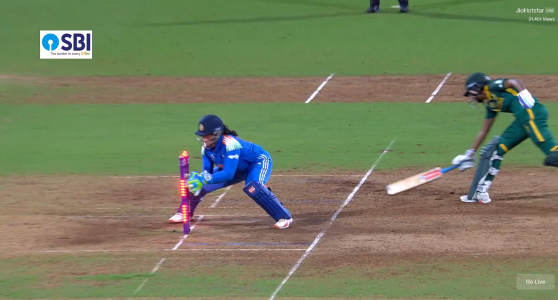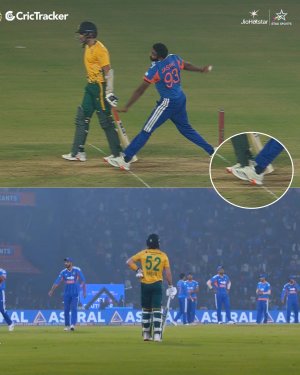




You’re trying to turn this into a gotcha when it isn’t one, so let’s reset the frame properly.
Yes in my original post I said that broadcasting + tech advantages are likely to re-occur in the upcoming T20 WC. I stand by that.
No that does not mean I claimed Star Sports personally presses a button and hands India trophies on demand.
Those two things are being deliberately conflated by you to derail the discussion.
1) “So how did India win the last T20 WC when Star Sports wasn’t host broadcaster?”
This question already assumes a false premise:
That only the host broadcaster matters and that only one variable can create advantage.
Institutional influence ≠ single broadcaster ≠ every decision going India’s way.
India winning a tournament without Star Sports involved does not disprove institutional advantage any more than Australia winning abroad disproves home advantage.
Cricket outcomes are multi-factor:
Conditions
Scheduling
Travel
Rest days
Venue familiarity
Crowd pressure
Commercial leverage
Governance power
Broadcasting is one layer, not the whole cake.
You’re arguing as if I said:
“Without Star Sports, India cannot win”
I never said that. You invented that position.
2) “How many decisions did India benefit from? Name exact wickets.”
This is another classic derail tactic.
DRS and broadcast influence are not about counting wickets like a scorecard.
They’re about:
Marginal calls
Framing of replays
Which angles are shown first
How quickly evidence is provided
What gets normalised as ‘inconclusive’
Many calls never become “decisions
India benefited from” because:
Teams don’t review due to lack of convincing visuals
Soft signals remain because evidence is deemed insufficient
Momentum shifts quietly
You’re demanding courtroom-level proof for something that operates through systemic bias and probability, not written confessions.
That’s like asking:
“Which exact referee decision proves home advantage exists?”
It’s a dishonest standard.
3) Hawk-Eye explanation (via Grok) and what you’re missing
What you posted about Hawk-Eye is technically correct and contextually incomplete.
Yes:
Hawk-Eye is owned and operated by Sony
Cameras are dedicated
Operators are independent of broadcasters
Now here’s what you’re conveniently
ignoring:
a) Third umpires do not operate in a vacuum
They rely on:
What feeds are available immediately
What angles are prioritised
What is deemed “clear and conclusive”
Hawk-Eye does not decide:
Which replay the audience (and officials) see first
How long certain angles are held
Which moments are amplified or downplayed
b) Not all decisions are Hawk-Eye decisions
Snicko, UltraEdge, boundary calls, no-balls, front-foot checks, replays these all still involve broadcast feeds and sequencing.
Your Hawk-Eye paragraph addresses one slice of officiating and pretends it answers everything.
It doesn’t.
4) “Prove institutional influence with hard facts”
Here you go actual, documented facts, not vibes:
• ICC revenue dependence:
Over 70–80% of ICC revenue comes from India-linked media rights. This is publicly reported.
• Scheduling patterns:
India routinely receives:
Fewer cross-continent travel legs
Longer rest periods
Prime-time slots aligned with Indian audiences
• Governance reality:
BCCI officials (past and present) have held disproportionate influence in ICC committees. Jay Shah becoming ICC Chair wasn’t symbolic it formalised existing power.
• Historical admissions:
Chris Broad (former ICC referee) has stated India was treated differently in disciplinary matters, including over-rate penalties.
None of this requires Star Sports to rig a single replay.
That’s institutional influence.
5) Why your argument keeps slipping
You keep demanding I say one of two extremes:
“India cheats every match” or
“Cricket is perfectly neutral”
Reality sits in between and that’s what you’re uncomfortable engaging with.
I’m saying:
India is not unbeatable
India does not win only because of bias
But India operates in the most comfortable ecosystem international cricket has ever seen
That ecosystem subtly favours them more often than others.
That’s not conspiracy. That’s power dynamics.
6) Final point and this matters
If broadcasting, scheduling, and governance don’t matter:
Why does every board fight viciously for them? Why does ICC bend calendars around India? Why are “neutral broadcasters” demanded selectively? Why do broadcasters cost billions?
You can’t say:
“None of this matters”
while simultaneously watching cricket become financially dependent on one market.
That contradiction is the real issue not my post.
So no, I’m not “singing a different tune”.
I’m singing the same tune you’re trying very hard not to hear.
And no amount of cherry-picked Hawk-Eye manuals or invented absolutes will change that. Go and read my opening post no. 1 again and try to understand the issue
@Ryw Thats your post to which I was responding. Look at the bold sentences where you explicitly accuse of pretty much blatant misuse of tech to benefit India so much so that you are certain that it is bound to re-occur in the upcoming T20 WC.
But now in Post# 150 you seem to be singing a different tune? So how did India win the last T20 WC when Star sports wasn't even the host broadcaster ? Approximately How many decisions did India benefit from?
You keep saying that India keeps enjoying "institutional" influence. Prove it thru hard facts instead of sitting on the fence and being vague. Which matches/wkts decisions that resulted in India getting undue advantage according to you ?
But according to Grok this is how the Hawk-Eye system is used and the host broadcaster is not controlling those equipment:
Hawk-Eye Innovations (owned by Sony) fully owns, installs, and operates the system.
A dedicated team of Hawk-Eye technicians and operators (not broadcaster staff or match officials) handles setup before a series or tournament.
Operators work from an on-site control van or room, monitoring feeds, ensuring tracking locks onto the ball, and generating replays when the third umpire requests them for DRS.
Cameras are fixed and dedicated solely to Hawk-Eye—they are not the same as broadcast cameras controlled by the host broadcaster (e.g., Star Sports, Sky Sports).