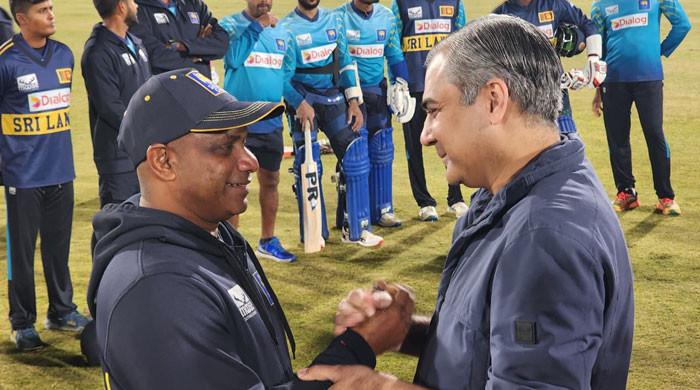
Q&A: Salman Ali Agha Press Conference
Q: First of all, best of luck to you and the entire team.
The government has decided not to play against India. Does that put extra pressure on the team to win the first two matches?
Salman Ali Agha:
Thank you. No, there is no such pressure at all. Whenever you come into an ICC tournament, you almost have to win all your games anyway. We came here with the same mindset — to win every match and give our best in each one. InshaAllah, whatever games we play, we will try to perform to our full potential.
Q: Pakistan last won this mega event in 2009. How do you see the team’s preparation now, and what kind of performance can we expect under your leadership?
Salman Ali Agha:
I remember 2009 very well. I was quite young at that time, and it has been a long while since then. Alhamdulillah, our preparation has been very good. We’ve been playing together for a long time, and over the last six months we haven’t lost a single series and have won most of our matches. Preparation-wise, everything is in place. Now it’s about how we execute once the tournament begins. If we perform the way we have over the past six months, I truly believe we can win this tournament.
Q: Since you started batting at number three, we’ve seen a different Salman Ali Agha. Will you continue at this position in the World Cup or remain flexible?
Salman Ali Agha:
I think things are going well at number three right now, so there’s no need to change. I will continue batting at number three.
Q: Pakistan has three matches left, and net run rate is also being discussed. Weather has already affected games and practice sessions. How are you approaching these challenges?
Salman Ali Agha:
If we focus on executing our plans and win all three matches, I don’t think net run rate will even come into the equation. Weather is something completely beyond our control. There’s no benefit in worrying about things we can’t control. As a team, we focus on what is controllable — playing good cricket and winning our matches.
Q: There is talk that Fakhar Zaman’s presence means Khawaja Nafay is being treated unfairly. Some believe Pakistan could score 200-plus if either Babar or Fakhar sits out. What’s your take?
Salman Ali Agha:
We have come here as a group of 15 players, and we will always try to play the best possible combination. If a senior player — whether it’s Fakhar or Babar — is not suited for a particular combination, we won’t play them. We’ll play whoever is best for the team. Fakhar has served Pakistan brilliantly over the last 10 years, and Babar has done the same. I fully support both of them. Ultimately, the playing XI will be selected purely on what’s best for the team.
Q: There have been many off-field controversies in recent tournaments. Do players feel that cricket itself is being overshadowed?
Salman Ali Agha:
That’s a very good question. Even when the event has just started, many questions in press conferences are not about cricket. I don’t think that’s a good thing. We come here as sportsmen to play cricket and talk about cricket. As a team and as individuals, we try not to let these things affect us. The less attention you give to such matters, the better it is for your game.
Q: How important is the toss in tomorrow’s match? Also, fans are worried that a boycott and rain could reduce Pakistan’s qualification chances.
Salman Ali Agha:
I’ve already mentioned that weather is not in our control, so we don’t really discuss it as a team. There’s no benefit in thinking about things you can’t control. Our focus is simple — how to win our three matches. Whatever the weather is, we’ll deal with it then, but we don’t overthink it.
Q: Players are seen as ambassadors of Pakistan. Do you feel the responsibility, especially given recent results? Also, death overs remain a concern — what’s the plan?
Salman Ali Agha:
Absolutely. As professionals, we represent our country. You can never doubt a player’s effort or intent, but the results haven’t gone our way, and we must be honest about that. We haven’t played the kind of cricket people expect from us — or the kind we expect from ourselves. We are aware of that and are working to improve, especially under pressure situations.
As for death bowling, yes, it is a concern. But if you look at the past six months, there has been noticeable improvement. Our bowlers are working closely with coaches and are fully aware of this issue. Hopefully, what has happened in previous tournaments will not be repeated this time, InshaAllah.
Q: There has been discussion about Tariq Usman’s bowling action. Is there a plan to protect him from scrutiny?
Salman Ali Agha:
I honestly don’t understand why there is still talk about his action. In my view, it is completely fair. He has been tested twice and cleared both times. It’s reached a point where he almost has to remind everyone that he’s been cleared. There is no issue with his action. He is an X-factor for us, and whenever we feel we need that X-factor, we will use him.
Q: Pakistan often chooses to bat first even after winning the toss. Is this due to conditions or team comfort?
Salman Ali Agha:
It is completely conditions-based. We have full belief in ourselves as a team — we can chase targets and we can set totals. If conditions suit chasing, we will chase.
Q: Pakistan’s record under the DLS method hasn’t been great. Has there been any discussion around that?
Salman Ali Agha:
You can’t really prepare specifically for DLS. You can only respond to the situation when it arises — whether it’s about scoring extra runs or restricting the opposition. Weather in Sri Lanka is unpredictable; it can rain and clear up within minutes. We’ll deal with the situation as it comes.
Q: How important is it to bring your A-game against associate nations?
Salman Ali Agha:
It’s very important because you don’t play against these teams often and don’t always know their strengths and weaknesses. That’s why you must bring your A-game. As a team, we focus on executing our plans across the full 40 overs. If we do that, I truly believe we can beat any side in the world.
Q: Do players feel hurt by the political tensions affecting cricket?
Salman Ali Agha:
It’s not about being hurt, but it’s definitely not good for the game. These things should not happen. As players, we are role models, and whatever we do gets picked up by kids. Role models should not promote such actions.
Q: Your personal form has improved significantly, with a higher strike rate. What changed?
Salman Ali Agha:
There was a gap between the tri-series against Sri Lanka and Zimbabwe, which gave me time to analyze my game. I was doing well in Tests and ODIs but not in T20s. That break helped me reflect. Earlier, I used to bat with a captain’s mindset. Now, I bat purely as a batter — expressing myself and enjoying the game. There have been minor technical tweaks, but the biggest change has been my mindset.
Q: Babar Azam has faced criticism over strike rate. Is this team-driven or something he’s personally working on?
Salman Ali Agha:
He is working on his game himself. He knows what he needs to improve, and that’s a good thing. He is a very key player for us in these conditions. He provides stability. If Babar is in form and scoring runs, Pakistan will win most of its games.
Q: Pakistan hasn’t won a major tournament recently. How important is this World Cup?
Salman Ali Agha:
This tournament is very important for us. As a group, we avoid discussing external noise and focus only on our game. Sri Lanka has supported us immensely, and we love playing here. There are still three more matches for fans to enjoy, and we’ll try our best to entertain them and win games.
Q: What is the key area the team wants to improve in this tournament?
Salman Ali Agha:
Consistency. Replicating good performances game after game. In tournaments like these, you have to perform in every match. We recently beat Australia 3–0, and we want to replicate that level of performance here — in batting, bowling, and fielding — every single game.
Salman Ali Agha:
Thank you very much, everyone.








 SLC WRITES A LETTER TO PCB


 , no handshakes either