PAK can no longer ignore their obvious flaws
Written by Shubh Agarwal, an ex-analyst at ESPN & Cricket.com. Follow him on X.
Known for their unpredictable nature, Pakistan have been quite predictable in the group stage of this World Cup. All their strengths and weaknesses have panned out as predicted before the start of the tournament:
the batting has mostly flunked, sometimes embarrassingly, while
the spin bowling remains their best hope.
Sahibzada Farhan has been the highest run-scorer amongst all teams in the group stage,
putting away 220 runs at a strike rate of 164.17. But no other Pakistani batter has even reached triple digits, with Shadab Khan accumulating 88 runs.
Their middle order (numbers three to six) has averaged 18.78, higher than only Namibia and Oman’s middle order.
They have the advantage of Sri Lanka’s venues to play all their games at, and
it’s an advantage that suits their potent and diverse spin attack. They can play as many as five spinners if they want, but it runs into an expected problem – the double-edged sword of the impact on their team composition and already weak batting order.
Slowdown against spin
Ironically,
the country’s batters have a tendency of slowing down against spin. In the build-up to this World Cup (January 2025 onwards) Pakistan had a strike rate of 124.85 against spin - only the eighth best among the 12 Full Member nations.
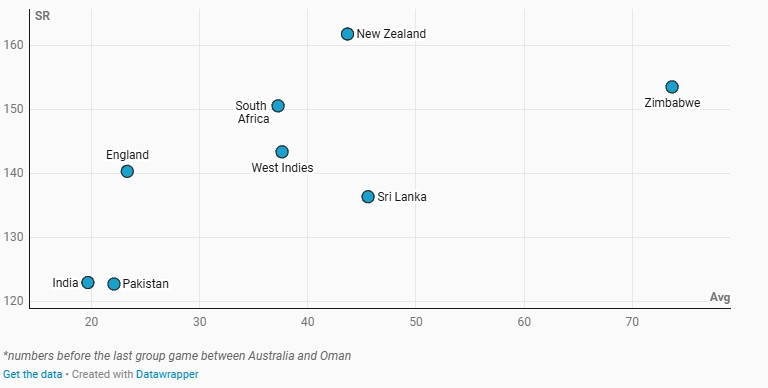
That timidness has reflected in this World Cup. Pakistan’s average of 22.08 is the second-lowest average against spin among all the Super 8 teams. Meanwhile, their strike rate (122.69) is the lowest.
SUPER 8 TEAMS FACING SPIN IN THE GROUP STAGE
Surprisingly, India have quite comparable numbers with Pakistan on this metric - average 19.67, strike rate 12.92. However, India compensate by going quick against pace at an average of 27.27 and a strike rate of 179.39.
Pakistan average 19.60 vs pace, the lowest among Super 8 teams and a strike rate of 138.03, the second lowest.
Pakistan’s strangulation against spin is a self-inflicted undoing, orchestrated by
the move to play Babar Azam at number 4.
Like number 3 in Tests, number 4 is the trickiest position to bat in T20 cricket. Teams often prefer a dynamic batter at this spot who can showcase all batting gears at his arrival to the crease, irrespective of the bowling type against him.
Pakistan chose Babar for this role, whose T20 game is on a steep decline. To add to it, the last time Babar batted at 4 in all T20s before this sudden move (which was initiated in the warm-up series against Australia) was way back in the 2018 edition of the Pakistan Super League (PSL).
Babar has traditionally been among the slowest starters in T20 cricket. Since 2025, he has a strike rate of 78.89 in the first 10 balls of his innings. That number is quite poor without requiring any comparison. Against spin, which he would be facing a lot as a number four batter, he strikes at only 66.67 at the start of his innings.
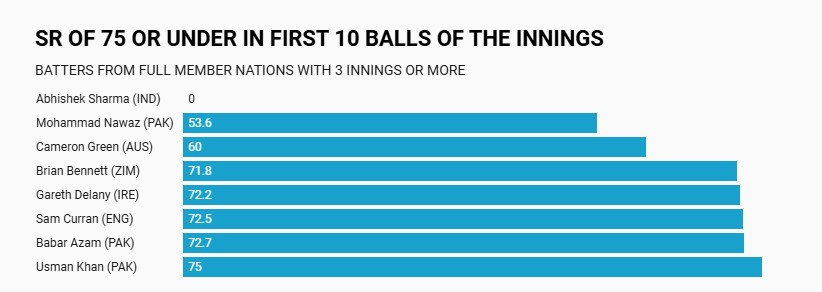
This World Cup, eight batters have a strike rate of 75 or lower in the first 10 balls of their innings.
Three are from Pakistan, including Babar at 72.7.
Against Netherlands, his 15 off 18 balls brought the run chase to a standstill. Against USA, he was 7 off his first 10 balls before accelerating later on for a brief period. He scored 5 off seven balls against India.
Babar hasn’t hit a boundary in the first 10 balls of his innings this World Cup.
Thus, Pakistan’s timidness versus spin is intertwined with Babar batting at four. And it should come as alarm bells given
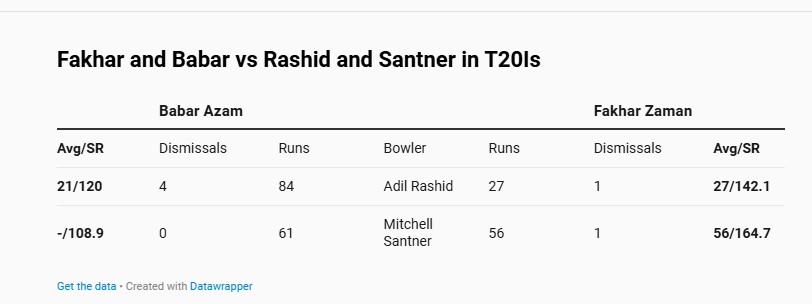
Pakistan will be up against the threat of Adil Rashid and Mitchell Santner in the Super 8s.
The matchups here account for
Fakhar Zaman’s inclusion in the side. Pakistan currently have a streak of right-handers from number three to six. Fakhar can break that monotony. He also has a much better record against Rashid and Santner.
The diminishing threat of pace
Fast bowling is another facet where Pakistan leave a lot to be desired. In their defence, they have bowled only 21.37% overs of pace, the lowest among all teams in the group stage - nearly 13% less than Sri Lanka. However, Shaheen’s poor form is a huge concern.
The left-arm seamer has three wickets in three games, averaging 33.66 at an economy of 11.22.
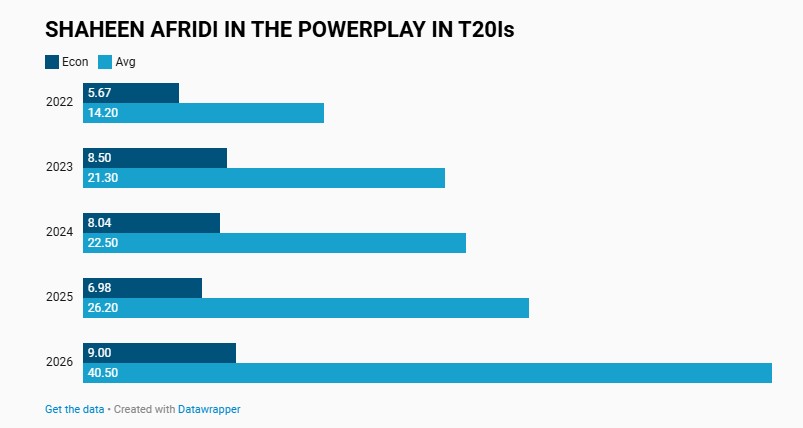
Known to be the best first-over bowler once, Shaheen has picked all his three wickets at the death. In fact,
his powerplay numbers have been on a nosedive since 2023.
Pakistan’s other seam-up options include
Naseem Shah who has been in modest form in T20Is since 2025 (six wickets in six matches, six wickets, 25.66 average, 8.8 economy),
Faheem Ashraf whom Pakistan didn’t trust for a single over against India, and
Salman Mirza who is the most inexperienced but in-form seamer for Pakistan since his debut in 2025 - 15 matches, 23 wickets, 15 avg, 6.33 economy.
Against Namibia, Pakistan benched Shaheen for Mirza. But in conditions when they would want to field three seamers,
the opposition will feel confident attacking Pakistan’s seam-up options.







 Reports that the PCB has decided to punish every member of the team and fine every player Rs 5 million each for the poor performance during the T20 WC.
 Fakhar came in 4 games too late.