
- Joined
- Oct 2, 2004
- Runs
- 218,158
With conflicting ethnic interests and even economic ones, would it be beneficial to add more provinces in Pakistan?

Follow along with the video below to see how to install our site as a web app on your home screen.
Note: This feature may not be available in some browsers.







I say no.
Provinces are an outdated concept and will result in dividing up the country

Creating more provinces results in more chief ministers, more bureaucracy, more provincial ministers and therefore leads to more corruption.
I'm not in favour of whole bunch of new provinces. The only changes I'll makes is FATA is merged with KPK. Punjab is split into Punjab and Seraiki province and incorporating the Seraiki speaking areas of Sindh in it as well, this is done so that we have more equitable distribution of national assembly seats. Right now you can give a rat's behind about the other three provinces and just win in Punjab and you will form the central government. This leads to a sense of deprivation and neglect amongst the other provinces.

I say no.
Provinces are an outdated concept and will result in dividing up the country


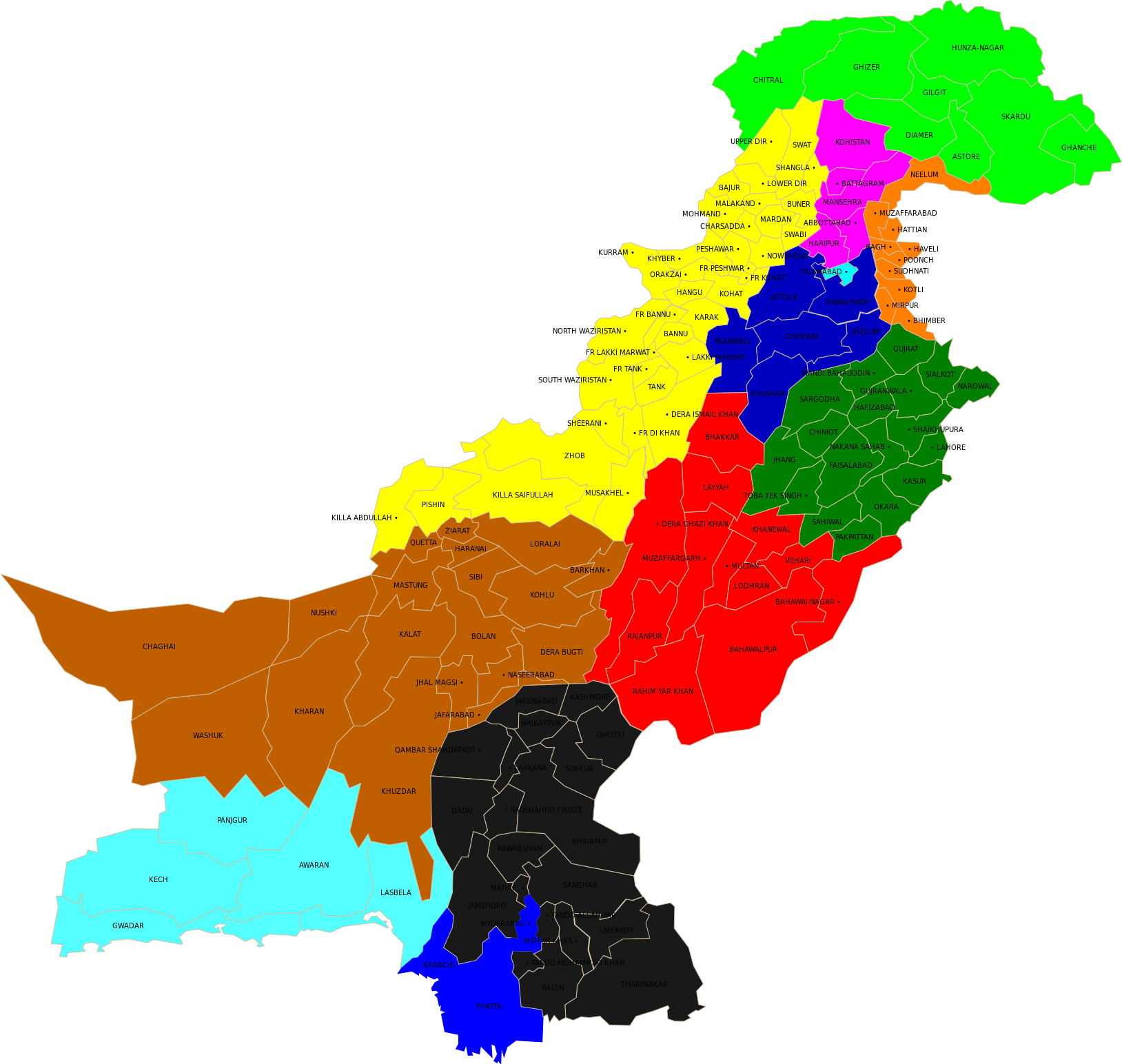
I'm absolutely for new provinces in Pakistan. I made this map to show what I would like to see.
Gilgit-Balitstan-Chitral
Hazara
Khyber Pakhtunkhwa
Hazara
Kashmir
Islamabad
Potohar
Punjab
Siraikistan
Sindh
Karachi
Balochistan
Makran
Provinces along ethnic lines aren't a good idea as letting ethnicity dominate a province would make it easier for secession. Mixed provinces are better as they would always split the vote and separatists would never be a major force.I'm absolutely for new provinces in Pakistan. I made this map to show what I would like to see.
Gilgit-Balitstan-Chitral
Hazara
Khyber Pakhtunkhwa
Hazara
Kashmir
Islamabad
Potohar
Punjab
Siraikistan
Sindh
Karachi
Balochistan
Makran



I think there is a case for creating more provinces in the Punjab. Punjab holds a demographic majority, and Punjabis do dominate in the military and bureaucracy. This has sometimes generated resentment in other provinces and the utterances of anti-Punjabi sentiments.
The reality, however, is that the Punjab is no homogenous monolith. Historian Ian Talbot identified four distinct economic and cultural zones. In the northern region (Rawalpindi division) where land is less suited for agriculture, historically army recruitment and remittances from the Gulf have been essential. Hindko and Pothwari are spoken alongside Punjabi. Central Punjab is the most populous area and includes the more fertile agricultural lands as well as the key industrialised region around Faisalabad. In the south-west (Multan and Bahawalpur divisions) Saraiki is spoken and landholdings can be more sizeable than central Punjab. The western districts (Sargodha and Dera Ghazi Khan divisions, plus Jhang district) remain deprived areas, where sway of the landlord is more pronounced.
Creating new provinces in the Punjab could therefore go some way in addressing perceptions of Punjabi domination and enable greater attention to the province’s poorer regions.
As a useful comparison, India did reorganise states along linguistic lines in the 1950s. This was initially against Nehru’s wishes as he feared it would encourage fissiparous tendencies. A Gandhian - Potti Sriamalu - called for a separate state of Andhra based on Teluga speaking districts of Madras and went on hunger-strike. He actually died from starvation, which triggered widespread protests. Eventually Nehru submitted to popular pressure, and the eventual re-organisation of states arguably dampened secessionist enthusiasm.
Until then, provincial boundaries had reflected the timing of imperial conquest or imperial strategy. The reorganisation in the 1950s, produced a closer fit between the shape of Indian society and the political map of the state.
Some Pakistanis (and indeed Indians) dislike the idea of more provinces based on culture, ethnicity or language, fearing that it legitimises identities other than the national one. As such they see it as weakening the nation by strengthening a ‘parochial’ identity. But people have multiple identities and many of South Asia's problems have often stemmed from an attempt to assert the primacy of the national identity. State-led efforts at imposing unity have often translated into attempts to efface 'difference' rather than acknowledge the plural nature of the nation and find accommodation for the sense of cultural difference.
It is in this spirit that South Asia could learn much from the great poet Rabindranath Tagore, who wrote with great wisdom that unity is not built by denying difference but giving it some legitimate space within the whole:
"When there is genuine difference, it is only by expressing and restraining the difference in its proper place that it is possible to fashion unity. Unity cannot be achieved by issuing legal fiats that everybody is one.”


