What's new

Your type of investments for your future?

Hitman

Senior T20I Player
Joined
Feb 25, 2013
Runs
19,802
I've been an extremely irresponsible person all my life when it comes to my finances. It's been about 4 months since I've completely changed my attitude towards my money, thinking about the future. I've started investing in mutual funds, and I'll remain invested all my life.

I was wondering what type of investments posters here on PP have made to secure their future?
 
I live in the UK, my breakup, including pension, is roughly as follows:

Real estate: 67%
Stocks: 10%
Cash: 15%
Crypto: 3%
Rainy day saving: 5%

It's not ideal, but I've been sitting on cash waiting to bottom feed as markets come off, I've only recently started taking small nibbles with snp at 3650, aim to convert at least 5% of that cash to stock if we see a fall to 3300 kinda levels.

As always do you own research, my asset allocation is not ideal by any means.
 
My break up

Unmanaged ISA (I select my own funds) - Precious Metals and Emerging Markets

Unmanaged SIPP (PMs, Emerging Markets, Global property with Income)

Company Pension which is managed, so I do not get to choose the funds.

Physical precious metals

Premium Bonds

Cash

While there has been a decline in equity funds, the drop in GBP has lead a rise to the value of my PM holdings (which are priced in USD).

Like Elraja, I do my own research.
 
I've been cash and crypto heavy for the last two years.

Don't really count my pension its just one of those things that are there.
 
Property, company shares, private pension.
 
Real-estate - ~75%
Equity - 15-18% -
MF - 2-3%
Cash - 5%
Gold - 10%

I am mostly debt free, want to be 100% debt free before my kids start school in 18 months.
Most likely wont buy a property for next 10 years
Equities, have moved ~80% to dividend paying from high beta stocks
MF - just small sips, wont add more.
Gold - Never been a fan, but am just forced to.
 
One point I did not mention, I also short financial instruments such as GBP/USD, and Indices via In-The-Money Put Options. Not exactly investing, but more so hedging/insurance. I use IG Index.
 
Property, company shares, private pension.

WRT to Shares and Pensions, ultimately the trend is up, so when markets do drop in double digits, it's always wise to buy more, thus known as averaging down - so when markets do pick up, the gains are higher.
 
WRT to Shares and Pensions, ultimately the trend is up, so when markets do drop in double digits, it's always wise to buy more, thus known as averaging down - so when markets do pick up, the gains are higher.

The company share plan is generous. It’s a matching scheme, so the company grants an extra 2 shares for each 1 share that you invest in (up to a certain amount), which for a FTSE index firm makes it very difficult to lose money.

The shares initially get locked down. Ultimately after 5 years each share can be sold tax free. Also when the company pays a divided at year end, that gets reinvested into the main pot.

I have worked for the same financial institution for a long time now, so it’s become a bit of a nest egg. I do pre-tax salary contributions (vary from month to month depending on my elected amount) and watch the value build up for retirement.

I had to hook out £1500 for a veterinary emergency a while ago when the cat nearly died! — was easy.
 
The company share plan is generous. It’s a matching scheme, so the company grants an extra 2 shares for each 1 share that you invest in (up to a certain amount), which for a FTSE index firm makes it very difficult to lose money.

The shares initially get locked down. Ultimately after 5 years each share can be sold tax free. Also when the company pays a divided at year end, that gets reinvested into the main pot.

I have worked for the same financial institution for a long time now, so it’s become a bit of a nest egg. I do pre-tax salary contributions (vary from month to month depending on my elected amount) and watch the value build up for retirement.

I had to hook out £1500 for a veterinary emergency a while ago when the cat nearly died! — was easy.

Splendid!

I was a paper millionaire during the Dot.Com boom, lock down period was 3 years. Had 6 months to go, then the crash happened.

Taught me a valuable lesson - it's not cash until you crystalize profits.
 
Splendid!

I was a paper millionaire during the Dot.Com boom, lock down period was 3 years. Had 6 months to go, then the crash happened.

Taught me a valuable lesson - it's not cash until you crystalize profits.

The hardest, and most expensive lesson a person can learn.
 
Nice , good to see some very smart and fiscally responsible people on the forum.
 
if we are talking about lessons, theee most the important lesson bar none

"do not play with money you cannot afford to lose"

if making a loss will have a material impact on your life, you are setting yourself up for misery. and when a loss doesnt have a material impact on your life, u can usually ride out the losses and think rationally even in bad times.


[MENTION=1842]James[/MENTION] that is an amazing deal u have with ur employer, that's some serious incentive to ensure staff retention lol.
 
Real-estate - ~75%
Equity - 15-18% -
MF - 2-3%
Cash - 5%
Gold - 10%

I am mostly debt free, want to be 100% debt free before my kids start school in 18 months.
Most likely wont buy a property for next 10 years
Equities, have moved ~80% to dividend paying from high beta stocks
MF - just small sips, wont add more.
Gold - Never been a fan, but am just forced to.

Bro, would be nice if you open up a little about your investments in real estate.
 
[MENTION=1842]James[/MENTION] that is an amazing deal u have with ur employer, that's some serious incentive to ensure staff retention lol.

Yes bro, it is a good scheme, unfortunately some colleagues don’t understand it (and don’t make the effort to educate themselves on it) so there is untapped potential in their salary packets.
 
I was born and raised in India, and I'll never move to another state within India, let alone another country.

The only reason I was asking is that if your government offer tax free investments (ISA in UK, 402K in USA), then it is worth investing in said financial products.
 
The only reason I was asking is that if your government offer tax free investments (ISA in UK, 402K in USA), then it is worth investing in said financial products.

No worries, I was not offended at all. Don't really know that.
 
The only reason I was asking is that if your government offer tax free investments (ISA in UK, 402K in USA), then it is worth investing in said financial products.

When I was in India there used to be many like NPS, LIC.

Also do you mean 401k? I somehow have never heard of 402k.
 
Oh for sure :))

Although during these painful times I try to console myself with another lesson

"It's not a loss unless you sell"

:))) man , have you ever been to stocktwits its my second favorite app to read comments after reddit.
 
The corporations have made literally everything irrelevant, everyone has to do a lot of analysis now or just invest in Gold and real estate as everything else is unfortunately manipulated
 
Real Estate - 50%
Dividend ETF's - 20%
Growth Stocks - 30%

95% of your money must be invested and working for you even while you are sleeping.
 
Real Estate - 50%
Dividend ETF's - 20%
Growth Stocks - 30%

95% of your money must be invested and working for you even while you are sleeping.
Is real estate still lucrative in USA?

In UK property market for retail investors seems quite dead now and with little tax incentives it's a bit of a dead end now.
 
Do people consider the place they live in as a real estate investment or is it some other properties or more radically; real estate stock 🧐
 
Is real estate still lucrative in USA?

In UK property market for retail investors seems quite dead now and with little tax incentives it's a bit of a dead end now.
In Melbourne.there is an additional taxing on investment houses.is it same case in UK too?.
 
I'm not big on investment. I like keeping my money in the bank and retirement funds. I have a real estate property I saved up to purchase and that's about the only investment I have.
 
Normally I prefer more in real estate , mutual funds, and hell bent on debt free policy.stocks never helped me in needed times .
 
Do people consider the place they live in as a real estate investment or is it some other properties or more radically; real estate stock 🧐
its part of your net worth, and a significant part if your not at least seven figures net worth, so it makes sense to include it IMO. real estate stock in the UK is utter tripe. the real money is in holding the real stuff, rents have gone up massively, its the only real inflation protection the average investor in the UK can get. also from a portfolio point of view it makes sense to include everything, even your pension, cos otherwise you wont get a clear idea of ur diversification.

im now

Real estate: 52%
Stocks (including pension, which is 15%): 24%
Cash (including rainy day fund): 19%
Crypto: 5%

but its a bit skewed as im pbly gonna look to increase that the real estate proportion at some point this year.
 
In Melbourne.there is an additional taxing on investment houses.is it same case in UK too?.
yes, you get tax breaks for first time buyers, and rent is taxed as income, so the way to do it is buy property in a ltd company, expense your mortgage payments and pay corporate taxes.
 
its part of your net worth, and a significant part if your not at least seven figures net worth, so it makes sense to include it IMO. real estate stock in the UK is utter tripe. the real money is in holding the real stuff, rents have gone up massively, its the only real inflation protection the average investor in the UK can get. also from a portfolio point of view it makes sense to include everything, even your pension, cos otherwise you wont get a clear idea of ur diversification.

im now

Real estate: 52%
Stocks (including pension, which is 15%): 24%
Cash (including rainy day fund): 19%
Crypto: 5%

but its a bit skewed as im pbly gonna look to increase that the real estate proportion at some point this year.
Do you guys not have retirement funds in the UK?
 
Normally I prefer more in real estate , mutual funds, and hell bent on debt free policy.stocks never helped me in needed times .
I personally prefer equity mutual funds over stocks. Mostly because I'm into small caps. Direct equity in small caps is way too much of a risk.​
 
I personally prefer equity mutual funds over stocks. Mostly because I'm into small caps. Direct equity in small caps is way too much of a risk.​
Yeah few stocks even after a thorough research gave me enough loss and wisdom .
 
50% real estate but rental, I don’t own the place I live as I rent. 25% stocks, 25% index funds which are held in an isa.
 
Is real estate still lucrative in USA?

In UK property market for retail investors seems quite dead now and with little tax incentives it's a bit of a dead end now.
Not really. It is lucrative when you can time the market during hosing market collapse like it happened in 2008. People had the opportunity to buy great houses, condos and apartments at dirt cheap prices. Banks were looking for a customer to buy the foreclosed houses and were willing to sell them for great discounts. Some of my smart friends bought 2 or 3 condos at that time at great locations and are now landlords earning up to $10k passively. I was too scared and also did not have the money and guts to take the plunge, I was young and naive.

Right now, the house prices are still at all time highs even though in certain areas and cities the prices have come down by 10-15%. With interest rates coming down in the coming months and years under Trump, the prices will climb up again.

I would not think of buying a rental property unless there is a 50% correction. Don't know if it will ever happen. I will not chase anything. I am in no hurry. I am happy as of now with my portfolio.
 
Do people consider the place they live in as a real estate investment or is it some other properties or more radically; real estate stock 🧐
Real Estate is an investment as you are building equity with each payment you are putting towards the house. You will get all that money back when you sell it. Of course, you have to minus the interest you are paying on the loan. Whether you live in the house you bought or not, it is immaterial.
 
Real Estate is an investment as you are building equity with each payment you are putting towards the house. You will get all that money back when you sell it. Of course, you have to minus the interest you are paying on the loan. Whether you live in the house you bought or not, it is immaterial.

I thought about it because felt it could potentially be considered a liability since it’s not making me any money, however, I guess if I was to take part of the equity out and remortgage / use the sums for another investment then I guess from that end it becomes an asset. Majority of people I’d have thought, well for myself anyway, in the short term wouldn’t sell the house they live in unless there is a unforeseen event and usually when people do, it’s either to up/down size.
 
its part of your net worth, and a significant part if your not at least seven figures net worth, so it makes sense to include it IMO. real estate stock in the UK is utter tripe. the real money is in holding the real stuff, rents have gone up massively, its the only real inflation protection the average investor in the UK can get. also from a portfolio point of view it makes sense to include everything, even your pension, cos otherwise you wont get a clear idea of ur diversification.

im now

Real estate: 52%
Stocks (including pension, which is 15%): 24%
Cash (including rainy day fund): 19%
Crypto: 5%

but its a bit skewed as im pbly gonna look to increase that the real estate proportion at some point this year.

Yes, in the UK property is king and imo the ideal ‘premium’ investment. Though in the current market, other than your own home, it would take a substantial deposit to start a property portfolio. When you say increase your RE proportion, would it count to say make additional payments to bring down your LTV or more applicable to say rental property investment.

You’re right, rents are still mental right now especially in the big city’s, though I know a few have had tenants/family’s for decades and have looked to find a way to best accommodate them. Then there’s UK property law etc as well and the gov always making it difficult for landlords, but the market generally is resilient.
 
Do you guys not have retirement funds in the UK?
theres lots of types of retirement funds, however most have a company DC plan which they can invest into and get a tax benefit, also long term property yields are so good that beyond a certain point the long term trend always tends towards property investments which makes it a slightly dangerous feedback loop, however it also means that any government cannot afford to let the property market crash so finds ways to manipulate it in ways which does not hurt it long term but keeps letting out a bit of the steam.
 
Is real estate still lucrative in USA?

In UK property market for retail investors seems quite dead now and with little tax incentives it's a bit of a dead end now.
Depends upon the state, Good investments in Texas, Florida not so in Oregon
 
Yes, in the UK property is king and imo the ideal ‘premium’ investment. Though in the current market, other than your own home, it would take a substantial deposit to start a property portfolio. When you say increase your RE proportion, would it count to say make additional payments to bring down your LTV or more applicable to say rental property investment.

You’re right, rents are still mental right now especially in the big city’s, though I know a few have had tenants/family’s for decades and have looked to find a way to best accommodate them. Then there’s UK property law etc as well and the gov always making it difficult for landlords, but the market generally is resilient.
rental properties. I'm in my mid-30s and need a roadmap to give me some hope that I can eventually leave the rat race before I'm a geriatric, lol. Even if that doesn't materialise, it's best to diversify income sources so you don't have stress about what happens if you lose your job.

As the Urdu saying goes, "Qatari Qatari sai banta hai darya," so you have to start somewhere. I have some exposure to the industry and while an average Joe might be getting 6% or 7% rental yields, I know people picking up 12% and 13%. ive seen riskier plays in the low 20% range. that's before u include property price appreciation, which becomes a bigger contributor over time.
 
Many people are putting real estate as one of their primary investment. Do you guys own multiple properties? Live in one and rent out others?
 
@ElRaja - hypothetically say you have 100k in your bank account, how would you diversify the investments/savings? Want the breakdown in numbers pls. Thanks in advance.
 
Many people are putting real estate as one of their primary investment. Do you guys own multiple properties? Live in one and rent out others?
It’s not profitable anymore in UK, 5-10 years ago the taxing on rental income wasn’t as high.

Owning rental properties is one of the ways most people make money in States. I don’t have one but all Indians in DFW area have multiple rental properties.
 
@ElRaja - hypothetically say you have 100k in your bank account, how would you diversify the investments/savings? Want the breakdown in numbers pls. Thanks in advance.
in UK, rainy day fund, 4 to 6 months of your absolutely fixed outgoings, for me that's around £25k pbly. remaining depends on time horizon and your credit. if you have a long time horizon and good credit id put the rest in an investment BTL property, incorporated, however you will have to wait for a good deal which isnt available immediately. assuming you expect to land a deal in ~ 3 to 6 months id put it in easy access savings which will give you about 4% return, if you expect to wait for longer, like a year, then id put half the money in an index tracker for stock markets, and other half in fixed term deposit.

so with numbers assuming you get a good deal in six months
75k -> 76.5k
you find a rental property, ~£300k value yielding ~6.5%, gross rental of 19.5k, but buy it at a 10% discount so 270k, 20k purchase cost and tax.
mortgage of 215k, at 5.5% ~£12,000 interest cost.
10% cash on cash yield, assuming it appreciates by twenty percent in value over 5 years, your total return is 60k+37.5k ~100k on 75k investment over 5.5 years, which is equivalent to ~16.6% annual returns assuming rents dont increase and ur maintenance costs are neglegible.
 
Alot of people mentioning Cash, what do you mean by that? You keep hard cash or foreign exchange?

Been dumping 40% of my income in a savings account especially when the interest rate was high. Its the safest investment here. For the last 6 months i started experimenting with 10% investment in Mutual Funds. Now planning to invest in PSX and going for stocks.

In Pakistan having a car as an asset or property is a good investment. There are also alot of people that have became rich through crypto, but i am abit reluctant considering how its illegal in Pakistan and withdrawing any investments made on crypto can land you in fbr troubles here
 
in UK, rainy day fund, 4 to 6 months of your absolutely fixed outgoings, for me that's around £25k pbly. remaining depends on time horizon and your credit. if you have a long time horizon and good credit id put the rest in an investment BTL property, incorporated, however you will have to wait for a good deal which isnt available immediately. assuming you expect to land a deal in ~ 3 to 6 months id put it in easy access savings which will give you about 4% return, if you expect to wait for longer, like a year, then id put half the money in an index tracker for stock markets, and other half in fixed term deposit.

so with numbers assuming you get a good deal in six months
75k -> 76.5k
you find a rental property, ~£300k value yielding ~6.5%, gross rental of 19.5k, but buy it at a 10% discount so 270k, 20k purchase cost and tax.
mortgage of 215k, at 5.5% ~£12,000 interest cost.
10% cash on cash yield, assuming it appreciates by twenty percent in value over 5 years, your total return is 60k+37.5k ~100k on 75k investment over 5.5 years, which is equivalent to ~16.6% annual returns assuming rents dont increase and ur maintenance costs are neglegible.


Thank you. This is an excellent post.
 
goldbugs having a field day today, should have bought a little bit back in the day. @Markhor you a holder?
Yes I went on a bit of spree since last October. Britannia coins as they're CGT exempt plus the odd collector's item. Still have a decent chunk in stocks so not going all in on one asset class.

With a balanced portfolio it doesn't matter where the wheel ends up, the house always wins (barring a black swan event that sees both gold and stocks dip).
 
Last edited by a moderator:
in UK, rainy day fund, 4 to 6 months of your absolutely fixed outgoings, for me that's around £25k pbly. remaining depends on time horizon and your credit. if you have a long time horizon and good credit id put the rest in an investment BTL property, incorporated, however you will have to wait for a good deal which isnt available immediately. assuming you expect to land a deal in ~ 3 to 6 months id put it in easy access savings which will give you about 4% return, if you expect to wait for longer, like a year, then id put half the money in an index tracker for stock markets, and other half in fixed term deposit.

so with numbers assuming you get a good deal in six months
75k -> 76.5k
you find a rental property, ~£300k value yielding ~6.5%, gross rental of 19.5k, but buy it at a 10% discount so 270k, 20k purchase cost and tax.
mortgage of 215k, at 5.5% ~£12,000 interest cost.
10% cash on cash yield, assuming it appreciates by twenty percent in value over 5 years, your total return is 60k+37.5k ~100k on 75k investment over 5.5 years, which is equivalent to ~16.6% annual returns assuming rents dont increase and ur maintenance costs are neglegible.

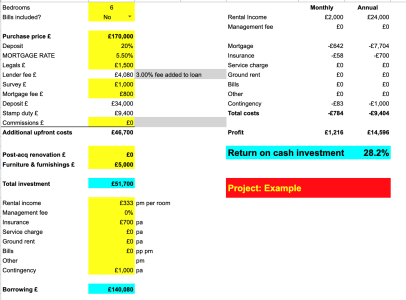
Rental property can still be very profitable in the UK, but much harder to find those gems now. Legislation, tax, planning, interest rates, lender appetite... all these factors mean it is difficult to get 10%+ annual return on investment unless you know what you are doing. The days of the accidental landlord are over.

As an example, this is a live deal I'm currently working on. This gives an annual return of nearly 30%, and has no planning issues. It also doesnt take into account any uplift from capital appreciation of the property over time.
 

Attachments

  • Screenshot 2025-09-03 at 01.32.31.png
    Screenshot 2025-09-03 at 01.32.31.png
    193.2 KB · Views: 9
I am in Canada.

I currently have this portfolio:

Cryptos: 30%
Stocks/ETFs: 51%
Gold/Silver: 19%

I want to reduce crypto investment further and increase stocks/ETFs/Gold/Silver percentage.
 
Rental property can still be very profitable in the UK, but much harder to find those gems now. Legislation, tax, planning, interest rates, lender appetite... all these factors mean it is difficult to get 10%+ annual return on investment unless you know what you are doing. The days of the accidental landlord are over.

As an example, this is a live deal I'm currently working on. This gives an annual return of nearly 30%, and has no planning issues. It also doesnt take into account any uplift from capital appreciation of the property over time.
that is a really good deal, which area is that in? im south east, and £170k for six beds sounds crazy down here. also im not talking about accidental landlords, im talking about professionals when it comes to the best deals, but even for a regular guy, if ur investment horizon is long enough, and you can buy 2 or 3 properties, u wont worry about ur pension when u hitting mid 60s.
 
that is a really good deal, which area is that in? im south east, and £170k for six beds sounds crazy down here. also im not talking about accidental landlords, im talking about professionals when it comes to the best deals, but even for a regular guy, if ur investment horizon is long enough, and you can buy 2 or 3 properties, u wont worry about ur pension when u hitting mid 60s.

It is in the North West. As are most the best BTL properties, if you are using yield as a metric.

HMOs give the best yields, and the number simply do not work south of the Midlands. It is why planning restrictions are so much more onerous outside of the South East.

For social housing, the rents are around 80% in the North West (compared to the South East), but the property will be less than 1/3 of the price. It is why most investors in the South East will invest North of the Midlands.
 
It is in the North West. As are most the best BTL properties, if you are using yield as a metric.

HMOs give the best yields, and the number simply do not work south of the Midlands. It is why planning restrictions are so much more onerous outside of the South East.

For social housing, the rents are around 80% in the North West (compared to the South East), but the property will be less than 1/3 of the price. It is why most investors in the South East will invest North of the Midlands.
Lot of Jewish investors are big into HMOs in London. How are they getting the numbers to work?

It is a mystery to me, they are buying 3 bed properties, and converting it to 6 beds but there is a considerable outlay upfront with extension and loft on top of the high property price in London.
 
The Jewish investors will have bought pre-2000 - before the massive uplift in property prices.

It is impossible to buy ANY 6-bed house in London for less than £1.5m - even in the most deprived areas. In the late 1990s, you could still buy a 6-bed in East London for £150k. The numbers no longer work.
 
The Jewish investors will have bought pre-2000 - before the massive uplift in property prices.

It is impossible to buy ANY 6-bed house in London for less than £1.5m - even in the most deprived areas. In the late 1990s, you could still buy a 6-bed in East London for £150k. The numbers no longer work.
They bought 3 bed 500k properties in the last few years and converted it to 6 bed HMOs by adding a loft and 6m ground floor extensions. Locals petitioned the council to stop issuing anymore HMO licenses, which they agreed and its now come to a halt. I presume they are more in for the property price inflation over time than the netback from rental income.
 
That nakes sense. Permitted development rights in non Article 4 areas mean you can convert any house into a 6 bed HMO without planningpermission- assuming each room is minimum 6.5msq. Very few areas outside the SE now enjoy this privilege.

Big difference between licencing and planning. The former just requires the house to be compliant (room sizes, certificates, etc). The latter depends on whether you can have HMO in that area, and trumps licensing. These investors tried to circumnavigate around the planning rules.

With capital gains tax, selling for a profit isn't attractive. I prefer passive income from renting out long-term.
 
It is in the North West. As are most the best BTL properties, if you are using yield as a metric.

HMOs give the best yields, and the number simply do not work south of the Midlands. It is why planning restrictions are so much more onerous outside of the South East.

For social housing, the rents are around 80% in the North West (compared to the South East), but the property will be less than 1/3 of the price. It is why most investors in the South East will invest North of the Midlands.
do you manage them yourself, or do you have a lettings manager. the main thing holding me back from doing something like that is just being so far from a property makes me nervous.
 
Lot of Jewish investors are big into HMOs in London. How are they getting the numbers to work?

It is a mystery to me, they are buying 3 bed properties, and converting it to 6 beds but there is a considerable outlay upfront with extension and loft on top of the high property price in London.
a lot of jewish money is moving out of london proper and into the home counties, the legacy portfolios are still london, but the new money is in home county deveopments. there is no juice inside id say zone 4 these days, unless u getting a run down property.
 
Has anyone created their own pie of ETF’s for an upfront car purchase (for enthusiasts especially because it’s not a flex)
:yk3


A slight change from all the sensible talk, I do think you should prioritise a property purchase at the minimum to live in, beyond that, does it hurt to treat yourself
:amir

2020 could have been the end of the world and I know we are still here, but maybe some food for thought.

The sensible thing would be to use the funds towards a BTL though or securing the emergency fund.
 
do you manage them yourself, or do you have a lettings manager. the main thing holding me back from doing something like that is just being so far from a property makes me nervous.

Do you have any sort of relatives or in-laws up north / trusted friends, perhaps that could encourage you potentially, otherwise extensive research & trips to the neighbourhood but the former is certainly a lot more straight forward
 
do you manage them yourself, or do you have a lettings manager. the main thing holding me back from doing something like that is just being so far from a property makes me nervous.

We use managing agents (typically 10-12%) where there are individual tenants, who also look after the compliance, certificates and repairs. But our model is now moving towards social housing providers who offer a 3-year deal but look after everything apart from major infrastructure repairs. This is more lucrative in my experience, and definitely more stress free and far less hands-on.
 
Do you have any sort of relatives or in-laws up north / trusted friends, perhaps that could encourage you potentially, otherwise extensive research & trips to the neighbourhood but the former is certainly a lot more straight forward

The best way, in my experience, is to use a property broker, though a good one can be difficult to find as people want to keep them to themselves for the best deals. A decent broker will find you a deal, send you a whatsapp video so you dont have to view every single property, negotiate the price, sort out a local solicitor, introduce you to mortgage brokers, and even manage any works required.
 
Do you have any sort of relatives or in-laws up north / trusted friends, perhaps that could encourage you potentially, otherwise extensive research & trips to the neighbourhood but the former is certainly a lot more straight forward
nope, i think ill focus near me for the time being, even if it is saturated
We use managing agents (typically 10-12%) where there are individual tenants, who also look after the compliance, certificates and repairs. But our model is now moving towards social housing providers who offer a 3-year deal but look after everything apart from major infrastructure repairs. This is more lucrative in my experience, and definitely more stress free and far less hands-on.
yep, i have someone locally who does that for me, but no one out there. i think maybe some day i might look at that, until then will keep focus near my patch. its just tiring waiting, desis have a lot of hidden cash and like to stick to areas they know so tend to snap up deals when they show up.

social demand is crazy in london, they bite ur hand off.
 
Has anyone created their own pie of ETF’s for an upfront car purchase (for enthusiasts especially because it’s not a flex)
:yk3


A slight change from all the sensible talk, I do think you should prioritise a property purchase at the minimum to live in, beyond that, does it hurt to treat yourself
:amir

2020 could have been the end of the world and I know we are still here, but maybe some food for thought.

The sensible thing would be to use the funds towards a BTL though or securing the emergency fund.
i know someone who buys cars in cash, but his cousin is a dealer, so he gets great deals, and generally tends to sell em for very little loss two years or so later, he does much better than leases, but hes got inside intel.
 
The best way, in my experience, is to use a property broker, though a good one can be difficult to find as people want to keep them to themselves for the best deals. A decent broker will find you a deal, send you a whatsapp video so you dont have to view every single property, negotiate the price, sort out a local solicitor, introduce you to mortgage brokers, and even manage any works required.

In the NW there are 2-3 bed houses available for <£100k, for these do you still tend to get a mortgage out or look to save for a while & buy cash; what is the better option, I guess for less experienced folk maybe cash is better to avoid the curve balls during the day to day running stuff.

Also, a big chunk of these houses are on very long leases, does that bother you, being in the city I found it odd but it seems to be the norm up there, you know the average asian terraced street close to town
 
i know someone who buys cars in cash, but his cousin is a dealer, so he gets great deals, and generally tends to sell em for very little loss two years or so later, he does much better than leases, but hes got inside intel.

Yeah PCP seems to be the norm otherwise, I’ve been looking into it more recently as I’ve never taken a finance out before. From what I read, it’s better to go PCP or HP then having weaker liquidity
 
Back
Top