What's new

Afghanistan under the Taliban regime discussion

In coming day's Pakistan will be pounded by Afghanistan. Wait for some news I'll give updates how Pakistan soldier's leave the Check Post from KPK border along with Afghanistan.

:klopp :kp
Kandao military post was overrun by a group of Pakistani Taliban on mid night. IMP, a proxy group for TTP, has claimed responsibility for the attack. 11 Pakistan Soldier killed.

@Rajdeep I told you yesterday and this happened when we were discussing the news at that time
 
Pak threw India out of Afghanistan putting waste to their $3 billion. India possibly stopped Cricketing nations touring Pak costing us a few $million at best. Do your sums who has won here:afridi
Hanji... You were enjoyed when Taliban takeover in Afghanistan and said Pakistan threw india out of Afghanistan.

But as of now india - Afghanistan relations are getting stronger while Pakistan is facing the attack's after attacks

Taliban will now take care of the TTP and all those holed up in Afghanistan. Now these so called translators are begging the American's to grant them asylum. The majority that remain behind will be begging the Talib's for mercy.

You are right, the Establishment will be the winners, beats having a hostile govt next door, that's for sure.
Who is the winner now ? Establishment ? Lol

:klopp :kp
 

India to reopen embassy in Kabul after four years​


India will reopen its embassy in the Afghan capital, Kabul, nearly four years after shutting it down following the Taliban’s return to power, External Affairs Minister Subrahmanyam Jaishankar announced on Friday — a move signaling New Delhi’s growing engagement with the Taliban administration.

The meeting between the Foreign Minister of the Islamic Emirate of Afghanistan, Mr. #Mawlawi_Amir_Khan_Muttaqi, and his Indian counterpart, @DrSJaishankar, is currently underway in #NewDelhi, the capital of India. pic.twitter.com/q8uKtusenS

According to Reuters, India had closed its diplomatic mission in Kabul in 2021 after the Taliban seized control following the withdrawal of US-led NATO forces. A limited “technical mission” was later established in 2022 to oversee humanitarian aid, trade, and medical assistance.

Read: Afghan FM in India on landmark visit

“India is fully committed to the sovereignty, territorial integrity and independence of Afghanistan,” Jaishankar said during talks with Afghan Taliban Foreign Minister Amir Khan Muttaqi, who is on a six-day visit to India — the first by a Taliban leader since 2021.

Jaishankar added that closer cooperation between the two sides would contribute to Afghanistan’s “national development, as well as regional stability and resilience,” confirming that the technical mission would be upgraded to a full-fledged embassy. He did not specify a timeline for the reopening.

About a dozen countries, including China, Russia, Iran, Pakistan and Turkey, currently maintain embassies in Kabul. Of these, only Russia has formally recognised the Taliban government.

Muttaqi’s visit comes as the Taliban seek to strengthen diplomatic and economic ties with regional powers. His travel was permitted after the UN Security Council temporarily lifted a travel ban on him to enable official engagements abroad.

India and Afghanistan have long shared friendly relations, though New Delhi has not formally recognised the Taliban government. Western nations have withheld recognition over the Taliban’s restrictions on women’s rights.

Talks between Jaishankar and Muttaqi are expected to cover political, economic, and trade cooperation.

Source: The Express Tribune
 

India to reopen embassy in Kabul after four years​


India will reopen its embassy in the Afghan capital, Kabul, nearly four years after shutting it down following the Taliban’s return to power, External Affairs Minister Subrahmanyam Jaishankar announced on Friday — a move signaling New Delhi’s growing engagement with the Taliban administration.

The meeting between the Foreign Minister of the Islamic Emirate of Afghanistan, Mr. #Mawlawi_Amir_Khan_Muttaqi, and his Indian counterpart, @DrSJaishankar, is currently underway in #NewDelhi, the capital of India. pic.twitter.com/q8uKtusenS

According to Reuters, India had closed its diplomatic mission in Kabul in 2021 after the Taliban seized control following the withdrawal of US-led NATO forces. A limited “technical mission” was later established in 2022 to oversee humanitarian aid, trade, and medical assistance.

Read: Afghan FM in India on landmark visit

“India is fully committed to the sovereignty, territorial integrity and independence of Afghanistan,” Jaishankar said during talks with Afghan Taliban Foreign Minister Amir Khan Muttaqi, who is on a six-day visit to India — the first by a Taliban leader since 2021.

Jaishankar added that closer cooperation between the two sides would contribute to Afghanistan’s “national development, as well as regional stability and resilience,” confirming that the technical mission would be upgraded to a full-fledged embassy. He did not specify a timeline for the reopening.

About a dozen countries, including China, Russia, Iran, Pakistan and Turkey, currently maintain embassies in Kabul. Of these, only Russia has formally recognised the Taliban government.

Muttaqi’s visit comes as the Taliban seek to strengthen diplomatic and economic ties with regional powers. His travel was permitted after the UN Security Council temporarily lifted a travel ban on him to enable official engagements abroad.

India and Afghanistan have long shared friendly relations, though New Delhi has not formally recognised the Taliban government. Western nations have withheld recognition over the Taliban’s restrictions on women’s rights.

Talks between Jaishankar and Muttaqi are expected to cover political, economic, and trade cooperation.

Source: The Express Tribune


This might be good news long term. The Taliban might even build a Hindu temple for their Hindu communities, which would mean a softening of their severe Islamic stance against idolators. If that happened it would pave the way for better relations with Pakistan as well, because as the Taliban consider Pakistan as unIslamic, that view might become less severe also.
 
So Indian allies include Zionists and the Taliban 🤣🤣 @Devadwal @Rajdeep

What does that say about Hindutva and your country, yet you have the cheek to call Pakistanis terrorists.
 
So Indian allies include Zionists and the Taliban 🤣🤣 @Devadwal @Rajdeep

What does that say about Hindutva and your country, yet you have the cheek to call Pakistanis terrorists.
Islamist are always includes religion in every things. Every nation first looks at own national interest.


:klopp :kp
 
Last edited by a moderator:

Source - https://www.bbc.com/news/articles/c8exzzz5dp5o

Why Taliban minister's visit to India is so groundbreaking​


grey-placeholder.png
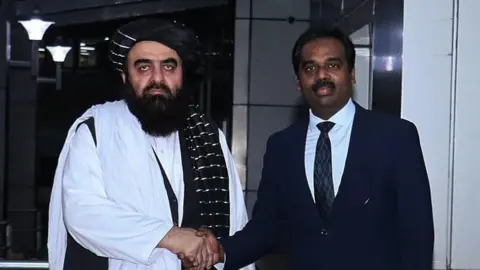
Randhir Jaiswal/MEA Twitter Amir Khan Muttaqi shakes hands with an Indian diplomat
Randhir Jaiswal/MEA Twitter
Amir Khan Muttaqi arrived in India on Thursday for a week-long trip
Afghan Taliban Foreign Minister Amir Khan Muttaqi has arrived in India for a week of talks - a visit which had been previously unimaginable.

It is the Taliban's highest-level visit to the country since seizing power in 2021, and Muttaqi is due to discuss diplomatic, trade and economic ties with Indian officials during an eight-day stay.

The visit is being seen as a ramping up of India's Afghan policy. On Friday, after Muttaqi met Indian Foreign Minister S Jaishankar, Delhi said that it will reopen its embassy in Kabul which was shut four years ago when the Taliban returned to power.

Arch-rival Pakistan, which historically had close ties with the Taliban, will be watching closely.
Muttaqi - who was granted a temporary exemption from UN sanctions allowing him to travel - flew into Delhi from Russia, the only country so far to fully recognise the Taliban government.

The astonishing fact is that neither Islamabad, Delhi or the Taliban could have anticipated that so soon after taking power, the Taliban's relations with Pakistan would deteriorate to such a degree, while India would establish a multilateral relationship with the new government in Kabul.

Delhi used to support the Western-backed Afghan government, which the Taliban drove from power, and this visit illustrates pragmatism and realpolitik on both sides, indicating they are serious about upgrading diplomatic, political and trade links.

Muttaqi, accompanied by Afghan trade and foreign ministry officials, held talks with India's Jaishankar in Delhi on Friday.

"Closer cooperation between us contributes to your national development as well as regional stability and resilience," Jaishankar said. He also affirmed India's "full commitment to the sovereignty, territorial integrity and independence of Afghanistan".

Meanwhile, Muttaqi called India a "close friend" and added that his visit would improve relations between the two countries.

The Afghan delegation will also meet representatives of the Indian business community.
grey-placeholder.png
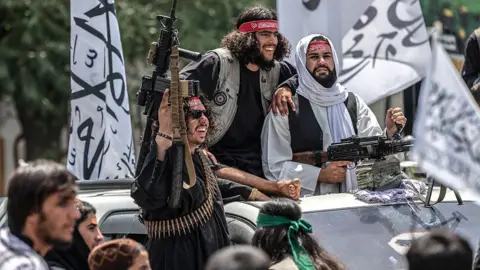
Getty Images A convoy of Taliban security personnel moves along a street as they celebrate the fourth anniversary of their takeover of Afghanistan in Kabul on August 15, 2025.
Getty Images
The Taliban took control of Afghanistan in August 2021

Building understanding between unlikely allies​

Although India has not formally recognised Afghanistan's de facto rulers, it is one of a number of countries that maintain some form of diplomatic or informal relations with the Taliban. India currently has a small mission in Kabul, and sends humanitarian aid to Afghanistan, one of the poorest countries in the world.

The growing engagement between India's right-wing Hindu nationalist government and the Islamist Taliban started not long after the group's return to power in Kabul.

This particular trip comes against a backdrop of worsening ties between both India and Pakistan, and Pakistan and the Taliban government.

"The deterioration in ties with Pakistan also allows them [Taliban] to hedge their bets and show how it is no longer dependent on Islamabad for its survival - carving out an identity separate from their over-dependence on Pakistan," Harsh V Pant and Shivam Shekhawat, of the Observer Research Foundation think tank, wrote in a piece for NDTV news channel.

Deeper engagement with India also gives the group a chance to "create a perception of legitimacy for their domestic constituents", according to Mr Pant and Mr Shekhawat.
grey-placeholder.png
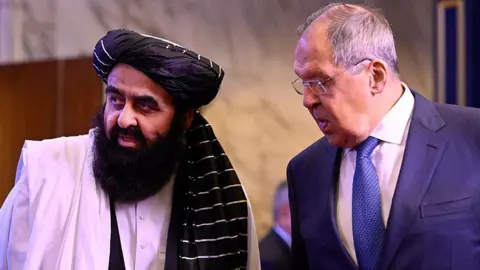
Getty Images Afghanistan's Foreign Minister Amir Khan Muttaqi and Russian Foreign Minister Sergei Lavrov attend the Moscow Format consultations on Afghanistan, in Moscow on October 7, 2025.
Getty Images
Muttaqi and Russian Foreign Minister Sergei Lavrov at the Moscow Format consultations on Afghanistan
The visit "represents a setback for Pakistan" and marks a significant step towards the Taliban regime's de facto recognition, said Brahma Chellaney, a strategic affairs analyst on X.

It signals "a cautious reset in India-Taliban relations, with both sides prioritising pragmatic engagement to advance their strategic interests", Chellaney added, saying the visit also marks a possible shift in Afghanistan's regional power dynamics.

Just more than four years ago, all this seemed unlikely.

After a timeline was set for US-led forces to withdraw by mid-2021, panic prevailed in Indian policy circles. As the Taliban captured Kabul on 15 August 2021, India shut its embassy and four consulates in Afghanistan and stopped issuing visas to Afghans from all walks of life, including students, patients, traders and former government officials and politicians.

With just one click it cancelled nearly all the visas it had already issued to thousands of Afghans, allegedly due to security concerns.

But within a year India had re-established its diplomatic presence, sending a "technical team" to Afghanistan in June 2022, tasked with overseeing the distribution of humanitarian aid.

Delhi also started issuing visas to influential Taliban figures, government officials and their family members. Such visits, though not announced officially, helped build trust and understanding.

Last November, India allowed the Taliban to appoint an envoy in Delhi and to open consulates first in Mumbai, then a few months later in Hyderabad.

Over the past three years, the two countries have been working on gradually rebuilding ties, with Indian officials and diplomats holding several high-level engagements abroad, including a meeting between Muttaqi and India's Foreign Secretary Vikram Misri in Dubai in January this year.
grey-placeholder.png
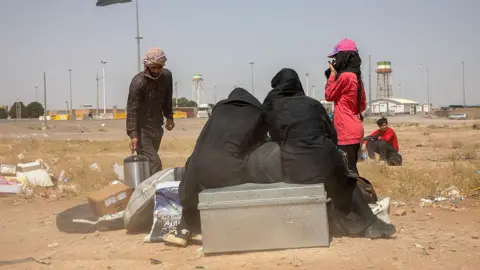
Getty Images Afghan deportees sit near the border at Islam Qala crossing on July 4, 2025. Mass expulsions surged after the IranIsrael war, with Iranian authorities accusing Afghans of espionage and deporting thousands daily.
Getty Images
Afghanistan is one of the poorest countries in the world

A battle for influence​

India and Pakistan have long been engaged in a zero-sum game in Afghanistan, with each vying to dominate its political landscape at the expense of the other.

Due to the Taliban's close ties with Pakistan, the Indian military and political establishment had viewed the group since its foundation in 1994 as a Pakistani proxy aiming to evict India from Afghanistan.

India, along with Russia and Iran, supported factions fighting against the Taliban in Afghanistan until the group was removed from power after the 2001 US invasion.

For the next 20 years, India remained a major supporter of the US-backed, internationally-recognised Afghan government as insurgents, mainly the Taliban, waged an increasingly bloody war.

While Pakistan enjoyed good relations with the Taliban during the group's first rule (1996-2001) and the beginning of their second period in power, relations between the two have become increasingly strained.

So much so that various Pakistani officials including its defence minister have publicly called Afghanistan an "enemy country". Pakistan accuses the Taliban government of allowing the Pakistani Taliban (TTP) to use Afghan territory to launch attacks inside Pakistan, and has carried out air strikes inside Afghanistan against what it calls TTP sanctuaries.

These accusations have been repeatedly rejected by the Taliban, which in turn accuses elements within Pakistan of trying to destabilise Afghanistan.

India's reasons for maintaining good relations with the Taliban are first and foremost about advancing its national interest.

Delhi's biggest concern is security, and especially the activities of the Islamic State group, al-Qaeda and other India-focused militant outfits. The Taliban have assured Delhi they will not allow Afghan territory to be used for terrorist activity against India, a statement reiterated by Muttaqi on Friday.

Ties with the Taliban are also key to Delhi's desire to deepen connectivity with Iran and Central Asia to counter China and Pakistan's influence in the region.

Despite deepening ties between India and the Taliban government, both sides are cautious. Their relationship remains tactical due to reservations over what happened in the past, as well as various domestic considerations and possible foreign repercussions.
 

Source - https://www.bbc.com/news/articles/c8exzzz5dp5o

Why Taliban minister's visit to India is so groundbreaking​


grey-placeholder.png
Randhir Jaiswal/MEA Twitter Amir Khan Muttaqi shakes hands with an Indian diplomat
Randhir Jaiswal/MEA Twitter
Amir Khan Muttaqi arrived in India on Thursday for a week-long trip
Afghan Taliban Foreign Minister Amir Khan Muttaqi has arrived in India for a week of talks - a visit which had been previously unimaginable.

It is the Taliban's highest-level visit to the country since seizing power in 2021, and Muttaqi is due to discuss diplomatic, trade and economic ties with Indian officials during an eight-day stay.

The visit is being seen as a ramping up of India's Afghan policy. On Friday, after Muttaqi met Indian Foreign Minister S Jaishankar, Delhi said that it will reopen its embassy in Kabul which was shut four years ago when the Taliban returned to power.

Arch-rival Pakistan, which historically had close ties with the Taliban, will be watching closely.
Muttaqi - who was granted a temporary exemption from UN sanctions allowing him to travel - flew into Delhi from Russia, the only country so far to fully recognise the Taliban government.

The astonishing fact is that neither Islamabad, Delhi or the Taliban could have anticipated that so soon after taking power, the Taliban's relations with Pakistan would deteriorate to such a degree, while India would establish a multilateral relationship with the new government in Kabul.

Delhi used to support the Western-backed Afghan government, which the Taliban drove from power, and this visit illustrates pragmatism and realpolitik on both sides, indicating they are serious about upgrading diplomatic, political and trade links.

Muttaqi, accompanied by Afghan trade and foreign ministry officials, held talks with India's Jaishankar in Delhi on Friday.

"Closer cooperation between us contributes to your national development as well as regional stability and resilience," Jaishankar said. He also affirmed India's "full commitment to the sovereignty, territorial integrity and independence of Afghanistan".

Meanwhile, Muttaqi called India a "close friend" and added that his visit would improve relations between the two countries.

The Afghan delegation will also meet representatives of the Indian business community.
grey-placeholder.png
Getty Images A convoy of Taliban security personnel moves along a street as they celebrate the fourth anniversary of their takeover of Afghanistan in Kabul on August 15, 2025.
Getty Images
The Taliban took control of Afghanistan in August 2021

Building understanding between unlikely allies​

Although India has not formally recognised Afghanistan's de facto rulers, it is one of a number of countries that maintain some form of diplomatic or informal relations with the Taliban. India currently has a small mission in Kabul, and sends humanitarian aid to Afghanistan, one of the poorest countries in the world.

The growing engagement between India's right-wing Hindu nationalist government and the Islamist Taliban started not long after the group's return to power in Kabul.

This particular trip comes against a backdrop of worsening ties between both India and Pakistan, and Pakistan and the Taliban government.

"The deterioration in ties with Pakistan also allows them [Taliban] to hedge their bets and show how it is no longer dependent on Islamabad for its survival - carving out an identity separate from their over-dependence on Pakistan," Harsh V Pant and Shivam Shekhawat, of the Observer Research Foundation think tank, wrote in a piece for NDTV news channel.

Deeper engagement with India also gives the group a chance to "create a perception of legitimacy for their domestic constituents", according to Mr Pant and Mr Shekhawat.
grey-placeholder.png
Getty Images Afghanistan's Foreign Minister Amir Khan Muttaqi and Russian Foreign Minister Sergei Lavrov attend the Moscow Format consultations on Afghanistan, in Moscow on October 7, 2025.'s Foreign Minister Amir Khan Muttaqi and Russian Foreign Minister Sergei Lavrov attend the Moscow Format consultations on Afghanistan, in Moscow on October 7, 2025.
Getty Images
Muttaqi and Russian Foreign Minister Sergei Lavrov at the Moscow Format consultations on Afghanistan
The visit "represents a setback for Pakistan" and marks a significant step towards the Taliban regime's de facto recognition, said Brahma Chellaney, a strategic affairs analyst on X.

It signals "a cautious reset in India-Taliban relations, with both sides prioritising pragmatic engagement to advance their strategic interests", Chellaney added, saying the visit also marks a possible shift in Afghanistan's regional power dynamics.

Just more than four years ago, all this seemed unlikely.

After a timeline was set for US-led forces to withdraw by mid-2021, panic prevailed in Indian policy circles. As the Taliban captured Kabul on 15 August 2021, India shut its embassy and four consulates in Afghanistan and stopped issuing visas to Afghans from all walks of life, including students, patients, traders and former government officials and politicians.

With just one click it cancelled nearly all the visas it had already issued to thousands of Afghans, allegedly due to security concerns.

But within a year India had re-established its diplomatic presence, sending a "technical team" to Afghanistan in June 2022, tasked with overseeing the distribution of humanitarian aid.

Delhi also started issuing visas to influential Taliban figures, government officials and their family members. Such visits, though not announced officially, helped build trust and understanding.

Last November, India allowed the Taliban to appoint an envoy in Delhi and to open consulates first in Mumbai, then a few months later in Hyderabad.

Over the past three years, the two countries have been working on gradually rebuilding ties, with Indian officials and diplomats holding several high-level engagements abroad, including a meeting between Muttaqi and India's Foreign Secretary Vikram Misri in Dubai in January this year.
grey-placeholder.png
Getty Images Afghan deportees sit near the border at Islam Qala crossing on July 4, 2025. Mass expulsions surged after the IranIsrael war, with Iranian authorities accusing Afghans of espionage and deporting thousands daily.
Getty Images
Afghanistan is one of the poorest countries in the world

A battle for influence​

India and Pakistan have long been engaged in a zero-sum game in Afghanistan, with each vying to dominate its political landscape at the expense of the other.

Due to the Taliban's close ties with Pakistan, the Indian military and political establishment had viewed the group since its foundation in 1994 as a Pakistani proxy aiming to evict India from Afghanistan.

India, along with Russia and Iran, supported factions fighting against the Taliban in Afghanistan until the group was removed from power after the 2001 US invasion.

For the next 20 years, India remained a major supporter of the US-backed, internationally-recognised Afghan government as insurgents, mainly the Taliban, waged an increasingly bloody war.

While Pakistan enjoyed good relations with the Taliban during the group's first rule (1996-2001) and the beginning of their second period in power, relations between the two have become increasingly strained.

So much so that various Pakistani officials including its defence minister have publicly called Afghanistan an "enemy country". Pakistan accuses the Taliban government of allowing the Pakistani Taliban (TTP) to use Afghan territory to launch attacks inside Pakistan, and has carried out air strikes inside Afghanistan against what it calls TTP sanctuaries.

These accusations have been repeatedly rejected by the Taliban, which in turn accuses elements within Pakistan of trying to destabilise Afghanistan.

India's reasons for maintaining good relations with the Taliban are first and foremost about advancing its national interest.

Delhi's biggest concern is security, and especially the activities of the Islamic State group, al-Qaeda and other India-focused militant outfits. The Taliban have assured Delhi they will not allow Afghan territory to be used for terrorist activity against India, a statement reiterated by Muttaqi on Friday.

Ties with the Taliban are also key to Delhi's desire to deepen connectivity with Iran and Central Asia to counter China and Pakistan's influence in the region.

Despite deepening ties between India and the Taliban government, both sides are cautious. Their relationship remains tactical due to reservations over what happened in the past, as well as various domestic considerations and possible foreign repercussions.


Stabbed in the back again by the Afghans whom Pakistan has helped so much time and again. This is one of the many reasons why I advocate Pakistan should prioritize "Pakistan for Pakistanis" first before declaring Ummah brotherhood and bearing the burden of some other Muslim nation.

Nobody cares for us and only backstab us, why shouldn't we just care for ourselves instead of being so clueless?
 
Pakistan is always 10 steps behind. Makes illogical moves, shoots itself in the foot, no long term strategic thinking. Pak plays speed checkers while others play Chess and Go. It's the same thing with PCB and the recent Asia cup. The decision making is so child like that if they run their ideas through an AI engine like chatgpt, it will be 100x better. I used to think being monolithic was its strength but in reality, Pakistan is even more fragmented and fragile than India.
 
Islamist are always includes religion in every things. Every nation first looks at own national interest.


:klopp :kp
Every country that makes religion part of their country tends to suffer for it. It curbs economic growth. And unfortunately terroism thrives in these sort of countries.

Countries should be secular and religion should be individual and not mix with politics or business.

The religious model just doesn’t work. And if it continues you’ll continue to see politicians and rulers abusing religion to exploit their country and impede economic growth and foreign relations.

Pakistan going secular would be a fantastic first step in fighting terroists and it would promote religious tolerance. But unfortunately I think people would uproar against it as they’re used to it for so long.
 

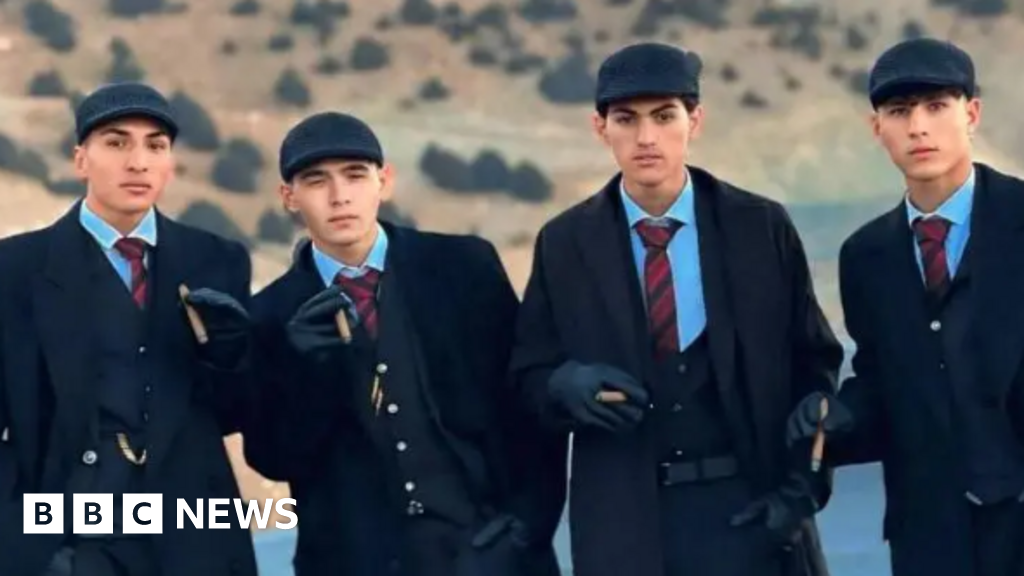
Taliban warn Afghans who wore 'un-Islamic' Peaky Blinders outfits​


Four Afghan men were ordered to report to the Taliban government's department of vice and virtue for dressing in costumes inspired by the TV series Peaky Blinders.

The friends were told that their clothing was "in conflict with Afghan and Islamic values", a Taliban spokesman told the BBC, adding the values in Peaky Blinders went against Afghan culture.

In videos posted online, the men, who have been released, can be seen posing in flat caps and three-piece suits similar to those worn in the series set in England soon after World War One.

Since the Taliban seized power in 2021, they have imposed a number of restrictions on daily life in accordance with their interpretation of Islamic Sharia law.

"Even jeans would have been acceptable, but the values in the Peaky Blinders series are against Afghan culture," Saiful Islam Khyber, a spokesman for the Taliban government's provincial department of Vice and Virtue in Herat city told the BBC.

The men, all in their early twenties, come from the town of Jibrail in Herat province. They were ordered to report to the Taliban's "morality police" on Sunday, and presented themselves for questioning in Herat the following day.

"They were promoting foreign culture and imitating film actors in Herat," Khyber wrote on social media, adding that they had undergone a "rehabilitation programme".

They were not formally arrested, "only summoned and advised and released", Khyber told the BBC's US partner CBS News.

"We have our own religious and cultural values, and especially for clothing we have specific traditional styles," he said.

"The clothing they wore has no Afghan identity at all and does not match our culture. Secondly, their actions were an imitation of actors from a British movie. Our society is Muslim; if we are to follow or imitate someone, we should follow our righteous religious predecessors in good and lawful matters."

The men could be seen thanking officials for their advice and saying they were unaware they had violated any laws in a video released by the ministry after they were questioned - though it is unclear under what circumstances the interview was recorded.

"I have innocently been sharing content that was against Sharia which had many viewers," one said in the recording.

He said he had been "summoned and advised", and would no longer do "anything like this".

In an interview with YouTube channel Herat-Mic uploaded at the end of November, before they were summoned, the friends said they admired the fashion displayed in the series, adding that they had received positive reactions from locals.

"At first we were hesitant, but once we went outside, people liked our style, stopped us in the streets, and wanted to take photos with us," one of the men said, according to a translation by CBS News.

 
British WAR CRIMES Exposed - The Truth Will SHOCK You


Nearly all of main stream media here in the UK is chosing not to show this


They don't shock me. I was on here at the time arguing with Robert who no longer posts here, that any war crimes would always be brushed under the carpet by British courts. As they say, all is fair in love and war. It's a British saying. Except when Brits are on the receiving end, then it's not fair at all. :mad:
 
They don't shock me. I was on here at the time arguing with Robert who no longer posts here, that any war crimes would always be brushed under the carpet by British courts. As they say, all is fair in love and war. It's a British saying. Except when Brits are on the receiving end, then it's not fair at all. :mad:
Yeh i can remember those topics, i remember robert, most of the time he always eant to the right side of life, always had high regard off the Brirtish army - never did anything wrong - ultra defensive over the british armies and air force, - he even defended blair illegal invasion into iraq
 
Back
Top