Adani-led firm charged Rajasthan PSU over Rs 1,400 crore it wasn’t entitled to: Jaipur court
The judgement brought rare scrutiny to one of Adani’s most profitable coal mine contracts.

scroll.in
The judgement brought rare scrutiny to one of Adani’s most profitable coal mine contracts.
An Adani Group-led coal mining firm earned more than Rs 1,400 crore in transportation charges at the cost of the Rajasthan government, a district court in Jaipur ruled in July.
During the proceedings, the state admitted to “very humbly” complying with the firm’s “arm-twisting” tactics to avoid power shortages that could have crippled the state’s economy. It accused the Adani-led firm of “always extorting” it and “making wrongful gain”.
The judgement, delivered on July 5, directed the Adani-led company to pay a fine of Rs 50 lakh, and directed the state government to request the Comptroller and Auditor General, the constitution-mandated auditor of government accounts, to audit the deal between the state and the conglomerate.
These directions were stayed by the Rajasthan High Court 13 days later. But the judgement marked the first time that key details of a nearly two-decade-old arrangement – widely seen as one of India’s most contentious coal contracts – emerged in the public domain.
The agreement
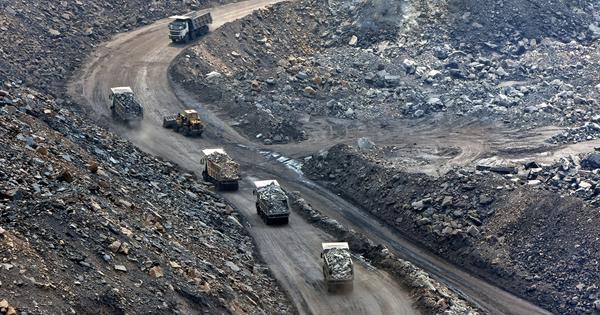
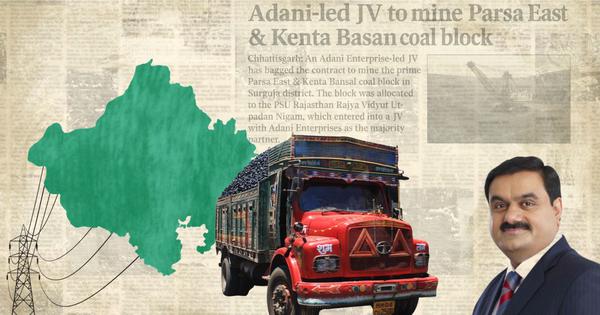
In 2007, the ministry of coal allocated a coal block in Chhattisgarh’s dense Hasdeo Arand forests to a Rajasthan state electricity firm, Rajasthan Rajya Vidyut Utpadan Nigam Limited. The block, called Parsa East and Kente Basan, held over 450 million tonnes of coal.
Soon after, under the Vasundhara Raje-led Bharatiya Janata Party government, RRVUNL entered into a joint-venture agreement with Adani Enterprises, forming a new company that would be responsible for mining the coal and transporting it from Chhattisgarh to its power plants in Rajasthan.
The new company was called Parsa Kente Collieries Limited – while Adani Enterprises held 74% of its shares, the state-owned firm held 26%. This put the Adani Group in the driver’s seat of the joint venture.
This was a relatively new kind of arrangement in the country, under which the government paid a private contractor, called a Mine Developer and Operator, a fee for mining services.
Many independent experts have
raised questions about such arrangements, arguing that they allow private conglomerates to profit from mines allocated strictly for public sector-use.
Earlier, only companies that owned plants that relied on coal, such as thermal power plants, were eligible to be allocated coal mines. The companies would have to establish the intended end-use of coal before vying for the mine, and would then bear the burden of ensuring that the mining was profitable for them.
The Mine Developer and Operator model allowed private companies to make money off mining without this pressure – for instance, without having to own and run a huge power plant. Instead, those costs would be borne by the state.
“The problem with this model has always been that it shifts all the risk of running a coal business to the public sector utility while the private company enjoys backdoor access to lucrative mines at secretive prices,” said Dr Priyanshu Gupta, a researcher who tracks the sector. “A private firm cannot ask for a sweeter deal.”
Over time, Adani became India’s largest coal Mine Developer and Operator, with
nine contracts covering over 2,800 million tonnes of coal.
The legal battle between Adani-led joint venture and the Rajasthan state electricity firm – beginning in 2020 and culminating in 2025 – brought rare scrutiny to one of Adani’s most profitable coal mine contracts in India.
The legal tussle
In July 2008, around a year after the joint venture was formed, the Adani-led joint venture and the Rajasthan state firm entered into a Coal Mining and Delivery Agreement that chalked out the terms of their arrangement.
Under this agreement, the Adani-led joint venture was responsible for mining and transporting coal to the Rajasthan state firm’s power plants. It secured the contract by factoring all its costs and quoting a per-tonne price for the coal it would hand over to the power generator.
Mining began in March 2013, but at the time there were no railway tracks, known as sidings, to help move the coal from the mines to the nearest railway stations. The court noted that according to the contract, it was the responsibility of the Adani-led joint venture “to build, construct and develop the railway siding from mine head up to the nearest connecting railway line”.
The two firms agreed to go ahead with a stopgap arrangement – to transport coal by road from the mine to the stations until the sidings were laid. This was outside the ambit of the agreement, which did not mention road transport. The two firms engaged a transport agency for this work in March 2013.
The case in the court centred on the question of payments to this agency. The court noted the government company bore, “the entire cost of road transportation from loading point at the mine head up to the nearest railway stations”.
It said that since the contract required the Adani-led firm to transport coal to the nearest railway line, it was “beyond imagination” that the firm “could avoid payment of road transportation charges”.
This was the amount that totalled more than Rs 1,400 crore.
But in fact, the dispute before the court was not about this amount at all – which the Rajasthan firm paid. Rather, it arose because the Adani-led firm claimed interest from the state company because of delayed reimbursements of these transportation charges.
Under the timeline laid out by the Adani-led joint venture, it would pay the transporter for its services and the Rajasthan state company would reimburse this amount within 15 days. The joint venture was willing to “allow” a seven-day grace period too. These terms, the court judgement explains, were not stipulated in the contract, but part of an arrangement that the companies separately arrived at, confirmed in a March 2013 letter.
The Adani-led joint venture claimed that the state company delayed payments, forcing it to rely on bank loans. It alleged that while the Rajasthan company reimbursed the payments, as a result of delays, bank loan interests piled up to around Rs 65 crore. The Adani-led joint venture demanded it be paid for this interest as well. In February 2018, with the BJP in power, the state company refused to do so.
In April 2018, the Adani-led joint venture requested the state firm to enter into a mediation to settle the issue. In August 2018, the government-owned company refused. The BJP was still in power, with Vasundhara Raje as chief minister.
The Adani-led joint venture went to court in July 2020, a year-and-a-half after the Congress had returned to power, with Ashok Gehlot at the helm.
Despite initiating legal action, the Adani-led joint venture did not submit the coal mine and delivery agreement that forms the basis of the case.
Neither did the joint venture submit minutes of board meetings, its financial books and details of transactions, despite mentioning them in its court filings. This withholding of information prompted the district court to call the joint venture’s complaint a “half told story”, and a “selective accounts to the events”.
In its court submissions, Rajasthan Rajya Vidyut Utpadan Nigam Limited stated that it gave into the the Adani-led joint venture’s demands because any problems in the delivery of coal to the state’s power plants “could lead to power shortage and devastating effect on the economy of the state”.
The court noted that RRVUNL offered no oral or documentary evidence except two interest calculation sheets. The court was taken aback by this lack of information, forcing it to “go into minor details of the case to rule out any chance of some apparent grave error being committed by the court in delivering the judgment, which also consumed considerable time of the court”.
The court expressed shock at the Adani-led firm’s moves. It noted that if the company “had failed to perform its obligation to build, develop and construct railway siding from the mine head up to the nearest connecting railway line”, it should “have suffered at least the burden of road transportation charges for its own default, if had not suffered some penalty on this count”.
Instead, the court noted, the company reclaimed costs of more than Rs 1,400 crore towards road transportation of coal. Further, it sought to gain additional “profit by avoiding interest burden for such cost”.
In effect, the court observed that the company had “benefited despite committing default in performance of the contract on multiple counts”. It added, “It is settled preposition of law that one cannot take advantage of its own fault.”
It was based on these findings that the court ordered the Adani-led firm to pay the Rs 50-lakh fine, and directed the state government to request the Comptroller and Auditor General to audit the deal between the two entities.
These actions have been stayed by the Rajasthan High Court, after the Adani-led joint venture filed an appeal.
Scroll emailed Adani Enterprises and RRVUNL, seeking responses to the Jaipur court’s judgement, and the allegations that the companies made in their submissions in the case. This story will be updated if they respond.