What's new

India pollution and extreme heat discussion

Air quality ‘very poor’, Delhi wakes up to thick blanket of smog; IGI airport issues advisory​


Delhi Weather, AQI, Pollution, IGI Airport Advisory Today: Forecasts indicate that pollution levels are unlikely to ease significantly in Delhi-NCR in the coming days.


An anti-smog gun sprays water to control pollution at Kartavya Path, in New Delhi on Sunday. (ANI Photo)
Weather in Delhi Today: Delhi woke up to a thick layer of smog on Monday (Dec 22) morning, as the Air Quality Index (AQI) continues to remain in the ‘very poor’ category.

Many areas experienced low visibility due to smog, making it difficult for travellers. Visuals from the Red Fort showed lingering air pollution severely reducing visibility.
 

Toxic Haze Hangs Over Delhi As 12 Stations Log 'Severe' Air Quality​


Out of the 39 functional monitoring stations, 12 logged readings in the 'severe' category, while 27 recorded 'very poor' air quality.

New Delhi:
A thick grey haze hung over the capital on Monday while the air quality settled in the 'very poor' category, with the 24-hour average AQI recorded at 373.

Out of the 39 functional monitoring stations, 12 logged readings in the 'severe' category, while 27 recorded 'very poor' air quality.

Among the stations in the severe zone, Anand Vihar emerged as the most polluted, logging an Air Quality Index (AQI) of 425, according to the CPCB's SAMEER app.

Delhi also recorded the worst air quality in the National Capital Region, followed by Noida at 366, according to Central Pollution Control Board (CPCB).

Toxic Haze Hangs Over Delhi As 12 Stations Log 'Severe' Air Quality​

Out of the 39 functional monitoring stations, 12 logged readings in the 'severe' category, while 27 recorded 'very poor' air quality.​

  • Press Trust of India
  • India News
  • Dec 22, 2025 21:25 pm IST
    • Published OnDec 22, 2025 21:25 pm IST
    • Last Updated OnDec 22, 2025 21:25 pm IST
Read Time:3 mins
Share
  • Twitter
  • WhatsApp
  • Facebook
  • Reddit
  • Email


Toxic Haze Hangs Over Delhi As 12 Stations Log 'Severe' Air Quality

Earlier in the day, thick haze shrouded the city (Representational)
New Delhi:
A thick grey haze hung over the capital on Monday while the air quality settled in the 'very poor' category, with the 24-hour average AQI recorded at 373.

Out of the 39 functional monitoring stations, 12 logged readings in the 'severe' category, while 27 recorded 'very poor' air quality.

Among the stations in the severe zone, Anand Vihar emerged as the most polluted, logging an Air Quality Index (AQI) of 425, according to the CPCB's SAMEER app.

Delhi also recorded the worst air quality in the National Capital Region, followed by Noida at 366, according to Central Pollution Control Board (CPCB).


https://vdo.ai/contact?utm_medium=video&utm_term=ndtv.com&utm_source=vdoai_logo
LATEST
U19 Asia Cup SF LIVE: Play Starts After 5-Hour Delay; India
Saudi Arabia Deports 24,000 Pakistani Beggars After Warning
Hindu Man Lynched, Set On Fire In Bangladesh Amid Anti-India
Bangladesh Unrest LIVE: Dhaka Condemns Lynching Of Hindu Man
Ram Gopal Varma Says Dhurandhar Success A "Warning" To Film
An Anecdote By Priyanka Gandhi Made PM, Rajnath Singh Smile:
Anti-India Leader Behind 'Greater Bangladesh' Map Dies, Dhak
Bharti Singh And Haarsh Limbachiyaa Welcome Second Child
Video: Guards Smash Mercedes' Windscreen, Windows With Stick
U19 Asia Cup: Who Will Reach Final If India vs Sri Lanka Is
Bill Gates, Noam Chomsky Seen In Fresh Pics From Epstein's E
Why Anti-India Mob Attacked Bangladesh Media Houses, Mujibur
G RAM G Clears Parliament, To Replace MNREGA. What Is In The
U19 Asia Cup SF LIVE: Play Starts After 5-Hour Delay; India
Saudi Arabia Deports 24,000 Pakistani Beggars After Warning
Hindu Man Lynched, Set On Fire In Bangladesh Amid Anti-India
Bangladesh Unrest LIVE: Dhaka Condemns Lynching Of Hindu Man
Ram Gopal Varma Says Dhurandhar Success A "Warning" To Film
An Anecdote By Priyanka Gandhi Made PM, Rajnath Singh Smile:
Anti-India Leader Behind 'Greater Bangladesh' Map Dies, Dhak
Bharti Singh And Haarsh Limbachiyaa Welcome Second Child
Video: Guards Smash Mercedes' Windscreen, Windows With Stick
U19 Asia Cup: Who Will Reach Final If India vs Sri Lanka Is
Bill Gates, Noam Chomsky Seen In Fresh Pics From Epstein's E
Why Anti-India Mob Attacked Bangladesh Media Houses, Mujibur
G RAM G Clears Parliament, To Replace MNREGA. What Is In The


According to CPCB standards, an AQI between 0 and 50 is considered 'good', 51 to 100 'satisfactory', 101 to 200 'moderate', 201 to 300 'poor', 301 to 400 'very poor' and 401 to 500 'severe'.

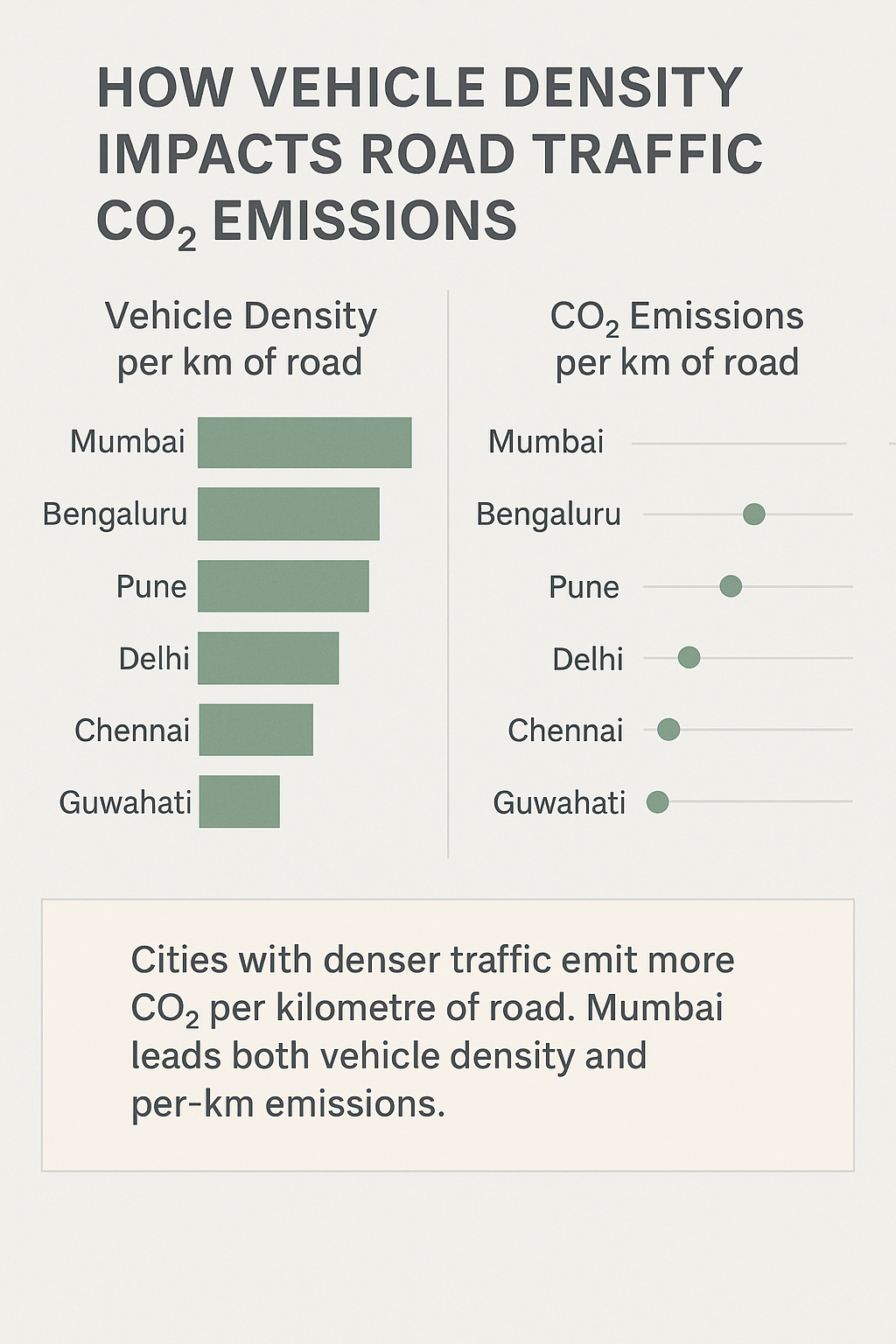
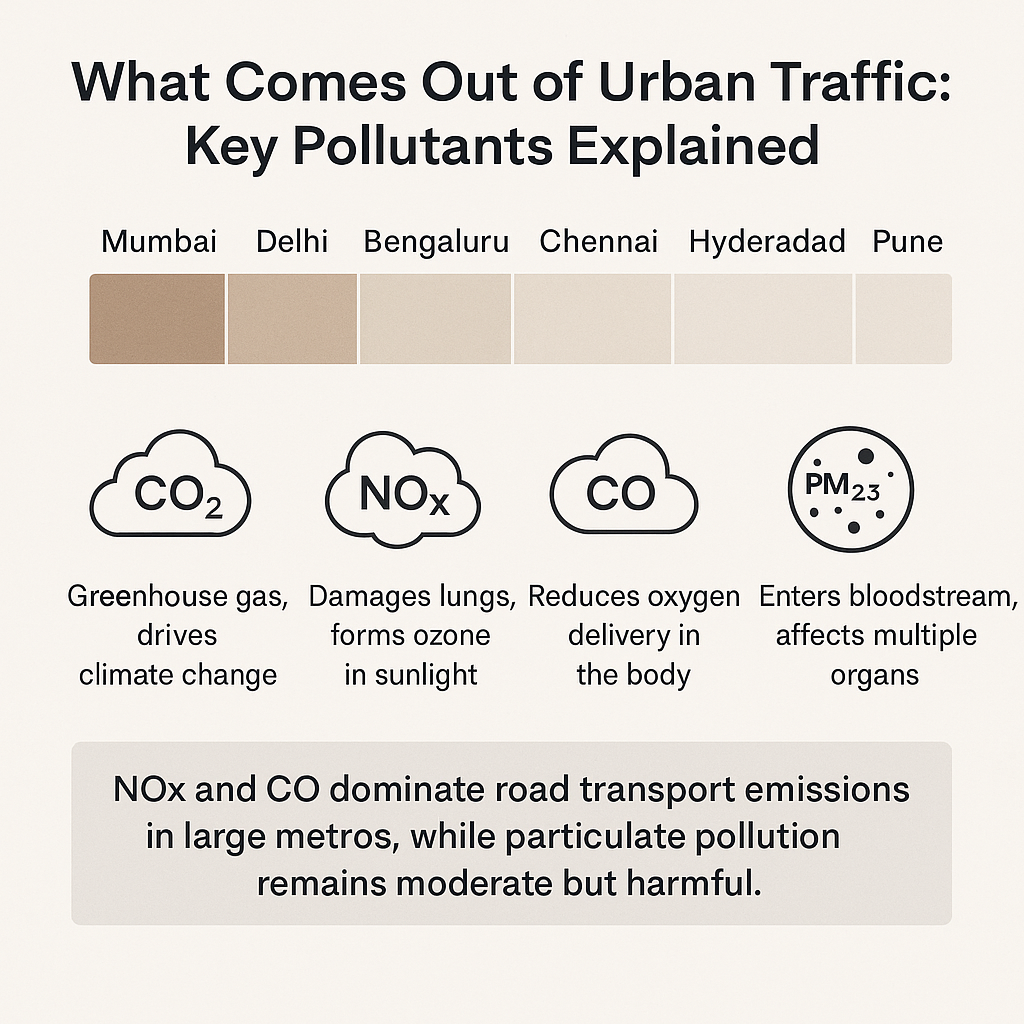
Data from the Decision Support System for Air Quality Management showed that vehicular emission was the largest contributor to pollution, accounting for 15.7 per cent of the total share.

This was followed by industries in Delhi and peripheral areas, contributing 7.1 per cent, residential sources 3.8 per cent, construction activities 2.0 per cent, and waste burning 1.3 per cent.

Among NCR districts, Gurugram contributed 8.6 per cent, Jhajjar 8.5 per cent, Bharatpur 5.1 per cent, Faridabad 4.8 per cent, Sonipat 4.6 per cent, Ghaziabad 2.7 per cent, and Rohtak 2.0 per cent, the data showed.

According to the Air Quality Early Warning System, Delhi's air quality is likely to remain in the very poor category from Tuesday to Thursday, and is expected to oscillate between very poor and severe levels over the next six days.

This December, the air quality has persistently remained in the red zone with AQI readings above 300 from December 1 to 8.

The city saw brief relief for two consecutive days when pollution levels dipped to the 'poor' category, before returning to the red zone on December 11 and remaining there since, according to CPCB data.

Apart from those two days, Delhi air has largely remained 'very poor', with AQI levels hovering above 300 for most of the month.

Earlier in the day, thick haze shrouded the city, with morning AQI readings remaining in the very poor category at 366.

The AQI at seven air quality monitoring stations was 'severe', with Narela logging the highest reading at 418.

Meanwhile, the India Meteorological Department said Delhi recorded a maximum temperature of 21.8 degrees Celsius, 1.1 notches above normal, and a minimum temperature of 11.0 degrees Celsius, 3.5 degrees above normal.

Relative humidity stood at 100 per cent at 8:30 am and 79 per cent at 5:30 pm, it said.

The IMD had forecast a minimum temperature of 10 degrees Celsius, and a maximum of 22 degrees Celsius, accompanied by moderate fog.

It also predicted a prevailing average wind speed of less than 10 km per hour, unfavourable for the dispersion of pollutants, likely prolonging the spell of poor air quality in the capital


Wooooooooooow it hit severe - over 500, thats crazy

fellow indians- ideas on how to improve the pollution ;

@Rajdeep @cricketjoshila @Champ_Pal @JaDed @Devadwal @uppercut @Theanonymousone @straighttalk @Vikram1989 @RexRex @Varun @Romali_rotti @Bhaijaan @Cover Drive Six @rickroll @rpant_gabba, @Romali_rotti
 
Fog grips Delhi Air quality - stays in poor zone, like to turn severe by end of December


NEW DELHI: The air quality remained very poor for the second straight day on Wednesday, though the air quality
index (AQI) marginally improved from 354 a day earlier to 334 helped by strong winds flowing into the city.


No respite is likely with the air predicted to hover within the same category until Dec 20. It may deteriorate
to severe in the last week of this month, the Air Quality Early Warning System for Delhi said.

Delhi Pollution: China Shares Playbook On How To Fix Air Quality Amid Politics Over Accountability

According to Decision Support System, which estimates local and regional sources of pollution in Delhi's air, emissions from Haryana's Jhajjar were recorded at 16.53%, followed by the city's own vehicular emissions at 16.32%. Industries in the city and its periphery accounted for just over 8% of pollutants. "Though westerly winds briefly blew at
8-10kmph during the day, a layer of shallow fog trapped the pollutants," said an official.

Owing to the fog, a visibility of 800 metres was recorded at Palam at 8 am and 700m at Safdarjung, the city's base
station, at 8.30 am, said an official of India Meteorologica Department (IMD).

Though visibility was relatively better than the previous days, 24 flights were cancelled and over 200 delayed.

"Some flights were cancelled in advance. Others were impacted due to low visibility at other airports," an official said.

On Tuesday, more than 500 flights were delayed and over 100 cancelled at IGI Airport. On Monday, over 800 flights faced delays, more than 200 were cancelled and five diverted.

The Met department forecast shallow fog will continue in the region until Dec 20. Moderate fog will envelop isolated pockets. A yellow alert was issued for moderate to dense fog on Dec 21 and 22.


Delhi recorded a maximum temperature of 24.7 degrees Celsius, three degrees above normal. The minimum stood at
10.4, two notches above normal.
 

Man shares 6 reasons why Delhi NCR no longer feels liveable, compares it to Bengaluru​


A man criticised Delhi NCR's quality of life compared to other cities he lived in, including Bengaluru and Hyderabad, while citing concerns over pollution, safety, job prospects, and housing affordability in the capital region.


A man, visibly tired and annoyed with life in Delhi NCR, triggered a debate online after ranting about the region’s declining livability in a now-viral Reddit post.

Titled “Delhi NCR is cooked, no point of defending it now” and shared on r/delhi, the post came from an IT professional who said he was “born and brought up in Noida” and has lived in Bangalore and Hyderabad for work, while also recently spending a week in Pune. After comparing his experiences across cities, he bluntly concluded, “After seeing all this, I honestly feel Delhi NCR is done.

He first targeted food, writing that “apart from variety, NCR doesn’t really stand out any more.” According to him, when compared to cities like Hyderabad and Bangalore, “especially for non-vegetarians, South India easily wins.”

He also criticised pricing and hygiene, calling food in NCR “overpriced.” He wrote, “In the South, you can easily eat well for Rs 100-150, and a proper biryani won’t cost more than 200,” adding that in NCR, “for Rs 200, you’ll get unhygienic Moradabadi-style biryani at best.”

On employment, the user was equally direct. “As an IT professional, there’s no comparison,” he said, claiming that “Bangalore, Hyderabad, and Pune are way ahead of North India in tech opportunities,” and that “pay is actually better there.” For him, this gap in job prospects was one of the biggest reasons NCR is falling behind.

While acknowledging that traffic is a universal urban problem, he observed, “Traffic is bad everywhere,” adding that “Delhi NCR might slightly win here, but peak-hour traffic feels the same in all metros.”

Recalling his time in Pune, he said he saw people “roaming freely enjoying winters at 12:30 am.” In contrast, “in NCR, you think twice before stepping out after 10-11 pm. The city just goes silent, and empty streets don’t feel safe.”

Discussing housing, the man used sarcasm to underline his point. “This is the only area where NCR ‘beats’ the South,” he wrote, referring to real estate. According to him, “in places like Gurgaon, you won’t get anything decent under 101.5 crore,” whereas “in Pune (Kharadi), you can get a decent 2BHK on the same budget." He also added that rents for a 3BHK hover around 30–40k everywhere, making NCR’s prices hard to justify.

The strongest criticism, however, was reserved for air pollution. “No comparison at all,” he wrote, pointing out that “the AQI in Noida/Delhi is around 700+.” He stressed that “the real problem isn’t just pollution - it’s how normalised it has become,” accusing politicians of downplaying the crisis while sitting in “air-purified cabins.”

The post ended on a blunt note. “If you are still defending Delhi, then you haven’t visited any other city yet,”
 

Year of Monsoon in Metro Cities: How 2025’s Heavy Rains Brought Bengaluru, Mumbai, Chennai, Delhi to a Standstill​


In 2025, India's major metro cities faced unprecedented challenges due to erratic and intense rainfall, revealing vulnerabilities in urban infrastructure. Bengaluru experienced pre-monsoon flooding and significant disruptions in traffic and services, while Mumbai dealt with heavy downpours leading to overcrowded trains and airport delays.


Rains

When the Monsoon Took Over India’s Metros (AI-generated image by Chat GPT)
GoogleNewsIconfollow usfollow us
google
The year began with early weather warnings, but as 2025 unfolded, India’s biggest metro cities were repeatedly caught off guard by intense and erratic rainfall. What started as pre-monsoon showers soon turned into prolonged disruptions, exposing weak drainage systems, unchecked urban expansion and a growing gap between weather extremes and civic preparedness. From Bengaluru to Delhi, the monsoon did not arrive as a single season but as a series of shocks that affected daily life month after month.

Bengaluru: Early Rains, Repeated Disruptions​

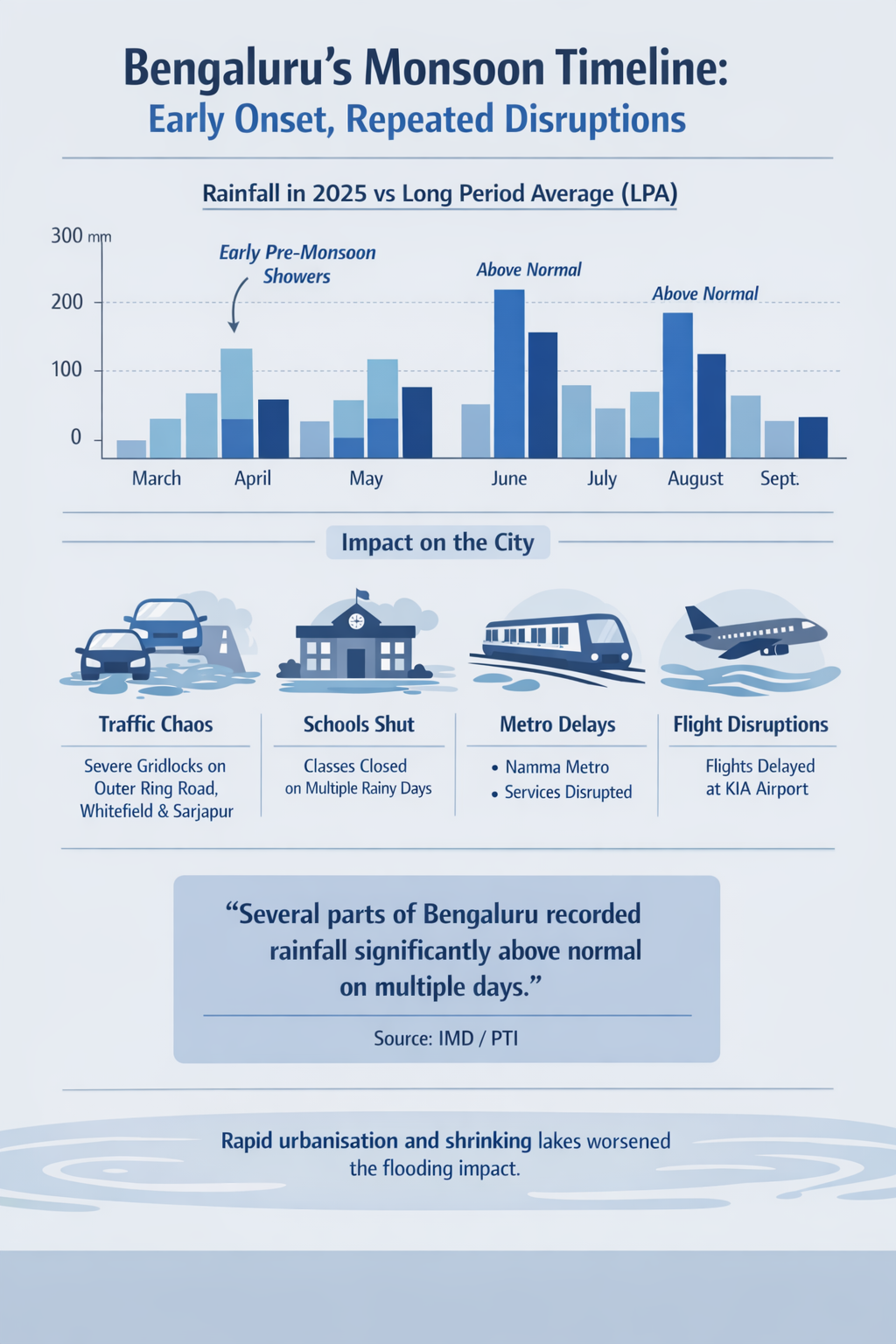
Bengaluru saw rain-related trouble much before the official onset of the southwest monsoon. Pre-monsoon showers in March and April flooded low-lying areas, while heavy rain spells in May and June pushed the city into repeated gridlocks. As reported by PTI and ANI, several parts of the city recorded rainfall well above normal levels on multiple days, with some localities witnessing record single-day totals.
Bengaluru Rains

Bengaluru’s Monsoon Timeline: Early Onset, Repeated Disruptions (AI-infographic generated by Chat GPT)
Traffic movement across tech corridors such as Outer Ring Road, Whitefield and Sarjapur slowed to a crawl due to waterlogged roads and fallen trees. Offices asked employees to work from home as vehicles remained stranded for hours. Schools in several areas were shut temporarily as a precaution. Namma Metro services faced intermittent delays due to water seepage and power issues, while air traffic at Kempegowda International Airport was disrupted by poor visibility and rain-soaked access roads. The monsoon once again highlighted how concretisation and the loss of natural drainage have left Bengaluru vulnerable to even short bursts of heavy rain.

Mumbai: Monsoon Brings the City to a Crawl​

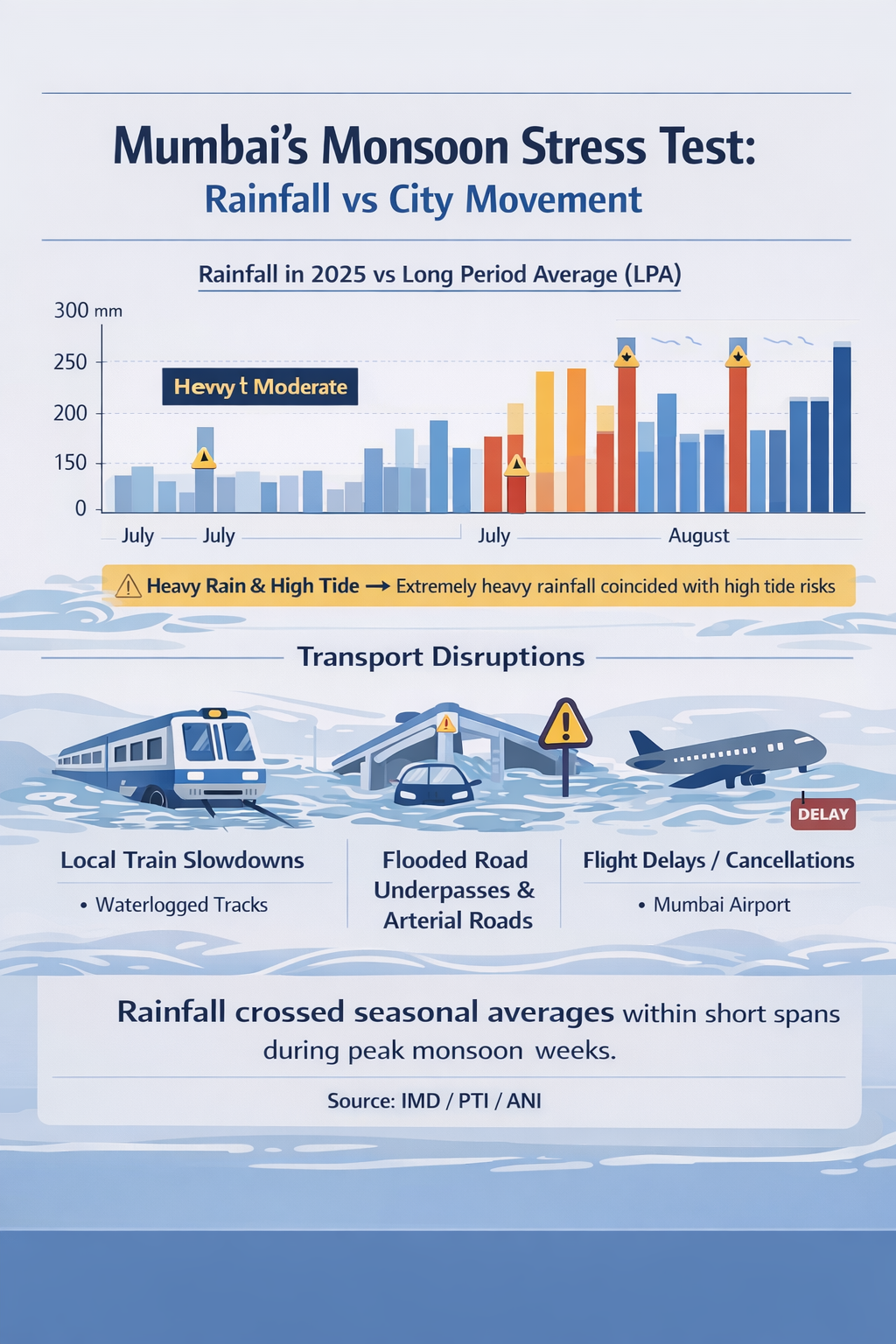
Mumbai’s monsoon followed a familiar pattern, with heavy rainfall intensifying from July onwards. After a brief pause in June, the city was hit by repeated spells of extremely heavy rain, prompting the IMD to issue orange and red alerts on multiple occasions. According to agency reports, rainfall levels crossed seasonal averages within short periods.


Not looking good for the future generation, glabal warming is hitting the sub continent countries hard and the politicans are not introducing better laws required to deal with this, what will we pass onto our next generations = not looking good


@Rajdeep @cricketjoshila @Champ_Pal @JaDed @Devadwal @uppercut @Theanonymousone @straighttalk @Vikram1989 @RexRex @Varun @Romali_rotti @Bhaijaan @Cover Drive Six @rickroll @rpant_gabba, @Romali_rotti
 

Gurugram Weather Today: Dense Smog, Air Quality at 'Very Poor', and the Week’s IMD Forecast​


Gurugram experienced a cold morning on December 23, with dense fog and an air quality index (AQI) of 331, categorizing it as very poor.


Gurugram Weather: Gurugram woke up to a cold morning on Tuesday (23 December) with dense fog engulfing the sky across the district. The overall air quality index (AQI) of the district stood in the ‘very poor’ category at 331 the Times of India reported, and the temperature dipped to 12° C in the early morning hours. The humidity is expected to remain high till the end of the week; along with calm winds and the cold weather conditions that are expected to persist till 28 December, fog conditions may intensify from dense to very dense fog.
The Indian Meteorological Department (IMD) has forecast that the district will experience fog mist in the mornings throughout this week. From Wednesday, 24 December to Thursday, 26 December, the sky is expected to remain partly cloudy.

Gurugram AQI Today
Gurugram’s overall AQI measured at 331, placing the city in the very poor category, the Times of India reported. The weather department has warned of “severely reduced visibility” as local emissions and cold weather conditions trap pollutants close to the surface in a dense fog.

AQI for Various Stations
Sector 51 - 346
Teri Gram - 329
NISE Gwal Pahari - 317
Station-wise data was reported by the Times of India.

IMD Places Yellow Warning in Gurugram
The IMD has placed the district under a yellow warning, indicating that citizens need to be cautious of impactful weather conditions.
Commuters have been advised to travel with caution while driving on highways and major roads at night. Advisories include instructions to use fog lights and avoid high-speed driving while visibility remains low. Fog related disruptions are likely to affect road traffic during late hours of the day, and slow down the traffic. IMD cautioned travellers that “driving conditions may turn hazardous”, and the risk of road accidents is expected to be higher than usual.
The IMD has also warned citizens that with cold weather conditions and no rainfall forecast, fog is expected to remain a concern throughout till Sunday, December 28. Gurugram will experience dense fog on Tuesday, December 23 and conditions are expected to worsen to very dense fog from Wednesday, December 24.
 
Back
Top