What's new

India pollution and extreme heat discussion

Air quality ‘very poor’, Delhi wakes up to thick blanket of smog; IGI airport issues advisory​


Delhi Weather, AQI, Pollution, IGI Airport Advisory Today: Forecasts indicate that pollution levels are unlikely to ease significantly in Delhi-NCR in the coming days.


An anti-smog gun sprays water to control pollution at Kartavya Path, in New Delhi on Sunday. (ANI Photo)
Weather in Delhi Today: Delhi woke up to a thick layer of smog on Monday (Dec 22) morning, as the Air Quality Index (AQI) continues to remain in the ‘very poor’ category.

Many areas experienced low visibility due to smog, making it difficult for travellers. Visuals from the Red Fort showed lingering air pollution severely reducing visibility.
 

Toxic Haze Hangs Over Delhi As 12 Stations Log 'Severe' Air Quality​


Out of the 39 functional monitoring stations, 12 logged readings in the 'severe' category, while 27 recorded 'very poor' air quality.

New Delhi:
A thick grey haze hung over the capital on Monday while the air quality settled in the 'very poor' category, with the 24-hour average AQI recorded at 373.

Out of the 39 functional monitoring stations, 12 logged readings in the 'severe' category, while 27 recorded 'very poor' air quality.

Among the stations in the severe zone, Anand Vihar emerged as the most polluted, logging an Air Quality Index (AQI) of 425, according to the CPCB's SAMEER app.

Delhi also recorded the worst air quality in the National Capital Region, followed by Noida at 366, according to Central Pollution Control Board (CPCB).

Toxic Haze Hangs Over Delhi As 12 Stations Log 'Severe' Air Quality​

Out of the 39 functional monitoring stations, 12 logged readings in the 'severe' category, while 27 recorded 'very poor' air quality.​

  • Press Trust of India
  • India News
  • Dec 22, 2025 21:25 pm IST
    • Published OnDec 22, 2025 21:25 pm IST
    • Last Updated OnDec 22, 2025 21:25 pm IST
Read Time:3 mins
Share
  • Twitter
  • WhatsApp
  • Facebook
  • Reddit
  • Email


Toxic Haze Hangs Over Delhi As 12 Stations Log 'Severe' Air Quality

Earlier in the day, thick haze shrouded the city (Representational)
New Delhi:
A thick grey haze hung over the capital on Monday while the air quality settled in the 'very poor' category, with the 24-hour average AQI recorded at 373.

Out of the 39 functional monitoring stations, 12 logged readings in the 'severe' category, while 27 recorded 'very poor' air quality.

Among the stations in the severe zone, Anand Vihar emerged as the most polluted, logging an Air Quality Index (AQI) of 425, according to the CPCB's SAMEER app.

Delhi also recorded the worst air quality in the National Capital Region, followed by Noida at 366, according to Central Pollution Control Board (CPCB).


https://vdo.ai/contact?utm_medium=video&utm_term=ndtv.com&utm_source=vdoai_logo
LATEST
U19 Asia Cup SF LIVE: Play Starts After 5-Hour Delay; India
Saudi Arabia Deports 24,000 Pakistani Beggars After Warning
Hindu Man Lynched, Set On Fire In Bangladesh Amid Anti-India
Bangladesh Unrest LIVE: Dhaka Condemns Lynching Of Hindu Man
Ram Gopal Varma Says Dhurandhar Success A "Warning" To Film
An Anecdote By Priyanka Gandhi Made PM, Rajnath Singh Smile:
Anti-India Leader Behind 'Greater Bangladesh' Map Dies, Dhak
Bharti Singh And Haarsh Limbachiyaa Welcome Second Child
Video: Guards Smash Mercedes' Windscreen, Windows With Stick
U19 Asia Cup: Who Will Reach Final If India vs Sri Lanka Is
Bill Gates, Noam Chomsky Seen In Fresh Pics From Epstein's E
Why Anti-India Mob Attacked Bangladesh Media Houses, Mujibur
G RAM G Clears Parliament, To Replace MNREGA. What Is In The
U19 Asia Cup SF LIVE: Play Starts After 5-Hour Delay; India
Saudi Arabia Deports 24,000 Pakistani Beggars After Warning
Hindu Man Lynched, Set On Fire In Bangladesh Amid Anti-India
Bangladesh Unrest LIVE: Dhaka Condemns Lynching Of Hindu Man
Ram Gopal Varma Says Dhurandhar Success A "Warning" To Film
An Anecdote By Priyanka Gandhi Made PM, Rajnath Singh Smile:
Anti-India Leader Behind 'Greater Bangladesh' Map Dies, Dhak
Bharti Singh And Haarsh Limbachiyaa Welcome Second Child
Video: Guards Smash Mercedes' Windscreen, Windows With Stick
U19 Asia Cup: Who Will Reach Final If India vs Sri Lanka Is
Bill Gates, Noam Chomsky Seen In Fresh Pics From Epstein's E
Why Anti-India Mob Attacked Bangladesh Media Houses, Mujibur
G RAM G Clears Parliament, To Replace MNREGA. What Is In The


According to CPCB standards, an AQI between 0 and 50 is considered 'good', 51 to 100 'satisfactory', 101 to 200 'moderate', 201 to 300 'poor', 301 to 400 'very poor' and 401 to 500 'severe'.

Data from the Decision Support System for Air Quality Management showed that vehicular emission was the largest contributor to pollution, accounting for 15.7 per cent of the total share.

This was followed by industries in Delhi and peripheral areas, contributing 7.1 per cent, residential sources 3.8 per cent, construction activities 2.0 per cent, and waste burning 1.3 per cent.

Among NCR districts, Gurugram contributed 8.6 per cent, Jhajjar 8.5 per cent, Bharatpur 5.1 per cent, Faridabad 4.8 per cent, Sonipat 4.6 per cent, Ghaziabad 2.7 per cent, and Rohtak 2.0 per cent, the data showed.

According to the Air Quality Early Warning System, Delhi's air quality is likely to remain in the very poor category from Tuesday to Thursday, and is expected to oscillate between very poor and severe levels over the next six days.

This December, the air quality has persistently remained in the red zone with AQI readings above 300 from December 1 to 8.

The city saw brief relief for two consecutive days when pollution levels dipped to the 'poor' category, before returning to the red zone on December 11 and remaining there since, according to CPCB data.

Apart from those two days, Delhi air has largely remained 'very poor', with AQI levels hovering above 300 for most of the month.

Earlier in the day, thick haze shrouded the city, with morning AQI readings remaining in the very poor category at 366.

The AQI at seven air quality monitoring stations was 'severe', with Narela logging the highest reading at 418.

Meanwhile, the India Meteorological Department said Delhi recorded a maximum temperature of 21.8 degrees Celsius, 1.1 notches above normal, and a minimum temperature of 11.0 degrees Celsius, 3.5 degrees above normal.

Relative humidity stood at 100 per cent at 8:30 am and 79 per cent at 5:30 pm, it said.

The IMD had forecast a minimum temperature of 10 degrees Celsius, and a maximum of 22 degrees Celsius, accompanied by moderate fog.

It also predicted a prevailing average wind speed of less than 10 km per hour, unfavourable for the dispersion of pollutants, likely prolonging the spell of poor air quality in the capital


Wooooooooooow it hit severe - over 500, thats crazy

fellow indians- ideas on how to improve the pollution ;

@Rajdeep @cricketjoshila @Champ_Pal @JaDed @Devadwal @uppercut @Theanonymousone @straighttalk @Vikram1989 @RexRex @Varun @Romali_rotti @Bhaijaan @Cover Drive Six @rickroll @rpant_gabba, @Romali_rotti
 
Fog grips Delhi Air quality - stays in poor zone, like to turn severe by end of December


NEW DELHI: The air quality remained very poor for the second straight day on Wednesday, though the air quality
index (AQI) marginally improved from 354 a day earlier to 334 helped by strong winds flowing into the city.


No respite is likely with the air predicted to hover within the same category until Dec 20. It may deteriorate
to severe in the last week of this month, the Air Quality Early Warning System for Delhi said.

Delhi Pollution: China Shares Playbook On How To Fix Air Quality Amid Politics Over Accountability

According to Decision Support System, which estimates local and regional sources of pollution in Delhi's air, emissions from Haryana's Jhajjar were recorded at 16.53%, followed by the city's own vehicular emissions at 16.32%. Industries in the city and its periphery accounted for just over 8% of pollutants. "Though westerly winds briefly blew at
8-10kmph during the day, a layer of shallow fog trapped the pollutants," said an official.

Owing to the fog, a visibility of 800 metres was recorded at Palam at 8 am and 700m at Safdarjung, the city's base
station, at 8.30 am, said an official of India Meteorologica Department (IMD).

Though visibility was relatively better than the previous days, 24 flights were cancelled and over 200 delayed.

"Some flights were cancelled in advance. Others were impacted due to low visibility at other airports," an official said.

On Tuesday, more than 500 flights were delayed and over 100 cancelled at IGI Airport. On Monday, over 800 flights faced delays, more than 200 were cancelled and five diverted.

The Met department forecast shallow fog will continue in the region until Dec 20. Moderate fog will envelop isolated pockets. A yellow alert was issued for moderate to dense fog on Dec 21 and 22.


Delhi recorded a maximum temperature of 24.7 degrees Celsius, three degrees above normal. The minimum stood at
10.4, two notches above normal.
 

Man shares 6 reasons why Delhi NCR no longer feels liveable, compares it to Bengaluru​


A man criticised Delhi NCR's quality of life compared to other cities he lived in, including Bengaluru and Hyderabad, while citing concerns over pollution, safety, job prospects, and housing affordability in the capital region.


A man, visibly tired and annoyed with life in Delhi NCR, triggered a debate online after ranting about the region’s declining livability in a now-viral Reddit post.

Titled “Delhi NCR is cooked, no point of defending it now” and shared on r/delhi, the post came from an IT professional who said he was “born and brought up in Noida” and has lived in Bangalore and Hyderabad for work, while also recently spending a week in Pune. After comparing his experiences across cities, he bluntly concluded, “After seeing all this, I honestly feel Delhi NCR is done.

He first targeted food, writing that “apart from variety, NCR doesn’t really stand out any more.” According to him, when compared to cities like Hyderabad and Bangalore, “especially for non-vegetarians, South India easily wins.”

He also criticised pricing and hygiene, calling food in NCR “overpriced.” He wrote, “In the South, you can easily eat well for Rs 100-150, and a proper biryani won’t cost more than 200,” adding that in NCR, “for Rs 200, you’ll get unhygienic Moradabadi-style biryani at best.”

On employment, the user was equally direct. “As an IT professional, there’s no comparison,” he said, claiming that “Bangalore, Hyderabad, and Pune are way ahead of North India in tech opportunities,” and that “pay is actually better there.” For him, this gap in job prospects was one of the biggest reasons NCR is falling behind.

While acknowledging that traffic is a universal urban problem, he observed, “Traffic is bad everywhere,” adding that “Delhi NCR might slightly win here, but peak-hour traffic feels the same in all metros.”

Recalling his time in Pune, he said he saw people “roaming freely enjoying winters at 12:30 am.” In contrast, “in NCR, you think twice before stepping out after 10-11 pm. The city just goes silent, and empty streets don’t feel safe.”

Discussing housing, the man used sarcasm to underline his point. “This is the only area where NCR ‘beats’ the South,” he wrote, referring to real estate. According to him, “in places like Gurgaon, you won’t get anything decent under 101.5 crore,” whereas “in Pune (Kharadi), you can get a decent 2BHK on the same budget." He also added that rents for a 3BHK hover around 30–40k everywhere, making NCR’s prices hard to justify.

The strongest criticism, however, was reserved for air pollution. “No comparison at all,” he wrote, pointing out that “the AQI in Noida/Delhi is around 700+.” He stressed that “the real problem isn’t just pollution - it’s how normalised it has become,” accusing politicians of downplaying the crisis while sitting in “air-purified cabins.”

The post ended on a blunt note. “If you are still defending Delhi, then you haven’t visited any other city yet,”
 

Year of Monsoon in Metro Cities: How 2025’s Heavy Rains Brought Bengaluru, Mumbai, Chennai, Delhi to a Standstill​


In 2025, India's major metro cities faced unprecedented challenges due to erratic and intense rainfall, revealing vulnerabilities in urban infrastructure. Bengaluru experienced pre-monsoon flooding and significant disruptions in traffic and services, while Mumbai dealt with heavy downpours leading to overcrowded trains and airport delays.


Rains

When the Monsoon Took Over India’s Metros (AI-generated image by Chat GPT)
GoogleNewsIconfollow usfollow us
google
The year began with early weather warnings, but as 2025 unfolded, India’s biggest metro cities were repeatedly caught off guard by intense and erratic rainfall. What started as pre-monsoon showers soon turned into prolonged disruptions, exposing weak drainage systems, unchecked urban expansion and a growing gap between weather extremes and civic preparedness. From Bengaluru to Delhi, the monsoon did not arrive as a single season but as a series of shocks that affected daily life month after month.

Bengaluru: Early Rains, Repeated Disruptions​

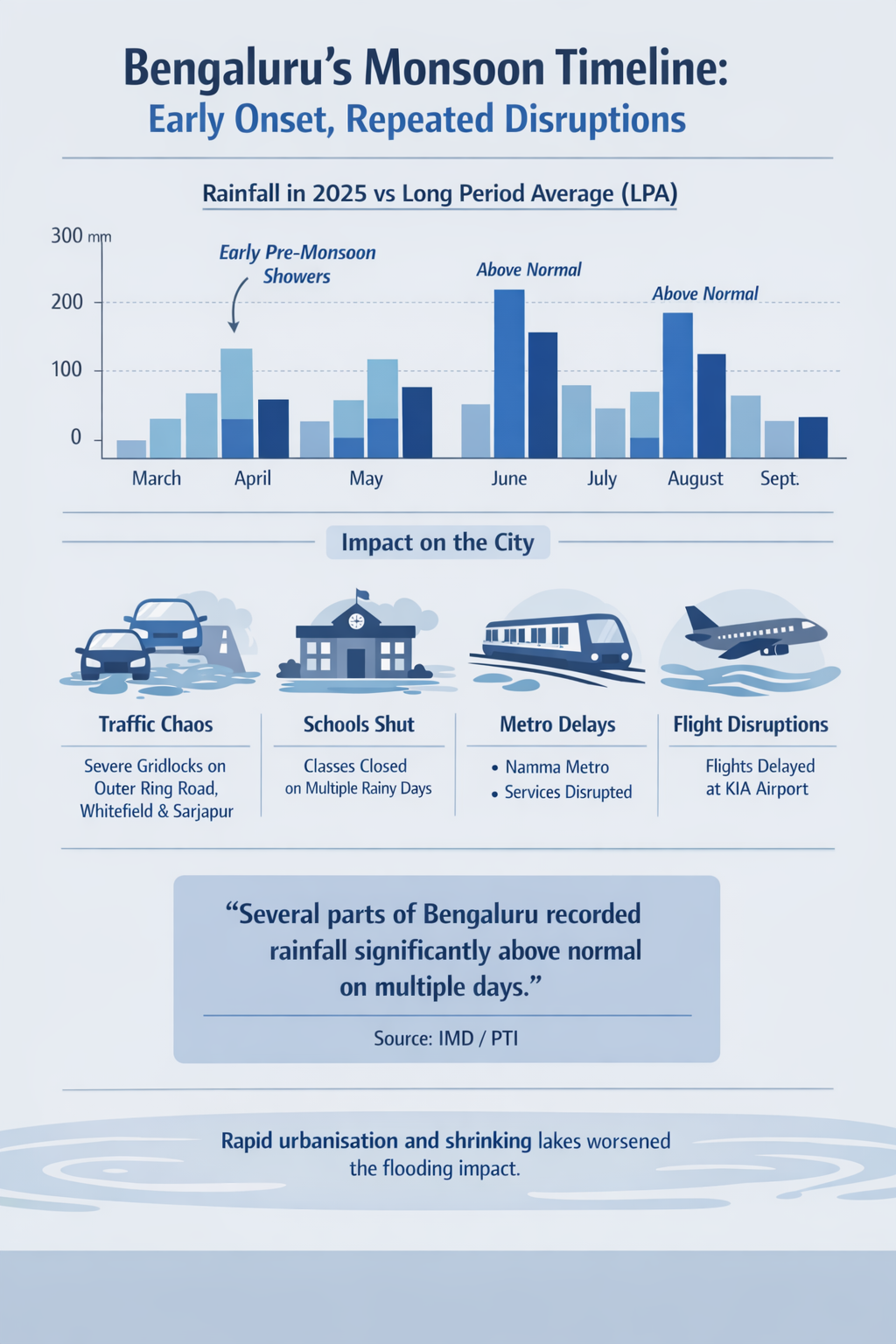
Bengaluru saw rain-related trouble much before the official onset of the southwest monsoon. Pre-monsoon showers in March and April flooded low-lying areas, while heavy rain spells in May and June pushed the city into repeated gridlocks. As reported by PTI and ANI, several parts of the city recorded rainfall well above normal levels on multiple days, with some localities witnessing record single-day totals.
Bengaluru Rains

Bengaluru’s Monsoon Timeline: Early Onset, Repeated Disruptions (AI-infographic generated by Chat GPT)
Traffic movement across tech corridors such as Outer Ring Road, Whitefield and Sarjapur slowed to a crawl due to waterlogged roads and fallen trees. Offices asked employees to work from home as vehicles remained stranded for hours. Schools in several areas were shut temporarily as a precaution. Namma Metro services faced intermittent delays due to water seepage and power issues, while air traffic at Kempegowda International Airport was disrupted by poor visibility and rain-soaked access roads. The monsoon once again highlighted how concretisation and the loss of natural drainage have left Bengaluru vulnerable to even short bursts of heavy rain.

Mumbai: Monsoon Brings the City to a Crawl​

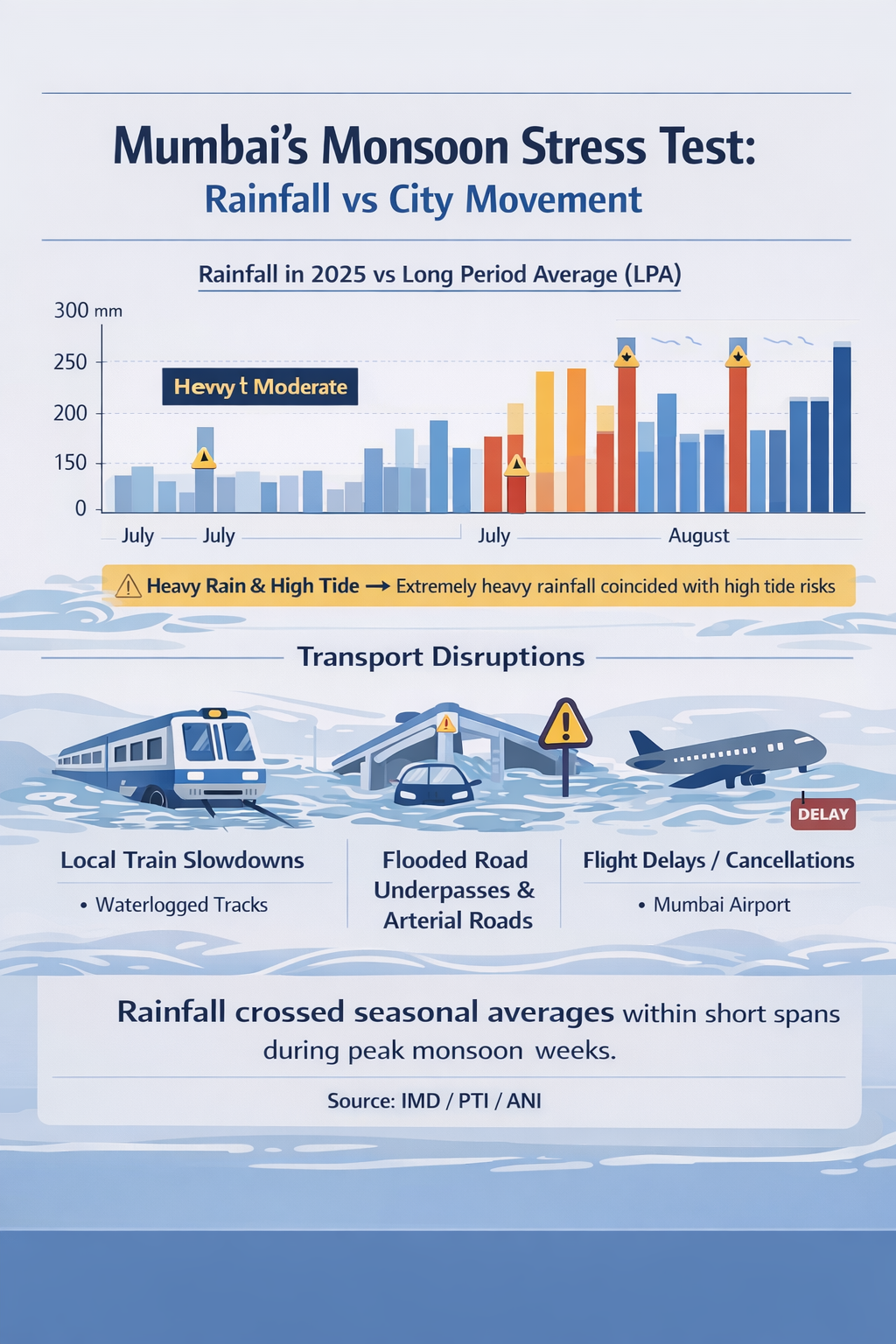
Mumbai’s monsoon followed a familiar pattern, with heavy rainfall intensifying from July onwards. After a brief pause in June, the city was hit by repeated spells of extremely heavy rain, prompting the IMD to issue orange and red alerts on multiple occasions. According to agency reports, rainfall levels crossed seasonal averages within short periods.


Not looking good for the future generation, glabal warming is hitting the sub continent countries hard and the politicans are not introducing better laws required to deal with this, what will we pass onto our next generations = not looking good


@Rajdeep @cricketjoshila @Champ_Pal @JaDed @Devadwal @uppercut @Theanonymousone @straighttalk @Vikram1989 @RexRex @Varun @Romali_rotti @Bhaijaan @Cover Drive Six @rickroll @rpant_gabba, @Romali_rotti
 

Gurugram Weather Today: Dense Smog, Air Quality at 'Very Poor', and the Week’s IMD Forecast​


Gurugram experienced a cold morning on December 23, with dense fog and an air quality index (AQI) of 331, categorizing it as very poor.


Gurugram Weather: Gurugram woke up to a cold morning on Tuesday (23 December) with dense fog engulfing the sky across the district. The overall air quality index (AQI) of the district stood in the ‘very poor’ category at 331 the Times of India reported, and the temperature dipped to 12° C in the early morning hours. The humidity is expected to remain high till the end of the week; along with calm winds and the cold weather conditions that are expected to persist till 28 December, fog conditions may intensify from dense to very dense fog.
The Indian Meteorological Department (IMD) has forecast that the district will experience fog mist in the mornings throughout this week. From Wednesday, 24 December to Thursday, 26 December, the sky is expected to remain partly cloudy.

Gurugram AQI Today
Gurugram’s overall AQI measured at 331, placing the city in the very poor category, the Times of India reported. The weather department has warned of “severely reduced visibility” as local emissions and cold weather conditions trap pollutants close to the surface in a dense fog.

AQI for Various Stations
Sector 51 - 346
Teri Gram - 329
NISE Gwal Pahari - 317
Station-wise data was reported by the Times of India.

IMD Places Yellow Warning in Gurugram
The IMD has placed the district under a yellow warning, indicating that citizens need to be cautious of impactful weather conditions.
Commuters have been advised to travel with caution while driving on highways and major roads at night. Advisories include instructions to use fog lights and avoid high-speed driving while visibility remains low. Fog related disruptions are likely to affect road traffic during late hours of the day, and slow down the traffic. IMD cautioned travellers that “driving conditions may turn hazardous”, and the risk of road accidents is expected to be higher than usual.
The IMD has also warned citizens that with cold weather conditions and no rainfall forecast, fog is expected to remain a concern throughout till Sunday, December 28. Gurugram will experience dense fog on Tuesday, December 23 and conditions are expected to worsen to very dense fog from Wednesday, December 24.
 
'We Do Not Want…': What Did Supreme Court Say On Toll Plazas Amid Delhi Air Pollution Crisis


The Supreme Court on Wednesday (December 17) issued directions to authorities regarding the levying of tolls for the next few months, observing that traffic congestion at toll plazas in busy areas was contributing to worsening air pollution in the Delhi-NCR region.


New Delhi: The Supreme Court on Wednesday (December 17) issued directions to authorities regarding the levying of tolls for the next few months, observing that traffic congestion at toll plazas in busy areas was contributing to worsening air pollution in the Delhi-NCR region. During the hearing on air pollution, a lawyer highlighted the issue of the Municipal Corporation of Delhi (MCD) toll plaza at Gurugram, stating that it often leads to hours-long traffic jams and long queues of vehicles, thereby adding to pollution levels.
Questioning the authorities, the Chief Justice of India (CJI) remarked, “Why can’t the officials say that till January, there will be no toll plaza?”
The CJI further cautioned against revenue-driven decisions, stating that toll plazas should not be placed in congested areas merely for income generation. “We do not want the income you generate. You definitely generate a lot of revenue from these tolls. We want to come out with a concrete plan for absolute no toll plaza till January 31 next year,” the court observed.

Shift Toll Plazas​

Following the hearing, the Supreme Court issued notices to the National Highways Authority of India (NHAI) and the MCD, seeking their response on whether toll plazas on national highways can be shifted, and whether MCD toll plazas manned by NHAI can also be relocated to non-congested areas


The top court described the pollution crisis as an "annual feature" and called for pragmatic and practical solutions to tackle the menace.

Delhi Vehicle Ban​

Meanwhile, Delhi will impose a ban on all non-BS VI vehicles to curb pollution. This also bans entry to vehicles coming from neighbouring cities, such as Nodia, Gurugram, starting Thursday, December 18, 2024. Lakhs of commuters across the NCR who owns BS-III petrol or BS-IV diesel vehicles have objected to the decision.


India in not taking any responsibility over thr pollution, next few generations are screwed - considering your populaton is increasing:

@Rajdeep @cricketjoshila @Champ_Pal @JaDed @Devadwal @uppercut @Theanonymousone @straighttalk @Vikram1989 @RexRex @Varun @Romali_rotti @Bhaijaan @Cover Drive Six @rickroll @rpant_gabba, @Romali_rotti @kron @globetrotter


#FreeMinoritiesOfIndia

#SaveAllIndianMinorities

#FreeIndiaFromHinduExtremism

#SanctionIndia
 

Year of Monsoon in Metro Cities: How 2025’s Heavy Rains Brought Bengaluru, Mumbai, Chennai, Delhi to a Standstill​


In 2025, India's major metro cities faced unprecedented challenges due to erratic and intense rainfall, revealing vulnerabilities in urban infrastructure. Bengaluru experienced pre-monsoon flooding and significant disruptions in traffic and services, while Mumbai dealt with heavy downpours leading to overcrowded trains and airport delays.


The year began with early weather warnings, but as 2025 unfolded, India’s biggest metro cities were repeatedly caught off guard by intense and erratic rainfall. What started as pre-monsoon showers soon turned into prolonged disruptions, exposing weak drainage systems, unchecked urban expansion and a growing gap between weather extremes and civic preparedness. From Bengaluru to Delhi, the monsoon did not arrive as a single season but as a series of shocks that affected daily life month after month.

Bengaluru: Early Rains, Repeated Disruptions​

Bengaluru saw rain-related trouble much before the official onset of the southwest monsoon. Pre-monsoon showers in March and April flooded low-lying areas, while heavy rain spells in May and June pushed the city into repeated gridlocks. As reported by PTI and ANI, several parts of the city recorded rainfall well above normal levels on multiple days, with some localities witnessing record single-day totals.


Traffic movement across tech corridors such as Outer Ring Road, Whitefield and Sarjapur slowed to a crawl due to waterlogged roads and fallen trees. Offices asked employees to work from home as vehicles remained stranded for hours. Schools in several areas were shut temporarily as a precaution. Namma Metro services faced intermittent delays due to water seepage and power issues, while air traffic at Kempegowda International Airport was disrupted by poor visibility and rain-soaked access roads. The monsoon once again highlighted how concretisation and the loss of natural drainage have left Bengaluru vulnerable to even short bursts of heavy rain.

Mumbai: Monsoon Brings the City to a Crawl​

Mumbai’s monsoon followed a familiar pattern, with heavy rainfall intensifying from July onwards. After a brief pause in June, the city was hit by repeated spells of extremely heavy rain, prompting the IMD to issue orange and red alerts on multiple occasions. According to agency reports, rainfall levels crossed seasonal averages within short periods.

The impact was felt across the city. Waterlogged railway tracks slowed suburban train services, leading to overcrowding and long delays during peak hours. Several arterial roads and subways were flooded, particularly in the western and central suburbs, disrupting road traffic. Flight operations at the city’s airport were frequently affected due to low visibility and runway conditions. Authorities also issued repeated warnings on days when heavy rain coincided with high tides, a combination that worsened flooding in coastal and low-lying areas.

Chennai: Sudden Downpours and Flood Anxiety​

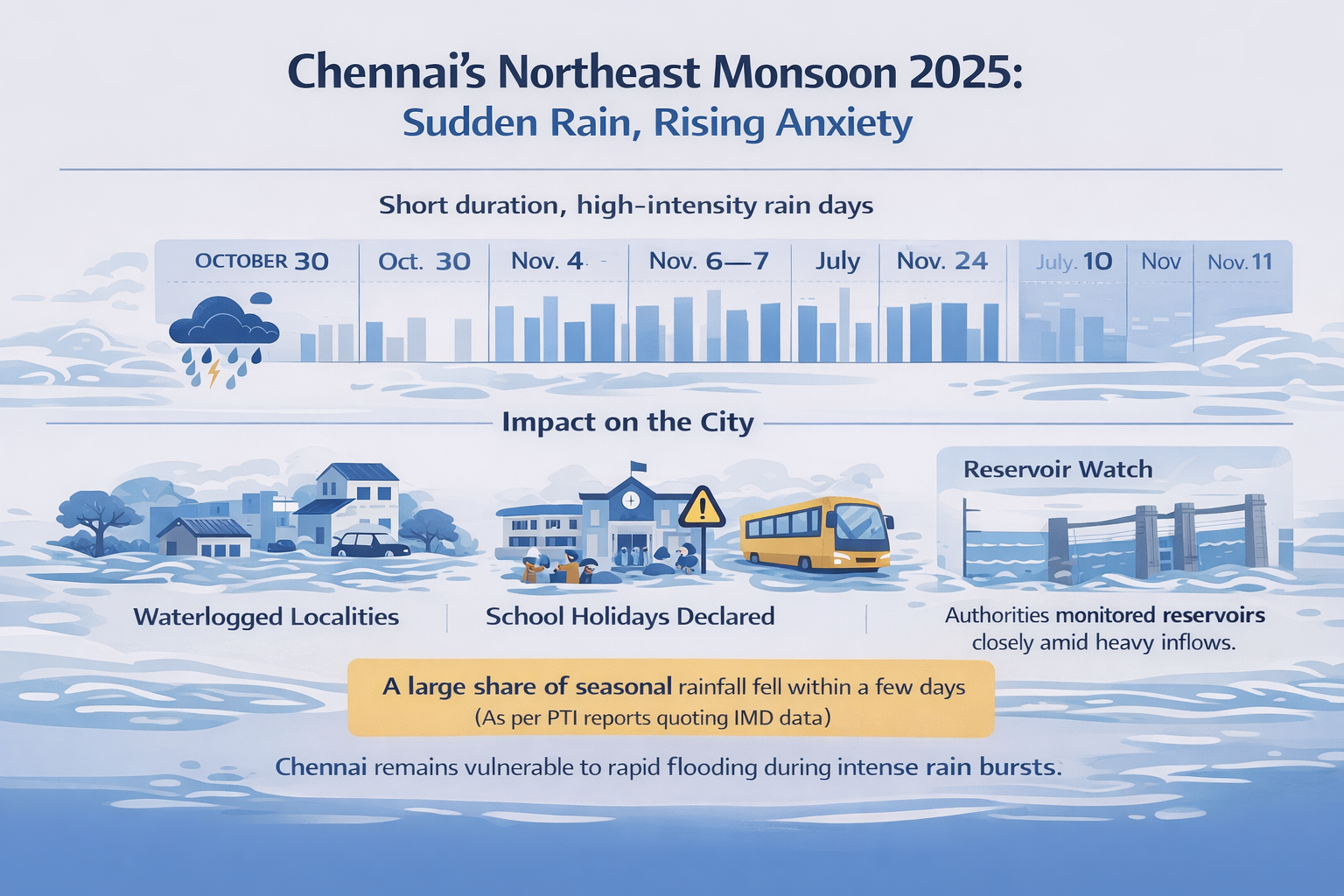
Chennai’s experience this year was marked by sudden and intense rain spells, particularly during the northeast monsoon period. After a relatively calm start, heavy rainfall events in October and November triggered flash flooding in several neighbourhoods. PTI reports noted that some rain spells delivered a large share of the season’s rainfall within just a few days.

Residential areas reported waterlogging within hours of heavy showers, forcing people to stay indoors. Schools were closed on precautionary grounds during peak rain days, while bus services were diverted and suburban train operations slowed. Authorities kept a close watch on reservoir levels as inflows rose sharply, reviving concerns shaped by the city’s past flood experiences. The year once again underlined how quickly Chennai can shift from dry spells to flood-like situations.

Delhi: From Heatwaves to Cloudbursts​

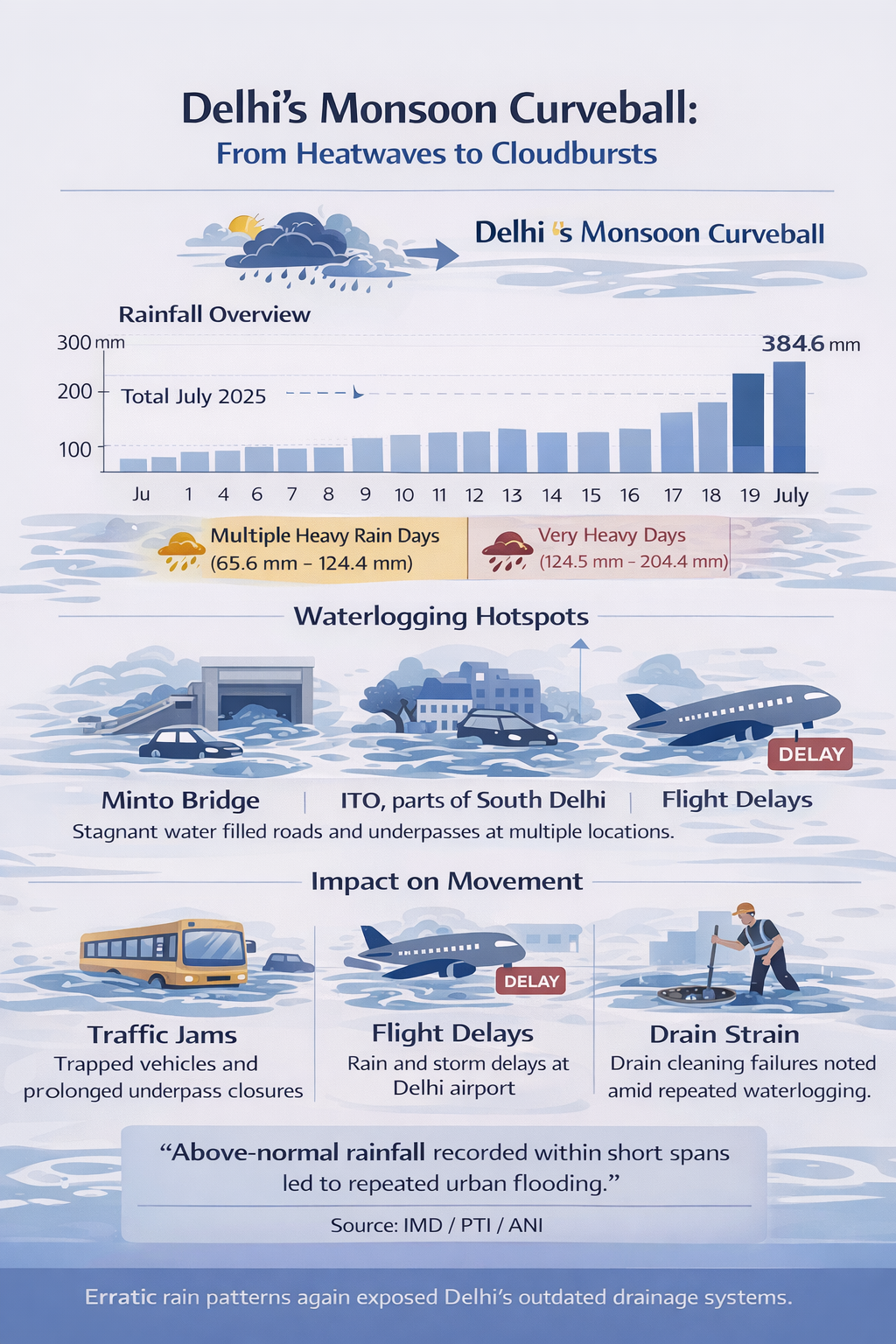
Delhi’s weather narrative in 2025 swung sharply between extremes. The year began with prolonged heatwaves, but by July, intense monsoon showers arrived suddenly, bringing relief from the heat while creating fresh challenges. According to IMD data cited in agency reports, Delhi recorded above-normal rainfall on several days, much of it concentrated in short, heavy spells.

Waterlogging returned to known hotspots such as Minto Bridge, ITO and parts of South Delhi, leading to traffic snarls and temporary road closures. Underpasses were shut for safety as water levels rose rapidly after heavy showers. Flight operations at Indira Gandhi International Airport were also affected during thunderstorms and intense rain. The recurring scenes once again drew attention to clogged drains and delayed pre-monsoon desilting.

What the Monsoon of 2025 Taught India’s Metros​

Across Bengaluru, Mumbai, Chennai and Delhi, the monsoon of 2025 showed that heavy rain is no longer an occasional disruption but a recurring urban crisis. Erratic weather patterns, combined with stressed civic infrastructure, turned rain into a test of governance and preparedness. Flooded streets, delayed trains, grounded flights and repeated school closures became common across cities, reinforcing the need for long-term planning instead of seasonal emergency measures.


Mumbai Rains

Mumbai Monsoon 2025 — Heavy Rain, High Tide, High Risk (AI-generated infographic by Chat GPT)


Chennai Rains

Chennai Monsoon 2025 — Flash Flood Risk Returns (AI-generated infograhic by Chat GPT)


Delhi Rains

Delhi: From Heatwaves to Cloudbursts (AI-generated infographic


What Makes Mumbai India’s Biggest Road Traffic Polluter and Why Bengaluru and Pune Are Close Behind​


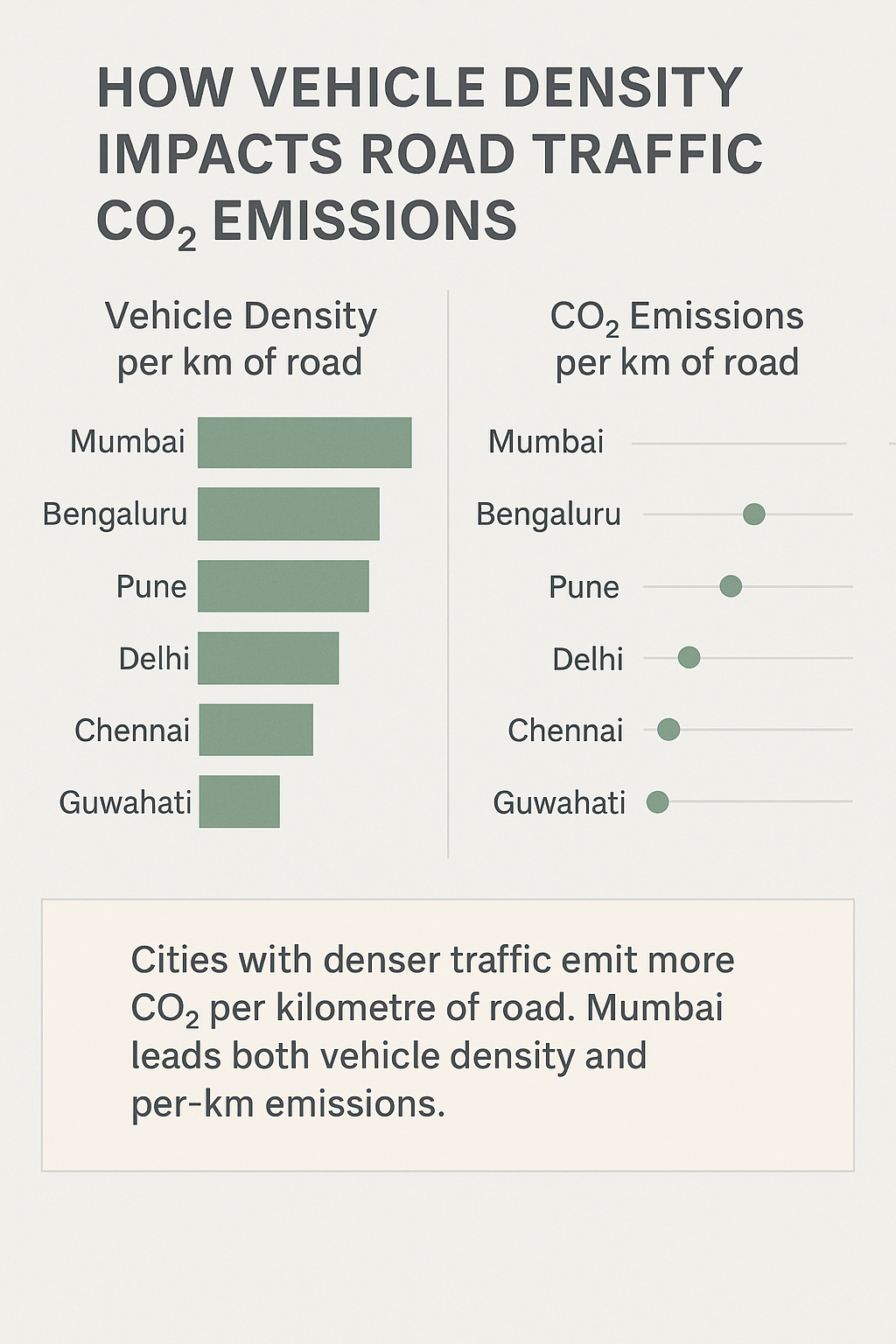
Mumbai has the highest road traffic CO₂ emissions per kilometer among major Indian cities due to high vehicle density, as revealed by a study published in Scientific Data. The research, involving multiple institutions, mapped emissions across 15 cities using 2021 traffic data.


Mumbai: Driven by extremely high vehicle density, Mumbai has recorded the highest road traffic carbon dioxide (CO₂) emissions per kilometre of road length among major Indian cities, according to a new high-resolution emissions dataset published in Scientific Data, a Nature portfolio journal.
The study also found that other large metros - including Delhi, Bengaluru, Chennai, Hyderabad and Pune - continue to record high levels of nitrogen oxides (NOx) and carbon monoxide (CO) from road transport.

High-Resolution Mapping Across 15 Cities​

The research was led by scientists from France’s Laboratoire des Sciences du Climat et de l’Environnement and Université Paris-Saclay, with contributions from IIT Bombay and Paris-based urban mobility data firm NEXQT SAS., as per a TOI report
Using traffic data for 2021, the team mapped daily road traffic CO₂ and air pollutant emissions at a fine 500-metre resolution across 15 Indian cities.

The study forms part of the CHETNA project, short for city-wise high-resolution carbon emissions tracking and nationwide analysis, which aims to track emissions across more than 100 Indian cities.

Mumbai Stands Out in Vehicle Density and CO₂ Emissions​

A city-wise comparison showed a clear pattern: cities with denser traffic emitted more CO₂ per kilometre of road.
Mumbai emerged as the clear outlier, recording both the highest vehicle density and the highest CO₂ emissions per km among all cities analysed.
How Vehicle Density Impacts Road Traffic CO₂ Emissions

How Vehicle Density Impacts Road Traffic CO₂ Emissions
Other cities such as Chandigarh, Chennai, Pune and Bengaluru fell into a high-density, high-emissions cluster, though at lower levels than Mumbai. Delhi ranked in the mid-high range, with lower per-km CO₂ emissions than some similarly dense cities.
In contrast, Guwahati, Indore and Jaipur recorded relatively lower traffic density and emissions.

Total Emissions Tell a Different Story​

While Delhi does not top per-kilometre emissions, it joins Mumbai and Bengaluru as the top three cities for total CO₂ emissions from road traffic, largely due to their size and traffic volume.
However, per capita emissions across cities were strikingly similar. Nearly all 15 cities recorded less than 0.2 tonnes of CO₂ per person annually, suggesting broadly comparable vehicle usage patterns per resident across Indian cities.

NOx and CO Dominate Urban Traffic Pollution​

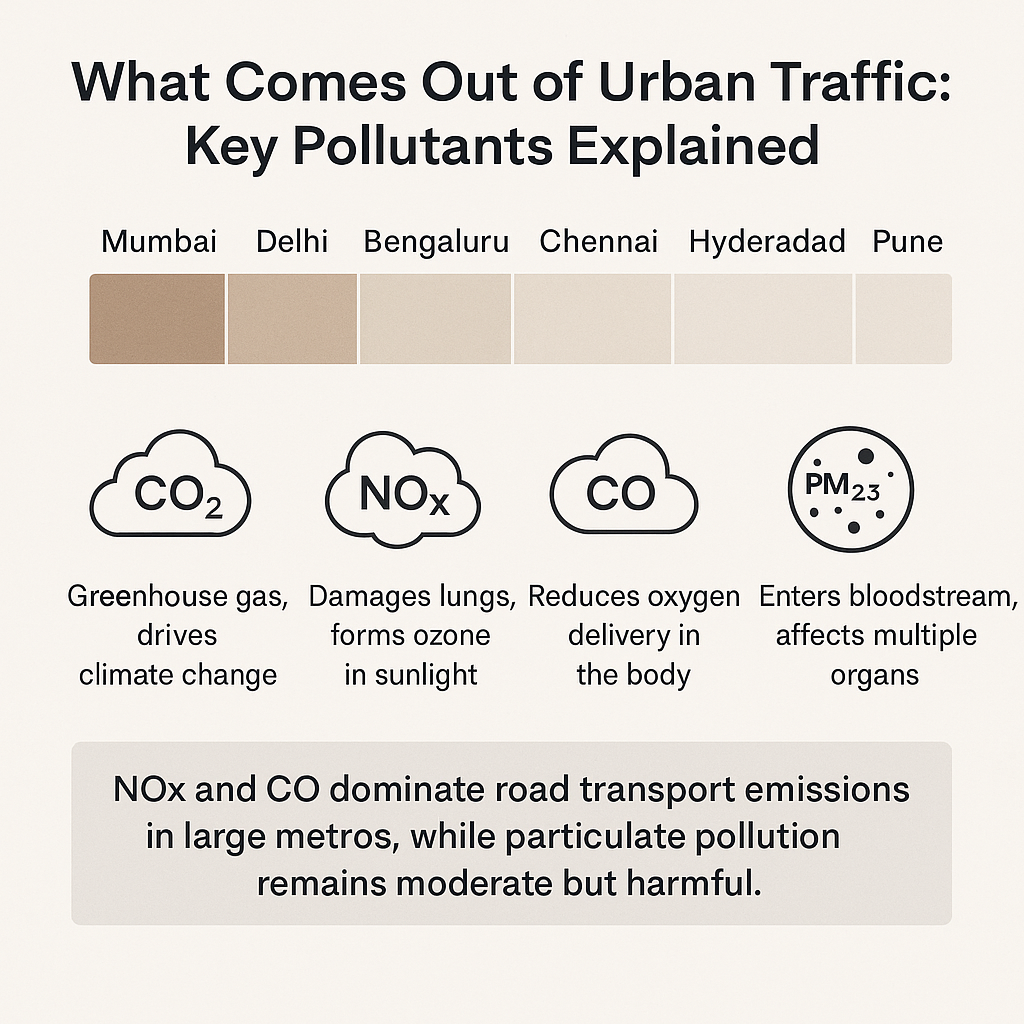
Pollutant-wise estimates showed that nitrogen oxides (NOx) and carbon monoxide (CO) dominate road transport emissions across all cities studied.
A comparative heatmap indicated that large metropolitan cities, including Mumbai, Delhi, Bengaluru, Chennai, Hyderabad and Pune, recorded significantly higher NOx and CO emissions than smaller cities such as Guwahati, Mangaluru and Tiruppur.
Traffic-related particulate pollutants, including PM₁₀, PM₂.₅ and black carbon, were present at moderate levels in major cities but remained lower in magnitude than NOx and CO, the study found.
What Comes Out of Urban Traffic: Key Pollutants Explained

What Comes Out of Urban Traffic: Key Pollutants Explained

Why These Emissions Matter​

CO₂ is a greenhouse gas that traps heat in the atmosphere when released in large quantities, primarily from vehicles, power plants and industry. Rising CO₂ levels are linked to global warming, hotter temperatures, frequent heatwaves, erratic rainfall, floods, droughts and rising sea levels.


Cmon indian, what steps can we help your government to tackle pollution:

@Rajdeep @cricketjoshila @Champ_Pal @JaDed @Devadwal @uppercut @Theanonymousone @straighttalk @Vikram1989 @RexRex @Varun @Romali_rotti @Bhaijaan @Cover Drive Six @rickroll @rpant_gabba, @Romali_rotti @kron @globetrotter @Hitman @jnaveen1980


#FreeMinoritiesOfIndiaFromHindus

#SaveAllIndianMinorities

#FreeIndiaFromHinduExtremism

#SanctionIndia
 
AQl is a western construct. India must have its own index -Bharatiya Air Quality Weather Administrative System (BAQWAS).Under BAQWAS, AQI of 250 will correspond to 1 on BAQWAS and this will be categorised as "Ati Uttam". Similarly AQI of 1000 will corespond to 2, and this will be categorised as "Param Uttam".Smoke and its generation has been a part of our ancient rituals since time immemorial. It is Western culture that has now made us look upon it as something undesirable.BAQWAS will peak during Deepavali and winter and restore the pride we had lost due to this foreign imposed "AQl", which as we all know actually stands for Al Qaeda International.

 
AQl is a western construct. India must have its own index -Bharatiya Air Quality Weather Administrative System (BAQWAS).Under BAQWAS, AQI of 250 will correspond to 1 on BAQWAS and this will be categorised as "Ati Uttam". Similarly AQI of 1000 will corespond to 2, and this will be categorised as "Param Uttam".Smoke and its generation has been a part of our ancient rituals since time immemorial. It is Western culture that has now made us look upon it as something undesirable.BAQWAS will peak during Deepavali and winter and restore the pride we had lost due to this foreign imposed "AQl", which as we all know actually stands for Al Qaeda International.


LOL!

Sanghis always try to change history and norms they don't like.

What they don't realize is it is damaging for them the most.
 
AQl is a western construct. India must have its own index -Bharatiya Air Quality Weather Administrative System (BAQWAS).Under BAQWAS, AQI of 250 will correspond to 1 on BAQWAS and this will be categorised as "Ati Uttam". Similarly AQI of 1000 will corespond to 2, and this will be categorised as "Param Uttam".Smoke and its generation has been a part of our ancient rituals since time immemorial. It is Western culture that has now made us look upon it as something undesirable.BAQWAS will peak during Deepavali and winter and restore the pride we had lost due to this foreign imposed "AQl", which as we all know actually stands for Al Qaeda International.

LOL!

Sanghis always try to change history and norms they don't like.

What they don't realize is it is damaging for them the most.

Anyway, this tweet was a satire. He is one of the sensible Indians I guess. :inti
 

India Air Quality Alert​


India Air Quality Alert​

30 Dec 2025
India Air Quality Alert

Is the air quality good in India?​

As of December 30, 2025, air quality in India remains poor, with major cities experiencing "unhealthy" to "very unhealthy" levels and high PM2.5 concentrations, posing serious health risks to residents, especially children and the elderly.

By 10:30 AM (India Standard Time), many urban centers have recorded AQI readings above 200, prompting health warnings. Residents are advised to limit outdoor activity, keep windows closed, wear masks when outside, and use air purifiers indoors.

While conditions remain poor, India’s average PM2.5 concentration in 2024 was 50.6 µg/m3, equivalent to an AQI of 138, classified as “unhealthy for sensitive groups". This level is nearly 11 times higher than the WHO annual guideline of 5 µg/m3, placing India fifth globally in the 2024 World Air Quality Report.

MAP_India_12_30_25.jpg
Air quality map of India and neighboring countries on the morning of December 30, 2025. Source: IQAir.


Which cities are affected by bad air quality in India?​

As of December 30, 2025, several major cities across India are reporting poor air quality. The most affected cities include:

Air quality conditions can change rapidly throughout the day. For a complete, real-time overview of pollution levels nationwide, see India's air quality map.

LR_India_12_30_25.jpg
Delhi ranked as the world’s most polluted major city, while Kolkata and Mumbai placed 5th and 11th globally, respectively, on the morning of December 30, 2025. Source: IQAir.


When will the air quality improve in India?​

Improvement in the short term depends on favorable weather, winds, rain, and higher mixing will help disperse pollutants. However, as winter sets in, cooler air and temperature inversions trap pollution near the ground, meaning conditions may remain poor without major emission reductions. Forecasts suggest air quality may stay in unhealthy ranges throughout winter unless significant interventions occur.

What is causing poor air quality in India?​

Air pollution in India during winter stems from a combination of human activities and weather conditions. Recent studies confirm that the main contributors include large-scale crop residue burning in northern states and stagnant atmospheric conditions (1).

Additional sources include residential use of coal and biomass for heating, and emissions from vehicles, industries, and construction (2). During winter, temperature inversions, calm winds, and shallow boundary layers trap pollutants near the ground, leading to a buildup of smog and significantly worsening air quality (3).
 

Delhi To Welcome 2026 With Light Rain And "Very Poor" AQI​


For the subsequent six days, the air quality is expected to remain in the 'very poor' category.


New Delhi:


The national capital's air quality improved marginally to the 'very poor' category on Tuesday, even as dense fog reduced visibility in parts of the city.

The India Meteorological Department (IMD) has predicted that the dense fog is likely to persist on Wednesday.

Delhi recorded a 24-hour average Air Quality Index (AQI) of 388, down from 401 on Monday, according to Central Pollution Control Board (CPCB) data.

While 17 air quality monitoring stations in Delhi recorded pollution levels in the 'very poor' category, another 17 logged 'severe' readings.

Anand Vihar recorded the worst AQI at 460, according to the CPCB's Sameer app.

An AQI between 0 and 50 is considered 'good', 51 to 100 'satisfactory', 101 to 200 'moderate', 201 to 300 'poor', 301 to 400 'very poor', and 401 to 500 'severe'.

The Air Quality Early Warning System said the AQI is likely to be in the 'severe' category on December 31 and January 1, before returning to the 'very poor' category on January 2.

For the subsequent six days, the air quality is expected to remain in the 'very poor' category.

Officials attributed the poor outlook to an unfavourable ventilation index of less than 6,000 sq m per second and average wind speeds of less than 10 kmph, which are not conducive for the dispersion of pollutants.

According to the Decision Support System (DSS) for Air Quality Management, Delhi transport was the biggest contributor to air pollution on Tuesday at 15.3 per cent, followed by industries in the city and its peripheral areas at 7.6 per cent, residential sources at 3.7 per cent, construction activities at 2 per cent and waste burning at 1.3 per cent.

Among NCR districts, Jhajjar was the biggest contributor at 18.2 per cent, followed by Rohtak at 4.7 per cent, Bhiwani at 4.4 per cent, Gurugram at 1.8 per cent and Sonipat at 1.4 per cent.

Delhi recorded a maximum temperature of 21.5 degrees Celsius, 1.1 notches above normal, and a minimum of 9.4 degrees Celsius, 2.6 notches above normal.

Low visibility conditions prevailed during the morning hours due to dense fog.

The visibility at Safdarjung was recorded at around 100 metres at 7.30 am and it improved to around 200 metres by 8.30 am. At Palam, moderate fog was observed, with visibility around 300 metres at 8.30 am.

The IMD has forecast dense fog on Wednesday. The minimum temperature is expected to settle at 8 degrees Celsius and the maximum at 23 degrees Celsius.

It has forecast generally cloudy skies with light rain on New Year's Day.


What can be done about your pollution?, please list some ideas


@Rajdeep @cricketjoshila @Champ_Pal @JaDed @Devadwal @uppercut @Theanonymousone @straighttalk @Vikram1989 @Varun @Romali_rotti @Bhaijaan @Cover Drive Six @rickroll @rpant_gabba, @Romali_rotti @kron @globetrotter @Hitman @jnaveen1980


#FreeMinoritiesOfIndiaFromHindus

#SaveAllIndianMinorities

#FreeIndiaFromHinduExtremism

#SanctionIndia
 

How IIT-Kanpur is using mobile labs and AI to map solutions for Delhi’s pollution​


The team stationed a state-of-the art lab at two locations — Anand Vihar and Dwarka — to pinpoint where Delhi’s pollution comes from and how it can be solved.


The mobile lab was parked in Anand Vihar, one of Delhi’s busiest and most polluted junctions, and then taken to Dwarka, a relatively calmer neighbourhood. The aim? To check how pollution varies across Delhi. Express
Between May and June, researchers from IIT-Kanpur parked a vehicle along Anand Vihar, one of Delhi’s busiest and most polluted junctions. The same vehicle was then taken to Dwarka, a relatively calmer suburban neighbourhood about 30 km away.

Both locations told a different story about the air people were breathing.
 

Desperate Delhi bans tandoors in its fight against pollution​


With AQI at hazardous levels and no solution in sight to fight pollution, the Delhi government has banned tandoors that use coal or firewood.


The humble tandoor, used to prepare rotis and roasted delights, has become the latest target of Delhi's pollution fight. The Delhi Pollution Control Committee (DPCC) issued directions banning tandoors that use coal and firewood across all hotels, restaurants and open eateries in the city.

The Air Quality Index (AQI) in Delhi was recorded around 400 at Delhi's Anand Vihar and ITO at 10 am on Tuesday. The ban on tandoors, which are used by restaurants and eateries, came last week.

The order was issued under Section 31(A) of the Air (Prevention and Control of Pollution) Act, 1981, according to a report from news agency PTI on December 9.

All restaurants and eateries have to immediately switch to electric, gas-based or other clean-fuel appliances.

With air quality worsening in Delhi-NCR, stage IV of the Graded Response Action Plan (GRAP) was implemented on Saturday last week.

The Commission for Air Quality Management (CAQM), said its GRAP sub-committee had decided to enforce all measures under stage-IV or "severe+" air quality with immediate effect after pollution levels crossed critical thresholds.

Under GRAP IV, any open burning of biomass, waste, or similar materials (which could include coal) is strictly prohibited.

"Urban local bodies, including commissioners and chief engineers of municipal agencies, have been instructed to conduct checks and ensure that all eateries under their jurisdiction immediately discontinue use of coal and firewood," according to the PTI report.

It said the order had been sent via speed post and email to all departments concerned for immediate action.


@Rajdeep @cricketjoshila @Champ_Pal @JaDed @Devadwal @uppercut @Theanonymousone @straighttalk @Vikram1989 @Varun @Romali_rotti @Bhaijaan @CoverDriveSix @rickroll @RexRex @rpant_gabba, @Romali_rotti @kron @globetrotter @Hitman @jnaveen1980 @Local.Dada


#FreeMinoritiesOfIndiaFromHindus

#SaveAllIndianMinorities

#FreeIndiaFromHinduExtremism

#SanctionIndiaIndians
 
STORY | No conclusive data linking higher AQI to lung diseases: GovtThere is no conclusive data establishing a direct correlation between higher air quality index (AQI) levels and lung diseases, the government has told Parliament.


@Rajdeep @cricketjoshila @Champ_Pal @JaDed @Devadwal @uppercut @Theanonymousone @straighttalk @Vikram1989 @Varun @Romali_rotti @Bhaijaan @CoverDriveSix @rickroll @RexRex @rpant_gabba, @Romali_rotti @kron @globetrotter @Hitman @jnaveen1980 @Local.Dada


#FreeMinoritiesOfIndiaFromHindus

#SaveAllIndianMinorities

#FreeIndiaFromHinduExtremism

#SanctionIndiaIndians
 

‘India soon to be a masking nation’: Mumbai man puts N95 mask on air quality monitor, AQI drops to almost 37; video sparks public outcry​


As soon as the mask covered the air inlet, the AQI began to drop rapidly, stopping at 37.


Air pollution in India has been grabbing global attention with the Air Quality Index (AQI) surging over 400 in the Delhi-NCR region. However, major cities, including Mumbai, are also battling air pollution, with several residents raising the issue on social media. Amid several videos capturing the hazardous sight of smog, a video of a Mumbai man conducting an experiment with an N95 mask has gone viral.

In the viral video, the man first showed the AQI in his area, which is Juhu Beach. As per an air quality monitor, the AQI was between 191 and 192- “almost 200”. The man then covers the monitor’s air inlet. As soon as the mask covered the air inlet, the AQI began to drop rapidly, stopping at 37.
 

Express Impact: In dust bowl of Rohini, how Delhi govt plans to clear the air​


The visit follows a report by The Indian Express on December 19, which flagged that North West Delhi’s Rohini continues to grapple with dust pollution even as flying squads of the Commission for Air Quality Management (CAQM) had raised concern over high visible dust on 12 of 57 roads in the area during an inspection earlier this month.


etting up a Rohini Dust Action Cell for coordination among civic agencies; weekly joint inspections by the Delhi Pollution Control Committee, Delhi Development Authority, Municipal Corporation of Delhi and the traffic police; a time-bound dust-suppression mandate through daily mechanised sweeping and regular sprinkling of water or approved dust suppressants — these are among the remedial measures in focus after Rohini MLA Vijender Gupta on Saturday issued directions to fight dust pollution in his constituency, which is aggravating the air quality.

The visit follows a report by The Indian Express on December 19, which flagged that North West Delhi’s Rohini continues to grapple with dust pollution even as flying squads of the Commission for Air Quality Management (CAQM) had raised concern over high visible dust on 12 of 57 roads in the area during an inspection earlier this month. During a spot check, The Indian Express had found roads dug up, untarred or covered with loose soil in the area more than 10 days after the CAQM inspection on December 8.
 

‘India soon to be a masking nation’: Mumbai man puts N95 mask on air quality monitor, AQI drops to almost 37; video sparks public outcry​


As soon as the mask covered the air inlet, the AQI began to drop rapidly, stopping at 37.


Air pollution in India has been grabbing global attention with the Air Quality Index (AQI) surging over 400 in the Delhi-NCR region. However, major cities, including Mumbai, are also battling air pollution, with several residents raising the issue on social media. Amid several videos capturing the hazardous sight of smog, a video of a Mumbai man conducting an experiment with an N95 mask has gone viral.

In the viral video, the man first showed the AQI in his area, which is Juhu Beach. As per an air quality monitor, the AQI was between 191 and 192- “almost 200”. The man then covers the monitor’s air inlet. As soon as the mask covered the air inlet, the AQI began to drop rapidly, stopping at 37.
 

GRAP-4 Curbs in NCR: Gurugram Orders WFH, Staggers Office Timings As Pollution Worsens - All Details Here​


Amid worsening air quality, the Gurugram Deputy Commissioner has ordered offices to operate at 50% strength, with the rest working from home, after GRAP-IV curbs were imposed in Delhi-NCR. Public office timings have also been changed.


As the air quality in Delhi-NCR continues to worsen with increasing pollution, the Deputy Commissioner of Gurugram has announced to impose work from home (WFH) for all offices, and have directed to operate at 50 per cent strength, with the remaining staff working from home.
The Gurugram DC noted that the Commission for Air Quality Management (CAQM) invoked Stage-IV of the Graded Response Action Plan (GRAP) in Delhi and NCR on December 13.

Accordingly, all Private Institutions and Corporate Offices in District Gurugram are advised to encourage employees to work from home w.e.f. 22.12.2025 until further orders," the post read on X


In view of the deteriorating air quality, the Commission for Air Quality Management (CAQM) has invoked Stage-IV of the Graded Response Action Plan (GRAP) in Delhi & NCR vide order dated 13.12.2025.As per the directions, State Governments/ GNCTD may allow offices to operate at 50% strength, with the remaining staff working from home.Accordingly, all Private Institutions and Corporate Offices in District Gurugram are advised to encourage employees to work from home w.e.f. 22.12.2025 until further orders.This collective effort will support the effective implementation of GRAP measures and contribute towards improving air quality in the region


Gurugram Offices' Timings Changed​


In another post, the Gurugram DC also announced to alter office timings for all public offices in District Gurugram under the State Government and Municipal Corporations/Councils/Committees.


Gurugram Deputy Commissioner Ajay Kumar issued an advisory in compliance with orders issued by the CAQM, under the fourth phase of the GRAP.


(In view of the deteriorating air quality, the Commission for Air Quality Management (CAQM) has invoked Stage-IV of the Graded Response Action Plan (GRAP) in Delhi & NCR vide order dated 13.12.2025.As per the directions, State Governments/ GNCTD may allow offices to operate at 50% strength, with the remaining staff working from home.Accordingly, all Private Institutions and Corporate Offices in District Gurugram are advised to encourage employees to work from home w.e.f. 22.12.2025 until further orders.This collective effort will support the effective implementation of GRAP measures and contribute towards improving air quality in the region)


Check Office Timings Here​


State Government Offices
09:30 AM – 05:30 PM
Municipal Corporation, Gurugram & Manesar
08:30 AM – 04:30 PM
Municipal Council, Sohna & Pataudi Mandi Municipal Committee, Farrukhnagar
08:30 AM – 04:30 PM
According to the orders, "Office timings shall be effective in all public offices in Gurugram district under the State Government and Municipal Corporations/Councils/Committees during Stage-IV of GRAP," the post read.
The DC further said that the decision has been taken to control the level of air pollution and reduce traffic and congestion.

Gurugram​


Gurugram on Monday recorded an AQI of 325, falling it under the “very poor” category, according to the Sameer app, with the highest air quality recorded in Sector-51 station, at 337. As read on the air quality check app, it has been advised, “Air quality is very poor and can cause respiratory illness on prolonged exposure.
 

Breathing Has Become Harder For Many, No Thanks To Air Pollution: What Lungs Need As You Enter 2026​


Air pollution in India has reached alarming levels and has started seriously affecting lung health across all ages.


Air pollution in India has reached alarming levels and has started seriously affecting lung health across all ages. The growing concentration of harmful pollutants is leading to a wide range of respiratory diseases, from COPD and asthma to lung cancer and bronchitis. Among such pollutants, the most dangerous ones are those called PM 2.5, comprising extremely fine particulate matter that can go deep inside the lungs because of their very tiny size. These particles accumulate in the lower respiratory tract once inhaled and trigger inflammation there, leading to long-term damage. This may lead to reduced lung function with time and increases the susceptibility to respiratory diseases, particularly in vulnerable populations, such as children and the elderly.

India's Air Pollution Crisis - Key Sources of the Problem​

There are numerous causes to India's air pollution crisis, but a few large ones stand out. To begin with, vehicle emissions-the huge amount of exhaust fumes coming from a sea of traffic-is spewing billions of cubic centimeters of toxic chemicals and particulate matter into the atmosphere.And also the crops burnings in the north, which seem to kick off pollution spikes and thick smog episodes that everyone in Delhi is dealing with. Then there's the indoor air pollution from burning biomass, wood, or firewood in kitchens and stoves all over the country - that's causes pollution. Weather factors like falling temperatures and low wind speeds can trap these close to the ground, increasing exposure to all these pollutants.

Simple Measures to Reduce Daily Exposure​

The protective measures against these pollutants in the lungs are a must. Firstly, it's about the minimization of the volume of polluted air entering the organism. Thus, a well-fitting N95 mask can be quite efficient as a barrier for catching fine particulate matter. Also, it makes sense to limit outdoor activities during hours of peak pollution; for instance, one can reschedule walks or exercise sessions indoors. Thus, a high-quality air purifier installed in homes will help keep the air indoors much safer by filtering out harmful particles.

Improving Indoor Air Quality for Better Lung Health​

Equally important is the reduction of indoor pollution. Avoid burning firewood, incense, or mosquito coils, because these will add to poor indoor air quality. Smoking in all its forms is to be avoided at all costs. This involves the first-hand, second-hand, and even third-hand smoke, all dangerous to lung health. Keeping up with an active lifestyle through regular indoor exercise, staying well hydrated, and consuming a nutritious diet will do much to strengthen overall respiratory health.

Vaccinations That Can Strengthen Respiratory Protection​

Adults, especially those over the age of 50 years, are encouraged to get vaccinations that protect the lungs, like the annual flu shot and the pneumococcal vaccine. These would reduce the risk of serious respiratory infections that may be worsened by high levels of air pollution.

When to Seek Medical Attention​

Finally, persons with chronic conditions like heart disease, asthma, or COPD should continue their medications without interruption. If symptoms worsen, such as persistent coughing or difficulty breathing, a pulmonologist should be consulted immediately.

(By Dr. Anusha C M, Consultant - Respiratory Medicine, Manipal Hospital Malleswaram, Bengaluru)

Disclaimer: The opinions expressed within this article are the personal opinions of the author. NDTV is not responsible for the accuracy, completeness, suitability, or validity of any information on this article. All information is provided on an as-is basis. The information, facts or opinions appearing in the article do not reflect the views of NDTV and NDTV does not assume any responsibility or liability for the same.
 

Aravalli Row Back in Supreme Court After Environmentalist Seeks Review of '100-Metre' Rule - What We Know​


Environmental activist Hitendra Gandhi has approached the Supreme Court to review the Centre's new "100-metre test" for defining protected areas in the Aravalli Range.


New Delhi: Environmental activist and lawyer Hitendra Gandhi has once again approached the Supreme Court seeking a review and clarification over so called Centre's "100-metre test" (100-metre rule) to identify protected areas within the Aravalli Range.
According to the new definition for the mountain range from the Centre and approved by Supreme Court, "Aravalli hill is any landform in the designated Aravalli districts with an elevation of 100 metres or more above its local relief", and an "Aravalli range is a collection of two or more such hills within 500 metres of each other".

However, as protect 'Aravallis' campaign gains momentum where environmentalists are protesting against the new definition to describe the oldest mountain range, Environment Minister Bhupender Yadav defended the Centre's stand saying that the Supreme Court-approved definition will bring more than 90 per cent of the Aravalli region under "protected area".

Why​


Former Rajasthan Chief Minister Ashok Gehlot upped the ante on the Aravalli definition issue and has questioned why the BJP government validated the '100 metre' formula that the Supreme Court had already rejected in 2010.

Gehlot reiterated that the new definition would destroy 90 per cent of the mountain range in the state.

How BJP Refuted Congress' Claim​


Calling Gehlot's claim "baseless" and "misleading", senior BJP leader Rajendra Rathore also said earlier in the day that the new framework is "stricter" and "more scientific than before".

Did Congress' Brought A Similar Policy in 2003?​


Following Rathore's statement, Gehlot said that in 2003, an expert committee had recommended the '100 metre' definition from the perspective of livelihood and employment.
"Acting on this recommendation, the then state government submitted an affidavit before the Supreme Court on February 16, 2010. However, the court rejected this definition within just three days," he said.
Gehlot said his then government accepted the judiciary's order and subsequently got the Aravalli region mapped through the Forest Survey of India.
"Our Congress government made serious efforts to detect illegal mining in the Aravallis by directing the use of remote sensing (satellite imagery). A budget of Rs 7 crore was allocated for surveys across 15 districts," he said, adding that the SPs and district collectors were given the direct responsibility of curbing illegal mining.
"Now, the question is why did the present government in Rajasthan support and recommend to a Union government committee the very definition that had already been rejected by the Supreme Court in 2010," he said, suspecting that pressure or "a larger game" could be at play.

Congress Claims of Acting Against Mining Mafia​


The former chief minister said that his government followed a zero-tolerance policy against illegal mining and empowered both the mining department and police to curb it.
With his government between 2019 and 2024, penalties amounting to Rs 464 crore were recovered from illegal mining operators — more than double the Rs 200 crore recovered during the previous BJP government's term from 2013 to 2018, the Congress leader said.
"The Congress government broke the backbone of the mining mafia by registering 4,206 FIRs over five years. Of these, a large number were filed in the first three years alone -- 930 in 2019-20, 760 in 2020-21, and 1,305 in 2021-22," he said.
In contrast, Gehlot said, 508 FIRs have been registered in the first year of the the present BJP government (2024-25).
"This clearly indicates the BJP government’s soft approach towards the mining mafia, which is, once again, boosting their confidence," he alleged.
Gehlot said the Aravallis are not merely a range of hills but the lifeline of Rajasthan, acting as a natural barrier that prevents the expansion of the Thar desert.
He said Union Environment Minister Bhupender Yadav, who hails from Rajasthan and represents the Alwar Lok Sabha constituency, was expected to act as a protector of the Aravallis, not someone who allows their destruction.
Meanwhile, the X handle of the Congress party released a short video on the issue, reiterating its stand.
"To save Aravalli, people are raising their voice, and villagers are protesting. Scientists and ecologists are sounding dire warnings, and communities are fighting to protect the land that sustains them. And yet, the Modi government refuses to listen because crony capitalists are their priorities," it alleged.

The Leader of Opposition in Rajasthan Assembly, Tikaram Jully, held a press conference in Alwar and targeted Yadav, accusing him of betraying the people from his constituency.
He accused both the central and state governments of attempting to destroy the Aravalli range and turn Rajasthan into a desert.
"While BJP leaders express concern for trees in the name of environmental protection, they are enabling the cutting down of thousands of trees to hollow out the Aravalli hills. The BJP government is working to destroy the very foundation of our state," he said.
The LoP further accused Yadav of "working as a brand ambassador for the mining mafia", despite having grown up in Ajmer.
He added that the Congress party's "Save Aravalli-Save Sariska" campaign should be a collective effort to protect nature and safeguard not just Rajasthan, but four states of the country from environmental devastation.
Meanwhile, former minister Pratap Singh Khachariawas took out a silent march from his residence to Ambedkar Circle in Jaipur to protest against the new definition.
 

Taj Mahal Disappears As Dense Fog Engulfs North India; Flights, Train Services Hit​


Similar foggy conditions were witnessed in multiple cities including Ayodhya, Moradabad, and the National Capital Region.


The Taj Mahal vanished behind a thick veil of fog on Sunday morning as dense mist enveloped the Northeast India, including Agra, sharply reducing visibility across the city. Situation has been worse in Delhi-NCR which saw a dip in temperature on Sunday accompanied with a thick layer of toxic smog this morning.
Visuals from the Taj View Point ADA, shared by news agency ANI, showed the iconic monument barely visible.


(Uttar Pradesh | A thick layer of dense fog envelops Agra city. Visuals from Taj View Point ADA, as the iconic Taj Mahal seemingly disappears behind the fog.)

Similar foggy conditions were witnessed in multiple cities including Ayodhya, Moradabad, and the National Capital Region.

In Ayodhya, a dense layer of fog covered the city during the early morning hours. According to the India Meteorological Department (IMD), the minimum temperature in Ayodhya was recorded at 8 degrees Celsius, while the maximum temperature is likely to hover around 16 degrees Celsius.

Moradabad also woke up to foggy conditions. The IMD reported that the minimum temperature in Moradabad stood at 10 degrees Celsius, with the maximum expected to reach around 19 degrees Celsius.

Dense Smog Covers Delhi-NCR​


The overall Air Quality Index (AQI) was recorded at 390 around 7 am, placing it in the 'very poor' category, according to the Central Pollution Control Board (CPCB). However, several areas witnessed air quality deteriorating further to 'severe' levels.
Multiple parts of Delhi experienced a dense haze, with pollution levels remaining alarmingly high. The trains and flight services have been severly affected in the region.

In the Akshardham area, the AQI stood at 438, categorised as 'severe'. Similar conditions were reported from the Ghazipur area, where AQI levels were also recorded at 438, as per CPCB data. In Central Delhi, the India Gate and Kartavya Path were covered under a thick layer of smog . The AQI in this area was recorded at 381, falling in the 'very poor' category.
In east Delhi's Anand Vihar locality, pollution levels touched 'severe', with the AQI again at 438, making it one of the most polluted pockets of the capital on Sunday morning. The ITO area also remained under a blanket of smog, with the AQI recorded at 405, categorised as 'severe'. Moreover, around the Barapullah flyover, the AQI was recorded at 382, categorised as 'very poor', and similar conditions prevailed in the Dhaula Kuan area, where the AQI stood at 397, also falling under the 'very poor' category.
In response to the deteriorating air quality, the Commission for Air Quality Management (CAQM) has invoked all measures under the Graded Response Action Plan (GRAP) Stage-IV across Delhi-NCR. According to AQI categorisation, 0-50 is 'good', 51-100 'satisfactory', 101-200 'moderate', 201-300 'poor', 301-400 'very poor', and 401-500 'severe'. (ANI)
 

‘Humans Are Most Invasive Species’: Viral Video Shows Littering At Everest Camp! WATCH​


The internet was left triggered and fuming after a concerning video showed littering and trash at Everest Camp 4. The clip immediately went viral, leading to netizens demanding stricter rules.


In yet another blatant reminder of how insensitive the human species has become when it comes to protecting the Earth and its environment, a video allegedly from Everest Camp 4 surfaced on social media and went viral. The clip showed the camp heavily littered, with trash and plastic waste lying all around the area. The clip was seemingly recorded by two mountaineers, who were equally shocked to see the condition of a place that was once an achievement for humans. From food, Coke bottles, and abandoned tents to plastic bags, random plastic containers, and more- the clip showed the area full of things that were supposed to be inside trash-bins.
The clip left most netizens fuming and even concerned. The rest demanded stricter punishment against such problematic behaviour, while some called for better rulers and regulations.

“Once seen as the final push toward the summit, Everest Camp 4 now tells a troubling story of human impact, with piles of garbage and human waste exposing how even the world’s highest peaks are no longer untouched by pollution,” the post read.
The post was shared on Instagram, by the handle ‘Times Now’. The post was shared today, and pulled many views from netizens.


“It's always sad to see all this,” a user said. “This will never be okay. Humans really are the most invasive species. The Earth will be better without us, and that is the only truth,” commented a second internet user.
“Can we do clean up activity here like a CSR thing, I am sure there'll be some way to do it...like an all sponsored trip to clean the mountain,” commented the next person in the comments section.

“What is taken up filled and heavy can also be brought down empty and lighter. Its Nepal Govt who has to make rules on the mountaineering trash and implement it vigorously,” added the next internet user.


@Rajdeep @cricketjoshila @Champ_Pal @JaDed @Devadwal @uppercut @Theanonymousone @straighttalk @Vikram1989 @Varun @Romali_rotti @Bhaijaan @Cover Drive Six @rickroll @RexRex @rpant_gabba, @Romali_rotti @kron @globetrotter @Hitman @jnaveen1980 @Local.Dada @CrIc_Mystique @Van_Sri


#FreeMinoritiesOfIndiaFromHindus

#SaveAllIndianMinorities

#FreeIndiaFromHinduExtremism

#SanctionIndiaIndians
 

Taj Mahal Disappears As Dense Fog Engulfs North India; Flights, Train Services Hit​


Similar foggy conditions were witnessed in multiple cities including Ayodhya, Moradabad, and the National Capital Region.


The Taj Mahal vanished behind a thick veil of fog on Sunday morning as dense mist enveloped the Northeast India, including Agra, sharply reducing visibility across the city. Situation has been worse in Delhi-NCR which saw a dip in temperature on Sunday accompanied with a thick layer of toxic smog this morning.
Visuals from the Taj View Point ADA, shared by news agency ANI, showed the iconic monument barely visible.


(Uttar Pradesh | A thick layer of dense fog envelops Agra city. Visuals from Taj View Point ADA, as the iconic Taj Mahal seemingly disappears behind the fog.)

Similar foggy conditions were witnessed in multiple cities including Ayodhya, Moradabad, and the National Capital Region.

In Ayodhya, a dense layer of fog covered the city during the early morning hours. According to the India Meteorological Department (IMD), the minimum temperature in Ayodhya was recorded at 8 degrees Celsius, while the maximum temperature is likely to hover around 16 degrees Celsius.

Moradabad also woke up to foggy conditions. The IMD reported that the minimum temperature in Moradabad stood at 10 degrees Celsius, with the maximum expected to reach around 19 degrees Celsius.

Dense Smog Covers Delhi-NCR​


The overall Air Quality Index (AQI) was recorded at 390 around 7 am, placing it in the 'very poor' category, according to the Central Pollution Control Board (CPCB). However, several areas witnessed air quality deteriorating further to 'severe' levels.
Multiple parts of Delhi experienced a dense haze, with pollution levels remaining alarmingly high. The trains and flight services have been severly affected in the region.

In the Akshardham area, the AQI stood at 438, categorised as 'severe'. Similar conditions were reported from the Ghazipur area, where AQI levels were also recorded at 438, as per CPCB data. In Central Delhi, the India Gate and Kartavya Path were covered under a thick layer of smog . The AQI in this area was recorded at 381, falling in the 'very poor' category.
In east Delhi's Anand Vihar locality, pollution levels touched 'severe', with the AQI again at 438, making it one of the most polluted pockets of the capital on Sunday morning. The ITO area also remained under a blanket of smog, with the AQI recorded at 405, categorised as 'severe'. Moreover, around the Barapullah flyover, the AQI was recorded at 382, categorised as 'very poor', and similar conditions prevailed in the Dhaula Kuan area, where the AQI stood at 397, also falling under the 'very poor' category.
In response to the deteriorating air quality, the Commission for Air Quality Management (CAQM) has invoked all measures under the Graded Response Action Plan (GRAP) Stage-IV across Delhi-NCR. According to AQI categorisation, 0-50 is 'good', 51-100 'satisfactory', 101-200 'moderate', 201-300 'poor', 301-400 'very poor', and 401-500 'severe'. (ANI)

North India. Isn't that the sanghi territory? :inti

Sanghis cannot blame this on Mughals, British Empire, Bangladesh, Pakistan, China, or Timbuktu. This is the product of their own irresponsible actions.

Nature is not always politically correct.
 

Delhi's poisoned air and the failure of Indian environmentalism​


A city that cannot guarantee clean air to its children has failed a basic test of civilisation.


Every winter, Delhi becomes a gas chamber. The air thickens, the horizon disappears, lungs burn, and schools shut down. Political leaders exchange accusations, courts issue stern directives, and television studios discover the language of apocalypse. And then, when the winds change, the crisis recedes from public memory, only to return with grim predictability the following year.

The pollution of Delhi and the wider National Capital Region is often described as a seasonal problem. This is deeply misleading. What we witness each winter is not a sudden catastrophe but the visible manifestation of a long and cumulative failure: of governance, of planning, of environmental imagination, and of civic responsibility. The smog is merely the final symptom of a deeper disease.

To understand Delhi’s air, we must first understand Delhi itself: a city built too fast, governed too loosely, and inhabited too unequally.

A City Outgrowing Its Ecology

Delhi has never been an easy place to live in ecological terms. It sits in a semi-arid zone, dependent historically on the Yamuna and on seasonal winds for renewal. Pre-colonial settlements were compact, shaded, and built around water bodies. The British imperial capital, for all its excesses, still maintained tree-lined avenues and clear spatial zoning.

Post-Independence Delhi, however, grew without ecological restraint. Its population has multiplied more than tenfold since 1951. The National Capital Region was conceived as a buffer to this growth, but instead it became an extension of the same ecological chaos. Farmlands gave way to real estate, wetlands to highways, forests to concrete.

This relentless urban expansion has exacted a severe environmental cost. Vehicular emissions dominate the pollution load. Construction dust is omnipresent. Industrial clusters, relocated in theory, continue to operate in practice. The city’s green cover exists largely on paper, while its water bodies have been reduced to drains.

When winter arrives and atmospheric conditions trap pollutants close to the ground, the city’s accumulated sins become unbreathable.

The Convenient Villain of Stubble Burning

Public discourse on Delhi’s pollution requires a villain, and every year it finds one in the farmers of Punjab and Haryana. Stubble burning does contribute to the problem. Satellite images and air quality data leave little doubt about this.

But to focus obsessively on farmers is to commit a moral and analytical error. The practice of burning crop residue is itself the result of policy decisions taken decades ago. The Green Revolution promoted monoculture, water-intensive crops, and mechanised harvesting. Farmers were encouraged to grow rice in regions ecologically unsuited for it. They were given neither viable alternatives nor adequate compensation to manage crop waste sustainably.

Blaming farmers for air pollution while ignoring the policy architecture that trapped them is both unjust and ineffective. Environmental crises are rarely caused by individual malice. They are produced by systemic incentives gone wrong.

The Automobile as Sacred Cow

If stubble burning is a seasonal contributor, private vehicles are a perennial one. Delhi has more cars than Mumbai, Chennai, and Kolkata combined. Flyovers multiply, road widths increase, yet congestion worsens. Each new road induces more traffic, a fact well known to urban planners and persistently ignored by politicians.

Public transport, despite the undeniable success of the Delhi Metro, remains inadequate for a region of this size and density. Bus fleets have shrunk rather than expanded. Pedestrians and cyclists are treated as inconveniences rather than citizens. The middle classes, who dominate public discourse, demand cleaner air while insisting on the right to drive everywhere.

Environmentalism that refuses to question private consumption is environmentalism in name alone.

Courts, Committees, and the Illusion of Action

India has no shortage of environmental regulation. There are action plans, task forces, graded response mechanisms, and judicial orders. What we lack is implementation with continuity and accountability.

The Supreme Court and the National Green Tribunal have stepped into the vacuum left by executive failure. Their intentions are often laudable, but courts cannot govern cities. Judicial interventions tend to be reactive, episodic, and blunt. They may ban diesel generators or halt construction temporarily, but they cannot redesign transport systems or reform urban governance.

Moreover, governance by emergency creates the illusion of action without addressing root causes. Smog towers are erected as symbols of resolve, though their impact is negligible. Odd-even traffic schemes are announced, though evidence of their effectiveness is mixed at best. These measures reassure anxious citizens without challenging the structures that produce pollution.

The Inequality of Breathing

Air pollution is often described as a “great leveller,” affecting rich and poor alike. This is only partly true. The wealthy retreat into air-purified homes, sealed cars, and private hospitals. The poor continue to work outdoors, cook with dirty fuels, and live near highways and industrial zones.

Children from low-income families suffer higher rates of asthma and impaired lung development. Migrant workers have no option of leaving the city during peak pollution. For them, the smog is not an inconvenience but a daily assault.

Environmental degradation in India, as elsewhere, mirrors social inequality. Those who contribute least to the problem suffer its worst consequences.

A Historical Failure of Environmental Politics

India once had a vibrant environmental movement. From Chipko to Silent Valley, from the Narmada Bachao Andolan to campaigns for urban commons, environmentalism was rooted in questions of justice, livelihoods, and long-term sustainability.

Today, environmental politics has been hollowed out. It oscillates between technocratic managerialism and symbolic nationalism. Ecological concerns are framed as obstacles to development or reduced to matters of individual behaviour: bursting fewer crackers, switching off engines at red lights.

What is missing is a serious public conversation about limits: limits to growth, limits to consumption, limits to ecological exploitation. Delhi’s air crisis is not merely a failure of policy but a failure of imagination. We have refused to ask how large a city can grow, how many cars it can absorb, how much pollution it can tolerate.

Towards a Breathing City

Cleaning Delhi’s air will require more than emergency measures. It demands structural change sustained over decades.

First, urban planning must be reclaimed from real estate interests and short-term political calculations. Green spaces, wetlands, and floodplains must be protected not as luxuries but as life-support systems.

Second, public transport must become the backbone of urban mobility. This means massive investment in buses, last-mile connectivity, and non-motorised transport. It also means disincentivising private vehicle use through pricing, parking regulation, and urban design.

Third, regional cooperation must replace competitive federalism. Delhi’s air does not respect state boundaries. Pollution control requires coordinated action across the NCR, backed by shared funding and authority.

Finally, environmentalism must be democratised. Citizens must see clean air not as a favour granted by courts or governments, but as a right that carries responsibilities. This includes rethinking lifestyles, consumption patterns, and political priorities.

A Moral Test

The pollution of Delhi is often framed as a technical challenge. It is, at heart, a moral one. It asks whether we are willing to place long-term collective well-being above short-term individual convenience. Whether governance can rise above blame-shifting and symbolism. Whether development can be reimagined without ecological self-destruction.

Future historians may judge our generation harshly. We knew the damage we were causing. We had the data, the warnings, and the examples from other cities. Yet we allowed our capital to become a place where breathing itself is an act of endurance.

A city that cannot guarantee clean air to its children has failed a basic test of civilisation. Delhi’s smog is not merely an environmental crisis. It is a mirror held up to the republic, reflecting the costs of our neglect and the urgency of our choices.

The air we breathe today will shape the citizens we become tomorrow.

(The author writes on society, literature, arts and environment, reflecting on the shared histories and cultures of South Asia.)


@Rajdeep @cricketjoshila @Champ_Pal @JaDed @Devadwal @uppercut @Theanonymousone @straighttalk @Vikram1989 @Varun @Romali_rotti @Bhaijaan @Cover Drive Six @rickroll @RexRex @rpant_gabba, @Romali_rotti @kron @globetrotter @Hitman @jnaveen1980 @Local.Dada @CrIc_Mystique @Van_Sri


#FreeMinoritiesOfIndiaFromHindus

#SaveAllIndianMinorities

#FreeIndiaFromHinduExtremism

#SanctionIndiaIndians
 

As North India chokes, there can be no hiding 'behind the smokescreen of farm fires anymore'​


The problem is no longer confined to megacities alone. Smaller towns across the wider airshed are witnessing longer and more intense smog episodes


The abandonment of the India–South Africa T20 match amid thick smog on Wednesday has once again thrown a harsh spotlight on the worsening air pollution gripping large parts of north India, with real-time data and new studies pointing to a deeply entrenched winter pollution problem driven largely by local sources.

On the day of the match, air quality across several north Indian cities remained firmly in the 'poor' to 'very poor' category.

On Thursday noon, in Lucknow, the city-level Air Quality Index (AQI) stood at 201, categorised as 'poor', according to official monitoring data. Station-level readings revealed sharp spatial variation, with AQI touching 297 at Talkatora Industrial Area and 292 at Kendriya Vidyalaya, while relatively greener pockets like Kukrail Picnic Spot recorded lower but still elevated levels around 95.

Health advisories warned that prolonged exposure at these levels could cause breathing discomfort for most people, even those without underlying respiratory illness. The conditions on the ground continue to mirror the smog blanket that ultimately forced the T20 match to be called off, raising concerns about athlete safety and spectator exposure.

Toxic cocktail; old excuses don't wash anymore

Environmental experts say the episode is emblematic of a larger structural crisis. A recent early-winter assessment by the Centre for Science and Environment (CSE) has found that pollution levels across Delhi-NCR and increasingly in neighbouring cities have risen to dangerously high levels, despite lower farm fire contributions this season.

"Delhi and NCR cannot hide behind the smokescreen of farm fires anymore," said Anumita Roychowdhury, Executive Director at CSE. "Even with a much lower contribution from stubble burning, air quality has turned very poor to severe, clearly exposing the dominance of local sources such as vehicles, industry and combustion."

The CSE analysis highlights what it calls a "toxic cocktail" of pollutants during early winter, a synchronised rise in PM2.5, nitrogen dioxide (NO₂) and carbon monoxide (CO), especially during morning and evening traffic peaks. While PM2.5 remains the main driver of AQI spikes, toxic gases linked to vehicular emissions are increasingly reinforcing particulate pollution under shallow winter boundary layers.

"What is worrying is that pollution control responses continue to focus disproportionately on dust control, while action on vehicles, waste burning and solid fuels remains weak," Roychowdhury added.
Pollution, India

A person holds a sign during a protest against what they called the government's lack of action to combat air pollution in New Delhi.(File Photo | AP)
Not confined to cities alone

The problem is no longer confined to megacities alone.

CSE's findings show that smaller towns across the wider airshed are witnessing longer and more intense smog episodes, often rivaling or exceeding pollution levels in Delhi. This regional saturation of pollution explains why sporting events, transport corridors and daily life are increasingly vulnerable to disruption across north India.

'A turning point'?

Yet, amid this grim backdrop, new evidence suggests that exposure is not uniform and that targeted interventions can significantly reduce health risks.

India's first in-bus air quality study, released on Thursday, found that passengers travelling on long-distance routes breathed cleaner air for up to 80% of their journey time, even while passing through some of the country’s most polluted corridors.

"This dataset marks a turning point in how we understand air quality during intercity journeys," said Ronak Sutaria, Founder and CEO of Respirer Living Sciences, which conducted the study along with IntrCity SmartBus. "For the first time, we can quantify what passengers are actually breathing inside buses and show that clean-air systems can make a measurable difference."

Monitoring across 11 intercity buses, including the Delhi–Lucknow route, showed PM2.5 levels staying below 60 µg/m³ for more than 80% of travel time, even as ambient air outside frequently remained in the 'very poor' range. High-pollution spikes were short-lived and typically coincided with traffic bottlenecks or boarding points.

Public health experts say such findings underline the importance of exposure reduction strategies, particularly as outdoor air quality improvements remain slow and uneven.
 

Delhi Faces Dense Fog, ‘Severe’ AQI and IMD Warning - Check Area-wise AQI, Flight Status​


Delhi woke up to dense fog on December 27, disrupting commuters. IMD issued a yellow alert for December 28–29 as fog may worsen, affecting visibility, flights and AQI, which remains severe.


Delhi AQI: A thick blanket of fog covered Delhi on Saturday morning (December 27), causing major inconvenience to early commuters. Foggy conditions are expected to intensify in the coming days, prompting the India Meteorological Department (IMD) to issue a yellow alert for two consecutive days starting Sunday. Dense fog and low visibility may also disrupt flight operations, and passengers are advised to check their flight status before heading to the airport. Meanwhile, Delhi’s Air Quality Index (AQI) remained in the ‘severe’ category on Saturday.

Delhi AQI Today​

After two days of brief relief, the national capital’s air quality slipped back into the ‘very poor’ category at 332, with several monitoring stations recording ‘severe’ pollution levels.

  • Dwarka Sector: 248
  • IGI Airport: 248
  • Dilshad Garden: 387
  • Jahangirpuri: 417
  • JLN Stadium: 340
  • Mundka: 375
  • Narela: 417
  • Nehru Nagar: 402

Delhi Flight Status​


As of now, flight operations are running normally. However, worsening fog and smog conditions could reduce visibility, potentially leading to delays. Passengers are advised to track their flight status or contact their respective airlines for the latest updates.

Delhi Weather​

The coming days will see foggy mornings, with denser fog likely on December 28 and 29. From December 30 onwards, fog intensity is expected to reduce, with gradual improvement in visibility during the day.
  • December 27: Dense fog is expected during morning hours, with poor visibility early on before gradual improvement.
  • December 28 (Warning): Dense fog is forecast in the morning, which may disrupt road and air travel due to very low visibility.
  • December 29 (Warning): Moderate fog is likely in the early hours, with reduced visibility affecting commuters.
  • December 30: Moderate morning fog is expected, followed by clearer conditions as the day progresses.
  • December 31: The day may begin with moderate fog, especially in low-lying areas, before visibility improves.
  • January 1: Moderate fog is expected during morning hours, with better visibility later in the day.


@Rajdeep @cricketjoshila @Champ_Pal @JaDed @Devadwal @uppercut @Theanonymousone @straighttalk @Vikram1989 @Varun @Romali_rotti @Bhaijaan @Cover Drive Six @rickroll @RexRex @rpant_gabba, @Romali_rotti @kron @globetrotter @Hitman @jnaveen1980 @Local.Dada @CrIc_Mystique @Van_Sri @nish_mate


#SaveIndianMinorities

#SaveIndianDalits

#StopMinorityGenocideInIndia

#FreeIndiaFromHinduExtremism

#SaveIndianMuslims

#SaveIndianChristians

#SanctionIndia

#BoycottIndia

#StopIndianApartheid
 

Delhi’s Biggest Pollution Offenders Are Not Cars But Bikes - Check Which Two-Wheeler Tops Challan List​


Delhi’s worst PUC violators are two-wheelers, not cars, with bikes dominating challans despite strict laws, higher fines and fuel restrictions, exposing widespread indifference towards emission rules.


Delhi AQI: One of the key reasons that Delhi is currently reeling under 'severe' air quality is vehicular pollution. If there was a leaderboard for ignoring vehicle pollution rules, a 2016 Hero Passion Pro would be leading it, according to TOI. The bike has 47 pending Pollution Under Control (PUC) challans, and its emission certificate has long expired, added the media report. It is usually considered that cars or other four-wheelers cause the most pollution, but a recent data tells a different story. Two-wheelers dominate PUC violations in the national capital. In fact, the top five PUC offenders in Delhi are all bikes or scooters.
Right behind the 2016 Passion Pro is another Passion Pro from 2018, carrying 38 pending challans, with its PUC expired years ago. A 2022 Hero Splendor matches the same record. These are not rare slip-ups but repeated violations.


Close behind them is a 2018 TVS Jupiter scooter with 37 challans. Fifth on the list is a 2021 Yamaha Ray ZR Street Rally whose owner never obtained a PUC certificate at all. It was not lost or forgotten, it was simply never made.

What the law clearly says​

Under Section 190(2) of the Motor Vehicles Act, 1988, every vehicle on a public road must meet emission norms and carry a valid PUC certificate issued by an authorised centre. New vehicles must get a PUC one year after registration, while older vehicles must renew it every six months, or even every three months for high-polluting vehicles, depending on local rules, the media report added.

The penalties are not mild. The law allows a fine of up to Rs 2,000, but a 2019 amendment made the rules much stricter. Driving without a valid PUC can now attract a Rs 10,000 fine, up to three months in jail, and three months’ licence disqualification. Repeat offences can push the fine to Rs 20,000. Delhi enforces this through e-challans, yet deterrence seems weak.
The Graded Response Action Plan (GRAP) came into force on October 14. By the end of November, authorities had issued over 1.05 lakh PUCC challans — more than 2,300 every day. Of these, 82,774 challans went to bikes and scooters, making up nearly 78% of all violations. In simple terms, four out of every five PUC offenders are two-wheelers.

Habitual, not accidental​

According to Additional Commissioner of Police (Traffic) Satya Vir Katara, repeated violations show intent, not oversight. “Vehicle owners are responsible for ensuring they have a valid PUC certificate. Cases with more than 10 pending challans show a clear disregard for the law. Even if immediate challaning is not possible, such cases go to court,” he said, the media report added.


@Rajdeep @cricketjoshila @Champ_Pal @JaDed @Devadwal @uppercut @Theanonymousone @straighttalk @Vikram1989 @Varun @Romali_rotti @Bhaijaan @Cover Drive Six @rickroll @RexRex @rpant_gabba, @Romali_rotti @kron @globetrotter @Hitman @jnaveen1980 @Local.Dada @CrIc_Mystique @Van_Sri @nish_mate


#SaveIndianMinorities

#SaveIndianDalits

#StopMinorityGenocideInIndia

#FreeIndiaFromHinduExtremism

#SaveIndianMuslims

#SaveIndianChristians

#SanctionIndia

#BoycottIndia

#StopIndianApartheid
 

'11 Years of AAP Responsible for Delhi Air Situation': LG VK Saxena Writes Scathing Letter to Kejriwal​


Delhi LG VK Saxena criticized former Chief Minister Arvind Kejriwal in a 15-page letter for Delhi's poor air quality and insufficient infrastructure. He cited the Central Pollution Control Board's report of severe pollution levels in the NCR. The LG accused Kejriwal of failing to deliver on promises for new schools and hospitals while spending heavily on advertisements.


New Delhi: Delhi Lieutenant Governor VK Saxena on Tuesday wrote a 15-page letter to former Chief Minister Arvind Kejriwal, holding him and his Aam Aadmi Party (AAP)-led government responsible for Delhi's deteriorating air quality and lack of new infrastructure and facilities.
According to the Central Pollution Control Board (CPCB), air quality in certain areas of the National Capital Region (NCR) spiked to 'severe' levels. Multiple parts of the city continued to witness alarmingly high pollution.
"In the 11 years you have been being Chief Minister, you have finished each and every norm of political, constitutional, and democratic institutions", LG Saxena wrote in the letter.

Writing about an incident involving the former Chief Minister, LG Saxena said he had asked Kejriwal about the pollution, and the concerns were dismissed as an issue that is raised every year but forgotten later.

According to the LG, Kejriwal told him, "Sir, this happens every year. The media raises it for 15-20 days. Activists and the courts make it an issue, and then everyone forgets. You too should not pay much attention to it".
Alleging multiple other lapses in governance, LG Saxena also criticised the lack of new hospitals, schools, or infrastructure during Kejriwal's tenure. "You had promised 500 new schools, but almost nothing was made. Also, school toilets were counted as classrooms to make the numbers look better", the LG wrote.

According to the LG, Kejriwal told him, "Sir, this happens every year. The media raises it for 15-20 days. Activists and the courts make it an issue, and then everyone forgets. You too should not pay much attention to it".
Alleging multiple other lapses in governance, LG Saxena also criticised the lack of new hospitals, schools, or infrastructure during Kejriwal's tenure. "You had promised 500 new schools, but almost nothing was made. Also, school toilets were counted as classrooms to make the numbers look better", the LG wrote.

"Your government, in 11 years, have not made any new hospitals in Delhi. In the last 5 years, you had promised to increase the bed capacity, but that work was also not done by you. Looking at certain media reports, you did not have the 600 crore rupees needed to do this. But in the same five years, you had spent 2,500 crore rupees on advertisements", he added.
In turn, it was the centrally funded schemes which could have helped Delhi, with the expansion of AIIMS, IIT Delhi, developing the metro, UER, GPRA colony, underpasses, and overbridges, but the Kejriwal-led government did not give tree-cutting/transplantation permissions for such projects for a long time.

"The central government funded schemes, which are beneficial for the people, like Expansion of AIIMS, IIT Delhi, Development of Metro, UER, GPRA Colony, RRTS, Underpass, Over Bridge, but you did not give permission for tree cutting/transplantation, and stalled those for 5 years without reason", he said.

The Governor also pointed to the lapses in the excise policy, the Comptroller and Auditor General (CAG) of India's reports, which pointed to mismanagement, neglect of the bus services, among multiple other problems under the AAP government.
LG Saxena claimed that after losing elections, Kejriwal did not come to meet him, and when the Governor tried to send him greetings on Diwali, it was found out that Kejriwal had blocked the Governor's number.
"I could have said all this on the phone or by meeting you too, but after losing elections, you never came to meet me and went to Punjab instead. When I tried to phone you, I could not get in contact, and when I sent you wishes on Diwali on your phone, I got to know that my number has been blocked by you", he said.

Meanwhile, in Delhi, CAQM (Commission for Air Quality Management) has invoked all actions under GRAP Stage-IV in Delhi-NCR, including deploying truck-mounted water sprinklers.
Several pollution hotspots included Anand Vihar (466), Chandni Chowk (425), and Ashok Vihar (444), also falling under the 'severe' category across large swathes of the national capital.
 

Luxury Homes, Toxic Air: How an Illegal ‘Concrete Mafia’ Is Choking Noida’s Elite Neighbourhoods​


Behind Noida’s glass-fronted luxury towers and crore-priced river-view homes, an unchecked pollution racket is choking residents, with illegal concrete plants openly poisoning the Yamuna floodplains even as authorities promise action.


Homebuyers in Noida’s premium sectors were sold a dream of clean air and serene Yamuna-facing views, paying Rs 20,000 to Rs 30,000 per sq ft for luxury apartments along the Noida–Greater Noida Expressway. Instead, they now live beside a sprawling network of illegal Ready-Mix Concrete (RMC) plants, batching units and hot-mix facilities operating brazenly on the ecologically sensitive Yamuna floodplains.
At least a dozen such unauthorised units are functioning round the clock along a five-kilometre stretch from Sector 94 to 135, a report by NDTV stated. These plants spew thick dust clouds laden with PM2.5 and PM10 particles, while heavy trucks and diesel generators add constant noise and toxic fumes, in clear violation of the strictest pollution curbs under the Graded Response Action Plan (GRAP).


“We paid crores for peace and clean air. Instead, we’re living next to a pollution factory,” Sector 135 resident Rahul Mishra was quoted by NDTV as saying.

The floodplains, once marketed as lush green buffers, have turned into scrap yards piled with construction debris, transforming promised “river views” into industrial eyesores. Locals say Pushta Road, which runs parallel to the Yamuna, has become a dust bowl, with trucks, banned under GRAP Stage 4, continuing to ply unchecked.


Residents allege the rise of an “RMC mafia” thriving amid weak enforcement. “We’ve been complaining for months. The dust is choking our families, trucks roar through all night, and nothing changes. This is a complete failure of authorities,” the report quoted resident Shrikumar Maheshwari as saying.
Officials, however, maintain that action is imminent. “We are aware of these violations and have issued notices in the past. Strict action will be taken under GRAP and environmental laws,” UP Pollution Control Board regional officer Ritesh Kumar Tiwari was quoted as saying by NDTV, adding that monitoring is ongoing.
Yet, with no confirmation of permissions ever being granted and repeated assurances yielding little change, residents fear the Yamuna floodplains are fast becoming a permanent pollution hotspot — endangering lives, luxury investments and a fragile ecosystem alike.
 

Not just bad air quality but also bad water quality. :inti

I recently learned Bihar apparently had a major water quality issue --> https://www.downtoearth.org.in/heal...stricts-links-it-to-groundwater-contamination.

India cannot blame these on Mughals, Pakistan, Bangladesh, or China. This is their own doing. :inti

They cannot play with nature and expect to get away.
 
Not just bad air quality but also bad water quality. :inti

I recently learned Bihar apparently had a major water quality issue --> https://www.downtoearth.org.in/heal...stricts-links-it-to-groundwater-contamination.

India cannot blame these on Mughals, Pakistan, Bangladesh, or China. This is their own doing. :inti

They cannot play with nature and expect to get away.
typical india, and typicla indian pp's will find a way to blame the Mughals, Pakistan, Bangladesh, or China
 

Delhi on Cold Wave Alert: Temperature At 4°C, Dense Fog Chokes City - Where Does AQI Stand?​


IMD has issued an orange alert as a cold wave grips Delhi, with temperatures dropping to 4°C and dense fog reducing visibility. After touching 2°C earlier this week, temperatures are expected to gradually rise from January 15, though foggy mornings will persist.


Delhi Temperature: As the cold wave grips Delhi, the India Meteorological Department (IMD) has issued an "orange alert" for the national capital for Wednesday (January 14). According to the weather department's forecast, temperatures are likely to drop to a minimum of 4 degrees Celsius, with a maximum of 20 degrees Celsius.
According to the met department forecast, a cold wave will grip the city majorly during the morning hours, causing reduced visibility.

The maximum temperature, however, is likely to be around 20 degrees Celsius throughout the day, with clear skies expected. As Delhi people have been feeling the shivers for almost a week now, the temperature dropped to the lowest on Monday as the city recorded 2 degrees Celsius with dense fog.

Delhi Temperature This Week​


According to the IMD, from January 15 onwards, temperatures are expected to gradually rise, with minimums climbing to 6–9°C and maximums touching 22–23°C, while foggy mornings persist.

Skies will remain mainly clear to partly cloudy throughout the week, with light winds, keeping cold mornings and reduced visibility a concern for commuters.

Delhi AQI​


Amid the shivering cold weather, the pollution in Delhi remains a concern as the air quality index (AQI) stood in the "Very Poor" category on Wednesday. According to the Sameer app, the AQI is at 360 today, with 33 stations recording very poor air quality and 5 stations recording "severe" air quality.

Areas Recording 'Severe' AQI​

Dwarka Sec 8, Delhi: 414
Jahangirpuri: 419
Nehru Nagar: 427
RK Puram: 413
Sirifort: 406

Here's How AQI is Recorded​


51–100: Satisfactory
101–200: Moderate
201–300: Poor
301–400: Very poor
Above 400: Severe


A national bulletin from the Central Pollution Control Board read, “The air quality is likely to be in the ‘very poor’ category for the next six days."
The Delhi government is planning to install around 7,000 new electric vehicle charging stations by the end of the year, according to a PTI report. The initiative forms part of a broader strategy to reduce vehicular emissions, a major driver of air pollution in the capital.


@Rajdeep @cricketjoshila @Champ_Pal @JaDed @Devadwal @uppercut @Theanonymousone @straighttalk @Vikram1989 @Varun @Romali_rotti @Bhaijaan @Cover Drive Six @rickroll @RexRex @rpant_gabba, @Romali_rotti @kron @globetrotter @Hitman @jnaveen1980 @Local.Dada @CrIc_Mystique @Van_Sri @nish_mate @SportsWarrior @kaayal
 

Delhi Weather Tomorrow: Dense Morning Fog Likely, IMD Issues Yellow Alert for 2 Days​


Residents of Delhi are expected to experience foggy mornings for the next two days, as the India Meteorological Department (IMD) has issued a yellow alert for moderate to dense fog. While daytime temperatures will remain pleasant, the fog may disrupt road, rail, and air travel.


New Delhi: Delhi residents are likely to wake up to foggy mornings over the next two days, with the India Meteorological Department (IMD) issuing a yellow alert for moderate to dense fog across the capital. While daytime temperatures are expected to remain pleasant under clear skies, reduced visibility during early hours could impact road, rail and flight movement.
The IMD has warned that moderate to dense fog is likely during morning hours on Saturday and Sunday, especially in isolated pockets of the city. On Friday morning, several parts of Delhi witnessed light mist, which cleared as the day progressed, giving way to bright sunshine by late morning.

Weather officials said fog intensity is expected to increase slightly over the weekend, prompting the two-day yellow alert.

Temperatures Remain Above Normal​

At Delhi’s Safdarjung observatory, the maximum temperature was recorded at 22.7°C, around 1.9°C above normal, while the minimum settled at 7.7°C, marginally higher than the seasonal average. Humidity levels fluctuated between 47% and 100%, creating favourable conditions for fog formation during the night and early morning hours.

Saturday’s Forecast: Foggy Start, Sunny Day​

For Saturday, the IMD has forecast a maximum temperature between 21°C and 23°C, while the minimum is likely to range between 6°C and 8°C. Morning fog is expected to linger for a few hours before clearing, after which sunny conditions are likely to dominate the day.

Winds are expected to blow at speeds of 5 to 15 kmph, aiding the gradual dispersal of fog later in the morning.
According to the IMD’s outlook, foggy mornings are likely to continue into early next week, with mainly clear skies during the day. Night-time and early-morning travellers are advised to remain cautious as visibility may drop sharply in some areas.
Authorities have urged commuters to drive carefully during early hours, follow traffic advisories, and stay updated on flight and train schedules. While the sunshine may offer relief during the day, winter fog remains the key weather challenge for Delhi in the coming days.
For now, Delhi’s winter continues its familiar pattern — cold mornings, hazy starts, and surprisingly warm afternoons.
 

Red alert in Delhi as dense fog blinds capital; airlines issue travel advisories​


The IMD has upgraded its dense fog alert for Delhi from orange to red till Tuesday afternoon, warning of severe visibility reduction and widespread disruption to air, road and rail traffic.


Delhi remained under a blanket of dense fog on Monday evening, prompting the India Meteorological Department (IMD) to upgrade its warning from an orange alert to a red alert for dense fog, effective till Tuesday afternoon. The weather agency warned of severely reduced visibility, raising the likelihood of major disruptions to air, road and rail traffic across the capital and parts of north India.

Visibility at the Indira Gandhi International (IGI) Airport and Safdarjung observatory plunged to 50 metres at 8 am, improving marginally to 100 metres by 9 am, according to IMD data. The low visibility led to widespread disruption at the airport, with at least 128 flights cancelled, eight diverted, and nearly 200 delayed, as per officials and data from flight tracking website Flightradar24.

Major carriers including Air India, IndiGo and SpiceJet issued travel advisories, warning passengers of potential delays, diversions and cancellations in the coming days due to the daunting weather conditions and reduced visibility across northern India. Air India cautioned that dense fog may affect departures and arrivals on Tuesday, particularly at Delhi and other north and north-eastern cities, urging travellers to stay updated on flight status and plan accordingly.


DENSE FOG SHROUDS NORTH INDIA​

The IMD said dense fog conditions are likely to persist till late afternoon, significantly affecting travel and daily activities. Satellite imagery showed a thick fog and low cloud layer stretching across Punjab, Haryana, parts of Rajasthan, Uttarakhand, Uttar Pradesh, Bihar, Jharkhand, sub-Himalayan West Bengal, Assam, Meghalaya and Bangladesh, indicating the scale of the weather system affecting the region.


Delhi recorded a minimum temperature of 8.3 degrees Celsius, about 1.5 degrees above normal, while the maximum settled at 22.5 degrees Celsius, 2.1 degrees above normal, the IMD said.


FOG EPISODE PUSHES AIR QUALITY INTO ‘SEVERE’​

The dense fog episode has coincided with a sharp deterioration in air quality. Delhi’s 24-hour Air Quality Index (AQI) stood at 401, placing it in the ‘severe’ category, according to Central Pollution Control Board (CPCB) data. On Monday, the AQI was recorded at 390, in the ‘very poor’ category.

Data from the CPCB’s SAMEER app showed that air quality was ‘severe’ at 24 monitoring stations and ‘very poor’ at 13 stations. Wazirpur recorded the worst AQI at 462. An AQI reading above 401 is classified as ‘severe’, while levels between 301 and 400 fall under ‘very poor’.


@Rajdeep @cricketjoshila @Champ_Pal @JaDed @Devadwal @uppercut @Theanonymousone @straighttalk @Vikram1989 @Varun @Romali_rotti @Bhaijaan @Cover Drive Six @rickroll @RexRex @rpant_gabba, @Romali_rotti @kron @globetrotter @Hitman @jnaveen1980 @Local.Dada @CrIc_Mystique @Van_Sri @nish_mate @SportsWarrior @kaayal
 

Why did India face climate disasters on 99% of days in 2025? Know what's next​


India faced relentless extreme weather events for 331 days in 2025, claiming thousands of lives and ravaging millions of hectares of crops. Urgent global mitigation and local resilient farming are now the only paths to survival.


Imagine waking up every day to news of a natural calamity hitting cities, a heatwave scorching farmlands, a storm ripping apart homes, or a flood engulfing towns. For India in 2025, this was not imagination.

According to data from the Centre for Science and Environment and Down to Earth, India faced extreme weather events on 331 out of 334 days from January to November, which is a staggering 99 per cent of the time. In 2024, India experienced such events for 295 days.

Over 4,400 lives were claimed and 17.4 million hectares of crops ravaged, painting a grim picture of a nation under siege from its own changing climate.

Questions arise: why did this happen, and what lies next?

No corner of India had respite, with all 36 states and Union Territories facing disasters, from heatwaves in February to floods in November.

North-west India was the highest-affected region in terms of number of days, experiencing extreme weather events for 311 days. Meanwhile, Himachal Pradesh had the greatest frequency of such events, witnessing extremes on nearly 80 per cent of the days.

Over 1,500 casualties occurred as a result of lightning and thunderstorms, and 2,707 fatalities happened due to monsoon floods.

Andhra Pradesh reported the highest death toll at 608, followed by Madhya Pradesh at 537.

Pre-monsoon months saw 990 deaths, which was triple that of 2022.

After the August floods, fields in Punjab were ruined.

This was not mere bad luck, but a pattern escalating over four years, shrinking the window for normal weather.

HUMAN TOLL AND ECONOMIC LOSS​

The human stories behind these numbers are heartbreaking, with families in Jharkhand losing everything to landslides, Gujarat’s farmers witnessing 4.4 million hectares of crops drown, and Maharashtra suffering the worst crop hit at 8.4 million hectares, about nine times the damage that occurred in 2022.

These losses imply empty plates, devastated livelihoods, and communities losing everything, compelling them to start everything from scratch.

The rural poor bore the brunt, because they are vulnerable and lack recovery resources.

Such events were once rare, but now, they strike with alarming regularity, exposing gaps in our preparedness. Billions are needed in aid and reconstruction, straining an already pressured system.

Anthropogenic climate change is at the heart of this turmoil. Since the early 1990s, India’s average temperature has risen by 0.89 degree Celsius.

The south-west monsoon, essential for 70 per cent of India’s agriculture, has declined by 0.5 to 1.5 millimetres per day per decade in regions such as the Indo-Gangetic Plain.

Despite this, extremes intensify, with coastal Gujarat witnessing heavier rain events.

Oceans have become warmer by 0.12 degree Celsius per decade, leading to fiercer cyclones in the Arabian Sea, which are 40 per cent more intense than those that occurred in the 1980s.

Sea levels are rising at 3.3 millimetres per year, and more severe droughts are occurring, government assessments confirm.

This is a disrupted rhythm which blurs seasonal lines, with heatwaves creeping into winter and floods invading dry spells.

WHAT’S NEXT AND URGENT ACTION​

The future will be irredeemable without swift emission cuts. A 1.2-to-1.3 degree-Celsius warming is likely by mid-century, models forecast.
This will increase monsoon rains by up to six to eight per cent overall but with wild swings.

Heatwaves could last one to two months longer, marine heatwaves increase to 200 days a year, and extreme sea levels turn annual in coastal regions.

Himalayan glaciers may shrink 30 to 50 per cent by 2100, threatening water for millions.

But this can be solved through urgent action. It is important to bolster resilient farming, develop early warning systems, and sign global pacts like those at the United Nations Climate Change Conference (COP).

Massive mitigation and equitable adaptation are paramount to weathering this storm.

India has no time to wait: the clock is ticking.


@Rajdeep @cricketjoshila @Champ_Pal @Devadwal @uppercut @straighttalk @Vikram1989 @Varun @Romali_rotti @Bhaijaan @Cover Drive Six @rickroll @RexRex @rpant_gabba, @Romali_rotti @kron @globetrotter @Hitman @jnaveen1980 @Local.Dada @CrIc_Mystique @Van_Sri @nish_mate @SportsWarrior @kaayal
 

Delhi air quality in 'very poor' category: IMD predicts dense fog, light rain for next two days​


The Air Quality Early Warning System said the AQI is likely to be in the 'severe' category on December 31 and January 1, before returning to the 'very poor' category on January 2.


New Delhi:
The air quality in the national capital improved marginally to the 'very poor' category on Tuesday, even as dense fog reduced visibility in parts of the city. In the meantime, the India Meteorological Department (IMD) predicted dense fog and light rain for the next two days. Delhi recorded a 24-hour average Air Quality Index (AQI) of 388, down from 401 on Monday, according to Central Pollution Control Board (CPCB) data.


17 stations in Delhi recorded pollution in 'very poor' category

While 17 air quality monitoring stations in Delhi recorded pollution levels in the 'very poor' category, another 17 logged 'severe' readings. Anand Vihar recorded the worst AQI at 460, according to the CPCB's Sameer app. An AQI between 0 and 50 is considered 'good', 51 to 100 'satisfactory', 101 to 200 'moderate', 201 to 300 'poor', 301 to 400 'very poor', and 401 to 500 'severe'.


AQI likely to be in 'severe' category on Dec 31

The Air Quality Early Warning System said the AQI is likely to be in the 'severe' category on December 31 and January 1, before returning to the 'very poor' category on January 2.

For the subsequent six days, the air quality is expected to remain in the 'very poor' category. Officials attributed the poor outlook to an unfavourable ventilation index of less than 6,000 sq m per second and average wind speeds of less than 10 kmph, which are not conducive for the dispersion of pollutants.

According to the Decision Support System (DSS) for Air Quality Management, Delhi transport was the biggest contributor to air pollution on Tuesday at 15.3 per cent, followed by industries in the city and its peripheral areas at 7.6 per cent, residential sources at 3.7 per cent, construction activities at 2 per cent and waste burning at 1.3 per cent.

Check district-wise pollution level

Among NCR districts, Jhajjar was the biggest contributor at 18.2 per cent, followed by Rohtak at 4.7 per cent, Bhiwani at 4.4 per cent, Gurugram at 1.8 per cent and Sonipat at 1.4 per cent.

Delhi recorded a maximum temperature of 21.5 degrees Celsius, 1.1 notches above normal, and a minimum of 9.4 degrees Celsius, 2.6 notches above normal. Low visibility conditions prevailed during the morning hours due to dense fog.

Visibility at Safdarjung recorded at 100 metres

The visibility at Safdarjung was recorded at around 100 metres at 7.30 am and it improved to around 200 metres by 8.30 am. At Palam, moderate fog was observed, with visibility around 300 metres at 8.30 am.

The IMD has forecast dense fog on Wednesday. The minimum temperature is expected to settle at 8 degrees Celsius and the maximum at 23 degrees Celsius. It has forecast generally cloudy skies with light rain on New Year's Day.


Sources:
 

Delhi's air quality edges closer to 'severe' again as smog engulfs capital​


Delhi AQI: Of the 40 air quality monitoring stations in Delhi, 20 logged readings in the 'severe' category. The worst AQI was recorded in the Anand Vihar, where it was 445 on Sunday morning.


New Delhi:
The air quality index (AQI) in Delhi-NCR edged closer to the 'severe' category once again and was hovering around the 391-mark on Sunday morning, with a thin layer of smog engulfing parts of the national capital, according to the Central Pollution Control Board (CPCB).


Of the 40 air quality monitoring stations in Delhi, 20 logged readings in the 'severe' category. The worst AQI was recorded in the Anand Vihar, where it was 445, followed by Shadipur at 443, as per the CPCB's SAMEER app that provided hourly AQI updates in more than 100 cities.

Other areas where the AQI crossed the 'severe' category mark were Ashok Vihar (424), Bawana (422), Chandni Chowk (415), Dr Karni Singh Shooting Range (407), DTU (409), Dwarka Sector 8 (404), ITO (403), Mundka (414), Narela (426), Jahangirpuri (430), Okhla Phase 2 (424), Patparganj (424), Punjabi Bagh (416), RK Puram (417), Rohini (434), Nehru Nagar (434), Vivek Vihar (428), and Wazirpur (433).

NSIT Dwarka was the only air quality monitoring station where the AQI was in the 'poor' category at 214.

According to the CPCB, AQI levels between 0 and 50 is 'good', 51-100 'satisfactory', 101-200 'moderate', 201-300 'poor', 301-400 'very poor' and 401-500 'severe'.

Smog shrouds Delhi-NCR

With the AQI edging closer to the 'severe' category again, a layer of smog engulfed the National Capital Region (NCR) on Sunday, affecting the visibility in the region. The India Meteorological Department (IMD) has said that the wind speed in the region has remained low, trapping pollutants and causing a rise in the AQI.


According to the data provided by Decision Support System (DSS) for Air Quality Management, vehicular emissions remained the largest contributor to Delhi's pollution load on Saturday, accounting for 16.2 per cent. This was followed by emissions from industries in Delhi and adjoining areas (8.5 per cent), residential emissions (4 per cent) and biomass burning (1.6 per cent).

The AQI, the weather department believes, will remain in the 'very poor' category for next few days.


Sources:
 

No conclusive data linking higher AQI to lung diseases: Govt​


NEW DELHI: (Dec 19) There is no conclusive data establishing a direct correlation between higher air quality index (AQI) levels and lung diseases, the government has told Parliament.

In a written reply in the Rajya Sabha on Thursday, Union Minister of State for Environment Kirti Vardhan Singh on Thursday, however, acknowledged that air pollution is one of the triggering factors for respiratory ailments and associated diseases.

Singh was responding to a question by BJP MP Laxmikant Bajpayee, who asked whether the government was aware that studies and medical tests have confirmed that prolonged exposure to hazardous AQI levels in Delhi-NCR is leading to lung fibrosis, an irreversible reduction in lung capacity.


Source:


Indians, when will you take this seriously?

@Rajdeep @cricketjoshila @Champ_Pal @Devadwal @uppercut @straighttalk @Vikram1989 @Varun @Romali_rotti @Bhaijaan @Cover Drive Six @rickroll @RexRex @rpant_gabba, @Romali_rotti @kron @globetrotter @Hitman @jnaveen1980 @Local.Dada @CrIc_Mystique @Van_Sri @nish_mate @SportsWarrior @kaayal
 

'You did nothing for 11 years': Delhi LG Saxena blames Kejriwal for pollution in scathing letter​


Delhi LG VK Saxena said that Kejriwal is responsible for the pollution in Delhi and added that if he had done something in 11 years, the pollution situation in Delhi would not be this bad.


New Delhi:
Delhi Lieutenant Governor VK Saxena on Tuesday wrote a letter to Arvind Kejriwal and said in 11 years, he did not do anything for the welfare of the people of Delhi but now making fun of the efforts of a 10-month-old government. Nowadays, you are not coming forward yourself but putting party leaders in front. You yourself went and settled in Punjab,” he wrote in the matter to the AAP chief.

Saxena says Kejriwal responsible for pollution in Delhi

Saxena also said that Kejriwal is responsible for the pollution in Delhi and added that if he had done something in 11 years, the pollution situation in Delhi would not be this bad.

Saxena reminded Arvind Kejriwal of what he used to say about pollution. “When you were the CM and I talked to you about pollution, you used to say that this is a 15-20 day fuss. After that, the media will forget about it. The NGOs will also forget about it.”

VK Saxena said that Kejriwal only made big announcements and did no work. Saxena also added that Kejriwal cannot fool everyone all the time. “The same thing happened to you. The people of Delhi defeated you,” he said.

LG Saxena alleges Kejriwal blocked his phone number

Saxena also alleged that after losing the election, Arvind Kejriwal blocked his mobile number. He had called to wish him on Diwali, and that's when he found out that Kejriwal had blocked the LG's number.

However, there was no immediate reaction from AAP. In the 15-page letter, Saxena accused the AAP supremo of "unnecessarily bogging down" the 10-month BJP government, "which is trying to do everything possible to undo your wrongs, for petty political gains".

Kejriwal refused to learn from results, says Saxena

Saxena said despite a crushing defeat in the Delhi Assembly elections, Kejriwal and his party have refused to learn from the results, saying that the AAP continues to "indulge in petty politics and spreading lies over the critical issues concerning the people of Delhi".

"The inaction of AAP govt in the last 11 years is primarily responsible for such severe condition of air pollution in the national capital. All that Kejriwal government did was blaming the then Punjab government and the Government of India. It never cared to take any step to curb dust generation that is majorly responsible for air pollution in Delhi," the L-G wrote.

Saxena also alleged the AAP government discontinued the practice of holding weekly cabinet meetings. Key policy and administrative decisions were taken through circulation, leaving no room for any discussion or deliberation, he said, adding that this reflected the government's insensitivity towards the people of Delhi.


Source:
 

Delhi air pollution: Over 11,000 vehicles challaned in 24 hours for causing pollution, violating rules​


Delhi Air Pollution: Police said more than 12,164 metric tons of waste collected and 2,068 kilometers of roads cleaned using machines. Apart from this, over 9,400 kilometers of roads cleaned using machines, water sprinkling, and anti-smog guns.


New Delhi:
Amid 'No PUC, No Fuel' drive in the national capital, more than 11,000 polluting vehicles were penalised in the last 24 hours. As per updates from police, 11,776 vehicles fined in 24 hours for causing pollution and violating rules. Police said more than 12,164 metric tons of waste collected and 2,068 kilometers of roads cleaned using machines. Apart from this, over 9,400 kilometers of roads cleaned using machines, water sprinkling, and anti-smog guns.

3,700 vehicles challaned on the first day

On the first day of the 'No PUC, No Fuel' drive, more than 3,700 vehicles were challaned, while nearly 570 non-compliant or non-destined vehicles were turned back from Delhi's borders, Environment Minister Manjinder Singh Sirsa said on Thursday.

Joint teams of the Delhi Traffic Police and the Transport Department checked around 5,000 vehicles at key entry points into the national capital on the first day of the crackdown, officials said on Thursday.

At least 3,746 vehicles were challaned in Delhi over the past 24 hours for not possessing valid Pollution Under Control Certificates (PUCC), while 568 non-compliant or non-destined vehicles were turned back from border points during intensified enforcement.

217 non-destined trucks were diverted

Additionally, 217 non-destined trucks were diverted via the Eastern and Western Peripheral Expressways to prevent unnecessary entry into the capital, an official statement said.

The enforcement action coincided with a sharp surge in demand for PUCCs, with more than 61,000 certificates issued between December 17 and 18, indicating increased compliance after the launch of the 'No PUC, No Fuel' rule.

Sirsa said the figures reflected both strict enforcement and growing public cooperation. He said turning back vehicles at border points has led to a visible reduction in the inflow of outside vehicles, adding that coordination with neighbouring states was crucial for effective regional pollution control.

Strong action taken against polluting vehicles

The Delhi government said the action against polluting vehicles was part of a broader strategy to curb emissions during severe air pollution episodes, alongside measures targeting road dust, industrial pollution and waste management.

Delhi’s air quality was recorded in the "very poor" category on Friday, with the 4 pm 24-hour average AQI standing at 374, according to data from the Central Pollution Control Board (CPCB).

According to the CPCB, an AQI between 0 and 50 is considered "good", 51–100 "satisfactory", 101–200 "moderate", 201–300 "poor", 301–400 "very poor" and 401–500 "severe".


Source:


@Rajdeep @cricketjoshila @Champ_Pal @Devadwal @uppercut @straighttalk @Vikram1989 @Varun @Romali_rotti @Bhaijaan @Cover Drive Six @rickroll @RexRex @rpant_gabba, @Romali_rotti @kron @globetrotter @Hitman @jnaveen1980 @Local.Dada @CrIc_Mystique @Van_Sri @nish_mate @SportsWarrior @kaayal
 

Pollution in Delhi NCR: 68 pc sought medical help, 85 pc face rising costs, says survey​


NEW DELHI: (Nov 27) More than 80 per cent of residents in Delhi-NCR surveyed reported experiencing persistent health issues, including chronic cough, debilitating fatigue, and respiratory irritation due to polluted air, according to a survey.

The SmyttenPulseAI Survey revealed that 68.3 per cent have sought medical assistance in the past year specifically for pollution-related ailments -- a healthcare crisis in the making.

As many as 76.4 per cent of respondents have drastically reduced outdoor time, turning homes into virtual prisons as families hide indoors from the toxic haze, the survey claimed.


Source:
 

Any judicial direction on air purifier GST will violate basic structure: Govt to HC​


Centre questions PIL motive, says it will open a Pandora’s box


Opposing the Delhi High Court’s intervention in a PIL seeking GST reduction on air purifiers from 18% to 5% by classifying them as medical devices, the Centre said Friday that any judicial direction will amount to the court stepping into the legislative domain and violating the Constitution’s basic structure of separation of powers.

Stating that entertaining the petition will “open a Pandora’s box” and the government is “scared from the constitutional perspective”, Additional Solicitor General N Venkataraman, appearing for the Centre, said there is already a legislative process involved in dealing with recommendations made in Parliamentary standing committee reports as well as how GST Council meetings deliberate on proposals. “How can this process be scuttled through a court process?” he said.


Source:
 

Illegal se?ual health clinics in Bengaluru disappear after ₹48 lakh fraud case: Report​


Bengaluru's notorious roadside health tents have largely vanished after a shocking fraud case, but the demand for quick sexual health solutions persists.


Bengaluru has been seeing bright tents lining bus stands and crowded junctions that promised “sure-shot cures” for sexual problems, stress and anxiety, for years. With bold lettering and instant solutions, they drew in people weighed down by embarrassment and fear of being judged. Today, those tents have largely disappeared from the city’s main roads, but the business itself reportedly hasn’t vanished. It has quietly slipped into residential bylanes and highway edges, away from watchful eyes.

The trigger for this sudden retreat was a shocking fraud case that jolted the city. A software engineer seeking help for sexual health issues after marriage was allegedly cheated of ₹48 lakh by a fake healer operating from a tent near Kengeri, said a report by the Deccan Herald. What made the case even more disturbing was the medical fallout: the man reportedly suffered severe kidney damage after consuming so-called “herbal” medicines, exposing the danger behind these roadside cures.

Following the incident, Bengaluru Police launched an aggressive crackdown. Police Commissioner Seemant Kumar Singh said all stations were instructed to identify and shut down illegal treatment centres, as per the report. Certificate checks revealed that none of the operators were authorised, the report added. The police have now asked health authorities to create a clearer verification system for traditional medicine practitioners and tightened beat patrols to prevent their return.

Doctors told the publication that enforcement alone won’t solve the problem. Sexual health issues are far more common than people admit, affecting both men and women. Yet, experts argued that India’s healthcare system does not adequately address sexual medicine, leaving patients confused about where to seek help. This vacuum, is exactly what quacks exploit with flashy promises and fear-based marketing, they said.


The health risks are serious. City hospitals are seeing more patients with kidney failure linked to unregulated “herbal” drugs laced with steroids, painkillers or heavy metals, the report stated. Gynaecologists warned that women taking these medicines without tests risk hormonal damage, infections and excessive bleeding.

The state government has now acknowledged that temporary evictions aren’t enough. Health Minister Dinesh Gundu Rao has said stronger, long-term measures are under discussion, as many quacks simply relocate and restart, the report further stated.

Ground reports suggested the tents may be fewer, but demand remains strong, the report noted. New “mystery clinics” continued to surface, discreetly catering to young men seeking quick fixes, it added.


Source;
 

Bengaluru techie loses ₹48 lakh at fake ‘Ayurvedic Dawakhana’, internet shocked: ‘Educated people falling for quacks’​


A Bengaluru software engineer lost


A Bengaluru software engineer lost ₹48 lakh and developed kidney problems after seeking a sexual wellness cure at the roadside tent of a fake Ayurvedic practitioner.

In a complaint filed Saturday with the Jnanabharathi police, the victim said that he developed a sexual health problem after his marriage in 2023. He initially sought treatment at a multi-speciality hospital in Kengeri, near Bengaluru, according to a report in The Hindu.

Fake medical tent dupes techie​

On May 3, the victim noticed a roadside ‘Ayurvedic Dawakhana’ tent near KLE Law College promising a ‘quick cure’ for sexual problems. Inside the tent, a man who introduced himself as ‘Vijay Guruji’ told the victim that he could be cured permanently if he took some ‘rare Ayurvedic medicines’.
The Guruji told the Bengaluru techie to buy a product called ‘Devaraj Booti’ from Vijayalakshmi Ayurvedic Store in Yeshwantpur. He claimed that this Booti was sourced specially from Haridwar and cost ₹1.6 lakh a gram.

The fake Ayurvedic practitioner further instructed the techie not to bring anyone else along when he purchased the medicine, and to pay only in cash.


A loss of​

The techie, believing the quack, purchased the medicine. The Guruji then convinced him to buy another so-called herbal concoction named ‘Bhavana Booti Taila’, costing ₹76,000 a gram.
The Bengaluru software engineer borrowed ₹17 lakh from his wife and parents to make the purchase.

Then, Vijay Guruji began asking him to buy more ‘Devaraj Booti’, claiming that the treatment would fail otherwise. The victim took a bank loan of ₹20 lakh to buy more of the medicine. All in all, he spent ₹48 lakh believing the quack and saw no improvement in his condition.

Internet shocked​

The internet did not react kindly to the incident.
“Spent 48 lakh! On that Dawakhana!!! He deserves to be duped,” wrote Bengaluru based cardiologist Dr Deepak Krishnamurthy.

“I am shocked that nowadays educated people are falling for quakes and scams . Despite social media awareness and many people shouting about their own experiences, people get duped with such insane amounts. Never believe too good things that are offered in social media or outside,” another X user added.

Many urged Bengaluru authorities to look into the legality of similar roadside Ayurvedic tents that can be seen across the city.


Source:
 

From Satisfactory to Poor Air: Mumbai AQI Worsens in First Four Days of 2026 - Check Today’s Weather Update​


Mumbai's air quality worsened in the first four days of January, with the average AQI dropping to poor in several areas. While the weather remains cold, with hazy skies covering the city.


Mumbai air quality has worsened significantly in the first few days of January 2026, with the average Air Quality Index (AQI) dropping from 'satisfactory' to 'moderate' and even 'poor' in certain areas. On Sunday, the AQI in Mumbai reached 140, a notable increase from 106 the previous day, and higher than the 79 recorded on Friday and 90 on Thursday.

Meteorological officials have warned that hazardous air conditions may persist for the next 24 hours, advising citizens to limit outdoor exposure, particularly children, the elderly, and those with respiratory issues.
Thane and Navi Mumbai Also Affected

Thane experienced a similar decline, with its AQI rising to 124 from 82 on January 1. Navi Mumbai, which reported AQIs of 99 and 86 on January 1 and 2, respectively, deteriorated to an average of 151 by Sunday. The situation has raised concerns among residents and environmental experts alike.

What's Causing Toxic Air in Mumbai?

According to experts cited by a TOI report, the worsening air quality is attributed to a combination of unfavourable winter conditions and persistent dust pollution. Several localities reported pollution levels exceeding city averages. In Mumbai, Byculla recorded the highest AQI at 184, while the vicinity of Chhatrapati Shivaji Maharaj International Airport saw an AQI of 167. In Navi Mumbai, some areas fell into the 'poor' category, with Nerul recording an AQI of 206 and Sanpada reaching 215.

Mumbai Weather​

Mumbai woke up to a hazy sky on Monday (January 5), with temperatures dropping. The minimum temperature is likely to drop to 19 degrees Celsius, with the maximum going to 32 degrees Celsius.
The India Meteorological Department (IMD) has forecasted "Partly cloudy sky with haze". However, no alerts have been issued by the weather department.


Source:


@Rajdeep @cricketjoshila @Champ_Pal @Devadwal @uppercut @straighttalk @Vikram1989 @Varun @Romali_rotti @Bhaijaan @Cover Drive Six @rickroll @RexRex @rpant_gabba, @Romali_rotti @kron @globetrotter @Hitman @jnaveen1980 @Local.Dada @CrIc_Mystique @Van_Sri @nish_mate @SportsWarrior @kaayal @saimayubera
 

Delhi Weather Today: Coldest February in 4 Years as Dense Fog Grips Capital, IMD Issues Yellow Alert - Check Forecast​


Delhi witnessed a second straight day of dense fog on February 3, with sharply reduced visibility, cold conditions, strong winds and light rain likely, while air quality remained in the poor category.


New Delhi: Delhi woke up to a thick blanket of fog for a second-consecutive day on Tuesday (February 3), leading to sharply reduced visibility across several parts of the national capital, as India Meteorological Department sounded 'Yellow' alert for very dense to dense fog alert for Delhi NCR.

This comes after Delhi recorded its coldest February day in the last four years on Monday with dense fog and biting cold gripping the capital from early morning. At the Safdarjung weather station, the maximum temperature was recorded at 17.5 degrees Celsius, which is 4.8 degrees below normal and the lowest for the month since February 3, 2022.
During the morning hours, visibility in areas such as Palam and Safdarjung dropped to just 100 metres, disrupting traffic and slowing movement across parts of the city.


Source:

(Delhi woke up to a layer of dense fog in parts of the city this morning. Visuals from Anand Vihar. AQI in the area recorded at '334' in 'Very Poor' category, as claimed by CPCB.)

Delhi Weather​


As per IMD, light to moderate rainfall is likely during the morning hours, while cloudy skies are expected to persist throughout the day. The combination of rain and cloud cover is expected to intensify the cold, giving residents a chilly start to the day.

The IMD has forecast maximum temperatures around 19 to 21 degrees Celsius, while minimum temperatures are expected to hover near 7 to 9 degrees Celsius. With increased moisture in the air and reduced sunshine, the overall feel is likely to remain cold through the day, with night-time temperatures dipping further.

Delhi Weather Update: Strong Winds and Dense Fog​


The weather department has also warned of strong surface winds, with speeds ranging between 55 and 60 kilometres per hour. Winds are expected to blow from the north-west, which could make temperatures feel lower than recorded values.


(Delhi wakes up to a layer of dense fog in parts of the city this morning. Visuals from Akshardham. AQI in the area recorded at '334' in 'Very Poor' category, as claimed by CPCB.)

Dense fog is likely during the morning hours, significantly reducing visibility across parts of the city. This may impact road traffic and flight operations, particularly during early hours. The ongoing western disturbance has already triggered rainfall across several parts of north India.
Along with Delhi, alerts for rain and thunderstorms have been issued for nine states. Authorities have advised commuters to exercise caution, especially while driving in foggy conditions. Reduced visibility may slow traffic movement during peak hours.

Delhi AQI​


Along with the impact of adverse weather conditions, Delhi’s air quality continues to remain in the “poor” category. On Monday, the city’s average Air Quality Index stood at 210.
Pollution data showed that local sources played a significant role in deteriorating air quality, with the transport sector emerging as the largest contributor at 12.2 percent. Industrial emissions and construction activities also accounted for a substantial share of the pollution load.


(Delhi wakes up to a layer of fog in some parts of the city this morning. Visuals from IGI Airport Terminal 3.)


In addition to local factors, pollution drifting in from neighbouring districts such as Jhajjar, Sonipat and Ghaziabad further worsened Delhi’s air quality. Experts believe these regional contributions have compounded the impact of unfavourable meteorological conditions.
According to projections, air quality is expected to remain in the “poor” category until February 4. However, a gradual improvement is likely from February 5 onwards, when air quality may shift to the “moderate” category.


Source:


@Rajdeep @cricketjoshila @Champ_Pal @Devadwal @uppercut @straighttalk @Vikram1989 @Varun @Romali_rotti @Bhaijaan @Cover Drive Six @rickroll @RexRex @rpant_gabba, @Romali_rotti @kron @globetrotter @Hitman @jnaveen1980 @Local.Dada @CrIc_Mystique @Van_Sri @nish_mate @SportsWarrior @kaayal @saimayubera
 

Mumbai Under Yellow Alert: Temperatures to Fluctuate Over Next 48 Hours as Fog, Cold Wave Grip Parts of India​


Mumbai will experience fluctuating temperatures over the next 48 hours, with warm daytime conditions followed by cooler evenings, influenced by changing weather patterns in north and central India.


Mumbai Weather: Mumbai is set to witness fluctuating temperatures over the next 48 hours, with brief spells of heat during the day and a slight drop by evening and night, as changing weather patterns across north and central India begin to influence Maharashtra. The warning has been issued by the India Meteorological Department.

According to weather officials, Mumbai city and its suburbs will feel warmer conditions once the sun comes overhead, especially during late morning and early afternoon hours. However, temperatures are expected to dip slightly after afternoon, bringing some relief by evening and night. Similar conditions are likely to prevail across the Konkan region, where mornings and nights may remain comparatively cooler.

Mumbai Weather: Colder Nights in Interior Maharashtra​

In Marathwada, North Maharashtra and Vidarbha, minimum temperatures are expected to range between 10°C and 12°C. However, pockets such as Niphad and Parbhani could see a further drop in night temperatures. North Maharashtra, in particular, is likely to record a fall of 1–2°C over the next two days, even as the state sees mild overall warming during daytime hours.

Related News


Dense fog is expected in parts of Maharashtra, reducing visibility and potentially affecting road, rail and air traffic. Officials have warned that fog-related disruptions could lead to train delays or cancellations, especially for services connecting north India with Maharashtra and other regions. Travellers have been advised to plan journeys in advance and stay updated with real-time travel information.

Cold Wave and Fog Sweep North India​

The IMD has also flagged a broader cold wave and fog situation across north India. Between January 3 and 5, severe fog is expected in Delhi, Rajasthan, Haryana, Punjab, Uttar Pradesh, Bihar and Madhya Pradesh, prompting a Yellow Alert in several areas. The cold conditions are being linked to weather activity in higher altitudes, including Uttarakhand, Himachal Pradesh, Ladakh and Jammu and Kashmir, where cloudy skies, rain and snowfall have been forecast due to the ongoing Chilla-e-Kalan period in Kashmir.

Rain Alert for Coastal South India​

While northern and central regions grapple with cold and fog, coastal parts of south India have been placed under a rain and lightning alert. This contrasting weather pattern highlights the sharp regional variations currently affecting the country.
Authorities have urged citizens, especially commuters and long-distance travellers, to remain cautious, monitor weather advisories closely and avoid unnecessary early-morning travel where fog conditions are severe.


Source:
 
Back
Top