



What's new

Indian railway discussion thread

Bengaluru Metro Costliest in India: Commuters Hit Out at Repeated Namma Metro Fare Hikes​


Bengaluru commuters have criticised BMRCL’s decision to hike Namma Metro fares for the second year in a row, warning it undermines public transport goals. With fares rising by Rs 1-5 from February 9, users fear higher costs will reduce ridership and worsen traffic congestion.


After Bengaluru Namma Metro announced to hike fare for the second consecutive year, commuters have raised concerns over the Bengaluru Metro Rail Corporation Limited (BMRCL) fleecing the passengers. They further stressed that surging fares repeatedly defeat the very purpose of promoting public transport, according to a TOI report. This comes after the BMRCL said to increase fares by Rs 1 to Rs 5 from February 9.
Last year, the BMRCL proposed fare hikes of over 110 per cent. However, after the public and commuters slammed the hike, it rearranged the fare matrix and brought the maximum increase to 71 per cent.

Higher Bengaluru Metro Fares Could Backfire​


One of the commuters, Vijay S, said that metro fares are already among the highest compared to similar urban transit systems. "Imposing an annual fare hike is unjustified. Public transport should not function like a profit-driven enterprise. A Metro system built with public funds has a social obligation to remain affordable, inclusive, and accessible," he told TOI.

Another commuter, Rajesh Naidu, stressed that the higher fares could backfire, adding that if they make it affordable, it would increase ridership and overall revenue eventually. "Why is BMRCL missing this simple logic?" he asked, according to TOI.

A third commuter told TOI that it is time to rethink using the Namma metro. "The govt should ensure that people use public transport so as to decrease the number of vehicles on roads and ease traffic. But, here they seem to be doing the opposite."

Bengaluru Metro Fare Hike​

Bengaluru Metro, one of the costlier metro rail systems in the country, will revise ticket prices based on the distance travelled. The move follows recommendations made by the First Fare Fixation Committee (FFC), which suggested small, yearly revisions to prevent sudden and steep fare hikes.

Check Dates and Fare​


According to BMRCL, metro fares were not revised for nearly 7.5 years. When fares were increased last year, the average hike worked out to around 51.55 per cent. To avoid such large increases in the future, the committee recommended an annual revision of fares.
“In keeping with the recommendations of the FFC, which are binding on BMRCL, an Annual Automatic Fare Revision will be implemented with effect from February 9, 2026, on the expiry of one year from the date of implementation of the FFC’s recommended fares on February 9, 2025,” BMRCL said in a press statement.
The corporation said the marginal fare increase will range from a minimum of Rs 1 to a maximum of Rs 5 across 10 fare zones on the entire 96.10-km Namma Metro network.


Source:


@Rajdeep @cricketjoshila @Champ_Pal @Devadwal @uppercut @straighttalk @Vikram1989 @Varun @Romali_rotti @Bhaijaan @Cover Drive Six @rickroll @RexRex @rpant_gabba, @Romali_rotti @kron @globetrotter @Hitman @jnaveen1980 @Local.Dada @CrIc_Mystique @Van_Sri @nish_mate @SportsWarrior @kaayal @saimayubera
 

Bengaluru Metro Fare Hike On Hold: BMRCL Issues Statement As Commuters Hit Out At Repeated Fare Surge​


Bengaluru Metro has put its proposed annual fare hike on hold following commuter backlash. BMRCL said the revised fares, earlier set to take effect from February 9, will now be reviewed by its Board. A final decision will be announced later, the metro authority said in a statement on X.


Bengaluru Metro has temporarily put a hold on the annual fare hike, announced earlier this week. The Bangalore Metro Rail Corporation Limited (BMRCL) in a post on X, stated the decision on the revised fare will be shared after the Board's review. This comes after commuters raised concerns over the Namma Metro fleecing the passengers, stressing that surging fares repeatedly defeat the very purpose of promoting public transport.
"Bangalore Metro Rail Corporation Limited hereby informs that the Media Release dated February 5 2026, announcing the implementation of the Annual Fare Revision with effect from 9 February 2026, has been kept on hold till further notice," the BMRCL stated on X.
"The decision on the revised fare will be communicated after the Board's review," they added.


The Namma Metro Authority further assured that it remains committed to providing safe, reliable, and affordable metro services to the citizens of Bengaluru.

Hike From Rs 1 to Rs 5 Announced​


Namma Metro fares were about to increase by Rs 1 to Rs 5 from February 9, 2026, following an annual fare revision announced by the Bangalore Metro Rail Corporation Limited (BMRCL). Bengaluru Metro, one of the costlier metro rail systems in the country, were revising ticket prices based on the distance travelled.

The move follows recommendations made by the First Fare Fixation Committee (FFC), which suggested small, yearly revisions to prevent sudden and steep fare hikes.
According to BMRCL, metro fares were not revised for nearly 7.5 years. When fares were increased last year, the average hike worked out to around 51.55 per cent. To avoid such large increases in the future, the committee recommended an annual revision of fares.

Commuters Hit Out at Repeated Namma Metro Fare Hikes​


One of the commuters, Vijay S, said that metro fares are already among the highest compared to similar urban transit systems. "Imposing an annual fare hike is unjustified. Public transport should not function like a profit-driven enterprise. A Metro system built with public funds has a social obligation to remain affordable, inclusive, and accessible," he told TOI.
Another commuter, Rajesh Naidu, stressed that the higher fares could backfire, adding that if they make it affordable, it would increase ridership and overall revenue eventually. "Why is BMRCL missing this simple logic?" he asked, according to TOI.
A third commuter told TOI that it is time to rethink using the Namma metro. "The govt should ensure that people use public transport so as to decrease the number of vehicles on roads and ease traffic. But, here they seem to be doing the opposite."


Source:
 

Mumbai to Delhi '12-Hour Dream' Gets a Reality Check: The South Gujarat Bottleneck Explained​


Why Is the Gujarat Section of Delhi Mumbai Highway Slow?: The Delhi-Mumbai Expressway completion date is now pushed to FY 2027-28. While the Delhi-Vadodara stretch opens by June 2026, an 87-km Gujarat bottleneck delays the full 12-hour road trip dream.


Why Is the Gujarat Section of Delhi Mumbai Highway Slow?: The '12-hour dream' of Delhi-Mumbai travel is likely to be on hold due to a disputed 87-km-long stretch in Gujarat. The Delhi–Mumbai Expressway is one of India’s biggest and most ambitious highway projects currently. Once fully operational, it would facilitate faster, hassle-free commute between the national and financial capital of India. It would also connect Madhya Pradesh and Rajasthan along the way. However, the ongoing conflict on the Gujarat stretch may cause significant delays or inconvenience to commuters.
Union Road Transport Minister Nitin Gadkari has confirmed that most of the expressway should be ready by June 2026. However, the full 1,386 km corridor will not be completed until FY 2027–28 because of the Gujarat stretch.

The 87-km Problem in Gujarat​

The delay boils down to an 87-km stretch in South Gujarat, part of the Vadodara–Virar section.
What’s going wrong?
Three construction segments — Jujuwa–Gandeva, Karvad–Jujuwa, and Talsari–Karvad — are less than 20% complete, reported Magicbricks.

There’s a dispute between:
  • National Highways Authority of India (NHAI)
  • The contractor, Renaissance Infrastructure (RSIIL)
The “blame game”

  • NHAI says the contractor’s performance is slow and unsatisfactory.
  • The contractor says they were not given “encumbrance-free” land — meaning land free from legal disputes, utilities, or local obstacles.
When land is not fully cleared, construction simply can’t move forward smoothly.
Also Read:

What does this mean for travelers?​

Because this 87-km link is missing:
  • Vehicles coming from Vadodara must exit the expressway near Ankleshwar/Bharuch
  • They then have to use the older, crowded National Highway 48
  • After crossing the congested stretch, they re-enter the expressway further south
Therefore, instead of a seamless high-speed ride, drivers face traffic bottlenecks — which defeats the purpose of the expressway.

Why It’s Still a Game-Changer​

Even with delays, this is not just another highway. It’s a “greenfield” expressway — built from scratch with modern planning.

Here’s what makes it special:​

Speed & Size
  • 8 lanes (expandable to 12)
  • Designed for speeds up to 120 km/h
  • Controlled access (no random village crossings)
Wildlife Protection
Near Ranthambore National Park, the highway includes animal overpasses — large green bridges that allow wildlife to cross safely. This is one of the first projects of its kind in Asia aimed at reducing roadkill and protecting migration routes.
Temporary Toll Relief
Because the entire corridor is not operational yet, the government has decided to charge normal highway toll rates instead of the higher 1.25x expressway rate until the missing stretch is complete.
That is small relief for commuters who are dealing with detours.

Economic Impact: Why the Delay Matters​

This project is not just about faster road trips - it is about money, logistics, and industry.
Logistics & Fuel Savings
When fully complete:
  • Travel distance to Jawaharlal Nehru Port Trust (JNPT) will reduce by about 180 km
  • Truck travel time will drop sharply
  • Fuel consumption and freight costs will fall
Right now, because of the missing link, the economy continues to lose money in wasted fuel, time, and supply chain inefficiencies.

Is Delhi Mumbai Expressway Fully Operational​

The Delhi–Mumbai Expressway is mostly ready and already transforming travel across several states. But infrastructure projects of this scale often get delayed — especially when land acquisition and contracts run into trouble.
Once the 87-km Gujarat stretch is resolved, the full impact will be massive:
  • 12-hour Delhi–Mumbai road trips
  • Cheaper logistics
  • Industrial growth
  • New real estate corridors


Source:
 

Delhi Metro Techie, Wife and 9-Year-Old Daughter Die After Fire Breakout in DMRC Quarters - What Happened?​


A tragic fire in north Delhi claimed the lives of Ajay Vimal, his wife Neelam, and their nine-year-old daughter Anvi. The incident occurred early Tuesday morning at their residence within the Delhi Metro Rail Corporation Staff Quarters. Emergency responders received calls around 2:39 am but struggled to access the locked apartment.


New Delhi: A pall of grief enveloped north Delhi on Tuesday as relatives gathered outside the mortuary of Babu Jagjivan Ram Memorial Hospital to collect the bodies of a family of three who died in a devastating fire at their official residence in the early hours of the morning.
The blaze erupted on the fifth floor of the Delhi Metro Rail Corporation (DMRC) Staff Quarters near Majlis Park, claiming the lives of Ajay Vimal (44), an assistant sub-section engineer with the Delhi Metro Rail Corporation, his wife Neelam Vimal (43), and their nine-year-old daughter Anvi Vimal.


According to the Delhi Fire Services, the first emergency call was received at 2.39 am, as per a TIE report. A family living on the floor below woke up after hearing glass shatter, followed by thick smoke rising from the flat above.

Neighbours Tried to Break In​

“The neighbours rushed upstairs and knocked on the door several times. When they heard no response from inside, they decided to try to break the door open,” said a DMRC official close to the family.

The rescue attempt was hampered because the flat had two entrance doors — a wooden door and a metal mesh door — both locked from the inside.
“While one person dialled 112 helpline, another used the emergency firefighting equipment kept in the hallway to try and douse the fire,” the official added.

Fire Localised to Bedroom​

A fire tender reached the spot around 3 am and took nearly 30 minutes to extinguish the flames. Firefighters later found that the blaze was localised to the only bedroom in the flat.
The bodies of the three victims were found lying on the same bed, charred beyond recognition.

“Preliminary indications suggest a possible explosion of a room heater,” said a senior police officer.
DMRC officials said it is likely that the heater was being used in a closed room, triggering a short circuit.
“The MCB (miniature circuit breaker) was triggered shut… there was no electricity in the house when the firefighters entered. So it’s possible that the heater caught fire and the smoke made it hard for the family to wake up…they must have suffocated to death before the fire spread,” the DMRC official said.

Family and Colleagues Mourn​

Ajay Vimal had been associated with the DMRC since 2006 and was allotted the staff quarters in 2016. At the time of his death, he was posted at Barakhamba Metro Station. Neelam was a homemaker, while Anvi was a Class IV student.
Vimal’s elder brother and sister travelled from Aligarh and Noida respectively to the mortuary to complete the last rites.
Delhi Police said they are continuing investigations to determine the exact cause of the fire and reconstruct the sequence of events that led to the tragedy, even as the incident has once again raised concerns over the safe use of room heaters during winter months.


Source:
 

Ticket checker saves woman passenger from falling at Tambaram station, averts mishap | VIDEO​


Nithish Kumar, Ticket Checking Staff, noticed the passenger losing her balance and reacted immediately. He quickly held her and helped her regain balance.


New Delhi:
A moment of sharp alertness and presence of mind by a railway staff member at Chennai’s Tambaram station has averted a possible accident and won widespread appreciation on social media. The incident, captured on camera and shared by Southern Railway, shows how timely action can make all the difference in ensuring passenger safety.

The incident took place on December 20, 2025, at Tambaram railway station in Chennai. A woman passenger accidentally slipped while trying to board a Beach-bound local train. As the train was in motion, the situation could have turned serious within seconds.

Nithish Kumar, Ticket Checking Staff (CCTC/TBM), noticed the passenger losing her balance and reacted immediately. He quickly held her and helped her regain balance, preventing her from falling between the platform and the train. Thanks to his alertness, the woman remained safe and unharmed.

Southern railway shares video

Southern Railway shared the video of the incident on social media platform X, praising the staff member’s presence of mind. In the post, the Railways said that Nithish Kumar’s prompt action helped avert a major mishap and reflected his dedication, courage, and commitment to passenger safety.


The video soon went viral, with users across social media lauding the railway staff’s responsible conduct. Many called the act commendable and said such employees deserve recognition for their service and alertness on duty.
 

Bengaluru Metro Gets Costlier: Fares Hiked by Rs 1–Rs 5 - What Commuters Should Know?​


Bengaluru's Namma Metro will implement a fare increase ranging from Rs 1 to Rs 5 starting February 9, 2026, as part of an annual fare revision strategy by the Bangalore Metro Rail Corporation Limited (BMRCL).


Bengaluru: Namma Metro fares are set to increase by Rs 1 to Rs 5 from February 9, 2026, following an annual fare revision announced by the Bangalore Metro Rail Corporation Limited (BMRCL). Bengaluru Metro, one of the costlier metro rail systems in the country, will revise ticket prices based on the distance travelled. The move follows recommendations made by the First Fare Fixation Committee (FFC), which suggested small, yearly revisions to prevent sudden and steep fare hikes.

Check Dates and Fare​

According to BMRCL, metro fares were not revised for nearly 7.5 years. When fares were increased last year, the average hike worked out to around 51.55 per cent. To avoid such large increases in the future, the committee recommended an annual revision of fare.

“In keeping with the recommendations of the FFC, which are binding on BMRCL, an Annual Automatic Fare Revision will be implemented with effect from February 9, 2026, on the expiry of one year from the date of implementation of the FFC’s recommended fares on February 9, 2025,” BMRCL said in a press statement.


(Bangalore Metro Rail Corporation Ltd – Annual Fare Revision. For further details, please refer to the media release.)


As per the revised fare structure effective February 9, 2026, the fare for travel up to 2 km will increase from Rs 10 to Rs 11, while fares for 2–4 km will rise from Rs 20 to Rs 21. For distances of 6–8 km, the fare will go up from Rs 40 to Rs 42. Travel between 8–10 km will cost Rs 53 instead of Rs 50, while fares for 10–15 km will increase from Rs 60 to Rs 63.
For longer distances, fares for 15–20 km will rise from Rs 70 to Rs 74, for 20–25 km from Rs 80 to Rs 84, and for journeys of 25–30 km and above from Rs 90 to Rs 95.


Source:
 

70-Year-Old Woman Run Over By Train In UP: Cops​


According to police, the woman-- identified as Chadri Devi (70), a resident of Ahraura -- had left her home on Sunday night due to domestic discord and had come to Jamui Bazaar.


Mirzapur:
A 70-year-old woman died after being hit by a train on a rail bridge in Jamui Bazaar area here on Monday, police said.

According to police, the woman-- identified as Chadri Devi (70), a resident of Ahraura -- had left her home on Sunday night due to domestic discord and had come to Jamui Bazaar.

On Monday, around 6.00 am, she was hit by a train on the rail bridge under Chunar police station limits, resulting in her death on the spot, police said.

Her son, who had been searching for her since she went missing the previous night, reached Jamui Bazaar and learned that a woman had died. Upon seeing the body, he identified her as his mother, police said.

The body of the woman has been sent for postmortem examination, they added.


Source:
 

Family Makes Sandwiches Inside Train Compartment, Sparks Debate About Civic Sense​


A family preparing homemade sandwiches inside a train has sparked a heated debate on civic sense. Here's why the viral video is dividing the internet.​


Train journeys are a common part of daily life for countless travellers. With so many people sharing the same space, maintaining cleanliness, safety, and basic etiquette becomes essential. This is where civic sense plays an important role - being mindful of fellow passengers, public property, and shared environments. Recently, a video of a family preparing vegetable sandwiches inside a train compartment has gone viral, sparking discussion online.

The clip, shared on Instagram, shows the family laying out slices of bread on their hands, spreading green pudina chutney, and adding sliced tomatoes and cucumbers. Packets of sauces, jars of chutneys, and other ingredients can be seen arranged nearby. One family member presses the vegetables between the bread slices, assembling the sandwiches as if they were in a kitchen. The video was shared with the caption, "Family time."

While the video shows a detailed and "homemade" approach to making food on the go, it sparked a debate online. Check out some of the comments below:


Source:


This is very desi, have you indians done the above:

@Rajdeep @cricketjoshila @Champ_Pal @Devadwal @uppercut @straighttalk @Bhaijaan @Vikram1989 @Romali_rotti @Cover Drive Six @rickroll @RexRex @rpant_gabba, @kron @globetrotter @Hitman @jnaveen1980 @Local.Dada @CrIc_Mystique @Van_Sri @nish_mate @SportsWarrior @kaayal @saimayubera @JaDed @Prince of Dorne @Cryin Out Loud @just a fan @deltexas @Ramsay @Hikaru @Bhimja turtle @GoogleToggle @big_gamer007 @IndoorCricket
 
I like how @finalfantasy7 uses whatever little cubic capacity he has upstairs to post stuff about everything Indian but especially Indian Railways .

It's far superior to the alternatives in the neighbourhood.

Went from 25 % to 100 % electrification in the last 25 years(near 70,000 kms)

Remind me again how much of PAK or BD railways has been electrified?

Virtually zero.
 
I like how @finalfantasy7 uses whatever little cubic capacity he has upstairs to post stuff about everything Indian but especially Indian Railways .

It's far superior to the alternatives in the neighbourhood.

Went from 25 % to 100 % electrification in the last 25 years(near 70,000 kms)

Remind me again how much of PAK or BD railways has been electrified?

Virtually zero.
why are you crying for, im just making sure ppl stay in touch with current news, Pakpassion can even be called a library with out of information we have gathered.....


as i havent posted anything negative, i dont know why your crying for, all i do every weekend is go to a few websites and saved the news - unfortunately it seems indian news like to cover mainly negative news - hence i just copy and paste it here,


ive been told many times by ndian posters, they come to PP / timepass to check news, due to me.


Dry those tears away mate
 
I like how @finalfantasy7 uses whatever little cubic capacity he has upstairs to post stuff about everything Indian but especially Indian Railways .

It's far superior to the alternatives in the neighbourhood.

Went from 25 % to 100 % electrification in the last 25 years(near 70,000 kms)

Remind me again how much of PAK or BD railways has been electrified?

Virtually zero.

Also you've got it wrong, below confirmation taht indian railways are not 100% electrified.​

India’s Rail Electrification Drive Nears Completion, Enabling Net-Zero Carbon Emissions and Cleaner, Faster Passenger Mobility​


India’s Rail Electrification Boosts Efficiency, Cuts Diesel Consumption and Sets Global Benchmark​


ndian Railways is close to completing the electrification of almost its entire broad-gauge network, with more than 99% already electrified and the remaining stretches expected to finish soon. The pace of work in recent years has been extraordinary. Between 2019 and 2025, Indian Railways electrified over 33,000 route kilometres, working at an average speed of more than 15 Route KMs every single day. The total distance electrified during this period alone is almost equal to the entire railway network of Germany, showing the scale and seriousness with which India has expanded clean and efficient rail traction.

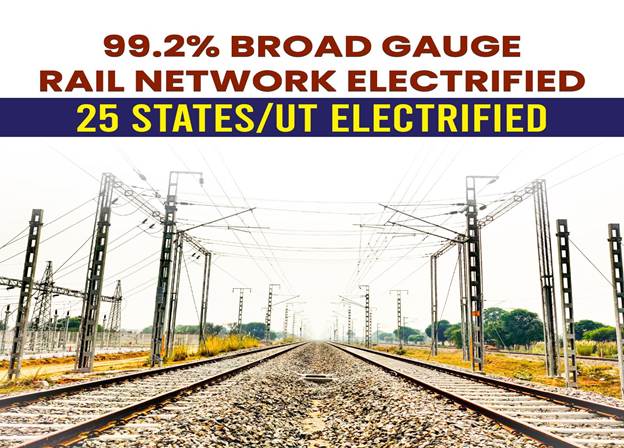
India’s broad gauge rail network is nearly fully electrified, with 99.2 percent coverage across 25 states and union territories.

image001TI2I.jpg


India’s achievement stands out even when compared with countries that have long-established railway systems. India has managed to electrify nearly its entire broad-gauge system despite operating one of the world’s largest and busiest rail networks.

This transition has reduced diesel consumption, cut emissions, lowered operational costs and improved the efficiency and speed of train operations. While several advanced economies still depend heavily on diesel traction due to cost or structural limitations, India has moved forward with clear planning and consistent execution.

As the final stretches are completed, the country is set to operate one of the world’s largest fully electrified railway systems, supporting Indian Railways’ goal of becoming a net-zero carbon emitter and offering cleaner, faster and more reliable mobility to millions of passengers every day.


Sorry but its jus 99.2%, when your posting in this thread, as i've created it, if you do reply, can you stick to the topic and tak about indian railways only.....

sorry to burst your bubble, regarding the lies you told, but dry those tears away (y)
 

Also you've got it wrong, below confirmation taht indian railways are not 100% electrified.​

India’s Rail Electrification Drive Nears Completion, Enabling Net-Zero Carbon Emissions and Cleaner, Faster Passenger Mobility​


India’s Rail Electrification Boosts Efficiency, Cuts Diesel Consumption and Sets Global Benchmark​


ndian Railways is close to completing the electrification of almost its entire broad-gauge network, with more than 99% already electrified and the remaining stretches expected to finish soon. The pace of work in recent years has been extraordinary. Between 2019 and 2025, Indian Railways electrified over 33,000 route kilometres, working at an average speed of more than 15 Route KMs every single day. The total distance electrified during this period alone is almost equal to the entire railway network of Germany, showing the scale and seriousness with which India has expanded clean and efficient rail traction.

India’s broad gauge rail network is nearly fully electrified, with 99.2 percent coverage across 25 states and union territories.

image001TI2I.jpg


India’s achievement stands out even when compared with countries that have long-established railway systems. India has managed to electrify nearly its entire broad-gauge system despite operating one of the world’s largest and busiest rail networks.

This transition has reduced diesel consumption, cut emissions, lowered operational costs and improved the efficiency and speed of train operations. While several advanced economies still depend heavily on diesel traction due to cost or structural limitations, India has moved forward with clear planning and consistent execution.

As the final stretches are completed, the country is set to operate one of the world’s largest fully electrified railway systems, supporting Indian Railways’ goal of becoming a net-zero carbon emitter and offering cleaner, faster and more reliable mobility to millions of passengers every day.


Sorry but its jus 99.2%, when your posting in this thread, as i've created it, if you do reply, can you stick to the topic and tak about indian railways only.....

sorry to burst your bubble, regarding the lies you told, but dry those tears away (y)
OK. Thank you for your paid copy and paste work
 

Woman Goes Into Labour On Train, Delivers Baby At Ambala Railway Station​


The woman was aboard a train headed to Kanpur from Jammu Tawi when she suddenly went into labour on Friday night​


Ambala:
A woman went into labour during a train journey and delivered a healthy baby girl at the Ambala railway station, officials said on Saturday.

The woman was aboard a train headed to Kanpur from Jammu Tawi when she suddenly went into labour on Friday night. When the train halted at Ambala Cantt railway station, Railway Police personnel along with assistance from a team of doctors prompted into action saving the woman and her newborn.

The woman was travelling from Jammu to Uttar Pradesh along with her husband.

Railway Police Assistant Sub-Inspector (ASI) Hans Raj was on duty at the station when a passenger informed him that a woman aboard a general coach of Jammu-Kanpur Express was suffering labour pains.

The ASI accompanied by female constable Jyoti then got into the coach after the train had a scheduled halt at the railway station here.

They found that the woman was having severe labour pains and her condition was deteriorating, following which the emergency helpline '112' was called.

The woman along with her husband was made to alight at the Ambala Cantonment station and the two were assisted by a female constable.

A doctor from the hospital had also reached there. She then gave birth to a healthy baby girl at the station under the supervision of doctors and women police personnel.

After the birth, the mother and the newborn were taken by ambulance to the Civil Hospital, Ambala Cantonment, where they have been admitted for further treatment.

Hospital sources said the condition of the mother and the child is stable.


Source:
 

Snake Planted Inside Mumbai–Solapur Vande Bharat Express; Accused Held​


Snake on Vande Bharat Express: Central Railway’s RPF arrested a man for allegedly releasing a rat snake inside the Mumbai–Solapur Vande Bharat Express toilet. He was identified through CCTV footage after the incident.​


Snake on Vande Bharat Train: Nearly one and a half months after a snake was found inside a toilet of the Mumbai–Solapur Vande Bharat Express, the Railway Protection Force (RPF) of Central Railway has arrested a 37-year-old man in connection with the incident. The accused, Jagan Arjun Bhale, who is originally from Nashik district, was arrested from Mumbra on Wednesday, according to meida reports. Officials traced him by carefully checking CCTV footage from the train and railway stations.
The incident took place in coach C-16 of train number 22225, which runs between Mumbai and Solapur. Passengers were shocked when they found a rat snake inside the washroom. Railway staff immediately closed and sealed the toilet to prevent panic and informed the control room about the situation, reported The Times of India.

When the train reached Solapur, the snake was safely rescued with the help of a professional snake catcher, according to Central Railway’s Chief Public Relations Officer, Swapnil Nila.
During the investigation, CCTV footage showed that Bhale had boarded the train at Thane and allegedly released the snake inside the toilet. Based on this evidence, the RPF identified and arrested him. Authorities are now taking further legal action in the case.

Stone Pelted at Vande Bharat​

In a similar incident, the Railway Protection Force (RPF) on Friday arrested a youth for allegedly hurling a stone at a Vande Bharat Express train, causing significant damage, officials said. The arrested person has been identified as Azharudeen AK (23), a native of Thayyil in Kannur, Railway Protection Force officials said. According to RPF officials, the incident occurred on the night of February 8 when the accused allegedly pelted a stone at the Thiruvananthapuram–Mangaluru Vande Bharat Express between Thalassery and Kannur railway stations, according to news agency PTI.
The train's glass pane was shattered in the incident, resulting in an estimated loss of around Rs 25,000, an official said. An RPF team led by Inspector Varghese J launched a probe, during which the accused was traced and taken into custody.


Source:
 

Loco Pilot Refuses To Work Beyond 9-Hour Shift, Train Halted For 3 Hours In Bihar​


The train was carrying hundreds of passengers, including traders, labourers and families travelling toward Siliguri, Kishanganj and nearby areas.​


In Bihar, a train came to an unexpected standstill after its loco pilot decided he had done his part for the day. After completing his 9-hour shift, the driver refused to continue, sticking firmly to railway rules.

On Wednesday, his decision left hundreds of passengers stranded, confused and frustrated at Thakurganj Railway Station in Bihar's Kishanganj district.

Latest and Breaking News on NDTV

The Diesel Electric Multiple Unit (DEMU) train (75719), travelling from Malda to Siliguri, reached platform number 1 at 2:52 pm at Thakurganj Railway Station. But instead of moving ahead, it remained parked for almost three hours. The driver informed officials that his work hours had ended and that he could not operate the train beyond the prescribed limit.

According to railway guidelines, a loco pilot can work only 9-10 hours at a stretch to ensure safe operations. Citing these rules, the driver declined to continue without the required rest.

The train was carrying hundreds of passengers, including traders, labourers and families travelling toward Siliguri, Kishanganj and nearby areas. The long delay left many travellers upset as they waited for the situation to be resolved.


Source:
 

Food Packed in Plastic, Yet Served Hot to Passengers: Delhi-Bound Vande Bharat Staff Admits on Camera​


Packaged Food Served Hot on Vande Bharat Train: A woman traveling on the Vande Bharat Express raised concerns after noticing packaged meals heated in plastic. IRCTC apologized, promising an investigation, while passenger urges public clarification on food safety.​


Packaged Food Served Hot on Vande Bharat Train: A woman traveling on the Allahabad-Delhi Vande Bharat Express confronted a staff member on Wednesday (February 18) after noticing that the packaged food served to passengers was being pre-heated in a microwave. The woman also claimed that on a separate trip on the Rajdhani train on Tuesday (February 19), she was given hot meals packed in plastic covers. She recorded the encounter on camera, where the staff member admitted that the packaged food was heated in a microwave and explained that the meals were provided by IRCTC (Indian Railway Catering and Tourism Corporation). Reacting to the incident, IRCTC’s official account apologised and asked for the train details, promising an investigation.
The incident raised concerns over authorities’ negligence regarding public safety.

In a post on X, lawyer Avani Bansal alleged that she was served hot kachori packed in a plastic cover. She ate the meal because she was hungry but later realized the potential risk. The next day, when she was offered pre-cooked food in plastic packaging again, she raised the issue with the staff member.


"Lakhs of passengers can verify this - the rotis are served warm with the plastic pack heated. The person in the train confirmed that rotis were being heated directly in the packet," said Avani in her post.

She added, "Food-grade plastic is not automatically heat-safe unless certified for microwave/steam use. Heating multilayer packaging without clear instructions can potentially increase chemical migration into food - especially when done repeatedly at scale."
The passenger raised several questions:
  • Are these institutional packs certified for in-pack heating?
  • If so, can that certification be publicly shared?
  • Is this happening on all trains?
  • Who has authorized this?
Avani Bansal also sought corrective measures, warning that officials might brush off the incident by shifting blame.
"The last thing we want is blame game buck to be passed between @IRCTCofficial @fssaiindia. Ministry of Consumer Affairs, Food and Public Distribution will say that it is Railways’ mistake. Railway minister will say it is the third-party vendor who has been given the tender - it’s their mistake. Third party vendor will find someone at the lowest in the ladder like the gentleman in this video who admitted that they were heated in microwave, to fix the blame on - while fixing NO Accountability of the damage already done and NO Responsibility for what’s to come."
IRCTC Response
"Apologising for the inconvenience," IRCTC asked Avani to share her contact details to investigate the matter. "Ma'am, our sincere apology for the inconvenience. Please DM your PNR and mobile number to enable us to address this."


However, Avani stressed that this is not an "individual problem". "@IRCTCofficial Appreciate the quick response very much! But this is not my ‘individual’ problem. Kindly publicly clarify the questions raised - are sealed packets being served hot? In which all trains? Since when? Whose responsible?"


Source:
 

Noida Commuters Forced to Cross Sewage: Sector 52 Metro Infrastructure Crumbles in 6mm Rain | Watch​


Commuters in Noida and Greater Noida are expressing outrage over the deplorable conditions at the Sector 52 metro station, which serves about 75,000 passengers daily. Following minimal rainfall of just 6mm, the station's entrance became waterlogged due to overflowing sewage drains.​


Commuters in Noida and Greater Noida Encounter Sewage-Flooded Metro Stations and Roads: Facilitating nearly 75,000 passengers every day, the Noida Metro's Sector 52 station is facing intense criticism online over its poorly maintained infrastructure. Right outside the station, commuters are forced to wade through a waterlogged entrance just to catch a train, a puddle that emerged after rain hit Noida on Monday, March 31. The irony is stark. Noida recorded just 6mm of rainfall that day. To put it in perspective, 6mm falls squarely in the "light rain" category, noticeable and umbrella-worthy, but nowhere near the kind of downpour that should flood civic infrastructure.

What made the situation worse was not the rain alone. Sewage drains beneath the metro station overflowed, mixing with the surface water and creating an unhygienic, foul-smelling mess right at the station entrance. For commuters who had stepped out dressed for work, college, or other commitments, it was an unpleasant and entirely avoidable ordeal.

A social media user captured the absurdity in a post that quickly went viral. "Wake up & take shower > wear branded clothes & perfume > get ready to go to office > reach metro station > walk through sewage water > work 10 hours at office > pay 50–60% taxes," she wrote, calling it "a daily humiliation ritual caused by corrupt babus and netas." Her post struck a nerve, triggering a wave of responses from commuters who shared similar frustrations and blamed local authorities for neglecting basic civic upkeep.


'Pay Taxes, Get Pathetic Life'​

Others were blunter. "Tum hume tax aur vote do, hum tumhe laanat bhari zindagi dene ka vaada karenge," wrote one user, loosely translated as: "You give us your taxes and votes; we promise you a wretched life in return." Another questioned the public's passivity: "Sheep who don't ask questions to the government. Imagine living in this condition in this century."
The anger is understandable. The Noida Metro, the 11th metro system in India and the second in Uttar Pradesh after Lucknow Metro, was built at a cost of ₹5,503 crore of taxpayer money. That a light drizzle can render its entrance impassable raises serious questions about maintenance standards and civic accountability.


Source:
 
Back
Top