



What's new

Assessing Murad Ali Shah's third term as Sindh chief minister: A performance overview

FearlessRoar

T20I Star
Joined
Sep 11, 2023
Runs
30,521
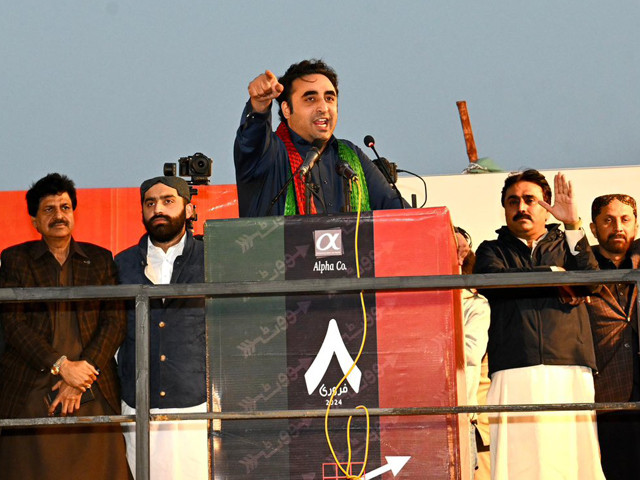
Pakistan Peoples Party (PPP) Chairman Bilawal Bhutto-Zardari revealed the crucial appointments for key positions in the Sindh Assembly during a party meeting held on Friday. The nominations include Murad Ali Shah for Sindh Chief Minister, Owais Shah for Speaker, and Naveed Anthony for Deputy Speaker.

In his address to the party members, Bilawal expressed gratitude to the people of Sindh for their unwavering support, emphasising that the electoral success achieved was not just a victory for the PPP but a testament to the trust bestowed upon them by the citizens of the province.

"The people of Sindh have not only made us successful but have also given us a better mandate than in the past," stated Bilawal. He went on to acknowledge that with increased expectations from the people, the PPP is committed to addressing the pressing issues faced by the province.

During his speech, Bilawal highlighted the challenges posed by the devastating floods of 2022, revealing that not only were a significant number of homes affected, but also 50 per cent of educational institutions were destroyed. In response, he assured the citizens that the PPP is dedicated to the reconstruction of these educational facilities, aiming to restore normalcy to the lives of the affected communities.

"We understand the hardships faced by our people, especially in the aftermath of the 2022 floods. We are determined to rebuild not only the homes but also the educational institutions that form the backbone of our society," Bilawal Bhutto-Zardari affirmed.

The announcement of key appointments marks a significant step in shaping the leadership of Sindh, and the newly appointed officials are expected to play a crucial role in addressing the challenges faced by the province. The focus on rebuilding educational institutions underscores the party's commitment to restoring the foundations of education and providing a brighter future for the people of Sindh.

It is unfortunate for Sindh's fate. Those who have devoured Sindh are repeatedly tormenting it. What are your thoughts on this nomination for CM Sindh?
 
why didnt they go for Vintage Sayeen Qayim Ali Shah? PPP cant find a better dummy than him.
 
Surely Billo can lead Sindh and show some progress that outside Karachi is lower than sub saharan Africa.
 
These parties are worse than monarchs, where even the king is dispelled after a disastrous reign but not in Sindh where people are doomed to live under the command of leech Murad, Bilawal knows Murad has set the percentage in everything so why change just carry on the loot & plunder mission
 
Murad Ali Shah is a Canadian Citizen. Someone in Canada photographed him with his wife in Canada going to a Service Ontario and Service Canada centre where he was registering for a Health Card, Driving License and SIN.

PPP have a number of people in Canada who play a major role in the Zardari Money Laundering System, PPP have also established a close relationship with a few realtors in the GTA who help them buy high profile properties to make their laundered money white. I have heard of a Seth Younis who lives in Canada and via one phone call to the CM office can dictate what needs to be done in Karachi.

Sindh desperately needs liberation from PPP.
 
Murad Ali Shah is a Canadian Citizen. Someone in Canada photographed him with his wife in Canada going to a Service Ontario and Service Canada centre where he was registering for a Health Card, Driving License and SIN.

PPP have a number of people in Canada who play a major role in the Zardari Money Laundering System, PPP have also established a close relationship with a few realtors in the GTA who help them buy high profile properties to make their laundered money white. I have heard of a Seth Younis who lives in Canada and via one phone call to the CM office can dictate what needs to be done in Karachi.

Sindh desperately needs liberation from PPP.
Now it makes sense how this inept buffoon keeps being made CM.
 
Murad Ali Shah is a Canadian Citizen. Someone in Canada photographed him with his wife in Canada going to a Service Ontario and Service Canada centre where he was registering for a Health Card, Driving License and SIN.

PPP have a number of people in Canada who play a major role in the Zardari Money Laundering System, PPP have also established a close relationship with a few realtors in the GTA who help them buy high profile properties to make their laundered money white. I have heard of a Seth Younis who lives in Canada and via one phone call to the CM office can dictate what needs to be done in Karachi.

Sindh desperately needs liberation from PPP.
Can you prove it that he is Canadian!!
 
Murad Ali Shah elected as Sindh chief minister for third time

In a resounding victory, Syed Murad Ali Shah has clinched his third term as the chief minister of Sindh, with overwhelming support from the assembly. The announcement was met with cheers and applause, marking a continuation of his leadership in the province.

However, the voting process saw the absence of nine independent members, along with a notable abstention from a member of Jamaat-e-Islami. Despite these absences, the outcome solidified Shah’s position as the chosen leader for Sindh.

Abdul Waseem, a prominent member of MQM in the Sindh Assembly, extended his heartfelt congratulations to Shah. “I congratulate Murad Ali Shah from the depths of my heart,” he proclaimed. “On behalf of MQM’s convener Khalid Maqbool Siddiqui, I extend our sincerest congratulations. He has been bestowed with this position for the third time, and it is our hope that he utilizes it for the betterment of Sindh.”

Waseem’s words echoed sentiments shared by Muhammad Bakhsh Mehr of the Pakistan People’s Party, who highlighted Shah’s leadership qualities and the mandate he received due to his past performance.

“The Pakistan People’s Party and the chairman have a vision,” Mehr affirmed. “They have always said that whoever delivers, he will get the opportunity. Murad Ali Shah got this opportunity for the third time, and he truly deserves it.”

Mehr emphasized the importance of unity in addressing regional challenges, particularly highlighting the need for attention to the situation in Ghotki. “We request for Ghotki’s air,” he stated. “The situation there is dire, and we must stand together. Where there is peace, there is progress.”

With words of encouragement and a call for collective action, the parliamentary session concluded with Shah’s re-election symbolizing continuity and hope for the people of Sindh.

Hum News

 
Starting his third term as CM of Sindh, but trust me, this person is bad luck for Sindh. As per my observation, Sindh is the least developed province in Pakistan.
 
So he enters another era , treating Sindh as a mafia tribe , lack of water , malnutrition, lack of schools, lawlessness, oppression of journalists, land mafia , street crimes all the virtues of this dark era
 
Maybe these losers wake up and actually do something for the people of Sindh. Sooner or later Sindh will be free of this mafia, then where will the PPP hide its criminality
 
Maybe these losers wake up and actually do something for the people of Sindh. Sooner or later Sindh will be free of this mafia, then where will the PPP hide its criminality

I m sure that Sindh can't get free from these looters as most of the people from interior sindh are mentally slaves. They know that the ones they are voting for are corrupt but still they vote for them because their ancestors did so.

So nothing is going to change with this mentality!
 
I m sure that Sindh can't get free from these looters as most of the people from interior sindh are mentally slaves. They know that the ones they are voting for are corrupt but still they vote for them because their ancestors did so.

So nothing is going to change with this mentality!
I wouldn't be so sure. They said lahore belonged to the Sharifs,this time around NS couldn't beat an 80 year old cancer sufferer that is in jail. The PPP have kept the poor illiterate and then used the Sindh card but sooner or later this won't work. IA that day will be soon
 
I wouldn't be so sure. They said lahore belonged to the Sharifs,this time around NS couldn't beat an 80 year old cancer sufferer that is in jail. The PPP have kept the poor illiterate and then used the Sindh card but sooner or later this won't work. IA that day will be soon
whole Pakistan can get changed but trust me sindh looks hopeless!
 
The Bulk of Sindh's Development Funds i.e. atleast 80% is laundered to Dubai, Canada, USA via the Zardari Money Laundering System and Network.
 
PPPs performance in Sindh is not worth mentioning actually it is the worst. People of Sindh are so backward that the may look like people from the stone age. There has been no development in Sindh over the last 4 decades and now people are gearing up for another term, it won't change anything. Sindh is bound to stay old school so this corrupt mafia can rule over them for ages.
 
Murad’s election shows continuation of policies

Syed Murad Ali Shah made history in Sindh when he became the chief minister for the third consecutive term on Monday, an indication that the ruling Pakistan Peoples Party (PPP) would continue the same governance policy that had been pursued for the past 15 years.

Shah is the first lawmaker to be elected as the chief minister three times in a row. Previously, Syed Qaim Ali Shah had also served as the provincial chief minister three times, but for two consecutive terms.

Syed Murad Ali Shah is the son of former chief minister Syed Abdullah Shah, the first father-son duo in Sindh. The other similar examples were set by the Jam family of the Lasbela district of Balochistan and later by the Sharif family—Hamza and Shehbaz Sharif, and now Maryam and Nawaz Sharif.

Syed Murad Ali Shah started his political career in 2002, when he became a member of the provincial assembly (MPA) of Sindh from his home constituency in Sehwan. It was the same constituency that was represented by his late father, Abdullah Shah, from 1970 to 1993.

He played a pivotal role while sitting on the opposition benches during the Gen Musharraf tenure. He won the provincial assembly seat again in the 2008 and 2013 elections, becoming a minister in Syed Qaim Ali Shah’s cabinet. In 2016, he replaced Syed Qaim Ali Shah as the chief minister.

After the general elections in 2018, the PPP did not opt to shake up its Sindh set-up and continued with Shah in the top post in the province, which he held till the end of the government tenure in August 2023.

Born in Karachi in 1962, Shah received early education from St Patrick’s High School, Karachi, then went to the prestigious DJ Science College, Karachi, in 1979. He completed his bachelor's degree in Civil Engineeringg from the NED University, Karachi, in 1985.

Later, he did a Masters in Civil-Structural Engineering from Stanford University in California in 1987 and Engineering Economic Systems in 1993. Before joining politics, he worked both in the public and private sectors in Pakistan, the United Kingdom, Kuwait, and the United States from 1986 to 2002.

In Pakistan, he worked as an engineer for the Hyderabad Development Authority, the Water and Power Development Authority, the Port Qasim Authority, and the Karachi Fish Harbour Authority. Later, he changed his career and started working as an investment banker, first at Citibank Karachi, then at Citibank London, Gulf Investment Corporation Kuwait, and Bizpivot USA.

Why a third time?

For many in the PPP and outside, Shah is considered a heavyweight politician, currently holding the position of vice president in the party as well as taking a seat in its Central Executive Committee (CEC). Besides, he is also seen as a close confidant of the PPP’s top leadership.

Several party leaders, when approached by The Express Tribune, gave credit to Shah for the overwhelming performance of the PPP in the February 8 general elections. In the last assembly, PPP had 91 seats in the 168-strong house. Now, it has a resounding majority of 112 seats in the house.

“For the first time in the history of the PPP, we have won the post of mayor of Karachi, along with the PPP’s victories on many provincial and national assembly seats. So Murad Ali Shah deserves credit for the PPP government’s performance,” PPP Sindh President Nisar Khuhro told The Express Tribune.

“Murad Ali Shah always took up Sindh’s case diligently with the federal government when it came to the distribution of financial and water resources. So, there was a party consensus on his name for the slot of chief minister,” he added.

In fact, a few names did make the rounds on social media for the post of chief minister, such as Syed Nasir Hussain Shah, Sharjeel Inam Memon, and Faryal Talpur. However, the PPP leadership stayed firm behind Shah and got him elected for a record third term.

Shah’s critics attribute his phenomenal rise in politics to his ‘utmost obedience’ to the party leadership. “No doubt Murad Ali Shah is competent, but I think he is more obedient to leadership than others,” opined analyst and writer Prof Nawaz Khoso.

He does disagree [on certain matters] but blindly follows whatever orders are issued by the party leadership. The example of the Sindh government’s land being sold out to builders at throwaway prices and appointments of blue-eyed boys in the civil and police bureaucracy to appease party leaders can be quoted here,” Khoso added, while talking about his election.

“During the PPP term, Sindh witnessed massive bungling in government departments. Bad governance, poor infrastructure, ghost schools, a lack of medicines at government hospitals, as well as a deteriorating law and order situation, point to a bad performance. I don’t know why people laud his performance.”

It is also an interesting fact that since the PPP’s return to power in Sindh in 1988, seven of its total of eight chief ministers belonged to the ‘Syed’ families: three times Syed Qaim Ali Shah, one time Syed Abdullah Shah, and three times Murad Ali Shah.

The only exception is Aftab Shaban Mirani, who replaced Syed Qaim Ali Shah months before the sacking of then prime minister Benazir Bhutto’s first government in 1990. Syed Abdullah Shah was provincial chief executive from 1993 to 1996.

After a gap of 11 years, when the PPP came to power in 2008, it again nominated Syed Qaim Ali Shah for this coveted slot, who retained his position in 2013. He was relieved of the position in 2016. Since then, the position has been held by Murad Ali Shah.

SOURCE: https://tribune.com.pk/story/2457742/murads-election-shows-continuation-of-policies
 
Murad Ali Shah sworn in as Sindh chief minister

Pakistan Peoples Party stalwart Syed Murad Ali Shah was sworn in as the 25th chief minister of the province on Tuesday.

Governor Kamran Tessori administered the oath in the evening at a ceremony held at the lawns of Governor House and attended among others by PPP chairman Bilawal Bhutto-Zardari, outgoing caretaker Chief Minister retired Justice Maqbool Baqar, several newly elected legislators and diplomats.

Moment after the oath-taking ceremony, chaos prevailed until Mr Bhutto-Zardari and CM Shah smoothly left in the cluster of their guards, who did not let even mediapersons to talk to them for journalistic consumption.

Taking his oath, the chief minister swore to uphold the duties and responsibilities entrusted to him by the people of the province. He vowed to steer the province towards prosperity, unity, and progress. He solemnly pledged to uphold the Constitution and work tirelessly for the betterment of the province.

The swearing-in ceremony of the chief minister was conducted by Chief Secretary Dr Fakhre Alam.

Those who attended the oath-taking ceremony among others were Faryal Talpur, former chief minister Syed Qaim Ali Shah, former speaker Agha Siraj Durani, Sindh Assembly Speaker Awais Qadir Shah, Deputy Speaker Anthony Naveed, former ministers and PPP MPAs Sharjeel Memon, Imtiaz Shaikh, Saeed Ghani, Sardar Shah and Jam Khan Shoro.

Earlier on Monday, he was comfortably elected chief minister for a third time in a row by securing 112 votes in the 168-member Sindh Assembly.

Taking to Dawn, Sharjeel Memon said one of the priorities set by the chief minister was the provision of potable water to urban and rural parts of the province. “Besides, the CM’s main focus will be on curbing street crimes and maintenance of law and order,” he added.

SOURCE: DAWN
 
Murad says people of Sindh handed PPP ‘historic success’ on Feb 8

Speaking to the media in Garhi Khuda Bakhsh, Sindh Chief Minister Murad Ali Shah said the people of Sindh handed the PPP “historic success” in the Feb 8 general election.

“The people of Sindh know the good work PPP has done,” he said, adding that he will do whatever is in his power to improve their lives.

“As Bilawal has said, our first priority in Sindh remains the rehabilitation of the 2022 flood victims, which we have done and will continue to do.”

Dawn
 
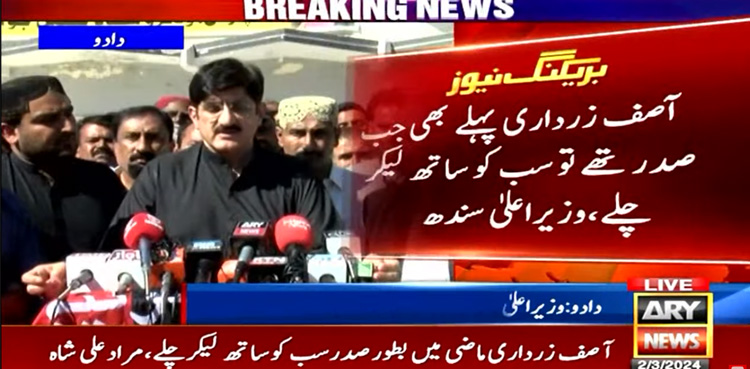
Sindh Chief Minister (CM) Syed Murad Ali Shah said that there is no better choice for the President slot than PPP co-chairman Asif Ali Zardari, ARY News reported.

While talking to media after submitting nomination papers, CM Sindh said Pakistan People’s Party (PPP) will request all parties including MQM- Pakistan to vote for Asif Ali Zardari in the Presidential election.

He said that the party has requested MQM-P members to vote for PPP’s candidates for the election of speaker and deputy Speaker election.

Replying to a question regarding MQM’s demand for amendment in Local Government Act, Shah said that in Sindh, Local Bodies were already powerful, MQM might have demanded local government powers for Punjab.

He said that PPP will approach legal forums for its grievances regarding polls.

It is pertinent to mention here that Pakistan Tehreek-e-Insaf (PTI)-backed Sunni Ittehad Council (SIC) named Pakhtunkhwa Milli Awami Party (PKMAP) chief Mahmood Khan Achakzai as their presidential nominee for the coveted constitutional post against Pakistan Peoples Party (PPP) Co-chairman Asif Ali Zardari.

Asif Ali Zardari will be presidential candidate of coalition partners including the PML-N, People’s Party and other allies.

The Election Commission of Pakistan (ECP) on Friday announced the schedule for the presidential elections.

According to the ECP schedule, polling for the presidential election will be held on March 9 from 10:00 am to 4:00 pm.

The nomination papers can be submitted till 12:00 noon on March 2 (today).

The Returning Officer (RO) will scrutinize the nomination papers on March 4 at 10:00 am whereas the final list of candidates for the presidential elections will be displayed on March 5:00 at 1:00 pm.

ARY

 
The President doesn't have the powers that the Prime Minister has, but Zardari is becoming President once again to complete what he couldn't loot last time.
 
Sindh’s Chief Minister Murad Ali Shah on Sunday said that the province has empowered its local government system, ARY News reported.

Talking to media Murad Ali Shah said, if any improvement will be required in local government law, it will be enforced by the Sindh Assembly. “There is no need of any agreement over it” chief minister said.

He said that the MQM has made an agreement with the PML-N, influenced by our reforms.

He said the people of Sindh have given us a big mandate, “We have to work hard after this mandate”.

He claimed that the People’s Party will easily win two vacant Senate seats in Sindh.

He questioned, who has encroached service roads in Karachi, built shops on nullahs, those responsible to degrade the city should be made answerable.

He said the presidential election of Pakistan will be held on March 09 and extended an “advance congratulation” to Asif Ali Zardari. “We will work over 10-point agenda under the leadership of Asif Zardari and Bilawal Bhutto,” Murad Ali Shah said.

“Consecutively fourth government of People’s Party in Sindh is result of our service to the people,” Murad Ali Shah claimed.

Sindh CM also claimed that “our two senators” will get elected in Sindh Assembly. He said four nomination papers submitted on two vacant senate seats of Nisar Khuhro and Jam Mehtab Dahar, who won the recent assembly elections.

He said Aslam Abro, Saifullah Dharejo, Waqar Mehdi and Aajiz Dhamra will submit nomination papers on vacant seats.

Jam Saifullah Dharejo and Aslam Abro were accompanied with the chief minister when he reached at the Sindh election commission’s office.

 
The President doesn't have the powers that the Prime Minister has, but Zardari is becoming President once again to complete what he couldn't loot last time.

Zardari is going to try and get more Millitary and establishment people in his pocket. He knows in order for PPP to get power in Punjab and Centre, they must develop links in the Millitary.
 
Zardari is going to try and get more Millitary and establishment people in his pocket. He knows in order for PPP to get power in Punjab and Centre, they must develop links in the Millitary.
He may do. But Billo will never be elected by the people of PK. AZ and Billo know this and that fact alone,has forced them to be the slaves of the establishment.
 
Murad Ali Shah appointed as the CM of Sindh only to fill the lockers of Bilawal House. He has done nothing for the people of Sindh so far and there is no hope for any progress from him in the future too.
 

Sindh cabinet members assigned portfolios​

Members of the Sindh cabinet have been assigned their portfolios after their oath-taking ceremony earlier today. A statement issued by Sindh Chief Minister Murad Ali Shah’s spokesperson Abdul Rasheed Channa said Sharjeel Memon was assigned the portfolios of the Department of Transport and Mass Transit and the Department of Excise, Taxation and Narcotics.

Dr Azra Pechuho was given the Ministry of Health and Population Welfare while Syed Nasir Hussain Shah was entrusted with the portfolio of the Department of Energy and Planning and Development.

Syed Sardar Ali Shah was given the portfolio of Department of School Education and Literacy, Department of College Education and Department of Mines and Minerals Development while Saeed Ghani was entrusted with the portfolio of Local Government and Housing Town Planning Department and Public Health Engineering and Rural Development.

Jam Khan Shoro was made the Minister of Irrigation and Foodstuffs Department while Zia Lanjar was assigned the portfolios of Interior and Law, Parliamentary Affairs and Criminal Prosecution.

Mohammad Bux Mahar was given the portfolios of Agriculture, Supply and Price, Sports and Youth Affairs and Inquiries and Anti-Corruption Establishment while Ali Hassan Zardari was given the portfolio of prisons.

Syed Zulfikar Ali Shah was assigned the portfolio of Culture, Tourism, Antiquities and Archives.

Source: Dawn News
 
PM Shehbaz or PTI founder in Center, Sindh will protect its rights: Murad

Sindh Chief Minister Murad Ali Shah was talking to the media outside the Sindh Assembly after casting votes for the Senate elections on six seats said that PPP rejected the appointment of Indus River System Authority (IRSA), a federal entirety, chairman.

Murad Ali Shah said that the problem has been made for small provinces and PPP has not been in favour of giving Irsa control to the federal government.

He said it is hoped that the new finance minister will play an important role to get the country out of its problems.

“PTI founder or Shahbaz Sharif will not tolerate injustice with Sindh. We will return the appointment notification of Irsa Chairman,” Sindh CM said.

“Law and order situation in Sindh is worse than last six months. The situation worsened during the caretaker government,” Sindh CM said.

“If we find anything wrong then we will protest. There will be full protest if anyone tries to harm the people of Sindh,” Shah said. He said that PPP first priority is to establish peace.

“I am looking into the matter of Karachi Interboard Chairman. There is no minister yet, you alone are looking after this department. This problem will be solved soon,” he told media persons.

SAMAA
 
Murad urges sticking to Constitution on NFC

Sindh Chief Minister Murad Ali Shah on Saturday said that the provinces’ share in the next NFC award would be granted as per the constitutional provisions.

“It is written in the Constitution about the NFC award that the provinces’ share [in the divisible pool/resources] cannot be reduced [but] it can be increased,” the chief minister said while speaking to the media at the Election Commission of Pakistan where he went to submit nomination papers of the Pakistan People’s Party candidates for the Senate election, being held on April 2.

When asked about the IMF’s condition to reduce the provinces’ share in the upcoming NFC Award, the chief minister said that he has heard about it too. However, he added that the federal government has reportedly informed the IMF that the matter was settled between the federal and provincial governments constitutionally and it cannot be negotiated or discussed.

The IMF on Thursday had called upon Pakistan to reopen discussions on the NFC award, seeking to address the ongoing imbalance in the distribution of fiscal resources between federal and provincial governments.

During the opening round of discussions for a $1.1 billion loan tranche, Nathan Porter, the IMF Mission Chief to Pakistan, had raised concerns over the distribution of resources and responsibilities, underscoring the need for a more equitable arrangement.

Representing Pakistan in the talks was Finance Minister Muhammad Aurangzeb.

Government officials had disclosed to The Express Tribune that the IMF emphasised the need to reassess the NFC award, citing disparities in resource allocation between federal and provincial authorities.

The current formula, established in 2010, resulted in provincial shares increasing from 47.5% to 57.5% of total federal taxes, without a commensurate transfer of additional responsibilities. This has led to a sustained fiscal imbalance and a rise in public debt.

The Pakistani authorities informed the IMF that the provincial shares cannot be reduced without bringing a constitutional amendment and making all the provinces agree to a new formula.

The 2010 NFC award had been agreed for a period of five years but since then there has not been any consensus to revisit it.

The Sindh chief minister said that the 10th NFC award was announced before the passage of the 18th Constitutional Amendment. “After the 18th Amendment, the provinces have been given more responsibilities, therefore the upcoming NFC award should be made accordingly,” he said and added the federal government has its own point of view, but the issues will be discussed at the NFC forum.

He reiterated that it was the PPP and Sindh government’s demand from the federal government to bring in a new NFC award since the old no longer applied after the 18th Amendment.

Article 160 of the Constitution governs the NFC award. Section 3A of the article says: “The share of the provinces in each award of National Finance Commission shall not be less than the share given to the provinces in the previous award.”

SOURCE: EXPRESS NEWS
 
Cabinet approves grant for PBS

The Sindh cabinet approved Rs521 million for fuel indexation of Intra-district Bus Service and Rs5.027 million for JS Academy for the Deaf. Additionally, they decided to launch the Kissan Card to support peasants.

Chief Minister Murad Ali Shah, presiding over the meeting, emphasized the implementation of PPP Chairman Bilawal Bhutto Zardari's instructions to issue Kissan Cards and promote development in every district. A committee will be formed to implement the party's election manifesto, focusing on the chairman's ten-point agenda. The meeting, held at CM House, was attended by provincial ministers, advisors, and officials.

The Kissan Cards will be issued to farmers benefiting from government programs, with a digital platform being developed to collect farmers' details, including demographics, contact information, crops, landholding, livestock, and irrigation systems. This initiative aims to ensure proper allocation of schemes, efficient communication, and centralized data management.

Cardholders will receive priority in wheat procurement and disaster relief. A committee comprising the minister of irrigation, senior member board of revenue and secretary of agriculture was tasked with developing data and submitting recommendations. The survey and registration for Kissan Cards, available to farmers with up to 12 acres of land, will commence within a week for issuance within six months.

Senior Minister Sharjeel Inam Memon informed the meeting that the project to supply, operate and maintenance for the Sindh Intra-District People's Bus Service was awarded to National Radio & Telecommunication Corporation (NRTC) in October 2021 for a term of 12 years, maturing in October 2033.

As many as 230 buses are operational and an additional 40 buses have also been added to the fleet under a government-to-government (G2G) initiative between the Sindh government and NRTC. He added that it was the first ever Intra City Public Transport Project operating in Mixed Traffic, particularly in Karachi and other cities of the province including Larkana, Hyderabad and Sukkur.

He said that the NRTC has requested the Sindh Mass Transit Authority for the release of payment of fuel indexations from January to June 24.

The cabinet was informed that in order to ensure the smooth operations of the PBS, an amount of Rs820. 996 million was required from Jan-Jun 2024.

Sharjeel said that Rs300 million, already kept in the account as Grant-in Aid for Fuel Indexation (one time) during the current financial year 2023-24, may be released and the remaining amount of Rs521 million may be released for the project to cover fuel indexation for Jan-Jun 2024 period. The cabinet approved the amount of Rs521 million for the purpose.

The cabinet was informed that the JS Academy offers free education, from grade one to postgraduate level, to deaf students, providing empowerment initiatives. Courses and training include sign language, audiometry, computer skills, music, art classes, healthcare, physical education, social skills, transportation, counseling, and library access, as explained by Secretary DEPD Tuaha Farooqi.

Registered by relevant education departments, the academy currently enrolls 152 students (81 male, 71 female) and employs 24 staff (6 male, 18 female). Facing an annual shortfall of Rs10.747 million, the DEPD requested a Rs5.027 million grant from the chief minister, drawing from a budgeted allocation of Rs1,000 million for such institutions. The cabinet approved the grant for JS Academy.

SOURCE: EXPRESS NEWS
 

Tribal feuds cause lawlessness in upper Sindh districts: Murad Ali Shah​


Talking to media here, chief minister Shah said that the government will end these disputes and it will also get support from the tribal chiefs in this respect.

Murad Ali Shah said that the situation was already bad, it worsens during the interim government. “What improvement made by the caretaker government in the law and order during its six months,” he questioned.

“We will soon restore peace in the area with assistance from the police, rangers and the military,” chief minister said.

He said, in previous term his government had requested to the federal government for provision of military arms and equipment.

“I don’t understand how these bandits getting military arms and equipment,” he said.

“We have appointed provincial home minister to tackle and improve the law and order”, he added.

 
Sindh cabinet lifts ban on recruitment in provincial govt departments

The Sindh cabinet on Wednesday lifted a ban it imposed last year in August on recruitment in the provincial government departments.

The then cabinet in its meeting on Aug 11, 2023 had imposed a complete ban on recruitment for the caretaker government. Before that ban, the Muttahida Qaumi Movement-Pakistan had moved the Sindh High Court against the provincial government’s plan to fill thousands of vacancies without completing required formalities and on its request the SHC had granted a stay order on recruitment in government departments from grade 1-15 across the province.

On Wednesday, Chief Minister Syed Murad Ali Shah, while chairing the cabinet meeting, asked the provincial chief law officer to get vacated the stay order of the SHC against the recruitment.

Official sources said that the cabinet members told the chief minister that there were thousands of posts of lower grades lying vacant in government departments, saying that the lifting of ban on recruitment would not only improve the working but the youth would get employment opportunities.

Approving the lifting of the ban with the consent of the cabinet members, the chief minister directed Minister Ziaul Hassan Lanjar and the advocate general to pursue the case in court and get the stay order issued against the recruitment vacated.

Meanwhile, the at the request of Education Minister Syed Sardar Shah the cabinet allowed the school education department to continue the recruitment process of Prime School Teachers (PST) and Junior Elementary School Teachers (JEST) in accordance with the Teachers Recruitment Policy 2021 through the Institute of Business Administration, Sukkur.

Extension granted

Health Minister Dr Azra Fazal told the cabinet that the health department had appointed doctors, nurses, skilled and supporting staff on a “service rendered basis” for 89 days in the wake of Covid-19 pandemic in 2020.

Subsequently, on the recommendation of the health department the Covid-19 doctors and nurses were given extensions in their hiring period from time to time up to June 30, 2023.

Acting on SHC’s order, she said, the health department had on March 17, 2023 referred the cases of 824 doctors and 324 staff nurses to the Sindh Public Service Commission (SPSC) to ascertain their suitability.

The minister said that the SPSC had recommended only 260 suitable nurses out of 324 and the results of doctors were still awaited.

The cabinet, on the recommendation of the health department, approved another extension in the contract of 705 doctors and nurses for a further period of one year i.e. from July 2023 to June 2024.

The extension of 374 technical and supporting paramedical staff and 2,957 skilled and supporting human resources from April 1, 2023 to June 2024 was also approved as per the recommendation of the scrutiny committee.

The CM also approved an amount of Rs2.03 billion to pay their salaries during 2023-24.

SOURCE: DAWN
 
The Sindh government has decided to remove the Karachi police chief due to a surge in street crimes in the metropolis, ARY News reported on Tuesday citing sources.

The incoming fourth-consecutive PPP government has decided to replace Additional IG Karachi Imran Yaqoob only 15 days after his appointment to the top post.

Javed Alam Odhu, who had earlier served as Karachi police chief, is top contender to replace Yaqoob.

Earlier, the caretaker Sindh government had appointed Khadim Hussain Rind as the new Karachi Additional Inspector General of Police (AIG) in September 2023.

Street Crimes in Karachi

Inspector General of Police (IGP) Riffat Mukhtar giving a presentation to the CM last month said that during the last two months, 23 people were killed during robberies, 3953 mobile phones, 46 four-wheelers, and 1537 two-wheelers were snatched.

To a question, the IGP police told the CM that street crimes are high within the limits of 22 police stations in Karachi. The CM directed the IGP to provide him with a list of 22 vulnerable police stations in terms of street crime and identify the hotspots so that special focus could be given to them.

Murad Ali Shah directed the city police chief to get all his SSPs on the roads in the evening time. He added that street crime mostly started after sunset, directing the police to ensure police presence on the roads to control them.

Source: Ary News
 
Eight more ministers take oath as Sindh CM expands cabinet

Chief Minister Syed Murad Ali Shah on Wednesday expanded his cabinet with eight more ministers, taking the number of cabinet members to 21.

Governor Kamran Khan Tessori administered oath to newly inducted ministers Jam Ikramullah Khan Dharejo, Muhammad Ali Malkani, Makhdoom Mehboob Zaman, Dost Muhammad Rahimoon, Shahid Abdul Salam Thahim, Riaz Hussain Shah Shirazi, Shahina Sher Ali and Mir Tariq Ali Talpur.

The oath-taking ceremony was attended by the chief minister, provincial ministers, advisors, city mayor, provincial secretaries, and family members of the newly appointed ministers.

On March 12, in the first phase, Sharjeel Inam Memon, Dr Azra Fazal Pechuho, Syed Nasir Hussain Shah, Saeed Ghani, Jam Khan Shoro, Ziaul Hassan Lanjar, Sardar Muhammad Bakhsh Mahar, Ali Hassan Zardari and Zulfiqar Shah took oath of office. Besides, the chief minister had also appointed three advisers — Allah Dino Khan Bhayo, Ehsan ur Rehman Mazari and Syed Najmi Alam.

Following the oath-taking ceremony of the second batch of ministers, the chief minister allotted the newly inducted members their portfolios.

Jam Ikram Dharijo was given industries and commerce department. He has been a member of the provincial assembly since 2008 and was first inducted into the provincial cabinet in Aug 2016 and was given the portfolio of co-operatives department.

He was elected to the Provincial Assembly of Sindh as a candidate of Pakistan Peoples Party (PPP) from Sukkur in 2008 and then again elected to Sindh Assembly in 2013 general election.

The 51-year-old PPP leader was re-elected in 2018 general election and was re-inducted in the provincial cabinet as minister of co-operatives and given an additional portfolio of industries and commerce in 2019. In Feb 2020, he was given the additional portfolio of inquiries and anti-corruption establishment.

Muhammad Ali Malkani was allocated the portfolio of universities and boards department.

Elected first in 2013 general election to the provincial assembly from Thatta, he was appointed as livestock and fisheries minister in 2016 and later given the additional ministerial portfolio of Environment, Climate Change and Coastal Development.

Makhdoom Mehboob Zaman, grandson of late PPP leader Makhdoom Ameen Faheem, was given portfolio of rehabilitation department. He was first elected to the provincial assembly in 2018 and was appointed as revenue and relief minister.

Dost Muhammad Rahimoon, who has been the member of the provincial assembly from Tharparkar since 2013, was made minister of environment, climate change and coastal development department.

Shahid Abdul Salam Thahim, son of late PPP leader Abdul Salam Thahim, was given labour and human resources ministry. He was elected to the provincial assembly from Sanghar in 2013 general election and was re-elected in 2018.

Riaz Hussain Shah Sheerazi, who has been a member of the provincial assembly since 2018, was appointed minister of Auqaf, Religious affairs, Zakat and Ushr department.

Shaheena Sher Ali, elected on a reserved seat, was given portfolio of women development department.

She had been a member of the provincial assembly from August 2018 to August 2023 and from June 2013 to 2018 on reserved seat.

Mir Tariq Ali Khan Talpur was made social welfare minister. He had been a member of the provincial assembly in 2018 from Murpurkhas.

Meanwhile, Prisons Minister Ali Hassan Zardari was allotted additional portfolio of works and services department by the chief minister.

SOURCE: DAWN
 
Eight more ministers take oath as Sindh CM expands cabinet

Chief Minister Syed Murad Ali Shah on Wednesday expanded his cabinet with eight more ministers, taking the number of cabinet members to 21.

Governor Kamran Khan Tessori administered oath to newly inducted ministers Jam Ikramullah Khan Dharejo, Muhammad Ali Malkani, Makhdoom Mehboob Zaman, Dost Muhammad Rahimoon, Shahid Abdul Salam Thahim, Riaz Hussain Shah Shirazi, Shahina Sher Ali and Mir Tariq Ali Talpur.

The oath-taking ceremony was attended by the chief minister, provincial ministers, advisors, city mayor, provincial secretaries, and family members of the newly appointed ministers.

On March 12, in the first phase, Sharjeel Inam Memon, Dr Azra Fazal Pechuho, Syed Nasir Hussain Shah, Saeed Ghani, Jam Khan Shoro, Ziaul Hassan Lanjar, Sardar Muhammad Bakhsh Mahar, Ali Hassan Zardari and Zulfiqar Shah took oath of office. Besides, the chief minister had also appointed three advisers — Allah Dino Khan Bhayo, Ehsan ur Rehman Mazari and Syed Najmi Alam.

Following the oath-taking ceremony of the second batch of ministers, the chief minister allotted the newly inducted members their portfolios.

Jam Ikram Dharijo was given industries and commerce department. He has been a member of the provincial assembly since 2008 and was first inducted into the provincial cabinet in Aug 2016 and was given the portfolio of co-operatives department.

He was elected to the Provincial Assembly of Sindh as a candidate of Pakistan Peoples Party (PPP) from Sukkur in 2008 and then again elected to Sindh Assembly in 2013 general election.

The 51-year-old PPP leader was re-elected in 2018 general election and was re-inducted in the provincial cabinet as minister of co-operatives and given an additional portfolio of industries and commerce in 2019. In Feb 2020, he was given the additional portfolio of inquiries and anti-corruption establishment.

Muhammad Ali Malkani was allocated the portfolio of universities and boards department.

Elected first in 2013 general election to the provincial assembly from Thatta, he was appointed as livestock and fisheries minister in 2016 and later given the additional ministerial portfolio of Environment, Climate Change and Coastal Development.

Makhdoom Mehboob Zaman, grandson of late PPP leader Makhdoom Ameen Faheem, was given portfolio of rehabilitation department. He was first elected to the provincial assembly in 2018 and was appointed as revenue and relief minister.

Dost Muhammad Rahimoon, who has been the member of the provincial assembly from Tharparkar since 2013, was made minister of environment, climate change and coastal development department.

Shahid Abdul Salam Thahim, son of late PPP leader Abdul Salam Thahim, was given labour and human resources ministry. He was elected to the provincial assembly from Sanghar in 2013 general election and was re-elected in 2018.

Riaz Hussain Shah Sheerazi, who has been a member of the provincial assembly since 2018, was appointed minister of Auqaf, Religious affairs, Zakat and Ushr department.

Shaheena Sher Ali, elected on a reserved seat, was given portfolio of women development department.

She had been a member of the provincial assembly from August 2018 to August 2023 and from June 2013 to 2018 on reserved seat.

Mir Tariq Ali Khan Talpur was made social welfare minister. He had been a member of the provincial assembly in 2018 from Murpurkhas.

Meanwhile, Prisons Minister Ali Hassan Zardari was allotted additional portfolio of works and services department by the chief minister.

SOURCE: DAWN
 
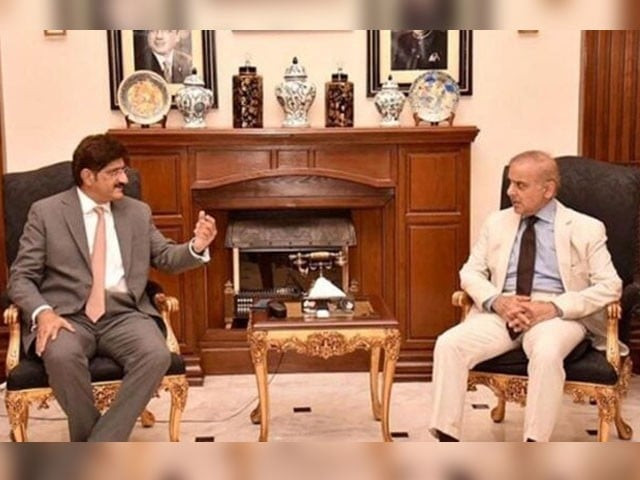
Prime Minister (PM) Shehbaz Sharif on Wednesday held a one-to-one meeting with the Sindh Chief Minister Syed Murad Ali Shah at CM’s House in Karachi.

The premier landed in Karachi early on Wednesday morning on a day-long visit.

According to Sindh CM House spokesperson, PM Shehbaz Sharif and CM Murad discussed issues relating to development works in the province.

Shah complained about a shortage of funds worth Rs82 billion from the federal government. He also raised the issue of non-provision of funds for the construction of houses for the flood victims in the province.

He also raised the issue of delaying NOCs for the K-4 project, KCR project is also facing delay, he added.

On the occasion, the Sindh CM complained about non-payment of funds. The premier assured the provincial chief executive of his cooperation and solution of the problems in the best interest of the people.

He directed the finance minister to address the reservations of the Sindh CM.

Upon arrival in Karachi, Sindh Governor Kamran Tessori and Sindh Chief Minister Syed Murad Ali Shah welcomed PM Shehbaz Sharif at the Jinnah International Airport.

Soon after arrival, the premier visited Mazar-e-Quaid, offered Fateha, and laid a floral wreath. He wrote his impressions in the book.

During his visit, the prime minister is also scheduled to meet the Karachi governor and prominent personalities of the business community, and a delegation of the Karachi Chamber of Commerce.

In these meetings, PM Shehbaz Sharif will take suggestions from the business community regarding the improvement in the country’s economy.

 
Sindh energy minister opposes proposed tax on solar panels

“Certain quarters have recommended imposition of tax on solar panels to federal government. This step will further overburden the poor class,” Nasir Hussain Shah has said in a statement.

“I plead to the prime minister avoid imposing tax on solar panels,” provincial minister said.

He also suggested offering convenience packages to people for purchase of solar panels.

It is to be mentioned here that the Central Power Purchasing Agency (CPPA) has proposed the federal government to impose tax on individuals using solar panels for residential or commercial purposes.

The sources privy to the development said that the CPPA has proposed a tax of Rs 2,000 per kilowatt on residential and commercial consumers installing 12 kilowatts or more.

The CPPA’s recommendation, which was sent to the Ministry of Energy (Power Division) for approval, has now been forwarded to Prime Minister Shehbaz Sharif for final approval.

After the prime minister’s approval, the consumers who install 12 kilowatt solar panels will have to pay a tax of Rs 24,000.

Meanwhile, the federal government is also reviewing the prices of solar panels as a suggestion to reduce the prices of solar panels is under consideration.

 
Sindh govt seeks control over Karachi’s Lyari Expressway

Sindh Chief Minister Murad Ali Shah on Monday asked the federal government to hand over the administrative control of the Lyari Expressway to the provincial government so that it could be opened for heavy traffic.

At a meeting with senior leadership of the National Highway Authority (NHA), Sindh Chief Minister Syed Murad Ali Shah said that the provincial government would carry out repair and maintenance of the Lyari Expressway and open it for heavy vehicles to ease out traffic congestion from inner parts of the city.

The meeting, which was held at the CM House, took place against the backdrop of the CM’s April 24 meeting with Prime Minister Shehbaz Sharif in which the former had raised several financial and development issues and also requested the latter to give control of the expressway to the provincial government.

A statement issued from the CM House said that the chief minister chaired a joint meeting of the NHA and the Sindh works and services department to review the progress of various road projects being executed by the NHA.

It said that the CM demanded that the federal government hand over not only the Lyari Expressway but the Karachi-Thatta and Mirpurkhas-Umerkot roads to the provincial government.

Last week, Sindh Governor Kamran Tessori and Karachi Mayor Murtaza Wahab had also asked the NHA and prime minister to allow heavy traffic on the Lyari Expressway.

A spokesperson for the CM House told Dawn that the NHA chairman assured the chief minister that the provincial government’s request for taking over the administrative control of the Lyari Expressway would be taken up favourably.

The NHA had off and on maintained that the Lyari Expressway was not fit for heavy traffic due to its design as it had 20 ramps, 12 bridges, around 27 while the north side of the road was built ‘solely with pillars’ at certain locations, which made it vulnerable for loaded heavy vehicles.

The expressway is also a source of revenue for the NHA as it charges toll from thousands of vehicles.

Discussing the Karachi-Thatta dual carriageway project, the CM said that the NHA handed over the Karachi-Thatta-Hyderabad section (N-5) to the Sindh government in January 2012.

In the handing over letter, the NHA said that the road would not be “de-federalised” but a no-objection certificate (NOC) being granted to the provincial government for its development on a public-private-partnership (PPP) mode.

The CM urged the NHA to de-federalise the road, as the provincial government constructed a dual carriageway at N-5 from Karachi to Thatta for Rs8.2 billion under the PPP mode and was unable to collect revenue including toll collection, fees from utility providers, right of way fees and NOC charges from petrol pumps, etc.

The NHA chairman said that it was a policy decision and it would be discussed with the communication ministry.

Indus Highway

The chief minister said that work on 130-km-long Jamshoro-Sehwan Road, which is part of the Indus Highway, was started by the NHA in 2018-19. Initially, it was an asset of the NHA but the provincial government had also contributed Rs7bn for its rehabilitation.

The CM said that the progress on the project was terribly slow. He added the straightening of curves at some locations between Jamshoro and Sehwan must be redesigned to avoid accidents.

He said that the rate of accidents per year on this particular road was higher than the whole country.

SOURCE: DAWN
 
Sindh to work over providing free electricity units soon: CM Murad

Addressing a press conference Sindh’s CM said that an announcement in this regard will be made soon.

He promised to provide safe drinking water to every village and neighborhood in Sindh.

The CM said that his government was working for the rehabilitation of those affected by the 2022 devastating floods, stating that six Lac housing units from total 2.1 million houses, have been constructed.

“We will also focus over the primary healthcare,” chief minister said.

Murad Ali Shah said that the people of Sindh have pinned hopes on the People’s Party.

He said PPP Chairman Bilawal Bhutto has given task to provide clean drinking water to every village of the province. “We will work over clean water schemes in the next five years,” he said.

Murad Ali Shah said that his government would launch the Kisan Card, adding that the promise of initiating the Benazir Labour Card had already been fulfilled.


Sindh CM Murad dismisses reports of changes to NFC formula


Sindh Chief Minister Murad Ali Shah has ruled out any change in the National Finance Commission (NFC) Award, saying neither the federal government nor any other official has discussed any such amendment.

He made these remarks while talking to reporters at the Hyderabad Press Club on Sunday.

When asked about reports of an IMF suggestion to renegotiate the resource distribution formula among provinces, Mr Shah said he only heard about this in the media.

“I have seen it only in the media because nobody has talked to me regarding any rethink of the NFC resource distribution formula.”

He explained that he has held three meetings with the prime minister and two with the finance minister, but nobody has discussed the issue with him.

The Constitution only allowed for the provinces’ share to be increased and it can not be reduced, the CM said.


Dawn
 
Stunting down by 18% in Sindh: CM

Sindh Chief Minister Syed Murad Ali Shah stated that critical environmental drivers of stunting, including water, sanitation, hygiene, and the agri-food system, are being addressed through ADP schemes and World Bank projects.

He made these remarks during a meeting with World Bank Country Director Najy Benhassine, and his delegation to discuss the Child Stunting Mission.

The meeting was attended by Minister for Health, Dr Azra Fazal Pechuho, acting Chief Secretary Musadqi Ahmad, PSCM Agha Wasif, Chairman P&D Najma Shah, and Secretary Health Agha Wasif. The World Bank delegation members were Economist Ghazaa Mansuri, Senior Health Specialist Ms Hinn Hinn Pyne and Senior Health Expert Ziauddin Hyder.

Murad said that the overall stunting rate in the province as assessed by Unicef in its survey of 2014 was 48 per cent. "The Sindh government launched the World Bank-assisted Multi-Sectorial Accelerated Action Plan (AAP) in 2017 to reduce stunting from 48 per cent to 30 per cent by 2021 and then further reduction up to 15 per cent by 2026," he said and added that the stunting rate had started coming down from 48 per cent but its assessment could be made through another survey.

The CM and the World Bank team agreed to address environmental drivers of stunting by expanding access to safe water and sanitation. Murad stated that the local government and Public Health Engineering department were ensuring the treatment of drinking water, sewage, and effluent. A mass behavioural change campaign by Public-Private Health Initiative (PPHI) and the health department was underway to shift cultural practices. Efforts included declaring Open Defecation Free (ODF) villages, testing water for contaminants, demonstrating household latrine construction, and promoting Community Led Total Sanitation (CLTS).

Murad stated that the Public Health Engineering (PHE) department handles rural water and sanitation services. The PHE will now focus on small, community-level drinking water schemes with poor geographic targeting. He noted that party chairman Bilawal Bhutto Zardari had directed investments in water treatment. As part of the party's election manifesto, the Sindh government will invest in water and sanitation schemes and increase the operation and maintenance budget to restore out-of-order systems, including reverse osmosis (RO) plants.

Discussing stunting, the chief minister decided to enhance access to quality healthcare and improve childcare and feeding practices. Nutritional supplementation will be strengthened for short-term high-risk situations, and family planning efforts will continue.Chief Minister Murad Ali Shah announced the establishment of Outpatient Therapeutic (OPT) Sites and Nutrition Stabilization Centers (NSC) in 23 districts. These centers treat Severe Acute Malnutrition (SAM) at OPT sites and SAM with medical complications at NSCs. Patients receive nutritional commodities (RUFT, MNP, F-75, F-100) and medicines (IFA tabs, Parenteral Iron, Deworm Tabs) for children, adolescents, and pregnant & lactating women (PLWs).

Capacity-building training for Community-based Management of Acute Malnutrition (CMAM) and Infant Young and Child Feeding (IYCF) is ongoing. To improve the agri-food system, the chief minister aims to promote sustainable and regenerative farming, crop diversification, and livestock productivity to enhance access to nutritious, diverse foods for small farmers. Efforts will also focus on ensuring food safety and reducing post-harvest waste.

Under the Asset Distribution initiative, livestock (five goats and 10 poultry per household) is provided, along with veterinary services (biannual vaccination and drenching) and awareness programs on nutrition and livestock management practices.

SOURCE: EXPRESS TRIBUNE
 
If achieved, this will be the only significant accomplishment of Murad Ali Shah's team in decades

---------------------------------------------------------------------------------------------------------------------

Plan prepared to give 100 units users free electricity: Nasir Shah

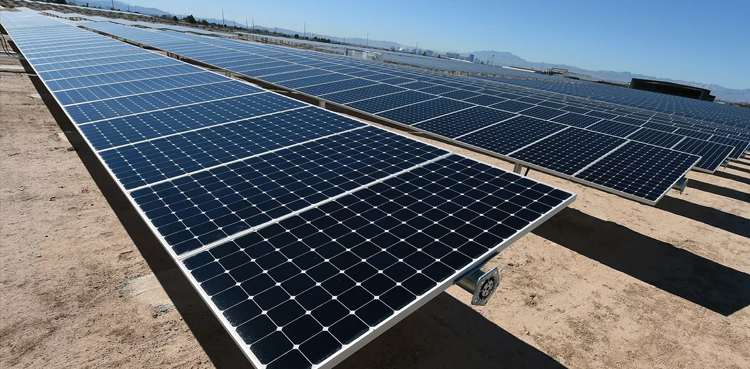
Talking to media, Sindh’s energy minister said that the government will provide 100 free power units to consumers from solar parks and mini grid stations.

He said the Government of Sindh has allocated amount for solar energy and mini grid in the budget. “The government initially allocating five billion rupees for solar energy in the budget,” minister said.

“We are also introducing a scheme in budget to provide solar panels on an extremely concessional price,” energy minister said. “Poor and middle-class people will be provided two lac solar panels,” he said. “The government will pay 80 percent of solar panel’s price, while 20 percent will be taken from people,” Nasir Shah said.

“There are five lac houses in Sindh with no power supply,” he further said. “Solar parks and mini grid stations will be installed in Karachi and other parts of Sindh,” energy minister added.

 
Sindh govt to equip JPMC with advanced AI, announces CM

The Sindh government plans to introduce advanced artificial intelligence (AI) technology at the Jinnah Postgraduate Medical Centre (JPMC), which would not only improve patient care but also provide access to data for research and help the hospital develop its own protocols for different diseases.

This was announced by Sindh Chief Minister (CM) Murad Ali Shah at the 2nd Postgraduate Research Conference organised by the JPMC at its auditorium on Friday.

Speaking at the gathering, the CM said: “This will be the first time outside the US that advanced AI technology will be deployed to make predictive algorithms based and trained on the local Pakistani population and disease patterns.”

“For this purpose, the Sindh government in collaboration with the Patient Aids Foundation has engaged the world’s renowned firm PAXERA to install PACS (Picture Archiving and Communication System) and artificial intelligence technologies at the JPMC, which are currently being used at Johns Hopkins Hospital and Harvard Medical School’s Mass General Hospital in the USA.”

Mr Shah also shared that the provincial government also planned to give open access to those AI models to other institutes, especially in rural areas, where less experienced doctors could emulate the same level of accuracy as the JPMC in disease diagnosis using AI.

“This was not the JPMC inherited from the federal government. At the time of the devolution of the JPMC, the National Institute of Cardiovascular Diseases (NICVD) and National Institute of Child Health (NICH) in 2011, their bed capacity was 2,092 with a budget of Rs1.9 billion,” he recalled.

The government, Mr Shah pointed out, had increased their bed capacities and their budgets. “In 2011, the JPMC had 1,185 beds, the NICH 443 and NICVD 464. Today, the JPMC has 2,208 beds, NICH 553 and NICVD 1,280. The government has also enhanced their budgets from a total of Rs1.9bn to Rs25.75bn today.”

Mr Shah informed the audience that the government had also introduced cutting-edge technologies such as CyberKnife and Tomo Therapy free of cost.

In his remarks, JPMC executive director Prof Shahid Rasool expressed his gratitude to the government and the PAF for helping the hospital become one of the largest health facilities in the country.

Higher Education Commission-Sindh Chairman Prof Tariq Rafi, vice chancellors Prof Nusrat Shah, Amjad Siraj and Gulshan Memon, and Aga Khan University Health Services-Pakistan Chief Executive Officer Dr Farhat Abbas also spoke.

SOURCE: DAWN
 
1,25,000 houses prepared for flood victims: Murad Ali Shah

The chief minister visited the office of the Sindh People’s Housing for Flood Affectees here. The CM was given briefing with regard to construction of houses for flood affected people.

Chief Minister said that the flood in year 2022 caused huge losses in Sindh.

“We are working on the world’s biggest project and constructing 2.1 mln housing units for flood victims,” chief minister said.

“We were lacking funds for housing project but determined to implement it. The project was presented in Geneva conference, and they helped us,” Murad Ali Shah said.

Chief Minister said that the affected people also being given ownership rights. The process with regard to ownership that was earlier suspended, has been resumed again, he said.

Murad Ali Shah said that 2.1 million housing units’ project has been launched and it is the world’s biggest construction project for flood affectees.

He said the federal government didn’t yet constitute the ECNEC, which is delaying release of development funds as approval of projects from the ECNEC has been compulsory.

CM Shah said that the housing project has also won award.

“There are eight lac women beneficiaries in 2.1 mln housing units project,” he said. Around eight lac houses of the project have been under construction”.

Murad Ali Shah said that the federal and provincial governments had allocated Rs25 billion each, but the funds were not released from the federal government. “Hopefully Prime Minister Shehbaz Sharif will fulfill his promise with the people of Sindh,” chief minister added.

 
No new development projects in Sindh’s budget 2024-25

The chairman of Pakistan Peoples’ Party (PPP), Bilawal Bhutto, directed the officials to complete the ongoing development projects during the upcoming financial year 2024-25.

The Annual Development Programme (ADP) book does not include new development projects for the province, while a total of 875 education-related projects, 1137 projects of the Department of Local Government & Town Planning, and 470 public health projects are part of the budget book.

Meanwhile, the provincial government included the 800 ongoing projects of works and services in the annual development funds.

Earlier in the day, Punjab Finance Minister Shujaur Rehman presented the provincial ‘tax-free’ budget for the fiscal year 2024-25 with a total outlay of 5.44 trillion amid protest by the Sunni Ittehad Council (SIC).

The finance minister laid before the House a Rs 5446 billion budget with a surplus of Rs 630 billion. He said that 77 new mega projects will be launched under the annual development plan.

Just like the centre, the Punjab government also proposed a raise of up to 25 percent of its employees’ salaries while the pension of retired employees is proposed to be raised by 15 percent. The workers’ minimum wage has been proposed to be raised Rs 37,000 from Rs 32,000.

In his budget speech, Shujaur Rehman claimed that no new taxes are imposed while existing taxes are not increased in the budget.

According to the budget documents, Rs 6 billion is earmarked for the laptop scheme, Rs 5 billion endowment fund, Rs 268 billion for supplementary grants, Rs 26 billion for the supplementary budget statement of the financial year 2023-24, Rs 26 billion for agricultural equipment, and Rs 10 billion Kisan card.

 
If no accountability had a face Laloo Prassad’s and Zardari’s political parties in their states would be poster children of the same.
 
Murad to unveil Rs3,049b budget today

Chief Minister Murad Ali Shah will present the Rs3,049 billion tax-free budget of Sindh for the next fiscal year 2024-25 in the Sindh Assembly today, Friday, June 14 evening.

The budget with Rs500 billion has Rs423 billion for the annual development program while the overall development budget is of Rs958 billion.

The pre-budget meeting of Sindh Cabinet has been called on June 14 at 9am. The final approval of the budget proposals will be given in the meeting, after which Shah will present the budget in the assembly.

In the Sindh budget, it has been proposed to allocate Rs16.80 billion for creating new posts and furniture and other things. Out of the 5,000 new jobs, 3,000 posts will be in the education department. It has been proposed to allocate Rs18 trillion for non-developmental expenses in the new financial year. Non-developmental expenditure includes salaries, pensions, interest on loans, furniture and other items while Rs400 billion is proposed to be allocated for education.

It has been proposed to allocate Rs275 billion for the health department. It is proposed to allocate Rs155 billion for the Sindh Local Government Department, while Rs170 billion has been estimated for the restoration of law and order. In the budget of the new financial year, it is proposed to increase the salaries of government employees by 15 to 20 percent, while the minimum wage is set at 35 thousand. More than 50,000 new recruitments will also be announced in the budget of the new financial year, while in the first phase, it has also been suggested to give solar system to 200 houses.

EXPRESS TRIBUNE
 
Murad to unveil Rs3,049b budget today

Chief Minister Murad Ali Shah will present the Rs3,049 billion tax-free budget of Sindh for the next fiscal year 2024-25 in the Sindh Assembly today, Friday, June 14 evening.

The budget with Rs500 billion has Rs423 billion for the annual development program while the overall development budget is of Rs958 billion.

The pre-budget meeting of Sindh Cabinet has been called on June 14 at 9am. The final approval of the budget proposals will be given in the meeting, after which Shah will present the budget in the assembly.

In the Sindh budget, it has been proposed to allocate Rs16.80 billion for creating new posts and furniture and other things. Out of the 5,000 new jobs, 3,000 posts will be in the education department. It has been proposed to allocate Rs18 trillion for non-developmental expenses in the new financial year. Non-developmental expenditure includes salaries, pensions, interest on loans, furniture and other items while Rs400 billion is proposed to be allocated for education.

It has been proposed to allocate Rs275 billion for the health department. It is proposed to allocate Rs155 billion for the Sindh Local Government Department, while Rs170 billion has been estimated for the restoration of law and order. In the budget of the new financial year, it is proposed to increase the salaries of government employees by 15 to 20 percent, while the minimum wage is set at 35 thousand. More than 50,000 new recruitments will also be announced in the budget of the new financial year, while in the first phase, it has also been suggested to give solar system to 200 houses.

EXPRESS TRIBUNE

Budget 2024-25: Sindh unveils Rs3.056tr budget with major focus on development, social welfare​


Sindh Chief Minister Syed Murad Ali Shah on Friday presented a Rs3.056 trillion budget for the fiscal year 2024-25. The budget includes a significant increase in development expenditure and proposes salary hikes of 22 to 30 per cent.

The budget allocates Rs959 billion, or 31 per cent, for development projects, highlighting a strong commitment to infrastructure and social services.

The projected revenue for the province exceeds Rs3 trillion, with 62 per cent coming from federal transfers and 22 per cent from provincial receipts.

Other sources of revenue include capital receipts, foreign project assistance, and grants. The expenditure breakdown shows Rs1.9 trillion (63 per cent) allocated for current revenue, Rs184 billion (6 per cent) for current capital and Rs959 billion (31 per cent) for development expenditure.

Sector-wise allocation

The budget allocates Rs519 billion for education, with Rs459 billion dedicated to current revenue expenditure. Healthcare receives a total allocation of Rs334 billion, with Rs302 billion earmarked for current expenses. The local government has a proposed budget of Rs329 billion.

Agriculture is allocated Rs58 billion, including Rs32 billion for current expenditure. The energy sector receives Rs77 billion, with Rs62 billion for ongoing costs.

Irrigation is allocated Rs94 billion, with Rs36 billion for current expenses. Works & Services receive Rs86 billion. Planning & Development is allocated Rs30 billion.

Social protection

The budget prioritises social protection, with Rs34.9 billion allocated for pro-poor initiatives and Rs116 billion in subsidies to alleviate the financial burden on citizens. A minimum wage increase of Rs37,000 is also proposed. Key relief measures include salary increases of 22-30 per cent, pension hikes of 15 per cent, and Rs25 billion for housing schemes.

New initiatives

Several new initiatives target long-term development and economic recovery. The Hari Card scheme allocates Rs8 billion for 12 million farmers. An Inclusive Enclave in Korangi, with an Rs5 billion allocation, will offer comprehensive facilities. The budget also introduces fiscal decentralisation for police stations with an Rs485 million allocation, a Rs5 billion solarisation initiative for solar home systems, a Rs5 billion Hub Canal Project for water supply to Karachi, and a Rs5 billion Mazdoor Card programme for labour welfare.

Investment in human capital

Investment in human capital is emphasised with Rs190 billion in grants for education and healthcare, including Rs35 billion earmarked for universities and support for major hospitals and medical institutes.

The Sindh budget for 2024-25 underscores a comprehensive approach to development, social welfare, and economic recovery, reflecting the government's commitment to the long-term growth and well-being of its citizens.


Federal govt must prioritize Sindh in development plans: CM Sindh​


Sindh Chief Minister Syed Murad Ali Shah emphasized the need for the federal government to consider Sindh as an integral part of Pakistan and to provide it with necessary development schemes.

During a post-budget press conference at the Sindh Assembly, Shah revealed that the total budget for the province stands at 3.056 trillion rupees. He expressed a commitment to completing development projects, stating that the focus will be on growth in the coming year without neglecting current projects.

The CM highlighted that 60 billion rupees have been allocated for the development budget, with a total of 956 billion rupees set aside for various development programs.

He criticized the caretaker government and the federal administration for discontinuing the development schemes initiated by the elected government.


Sindh govt announces interest-free loans for solar system installation​

The Sindh government has announced an initiative to provide interest-free loans to the middle class for installing solar systems.

Sindh Energy Minister Syed Nasir Hussain Shah shared this news while addressing the media at his residence, where he also extended Eid greetings to the nation and urged people to remember the martyrs.

During his address, the minister acknowledged the various issues faced by the region and highlighted the government's efforts to alleviate these problems through the budget. He emphasized that ongoing schemes have been prioritized, and the promises made to the public will be fulfilled.

He also announced measures to ensure the supply of clean water across Sindh. He pointed out that over 200,000 houses in the province still lack electricity.

To address this, the government plans to provide electricity to 500,000 people annually. Initially, very poor households will receive solar systems capable of powering a fan and three bulbs.

For those who wish to install solar systems independently, the government is introducing an interest-free loan scheme. The interest on these loans will be covered by the Sindh government. Additionally, Shah revealed plans to construct two grid stations in every district of Sindh to further improve the region's energy infrastructure.

Source: SAMAA
 

Sindh launches S-4 Smart Surveillance System with facial recognition​


Sindh Chief Minister Syed Murad Ali Shah on Thursday inaugurated two key projects, the Sindh Smart Surveillance System (S-4) and the Police Health Insurance Scheme, stating that the Safe City Project (S-4) will help restore law and order.

Speaking at the inauguration ceremony of S-4 and the Police Health Insurance Scheme at the CPO Karachi, Shah assured that safety measures for the Safe City project would be implemented seamlessly. He described S-4 as an excellent initiative that will effectively monitor all entry and exit points of the city using modern technology, aiding in crime reduction.

The chief minister approved Rs1.567 billion in funds for the purchase of camera systems from NRTC. He noted that modern cameras had been installed at 40 toll plazas in Sindh, including 18 in Karachi. A central control room and fusion system have been established at the CPO Data Centre for real-time alerts and monitoring.

Shah mentioned that the S-4 project would help apprehend over 80,000 fugitives. It comprises two programmes: ANPR (Automatic Number Plate Recognition) and FR (Facial Recognition). Advanced AI and analytical tools have been implemented for intelligence purposes, ensuring uninterrupted and smooth connectivity at each toll plaza.

The Sindh government has allocated approximately Rs1.5 billion for S-4, a comprehensive system utilising modern techniques. Cameras at all 40 toll plazas in Sindh can perform facial recognition and automated number plate checks. Live feeds from the cameras will be transmitted to a central command and control room server, instantly identifying stolen vehicles and individuals with criminal records. The National Radio Transmission Corporation played a crucial role in designing and installing this system.

"We are often criticised that this is our first step towards the Safe City Project," Shah remarked. "We must also install cameras on routes frequently used by criminals."

During a briefing on the Safe City Project S-4, CM Shah was informed that the advanced system would enable smart surveillance at all toll plazas. The installed 9-megapixel cameras come with night vision capabilities. Each toll plaza will have complete solar power installation with 8-10 hours of battery backup. The CPO Command and Control Room is equipped with global standard facilities, and mobile patrol units stationed near toll plazas will be available immediately under the computer-aided dispatch system. There are 183 9-megapixel ANPR cameras and 209 8-megapixel cameras for driver identification.

Shah highlighted the challenges Karachi faced, noting, "It was difficult to travel any highway without a police squad. Now, by the grace of God, our roads are safe." He added that 62 people were killed in Karachi in the past five months, with two-thirds of the killers apprehended, but these incidents did not make the news.

The chief minister also introduced the Health Insurance Scheme, named 'Bahbood-e-Jawan,' as an excellent initiative. The Sindh government approved a health insurance policy worth approximately Rs5 billion at the request of the Sindh Police. This policy will allow 127,482 police personnel and their families to receive medical treatment worth up to Rs1 million at private hospitals according to their health needs.


Sindh CM announces Rs1m compensation for families of street crimes victims​


Sindh Chief Minister Syed Murad Ali Shah has declared compensation of Rs1 million for each family who lost a member while resisting dacoity in the province since January.

Speaking at a Sindh Assembly session on Thursday, Shah acknowledged the tragic toll, with 84 fatalities reported in dacoity incidents during this period. He expressed remorse for not having personally visited the victims' families sooner.

"We will provide Rs1 million to the families of all those who lost their lives in dacoity incidents from January until now," Shah announced.

He also criticised the caretaker government, asserting that it is not their role to hinder the elected government's operations.
Shah highlighted financial challenges, noting that the federal government has withheld Rs76 billion.

Despite this, the Sindh government has allocated Rs3 billion towards a Rs40 billion plan and Rs25-30 billion for the K-4 project.

The announcement comes amid growing concerns over the rise in dacoity incidents across the province.

 
CM Murad winds up debate on Sindh budget 2024-25

Sindh Chief Minister Syed Murad Ali Shah on Thursday wound up the debate on the provincial budget 2024-25, shedding light on the provincial government’s priorities, future projects and the economic, political and social situation of the province.

As many as 131 members from the two sides of the aisle in a 168-member House participated in the discussion on the provincial budget in a congenial atmosphere.

The Sindh Assembly also unanimously approved a Rs213 billion supplementary budget — the additional funds spent by different ministries and departments during the fiscal year 2023-24.

Chief Minister Syed Murad Ali Shah presented 55 demands for grants of different ministries on the supplementary budget statement which were approved without any opposition as no cut-motions were moved by any member belonging to opposition parties.

The provincial ministries and departments had spent Rs213.164 billion more than the originally projected allocation in the budget 2023-24.

Earlier, the chief minister concluded the discussion on the provincial budget 2023-24 without any noise and commotion — a rare show of restraint from the opposition benches.

He said that the people of the province were happy with the Pakistan Peoples Party and they had always trusted the party which made all-out efforts for the uplift and development of the province.

“We have bagged 117 seats of the provincial assembly as people are happy with our performance,” he said adding that the PPP would secure more seats in future.

Mr Shah said that Karachi was his city and the provincial government had launched numerous uplift schemes for the city. Admitting that the water shortage was one of the biggest problems in the city, he said that the provincial government was making serious efforts on the early completion of the K-IV water project.

The chief minister said that before the February general elections, the provincial government had done a lot of work in the province, including Karachi, but the Election Commission stopped work on the ongoing schemes.

He said that the PPP’s provincial government had started the development of Thar and its coalfields during the period of the then CM Qaim Ali Shah.

“During the past five years we have completed all these works,” he said and added an airport was also established in Thar.

The chief minister said that the provincial government had done remarkable work in the health sector, mentioning the children’s hospital in Korangi and cyber-knife facility at the Jinnah Postgraduate Medical Centre and robotic surgery in SIUT.

He said that the provincial government had laid a network of roads across the province. He said that the provincial government had requested the federal government to hand over the Lyari Expressway to the provincial government and to run heavy traffic.

He said that the development of Karachi would require the help of the opposition parties in the assembly.

Opposition leader’s concerns

While concluding his speech on the budget, Opposition Leader Ali Khurshidi expressed concern and anger over the performance of the electricity distribution companies in the province, including Karachi, and asked the chief minister to immediately discuss the matter with the prime minister.

“If these institutions cannot stop loadshedding, then go away from Sindh,” he said.

He said that the biggest problem in Karachi at the moment was the acute shortage of water. “The city needs 1,200 million gallons per day (MGD) of water but the supply is only 450 to 500 MGD,” he lamented.

He said that people had been hearing about the Karachi Circular Railway for ages, but the federal and provincial governments were not showing interest in the project.

During his speech, the opposition members also chanted slogans Pani do Pani Do (supply water).

The leader of the opposition welcomed the induction of electric buses in the city but said that the city needed around 15,000 buses. He said it might take years to fulfil the city’s requirement for buses.

Mr Khurshidi also highlighted the issue of Afghan illegal immigrants and called for strict action in this regard. He said that the opposition would support the government in its action against illegal immigrants.

Later, the house was adjourned to Friday.

DAWN
 
Sindh Assembly passes Rs3.056tr budget amid opposition protest

The Sindh Assembly on Friday passed the Rs3.056 trillion provincial budget 2024-25 with majority vote, rejecting all cut-motions moved by the opposition members belonging to the Muttahida Qaumi Movement-Pakistan and Jamaat-i-Islami.

Amid protest and subsequent walkout by the MQM-P and JI members, the house also passed the Sindh Finance Bill of estimated Rs76 billion taxes and levies.

As Chief Minister Murad Ali Shah presented the Sindh Finance Bill in the house, Leader of the Opposition in the Sindh Assembly Ali Khurshidi rose to request Speaker Syed Awais Shah to form a committee for deliberations on the bill and consideration of opposition members’ proposals / amendments.

The opposition members had moved 1,197 cut-motions — a refusal against a specific allocations and demands in the budget proposal, terming them unnecessary and burden on the public exchequer — seeking reductions in the allocations to Chief Minister Secretariat.

However, all of them were opposed by the chief minister, who had laid the budget 2024-25 before the assembly.

After the rejection of some cut-motions, the opposition members’ all cut-motions were clubbed with their consent and subsequently rejected en bloc with a majority vote.

The provincial budget for the next financial year totals Rs3.056tr, with over Rs900bn allocated for development projects.

It includes Rs1.96tr in current revenue, Rs184bn in current capital, Rs42bn for debt repayment, and Rs142.5bn for government investments.

The chief minister submitted to the chair that under the rules Finance Bill could not be referred to the committee.

He pointed out that the opposition had ample time to forward its proposals / recommendations as the budget was presented in the assembly two weeks ago.

The MQM-P lawmakers chanted slogans against the tabling of the finance bill and tore its copies before they walked out of the house. Lawmakers belonging to Pakistan Tehreek-i-Insaf-backed Sunni Ittehad Council, however, stayed in the house.

Giving a brief introduction of the Finance Bill, the chief minister said that it was expedient to enact a law to rationalised, levy and enhance certain taxes and duties and to amend certain laws in the province.

He said that it was needed to bring certain professionals under the tax net as the provincial government wanted to increase its revenue generation. “If revenue is not enhanced, how can government provide services to people,” he questioned.

Duties, taxes on air tickets, cars, professionals

Under the newly passed Sindh Finance Act, stamps duty has been increased in certain categories.

Besides, Rs1,000 tax has been imposed on the sale or transfer of a registered vehicle and sale or transfer of immovable property or re-conveyance of a mortgage property.

There will be a tax of Rs5,000 on the booking of an apartment, shop, house, office or plot for the sale of general public in a project approved by the Sindh Building Control Authority.

A tax of Rs50 would be charged on air tickets for domestic flights and Rs400 for international flights.

Under the Sindh Finance Act, the excise duty on imported cars and jeeps with engine capacity of 3,000cc would be Rs450,000; Rs275,000 on 2,000cc to 2,999cc; Rs100,000 on 1,500cc to 1,900cc imported motor cars and jeeps and Rs50,000 on locally manufactured or assembled vehicles with engine capacity of 2,000cc and above.

Besides, the assembly with majority votes also approved 158 demands for grants for the financial year 2024-25 moved by the chief minister, who also holds the portfolio of finance.

Later, the assembly session was prorogued.

DAWN
 
The federal government has failed to allocate funds in the current fiscal year for 16 ongoing projects in Sindh, leading to significant delays in their progress

According to the Sindh Treasury Department, despite expectations of billions of rupees from the PSDP for the fiscal year 2023-24, no funds have been released due to federal non-allocation.

Details reveal that the federal government has not allocated funds for various projects, including the Karachi Industrial Estate revival, which allocated 2.5 billion rupees, the Rohri Gudu Beraaj M-5 Interchange project with a budget of 4 billion rupees, and the Tando Allahyar-Tando Adam Road project budgeted at 2 billion rupees.

Allocations of 4 billion rupees for the M-5 National Highway to Rani Pur and 3 billion rupees for a water filtration and sewage treatment plant were also expected but have not been disbursed.

Similarly, the federal government has not allocated 2 billion rupees for schools affected by floods, further delaying reconstruction efforts for these educational institutions.

Earlier this month, Sindh Chief Minister Syed Murad Ali Shah urged the government to consider Sindh as an integral part of Pakistan and to provide it with necessary development schemes.

Shah presented supplementary budget of Rs213.164 billion without facing any criticism from the opposition in the Sindh Assembly yesterday.

Asserting that the government is comitted to serve its people, Shah stated "We will complete most of the development schemes in the province during the next financial year. Karachi is also my city, and its development is important to us. We are trying to solve the city's water and other basic problems."

 
Murad orders removal of encroachments from Karachi’s footpaths, green belts

Expressing extreme displeasure and concern over encroachments on public spaces under the nose of authorities concerned, Chief Minister Syed Murad Ali Shah on Friday strictly directed all civic and local bodies to play their due role to eradicate the menace that had destroyed the beauty and sanctity of the city.

He directed the Karachi Metropolitan Corporation, town municipal corporation and city administration to remove encroachments from public spaces with the support of police.

However, he asked the authorities to give appropriate time to those who had encroached the public spaces before launching a vigorous operation.

The city is replete with encroachments on public spaces for the past many years and the Supreme Court and Sindh High Court have issued numerous orders asking the authorities to remove them, but to no avail as the footpaths, pavements, walkways, green belts, parks, grounds, service lanes, streets and roads remain encroached not only by common people or traders but even law enforcement agencies, government and private organisations, etc.

‘No institution has authority to allow encroachments on public spaces’

Presiding over a meeting to discuss the issue, the chief minister said that encroachments on footpaths, green belts, walkways and streets had defaced the city and caused serious issues in the flow of traffic even for the pedestrians but no authority was ready to remove them.

Mr Shah categorically said that no institution had the authority to allow encroachment on the green belts, footpaths and walkways.

“Some private offices have installed their generators on the footpath under the nose of the concerned local body and the deputy commissioner,” he said.

He directed the administration, KMC, TMCs, police and the development authorities to play their role and fulfil responsibilities.

The local government minister told the meeting that the local bodies had their anti-encroachment wings but were not as active as they should be.

It was pointed out that debris and construction materials were left on the footpaths, service roads and even the main roads.

The CM directed the Sindh Building Control Authority (SBCA) to get an undertaking from all the builders that they would not use public spaces for dumping the construction material.

“Meanwhile, the administration would launch a drive against such government and private builders, impose heavy fines against them and seize their material,” he ordered.

The CM said that different authorities such as KMC, KDA, TMCs and others were granting road-cutting permissions and collecting charges but failed to reconstruct the roads.

He directed the chief secretary to get the charges for road cutting revised and evolve a mechanism to reconstruct the dug-up roads within three months. He said that there must be a certification procedure.

Removal of illegal charged parking ordered

The meeting observed that various illegal charged parkings had been developed on the roads which were causing serious traffic issues.

The CM directed the local government and other concerned authorities to notify the parking officially in consultation with the traffic police and remove all the unauthorised.

It was pointed out that most of the shopping plazas had their parking areas, but the builders had converted them into warehouses and rented them out.

The chief minister directed the SBCA to share the list of the shopping plazas having parking areas with the commissioner.

“The commissioner through DCs and SSPS would launch operations against them and restore their parking areas,” he said.

The CM also constituted a traffic management body under the commissioner to resolve illegal parking issues.

The meeting was attended among others by provincial ministers Nasir Shah and Saeed Ghani, Mayor Murtaza Wahab, Chief Secretary Asif Hyder Shah, Commissioner Hassan Naqvi, Karachi police chief Imran Yakoob, Local Government Secretary Khalid Hyder Shah, Finance Secretary Fayaz Jatoi, Transport Secretary Asad Zamin, Karachi Development Authority Director General Shujaat Hussain and all deputy commissioners.

SOURCE: https://www.dawn.com/news/1845484/m...oachments-from-karachis-footpaths-green-belts
 

Sindh CM announces free electricity to users of up to 100 units​


Sindh Chief Minister Murad Ali Shah announced plans to provide free electricity to users consuming up to 100 units and to provide solar power systems to off-grid households.

Speaking at a meeting at the Chief Minister's House in Karachi on Friday, Shah discussed various proposals with Energy Minister Nasir Hussain Shah, Adviser Ahsan Mazari, Chief Secretary Asif Haider Shah, Principal Secretary Agha Wasif, and Energy Secretary Musaddiq Khan.

Energy Minister Nasir Shah briefed that approximately 80,000 households consuming 50 megawatts monthly include 441,483 under K-Electric, 229,338 in HESCO, and 125,500 in SEPCO’s jurisdiction.

Additionally, 1.9 million households consuming 100 megawatts monthly comprise 1,054,000 in Karachi (KE), 566,427 in Hyderabad region (HESCO), and 356,073 in Sukkur region (SEPCO).

It was highlighted that 2.6 million off-grid households could receive solar home systems (SHS), with an initial phase covering 500,000 households.

Each SHS, costing approximately 50,000 rupees, includes three LED bulbs, a 35-watt DC fan, and mobile charging ports with a six-hour battery backup.

Shah proposed establishing six micro-grids, each 75 kilowatts, as pilot projects across six divisions, catering to clusters of 100 households. The grids would provide power to homes consuming 100 kilowatts.

He also suggested setting up three solar parks of 305 megawatts each to supply K-Electric, HESCO, and SEPCO, benefiting both on-grid and off-grid households.

Murad Ali Shah directed the Energy Minister to prepare proposals for solar parks and solar home systems for further discussion and approval.


Sindh launches S-4 Smart Surveillance System with facial recognition​


Sindh Chief Minister Syed Murad Ali Shah on Thursday inaugurated two key projects, the Sindh Smart Surveillance System (S-4) and the Police Health Insurance Scheme, stating that the Safe City Project (S-4) will help restore law and order.

Speaking at the inauguration ceremony of S-4 and the Police Health Insurance Scheme at the CPO Karachi, Shah assured that safety measures for the Safe City project would be implemented seamlessly. He described S-4 as an excellent initiative that will effectively monitor all entry and exit points of the city using modern technology, aiding in crime reduction.

The chief minister approved Rs1.567 billion in funds for the purchase of camera systems from NRTC. He noted that modern cameras had been installed at 40 toll plazas in Sindh, including 18 in Karachi. A central control room and fusion system have been established at the CPO Data Centre for real-time alerts and monitoring.

Shah mentioned that the S-4 project would help apprehend over 80,000 fugitives. It comprises two programmes: ANPR (Automatic Number Plate Recognition) and FR (Facial Recognition). Advanced AI and analytical tools have been implemented for intelligence purposes, ensuring uninterrupted and smooth connectivity at each toll plaza.

The Sindh government has allocated approximately Rs1.5 billion for S-4, a comprehensive system utilising modern techniques. Cameras at all 40 toll plazas in Sindh can perform facial recognition and automated number plate checks. Live feeds from the cameras will be transmitted to a central command and control room server, instantly identifying stolen vehicles and individuals with criminal records. The National Radio Transmission Corporation played a crucial role in designing and installing this system.

"We are often criticised that this is our first step towards the Safe City Project," Shah remarked. "We must also install cameras on routes frequently used by criminals."

During a briefing on the Safe City Project S-4, CM Shah was informed that the advanced system would enable smart surveillance at all toll plazas. The installed 9-megapixel cameras come with night vision capabilities. Each toll plaza will have complete solar power installation with 8-10 hours of battery backup. The CPO Command and Control Room is equipped with global standard facilities, and mobile patrol units stationed near toll plazas will be available immediately under the computer-aided dispatch system. There are 183 9-megapixel ANPR cameras and 209 8-megapixel cameras for driver identification.

Shah highlighted the challenges Karachi faced, noting, "It was difficult to travel any highway without a police squad. Now, by the grace of God, our roads are safe." He added that 62 people were killed in Karachi in the past five months, with two-thirds of the killers apprehended, but these incidents did not make the news.

The chief minister also introduced the Health Insurance Scheme, named 'Bahbood-e-Jawan,' as an excellent initiative. The Sindh government approved a health insurance policy worth approximately Rs5 billion at the request of the Sindh Police. This policy will allow 127,482 police personnel and their families to receive medical treatment worth up to Rs1 million at private hospitals according to their health needs.

Fugitives that work for the waderas.
 
CM seeks urban flooding control system in Karachi

Sindh Chief Minister Syed Murad Ali Shah has stressed the need to establish an urban flooding control system in Karachi by identifying low-lying areas prone to flooding. The proposed plan aims to design sewers that will channel water to the main interceptor tunnels at the Lyari and Malir rivers.

The chief minister also underlined the importance of rejuvenating the Lyari and Malir rivers by eliminating sewer outfall structures, ensuring cleaner waterways. He said this during a meeting at the CM House attended by Minister of Local Government Saeed Ghani, Mayor Murtaza Wahab, Chief Secretary Asif Hyder Shah, PSCM Agha Wasif, LG Secretary Khalid Hyder Shah, CEO Salahuddin, Municipal Commissioner KMC Afzal Zaidi, and other officials.

The meeting identified various factors of urban flooding, including drain blockages from solid waste, flow obstructions, inadequate outfall infrastructure, and encroachment. Efforts to mitigate these issues through removal of unauthorised settlements and drain cleaning have shown limited effectiveness over time.

"We propose constructing new sewage tunnels in flood-prone areas to carry sewage from internal trunk sewers to treatment plants," said the CM. He added that the ongoing construction of treatment plants is tailored to the city's wastewater needs, with potential applications in agriculture and horticulture.

Highlighting technological advancements, the chief minister particularly mentioned proposals for a modern earth pressure balance tunneling system that minimises surface settlement issues. This system, combined with pipe jacking technology, aims to manage urban floods while restoring natural streams in Lyari and Malir rivers.

The CM directed the Karachi Water & Sewerage Board (KWSB) to explore options for a combined sewerage system accommodating both domestic and industrial effluents in treatment plans. He stressed the need for a comprehensive master plan study on urban flooding control in Karachi, to include tunneling solutions, scheduled for completion within six months.

The KWSB proposed a pilot study focusing on wastewater projections until 2047, aligning with their ongoing master plan for water and sewerage infrastructure.

Mayor suggested prioritising old city areas as pilot projects for testing urban flooding control systems.

EXPRESS TRIBUNE
 
CM Murad opens regulator, underpass on LBOD to give passage to natural waterway

Sindh Chief Minister Syed Murad Ali Shah on Wednesday inaugurated escape regulator on spinal drain of Left Bank Outfall Drain, which had capacity of releasing 4,000 cusecs from the drain to save it from overflowing during floods, and an underpass that gave passage to Pangrio Dhoro’s natural route and allowed its water to fall into Puran Dhoro.

The underpass was a major ‘intervention’ on the drain at a point, which had brought residents of Tharparkar, Badin and Mirpurkhas districts to a standoff in 2022 floods when the authorities were mulling to breach the spinal drain to save areas in the upper reaches of the drain from flooding.

Sindh Irrigation Minister Jam Khan Shoro and secretary irrigation Zarif Khero briefed the chief minister about the interventions. Shoro said that LBOD’s water would be offloaded through the two interventions -- if it faced danger of overtopping during floods and rains. The projects were to be undertaken to revive natural waterways like Pangrio and Dhoro Puran as spinal drain component of LBOD had blocked their natural routes at the time of the drain’s construction, he said.

Shoro said that multiple interventions were planned in the spinal drain which would be completed by next monsoon season and this would ease pressure on waterways like Hakro river.

Four underpasses were to be built. Issue of Mirpurkhas Main Drain (MMD) would also be addressed and underpass at RD-210 was built under irrigation department’s annual development plan (ADP) scheme, he said.

Zarif informed the chief minister that Pangrio Dhoro would now cross through underpass with 2,500 cusecs discharge capacity while the regulator on the spinal drain had 4,000 cusecs capacity. These passages would allow runoff of Pangrio Dhoro and spinal drain to join Dhoro Puran, an old natural waterway, blocked by LBOD in the 80s, he said.

He said that a submerged weir would be built at RD-297 of the spinal drain near Jhuddo, a regulator at RD-7-RD-8 of Puran Dhoro with a capacity of 2,000 cusecs and an underpass at RD-276 of the spinal drain would be built by next year. “Natural waterways of the area will be restored with execution of all these interventions in the areas which had been problematic in spinal drain,” he said.

Project Director Javed Memon disclosed that Rs2.9 billion were spent on remodeling of Puran Dhoro’s banks (112 RDs, from RD-110-210 and RD-210-222) and Rs550m were spent on the regulator under the World Bank- funded Sindh Flood Emergency Rehabilitation Programme.

The chief minister said at the inauguration ceremony that LBOD appeared to be a good initiative in 80s but over time it created problems for people. “Late Dr Sikandar Mandhro told me that Benazir Bhutto saheba had taken notice of complaints of Badin’s residents about LBOD which always wreaked havoc in their area during monsoon season. Afterwards, Wapda, too, had to concede it had committed mistakes [in the drain’s design],” CM said.

He recalled that there was immense pressure in 2022 to breach the drain at RD-210 to give relief to people in the upstream areas but then authorities found out a solution to avoid the breach. After floods of 2020 and 2022, Bilawal Bhutto-Zardari asked him to resolve this problem once and for all and today this problem finally stood resolved, he said.

He said that Badin faced water shortage problem for being tail-end district and that was the reason the distributaries of the area were being lined to overcome the area’s chronic shortage problem. Kotri Barrage’s Akram Wah would be remodelled as well and this would finally help improve water supply in tail-end reaches, he said.

Mr Shah promised that a reservoir would be built in Ali Bundar area, as mentioned by irrigation minister, to enable the coastal area’s people to cultivate their lands.

DAWN
 
200,000 families to get solar home system with 80pc subsidy: Murad

The Sindh government is set to bear 80 per cent cost of as many as 200,000 ‘solar home systems’ (SHS) to be provided to low-income households across the province.

The government on Saturday entered into framework agreements with three firms to provide each of the 200,000 families with a solar panel, battery, one DC fan, three LED bulbs and a mobile phone charging facility with an estimated cost of Rs55,000.

The solar panels and kits would be provided to eligible low-income families at around 80 per cent subsidy. The families, who will be selected through Benazir Income Support Program, have to pay Rs6,000 each for the SHS.

This was announced by Sindh Chief Minister Murad Ali Shah at the signing ceremony of the framework agreements with M/s Bboxx Ltd, UK; M/s Shenzen LEMI Technology Development Co. Ltd, China and M/s D.light Design Ltd, USA at CM House.

The chief minister said that by the end of October first batch of 50,000 SHS kits would reach Karachi for onward distribution.

The provincial government on July 19 decided to provide free-of-cost electricity to consumers living off-grid and those using 100 units per month through the World Bank-sponsored $100 million Sindh Solar Energy Project (SSEP) after the chief minister was informed that there were 2.6 million off-grid households and nearly two million households using 100 units per month in the province.

According to a statement issued from CM House, the ceremony at CM House was attended among others by Energy Minister Syed Nasir Shah, principal secretary to CM Agha Wasif, energy secretary Musaddiq Khan and representatives of three private companies selected through competitive process.

Murad Shah said that the Sindh Solar Energy Project (SSEP) was being executed for Rs27.4 billion with the $100 million ‘financial support’ of the World Bank.

He said that the Solar Home Systems would consist of an 80-100 W Solar PV Plate and a minimum 18 AH Lithium-ion battery, one DC fan, three LED bulbs and a mobile phone charging facility. The SHS set was shown to the CM which he approved.

The chief minister disclosed that the system’s estimated cost was around Rs55,000, including transport, taxes and duties and would be provided to eligible low-income families at around 80 per cent subsidy.

He said that the implementation strategy was being changed with the Bulk Procurement Model through international bidding in the light of World Bank procurement guidelines.

“The beneficiaries will be charged a small amount of Rs6,000,” he added.

Murad Shah said that the program was started in 2020, but the amount of subsidy was 40 per cent and the poor people were unable to pay the 60 per cent costs. He added that under the old program only 322 systems were sold. “Now, with the support of the WB, the subsidy amount has been increased up to 80 per cent but the program was delayed due to the devastating floods in 2022 and Covid-19 pandemic.”

Mr Shah said that the project strategy was revised with an increase in subsidy and the “Bulk Procurement Model” was adopted.

He added that in the original project, 10 districts were selected, but under the revised program all 30 districts, including seven districts of Karachi had been included.

The energy minister said that in the bidding process, 18 local and international firms had participated, and of them, three firms had qualified for signing of framework agreements.

He said that NGOs working under the Sindh Peoples Housing Foundation Project (SPHF) had been contracted under the WB Direct Contracting Method, which would be responsible for collecting SHS from appointed warehouses, distribution, installation and replacement service.

SOURCE:https://www.dawn.com/news/1849903/200000-families-to-get-solar-home-system-with-80pc-subsidy-murad
 

Free tablets to be distributed to students from grade 9 to intermediate in Sindh​


The Sindh Textbook Board has announced that students from Grade 9 to Intermediate across the province will receive free tablets to ensure uninterrupted studies, as part of a new initiative.

This decision was revealed during an event at the Sindh Textbook Board’s warehouse in Karachi, where Chairman Abdul Aleem Lashari was in attendance. The event marked the distribution of textbooks for the new academic year.

Speaking to the media, Lashari explained, "To avoid delays or shortages of books, we will distribute free tablets to students from Grade 9 to Intermediate, ensuring that their education continues without any disruption."

He added that in the first phase, tablets will be given to senior students, followed by other grades in the second phase. "Gradually, we aim to make the Sindh Textbook Board paperless, aligning with modern demands," he said.

Lashari noted that the final decision will be made by the Chief Minister of Sindh, and upon approval, the plan will be officially implemented. He also mentioned that the distribution of free textbooks for the current academic year is nearing completion.

The chairman highlighted that nearly 27.5 million books are being distributed for free across Sindh's 30 districts. The first phase began on July 30, with the second phase scheduled to start on August 15. Lashari warned that publishers who fail to deliver books to the market will face action.

While acknowledging delays in textbook distribution, Lashari attributed them to various factors, including technical issues and legal challenges. He confirmed that textbooks have been delivered to 17 districts, and the process in Karachi has been completed.

 
Sindh renews support to boost HEVs production

Chief Minister Syed Murad Ali Shah reaffirmed the Sindh government’s commitment to supporting the automotive industry through favourable policies and promoting small and medium vendor industries to increase localisation and reduce import dependency.

During his visit to Indus Motor Company’s (IMC) manufacturing facility at Port Qasim Authority, he said the provincial government was making all-out efforts to foster the large-scale production of hybrid electric vehicles (HEVs). “These efforts will generate more direct and indirect employment opportunities within the province,” he hoped.

The chief minister toured the IMC’s state-of-the-art facility and received a comprehensive briefing on the latest production processes, including the globally renowned Toyota Production System.

Mr Shah was also briefed on IMC’s recent export achievements, including the successful export of raw materials to Egypt, marking the company’s integration into Toyota’s Global Supply Chain.

Additionally, IMC has commenced exporting vehicles, including the Toyota Fortuner, Hilux, and Corolla Cross models, to Oceanian countries. These milestones highlight IMC’s commitment to advancing Pakistan’s automotive industry on the global stage.

IMC Chief Executive Ali Asghar Jamali emphasised the importance of stable policies for sustaining growth in the automotive sector. “It’s an honour to have Chief Minister Murad Ali Shah visit our plant, which is a morale boost for the entire team.”

DAWN NEWS
 
PPP reacts to Punjab govt’s ‘relief’ for electricity consumers

In a statement issued here, Barrister Murtaza Wahab said that there is a need for long-term relief measures for the people.

“When we (PPP’s Sindh government) think of relief, we also think of many options. What will happen after two months of relief to the people of Punjab?” he asked

Barrister Murtaza Wahab also criticised the Punjab government’s approach, saying that rulers should make long-term decisions, not ‘short-term’.

He said that high electricity is a national issue, saying that provincial cards should not played on it. He said that the Sindh government is generating 5,000 megawatts of electricity and supplying it to the national grid.

On Friday, former Prime Minister and PML-N supremo Nawaz Sharif has announced a major relief for electricity consumers in Punjab, with focus on providing relief to low-income households

Addressing a press conference, the PML-N supremo stated that consumers using up to 500 units of electricity will receive a relief of Rs 14 per unit.

Sharif praised Punjab CM Maryam Nawaz for her efforts in providing relief to the people and announced that she will be launching a solar panel scheme to provide further relief.

He added that the Punjab government has allocated Rs 700 billion for the solar panel scheme, which will help further reduce electricity bills in the future.

The relief package includes a relief of Rs 14 per unit for consumers using up to 500 units, which will cost the Punjab government Rs 45 billion.

 
Sindh govt will not tolerate polio vaccine refusals, declares Murad

Expressing serious concern over parents’ lack of cooperation in the ongoing anti-polio drive in the metropolis, Sindh Chief Minister Murad Ali Shah on Saturday issued instructions to district administration and police to strictly deal with cases of vaccine refusal.

“I would not accept any type of refusal from the parents,” he said and directed the health department to make the drive more effective.

“Throughout the world, even smaller and less developed countries have got rid of polio but we, Pakistan, and Afghanistan, are still rearing the virus by refusing to administer polio drops to their children. Enough is enough. We would not allow any parent to refuse administering polio vaccine to their children,” he said.

He further stated: “We understand that this is a sensitive issue. There are certain prejudices, misunderstandings and taboos associated with the administration of polio. The government is trying its best to create awareness and address these challenges.”

‘Vaccination coverage fast improving’

The provincial authorities engaged in a major ongoing anti-polio campaign stated on Saturday that vaccination coverage was fast improving in high-risk areas after an initial hiccup.

“Over the past two days, we have seen a dramatic positive change on the ground in the same 40 union councils where 27 per cent parents had refused to get their children vaccinated on the first day of polio drive,” shared EOC (Emergency Operation Centre) Coordinator Irshad Sodhar.

“I think that’s because parents are seeing that the vaccine injection is painless with no side-effects. The growing acceptability of the new strategy would definitely help us protect vulnerable children and communities,” he added.

According to him, vaccination coverage has increased from 62pc to over 80pc in two days in the same 40 union councils that will be continue to be the focus in the drive till Monday.

“I have personally visited sites in three districts and was happy to see parents’ participation, particularly of mothers.”

It might be recalled that the chief minister had launched a special 10-day campaign on Aug 14 targeting over 1.1 million children in 85 high-risk union councils.

The province has reported two polio cases so far this year. One of them was detected in district Keamari in Karachi reporting over 70 positive environmental samples this year.

DAWN NEWS
 

CM orders probe into child marriages in Pakistan’s Sindh in wake of deadly 2022 floods​


The chief minister of Pakistan’s southern Sindh province has ordered an inquiry into dozens of child marriages in the Dadu district in the wake of deadly floods that hit the region two years ago, the Sindh CM’s office said on Sunday.

Pakistan’s high rate of marriages for underage girls had been inching lower in recent years, but after the unprecedented floods in 2022, rights workers warn such weddings are now on the rise due to climate-driven economic insecurity.

Many villages in the agricultural belt of Sindh have not recovered from the 2022 floods, which plunged a third of the country underwater, displaced millions and ruined harvests. Child marriages have particularly spiked in the Dadu district that for months resembled a lake, according to social activists. In Khan Mohammad Mallah village alone, 45 underage girls have become wives since the last monsoon — 15 of them in May and June this year.

Sindh CM Murad Ali Shah sought a report from the Hyderabad commissioner into these marriages in return for money given to families of the brides, inquiring about the social, financial and legal factors behind them.

“Form a committee for a detailed inquiry and furnish a report whether these girls hailed from flood-affected families,” Shah told the Hyderabad commission, according to the CM’s office.

“What is the condition of these married girls at present? Give a report from every aspect so that it can be resolved.”

Child marriages are common in parts of Pakistan, which has the sixth-highest number of girls married before the age of 18 in the world, according to government data published in December. The legal age for marriage varies from 16 to 18 in different regions, but the law is rarely enforced.

Parents of these young girls said they hurried the marriage of their daughters to save them from poverty, usually in exchange for money.

“Before the 2022 rains, there was no such need to get girls married so young in our area,” village elder Mai Hajjani, 65, told AFP this week. “They would work on the land, make rope for wooden beds, the men would be busy with fishing and agriculture. There was always work to be done.”

Pakistan is recognized as one of the most vulnerable countries to climate change effects in the world. The summer monsoon between July and September is vital for the livelihoods of millions of farmers and food security, but scientists say climate change is making them heavier and longer, raising the risk of landslides, floods and long-term crop damage.

In June, a senior UN official warned that an estimated 200,000 people in Pakistan could be affected by the upcoming monsoon season, which is expected to bring heavier rains than usual.


Thar coal producing the cheapest electricity in Pakistan: CM Murad Ali Shah​


Sindh Chief Minister Murad Ali Shah on Wednesday emphasised the significant impact of Thar coal power plants in generating the cheapest electricity in Pakistan.

Speaking to media in Lahore, CM Murad highlighted that the Sindh government had advocated for investment in wind and solar energy a decade ago, a vision that is now shared nationwide.

CM Murad revealed that Thar coal power plants are currently generating over 3,000 megawatts of electricity, which is supplied to the national grid and later to Faisalabad.

He noted, however, that this electricity is not being supplied directly to Sindh.

"Thar coal could generate cheaper electricity for Pakistan, creating jobs and increasing exports with industries powered by it," he added.

The Sindh chief minister also called for a comprehensive restructuring of the power sector to fully leverage the potential of Thar coal.

 
Sindh CM visits Sujawal, inspects rain emergency measures

Sindh’s CM Shah was talking to media at Sujawal-Thatto Bridge today during his visit of Sujawal district to monitor arrangements to tackle the rain emergency situation.

Murad Ali Shah said that Tharparkar receiving heavy rainfall for last two days. “Karachi, Thatto, Sujawal, Badin, Umarkot, Sanghar and Shaheed Benazirabad have more threat of the stormy weather system,” chief minister said.

“Continuous heavy rainfall makes the rainwater drainage a difficult challenge,” he said.

Sindh’s CM said that his government building 2.1 million housing units for around 12 million people affected in 2022 heavy rainfall and flooding.

“We have completed two lac houses, while six lac homes have been under construction,” he said.

Sindh’s chief minister after Karachi and Thatta reached Sujawal to be received by provincial minister Muhammad Ali Malkani and others.

He visited different areas with provincial cabinet members and also inspected the water flow at Dolah Darya Khan Bridge over the Indus River.

 
Sindh CM orders vigilance after cyclone alert

Sindh Chief Minister Murad Ali Shah on Thursday directed the local administration and all concerned departments to keep vigilance over an alert issued by the PDMA.

“According to the weather forecast heavy rainfall is likely in several districts of Sindh,” chief minister said.

“All necessary preparations should be completed, which needed to deal with any emergency situation,” CM Murad Ali Shah has said in a statement.


The chief minister also directed the health department to ensure that the province’s hospitals improving their arrangements and also ensure staff attendance.

He also instructed the fisheries department to ensure fishermen’s safety amid extraordinary sea conditions.

“Continue monitoring the embankments of rivers, streams and other water passages,” Murad Ali Shah directed the irrigation department.

 
Back
Top