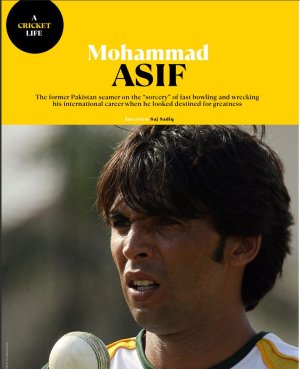
I wanted to play cricket professionally from a young age and had my mind set on being a professional cricketer even when I was at school when most other boys were concentrating on their studies. I had a passion for the game right from my school days before going on to play club cricket in my home city of Sheikhupura for the Gymkhana club when I was just 15 years of age. I was lucky to have been blessed with a lot of talent which meant that for most of my early years in cricket I was playing against players who were a couple of years older than me and this continued right up to the Regional Under-19 level before I progressed to First-Class cricket.
The things I learnt at the start of my career at Sheikhupura Gymkhana helped me throughout my career. They were difficult, yet enjoyable days and it was a tough environment to exist in, where you had to be a damn good bowler even to get into the starting XIs at Sheikhupura. Nothing came easy to me and I had to work hard to get where I was. There were guys like Rana Naved, Jaffar Nazir and many other pace-bowlers from that area who were all competing for places, so to get into that team was an achievement in itself. I believe that competitive environment really helped me develop as a bowler and I learnt the value of hard work from a young age. I would turn up a couple of hours before scheduled practice sessions and work with the coaches and if nobody was around, then I would just head to the nets and bowl delivery after delivery. We played twenty over cricket on cement pitches with short boundaries and they were conditions which were ideal for batting, so as a bowler if you didn’t know how to swing the ball or were unable to bowl skilfully and with variety you would get smashed all over the park. Those were the days where I feel I learnt a lot about myself and quickly learnt the art of bowling and handling pressure.
I had a routine, where ahead of the commencement of any season, I would start practising a month or two in advance, even when the temperatures were very hot. It helped build my stamina and meant that I could bowl long spells if needed throughout the season as I always felt that strength and stamina should never be underestimated as a pace-bowler. Also, my practice regime was different to most bowlers in that I would concentrate on one delivery all day. One day would be a day where I just bowled outswingers and tried to perfect that delivery, another day it would be inswingers, another day it would be bouncers or yorkers. It was a tough training regime that really worked for me throughout my career.
I played in the North West of England for Ainsdale cricket club near Liverpool and that was a great experience. I was just a young man, learning about life, in a foreign land on my own. It was daunting at times, yet very enjoyable. I was there playing as an overseas professional and carrying the hopes of my team and I was expected to earn every penny and ensure that the club got their money’s worth from me. I learnt a lot when playing club cricket in England and had to mature quickly, whilst at the same time it taught me a lot of things about life, about people and it was an experience that I always look back on with interest. I always recommend playing club cricket overseas to young bowlers as it really does help in your development. I feel that too many of the young Pakistani bowlers of today are pampered and miss out on their development by not playing club cricket in the United Kingdom.
On my first senior international tour in Australia in 2005, there weren’t many coaches with the team and as a junior bowler I was the one who was given the duty of doing a lot of bowling in the nets. When I had bowled for an hour to one batsman, the next one would be ready. It was searing heat and it felt as if my back was going to break. It was no surprise that when my chance finally came for my debut in Sydney, I ended-up with figures of 0 for 88. Nowadays touring squads have so many coaches with them which means that the junior bowlers are well looked-after, but back in my day there was no hiding place as a young bowler when you were looking to make a name for yourself.
There were plenty of memorable moments in my career, but the match that I feel was vital for me and put me on the right path in my international career was when I took 7 wickets in just my third Test match in 2006 against India in Karachi, and which helped Pakistan win by 341 runs. Prior to this Test match I had played 2 Tests and had bowled poorly, taking only 1 wicket and the knives were already out despite being only 23 years old and many felt that I wasn’t good enough for international cricket. During that match in Karachi I took the wickets of Rahul Dravid, Yuvraj Singh, VVS Laxman twice, Virender Sehwag and Sachin Tendulkar. I feel that this was the match where I showed everyone what I was capable of and when the world realised that Mohammad Asif had arrived.
It’s a matter of great pride for me that many of my wickets were top-order batsmen. I wasn’t a bowler who feasted on taking the cheap wickets of tail-enders to boost my statistics. In fact, my new-ball spells would quite often set us up as a team and allow the other bowlers to clean up the middle and lower-order. I came up against some fantastic opponents who were some of the greats of the game. Matthew Hayden and Adam Gilchrist were formidable opponents as they wanted to dominate the bowlers and were always looking to attack you. I always felt they presented a different challenge to many other batsmen particularly in Test cricket and bowling to such greats was a challenge that I relished.
My philosophy as a bowler always was that if you don’t quickly work out a batsman, then he will work you out very soon, and that you always had to be one step ahead of the batsman and had to outsmart him. I always prepared ahead of a match and came into a match knowing the strengths and weaknesses of my opponents, and I didn’t like leaving anything to chance. I enjoyed the challenge that the likes of Virender Sehwag and Adam Gilchrist presented and whilst I knew that they had the ability to play incredible shots and could hit me around a bit, the fact was that I had that knowledge and self-belief that sooner or later I would get them out. Patience was important to me as a bowler and that is something that I feel is lacking in many modern-day bowlers. They want to bowl six magic deliveries an over, forgetting that you have to set-up a batsman and sometimes lull them into a false sense of security, and then strike when the batsman least expects it.
There will always be remorse about what happened and my subsequent ban. I was playing a sport that I loved, a sport that I had always dreamt of playing. I was playing at the highest level for my country and I couldn’t have wished for anything more, but then I threw it away. I made mistakes, I broke hearts, I upset my fans, but we all make mistakes in life and have regrets. I was the main bowler in the Pakistan side, I was at the top of my game and known throughout the world as a dangerous opponent and highly respected by batsmen, but I lost it all. I definitely regret what happened and wholeheartedly apologise to my fans and cricket lovers around the world for my actions and for the hurt I caused.
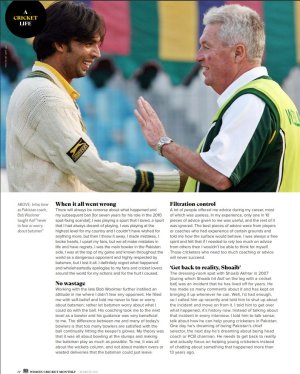
I was always confident about my abilities and working with the Late Bob Woolmer further instilled an attitude in me where I didn’t fear any opponent. He filled me with self-belief and told me never to fear or worry about batsmen, rather let batsmen worry about what I could do with the ball. His coaching took me to the next level as a bowler and his guidance was very beneficial to me. The difference with me and many of today’s bowlers is that too many bowlers bowl to the wicket-keeper and are satisfied with maiden overs or the ball continually hitting the wicket-keeper’s gloves. My theory was that it was all about bowling at the stumps and making the batsman play as much as possible. To me, it was all about the wickets column and not about maiden overs or wasted deliveries that the batsman could just leave.
A lot of people offered me advice during my career, most of which was useless. I always felt that a lot of the advice you get over the course of your career is of no use. In my experience, only one in ten pieces of advice given to me was useful, and the rest of it was ignored by me - it went into one ear, and out of the other ear. The best pieces of advice to me as a bowler were from players or coaches who had experience of certain grounds and told me how the surface would behave over the course of a day or during the 5 days of a Test match. I was always a free spirit and felt that if I needed to rely too much on advice from others then I wouldn’t develop as a cricketer or be able to think for myself. Those cricketers who need too much coaching or advice will never succeed.
The dressing room spat with Shoaib Akhtar in 2007 was an incident that Shoaib Akhtar has lived-off for 13 years. He has made so many comments about it and has kept on bringing it up whenever he can. Well, I had had enough, so I called him up recently and told him to shut up about the incident and move on from it. I told him to get over what happened, it’s history now. Instead of talking about that incident in every interview, I told him to talk sense, talk about how he can help young cricketers in Pakistan. One day he’s dreaming of being the Chief Selector, the next day he’s dreaming about being Pakistan’s Head Coach or Chairman PCB, he needs to get back to reality and actually focus on helping young cricketers instead of chatting about something that happened more than 13 years ago.
When I came back to cricket after my ban, I knew that I still had the skills and ability to play international cricket. At the time I said that a fish never forgets to swim, and I showed that with my impressive form in domestic cricket for WAPDA. I was bowling well and utilising my experience and I was still full of confidence. In fact, I was bowling so well at that I felt that I was like an adult bowling to kids in domestic cricket. I was toying with batsmen at the domestic level and Inzamam-ul-Haq called me up and said to me that I would be called up for a training camp for the national side. However, the Pakistan Super League fixing controversy of 2017 put paid to my future selection for Pakistan and that was that. The selectors ended up picking bowlers like Wahab Riaz who had not even taken half the number of wickets I had that domestic season and that was both heart-breaking and frustrating.
After participating in domestic cricket after my return I realised that there was a lot of favouritism and nepotism at play. Players were being picked based on who they knew rather than how good they were. Guys who were scoring 25 runs per innings were being labelled as great hopes and heroes. Bowlers with no performances were being given chance after chance, it was depressing and I knew people were trying to drop a hint to me to give up playing. I wanted to continue playing, but I started to think about alternatives to playing and focussed on coaching and I was asked to go to Afghanistan for a coaching stint with their young pace bowlers in 2016. However, the security situation meant that I had to decline the offer which was unfortunate as I was really looking forward to working with those youngsters.
I still get messages from fans all over the world saying that there will never be another Mohammad Asif and that makes me happy and proud. They say I made fast-bowling an art and that is what I wanted to do. For me bowling was about utilising your skills, not just about running in all day and breaking your back. There were bowlers who I called labourers, the type who bowled 25 overs a day and took 1 wicket, well, I wasn’t one of them. If I bowled 20 to 25 overs a day, I made sure that I had taken at least 4 or 5 wickets. For me, fast-bowling was all about skill, it was sorcery, it was an art, it was like a game of chess where you mesmerised the batsmen and you outmanoeuvred, out-thought and out-planned them.
These days I play club cricket around the world. I’ve played in Norway and more recently I’ve been playing in the United States. I’m available to play club cricket wherever teams want my services and I also do some coaching during those tournaments. I get a sense of joy and satisfaction teaching young cricketers about the art of pace-bowling. I plan to open a Cricket Academy in the United States with my friend Gurtej Singh who is keen to develop cricket in America and who has been hosting tournaments for several years out there. Let’s see what the future holds, I’m not someone who plans long-term, but coaching and working with young cricketers in an academy environment is something that I really enjoy.
When I look back at my career, despite the ban, whatever I achieved as a cricketer makes me proud. I want fans to always remember me as a thinking-bowler, with skill and intelligence, who fully tested batsmen. What makes me happy is when fans come up to me and say I remember the ball you bowled to get VVS Laxman out, or the ball that you bowled to Sachin Tendulkar, Virender Sehwag or Kevin Pietersen. I get great joy and satisfaction from the fact that young swing bowlers still watch my videos for inspiration and for coaching tips. What really makes me very happy is when young bowlers approach me and say that what they really hope for in their career is to one day be able to bowl like me.