What's new

India's ineptness in technology?

"Likes of you"? You are name calling and insulting instead of trying to refute/respond my assertion, especially when I did not hurl any personal insult towards you.
What do you for a living If I may ask? I promise to write a post addressing your question right after.

If I may guess, is it a bean counter? accountant? Auditor?
 
What do you for a living If I may ask? I promise to write a post addressing your question right after.

If I may guess, is it a bean counter? accountant? Auditor?
I'm not sure why what I do for a living matters instead of just addressing my question. Even if I choose to bite at this taunt -- perhaps answer what you do for a living first?

No, you may not guess what I do for a living. Not just because you are wildly inaccurate but you are also making assumptions based on your subjective bias+hatred and not based on the content of my post in this thread, which makes your assumption senseless.

Instead of trading insults or personal attacks, perhaps just engage in a valid discourse and answer my points especially when I'm openly admitting that I will change my opinion if presented with compelling facts? Or is it that you can only hurl insults and not engage in a reasonable discussion?
 
India had 27 years to become at least a known global entity for tech product based growth (be it software or hardware). But it has never happened ... why not? What did India lack despite investments, educational institutions, and IT workforce? Why did they never manage to jump that chasm between IT services and tech products in 27 years?
I think this is a far-fetched thing. IT revolution began on early 2000’s with much of 90’s barely having talent pool to work with. What started as a typical call center / operator jobs took 1-2 decades to move into actual value-added IT services.
India had 27 years to become at least a known global entity for tech product based growth (be it software or hardware). But it has never happened ... why not? What did India lack despite investments, educational institutions, and IT workforce? Why did they never manage to jump that chasm between IT services and tech products in 27 years?
India has decent tech products even today but we are directly competing with the US if we look at this from a product perspective. IT at the end of the day serves businesses which the Indian domestic market barely had in early 2000-10’s.

1. Today, India has one of the best FinTech products globally which is under-recognized. You are largely focusing on players like FAANG which are too big to compete but India produced some very good FinTech products (Paytm, Phonepay, Zerodha, GROW etc) which primarily serve domestic market. There is even no parallel if we compare the volumes they are able to handle currently with other Asia nations / West.
2. Our e-commerce players are no less than Alibaba product wise but the only difference is the presence of Chinese manufacturers which get recognized in the US. The quick-commerce products are as updated as any similar product in the US.
3. EdTech products are gradually expanding to MENA and upGrad is available in the US too.
4. Where we actually lag is the native social media apps. Jio has made the internet low-of cost in 2015-16 and that is the market shift. By, then penetration of US apps has become huge and entry barriers have become too big. I don't think we will see much activity in this space in the future too.
5. SaaS has producer mixed results as IT companies such as TCS, Wipro have produced some decent low-cost solutions which are customized but not universal. Zoho has picked up really well in its ERP solutions and with Indian government providing much required scale, it will be a key players in the next 4-5 years.

The true IT penetration happened 2015-25 with value-added services. So, its not as if India had some head-start. We struggled with Capital availability before. Overall, we did decently but not anything groundbreaking with overall B+ performance. We may not see universal products but customized solutions is what Indian startups are targeting currently.
Now your IT services bread and butter is at risk of being taken away due to agentic AI replacements. This can drastically hit the cashflows. Ramping up a new industry growth needs CapEx (capital expenditures) and traditionally unless the govt wants to spend its money to boost up a private sector industry (rare) then this CapEx comes from retained earnings thru cashflow. But if the cashflow is compromised then the ability to do this CapEx is also compromised. I do see other views regarding the growth of GCC centers in India and as a reason the cashflow may not be compromised but with the rise of agentic AI based solutions, GCC centers may also be slowed in the future.
The GCC centers are basically the core operations bases. Their growth is faster than ever growing at 20-25% in 2025. Only Hyderabad received 35+ fortune 500 GCCs and most of these roles are core-functions and not some support systems which India IT firms such as TCS/Wipro did. We never know the complete impact of AI but what I see in the market is quality of jobs improved while quantity may get affected. This makes it even tougher for them to move out of India as it is the only country that offers both cost and quality. Obviously GCC trend is not perpetual but once, it reaches certain level, India will have 10-15% of operational bases of most global MNCs which is equivalent to a structural integration of Indian workforce
 
I think this is a far-fetched thing. IT revolution began on early 2000’s with much of 90’s barely having talent pool to work with. What started as a typical call center / operator jobs took 1-2 decades to move into actual value-added IT services.

India has decent tech products even today but we are directly competing with the US if we look at this from a product perspective. IT at the end of the day serves businesses which the Indian domestic market barely had in early 2000-10’s.

1. Today, India has one of the best FinTech products globally which is under-recognized. You are largely focusing on players like FAANG which are too big to compete but India produced some very good FinTech products (Paytm, Phonepay, Zerodha, GROW etc) which primarily serve domestic market. There is even no parallel if we compare the volumes they are able to handle currently with other Asia nations / West.
2. Our e-commerce players are no less than Alibaba product wise but the only difference is the presence of Chinese manufacturers which get recognized in the US. The quick-commerce products are as updated as any similar product in the US.
3. EdTech products are gradually expanding to MENA and upGrad is available in the US too.
4. Where we actually lag is the native social media apps. Jio has made the internet low-of cost in 2015-16 and that is the market shift. By, then penetration of US apps has become huge and entry barriers have become too big. I don't think we will see much activity in this space in the future too.
5. SaaS has producer mixed results as IT companies such as TCS, Wipro have produced some decent low-cost solutions which are customized but not universal. Zoho has picked up really well in its ERP solutions and with Indian government providing much required scale, it will be a key players in the next 4-5 years.

The true IT penetration happened 2015-25 with value-added services. So, its not as if India had some head-start. We struggled with Capital availability before. Overall, we did decently but not anything groundbreaking with overall B+ performance. We may not see universal products but customized solutions is what Indian startups are targeting currently.

The GCC centers are basically the core operations bases. Their growth is faster than ever growing at 20-25% in 2025. Only Hyderabad received 35+ fortune 500 GCCs and most of these roles are core-functions and not some support systems which India IT firms such as TCS/Wipro did. We never know the complete impact of AI but what I see in the market is quality of jobs improved while quantity may get affected. This makes it even tougher for them to move out of India as it is the only country that offers both cost and quality. Obviously GCC trend is not perpetual but once, it reaches certain level, India will have 10-15% of operational bases of most global MNCs which is equivalent to a structural integration of Indian workforce

Finally a good answer and thank you for that! I will read through this again and post my response. Just an FYI - if I disagree or push back on some of these points with my assertions, it does not mean I'm trying to troll, please do not think so.
 

Modi's Semiconductor Boasts Mocked: No Clean Water, Yet Dreaming Big!​


India can't match China, your semi conductor failed in the 1980's, at that point was your best opportunity, now China, Taiwan, Usa are farr too ahead / advanced for india to competitive never ind catching to any of these countries:


Made in China 2025
Launched: 2015
Status: 86% success rate
Examples: Chinese EVs, DeepSeek, smartphones, shipbuilding, rare-earths, bio-tech, pharmaceuticals, robotics, semiconductors

Make in India Launched: 2014
Status: Failed
Example: Goals of increasing india's manufacturing share of GDP from 17% to 25% unrealised. Instead, it decreased to 13% of GDP by 2024

China focuses on actual growth. They focus on things which matter.

India is all about gimmicks and showing off.

This is why the gap is so huge. :inti
 
I think this is a far-fetched thing. IT revolution began on early 2000’s with much of 90’s barely having talent pool to work with. What started as a typical call center / operator jobs took 1-2 decades to move into actual value-added IT services.

India has decent tech products even today but we are directly competing with the US if we look at this from a product perspective. IT at the end of the day serves businesses which the Indian domestic market barely had in early 2000-10’s.

1. Today, India has one of the best FinTech products globally which is under-recognized. You are largely focusing on players like FAANG which are too big to compete but India produced some very good FinTech products (Paytm, Phonepay, Zerodha, GROW etc) which primarily serve domestic market. There is even no parallel if we compare the volumes they are able to handle currently with other Asia nations / West.
2. Our e-commerce players are no less than Alibaba product wise but the only difference is the presence of Chinese manufacturers which get recognized in the US. The quick-commerce products are as updated as any similar product in the US.
3. EdTech products are gradually expanding to MENA and upGrad is available in the US too.
4. Where we actually lag is the native social media apps. Jio has made the internet low-of cost in 2015-16 and that is the market shift. By, then penetration of US apps has become huge and entry barriers have become too big. I don't think we will see much activity in this space in the future too.
5. SaaS has producer mixed results as IT companies such as TCS, Wipro have produced some decent low-cost solutions which are customized but not universal. Zoho has picked up really well in its ERP solutions and with Indian government providing much required scale, it will be a key players in the next 4-5 years.

The true IT penetration happened 2015-25 with value-added services. So, its not as if India had some head-start. We struggled with Capital availability before. Overall, we did decently but not anything groundbreaking with overall B+ performance. We may not see universal products but customized solutions is what Indian startups are targeting currently.

The GCC centers are basically the core operations bases. Their growth is faster than ever growing at 20-25% in 2025. Only Hyderabad received 35+ fortune 500 GCCs and most of these roles are core-functions and not some support systems which India IT firms such as TCS/Wipro did. We never know the complete impact of AI but what I see in the market is quality of jobs improved while quantity may get affected. This makes it even tougher for them to move out of India as it is the only country that offers both cost and quality. Obviously GCC trend is not perpetual but once, it reaches certain level, India will have 10-15% of operational bases of most global MNCs which is equivalent to a structural integration of Indian workforce

Beginning of Indian IT growth - I see where you are coming from. I based my point from the data below and in my mind 1998 seemed like the foundation for growth year but I could be wrong since this is my interpretation. From the data it seems like 2000-2001 was when the IT export revenue kickstarted into higher growth rate. So this still gives 25+ years of consistent growth in IT expot revenue?

1766389485999.png

Fintech products - True this and interestingly some of these were considered for growth investments or acquisitions as part of our Indian investment arm's PE portfolio. The reason I'm hesitant to consider these as globally competitive Indian Fintech products is because they operate (and were able to grow + flourish) due to an unfair regulatory moat. Meaning, these companies flourished and had less competition due to the regulatory constraints in the Indian financial system on foreign based entities. Isn't that the case?

e-Commerce - True. Chinese manufacturing capabilities aid Alibaba. Ecommerce in general is a manufacturing+logistics+tech play, not just pure tech based market entry dynamics.

EdTech - This is one space I have been monitoring since 2012, the early days of Khan Academy. If anything I was expecting some Indian firm's entry given English prevalence, cheap tutors to aid the services component of a software play but this never seemed to be the case. UpGrad seems to rely on tie ups with US institutions for degrees which is a much more expansive and expensive offering especially at a time when vocational degrees seem more popular than costly AI susceptible college degrees. Forget the equivalent of UpGrad, why didn't India have its home grown equivalents of Coursera/Udemy/Udacity etc? By 2012 they had the cheap tutor workforce, tech workflorce for solution building, platform access for products, access to capital etc?

Social media apps - I think this is understandable tbh. Barring ByteDance (creator of TikTok), it has been difficult to compete against the power and deep pockets of American social media giants when English is the playing field. The Russian and Chinese social media companies flourished due to language moats.

SaaS products - This is where there is a clear gap and makes one question why it is so. I think FreshWorks and Zoho seem to be the only globally competitive Indian SaaS products in all these years which to me is super puzzling. The tech stack for many SaaS products since its early days (2008+) was in Java/PHP and later periods (2011+) also had Python (Django frameworks), Ruby etc. All of these tech stacks also had a big overlap with the areas of work by Indian IT services companies. So the tech workforce with know-how to build a SaaS product was there yet it never happened. This ties into my above point about EdTech (an area of vertical SaaS). The cliche saying for guaranteed failure in silicon valley is "Build it and they will come" because nobody comes if you just build a product, you also have to build a market. Does this mean India (barring Zoho, FreshWorks) does not have skills for global market development even if there is workforce for product development? Why so? At the very least they could hire global resources for that exactly like how FreshWorks or Zoho did? Lack of Capital was not an issue as I show below.

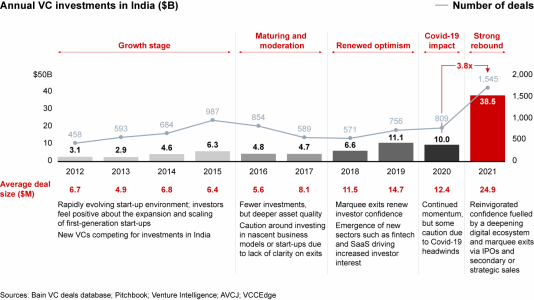
Capital Availability - There has been sizable capital inflow in terms of VC investments since 2012 time period. Please see the graph below. Even in 2012 India had $3.1B with average deal size of $6.1M which is a massive amount of funding for an early stage Indian tech startup even at current CPI (consumer price index) of India. So considering India's annual inflation rate (7%) this becomes a phenomenally high capital boost in 2012.

1766391662653.png

AI - This is one of the areas that you did not address. Even as of 2021 VC money into India was $38.5B and it is only bigger now in 2025. The average VC investment into an Indian tech startup is north of $25M today, which is a lot of money considering Indian tech workforce expense. Yet as of today, there is no breakthrough tech in LLMs or Gen AI from India. ChatGPT launched in 2022 and we have had many use case specific LLMs today from US and China. All of the LLM research is pure math (linear algebra to be specific) and software engineering layered on top to solution the concept. India has had this know-how. India has also had capital inflow (see data above) for the compute expenses but yet there is no major AI related breakthroughs from India.

Semiconductor - This is understandable since it is highly capital intensive and there is a rampup runway of 5-6 years after you set up a chip fabrication. Perhaps India is at least 25-30 years away from creating its own competitive GPU/TPU type chips even if they start today.

True IT penetration between 2015-2025 -- Are you referring to MSP type solutions as opposed to one time project based revenue when you say value added services? Didn't India already have hosted solution offerings and higher margin services at the top of the solution stack (value added) since 2008 timeframe itself albeit not as high as today? I'm in private equity (not a VC) and I recall some of our portfolio companies in Pharma and Biotech having their entire BPO+tech stack taken over by Indian services giants (think one of the WITCH companies). In any case what is the correlation between value added IT solutions versus the prevalence of tech workforce + capital availability (the vital factors for home grown tech products)?

GCC - I like how you worded this -- Obviously GCC trend is not perpetual but once, it reaches certain level, India will have 10-15% of operational bases of most global MNCs which is equivalent to a structural integration of Indian workforce. Yes it is true but it is still lower margin services work that is increasingly vulnerable to agentic AI. What I mean here is that even f that 10-15% is not immediately threatened, the growth rate of that segment will only get slower and slower due to tech disruption so it is not a ling term growing segment, wouldn't you agree?

Mind you that regardless of all of my questions above, I do appreciate India for having uplifted some level of middle class segment through their services industries. None of the South Asian countries have managed to do this at this extent (adjusted for their respective populations) and I wish Pakistan had achieved this as well. But this being said, one cannot help but wonder that despite this start, India has been unable to kick it into the next gear for more scalable product based growth (with lower marginal costs). One has to wonder if this is due to governance issues, higher workforce churn culture (product orgs need more stable teams that do not quit often) or any other reasons.
 
From the data it seems like 2000-2001 was when the IT export revenue kickstarted into higher growth rate. So this still gives 25+ years of consistent growth in IT expot revenue?
Of the IT exports, Engineering and R&D (co-creation, R&D, IP development etc) mix was minuscule prior to 2015. It reached 8% in FY24. BPO and ITes services heavily dominated prior which may provide revenue but not the adequate jobs for emerging talent. Even today, BPO services have 30-40% margins. Its quality vs quantity.
I recall some of our portfolio companies in Pharma and Biotech having their entire BPO+tech stack taken over by Indian services giants (think one of the WITCH companies). In any case what is the correlation between value added IT solutions versus the prevalence of tech workforce + capital availability (the vital factors for home grown tech products)?
If we compare the growth to the service category, Indian IT ecosystem specialized in B2B services category. Even today TCS and Infosys have their own SaaS products which are market leading such as Finacle, BaNCS etc catering to Banks for example. This is quite an achievement and thats how TCS/Wipro/Infy continued to grow. Majority of our talent pool went through H1-B path and we didn't witness the innovation until ER&D services started to build in India.
AI - This is one of the areas that you did not address. Even as of 2021 VC money into India was $38.5B and it is only bigger now in 2025. The average VC investment into an Indian tech startup is north of $25M today, which is a lot of money considering Indian tech workforce expense. Yet as of today, there is no breakthrough tech in LLMs or Gen AI from India. ChatGPT launched in 2022 and we have had many use case specific LLMs today from US and China. All of the LLM research is pure math (linear algebra to be specific) and software engineering layered on top to solution the concept. India has had this know-how. India has also had capital inflow (see data above) for the compute expenses but yet there is no major AI related breakthroughs from India.
I will try to find the relevant article but number of Indians working in Y-combinator start-ups is pretty high. I understand having LLMs is more of pride these days but even if you see DeepSeek from where it started to where it is now, China is way behind the West with a multitude of factors include Chips, training data sets and immature launch is what looks like DeepSeek. Now, I am not discrediting it but I refuse to accept it as a standard when it is still yet to mark its presence. Two Indian LLMs are expected to be released in 2026, and even it lags behind, we are what 1-year behind China? Its a race to build the product we need but not a product just to showcase.
Semiconductor - This is understandable since it is highly capital intensive and there is a rampup runway of 5-6 years after you set up a chip fabrication. Perhaps India is at least 25-30 years away from creating its own competitive GPU/TPU type chips even if they start today.
Only Taiwan and US are ahead in Chips production and even China lags behind. India has a very good IP base for hardware coding and shouldn't be a problem once we scale up. Our first semi-con prod will be live in next 2 years and ~7 manufacturing units are set to be operational by 2030. I am not making tall claims but we would have no-issues making Chips for mobiles and tablets, but will be reliant on imports for AI-based.
What I mean here is that even f that 10-15% is not immediately threatened, the growth rate of that segment will only get slower and slower due to tech disruption so it is not a ling term growing segment, wouldn't you agree?
I agree that growth rate will be moderated. But understand that till now, Indians are working on say TCS payroll vs working on say Vanguard / Eli Lily payroll. We have Novartis core research happening in Hyderabad while Eli Lily’s Data science division is also based in Hyderabad. JPMC, Novartis, Google, Amazon etc will have ~10-15% of their workforce in India. Thats a structural dependency on core-operations. While they may be impact by AI, its more of a functional change than a structural shift taking these operations out of India. And its impact on talent ecosystem is very understated right now.
India has been unable to kick it into the next gear for more scalable product based growth (with lower marginal costs). One has to wonder if this is due to governance issues, higher workforce churn culture (product orgs need more stable teams that do not quit often) or any other reasons.
When people say Indian engineering colleges needs to train better, the reality is that 15-20 years back, there were jobs only for basic coding and our colleges followed them like a herd of sheep. Only when diverse opportunities are available does the talent grow, which happened only in the last 5-10 yrs. And Indian IT companies were also complacent. One of the core issue.
 
What do you for a living If I may ask? I promise to write a post addressing your question right after.

If I may guess, is it a bean counter? accountant? Auditor?
You accused the person you are arguing with as a TROLL, and then trolling the person asking for source of income. You wanna be relevant, stop trolling yourself!
 
You accused the person you are arguing with as a TROLL, and then trolling the person asking for source of income. You wanna be relevant, stop trolling yourself!
Dude, that was a honest question. least troll post that I have ever made on PP.
 
Of the IT exports, Engineering and R&D (co-creation, R&D, IP development etc) mix was minuscule prior to 2015. It reached 8% in FY24. BPO and ITes services heavily dominated prior which may provide revenue but not the adequate jobs for emerging talent. Even today, BPO services have 30-40% margins. Its quality vs quantity.

If we compare the growth to the service category, Indian IT ecosystem specialized in B2B services category. Even today TCS and Infosys have their own SaaS products which are market leading such as Finacle, BaNCS etc catering to Banks for example. This is quite an achievement and thats how TCS/Wipro/Infy continued to grow. Majority of our talent pool went through H1-B path and we didn't witness the innovation until ER&D services started to build in India.

I will try to find the relevant article but number of Indians working in Y-combinator start-ups is pretty high. I understand having LLMs is more of pride these days but even if you see DeepSeek from where it started to where it is now, China is way behind the West with a multitude of factors include Chips, training data sets and immature launch is what looks like DeepSeek. Now, I am not discrediting it but I refuse to accept it as a standard when it is still yet to mark its presence. Two Indian LLMs are expected to be released in 2026, and even it lags behind, we are what 1-year behind China? Its a race to build the product we need but not a product just to showcase.

Only Taiwan and US are ahead in Chips production and even China lags behind. India has a very good IP base for hardware coding and shouldn't be a problem once we scale up. Our first semi-con prod will be live in next 2 years and ~7 manufacturing units are set to be operational by 2030. I am not making tall claims but we would have no-issues making Chips for mobiles and tablets, but will be reliant on imports for AI-based.

I agree that growth rate will be moderated. But understand that till now, Indians are working on say TCS payroll vs working on say Vanguard / Eli Lily payroll. We have Novartis core research happening in Hyderabad while Eli Lily’s Data science division is also based in Hyderabad. JPMC, Novartis, Google, Amazon etc will have ~10-15% of their workforce in India. Thats a structural dependency on core-operations. While they may be impact by AI, its more of a functional change than a structural shift taking these operations out of India. And its impact on talent ecosystem is very understated right now.

When people say Indian engineering colleges needs to train better, the reality is that 15-20 years back, there were jobs only for basic coding and our colleges followed them like a herd of sheep. Only when diverse opportunities are available does the talent grow, which happened only in the last 5-10 yrs. And Indian IT companies were also complacent. One of the core issue.
Thank you for the good responses @Theanonymousone
 

AI fraud: 700 Indian engineers did the work while Builder.ai claimed it was AI​


London-based Builder.ai, once hailed as a no-code AI unicorn, claimed its AI assistant could build apps autonomously. In truth, the company relied on 700 engineers in India.

A high-profile tech startup that marketed itself as a revolutionary AI platform for building apps has been exposed for operating under false pretences. Builder.ai, founded in 2016 by Sachin Dev Duggal, positioned itself as a no-code platform that used artificial intelligence to build custom software. But behind the slick marketing and billion-dollar valuation, the company was relying on 700 Indian engineers to manually write code—while clients and investors were led to believe it was all being done by an AI assistant.

At its peak, Builder.ai—formerly known as Engineer.ai—claimed to make software development “as easy as ordering pizza”, powered by its flagship AI tool Natasha. The startup raised more than $450 million, with a valuation touching $1.5 billion, backed by tech and financial giants including Microsoft, the Qatar Investment Authority, SoftBank’s DeepCore, and the IFC.

The AI That Wasn’t

Builder.ai’s pitch to the world was simple: let AI build your app, quickly and affordably. Its supposed innovation, Natasha, was touted as the secret sauce that automated software development. But insiders and investigators discovered that the AI capabilities were grossly exaggerated. Natasha was little more than a front-end interface that captured client inputs before the heavy lifting was sent to large engineering teams in India, who would write the code manually.

Former employees revealed that “there was no real AI”—a sentiment echoed by Robert Holdheim, a former executive who sued Builder.ai for $5 million. He claimed he was fired after raising concerns about deceptive practices and misleading marketing to investors. Internal documents showed that apps were advertised as being “80% built by AI” when in fact, the tools behind Natasha were barely functional.

Things took a sharper turn in early 2025 when Manpreet Ratia replaced Duggal as CEO in a last-ditch effort to regain credibility. What he found was alarming. Builder.ai had claimed $220 million in revenue for 2024, but an independent audit revealed the actual figure was closer to $50 million.

The financial manipulation prompted Viola Credit, a lender, to seize $37 million from Builder.ai’s accounts. Left with just $5 million in restricted funds, the company was no longer able to meet payroll or maintain global operations.
In a rare public admission, Builder.ai published a statement on LinkedIn, acknowledging its failure: “Despite the tireless efforts of our current team and exploring every possible option, the business has been unable to recover from historic challenges and past decisions that placed significant strain on its financial position.”

Bankruptcy filings have now been initiated in jurisdictions where the company operated, including India, the United Kingdom, and the United States. Nearly 1,000 employees have been laid off, and several client projects remain incomplete.


More Than Marketing: Allegations of Fraud

The fallout doesn’t stop with misrepresentation. Builder.ai is now under scrutiny for possible financial misconduct, including round-tripping—a tactic where revenue is inflated through circular transactions—with Indian tech firm VerSe. These moves allegedly helped the company project inflated growth to attract fresh funding.

Reports also indicate that Builder.ai owes $85 million to Amazon and $30 million to Microsoft for unpaid cloud services. A US federal investigation is now underway, with authorities seeking access to financial data and client contracts.
The Builder.ai scandal is now at the centre of a broader reckoning over “AI washing”—a growing trend in which startups exaggerate or falsify their AI capabilities to secure investments.

Phil Brunkard, Principal Analyst at Info-Tech Research Group, remarked: “Many of these so-called AI firms scaled on narrative, not infrastructure. They lacked the technical backbone or governance to deliver on what they promised.”
With regulators turning a sharper eye toward AI claims in marketing, Builder.ai has become a cautionary tale for founders, investors, and the broader tech ecosystem.


Really pathetic stuff, shameful ,

fellow indins, how do we stop these incidents from occuring:

@Rajdeep @cricketjoshila @Champ_Pal @JaDed @Devadwal @uppercut @Theanonymousone @straighttalk @Vikram1989 @RexRex @Varun @Romali_rotti @Bhaijaan @Cover Drive Six @rickroll @rpant_gabba, @Romali_rotti
 
Exclusive: How Indian scammers built a multi-billion-dollar global fraud empire


In the world’s most populous country, where unemployment is widespread, youngsters look at scamming as just another job and not any criminal activity.


Sandeep Khatri* was quiet when he entered the rented flat in New Delhi where we had agreed to meet. The blinds were drawn, and the ceiling fan creaked as he settled into a corner of the room, adjusting the cap that hid most of his face.

It had taken TRT World days of negotiation to get him here, on the condition that his identity be concealed, and his real workspace or photograph not be revealed.

The 27-year-old from Gurugram, a booming tech and finance city on the outskirts of Delhi, wasn’t always a scammer. Until a few years ago, he was a jobless college dropout, bouncing between low-paying gigs. “Nothing stable. Nothing dignified,” he said. “Just desperation.”

Then one night, sitting beside a friend who had landed a “tech support job,” he watched it unfold in real time: a voice calmly convincing a man that his computer had been hacked. “My friend made 80 dollars in under five minutes,” Khatri said. “That was more than I had earned in two months.”

He was hooked.

What followed was a crash course in cyber fraud: how to speak in an American accent, when to sound friendly, when to sound firm, which script to follow, and how to trigger panic.

He learned fast. Within weeks, he was pretending to be a technician from Amazon, Microsoft, or even the Internal Revenue Service (IRS) of the United States, depending on the day’s assignment.

The “office” where he works — though he refused to reveal its location — is a rented flat, he said, like the one where we met him, fitted with cheap partition walls, broadband connections, and rotating teams. “Every six months, we try to move,” he said. “You don’t stay in one place too long.”

Across India, thousands of unemployed young people like Khatri are quietly fuelling a multi-million-dollar cyber scam industry that snowballs by the day.

This burgeoning enterprise has garnered significant attention from international law enforcement agencies, including the FBI, the federal investigation agency of the US, and Interpol, the international criminal police organisation, leading to diplomatic challenges for New Delhi.

What was once a fringe criminal activity has evolved into a parallel economy, complete with training centres, managers, performance targets, and international revenue flows, all cloaked behind a screen and an English accent.

A scammer in Haryana’s Mewat region speaks on the phone with a victim during an extortion attempt, typically carried out during office hours. Mewat is widely known as the cyber scam capital of India (Danish Pandit).

A scammer in Haryana’s Mewat region speaks on the phone with a victim during an extortion attempt, typically carried out during office hours. Mewat is widely known as the cyber scam capital of India (Danish Pandit).
Western nations — particularly the US, Canada and the United Kingdom — are increasingly feeling the impact of these scams, with scammers in India routinely impersonating officials from agencies like the IRS, Drug Enforcement Administration (DEA, a US federal agency) and US Citizenship and Immigration Services (USCIS) to extract money from foreign nationals.

In response to mounting international pressure, Indian law enforcement agencies are launching collaborative operations to combat these transnational crimes.

For instance, last year, India’s Central Bureau of Investigation (CBI), with support from the FBI and Interpol, dismantled a sophisticated cyber-enabled financial crime network based in the National Capital Region (NCR) of India, arresting 43 individuals involved in defrauding victims of over $20 million.

Unemployment fuelling scam industry

Some 800 km away, in the India-administered Kashmir, Waseem Mir*, 28, is currently on the run, avoiding the intense crackdown on cyber fraud by the police.

Recently, authorities in the conflict-torn region launched coordinated raids across its capital city, Srinagar and neighbouring areas, uncovering a sprawling network of over 7,200 accounts linked to scams. Several individuals connected to these operations, including some of Mir’s former associates, have been arrested.

Mir so far continues to evade capture. He spoke to TRT World from a friend’s phone from an undisclosed location while on the run. “The police are after the entire syndicate. They are prowling on us like dogs. (sic),” he said.

His journey into cyber fraud began with a shaky call to Kansas, US, with Mir pretending to be from “Windows Support”. At the time, his palms sweated, and his voice cracked, but the American on the other end fell for it. A few hours later, $700 was wired into his digital wallet in India. “After that, I knew this was it,” Mir said. “I was done chasing job interviews.”

Mir, once an aspiring IT professional, turned to scams after repeated job rejections and seeing his peers thriving in the “calling” business. His operations now target victims in the US, UK, and Canada, tricking them into paying hundreds of dollars through fake tech support or refund scams.

“The victims are rich. We are not,” he said flatly. “To us, it feels like reverse colonialism.”

It is a rationale that echoes across India’s informal scam economy, where stories like Mir’s are not outliers but increasingly common.

A group of young scammers operates from an open field in Mewat, Haryana.

A group of young scammers operates from an open field in Mewat, Haryana.
TRT World spoke to around a dozen scammers for the story who had similar tales to share.

Raju*, 24, an “employed scammer” who runs his part of the operation from a rented apartment office in suburban Delhi, said a lack of a good job led him to this work. After completing a vocational training programme from a technical institute, he struggled to find work in a saturated job market. The call centre job he landed sounded legitimate — until it didn’t.

“It was only in the second week when I saw what we were really doing — asking for remote access, pushing pop-ups, pretending to be from Microsoft — that I understood the actual nature of my work,” he said. But by then, the money had started coming in.

Raju now handles the backend: managing digital wallets, coordinating SIM card purchases, and laundering funds through mule accounts. “It’s like running a company,” he said.

Elsewhere, the industry is thriving not in city apartments, but in dusty, overlooked districts.

When TRT World met Sultan Kareem*, 30, at his modest home in Mewat, a predominantly rural region in the north Indian state of Haryana, he was candid about how cybercrime had become a way of life in his village. Job scarcity and systemic neglect have made cybercrime an alternative economy in the entire region.

Over the past decade, the region has gained notoriety as a national hotspot for cyber fraud, with entire networks operating across villages and involving hundreds of young, unemployed men. The area’s dense clusters of poverty, low literacy, and lack of employment have created fertile grounds for such rackets to flourish, often with little fear of consequences.

“No one in my village has ever gotten a government job,” Kareem said. “So when someone offers training, a headset, and 25,000 rupees (about $300) a month, you say ‘yes’.”

According to the India Employment Report 2024, jointly published by the International Labour Organisation (ILO) and the Institute for Human Development (IHD), individuals aged 15 to 29 account for a staggering 83 per cent of the country’s unemployed population.

With limited access to stable jobs and few pathways into the formal economy, many young Indians are turning to online fraud, not just as a hustle, but as their primary livelihood.

For those who succeed, the rewards can be substantial.

Top scammers in his circle easily earn Indian rupees 0.1 million (about $1,200) a month — a figure that dwarfs salaries in many legitimate tech support jobs. “I have bought a luxurious car, I help run the house, and I even save a lot,” Kareem said with pride. “What else does a job need to be?”

Kareem, who calls himself an "intermediary" in the scam chain, claims to manage a team of five to six people. “One guy recently made INR 0.3 million (about $3,600) from just one victim. Some have earned up to INR 5 million (around $60,000) over a year,” he said.

A scammer looks at his phone while operating from an open field in Mewat, Haryana (Danish Pandit).

A scammer looks at his phone while operating from an open field in Mewat, Haryana (Danish Pandit).
Many of these scam operations are run from indoor setups resembling makeshift call centres.

However, some scammers – particularly in rural areas like Mewat – prefer more mobile arrangements.
In these regions, it’s not uncommon to find young men perched in fields or near roadside eateries, using nothing more than a smartphone and strong cell reception to run their scams.

These open-air spots also offer a quick escape in case of a police raid, making them a tactical choice.

Organised, scalable, and invisible

Foreign nationals are typically targeted through tech support or refund scams, where Indian scammers pose as representatives from companies like Microsoft or government agencies.

They cold-call or send pop-up alerts warning victims of fake security issues. Once victims respond, the scammers gain remote access to their computers, run bogus diagnostics, and convince them to pay for unnecessary services or “refunds”.

Payments are extracted through gift cards, wire transfers, or cryptocurrency, often routed through complex networks to avoid detection.

Cybercrime expert Prabesh Choudhary, founder of Cryptus Cyber Security Pvt. Ltd, has tracked these operations for over a decade. According to him, the scam industry has evolved into an informal sector with its own hierarchy, roles, and systems of operation.

“These are not a few lone hackers,” Choudhary said. “We are talking about entire call centres, with HR departments, training modules, and supervisors.”

According to Choudhary, many of these centres masquerade as legitimate tech-startups or back-office business processing centres.

“The scams operate with a lot of precision: calling scripts are shared, psychological manipulation tactics taught, and new recruits trained to handle angry or suspicious targets. The fraudsters use VPNs, spoofed caller IDs, and different digital and cryptocurrency wallets to cover their tracks,” Choudhury said.

While the Indian authorities have occasionally cracked down on high-profile scam centres — including dramatic raids coordinated with the FBI — experts say prosecution is rare and convictions even rarer.

“There is a clear gap in cyber enforcement,” said Pavan Duggal, a Supreme Court lawyer and one of the country’s leading voices on cyberlaw. “There is no dedicated law on spam in the country, and we don't have dedicated cybercrime laws. Also, India's cybercrime conviction ratio is less than 1 per cent, which doesn’t help,” he said.

A 17-year-old scammer from India who has been involved in cyber fraud for the past three years (Danish Pandit).

A 17-year-old scammer from India who has been involved in cyber fraud for the past three years (Danish Pandit).
Duggal explained that the problem is compounded by the absence of enforcement mechanisms and the delay in implementing key regulations. “We also have not yet implemented the Digital Personal Data Protection Act 2023, because the government is still working on its draft rules,” he said.

The Act, once fully enforced, is expected to provide a legal framework for how personal data is collected, stored, and used — critical tools for tracing digital fraud and holding platforms accountable. Yet, even 20 months after the law was passed, the government remains in the process of finalising its operational guidelines.

In this vacuum, India has become, in Duggal’s words, “a destination hub or a fertile ground for growth of all these kinds of spam-related calls,” many of which are “manifestations of internet fraud or cyber fraud activities.”

The lack of deterrence in India’s legal system, according to Duggal, has only made matters worse, allowing scammers to operate with a sense of impunity.

“The absence of any effective convictions in the country further emboldens them. Also, the existing law makes almost all of these online crimes bailable offences, thereby giving an impression to all cyber criminals that the law is soft on them,” he said.

Duggal also advocates for urgent reform of India’s cyberlaws. “We need a dedicated Cybercrime Act, one that understands the new age of scams and has built-in protocols for rapid prosecution, victim redress, and international coordination.”

But while legal experts like Duggal call for stronger deterrence through better laws, the ease and low cost of setting up a scam operation in India continues to fuel its rapid growth.

Some fraudsters operate solo, spending as little as INR 50,000 ($600) on a second-hand laptop, a smartphone, and a stable internet connection.

But larger, more organised scam operations — often mimicking legitimate call centres—can cost upwards of INR two million ($24,000), excluding rent.

These setups may involve teams of 10 to 40 people, each assigned roles from tech support to payment processing, making the operations look startlingly professional.

A parallel economy

The scale of this cyber scam industry in the country is staggering.

According to data from the National Cyber Reporting Platform, which functions under the Ministry of Home Affairs, swindlers cheated people out of 331.65 billion Indian rupees (approximately $3.88 billion) over the past four years, with INR 228.12 billion ($2.67 billion) lost in 2024 alone.

Fueled by India's digital payments boom and inconsistent cyber law enforcement, these scams have grown increasingly complex.

According to Choudhary, the cybercrime economy is now so entrenched that it mimics the structure of traditional employment sectors. “There are recruiters, resellers of data, trainers, even headhunters. Some people specialise in acquiring leads — emails, phone numbers, personal data — and sell them in bulk.”

“In just Delhi-NCR, there were more than a thousand such tech support companies running in 2017-18,” he said. “That was before COVID. After that, the modus operandi changed, but the scale didn’t shrink. They just got smarter.”

 One of the scammers speaks to a victim on a call in Mewat, Haryana (Danish Pandit).

One of the scammers speaks to a victim on a call in Mewat, Haryana (Danish Pandit).
According to Choudhary, many of the scammers come from modest backgrounds and have little formal education.

“They have hardly passed the 12th standard. Some are school or college dropouts,” he said. “They do it because they don’t have another way to earn money. It’s quick. You scam someone and you get instant money — no waiting for a monthly paycheck.”

Fuelled by low entry barriers and high returns, this scam ecosystem has evolved into an informal economy that mirrors the structure of legitimate businesses.

Within this ecosystem, individuals like Kareem see themselves less as criminals and more as entrepreneurs. He describes his work in corporate terms. “We do ‘pitch meetings.’ We close sales. It is just that our product is fake,” he said with a shrug.

“But the hustle is real.”
 
Back
Top