What's new

Sati in Modern India: Legally Banned, Socially Persistent?

So the British had to invade India and than place a ban on Sati.

As an Indian, does this bother you? @Bhaijaan
Outsiders coming and banning your religious practices
Nope.
Sati was never widely prevalent in India. Some idiots may have been following it in 18th century. I am glad British banned it outright.

I have mentioned it before, there are tons of widows even in Hindu Texts that lived their full life. It has no religious stamp on it and there are no rules that it should be enforced. Just because some idiots do it to weed out women who they think are burden on the family does not mean it is part of Hindu culture.
 
@Major, didn't British ban Slavery in Arab countries? A religious practice among Muslims for the past 1400 years and some unbeliever comes and bans it?
 
For the mighty British that thankfully banned Sati in India, they were practicing the art of "Burning Witches" aka women they do not like until 17th century.
Scotland was burning women who were accused of witchcraft well into 18th century. An estimated 2000 women were burned alive by the people of British Isles. Very noble these people are.

Then again, we don't try to take moral high ground like some do on this board to feel better about themselves.

It was only after the West accepted scientific approach to issues, they started seeing the pathetic nature of religion in general and started outlawing or banning some religious and social practices in their homelands and the lands faraway they ruled. :dw :facepalm
 
For the mighty British that thankfully banned Sati in India, they were practicing the art of "Burning Witches" aka women they do not like until 17th century.
Scotland was burning women who were accused of witchcraft well into 18th century. An estimated 2000 women were burned alive by the people of British Isles. Very noble these people are.

Then again, we don't try to take moral high ground like some do on this board to feel better about themselves.

It was only after the West accepted scientific approach to issues, they started seeing the pathetic nature of religion in general and started outlawing or banning some religious and social practices in their homelands and the lands faraway they ruled. :dw :facepalm

Why don't you condemn sati without resorting to whataboutism and deflection? :inti

We are discussing evil of sati here. No need to bring up other topics. Stick to topic. :inti
 
Why don't you condemn sati without resorting to whataboutism and deflection? :inti

We are discussing evil of sati here. No need to bring up other topics. Stick to topic. :inti
I have repeatedly condemned sati. Read my posts without the green tinted glasses. I called it a pathetic practice that some were doing. Also, do not conflate sati with Jauhar.

Pointing out what was happening in British isles is pertinent to the topic as the usual suspects are pitting Brits on a higher pedestal to put down Indian culture.

Both are similar. Burning women for which is not their fault. Your own glorified culture was no better for women. But it is a different topic🙄
 
Topic: Sati

Indians: What about slave trade? What about European witch burning? What about Timbuktu? :inti

Very toddler-like mindset. :inti
 
Topic: Sati

Indians: What about slave trade? What about European witch burning? What about Timbuktu? :inti

Very toddler-like mindset. :inti
Nah.

We condemned the practice as a backward stupid thing. Whoever practiced it are scoundrels and worst of humans ever.

Now, condemn the slavery in Arabia right from Prophet's time till 1960's if you have the same integrity that you claim to be.
 
Trump imposed tariffs all over the world, stock market down world wide, rats as big as house cats swarming Birmingham streets, British MPs lining up to build airport in Mirpur, WAQF board bill been discussed in Indian parliament, Israel continuing its offence on Palestine, daddy league IPL is on...so many things happening world wide but we are discussing Sati.

:kp
 
Trump imposed tariffs all over the world, stock market down world wide, rats as big as house cats swarming Birmingham streets, British MPs lining up to build airport in Mirpur, WAQF board bill been discussed in Indian parliament, Israel continuing its offence on Palestine, daddy league IPL is on...so many things happening world wide but we are discussing Sati.

:kp
Its funny when the title of the thread says Sati is still persistent.

One can call something persistent if like 10-20% of the population are still practicing some abhorrent ancient custom. If the number of cases are 0.00000001% of the population, then it is not a persistent problem. It is more of an aberration.

The usual suspects want to feel good about themselves with nothing going their way. Its a coping mechanism.
 
For the mighty British that thankfully banned Sati in India, they were practicing the art of "Burning Witches" aka women they do not like until 17th century.

Then again, we don't try to take moral high ground like some do on this board to feel better about themselves.


It was only after the West accepted scientific approach to issues, they started seeing the pathetic nature of religion in general and started outlawing or banning some religious and social practices in their homelands and the lands faraway they ruled. :dw :facepalm

To be honest, this is exactly what you do, and the whole of cyberspace is awash with your people doing it. If you didn't, then you would be like Sri Lankans or Chinese, just doing your own thing and not posting on here at all.
 
To be honest, this is exactly what you do, and the whole of cyberspace is awash with your people doing it. If you didn't, then you would be like Sri Lankans or Chinese, just doing your own thing and not posting on here at all.

Sri Lankans and Chinese are pleasant and intelligent people. It is an insult to compare them to online bhakts. :inti

Your post reminded me of this video:

 
To be honest, this is exactly what you do, and the whole of cyberspace is awash with your people doing it. If you didn't, then you would be like Sri Lankans or Chinese, just doing your own thing and not posting on here at all.
Nice try Cap. I criticize Hinduism for its own evils. I am calling Sati an evil practice.

All I am asking the usual suspects is to criticize the evils in their own cult. I don’t think it is too much to ask.👍
 
Nice try Cap. I criticize Hinduism for its own evils. I am calling Sati an evil practice.

All I am asking the usual suspects is to criticize the evils in their own cult. I don’t think it is too much to ask.

Nice try champ, but you are an atheist Hindu 1743699199431.png whatever that means. Your criticism is just veiled apologism. Your "criticism is just a cover so you can join in with your Hindu comrades in going after Islam.
 
Nice try champ, but you are an atheist Hindu View attachment 152907 whatever that means. Your criticism is just veiled apologism. Your "criticism is just a cover so you can join in with your Hindu comrades in going after Islam.
I criticize anything that is wrong. No cover up.
It is very obvious who ignores the obvious evils in their own cult.
 
I criticize anything that is wrong. No cover up.
It is very obvious who ignores the obvious evils in their own cult.
Yes it is Hindus, and that is why their politicians need to go after even their own Muslims in order to appeal to their majority vote base.
 
Yes. Evil exists only in Hinduism. Others are all as white as milk.🤡

There are a couple of genuine Indians here who are either atheist or agnostic Hindus, possibly even observant Hindus in their own understanding. They tend to see things without the overt saffron specs on, and are able to view their own leadership objectively. You for all your claims of atheism are definitely not one of them.
 
I already mentioned where it was mentioned in Hindu Texts. One of them is Shiva's wife Sati(on whose name the practice was named). Then we have one incident in Mahabharata(Madri).

There were hundreds of widows in Mahabharata and Ramayana. No one ever committed Sati. For example Pandavas Matriarch Kunti was a widow. She lived her full life as a Maharani and she is the widow of Pandu. Same with Lor Ram's mother. They all lived after King Dashrath passed away. There are countless widows in the entire epics(Ramayana, Mahabharata) that never even considered Sati. They all lived on and moved on after their husband's death.

It is mentioned in other scriptures as well. Smriti and Purans , which also gives conditions of when it can be practiced.

For eg Parasara Smriti , Agni Puran etc.

In Valmiki Ramayan Vedvati also committed sati . Utara Kanda.
 
No need to make it into a religious issue. Sati is despicable and was rightly banned. And thats how all religions should be. The religious books are a guide to be a better person, not something you follow to the T and not something that you cant question. And it should apply to "every" religion.
If according to you religious books are a guide to be better person , why did you need to reform that ?
You yourself sati is despicable , so how can a book to guide people have despicable thing ?

If we are not supposed to follow a religious book , how are we supposed to be guided? Guidance without following !

Can you kindly shed some light to what you wrote?
 
It is mentioned in other scriptures as well. Smriti and Purans , which also gives conditions of when it can be practiced.

For eg Parasara Smriti , Agni Puran etc.

In Valmiki Ramayan Vedvati also committed sati . Utara Kanda.
Vedavati -
Ravana tried to molest Vedavati and her chastity was sullied beyond Ravana's redemption when she was performing penance to become the consort of Vishnu. Vedavati immolated herself on a pyre to escape Ravana's lust, vowing to return in another age and be the cause of Ravana's destruction. She was duly reborn as Sita. She committed suicide. No one burned her forcefully.

Regarding Parashara Smriti, it was written by Maharshi Parashara. It is not a divine revelation. Not a sacred text like Ramayana or Bhagavad Gita.

Hinduism has Vedas, Shruti and Smriti.

Vedas are supposed to be divine revelations.
Shruti's are also considered second in line to Vedas. In fact, Vedas are part of Shruti and are considered the most sacred.
Smriti is what is written down from memory and are not authoritative.


Since you are a Muslim, I will give you a correlation. For you, Quran is the most authoritative followed by Hadiths and followed by the Seerah of Prophet Muhammad. You will not take the ramblings of Fakirs, Peers who studied Islam as authoritative. Its the same in Hinduism. Vedas, followed by Upanishads. That is for Brahmins. Outside of Brahmins, no one knows Vedas and Upanishads. Its all about Ramayana and Mahabharata and Bhagavad Gita.
What Rishis like Parashara or Yagnavalyaka or Gautama or Bhrigu etc said is immaterial. What they said is not authoritative.

If you show examples from Gita or Ramayana or Vedas, then it should be accepted.
 
There are a couple of genuine Indians here who are either atheist or agnostic Hindus, possibly even observant Hindus in their own understanding. They tend to see things without the overt saffron specs on, and are able to view their own leadership objectively. You for all your claims of atheism are definitely not one of them.
This is what you can come up with? :facepalm

Everything should be condemned. Not selective. One is not holier than the other. I hope you agree with me at least on this.:rolleyes:
 
Last edited by a moderator:
Vedavati -
Ravana tried to molest Vedavati and her chastity was sullied beyond Ravana's redemption when she was performing penance to become the consort of Vishnu. Vedavati immolated herself on a pyre to escape Ravana's lust, vowing to return in another age and be the cause of Ravana's destruction. She was duly reborn as Sita. She committed suicide. No one burned her forcefully.

Regarding Parashara Smriti, it was written by Maharshi Parashara. It is not a divine revelation. Not a sacred text like Ramayana or Bhagavad Gita.

Hinduism has Vedas, Shruti and Smriti.

Vedas are supposed to be divine revelations.
Shruti's are also considered second in line to Vedas. In fact, Vedas are part of Shruti and are considered the most sacred.
Smriti is what is written down from memory and are not authoritative.


Since you are a Muslim, I will give you a correlation. For you, Quran is the most authoritative followed by Hadiths and followed by the Seerah of Prophet Muhammad. You will not take the ramblings of Fakirs, Peers who studied Islam as authoritative. Its the same in Hinduism. Vedas, followed by Upanishads. That is for Brahmins. Outside of Brahmins, no one knows Vedas and Upanishads. Its all about Ramayana and Mahabharata and Bhagavad Gita.
What Rishis like Parashara or Yagnavalyaka or Gautama or Bhrigu etc said is immaterial. What they said is not authoritative.

If you show examples from Gita or Ramayana or Vedas, then it should be accepted.

I do not expect this from you. Muslims can talk about authenticity because they have a hadeeth grading system , rijal .
Hindus should not be talking about that.

The Ramayana or Gita itself have different versions , and you are also aware of that.

But I agree with your point about Shruti and Smriti. Yet , these smritis and dharamasutras act as jurisprudence.

Most Hindus do accept Purans and Upanishads.
 
I do not expect this from you. Muslims can talk about authenticity because they have a hadeeth grading system , rijal .
Hindus should not be talking about that.

The Ramayana or Gita itself have different versions , and you are also aware of that.

But I agree with your point about Shruti and Smriti. Yet , these smritis and dharamasutras act as jurisprudence.

Most Hindus do accept Purans and Upanishads.
Hindus also have the heirarchy of scriptures.

Vedas>>Shruti>>>Smriti

No one knows who Rishi Parashara or Kapila or Angirasa are. Everyone wrote their musings and opinions aka Smritis. Not belittling their work or their credibility. But these rishis are a dime in a dozen in ancient India. No one takes their opinions seriously.

There are several Smritis. 18 major ones and many other minor ones. Many rishis wrote and orated them. Yes, they do form the Hindu Jurisprudence. But not all of it. Sati was not part of Hindu Jurisprudence. If it were, most Indian women would have committed suicide upon their husband's death. Ex - Pandava's mother Kunti and King Dasarath's 4 wives who were widows upon Dasarath's death.

Ramayana and Mahabharata are Itihasas. They are the most sacred to all Hindus. Even Bhagavad Gita is part of Mahabharata which is part of Itihasa.

Vedas and Upanishads are only important for Brahmins and to some extent Kshatriyas. No other castes learned them and in fact many were barred from learning them as per Manu Smriti. Again, the same Smriti which I repeatedly lampoon and laugh at. No Hindu knows what Manu Smriti is and no one has ever read it. No one keeps a copy of them in their prayer room to read them.

To answer your question, Hinduism does not have a single scripture like Quran to Islam and Bible to Christianity. Different groups of Hindus follow different scriptures. Ramayana, Mahabharata and Bhagavad Gita are the most accepted Hindu Books that fits all castes. Vedas, Shrutis and Smritis are rejected by many Hindu communities.
 
If according to you religious books are a guide to be better person , why did you need to reform that ?
You yourself sati is despicable , so how can a book to guide people have despicable thing ?

If we are not supposed to follow a religious book , how are we supposed to be guided? Guidance without following !

Can you kindly shed some light to what you wrote?
There is something called being rational. Common sense. And thats the issue worldwide. Common sense is not common. As I said its a "guide". You dont follow it word for word. So you can disagree with them as well. Doesn't mean if you disagree you are a k*. Women's treatment in these books for example. Rational societies adapt to modern norms unlike some . Plenty examples like these. And of something is wrong in the books- you criticize it . Thats why you have laws in place
 
Salt is banned in India? How is that even possible? Don't think this is true lol. No way it's true 😭😭
 
There is something called being rational. Common sense. And thats the issue worldwide. Common sense is not common. As I said its a "guide". You dont follow it word for word. So you can disagree with them as well. Doesn't mean if you disagree you are a k*. Women's treatment in these books for example. Rational societies adapt to modern norms unlike some . Plenty examples like these. And of something is wrong in the books- you criticize it . Thats why you have laws in place

Rationality and common sense are something which is subjective in nature .

I am not going into whether the books are good or bad.

My basic question is that if you believe something is a guide , it comes with the implication that you follow.
Now if you say that laws have been placed , then that means that the books that you considered as guide are subordinate to the law makers.
 
Hindus also have the heirarchy of scriptures.

Vedas>>Shruti>>>Smriti

No one knows who Rishi Parashara or Kapila or Angirasa are. Everyone wrote their musings and opinions aka Smritis. Not belittling their work or their credibility. But these rishis are a dime in a dozen in ancient India. No one takes their opinions seriously.

There are several Smritis. 18 major ones and many other minor ones. Many rishis wrote and orated them. Yes, they do form the Hindu Jurisprudence. But not all of it. Sati was not part of Hindu Jurisprudence. If it were, most Indian women would have committed suicide upon their husband's death. Ex - Pandava's mother Kunti and King Dasarath's 4 wives who were widows upon Dasarath's death.

Ramayana and Mahabharata are Itihasas. They are the most sacred to all Hindus. Even Bhagavad Gita is part of Mahabharata which is part of Itihasa.

Vedas and Upanishads are only important for Brahmins and to some extent Kshatriyas. No other castes learned them and in fact many were barred from learning them as per Manu Smriti. Again, the same Smriti which I repeatedly lampoon and laugh at. No Hindu knows what Manu Smriti is and no one has ever read it. No one keeps a copy of them in their prayer room to read them.

To answer your question, Hinduism does not have a single scripture like Quran to Islam and Bible to Christianity. Different groups of Hindus follow different scriptures. Ramayana, Mahabharata and Bhagavad Gita are the most accepted Hindu Books that fits all castes. Vedas, Shrutis and Smritis are rejected by many Hindu communities.

Common Hindus do not matter , they need not know or read everything. But those who studied above that level do know all the books mentioned above.

There are many Muslims who would not understand a word what is recited in Quran in original form without translation , does that mean that it is of no use? There are several law maxims or codes or sections which in India people do not know , so will they not be affected by them?

Yes Gita is the most widely read book among Hindus , but it does not deal with day to day life , it has no laws or rituals , in short it is basically a book of philosophy.
 
Common Hindus do not matter , they need not know or read everything. But those who studied above that level do know all the books mentioned above.

There are many Muslims who would not understand a word what is recited in Quran in original form without translation , does that mean that it is of no use? There are several law maxims or codes or sections which in India people do not know , so will they not be affected by them?

Yes Gita is the most widely read book among Hindus , but it does not deal with day to day life , it has no laws or rituals , in short it is basically a book of philosophy.
Except, one can reject Vedas or Upanishads or Shrutis and Smritis and still be Hindus. It is not like Islam where if you reject Quran or Hadith, you are out of Islam. You are looking at HInduism through Islamic lens. You will never understand it until you put the Islamic glasses down.

Gita does deal with how to live your life. All through the book, it deals with following Dharma and not look at the results. Ones duties and responsibilities are more important than relations and results. For specific situations, most of the punishments are generic and it depended on the King and the courtiers to decide the punishment based on which Dharmashastra they followed.
 
Except, one can reject Vedas or Upanishads or Shrutis and Smritis and still be Hindus. It is not like Islam where if you reject Quran or Hadith, you are out of Islam. You are looking at HInduism through Islamic lens. You will never understand it until you put the Islamic glasses down.

Gita does deal with how to live your life. All through the book, it deals with following Dharma and not look at the results. Ones duties and responsibilities are more important than relations and results. For specific situations, most of the punishments are generic and it depended on the King and the courtiers to decide the punishment based on which Dharmashastra they followed.

One point I forgot to mention in post earlier is that Islam is not one book , there are several , there are hadeeth , fiqh and history as well. But along with that Islam has system of judging authenticity as well.

Now , when you say someone who rejects all and still can be Hindu , that is a farce statement. It is a contradictory statement. The reason is who is a Hindu or you can use a fancy word " Sanatani " . A christian or Muslim cannot be one. The reason is the person for whom you are using the word sanatani , is used for a reason , that person follows certain things whatever it might be . But those who are addressed by that term have something in common. What are those common grounds? Now once you identify those things common , next we see what is the source of those , then you will understand you have to go to those scriptures.

There are many things about day to day life that Gita does not answer , if you want I can show a list but it serves no purpose because you also know this.
 
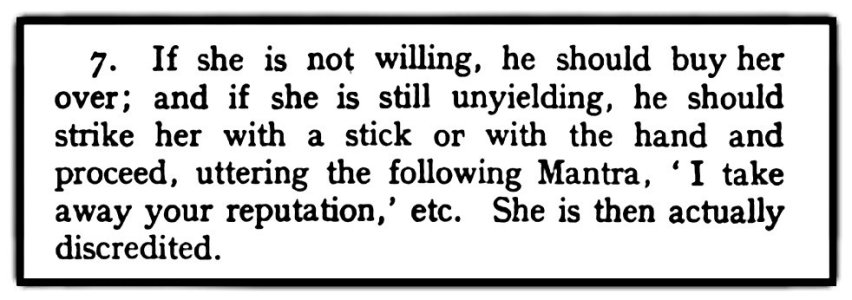
I recently came across references to a verse in the Brihadaranyaka Upanishad (6.4.7), which is part of the Vedas. Some translations say the passage suggests that if a wife refuses intimacy, the husband should first try persuasion and, if she still refuses, strike her and force the act which obviously is rape, how can a religion basically promote it?

i also heard of practice called Sati, where widows were burned on the funeral pyre of their husbands. Regardless of cultural or historical background, forcing or pressuring a widow to die in this way is an act of cruelty.

Bṛhadaranyaka Upanisad 6.4.7 translated by Swāmī Mādhavānanda.

picsart_23-07-02_09-42-08-091_350426_cs-7517.jpg
 
I recently came across references to a verse in the Brihadaranyaka Upanishad (6.4.7), which is part of the Vedas. Some translations say the passage suggests that if a wife refuses intimacy, the husband should first try persuasion and, if she still refuses, strike her and force the act which obviously is rape, how can a religion basically promote it?

i also heard of practice called Sati, where widows were burned on the funeral pyre of their husbands. Regardless of cultural or historical background, forcing or pressuring a widow to die in this way is an act of cruelty.

Bṛhadaranyaka Upanisad 6.4.7 translated by Swāmī Mādhavānanda.

View attachment 162911
This has been discussed to death in this forum. You can use the search functionality to enlighten yourself.
 
Islam came and protected women and widows from Pagans who had no respect for women and treated them like absolute dirt.

The practice of Sati is an abhorrent one that has no place in society. Thank God for Islam.
 
I recently came across references to a verse in the Brihadaranyaka Upanishad (6.4.7), which is part of the Vedas. Some translations say the passage suggests that if a wife refuses intimacy, the husband should first try persuasion and, if she still refuses, strike her and force the act which obviously is rape, how can a religion basically promote it?

i also heard of practice called Sati, where widows were burned on the funeral pyre of their husbands. Regardless of cultural or historical background, forcing or pressuring a widow to die in this way is an act of cruelty.

Bṛhadaranyaka Upanisad 6.4.7 translated by Swāmī Mādhavānanda.

View attachment 162911
I always find it funny when these Hindus and Christians criticise Islam about women's rights, when there are such abhorrent things written in their religious books.

This is why every single Muslim needs to educate themselves on Islam, and also a bit on other religions, so that we are able to defend our religion from these morons.
 
Sati? What are we in 3rd century bce?

There is only Jaguar that Rajput women would commit by either self immolation or jumping into a well to escape being taken as sex slave by the amazing brutes from Central Asia wearing feathered and woolen hats.
 
I recently came across references to a verse in the Brihadaranyaka Upanishad (6.4.7), which is part of the Vedas. Some translations say the passage suggests that if a wife refuses intimacy, the husband should first try persuasion and, if she still refuses, strike her and force the act which obviously is rape, how can a religion basically promote it?

i also heard of practice called Sati, where widows were burned on the funeral pyre of their husbands. Regardless of cultural or historical background, forcing or pressuring a widow to die in this way is an act of cruelty.

Bṛhadaranyaka Upanisad 6.4.7 translated by Swāmī Mādhavānanda.

View attachment 162911
@Vikram1989 wont comment for obvious reasons

they do have plenty of "dodgy" practises:

  • Manusmriti (8.299): This text states that a wife, a son, a slave, a pupil, and a younger brother, when they have committed faults, may be beaten with a rope or a split bamboo.

  • Brihadaranyaka Upanishad (6.4.7): This verse, in a section about ritual sex and procreation, suggests that if a wife is unyielding to her husband's sexual advances, he may "strike her with a stick or with his hand and overcome her".

  • Garuda Purana (1.109.31): A verse here suggests that "drums, uncivilized people, servants, and women are softened by being beaten".

  • Manusmriti (9.177): Dictates that a son of a Brahmin man and a Shudra woman is considered socially low (a "Parshav" or similar to a "dead body").

  • Child Marriage (Manusmriti 9.94): Recommends that a 30-year-old man marry a 12-year-old girl, or a 24-year-old man marry an 8-year-old girl.

  • Women’s Subjugation (Manusmriti 9.77, 9.80): Suggests a wife who obeys a lazy, diseased, or alcoholic husband must be punished, and that a barren wife or one who only bears daughters can be superseded

  • Bhagavad Gita (3.43): While technically instructing Arjuna to kill inner desire, critics sometimes cite this as a justification for violence in a wider context.
  • Violence by Deities (Srimad Bhagavatam 10.41.36-37): Describes Krishna slaying a washerman with his fingertips, often questioned in discussions regarding non-violence (Ahimsa),
Others:

Matraswastra ………..” – 2/215. Wise people should avoid sitting alone with one’s mother, daughter or sister. Since carnal desire is always strong, it can lead to temptation.

“Naudwahay……………..” – 3/8. One should not marry women who have reddish hair, redundant parts of the body [such as six fingers], one who is often sick, one without hair or having excessive hair and one who has red eyes.

“Nrakshvraksh ………..” – 3/9. One should not marry women whose names are similar to constellations, trees, rivers, those from a low caste, mountains, birds, snakes, slaves or those whose names inspires terror.

“Yastonabhavet…..…..” – 3/10. Wise men should not marry women who do not have a brother and whose parents are not socially well known.

“Uchayangh…………….” – 3/11. Wise men should marry only women who are free from bodily defects, with beautiful names, grace/gait like an elephant, moderate hair on the head and body, soft limbs and small teeth.

“Shudr-aivbharya………” – 3/12.Brahman men can marry Brahman, Kshatriya, Vaishya and even Shudra women but Shudra men can marry only Shudra women.

“Na Brahman kshatriya..” – 3/14. Although Brahman, Kshatriya and Vaishya men have been allowed inter-caste marriages, even in distress they should not marry Shudra women.

Heenjatistriyam……..” – 3/15. When twice born [dwij=Brahman, Kshatriya and Vaishya men in their folly marry low caste Shudra women, they are responsible for the degradation of their whole family. Accordingly, their children adopt all the demerits of the Shudra caste.

“Shudramshaynam……” – 3/17. A Brahman who marries a Shudra woman, degrades himself and his whole family,becomes morally degenerated, loses Brahman status and his children too attain status of Shudra.

“Daivpitrya………………” – 3/18. The offerings made by such a person at the time of established rituals are neither accepted by God nor by the departed soul; guests also refuse to have meals with him and he is bound to go to hell after death.

“Chandalash ……………” – 3/240. Food offered and served to Brahman after Shradh ritual should not be seen by a chandal, a pig, a cock, a dog, and a menstruating woman.

“Na ashniyat…………….” – 4/43. A Brahman, true defender of his class, should not have his meals in the company of his wife and even avoid looking at her. Furthermore, he should not look towards her when she is having her meals or when she sneezes/yawns.

“Na ajyanti……………….” – 4/44. A Brahman in order to preserve his energy and intellect, must not look at women who applies collyrium to her eyes,

“Mrshyanti…………….” – 4/217. One should not accept meals from a woman who has extra marital relations; nor from a family exclusively dominated/managed by women or a family whose 10 days of impurity because of death have not passed.

“Balyava………………….” – 5/150. A female child, young woman or old woman is not supposed to work independently even at her place of residence.


“Asheela kamvrto………” – 5/157. Men may be lacking virtue, be sexual perverts, immoral and devoid of any good qualities, and yet women must constantly worship and serve their husbands.

“Na aststrinam………..” – 5/158. Women have no divine right to perform any religious ritual, nor make vows or observe a fast. Her only duty is to obey and please her husband and she will for that reason alone be exalted in heaven.

“Kamam to………………” – 5/160. At her pleasure [after the death of her husband], let her emaciate her body by living only on pure flowers, roots of vegetables and fruits. She must not even mention the name of any other man after her husband has died.

“Vyabhacharay…………” – 5/167. Any woman violating duty and code of conduct towards her husband, is disgraced and becomes a patient of leprosy. After death, she enters womb of Jackal.

“Kanyambhajanti……..” – 8/364. In case women enjoy sex with a man from a higher caste, the act is not punishable. But on the contrary, if women enjoy sex with lower caste men, she is to be punished and kept in isolation.

“Utmamsevmansto…….” – 8/365. In case a man from a lower caste enjoys sex with a woman from a higher caste, the person in question is to be awarded the death sentence. And if a person satisfies his carnal desire with women of his own caste, he should be asked to pay compensation to the women’s faith.

“Ya to kanya…………….” – 8/369. In case a woman tears the membrane [hymen] of her Va?ina, she shall instantly have her head shaved or two fingers cut off and made to ride on Donkey.

“Bhartaram…………….” – 8/370. In case a woman, proud of the greatness of her excellence or her relatives, violates her duty towards her husband, the King shall arrange to have her thrown before dogs at a public place.


“Imam hi sarw………..” – 9/6. It is the duty of all husbands to exert total control over their wives. Even physically weak husbands must strive to control their wives.

“Patibharyam ……….” – 9/8. The husband, after the conception of his wife, becomes the embryo and is born again of her. This explains why women are called Jaya.


“Naitarupam……………” – 9/14. Such women are not loyal and have extra marital relations with men without consideration for their age.

“Poonshchalya…………” – 9/15. Because of their passion for men, immutable temper and natural heartlessness, they are not loyal to their husbands.

“Na astistrinam………” – 9/18. While performing namkarm and jatkarm, Vedic mantras are not to be recited by women, because women are lacking in strength and knowledge of Vedic texts. Women are impure and represent falsehood.

“Devra…sapinda………” – 9/58. On failure to produce offspring with her husband, she may obtain offspring by cohabitation with her brother-in-law [devar] or with some other relative [sapinda] on her in-law’s side.

“Vidwayam…………….” – 9/60. He who is appointed to cohabit with a widow shall approach her at night, be anointed with clarified butter and silently beget one son, but by no means a second one.

“Yathavidy……………..” – 9/70. In accordance with established law, the sister-in-law [bhabhi] must be clad in white garments; with pure intent her brother-in-law [devar] will cohabitate with her until she conceives.

“Atikramay……………” – 9/77. Any woman who disobey orders of her lethargic, alcoholic and diseased husband shall be deserted for three months and be deprived of her ornaments.

“Vandyashtamay…….” – 9/80. A barren wife may be superseded in the 8th year; she whose children die may be superseded in the 10th year and she who bears only daughters may be superseded in the 11th year; but she who is quarrelsome may be superseded without delay.

“Trinsha……………….” – 9/93. In case of any problem in performing religious rites, males between the age of 24 and 30 should marry a female between the age of 8 and 12.

“Yambrahmansto…….” – 9/177. In case a Brahman man marries Shudra woman, their son will be called ‘Parshav’ or ‘Shudra’ because his social existence is like a dead body


Care to explain =

@Rajdeep @cricketjoshila @Champ_Pal @Devadwal @uppercut @straighttalk @Vikram1989 @Romali_rotti @Bhaijaan @Cover Drive Six @rickroll @RexRex @rpant_gabba, @kron @globetrotter @Hitman @jnaveen1980 @Local.Dada @CrIc_Mystique @Van_Sri @nish_mate @SportsWarrior @kaayal @saimayubera @JaDed @Prince of Dorne @Cryin Out Loud @just a fan @deltexas @Ramsay @Hikaru @Bhimja turtle @GoogleToggle @big_gamer007 @IndoorCricket
 
Back
Top