



What's new

[VIDEO] Animal cruelty

Walrus Freya killed by Norway gets Oslo sculpture

Norway's capital Oslo has unveiled a statue of a walrus who was a popular attraction but was then put down because of public safety concerns.

The life-size bronze sculpture depicts Freya lying on her side on a shore.

"This is how humans treat wild nature, but it is also how humans treat humans. This is how we treated Freya. And so, I will call the statue For Our Sins," creator Astri Tonoian said.

An online campaign earlier raised $25,000 (£19,900) to make the statue.

"I started this because I'm furious about the way the [Norwegian] Fisheries Directorate and the state handled this situation," campaign organiser Erik Holm told the AFP news agency.

Freya - who weighed about 600kg (1,300lb) - was put down last August, triggering criticism across the Nordic nation.

The mammal rose to fame after clambering onto boats to sunbathe - sometimes sinking them.

The local authorities later said people had ignored warnings not to get too close to the animal, putting her and themselves at risk.

On one occasion, police blocked off a bathing area after the walrus chased a woman into the water, local media reported at the time.

Norway's fisheries ministry also issued a photograph of a large group of people, including children, standing within touching distance of the animal.

...
https://www.bbc.com/news/world-europe-65439294
 
Six more lions speared to death by Kenyan herders just days after one of the country's oldest lions was killed
Residents near Kenya's nature reserves say that lions and other animals kill livestock and domestic animals - a growing problem as humans and wildlife continue to compete for land and resources.

Six lions have been killed by herders in Kenya, just days after one of the country's oldest lions was also fatally targeted.

The six lions had killed goats and a dog in villages close to Amboseli National Park in Kenya's south, the country's wildlife service said.

They were speared to death on Saturday, three days after a 19-year-old male lion named Loonkiito was also killed by herders after wandering out of the national park in search of food.

Speaking about Saturday's deaths, Richard Bonham, executive chairman of Big Life Foundation Kenya, said the organisation's rangers had tried to disperse a group of nine lions after they attacked the goats and dog at a homestead, but six had refused to leave.

Police, a vet, and representatives from the Kenya Wildlife Service arrived on the scene, and it was decided that the remaining lions should be kept in the Big Life Foundation compound until the following night, when they could leave safely in darkness.

Mr Bonham said: "Over the course of the day, a crowd continued to build, and tensions spilled over as dozens of people broke through the compound fence, spearing all six lions.

"Many members of the crowd were armed with spears, and any intervention by KWS, the Kenya Police Service, or Big Life would have risked escalation of an extremely volatile situation, and almost certainly resulted in human injury or death.

...
https://news.sky.com/story/six-more...the-countrys-oldest-lions-was-killed-12881244
 
SHEIKHUPURA: FOUR CIRCUS LIONS RECAPTURED AFTER FLEEING CAGE

Four circus lions who escaped from their cage in Sheikhupura, have been recaptured by the circus staff, ARY News reported on Thursday.

Rescue sources said, four lions escaped the circus after the cage in which they were kept was broken due to strong winds in Sheikhupura’s Mela Pir Bahadur Shah area on Wednesday night.

However, their freedom remained short-lived as all of them were recaptured by the circus staff.

Panic prevailed in the area as the lions entered the residential area after the escape. They roamed freely in the streets for an hour and also entered nearby houses.

Police and rescue teams reached the spot and captured the lions. Police sources said that no one was injured in the incident.

ARY
 
The owner of the lion that roamed on Shahrah-e-Faisal was asked to visit the Karachi Zoo on Friday after the animal refused to eat in the cage he was put in.

Abdullah was asked to visit the zoo and feed the lion, which was handed over to the zoo after it escaped his vehicle on August 29. Upon seeing his owner, the lion hugged Abdullah who fed the lion inside the cage.

Abdullah and four others were booked by the provincial wildlife department after the lion escaped their vehicle and strolled on Shahrah-e-Faisal near Ayesha Bawani College.

The wildlife department said that the suspects were moving the lion and a turtle illegally in a car when the lion escaped. It attacked a man as well who fortunately remained safe.

The lion had refused to eat at the hands of zoo management and was starving for two days, after which the zoo management requested Abdullah to visit the lion at the zoo.

After successfully feeding the lion, the management requested Abdullah to daily visit the zoo and feed the lion.


Thankfully the man was rescued from the attack or else it could have been fatal.

The Lion seems very domesticated as it wouldnt eat at the Zoo until his owner was summoned.

This is very sad, as the big cat is very attached to owner, so must be suffering from some sort of depression.

I know some guys from Azad Kashmir who have lions in their houses. I told them its not right, cruel but people dont understand the mental pain animals go through in such conditions.
 
Switch in fishing methods saves thousands of dolphins
New fishing technique has drastically cut down entanglement, deaths of endangered species
KARACHI:
In 2013, at least 12,000 dolphins were killed in Pakistani territorial waters in the Arabian Sea, caught in the massive nets cast by fishermen.

Those gill nets, locally known as “bither,” were notorious for their high level of bycatch.

Pakistan’s territorial waters are home to 25 kinds of dolphins, notably spinner, bottlenose and tropical dolphins – and these endangered creatures were falling prey to the nets in massive numbers.

In just five years, however, the number of dolphins killed had plunged exponentially to a mere 186.

Behind that drastic reduction was a small but crucial shift from that conventional fishing method – subsurface gill nets instead of the surface ones.

As part of a pioneering project launched in 2012, over 700 local fishermen were trained to use the other type of nets, and the results of the change become evident over time, Mohammad Moazzam Khan, technical adviser for WWF-Pakistan, told Anadolu.

Since 2018, according to Khan, who headed the project, deaths of dolphins due to entanglements have become “extremely rare, if not zero.”

“There were no previous estimates or studies. It was believed that dolphins were being killed by these fishing nets, but there were no counts made until 2012,” he said.

However, despite the massive difference with the shift in fishing methods, dolphins are still considered an endangered species, as some 100,000 are still killed annually in the Indian Ocean alone, Khan added.

 
‘Suffered enough’: Calls grow to save distressed bear in Karachi Zoo
Wildlife activists want Himalayan brown bear captive in Karachi Zoo to be moved to sanctuary, some officials resistant

KARACHI:
Wildlife activists and experts have sounded the alarm over the life of Rano, a lone female Himalayan bear crammed in a small cage at a zoo in Karachi.

The calls come on the heels of the death of a female African elephant in April this year due to “inappropriate” conditions at the same facility, prompting local and international organisations to push for immediate steps to save other animals from a similar fate.

Also known as the Himalayan red bear, the Himalayan brown bear is a subspecies of the brown bear found in the western Himalayas. It is the largest mammal in the region, with males reaching up to 2.2 meters (7.2 feet) in length, while females are a little smaller.

The bear, whose natural habitat is the cold alpine meadows of Deosai National Park and other mountain regions of northern Pakistan, is a critically endangered species with only 150 to 200 left in the country, mainly because of human intrusion and the ravages of climate change.

Languishing in a barren cage, Rano was brought to the Karachi Zoo in 2017 along with an Asiatic black bear who died in 2020.

Her cage has two small chambers and an open courtyard with a tiny pond in the middle. The weather-beaten bear’s coat has already started losing its colour due to the hot and humid weather of the city.

In the wild, she would spend her days foraging for flowers, fruits, berries, grasses, insects, and small mammals such as the marmot.

Today, she paces back and forth in a corner of her cage as a small crowd huddle around for a better look.

 
Record set as 210-kg marlin caught off Karachi
It took senior angler Khalid four hours to catch the fish

KARACHI:
A new record of fish hunting has been set in Pakistan after a marlin weighing 210 kilogrammes was caught from the open waters in the Arabian Sea off the coast of Karachi.

According to Ahmed Mamour Amimi, the president of Pakistan Boat Rally and Fishing Association, senior angler Khalid caught a marlin (locally called Khadda) weighing 210 kg in the open sea near the continental shelf, 150 kilometres off the shoreline of Karachi.

He added that the fish was five feet wide and 10.5 feet long.

“It took four hours to hunt this giant fish,” he added.

It should be noted that marlin is one of the largest species of fish in the world.

Not only is it one of the largest fish in the ocean, it is also considered one of the fastest -- capable of travelling at speeds of up to 68 miles per hour.

The biggest threat to marlin is commercial fishing along with the highly migratory pelagic fish.

The lifespan of marlins varies depending on the species and gender. The Atlantic blue marlin can live up to 27 years, while the blue marlin lives up to 15 years.

A blue marlin can grow to over 12 feet long and weigh up to 2,000 pounds.

Female blue marlins grow larger than males and may live up to 20 years.

The relatively high fat content of its meat makes it commercially valuable in certain markets.

The Pacific blue marlin has a longer lifespan, with males living at least 18 years and females living at least 27 years.

 
The Bahawalpur division commissioner has formed a committee to probe the issue of death of a man in tigers’ cage at the Bahawalpur zoo.

The incident took place at Shair Bagh, a local zoo in Bahawalpur, on Wednesday.

Media reported that tigers had eaten a portion of flesh from the lower torso of the male body which was recovered by an employee. The employee spotted the body when he approached the cage to feed four tigers.

On being informed about the issue, the local government and the Rescue 1122 officials reached the spot.

Caretaker Chief Minister Mohsin Naqvi has taken notice of the incident and directed the wildlife department secretary and the Bahawalpur commissioner to submit a report. The CM also ordered the security audit of the zoo.

The probe committee formed by Commissioner Dr Ehtasham Anwar comprises additional deputy commissioner (revenue), head of forensic department of Quaid-e-Azam Medical College (QAMC), Bahawalpur, Forest Conservator Sheikh Manzoor Ahmed, Punjab Forensic Science Agency’s local head, Rescue 1122 DEO, and in charge of the police crime scene investigation, Punjab.

Officials have been asked to submit a detailed report within a week.

Source: Dunya News

 
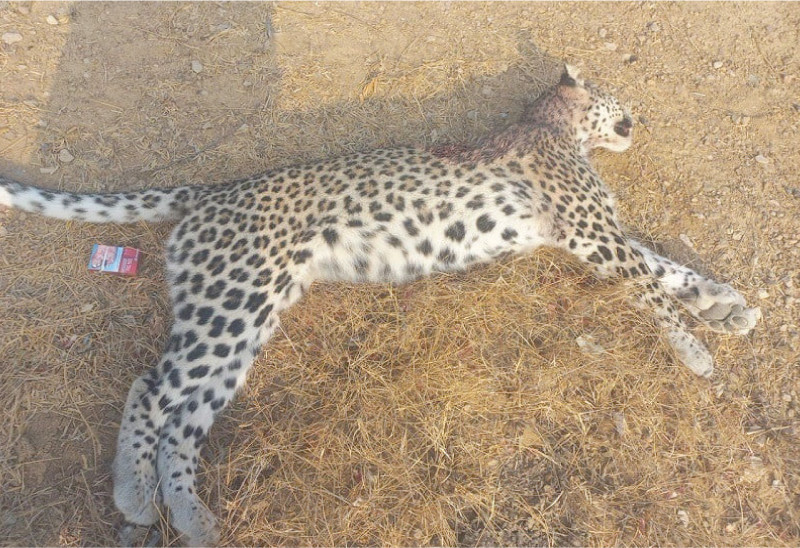
Local villagers killed a rare white leopard within the boundaries of Kirthar National Park on Monday night, officials said.

The Sindh Wildlife Department (SWD) swiftly took action and registered a case against five individuals involved in the killing.

Sources revealed to The Express Tribune that the leopard was shot dead at approximately 12:30am, and photos of the incident were circulated on social media.

SWD officials, led by Deputy Conservator Wajid Shaikh, identified two of the villagers responsible as Qadar Bux and Ghulam Hussain Sonaro from the local community.

Shaikh expressed the department's commitment to apprehending the culprits, stating, "We will have to arrest these men." The SWD learned about the incident through social media, prompting a prompt response.

The killed animal was found in the village of Mohammad Ali Faqeer, within the jurisdiction of taluka Thana Bola Khan.

Deputy conservator confirmed the unprecedented nature of the incident, noting that a white leopard had never been sighted in the Kirthar National Park before. He speculated that the leopard might have migrated from Balochistan.

The last recorded sighting of a leopard in the area dates back to 1976.

The SWD is taking legal measures in response to this unfortunate incident. The dead leopard is being transferred to Hyderabad, where it will be presented before the court.

Express Tribune


Donkey’s ears severed in Rawalpindi district in another case of animal cruelty​

In a second incident of animal cruelty in as many weeks in the country, a donkey (jennet) had its ears severed in a village in Rawalpindi district, with its owner accusing another man of committing the brutality but police suspecting that the incident could be the culmination of longstanding enmity and land dispute.

According to first information report (FIR) filed 14 days after the incident took place at Rawat Police Station on Monday, a farmer named Tanveer Hussain, who is a resident of Dhakala Dakkhana, Saagri, stated that following the harvest of his last crop, the field was empty and so he let his donkey loose on his fields.

The animal would return home to drink water everyday but it did not do so on June 4, he said.

However, when it returned in the evening, Hussain noticed that its ears had been chopped off.

The FIR stated that Hussain asked the locals about the perpetrator. and everyone pointed towards Arshad Mehmood, a member of Hussain’s family, although they were reluctant to name him explicitly due to fear.

Hussain said he conducted his own investigation and found some evidence, which was handed over to the police.

Despite the incident occurring 14 days prior, Hussain’s case was only registered recently, with station house officer (SHO) Chaudary Zulfiqar telling Dawn.com that no arrests have been made so far but the investigation was ongoing and a conclusion would be reached soon.

Meanwhile, assistant sub-inspector (ASI) Chaudhry Farrukh Shahzad, who is investigating the case, said that the suspect had filed a murder case against the plaintiff in 2005, accusing Hussain of killing Arshad’s father.

ASI Shahzad said that the “video evidence” submitted by the plaintiff only shows traces of blood outside the suspect’s residence, which he said was “insufficient to hold anyone guilty”.

Additionally, ASI Shahzad noted that there were ongoing land disputes between the parties, with Arshad having won four out of thirteen cases.

The accused, according to the ASI, is also suffering from back pain, which would make it difficult for him to pin down a donkey and cut off its ears.

Shahzad described the incident as suspicious and confirmed that the investigation was being conducted to cover all angles.

The case marks the second reported incident of animal mutilation in recent days. In an earlier case, a landlord chopped off a camel’s leg as punishment for foraging in his field in Sanghar.

Six suspects were remanded in police custody by a magistrate in Shahdadpur on Sunday.

Source: DAWN
 
Donkey’s ear chopped off, spine broken by landlord

Another disturbing incident was reported from Wazirabad, Punjab, where a cruel landlord brutally tortured and cut off the ear of a donkey as punishment for scavenging in his field, ARY News reported on Sunday.

The police officials stated that a case had been registered against the landlord, named Owais Gujjar, for breaking the spine of the donkey after brutally torturing him.

The local police took action after the video of the injured donkey went viral.

In the video shared on social media, the landlord can be seen torturing a donkey.

Similar to this, a donkey, who was subjected to severe torture in Hyderabad, died in Karachi’s Shelter home.

The donkey’s two legs were broken due to severe torture and was rushed to Karachi for treatment.

The news of the donkey’s death was shared by the NGO on social media.

It is to be noted that the donkey was tortured by its owner in a fit of anger that broke his two legs.

As per the details, another animal was brutalized in Hyderabad, the second largest city of Sindh, where the owner cut off the leg of another donkey over a dispute with the other donkey cart driver.


ARY News
 
Donkey’s ear chopped off, spine broken by landlord

Another disturbing incident was reported from Wazirabad, Punjab, where a cruel landlord brutally tortured and cut off the ear of a donkey as punishment for scavenging in his field, ARY News reported on Sunday.

The police officials stated that a case had been registered against the landlord, named Owais Gujjar, for breaking the spine of the donkey after brutally torturing him.

The local police took action after the video of the injured donkey went viral.

In the video shared on social media, the landlord can be seen torturing a donkey.

Similar to this, a donkey, who was subjected to severe torture in Hyderabad, died in Karachi’s Shelter home.

The donkey’s two legs were broken due to severe torture and was rushed to Karachi for treatment.

The news of the donkey’s death was shared by the NGO on social media.

It is to be noted that the donkey was tortured by its owner in a fit of anger that broke his two legs.

As per the details, another animal was brutalized in Hyderabad, the second largest city of Sindh, where the owner cut off the leg of another donkey over a dispute with the other donkey cart driver.


ARY News

Terrible.

I hope the coward who did this will be punished.
 
77 whales dead after mass stranding in Orkney

A pod of 77 pilot whales has died after a mass stranding on a beach in Orkney.

The British Divers Marine Life Rescue (BDMLR) rushed to Tresness beach on the Isle of Sanday just before 11am on Thursday to reports of a mass stranding of whales.

They found 77 whales, including several males up to 22ft (7m) long, as well as calves and juveniles.

Only 12 survived what is believed to be the largest mass stranding in Scotland since 1975.

However, on Friday, the BDMLR issued an update to say the surviving whales have been euthanised.

The statement said: "Sadly the remaining 12 pilot whales have been euthanised due to their condition deteriorating from the many hours they have spent stranded on the beach."


Another incident of animal cruelty surfaces in Sanghar

After a recent horrific incident involving a cruel owner who chopped off a camel’s leg for entering his fields, a similar case of animal cruelty emerged in Sanghar when a cow was shot in the leg over the same reason, ARY News reported on Friday.

The owner, Muharram Shar, claimed that his cow was shot by unknown individuals after it strayed into their fields. The incident occurred on the outskirts of Mangli village, within the jurisdiction of the local police station.

Shar claimed that the cow was found injured and taken to a veterinary doctor, who confirmed that the leg bone was fractured due to the gunshot wound.

Deputy Commissioner Sanghar has taken notice of the incident, and a team of police officials, including DSP and SHO, visited the scene to investigate. Two suspects have been detained for questioning.


British crocodile expert Adam Britton jailed for raping, torturing and killing dozens of dogs

A prominent British crocodile expert has been jailed for 10 years and five months for raping, torturing and killing dozens of dogs.

Adam Britton, a zoologist based in Darwin, Australia, pleaded guilty to 56 charges of bestiality and animal cruelty at the Supreme Court of the Northern Territory (NT) in September last year.

He also pleaded guilty to four counts of accessing and transmitting child abuse material.

Britton, 52, whose sentencing suffered a series of delays, was on Thursday also banned for life from purchasing animals and having them on his property, Australian media reports.

His offending involved the torture and exploitation of 42 dogs, and the deaths of 39, in a shipping container on his property - which he used to film many of his crimes.

Britton will not be eligible for parole for six years, according to ABC.

Chief Justice Michael Grant described Britton's "grotesque" and "unspeakable" crimes against animals as he sentenced him.

The judge excused court officers during his sentencing remarks, as he warned the gallery that details of the offences could cause a "nervous shock or some other adverse psychological reactions".

He said: "Although I'm loathe to do so, given the gross depravity and perversity of your actions, it is necessary for the purpose of sentencing you to provide some generally representative detail and description of the offending conduct."

The court previously heard Britton had a "sadistic sexual interest" in animals, and in particular dogs.

As well as torturing his own dogs, he also sourced animals from unsuspecting pet owners in the Darwin region.

"He often built a rapport with the dog owners in negotiating taking custody of their animals, many of whom had to reluctantly give their pets away due to travel or work commitments," prosecutor Marty Aust told the court back in September.


SKY News
 
A five-year-old son of a labourer was dragged away and mauled to death by a lion in Amreli district on Wednesday afternoon, a forest department official said.

The big cat was caged hours after the incident and shifted to an animal rescue centre.

The lion dragged away the child from a farm near Thordi village, said Range Forest Officer (RFO), Savarkundla range, Pratap Chandu.

The body of the victim, Gulsingh Harilal Ajnera, was found nearly 100 metres away from the spot, he said.

Following the incident, the forest department set up teams to trap the big cat who was caged by the evening and taken to a nearby animal rescue centre, Chandu added.

As per the census conducted in May 2025, Amreli district is not part of the traditional habitat of Asiatic lions who are inhabitants of the Gir National Park. The census recorded the presence of lions outside Gir National Park in 11 districts, including Amreli, of Saurashtra in non-forested and coastal areas.

The other ten districts where the presence of lions is recorded are: Junagadh, Gir Somnath, Bhavnagar, Rajkot, Morbi, Surendranagar, Devbhoomi Dwarka, Jamnagar, Porbandar and Botad.

The estimated population of Asiatic lions in their sole abode of Gujarat increased from 674 to 891 over the last five years, as per the census.

As many as 384 lions were counted in the Gir National Park and Wildlife Sanctuary and 507 outside its limits.

------------------------------------------------------------------------------

Link: https://www.ndtv.com/india-news/5-y...rm-mauled-to-death-by-lion-in-gujarat-8760290
 
British crocodile expert Adam Britton jailed for raping, torturing and killing dozens of dogs

A prominent British crocodile expert has been jailed for 10 years and five months for raping, torturing and killing dozens of dogs.

Adam Britton, a zoologist based in Darwin, Australia, pleaded guilty to 56 charges of bestiality and animal cruelty at the Supreme Court of the Northern Territory (NT) in September last year.

He also pleaded guilty to four counts of accessing and transmitting child abuse material.

Britton, 52, whose sentencing suffered a series of delays, was on Thursday also banned for life from purchasing animals and having them on his property, Australian media reports.

His offending involved the torture and exploitation of 42 dogs, and the deaths of 39, in a shipping container on his property - which he used to film many of his crimes.

Britton will not be eligible for parole for six years, according to ABC.

Chief Justice Michael Grant described Britton's "grotesque" and "unspeakable" crimes against animals as he sentenced him.

The judge excused court officers during his sentencing remarks, as he warned the gallery that details of the offences could cause a "nervous shock or some other adverse psychological reactions".

He said: "Although I'm loathe to do so, given the gross depravity and perversity of your actions, it is necessary for the purpose of sentencing you to provide some generally representative detail and description of the offending conduct."

The court previously heard Britton had a "sadistic sexual interest" in animals, and in particular dogs.

As well as torturing his own dogs, he also sourced animals from unsuspecting pet owners in the Darwin region.

"He often built a rapport with the dog owners in negotiating taking custody of their animals, many of whom had to reluctantly give their pets away due to travel or work commitments," prosecutor Marty Aust told the court back in September.


SKY News

10 years is too less.

He should've received a much harsher sentence for what he did to those poor dogs.
 
Lion's owner arrested after it attacked woman and children in Pakistan

The owners of a pet lion that escaped from a farmhouse and injured a woman and her two children in the eastern Pakistani city of Lahore have been arrested, authorities said on Sunday.

The arrest came after dramatic video footage emerged showing the lion leaping over a wall and attacking the victims in a residential area.

Faisal Kamran, a police official, said the woman and her five- and seven-year-old children sustained injuries to their faces and arms on Wednesday night when the lion escaped from its cage.

According to a police report, the children’s father said the lion’s owners had stood by and watched as the animal clawed at his family, making no effort to restrain it. The lion later returned to the owners’ farmhouse and was relocated to a wildlife park, police said.

Keeping exotic animals such as lions is considered a status symbol by some wealthy Pakistanis, despite the legal requirements and high fees associated with ownership.

In Turkey, a lion that escaped from a theme park near the resort of Antalya was shot dead on Sunday after attacking a man, the local governor and media reports said.

The lion, reportedly named Zeus, escaped his enclosure at the Land of Lions animal theme park in Manavgat, about 40 miles (65km) east of Antalya, in the early hours of the morning, the governor said.

According to the BirGün newspaper, the lion attacked an agricultural worker called Suleiman Kir who was asleep in a pistachio field with his wife. Kir tussled with the lion before it ran off. He was injured but not badly and was taken to a nearby hospital for treatment.

“We were covered with blankets to protect ourselves from mosquitoes and when the prayer call sounded, I tried to stand up but I couldn’t,” he told the newspaper. “Suddenly I felt something touch my left foot and when I eventually managed to get up, I saw it was something huge – I thought it was a dog.”

In a video posted online, he described the moments wrestling with the lion. “We called for help but there was no one around. As the lion was biting my calf and my neck, I grabbed him around the neck and began to squeeze and he backed off. At that moment, the security forces came,” he said. “If I had not been strong, I wouldn’t be here right now.”

Antalya’s governor said the lion had been tracked down and shot dead. “It was not possible to catch the escaped lion alive because it posed a danger to people and the environment, so it was shot,” he said.

He indicated that an investigation had been opened into the incident. BirGün said there were about 30 big cats at the Land of Lions.

--------------------------------------------------------------------------------

Link: https://www.theguardian.com/world/2...lahore-pakistan-woman-children-injured-attack
 
Last edited by a moderator:

Lion cubs among 23 wild cats rescued in Punjab wildlife crackdown​


An illegal network involved in the sale and purchase of big cats, including lions, tigers, and leopards, has dismantled by Punjab Wildlife Rangers.

In a series of operations, authorities recovered 23 big cats, several of them hidden in private homes. Among the seized animals were multiple lion cubs, officials confirmed.

In Lahore, Wildlife Rangers have rescued five lion cubs from a posh residential area where they were being secretly kept.

According to wildlife authorities, it has become increasingly common for individuals to buy newborn lions and tigers from private breeding farms as a hobby.

A single cub is sold for between Rs800,000 and Rs1 million, they said.

Valued for their exotic appearance, many of these animals are kept inside homes. However, officials warn that by six months of age, the cubs begin to exhibit wild behaviour, posing safety risks to both owners and surrounding communities.

Officials revealed that some breeding farm owners were illegally relocating cubs from their facilities and selling them through unlicensed channels. Following a series of targeted crackdowns, authorities now say that this underground market has been dismantled.

Additional Director General of the Punjab Wildlife Rangers, Syed Kamran Bukhari, stated that wild animals will only be allowed in captivity under the protocols of the World Association of Zoos and Aquariums (WAZA). He emphasised that, under WAZA regulations, dangerous wild animals cannot be kept in residential areas under any circumstances.

Bukhari confirmed that operations against individuals keeping lions and tigers illegally are still ongoing.

Of the 23 animals recovered so far, 12 were seized in Lahore, four in Gujranwala, two in Faisalabad, three in Multan, and one each in Rawalpindi and other districts. These enforcement actions have led to the arrest of eight individuals and the registration of seven criminal cases.

In Punjab, a total of 582 big cats have been officially declared as being in private possession. Lahore accounts for the largest number with 198, followed by Multan with 129, Rawalpindi with 104, Gujranwala with 86, Faisalabad with 20, the Salt Range with 26, Gujrat with nine, Bahawalpur with six, and one each in Sahiwal, Dera Ghazi Khan, and Sargodha. Wildlife authorities say verification of these animals is currently underway.

Registered wildlife breeding farms have been given a three-month deadline to rectify shortcomings in their facilities and bring their operations into full compliance with legal and safety standards.

Source: https://tribune.com.pk/story/255620...ild-cats-rescued-in-punjab-wildlife-crackdown
 
Big cat owners hide their animals amid Pakistani crackdown

The smell hanging in the air is the first sign there's something unusual about the farmhouse on the outskirts of one of Pakistan's largest cities, Lahore.

Once inside, the cause becomes clear: the property is home to 26 lions, tigers and cubs – and belongs to Fayyaz.

The rain, he says, has turned the ground into mud.

But the animals are "happy here", he insists. "When they see us, they come over, they eat... they're not aggressive."

Almost instantly, one of the lions roars.

"That one is aggressive, it's his nature," Fayyaz says.

Fayyaz loves big cats. From this facility – thought to be the largest of its kind in private hands nationwide – the 38-year-old has sold cubs and breeding pairs for the last 10 years. He is widely considered to be one of the biggest lion dealers in Pakistan.

For decades these animals – lions, tigers, pumas, cheetahs and jaguars – have been a sign of power, status and even political fealty in the country. The tiger, for example, is a symbol of the ruling Pakistan Muslim League-Nawaz.

More recently, with the dawn of short video social media apps like TikTok and Instagram, there's been a surge in ownership, with lions now sometimes even brought along to wedding events.

But in the wake of a pet lion escaping and attacking a woman and her two children as they walked down the street in Lahore, the government has launched a crackdown – one which is already impacting people like Fayyaz.


For a country which states it protects animals rights and has better laws for animals than humans, very poor​

India top court shelves plan to lock up Delhi's one million street dogs​


India's Supreme Court has modified its previous order asking authorities in Delhi and its suburbs to move all stray dogs into shelters amid widespread protests by animal welfare groups.

The three-judge bench said that strays should be released after being vaccinated and sterilised but added that dogs with rabies or aggressive behaviour should be immunised and kept in shelters.

The court also banned feeding of stray dogs in public spaces and ordered dedicated areas to be set up for the purpose.

On 11 August, a two-judge bench had expressed concern over the rising "menace of dog bites leading to rabies" in Delhi and its suburbs.
Delhi's stray dog population is estimated at one million, with suburban Noida, Ghaziabad and Gurugram also seeing a rise, municipal sources say.

India has millions of stray dogs and the country accounts for 36% of the total rabies-related deaths in the world, according to the World Health Organization.

To deal with the dog menace, on 11 August the Supreme Court ordered authorities in the capital and its suburbs to round up all stray dogs and put them in shelters.

It ordered authorities to build shelters to house these dogs in eight weeks' time.

The order went against existing rules that state that stray dogs should be released to their original site after being sterilised at shelters, sparking strong protests and legal challenges from several animal welfare groups.

They called for more humane solutions like vaccination and neutering and warned that putting all strays in shelters would lead to problems like overcrowding and culling.

Following the backlash, the Supreme Court set up a three-judge bench to hear the challenge.

In Friday's ruling, the court stayed the earlier order to round up all strays, stating that non-aggressive, non-infected dogs could be released to their capture site after being vaccinated and neutered.

The court also said that animal lovers could apply to municipal corporations to adopt strays but that these dogs were not to be returned to the street.

The court added that action would be taken against people found to be feeding stray dogs in public areas and warned animal welfare groups against interfering with its orders.

The Supreme Court has also said that it would formulate a national policy around stray dogs after hearing similar cases pending in different states.

The ruling has been welcomed by animal welfare groups.

Alokparna Sengupta, director of Humane World for Animals India, said it was "balanced, structured and compassionate".

However, she said there was a need for a clear criteria, based on scientific data, to be established to identify "aggressive dogs" so that the court's order was not misused to capture and confine dogs without justification or based on personal prejudice
 

Rogue elephant kills 22 in nine days in Jharkhand, state declares ‘emergency’ as tusker still at large​


Jharkhand has declared an "elephant emergency" as authorities hunt for a single-tusked rogue elephant that killed 22 people in a 9-day rampage after being separated from its herd


Jharkhand has declared an “elephant emergency” after a rogue male single-tusked elephant killed 22 people in just 9 days in a deadly rampage. Forest officials have been on a hunt for the tusker since the beginning of January.

The most recent victims include a 40-year old man, Prakash Malwa of Benisagar and a child. Eyewitnesses said that the child’s body was caught on the elephant’s tusk during the attack.

A forest official who arrived from West Bengal to deal with the jumbo was also injured as a team of villagers and officials tried to drive it away. The man was repeatedly slammed to the ground, leaving him critically injured.

The attacks began in early this year in West Singhbhum district and around the forests of Saranda, Kolhan and Chaibasa. Several villages were broken into at night and attacked as the victims slept.


(Killer elephant on the loose in India - it has ended at least 22 people, most likely a rogue male bull riled up during the mating season. Yeet!)

The animal is said to have become extremely aggressive after it was separated from its herd. It is also moving at an incredibly fast covering about 30 kilometres a day.

The Jharkhand forest department deployed over 100 personnel to track the animal, NDTV reported. They tried tranquillising it three times, all to no avail.

Wildlife specialists from three other states were also drafted to locate the tusker, but officials say that the animal's volatility and erratic movement made it difficult to track. Officials say that the elephant has been changing its locations quickly, attacking human settlements at night and hiding in dense forests during the day, making it difficult to track.

Human and elephant conflicts have been on the rise in India due to rising deforestation, food and water scarcity and increased encroachment over elephant corridors.

About 10 per cent of areas that used to be elephant corridors no longer exist. Jumbos in India are also dying due to electrocution, trains and retaliatory poisonings.

Divisional Forest Officer Kuldeep Meena said, "This is an unprecedented situation. It's the first time such a pattern of fatalities has been linked to a single male elephant in the region."

Authorities said that the animal is in a musth, a phase where the animal's testosterone levels rise, making them angrier and more aggressive. The behavior can last between 15 to 60 days.

Jharkhand is home to about 550 to 600 elephants. Villages near the forests are the most vulnerable to elephant attacks as the animals move into the human settlements for food and water.

The state saw about 1,400 fatalities and over 600 grave injuries between 2000 and 2025. Preliminary data suggests that the number of attacks may rise in 2026.


Source:
 

300 Dogs Found Dead in Pit Near Hyderabad; Locals Claim Mysterious Injections - Telangana Death Toll Hits 900​


Around 300 dogs were dumped in a Telangana pit, allegedly poisoned on local authorities’ orders, highlighting rural ABC programme gaps, rising stray populations, and calls for humane management.


Hyderabad: Around 300 dogs were reportedly found dumped in a pit in Jagtial district of Telangana under mysterious circumstances, bringing the total number of mass animal killings in the state to nearly 900 this month. An animal activist claimed that locals told her two unknown women had administered lethal injections to the dogs before they were dumped into the pit. She added that the pit—allegedly meant for burying the carcasses—was half full by noon and about 75% full by evening.
The reports of dog killings emerged soon after the Sarpanch Polls, during which candidates had promised to address the issue of excessive stray dogs on the streets.

The latest killings took place in Pegadapally village, about 200 km from Hyderabad, on Thursday. Animal rights activists claimed the dogs were killed on the orders of the village sarpanch (head of the village council). Following a complaint by Preethi Mudavath of the Stray Animal Foundation of India, police registered an FIR against the sarpanch, the gram panchayat secretary, and others. The case has been filed under Section 325 read with 3(5) of the Bharatiya Nyaya Sanhita (BNS) and Section 11(1)(a) of the Prevention of Cruelty to Animals (PCA) Act, 1960, which deal with killing or poisoning animals by a group of people.

Preethi said she visited the village on Friday and found the dog carcasses near the village boundary, prompting her to file a police complaint. She told The Times of India that villagers reported the dogs were given lethal injections by two women.
“Later, the bodies were moved using tractors belonging to the gram panchayat workers and buried in another pit about two kilometres away from the village,” she added.

How the Dogs Are Being Poisoned and Why​

A report by Deccan Herald claimed that some hired professionals are using cyanide or strychnine—crystalline rodenticides—to swiftly eliminate dogs in villages across Telangana. These individuals reportedly charge around Rs 500 per dog, covering both poisoning and disposal.

One of the main reasons for the unchecked growth of dog populations in rural areas is the inadequate implementation of Animal Birth Control (ABC) programmes, which are now largely limited to urban municipalities. Unlike cities, where ABC initiatives, vaccination drives, and monitoring are somewhat organised, rural areas often lack systematic coverage.
This gap allows stray and semi-owned dogs to breed freely, leading to rapidly increasing numbers. Additionally, rural regions provide abundant food sources—such as open garbage, leftover food, and livestock feed—which help sustain large dog populations. The combination of unchecked breeding and plentiful resources accelerates population growth, worsening public health risks, increasing human-animal conflicts, and intensifying the stray dog problem in villages.
The incidents have caused outrage among animal rights groups, who have demanded strict action against those responsible and requested humane methods to manage stray dog populations instead of resorting to killings.


Source:
 

Telangana villages kill 500 stray dogs in a week to fulfil Panchayat poll promises​


Viscera samples have been sent to the Forensic Science Laboratory to determine the exact cause of death and the type of poison used.


Kamareddy (Telangana) :
In another incident of stray dog killings, nearly 200 canines were allegedly killed in Telangana's Kamareddy district, pushing the death toll to around 500 over the past week, police said on Tuesday. According to news agency PTI sources in the affected villages, some elected representatives, including sarpanches, allegedly orchestrated the killings to "fulfil promises made to villagers" during the recent gram panchayat elections to address the stray dog problem.


Police said a case has been registered against six people, including five village sarpanches, for their alleged role in the incident.

Viscera samples sent for forensic

Earlier, police in Hanamkonda district had registered cases against nine people, including two women sarpanches and their husbands, in connection with the alleged killing of around 300 stray dogs in the villages of Shayampet and Arepally.

"Ahead of the gram panchayat elections held in December last year, some candidates promised villagers they would tackle the stray dog and monkey menace. They are now allegedly ‘fulfilling’ those promises by killing stray dogs," sources said.

Police said the carcasses were buried on the outskirts of the villages, following which veterinary teams exhumed the bodies and conducted post-mortem examinations.

Viscera samples have been sent to the Forensic Science Laboratory to ascertain the exact cause of death and identify the poison used, a senior police official told PTI.

Notices have been issued to the accused, the police added.

Complaint filed over poisonous injections to dogs

Gautam of the Stray Animal Foundation of India has alleged that stray dogs were killed by administering poisonous injections.

According to Gautam, the organisation recently received information that between 300 and 500 stray dogs were killed within the limits of Machareddy police station in Kamareddy district. He alleged that sarpanches of 5 villages were involved in the incident and that the dogs were injected with poison and later buried in the ground outside the villages.

He said a complaint has been filed against the 5 sarpanches, following which an FIR has been registered and post mortem examinations are being conducted. Gautam said what had taken place was completely wrong and illegal, and that killing 300 to 500 stray dogs in this manner amounts to a violation of the Prevention of Cruelty to Animals Act.

He added that as per rules, stray dogs should be sent to animal birth control centres and that there is no provision in the law allowing them to be killed in this way. Gautam said strict action should be taken against those responsible.

300 stray dogs were poisoned to death

Earlier, around 300 stray dogs were allegedly poisoned to death over a three-day period starting January 6 in Shayampet and Arepally villages of Hanamkonda district. Police have registered a case against nine people, including sarpanches, gram panchayat secretaries, and two hired individuals, in connection with the incident.

Meanwhile, the Supreme Court on Tuesday said it would consider issuing directions to states to provide "heavy compensation" to victims of dog-bite incidents and hold dog feeders accountable. The apex court expressed concern over the poor implementation of norms related to the management of stray animals over the past five years.


Source:
 

Bengaluru Shock: Man Smashes Puppy Against Wall, Pins It On Ground - Horrific Act Caught on Cam​


In Bengaluru’s JP Nagar, a man allegedly smashed a puppy against a wall, captured on CCTV. Police registered a case, and animal welfare activists have condemned the act, calling for stern action as other puppies remain missing.


A disturbing case from Bengaluru's JP Nagar has come to light, where a puppy was allegedly assaulted and brutally killed last week. According to the CCTV footage, a man was seen smashing the puppy against a wall before pinning it to the ground, according to a TOI report. Puttenahali police in South Bengaluru Care has registered a complaint and is making efforts to nab the accused.
The accused, identified as Nepal Kiran, worked as a security guard at a restaurant in JP Nagar and stayed at his brother's rented accommodation.


The incident came to light on January 9 after a local dog feeder shared videos on a WhatsApp group. The feeder used to take care of eight puppies in the locality, the animal welfare volunteers said, adding that the body of one puppy was recovered; however, the remaining puppies are missing.

"This is not about a neonate puppy who was brutally murdered; it is about the case of a psychopath who is a threat to society." Priyam Chhetri, another animal rights activist, demanded stern action against the accused," Manjari Chaitanya, founder of South Bengaluru Cares, told TOI.

Domestic Help Smashes Pet Dog to Death Inside Lift​


In a similar disturbing incident related to dog killing in October last year, a Bengaluru woman working as a domestic help allegedly threw the dog to the floor inside an apartment lift.
The video, caught on the CCTV camera, captured the horrific incident, raising concerns over animal cruelty. The video shows the accused allegedly slamming the dog named Goofy on the lift floor. The dog's owner, after checking the CCTV, found out that their house help had killed him. Following this, the owner filed a complaint at the Bagaluru Police Station.
According to reports, the house help was working with the family for about one and a half months.


Source:


@Rajdeep @cricketjoshila @Champ_Pal @Devadwal @uppercut @straighttalk @Vikram1989 @Varun @Romali_rotti @Bhaijaan @Cover Drive Six @rickroll @RexRex @rpant_gabba, @Romali_rotti @kron @globetrotter @Hitman @jnaveen1980 @Local.Dada @CrIc_Mystique @Van_Sri @nish_mate @SportsWarrior @kaayal @saimayubera
 

2 arrested, 4 cops suspended after animal remains found near Kanpur temple​


Police said two persons were arrested and four other detained in connection with the case.


The remains of "prohibited" animals in a field near a Durga temple in the city's Bilhaur area sparked protests and incidents of vandalism on Tuesday. Police said two persons were arrested and four other detained in connection with the case.

Four police personnel, including an SHO, have been suspended after the incident for alleged negligence, a senior police official said.

Protests broke out in the area, with demonstrators demanding strict action against those involved. Police said that during the agitation, some youths vandalised five parked vehicles, damaging window panes. The situation was brought under control promptly, they said.

The incident came to light on Monday evening after a video showing bones, skins and remains of "prohibited animals" circulated on social media. Senior police officers rushed to the spot and conducted an immediate inspection.

Local residents and Hindu organisations alleged that the remains were deliberately dumped at the site, which is about 300 metres away from the Durga temple and 1.5 kilometres away from the Bilhaur police station.

The site also lies close to a boundary wall of a graveyard, according to the official.

The remains were recovered from two tin enclosures in an agricultural field, which allegedly belonged to a local resident, Shakir. Remains were also found in a nearby shed allegedly owned by him, according to police officials.

The protesters accused Shakir and another local resident, Rehman, of cow slaughter and demanded their immediate arrest. They also alleged collusion by local police personnel.

Joint Commissioner of Police (Law and Order) Ashutosh Kumar said, "While about 100 prohibited animal remains were found, there was no evidence of fresh or live slaughter at the site. Veterinary teams were called in to examine the remains and conduct post-mortem procedures."

A case has been registered against 10 named persons under the relevant sections of the BNS and other laws, including provisions of the Prevention of Cruelty to Animals Act, the joint CP said and added that two accused persons have been arrested so far, while four others were detained and they are being questioned.

Police teams are searching for the remaining suspects.

Preliminary findings revealed that the site lies close also to a police outpost, a beat area, and regular patrol routes.

"This indicates serious lapses in supervision," Kumar further said.

Local residents claimed that police ignored earlier complaints. A public representative alleged that the police had been alerted several times but failed to act.

Around 100 advocates later took out a march and submitted a memorandum addressed to the chief minister to the SDM Sanjiv Dixit.

BJP MLA Rahul Bachcha Sonkar visited the Bilhaur police station and met senior officers, including ADCP Kapil Dev Singh.

He alleged that the scale of the recovered remains indicated long-running illegal activity and demanded swift action, giving the police a 48-hour deadline.

During the MLA's visit to Bilhaur police station, his supporters raised slogans demanding strict action against the accused, including calls for capital punishment and "bulldozer action". Slogans such as "Jai Shri Ram" were also raised inside the premises.

Additional police force, including PAC personnel, has been deployed in the area, officials said and added that the situation remains peaceful and under close monitoring.

"Strict action has been taken for negligence, and further legal steps will follow as the investigation progresses," Kumar asserted.

Senior officials, including Kumar, Additional DCP (West) Kapil Dev Singh, Assistant CP (Bilhaur) Manjay Singh and the SDM reached the spot to control the situation.

Veterinarians were called to conduct a post-mortem of the remains, while the shed was sealed on the instructions of senior police officers.

Following an on-site inspection and a preliminary inquiry, which pointed to serious lapses in supervision, the joint CP placed the four police personnel -- Bilhaur SHO Ashok Kumar Saroj, Outpost In-charge Premveer Singh, Beat Officer Aftab Alam and Head Constable Dileep Gangwar -- under suspension.


Source:
 

300 Stray Dogs 'Killed' With Lethal Injections in Telangana: 2 Sarpanches Among 9 Booked in Mass Killing Case​


In Hanumakonda district, Telangana, police have initiated legal action against nine individuals, including village sarpanches, for allegedly killing around 300 stray dogs using lethal injections. The incident, which reportedly occurred between January 6 and 8, drew attention after a complaint was lodged by an NGO representative.


Telangana: Police have booked cases against nine people, including the sarpanches of Shayampet and Arepally villages, in Telangana’s Hanumakonda district for allegedly killing around 300 stray dogs by administering lethal injections. The disturbing incident came to light after police and veterinary officials visited the villages and began procedures to examine the buried carcasses.
The case has triggered outrage among animal welfare groups, while village sources claim the action was taken amid public pressure due to the growing stray dog population.

Mass Killing Allegedly Carried Out Between January 6 and 8​

According to police, the alleged killings took place within the gram panchayat limits of Shayampet and Arepally between January 6 and 8, when two hired individuals allegedly injected the dogs with lethal substances.
The matter surfaced on Sunday when police teams, along with veterinary doctors, visited the area to conduct postmortems on the buried carcasses.

Parkal Assistant Commissioner of Police Satishbabu confirmed the case had been registered based on a formal complaint.


NGO Complaint Leads to FIR​

A person identified as A Goutham, representing the Stray Animal Foundation of India, an NGO based in Karimnagar district, lodged the complaint with Shayampet police.
In his complaint, Goutham alleged that hundreds of stray dogs were killed inside Shayampet and Arepally village limits after two individuals were hired to inject the animals.
Seeking strict action, the complainant also urged authorities to adopt humane population control measures.
“The government should implement measures such as animal birth control, sterilisation, and vaccination to manage the stray dog population,” the complaint stated.

Sarpanches, Officials and Labourers Among the Accused​

As per a TOI report, based on the complaint, police booked cases against:
  • the two sarpanches and their husbands
  • a deputy sarpanch
  • two village secretaries
  • two daily wage labourers
The case has been filed under provisions of the Prevention of Cruelty to Animals Act, 1960.

Village Sources Claim Action Was ‘Public Demand’​

However, sources from the villages have questioned the basis of the complaint and claimed the incident was linked to mounting local pressure.
They said village elders argued that the move was taken in response to public demand during the sarpanch elections, with residents complaining that the stray dog population had become a nuisance.
Police said investigation is ongoing and more details will emerge after forensic and veterinary examination findings are received.


Source:
 

Dog Killing Continues in Telangana: 100 More Canines Found Dead Near Hyderabad​


In Telangana, following a recent incident where nearly 200 dogs died, around 100 more were reportedly killed in Abbapuram village, igniting outrage among animal rights activists.


Hyderabad: Days after nearly 200 dogs were found dead in a Telangana village, another case of mass killing of stray dogs has been reported from the state. Around 100 dogs were allegedly killed on Sunday in Abbapuram village in Jagtial district, triggering outrage among animal rights activists.
The total death toll has now reached around 1,300.

According to the police, the killings were allegedly carried out on the instructions of the village sarpanch. The Gollapally police have registered an FIR against the sarpanch, the upa sarpanch, the panchayat secretary and others under Section 325 read with Section 3(5) of the Bharatiya Nyaya Sanhita (BNS).

The case came to light after an animal welfare activist alerted local authorities about the incident. The dogs were allegedly killed by administering poisonous injections and their bodies were later disposed of in a dumping yard, according to a Times of India report.


“I received information from an activist that dogs were being killed in Abbapuram village by administering poisonous injections. I visited the village with her and also the dump yard, where the carcasses of the dogs were being buried in a pit. While we were there, a tractor carrying more carcasses arrived,” said Adulapuram Goutham, the complainant, adding that almost 100 dogs had been killed in the village.

Police officials said an investigation is underway and statements of witnesses are being recorded. The role of village-level officials named in the FIR is also being examined.
This is the second such incident reported from Jagtial district in the last 10 days. Earlier, a similar case was reported from Pegadapally village, where around 300 stray dogs were allegedly killed using the same method.
Animal rights groups have demanded strict action against those responsible and called for proper implementation of animal protection laws to prevent such incidents in the future.


Source:
 

What’s Behind Dogs Killing in Telangana? 200 More Found Dead Near Hyderabad, Toll Rises to 1,000​


Hundreds of stray dogs were found dead near Hyderabad, with 300 more reportedly killed in Hanamkonda, taking the toll to nearly 1,100 in Telangana. Animal rights activists allege poisoning injections ordered by a Gram Panchayat secretary, and a police complaint has been filed.


Days after hundreds of dogs were found dead near Hyderabad, 300 more canines were reportedly killed in Hanamkonda district in Telangana. This has taken the total count of stray dogs found dead to nearly 1100, according to animal rights activists.
Animal welfare activist A Goutham, associated with the Stray Animal Foundation of India, filed a police complaint this week, claiming that 200 more stray dogs were brutally killed around a month ago in Pathipaka village of Shayampet mandal with poisoning injections allegedly on the orders of the Gram Panchayat Secretary, PTI reported.

Carcasses of Dogs Buried in Graveyard​


Goutham, who works as Cruelty Prevention Manager, said after getting information in this regard, he, along with other animal welfare activists, visited the village and enquired with a few villagers regarding the mass killing of stray dogs, and they stated about the Gram Panchayat Secretary's alleged involvement in the killings.

The carcasses of the dogs were then buried in a graveyard, the complainant said, and sought registration of an FIR.


A police official at Shayampet Police Station said they have included the latest complaint with an FIR already registered by them in connection with the alleged killing of around 300 stray dogs in Shayampet and Arepally villages in Hanamkonda district.
Earlier, nine persons, including two women sarpanches and their husbands, were booked over the killings. Further investigation is going on, he said.
Several incidents of stray dog killings were reported in Telangana in January alone.

Are Sarpanchs Involved in Dogs Killing in Telangana?​


The killings are suspected to have been carried out by some elected representatives, including Sarpanchs, allegedly to fulfill promises made to villagers ahead of the gram panchayat elections held in December last year, to address the stray dog menace.
Animal rights activists in a complaint blamed the village Sarpanch and Gram Panchayat Secretary for the gruesome act, following which police registered an FIR against the duo under relevant sections of the BNS and Prevention of Cruelty to Animals Act.

Mass Killings of Dogs Near​


A case was registered against the sarpanch, secretary, and ward member of Yacharam gram panchayat after 100 dogs were allegedly killed by being injected with some poisonous substances at Yacharam village near here on January 19.
About 300 canines were allegedly killed in the Pegadapally village of Jagtial district by administering poisonous injections on January 22.
In another incident, around 200 stray dogs were allegedly killed in Kamareddy district, and a case was booked against six persons, including five village sarpanches, for their alleged involvement in the incident.


Source:


@Rajdeep @cricketjoshila @Champ_Pal @Devadwal @uppercut @straighttalk @Vikram1989 @Romali_rotti @Bhaijaan @Cover Drive Six @rickroll @RexRex @rpant_gabba, @kron @globetrotter @Hitman @jnaveen1980 @Local.Dada @CrIc_Mystique @Van_Sri @nish_mate @SportsWarrior @kaayal @saimayubera @JaDed @Prince of Dorne @Cryin Out Loud @just a fan @deltexas @Ramsay @Hikaru @Bhimja turtle @GoogleToggle @big_gamer007
 
Back
Top