What's new

Water Crisis in India

IAJ

ODI Star
Joined
Dec 14, 2008
Runs
34,201
Post of the Week
1
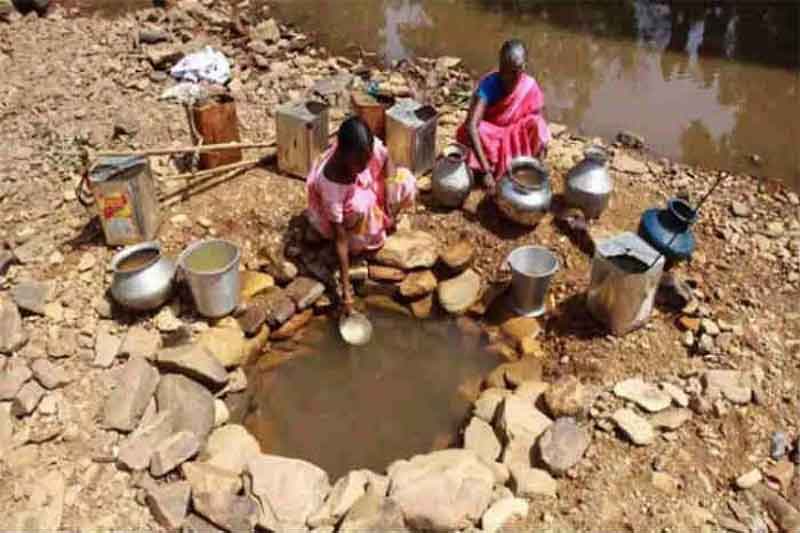
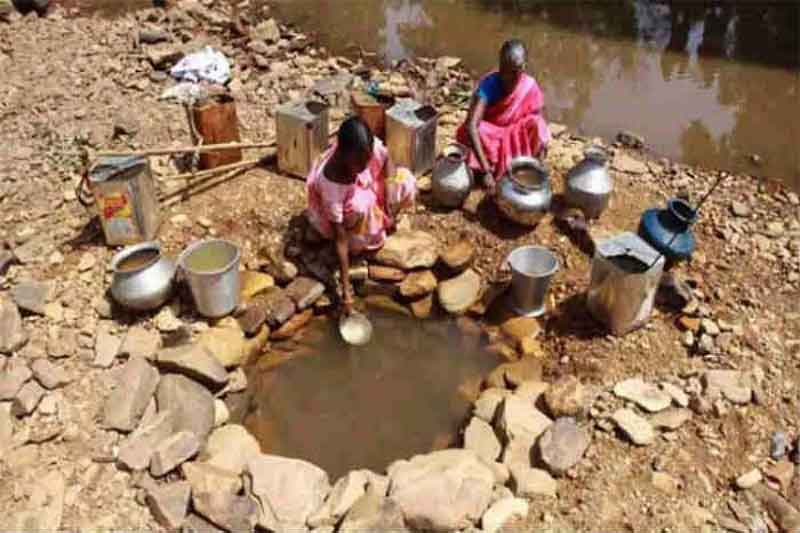
Just sitting and reading the paper here and one of the newz which caught my attention is the shortage of drinking water in Chennai and other big cities. They are taking about that Day Zero is approaching.
Are there no forecasts for moonsoon?

I believe Pakistan also have same problem?
 
I heard we had record snowfall this year and hence the rivers are full, but yes rainfall has been scant.


Before Modi goes about war mongering he should worry about his own people who are thirsty and without water or maybe South India does not vote for him so he doesn't really care.
 
Life in Chennai is very tough at the moment, the water crisis is severe, running water is stopped. We have to line up once in three days in designated public taps and get around 200L per family and even that is inconsistent. I am actually having to buy RO water cans for daily use, not just drinking but all activities, obviously that is costly and not something the poorer sections of society can afford. All of this is our own doing, we have encroached on too many wetlands, waterbodies in the city and depleted groundwater at an unsustainable rate. This is scary now because unlike rest of India we don't enjoy monsoon now, our rains arrive in November-December. How we will manage the next 4 months is a mystery.
 
uncontrolled urbanization due to lack of amenities and job opportunities in rural areas, leads to water crisis all around the third world. India is no exception to this, no matter how India is portrayed around the world by the Indian Government.
unfortunately there is no quick fix, but proper planning and implementation over decades to encourage de-urbanization.
 
Life in Chennai is very tough at the moment, the water crisis is severe, running water is stopped. We have to line up once in three days in designated public taps and get around 200L per family and even that is inconsistent. I am actually having to buy RO water cans for daily use, not just drinking but all activities, obviously that is costly and not something the poorer sections of society can afford. All of this is our own doing, we have encroached on too many wetlands, waterbodies in the city and depleted groundwater at an unsustainable rate. This is scary now because unlike rest of India we don't enjoy monsoon now, our rains arrive in November-December. How we will manage the next 4 months is a mystery.

That is really sad to hear. Let's hope rain arrives to your city as well. It's amazing how things are in different parts of the World. Here in Norway we waste too much water and that too without thinking how important this blessing actually is.
 
Life in Chennai is very tough at the moment, the water crisis is severe, running water is stopped. We have to line up once in three days in designated public taps and get around 200L per family and even that is inconsistent. I am actually having to buy RO water cans for daily use, not just drinking but all activities, obviously that is costly and not something the poorer sections of society can afford. All of this is our own doing, we have encroached on too many wetlands, waterbodies in the city and depleted groundwater at an unsustainable rate. This is scary now because unlike rest of India we don't enjoy monsoon now, our rains arrive in November-December. How we will manage the next 4 months is a mystery.

cant you ( chennai people) bore the water for the daily use ?
 
cant you ( chennai people) bore the water for the daily use ?

The borewells have run dry, we keep digging it deeper every year and now the groundwater level is too deep. Some of my neighbors have sunk borewells 450-500 feet below and still no water, not even saline water. Experts have conducted studies and concluded that the damage is irreversible, for all practical purposes Chennai has run out of groundwater and it will remain that way.
 
The borewells have run dry, we keep digging it deeper every year and now the groundwater level is too deep. Some of my neighbors have sunk borewells 450-500 feet below and still no water, not even saline water. Experts have conducted studies and concluded that the damage is irreversible, for all practical purposes Chennai has run out of groundwater and it will remain that way.

thats alarming situation bro. i dont think Indian govt have any solution in current situation. or do they have any ?
 
thats alarming situation bro. i dont think Indian govt have any solution in current situation. or do they have any ?

They talk about river inter-linking projects, rivers in South India are non-perennial unlike the ones in the North (source from Himalayan glaciers). Idea is fine in a country which suffers floods in one region and severe drought elsewhere but it will take many decades to implement and there haven't been many studies about the environmental impact. I am sure that this idea will be stalled, problems like land acquisition, environmental/tribal NGO protests, politics etc are inevitable and a flawed, messy democracy like India can never take swift action (like say China). Even if they manage to lay out the plans it will be a massive civil engineering project, don't know whether we have the ability to pull it off.

Our immediate hope is to construct as many rainwater harvesting systems as possible in the city (every single house, school, hospital, office, govt building), desilt existing waterbodies and reverse illegal construction (waterbody/wetland encroachment mafia is hand in glove with our state's politicians), change agricultural patterns to replace the water intensive crops, shut down water intensive industries, better reuse/recycling process (stiff challenge in third world countries), increasing green cover etc. Politicians here are increasingly talking about desalination plants but again that could be super costly. I guess these are some options on the table.
 
TN is not having a drought. It has ample rains in winter due to the return monsoon. But they have mismanaged their water resources and taken over most water bodies. There is no ground water replenishment due to this.

Now they are looking at setting up desalination plants.

For decades TN voted for parties which will give free cooker or tv or gold necklace etc etc, the parties hardly did much work towards future planning of civic amenities.
 
India did want to choke Pak some years back? Let this be a lesson for those wishing bad upon others. Karma has struck India big time!
 
Before you advise PM of another country, advise your own PM on how to manage your own country.

The 4 south Indian states combined, BJP has the most seats.

I am sure he was talking about Tamil Nadu because OP mentioned Chennai's water crisis. Anyway BJP swept in Karnataka which is neighboring state of Maharashtra and which has a lot of BJP/RSS/Hindi/Northie influence. There are 5 South Indian states, not 4. In Andhra, Kerala and Tamil Nadu (total 84 seats) BJP has ZERO seats, ZERO. 4 in Telangana I think, 26 in Karnataka. So the party is a big zero in 3 South Indian states, 4/17 in one and majority in Karnataka.

The reason is TN, Kerala, Andhra, Telangana have powerful regional parties which smashed BJP. Karnataka unfortunately is still stuck with the useless Congress party (JDS is minor) and they almost always lose (except Kerala, Punjab) in direct encounters with BJP. Anti-BJP parties swept aside BJP in 4 South Indian states and BJP swept Karnataka because of absence of strong regional players. In Ramanathapuram constituency (you know the religious significance for Hindus right?) BJP lost to Muslim League when majority voters were Hindu, that is the respect BJP commands in TN. So your explanation is very misleading and [MENTION=138254]Syed1[/MENTION] isn't wrong when he says South India didn't vote for BJP.
 
TN is not having a drought. It has ample rains in winter due to the return monsoon. But they have mismanaged their water resources and taken over most water bodies. There is no ground water replenishment due to this.

Now they are looking at setting up desalination plants.

For decades TN voted for parties which will give free cooker or tv or gold necklace etc etc, the parties hardly did much work towards future planning of civic amenities.

Insensitive of you to say that, TN is suffering major drought, most districts especially in the northern part have already been declared drought hit. What do you know about the state that you are so eager to pass judgment. Do you live here? Have you ever lived here? Last December monsoon was a failure and then there was no rain for 196 days before minor rain for less than 6 hours, now back to normal. What ample rains?

Mismanagement is true, you won't see us denying that.

The parties we voted for the last 40 years delivered us better HDI, development, infrastructure, social justice than most North/East/Central states, better than every single cow belt state. Our state's GDP is 2nd highest in India and we subsidize the mid day meals and other schemes of your states, never forget that. Those who depend on TN's (South by extension) money to run their schemes should never take the high ground. You are from Bengal, right? Look after your state first, or the BJP run states. Achieve something before talking about civic amenities of TN.
 
TN is not having a drought. It has ample rains in winter due to the return monsoon. But they have mismanaged their water resources and taken over most water bodies. There is no ground water replenishment due to this.

Now they are looking at setting up desalination plants.

For decades TN voted for parties which will give free cooker or tv or gold necklace etc etc, the parties hardly did much work towards future planning of civic amenities.

Why are you using this as an opportunity to further your poltical propaganda?


On topic, water is the most precious recourse to man. I hope the people in India who are affected stay well and somehow find a solution.
 
Why are you using this as an opportunity to further your poltical propaganda?


On topic, water is the most precious recourse to man. I hope the people in India who are affected stay well and somehow find a solution.

Not much wrong with what he said. How is it political? The Dravidian parties of TN have no agenda other than trying to buy votes and pilfering money from the state coffers and furthering the caste divide. They rode into power much like the Nazis on anti-Brahminism. Despite most of the Brahmins migrating away from TN, they continue to use this propaganda to dupe the masses.

The development that has happened there is in spite of these parties - rather than because of them. The Madras Presidency under the British was one of the better-developed parts of India - due to the port of Madras (which developed from the nearby British Fort). The DMK and the AIADMK are two of the most regressive parties of India - which is saying a lot! Unfortunately, the people there have no other choice but to vote one of these parties every other election. The political spectrum of TN only consists of these *****.
 
Pakistan's water problems stem from its lack of vision. It actually has plenty of water, it just doesn't have enough dams and reservoirs because in the 80s, 90s they seemed to have forgotten what a dam was.

When Musharraf took power, he began a bunch of projects, which were later inherited by PPP and then by PMLN. If the current construction trend continues of dams coupled with decreasing birth rates, we should be alright.

India however it playing with fire. In an attempt to take its full share of the Indus Water Treaty, Indian Punjab is being dried up into a desert, which in turn is riling up secessionist thoughts once again.

This documentary is worth a watch. It's a complete one hour documentary about how Indian Punjab is being screwed.

 
Life in Chennai is very tough at the moment, the water crisis is severe, running water is stopped. We have to line up once in three days in designated public taps and get around 200L per family and even that is inconsistent. I am actually having to buy RO water cans for daily use, not just drinking but all activities, obviously that is costly and not something the poorer sections of society can afford. All of this is our own doing, we have encroached on too many wetlands, waterbodies in the city and depleted groundwater at an unsustainable rate. This is scary now because unlike rest of India we don't enjoy monsoon now, our rains arrive in November-December. How we will manage the next 4 months is a mystery.

Which area are you in, my mother is in South Chennai and atleast she didnt tell me anything about this..
 
They talk about river inter-linking projects, rivers in South India are non-perennial unlike the ones in the North (source from Himalayan glaciers). Idea is fine in a country which suffers floods in one region and severe drought elsewhere but it will take many decades to implement and there haven't been many studies about the environmental impact. I am sure that this idea will be stalled, problems like land acquisition, environmental/tribal NGO protests, politics etc are inevitable and a flawed, messy democracy like India can never take swift action (like say China). Even if they manage to lay out the plans it will be a massive civil engineering project, don't know whether we have the ability to pull it off.

Our immediate hope is to construct as many rainwater harvesting systems as possible in the city (every single house, school, hospital, office, govt building), desilt existing waterbodies and reverse illegal construction (waterbody/wetland encroachment mafia is hand in glove with our state's politicians), change agricultural patterns to replace the water intensive crops, shut down water intensive industries, better reuse/recycling process (stiff challenge in third world countries), increasing green cover etc. Politicians here are increasingly talking about desalination plants but again that could be super costly. I guess these are some options on the table.

your second paragraph of this post is like carbon copy for karachi situation and same situation Karachi is going to face in a decade or so.
 
This should be the focus for everyone living in the sub continent. In 50 years who knows what the water situation will look like and how people will survive. The planet is getting screwed daily but politicians and media are good at distracting people from the main issue and focusing their attention on frevilous things.
 
Last edited:
Which area are you in, my mother is in South Chennai and atleast she didnt tell me anything about this..

I live in South Chennai and the crisis is severe. Is your mother buying from private tankers? Not only are they ridiculously expensive but unless you have a huge sump tank at home (minimum 3000 L capacity) you can't buy from them. Almost all the eateries and messes in my area are closed or operating at limited capacity because of lack of water.
 

Mumbai’s 99-Hour-Long Water Cut: When Will Supply Go Back To Normal? Check Dates, Timings And Areas​


Mumbai is set to experience a 99-hour low water pressure disruption starting Monday, December 22, due to essential pipeline work for the Metro Line 7A expansion. This interruption, announced by the Brihanmumbai Municipal Corporation (BMC), will affect various wards in the central and western suburbs until December 26.


Mumbai: Large parts of the city are bracing for a 99-hour spell of low water pressure, beginning Monday morning, as civic authorities carry out critical pipeline connection work linked to the expansion of the Mumbai Metro network. The prolonged disruption, announced by the Brihanmumbai Municipal Corporation, is expected to last nearly four days and will affect multiple wards across central and western suburbs.

Mumbai’s 99-Hour Water Disruption: What’s Happening and Why​

According to the Brihanmumbai Municipal Corporation (BMC), the low-pressure phase will begin at 10 am on Monday, December 22, and continue until 1 pm on Friday, December 26, 2025. The disruption is tied to water pipeline diversion and cross-connection works required for the Mumbai Metro Line 7A.
Civic officials said the work is unavoidable and forms a crucial part of long-term infrastructure upgrades in the city.

Metro Construction Behind the Supply Impact​

The construction work is being executed by the Mumbai Metropolitan Region Development Authority (MMRDA). As part of the Metro Line 7A project, a 2,400 mm diameter Upper Vaitarna main water pipeline is being diverted. The BMC will carry out technically complex cross-connections during this period, requiring controlled water flow to ensure safety and engineering precision.

Officials stressed that the exercise is essential to avoid future damage to both metro and water infrastructure.

G North Ward: Dharavi to See Fluctuating Supply​

Several parts of Dharavi in G North ward will receive water at low pressure during both morning and evening schedules.
Morning supply areas — including Dharavi Loop Road, A.K.G. Nagar, Jasmine Mill Road, Matunga Labour Camp, Sant Rohidas Road, 60 Feet Road, 90 Feet Road, Sant Kakeya Road, M.P. Nagar, Dhorwada and Mahatma Gandhi Road — normally receive water from 4 am to 12 noon, but will face low pressure between 9 am and 5 pm from December 22 to 25.
Evening supply areas such as Dharavi Main Road, Ganesh Mandir Road, Dilip Kadam Road, Jasmine Mill Road, Mahim Junction and A.K.G. Nagar, which usually receive water from 4 pm to 9 pm, will experience low pressure from 5 pm to 10 pm during the same dates.

K East Ward:​

In K East ward, low-pressure supply will impact both afternoon and evening water distribution.
Afternoon supply areas — Kabir Nagar, Bamanwada, Parsi Wada, Airport Area, Tarun Bharat Colony, Islampura, Deulwadi and P&T Colony — will see reduced pressure during their regular 2 pm to 5:30 pm supply window from December 22 to 25.
Evening supply areas, including Koldongri, Old Police Lane, Vijay Nagar (Sahar Road) and Mogarpada, will face low pressure during the usual 5 pm to 10 pm slot across the same period.

H East Ward: BKC and Bandra East to Feel the Pinch​

In H East ward, both late-night and early-morning supplies will be affected.
Areas such as Bandra-Kurla Complex (BKC) and Motilal Nagar, which receive water between 10 pm and 11:40 pm, will see low pressure from December 22 to 25.
Meanwhile, early-morning supply areas — Prabhat Colony, Kalina, CST Road (South Side), University Area, Khar Subway to Kherwadi, Bandra East, Golibar Road and nearby localities — will face reduced pressure from December 23 to 25, during their regular 3:30 am to 9 am supply window.

When Will Water Supply Return to Normal?​

The BMC has said that water pressure is expected to gradually normalise after 1 pm on Friday, December 26, once the cross-connection work is completed and the system stabilises.
BMC Advisory for Residents
Urging public cooperation, the BMC has advised residents in affected areas to store sufficient water in advance, use water judiciously, and boil and filter drinking water as a precaution. Officials acknowledged the inconvenience but said the temporary hardship is necessary for long-term improvements to Mumbai’s transport and civic infrastructure.
For now, Mumbai residents are being asked to plan ahead — and hold on — as the city navigates yet another complex infrastructure upgrade beneath its streets.
Get Latest News Live on Times Now along with Breaking News and Top Headlines from Mumbai, India and around the world.


Must be hard for you indians, i understand this is affecting the people of mumbai, but i get told this is very frequent across india,

what can be done indians

@Rajdeep @cricketjoshila @Champ_Pal @JaDed @Devadwal @uppercut @Theanonymousone @straighttalk @Vikram1989 @RexRex @Varun @Romali_rotti @Bhaijaan @Cover Drive Six @rickroll @rpant_gabba, @Romali_rotti @kron @globetrotter


#FreeMinoritiesOfIndia

#SaveAllIndianMinorities

#FreeIndiaFromHinduExtremism

#SanctionIndia
 

Mumbai’s 99-Hour-Long Water Cut: When Will Supply Go Back To Normal? Check Dates, Timings And Areas​


Mumbai is set to experience a 99-hour low water pressure disruption starting Monday, December 22, due to essential pipeline work for the Metro Line 7A expansion. This interruption, announced by the Brihanmumbai Municipal Corporation (BMC), will affect various wards in the central and western suburbs until December 26.


Mumbai: Large parts of the city are bracing for a 99-hour spell of low water pressure, beginning Monday morning, as civic authorities carry out critical pipeline connection work linked to the expansion of the Mumbai Metro network. The prolonged disruption, announced by the Brihanmumbai Municipal Corporation, is expected to last nearly four days and will affect multiple wards across central and western suburbs.

Mumbai’s 99-Hour Water Disruption: What’s Happening and Why​

According to the Brihanmumbai Municipal Corporation (BMC), the low-pressure phase will begin at 10 am on Monday, December 22, and continue until 1 pm on Friday, December 26, 2025. The disruption is tied to water pipeline diversion and cross-connection works required for the Mumbai Metro Line 7A.
Civic officials said the work is unavoidable and forms a crucial part of long-term infrastructure upgrades in the city.

Metro Construction Behind the Supply Impact​

The construction work is being executed by the Mumbai Metropolitan Region Development Authority (MMRDA). As part of the Metro Line 7A project, a 2,400 mm diameter Upper Vaitarna main water pipeline is being diverted. The BMC will carry out technically complex cross-connections during this period, requiring controlled water flow to ensure safety and engineering precision.

Officials stressed that the exercise is essential to avoid future damage to both metro and water infrastructure.

G North Ward: Dharavi to See Fluctuating Supply​

Several parts of Dharavi in G North ward will receive water at low pressure during both morning and evening schedules.
Morning supply areas — including Dharavi Loop Road, A.K.G. Nagar, Jasmine Mill Road, Matunga Labour Camp, Sant Rohidas Road, 60 Feet Road, 90 Feet Road, Sant Kakeya Road, M.P. Nagar, Dhorwada and Mahatma Gandhi Road — normally receive water from 4 am to 12 noon, but will face low pressure between 9 am and 5 pm from December 22 to 25.
Evening supply areas such as Dharavi Main Road, Ganesh Mandir Road, Dilip Kadam Road, Jasmine Mill Road, Mahim Junction and A.K.G. Nagar, which usually receive water from 4 pm to 9 pm, will experience low pressure from 5 pm to 10 pm during the same dates.

K East Ward:​

In K East ward, low-pressure supply will impact both afternoon and evening water distribution.
Afternoon supply areas — Kabir Nagar, Bamanwada, Parsi Wada, Airport Area, Tarun Bharat Colony, Islampura, Deulwadi and P&T Colony — will see reduced pressure during their regular 2 pm to 5:30 pm supply window from December 22 to 25.
Evening supply areas, including Koldongri, Old Police Lane, Vijay Nagar (Sahar Road) and Mogarpada, will face low pressure during the usual 5 pm to 10 pm slot across the same period.

H East Ward: BKC and Bandra East to Feel the Pinch​

In H East ward, both late-night and early-morning supplies will be affected.
Areas such as Bandra-Kurla Complex (BKC) and Motilal Nagar, which receive water between 10 pm and 11:40 pm, will see low pressure from December 22 to 25.
Meanwhile, early-morning supply areas — Prabhat Colony, Kalina, CST Road (South Side), University Area, Khar Subway to Kherwadi, Bandra East, Golibar Road and nearby localities — will face reduced pressure from December 23 to 25, during their regular 3:30 am to 9 am supply window.

When Will Water Supply Return to Normal?​

The BMC has said that water pressure is expected to gradually normalise after 1 pm on Friday, December 26, once the cross-connection work is completed and the system stabilises.
BMC Advisory for Residents
Urging public cooperation, the BMC has advised residents in affected areas to store sufficient water in advance, use water judiciously, and boil and filter drinking water as a precaution. Officials acknowledged the inconvenience but said the temporary hardship is necessary for long-term improvements to Mumbai’s transport and civic infrastructure.
For now, Mumbai residents are being asked to plan ahead — and hold on — as the city navigates yet another complex infrastructure upgrade beneath its streets.
Get Latest News Live on Times Now along with Breaking News and Top Headlines from Mumbai, India and around the world.


Must be hard for you indians, i understand this is affecting the people of mumbai, but i get told this is very frequent across india,

what can be done indians

@Rajdeep @cricketjoshila @Champ_Pal @JaDed @Devadwal @uppercut @Theanonymousone @straighttalk @Vikram1989 @RexRex @Varun @Romali_rotti @Bhaijaan @Cover Drive Six @rickroll @rpant_gabba, @Romali_rotti @kron @globetrotter


#FreeMinoritiesOfIndia

#SaveAllIndianMinorities

#FreeIndiaFromHinduExtremism

#SanctionIndia

Why is alleged 4th largest economy having such a severe water crisis? :inti

Is it because they are not really the 4th largest economy? :qdkcheeky
 

Madhya Pradesh Minister Admits Mistake As Indore Contaminated Water Kills 7​


Over the last one week, more than 1,100 people have been affected in some form by the vomiting-diarrhoea outbreak in Indore/


Madhya Pradesh Minister Admits Mistake As Indore Contaminated Water Kills 7​

Over the last one week, more than 1,100 people have been affected in some form by the vomiting-diarrhoea outbreak in Indore/​


Madhya Pradesh Minister Admits Mistake As Indore Contaminated Water Kills 7

Mayor Pushyamitra Bhargava has confirmed the death of seven persons so far.
Indore:
Madhya Pradesh minister Kailash Vijayvargiya on Wednesday acknowledged lapses by officials in connection with water contamination in Indore that has claimed seven lives so far, and said those found guilty will not be spared, irrespective of their rank.

Mayor Pushyamitra Bhargava has confirmed the death of seven persons so far within a week after falling ill due to contaminated water in the Bhagirathpura area of Indore, the cleanest city of the country.

Over the last one week, more than 1,100 people have been affected in some form by the vomiting-diarrhoea outbreak in Bhagirathpura, of whom 111 patients were admitted to hospitals, officials said.

Bhagirathpura falls under Urban Development and Housing Vijayvargiya's assembly constituency, Indore-1.

Asked about the contaminated drinking water incident, the MP Assembly Affairs Minister told reporters, "I feel that a mistake has been committed, but it is better if we first ensure that all patients recover and create a positive environment rather than discuss this now." None of those responsible for the contaminated drinking water incident would be spared, even if the official concerned held a very high position, he said.


On the number of fatalities due to contaminated water, Vijayvargiya said, "I will not comment on this at present because some people have died natural deaths, while some fatalities have occurred in this incident as well. Therefore, after an inquiry by doctors and the administration, we will share the figures." The minister said the number of patients suffering from vomiting and diarrhoea in Bhagirathpura has declined, but admissions in hospitals and health centres still continue.

Four ambulances and separate teams of medical personnel have been deployed in the Bhagirathpura area, he added.

According to Vijayvargiya, separate wards have been set up for the patients at the government-run Maharaja Yashwantrao Hospital and the private Shri Aurobindo Institute of Medical Sciences in the city.

He said private hospitals in Bhagirathpura have been informed that the state government will bear the entire medical treatment cost of all patients.

Municipal Corporation Commissioner Dilip Kumar Yadav said a leakage was detected at a point in the main water supply pipeline in Bhagirathpura, over which a toilet was found constructed, and the water possibly got contaminated due to this leakage.

An official said that following instructions from Chief Minister Mohan Yadav, a zonal officer and an assistant engineer of the municipal corporation have been suspended with immediate effect, while the services of an in-charge sub-engineer have been terminated.

The official said a three-member committee headed by an Indian Administrative Service (IAS) officer has been constituted to probe the contaminated drinking water incident.


@Rajdeep @cricketjoshila @Champ_Pal @JaDed @Devadwal @uppercut @Theanonymousone @straighttalk @Vikram1989 @Varun @Romali_rotti @Bhaijaan @Cover Drive Six @rickroll @RexRex @rpant_gabba, @Romali_rotti @kron @globetrotter @Hitman @jnaveen1980


#FreeMinoritiesOfIndiaFromHindus

#SaveAllIndianMinorities

#FreeIndiaFromHinduExtremism

#SanctionIndiaIndians
 

Contrasting Pics Show Poisoned Water For Citizens, But Mineral Water For Politicians​


As residents struggle with poisoned water, visuals of Madhya Pradesh ministers being served bottled water have highlighted the stark divide between the powerful and the common man, even when it comes to something as basic as drinking water. 13 people have died due to water contamination in Indore.


Indore: Visuals of top Madhya Pradesh ministers being served bottled water at a recent press conference as the masses continues to bear the brunt of poisoned water have reignited questions about the disparity between common men and the powerful class, even when it comes to something as basic as drinking water.
The visuals showed Chief Minister Mohan Yadav, state minister Kailash Vijayvargiya and other politicians sitting around a table, where several bottles of mineral water were kept. This is in stark contrast with visuals from Indore's Bhagirathpura showing family members crying over the loss of their loved ones. Among the heartbroken citizens is a woman who lost her 6-month-old child due to water contamination. The infant had consumed baby formula made by mixing the contaminated water.
The mother wailed, “My child is no more. He had vomiting and diarrhea since two days."

The city is filled with more such tragedies as at least 13 people have lost their lives after drinking contaminated water.

Lab reports from Bhagirathpura’s Narmada pipeline have confirmed contamination by fecal coliform, E. coli, Klebsiella and Vibrio cholerae.
Shockingly, the main pipeline, which supplies drinking water to the area, passes beneath a public toilet. Due to a leakage in the main line, sewage water reportedly mixed with the drinking water. Several water distribution lines were also found broken in the area, due to which contaminated water was reaching the households.

‘You Continued To Drink Bisleri...’​

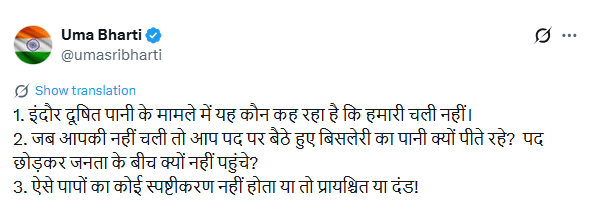
Former Chief Minister of Madhya Pradesh, Uma Bharti, on Friday launched an attack on the present state government. Bharti, who is also the former Union Minister of Drinking Water and Sanitation, said that the water contamination tragedy has "shamed and disgraced" not only Madhya Pradesh, but the entire system. She asked why did officials continued drinking packaged water and not reached out to the public if the state's government's plan failed.
The politician wrote on X, “When your plan didn't work, why did you continue to drink Bisleri water while sitting in your position? Why didn't you leave the position and reach out to the public?”
She added, "There is no explanation for such sins- either atonement or punishment!"
image-1767345320691.webp

‘Price Of Life Is Not Rs 2 Lakh’​

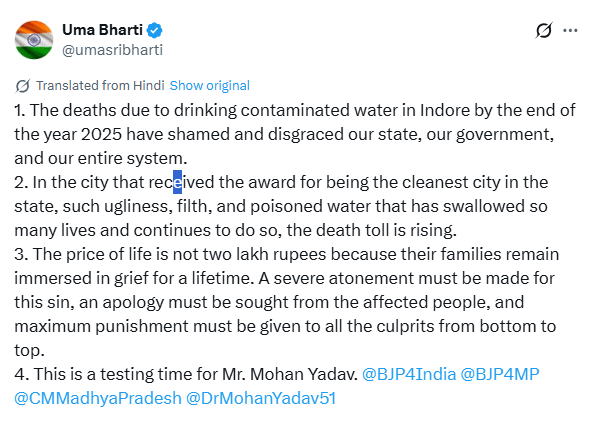
Commenting on the irony that the "cleanest city in India" reported "such ugliness and filth", Bharti said, “Poisoned water has swallowed so many lives and continues to do so...The death toll is rising.”
Madhya Pradesh Chief Minister Mohan Yadav earlier took cognizance of the deaths and announced ₹2 lakh assistance for the families of the deceased. Commenting on the ex-gratia, Uma Bharti said, “The price of life is not two lakh rupees because their families remain immersed in grief for a lifetime.”

‘Testing Time For Mohan Yadav’​

Calling for strict punishment for those responsible for contaminated water, Bharti said in a post on X, “A severe atonement must be made for this sin, an apology must be sought from the affected people, and maximum punishment must be given to all the culprits from bottom to top.”
Tagging BJP and the Chief Minister to her tweet, she added, “This is a testing time for Mr. Mohan Yadav.”
image-1767345338760.webp

Also Read- Indore Health Emergency: Mohan Yadav Govt Ensures Free Treatment, Promises Probe Into Water Contamination Tragedy


This is what i really dont understand with india,, how corrupt are your officials, bet all the snaghis will stay quiet


@Rajdeep @cricketjoshila @Champ_Pal @JaDed @Devadwal @uppercut @Theanonymousone @straighttalk @Vikram1989 @Varun @Romali_rotti @Bhaijaan @Cover DriveSix @rickroll @RexRex @rpant_gabba, @Romali_rotti @kron @globetrotter @Hitman @jnaveen1980

#FreeMinoritiesOfIndiaFromHindus

#SaveAllIndianMinorities

#FreeIndiaFromHinduExtremism

#SanctionIndiaIndians

 

Contrasting Pics Show Poisoned Water For Citizens, But Mineral Water For Politicians​


As residents struggle with poisoned water, visuals of Madhya Pradesh ministers being served bottled water have highlighted the stark divide between the powerful and the common man, even when it comes to something as basic as drinking water. 13 people have died due to water contamination in Indore.


Indore: Visuals of top Madhya Pradesh ministers being served bottled water at a recent press conference as the masses continues to bear the brunt of poisoned water have reignited questions about the disparity between common men and the powerful class, even when it comes to something as basic as drinking water.
The visuals showed Chief Minister Mohan Yadav, state minister Kailash Vijayvargiya and other politicians sitting around a table, where several bottles of mineral water were kept. This is in stark contrast with visuals from Indore's Bhagirathpura showing family members crying over the loss of their loved ones. Among the heartbroken citizens is a woman who lost her 6-month-old child due to water contamination. The infant had consumed baby formula made by mixing the contaminated water.
The mother wailed, “My child is no more. He had vomiting and diarrhea since two days."

The city is filled with more such tragedies as at least 13 people have lost their lives after drinking contaminated water.

Lab reports from Bhagirathpura’s Narmada pipeline have confirmed contamination by fecal coliform, E. coli, Klebsiella and Vibrio cholerae.
Shockingly, the main pipeline, which supplies drinking water to the area, passes beneath a public toilet. Due to a leakage in the main line, sewage water reportedly mixed with the drinking water. Several water distribution lines were also found broken in the area, due to which contaminated water was reaching the households.

‘You Continued To Drink Bisleri...’​

Former Chief Minister of Madhya Pradesh, Uma Bharti, on Friday launched an attack on the present state government. Bharti, who is also the former Union Minister of Drinking Water and Sanitation, said that the water contamination tragedy has "shamed and disgraced" not only Madhya Pradesh, but the entire system. She asked why did officials continued drinking packaged water and not reached out to the public if the state's government's plan failed.
The politician wrote on X, “When your plan didn't work, why did you continue to drink Bisleri water while sitting in your position? Why didn't you leave the position and reach out to the public?”
She added, "There is no explanation for such sins- either atonement or punishment!"
image-1767345320691.webp

‘Price Of Life Is Not Rs 2 Lakh’​

Commenting on the irony that the "cleanest city in India" reported "such ugliness and filth", Bharti said, “Poisoned water has swallowed so many lives and continues to do so...The death toll is rising.”
Madhya Pradesh Chief Minister Mohan Yadav earlier took cognizance of the deaths and announced ₹2 lakh assistance for the families of the deceased. Commenting on the ex-gratia, Uma Bharti said, “The price of life is not two lakh rupees because their families remain immersed in grief for a lifetime.”

‘Testing Time For Mohan Yadav’​

Calling for strict punishment for those responsible for contaminated water, Bharti said in a post on X, “A severe atonement must be made for this sin, an apology must be sought from the affected people, and maximum punishment must be given to all the culprits from bottom to top.”
Tagging BJP and the Chief Minister to her tweet, she added, “This is a testing time for Mr. Mohan Yadav.”
image-1767345338760.webp

Also Read- Indore Health Emergency: Mohan Yadav Govt Ensures Free Treatment, Promises Probe Into Water Contamination Tragedy


This is what i really dont understand with india,, how corrupt are your officials, bet all the snaghis will stay quiet


@Rajdeep @cricketjoshila @Champ_Pal @JaDed @Devadwal @uppercut @Theanonymousone @straighttalk @Vikram1989 @Varun @Romali_rotti @Bhaijaan @Cover DriveSix @rickroll @RexRex @rpant_gabba, @Romali_rotti @kron @globetrotter @Hitman @jnaveen1980

#FreeMinoritiesOfIndiaFromHindus

#SaveAllIndianMinorities

#FreeIndiaFromHinduExtremism

#SanctionIndiaIndians

Madhya Pradesh is a BJP-dominated state I believe. So, sanghis are drinking contaminated water there. I am surprised they are not making more noise about it. :inti

Andhbhakt much? :inti
 
Thanks for your concerns my friends.

After the suspension of the Indus Water Treaty, India has significantly improved its water resourcefulness while at the same time turned water into a weapon against our enemy nations.
 
Hundreds hospitalised in Indore after public toilet built above water pipeline appears to have let sewage into supply

Sewage-contaminated drinking water is being blamed for killing at least 10 people, including a baby boy, and sending more than 270 others to hospital in Indore, ranked India’s “cleanest city” for the last eight years.

Residents of a congested, lower-income neighbourhood in Indore, Madhya Pradesh’s commercial capital, had been warning authorities for months about foul-smelling tap water. Their complaints went unheeded, despite the city’s much-lauded ranking for waste segregation and other cleanliness measures.


“I have received information about 10 deaths due to a diarrhoea outbreak caused by contaminated water in the Bhagirathpura area,” said Indore’s mayor, Pushyamitra Bhargava. Sewage was mixing “in the main line leading from the water tank”, he added.

Local media reported that the death toll had climbed to 15, but there was no official confirmation. At least 32 patients remain in intensive care units. Beyond those hospitalised, the state’s chief minister, Mohan Yadav, said health teams conducting door-to-door visits identified 2,456 “suspected patients”, who were given first aid “on the spot”.

Authorities say a public toilet constructed above a drinking water pipeline appears to have allowed sewage to seep into the supply. The toilet was built without a septic tank.

Residents began streaming into hospitals earlier this week, complaining of vomiting, diarrhoea and high fever.

Water tests “confirmed the presence of abnormal bacteria generally found in sewer water comprising human waste”, a medical official said.

Residents said their complaints about the water had run into a bureaucratic maze of red tape.

“Prima facie, this case falls under gross dereliction of duty,” said an Indore municipal councillor, Kamal Waghela. Several municipal officials have been suspended pending an investigation.

The five-month-old infant who died had been bottle-fed using tap water, his father, Sunil Sahu, told reporters. “No one told us the water was contaminated. We filtered it. The same water was flowing throughout the neighbourhood. There was no warning,” he said.

An editorial in the Hindu called for “better enforcement of water guidelines and other environmental laws at all levels”. The newspaper noted that toxic air pollution, which blankets many cities, was already “wreaking havoc on citizens’ health” and said what happened in Madhya Pradesh should serve as “a wake-up call for India’s water management”.

The opposition Congress leader, Rahul Gandhi, accused the Bharatiya Janata party-led state government of negligence, saying “clean water isn’t a favour – it’s a right to life”.

The government said new rules would be framed to prevent similar incidents. “No stone will be left unturned to make sure it does not happen again,” Yadav said.

The Indore crisis comes amid broader concerns over water safety nationwide. The Times of India reported that only 8% of public water-testing laboratories run by the Delhi government were accredited by the National Accreditation Board for Testing and Calibration Laboratories, which certifies facilities meeting international quality-control standards. Nationwide, 59% of public labs are now accredited.

Experts warn that as India’s urban population grows rapidly, lapses in water testing heighten the risk of disease outbreaks.

 
Hundreds hospitalised in Indore after public toilet built above water pipeline appears to have let sewage into supply

Sewage-contaminated drinking water is being blamed for killing at least 10 people, including a baby boy, and sending more than 270 others to hospital in Indore, ranked India’s “cleanest city” for the last eight years.

Residents of a congested, lower-income neighbourhood in Indore, Madhya Pradesh’s commercial capital, had been warning authorities for months about foul-smelling tap water. Their complaints went unheeded, despite the city’s much-lauded ranking for waste segregation and other cleanliness measures.


“I have received information about 10 deaths due to a diarrhoea outbreak caused by contaminated water in the Bhagirathpura area,” said Indore’s mayor, Pushyamitra Bhargava. Sewage was mixing “in the main line leading from the water tank”, he added.

Local media reported that the death toll had climbed to 15, but there was no official confirmation. At least 32 patients remain in intensive care units. Beyond those hospitalised, the state’s chief minister, Mohan Yadav, said health teams conducting door-to-door visits identified 2,456 “suspected patients”, who were given first aid “on the spot”.

Authorities say a public toilet constructed above a drinking water pipeline appears to have allowed sewage to seep into the supply. The toilet was built without a septic tank.

Residents began streaming into hospitals earlier this week, complaining of vomiting, diarrhoea and high fever.

Water tests “confirmed the presence of abnormal bacteria generally found in sewer water comprising human waste”, a medical official said.

Residents said their complaints about the water had run into a bureaucratic maze of red tape.

“Prima facie, this case falls under gross dereliction of duty,” said an Indore municipal councillor, Kamal Waghela. Several municipal officials have been suspended pending an investigation.

The five-month-old infant who died had been bottle-fed using tap water, his father, Sunil Sahu, told reporters. “No one told us the water was contaminated. We filtered it. The same water was flowing throughout the neighbourhood. There was no warning,” he said.

An editorial in the Hindu called for “better enforcement of water guidelines and other environmental laws at all levels”. The newspaper noted that toxic air pollution, which blankets many cities, was already “wreaking havoc on citizens’ health” and said what happened in Madhya Pradesh should serve as “a wake-up call for India’s water management”.

The opposition Congress leader, Rahul Gandhi, accused the Bharatiya Janata party-led state government of negligence, saying “clean water isn’t a favour – it’s a right to life”.

The government said new rules would be framed to prevent similar incidents. “No stone will be left unturned to make sure it does not happen again,” Yadav said.

The Indore crisis comes amid broader concerns over water safety nationwide. The Times of India reported that only 8% of public water-testing laboratories run by the Delhi government were accredited by the National Accreditation Board for Testing and Calibration Laboratories, which certifies facilities meeting international quality-control standards. Nationwide, 59% of public labs are now accredited.

Experts warn that as India’s urban population grows rapidly, lapses in water testing heighten the risk of disease outbreaks.


what has this got to do with water crises someone please explain?

this needs it own thread
 
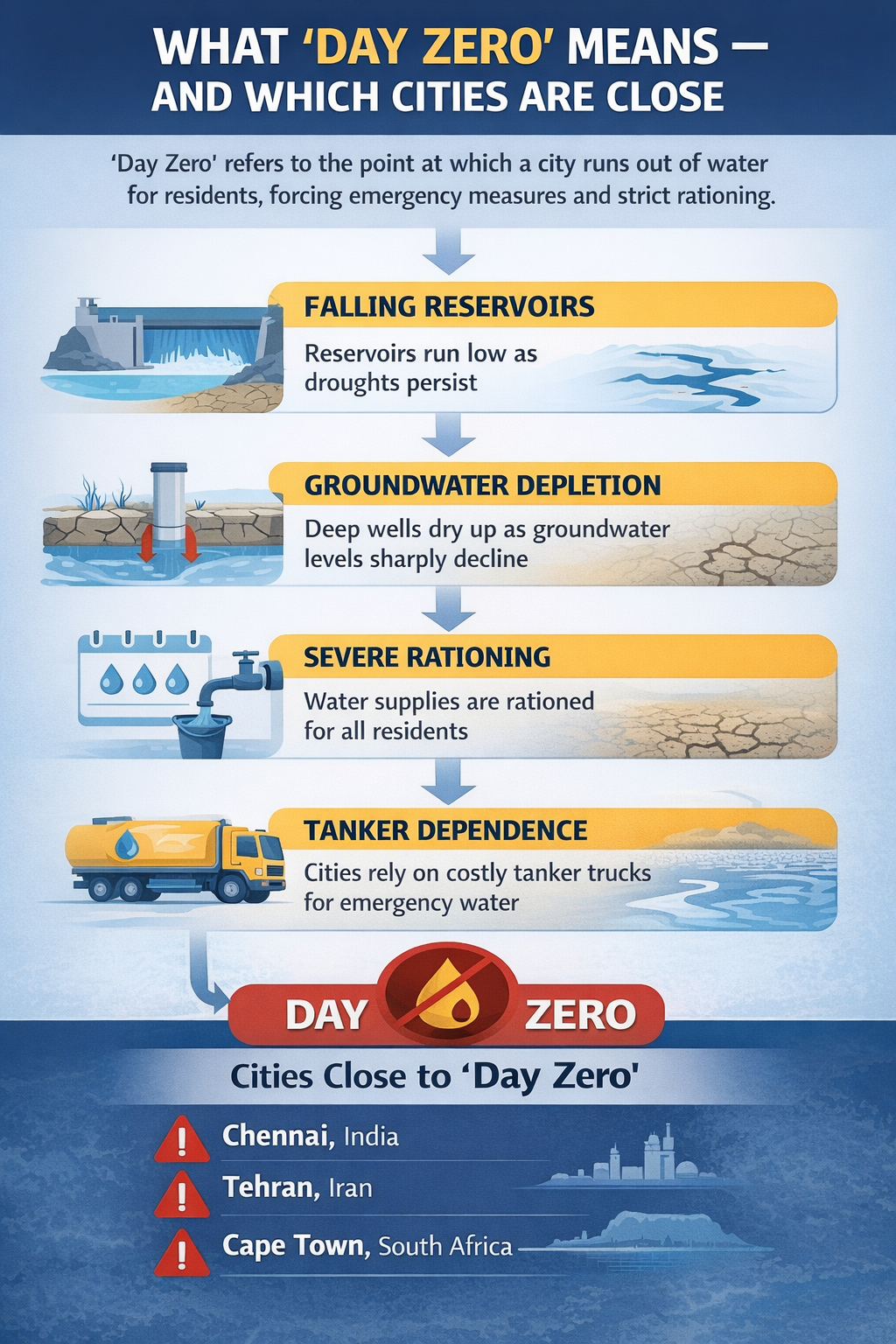
India's groundwatr crisis, whic states are heading towards 'day zero' first


In a narrow lane of india, men and women wait quietly with plastic drums lined in rows. Some squat, some sit, with eyes fixed on the bend ahead.

Suddenly, the silence breaks. A water tanker reverses into the alley, its engine drowning out the waiting. Young men rush forward climbing atop the truck, lowering pipes into the tank. Within moments, quiet order unravels into chaos.


Hundreds of kilometres away, in rural India, women walk long distances to empty wells, dried-up tubewells and shrinking water bodies, hoping to find a few litres of water.

Just because some cities suffered floods doesn’t mean you have water. For a country that supports nearly 17% of the world’s population with just 4% of its freshwater resources, water scarcity has become a daily reality, and not just a distant threat.

With India’s population expected to rise from 1.3 billion to nearly 1.7 billion by 2050 the question is no longer whether India is facing a water crisis.

But how soon parts of the country will run out!

What is a water crisis? How severe is it in India?

A water crisis occurs when the availability of safe usable water falls short of demand. The World Bank defines water scarcity as a situation where annual per capita water availability drops below 1,000 cubic metres.

India is steadily moving towards this threshold.

Despite supporting 17% of the world’s population, India has access to only 4% of global freshwater resources.
According to NITI Aayog's Composite Water Management Index (CWMI) the country is facing the worst water crisis in its history, with nearly 600 million people experiencing high to extreme water stress.

India’s per capita water availability stood at 1,486 cubic metres in 2021, placing it in the water-stressed category (below 1,700 cubic metres). Government estimates suggest this could fall further to 1,341 cubic metres by 2025 and 1,140 cubic metres by 2050, pushing large parts of the country closer to scarcity.

A shrinking global water reserve

Globally, freshwater reserves have declined sharply over the two decades, with losses estimated at 324 billion cubic metres every year, enough to meet meet the annual water needs of 280 million people.


According to the Union minister of Jal Shakti releases Dynamic Ground Water Resource Assessment Report of the Country for the Year 2025, “Groundwater assessment units across India are categorised as safe, semi critical,critical and over exploited, based on the ratio of annual groundwater extraction and replenishment in the
phreatic aquifer. The assigned categories aid in planning, management, and regulation of the country's groundwater resources.

Water consumption worldwide increased by 25% between 2000 and 2019, with nearly a third of that growth
occurring in already water-stressed regions, the report stated.

Northern India figures prominently among these drying zones, alongside parts of northern China, Central America
and the southwestern United States. Rising temperatures, erratic rainfall, worsening droughts and unsustainable land and water use have accelerated the decline.

For India, the implications are stark. Agriculture, livelihoods, urban growth and ecological sustainability all hinge
on groundwater, the country’s most heavily used and least regulated water source.

Groundwater india's invisible lifeline

Groundwater forms the backbone of India’s water security According to the 2019 NITI Aayog report, the Central Groundwater Board (CGWB) stated that the contribution of groundwater is nearly 62% in irrigation, 85% in rural
water supply and 45% in urban water supply.

Yet this invisible lifeline is being drawn down faster than it can be replenished. As per the Dynamic Ground Water Resource Assessment 2025, India’s total annual groundwater recharge stands at 448.52 billion cubic metres (bcm).


After accounting for natural discharge, the annual extractable resource is estimated at 407.75 bcm. Current extraction has reached 247.22 bcm, pushing the national stage of groundwater extraction to about 60.6%.


While the national average may suggest moderate stress the reality on the ground is far more uneven.
Out of the total 6,762 assessment units, around 25% have been categorised as Overexploited, Critical, or Semi-Critical. These are areas where extraction is approaching or exceeding natural recharge, a warning sign that aquifers are under severe stress.

States/cities staring at ‘Day Zero


The most vulnerable regions are concejtrated in three broad zones:

Northwest India: Punjab, Haryana, Delhi and western Uttar Pradesh — where groundwater recharge exists but
indiscriminate withdrawal, driven largely by agriculture, has led to over-extraction.

Western India: Rajasthan and parts of Gujarat - where arid conditions limit natural recharge

Southern peninsular India: including Karnataka, Tamil Nadu, Telangana and Andhra Pradesh, where hard
crystalline aquifers have low storage capacity.

States with the highest proportion of over-exploited and critical units include Punjab, Haryana, Rajasthan, Tamil
Nadu and Delhi. In Punjab, groundwater extraction stands at over 156% of annual recharge. Rajasthan follows closely at 147%, while Delhi’s extraction level exceeds 90%, placing placing it in the critical category.


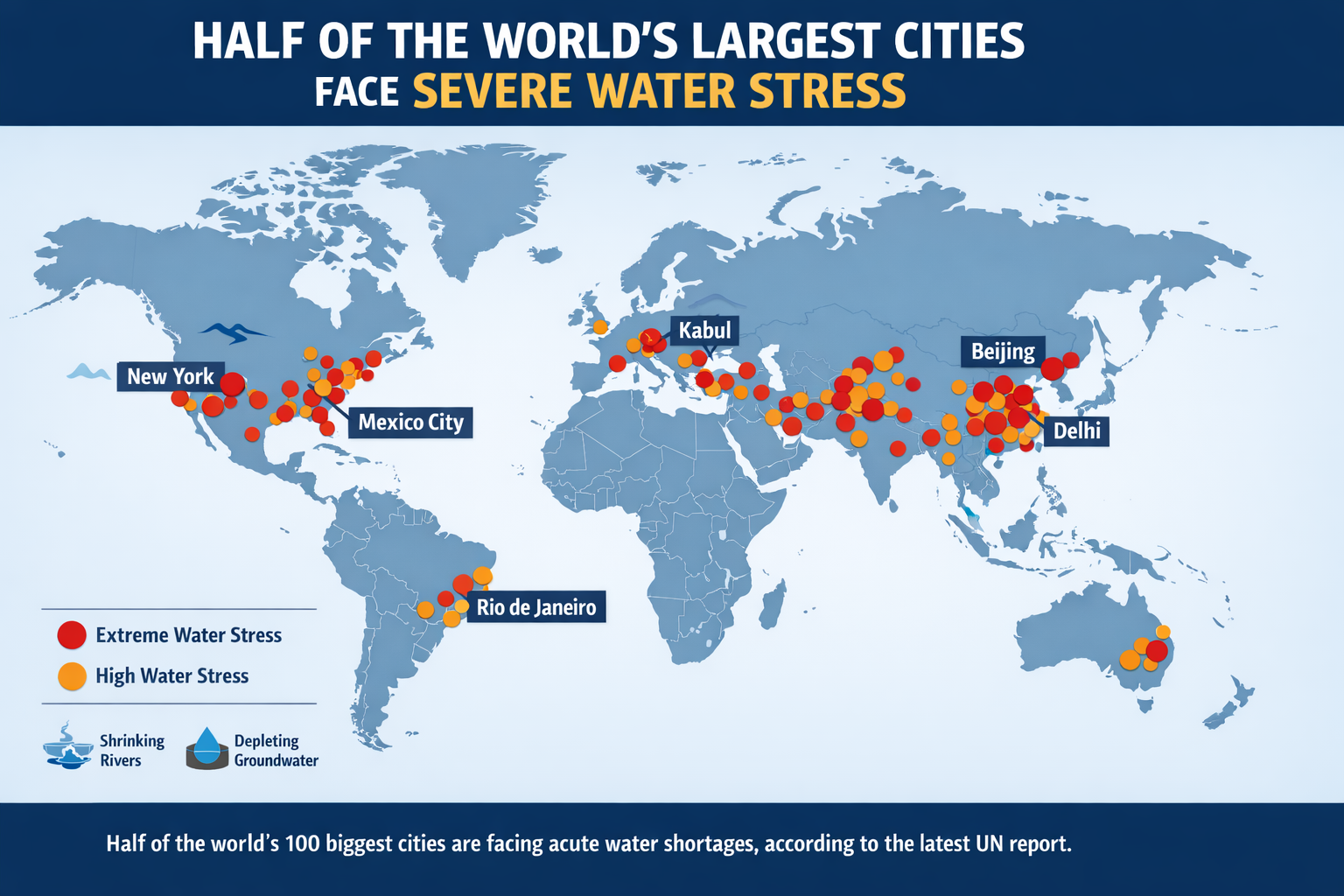
Urban centres are not immune. NITI Aayog has warned that 121 major cities, including Delhi, Bengaluru and Chennai, face the risk of depleting their groundwater reserves.

Chennai already experienced ‘day zero’ in June 2019, when all four major reservoirs of the big city reservoirs ran
dry. People had to line up for hours to wait for a small allocation of water brought in by trucks from other areas.

A BBC report, citing UN projections, ranked Bengaluru second after Brazil’s São Paulo, among 11 global cities at
risk of running out of drinking water. As water levels drop and summer temperatures rise, cities are imposing restrictions.

Lakhs of residents across the 'city of dreams,' Mumbai are grappling with acute water scarcity. In Bengaluru, authorities have banned the use of potable water for non-essential activities such as washing cars and watering gardens. Yet questions remain over whether fines and regulations alone can avert a full-blown crisis.


In rural areas, the crisis manifests differently, in longer walks for water, abandoned wells and failed crops


Why is india running out of water?

Experts point to multiple, interconnected causes:

Rising demand: India’s water demand is expected to outstrip supply by 2030

Agricultural overuse: Water-intensive crops like paddy in Punjab and Haryana

Encroachment of water bodies: Lakes and ponds dissapearing, especially in cities like Bengaluru

Climate change: Erratic monsoons and declining river flows

Pollution: Industrial waste, sewage, and mining contaminating groundwater

Weak regulation: Outdated laws like the Easement Act of 1882, which ties groundwater ownership to land

Fragmented governance: Separate authorities for surface and groundwater management

Public apathy: Water treated as a free, unlimited resource


Groundwater overuse and contamination


India is the largest user of groundwater in the world, accounting for over 25% of global groundwater extraction. The consequences are severe:

Nearly 70% of groundwater sources are contaminated

India ranks 120th out of 122 countries on the global water quality index


Groundwater extraction in India is assessed using data from the Minor Irrigation Census and sample surveys
conducted by State Ground Water Departments According to the National Compilation on Dynamic Ground
Water Resources of India, 2025, the country’s total the country’s total annual groundwater extraction is estimated
at 247.22 billion cubic metres (bcm).

The agriculture sector remains the largest consumer, accounting for 87% of total extraction, or 215.10 bcm. Domestic use
contributes 11% (27.89 bcm), while industrial use accounts for the remaining 2% (4.23bc)

Water-intensive cropping patterns, such as paddy cultivation in Punjab and Haryana, and it continues to strain aquifers, even in regions where rainfall is relatively adequate. As India’s population grows and incomes rise, food demand is expected to surge


According to the NITI report, India’s population is expected to increase to 1.66 billion by 2050. At the same time, per capita income is estimated to increase by 5.5% per annum With increasing population and purchasing power, the annual food requirement in the country will exceed 250 million tons by 2050.

The total demand for grains will increase to 375 million tons including grain for feeding livestock by 2050.”

“This will increase the demand for food. The surge in demand for these water-intensive crops will, ceteris paribus,
multiply our current agricultural consumption of water,” it added.

State and UT-wise classification shows:

Over-exploited (>100%): Haryana, Punjab and Rajasthan

Critical (90–100%): Delhi

High stress (70–90%): Tamil Nadu and Puducherry

Moderate to low stress (<70%): All remaining states and UTs, including Andhra Pradesh, Uttar Pradesh
Karnataka, Maharashtra, Telangana, West Bengal, Gujarat, Madhya Pradesh, and several northeastern states.


Despite a national average that masks local crises, groundwater stress is highly concentrated. More than 25% of administrative units fall under over-exploited, critical or semi-critical categories in nine states and UTs: Haryana,
Karnataka, Madhya Pradesh, Punjab, Rajasthan, Tamil Nadu, Uttar Pradesh, Delhi and Puducherry.


These regions face the highest risk of aquifer depletion, underscoring the urgent need for targeted groundwater
management, crop diversification and demand-side interventions.


Rainfall remains the primary source of groundwater recharge in India, but its distribution varies widely across regions and seasons. Most of the country receives rainfall during the southwest monsoon, while long dry spells dominate the rest of the year.


State - wise groundwater stress: What the data shows

Groundwater levels typically fall before the monsoon and recover partially during and after it. However, CGWB data shows that in 2024, more than 57% of monitored wells recorded a fall in water levels compared to the previous year, with significant declines observed in states such as Punjab, Rajasthan, Delhi, Maharashtra,
Telangana and Uttar Pradesh.

Karnataka:
According to the National Compilation on Dynamic Ground Water Resources of India, 2025, Karnataka’s annual groundwater recharge is estimated at 19.27 bcm, while extractable resources stand at 17.41 bcm. While recharge and extractable resources have increased marginally from 2024, extraction has also risen slightly. Overall, the state has seen a modest improvement, with extraction levels dropping from 68.44% in 2024 to 66.44% in 2024
to 66.49% in 2025.

Maharashtra:
Central Maharashtra, a drought-prone region receiving only 400–700 mm of rainfall annually, remains heavily dependent
on groundwater. The state’s annual groundwater recharge is estimated at 33.89 bcm, with extractable resources of 31.99
bcm. Extraction stands at 16.57 bcm, translating to a stage of extraction of 51.79% — a slight improvement from 2024.

Punjab:
Punjab remains among the most over-exploited states. Its annual groundwater extraction (26.27 bcm) far
exceeds its extractable resource (16.8 bcm), pushing the stage of groundwater extraction to 156.36%.Although extraction has marginally declined from 2024, the state continues to draw far more water than it replenishes, largely due to water-intensive agriculture.

Rajasthan:
Rajasthan’s groundwater situation is similarly alarming. With an annual extraction of 17.10 bcm against extractable resources of 11.62 bcm, the stage of extraction stands at 147.11%. Despite slight improvements in recharge, over-extraction remains entrenched.


Delhi:
Delhi’s groundwater extraction stands at 92.10%, placing it in the critical category. While extraction has reduced
slightly since 2024, the city remains heavily dependent on groundwater to meet domestic demand.


What is beng done by govt?

Jal shakti abhiyan (JSA)

To address India’s growing water crisis, the government has rolled out a series of initiatives aimed at conservation, recharge, and equitable acces to water One of the key programmes is the Jal Shakti Abhiyan (JSA) launched in 2019 as a nationwide movement to promote water conservation, groundwater recharge and rainwater harvesting.

Atal bhujal yojana
Another major intervention is the Atal Bhujal Yojana, which emphasises sustainable groundwater management through community participation, improved recharge and regulated extraction.


Atal missio for rejuvenation - In urban areas, the Atal Mission for Rejuvenation and Urban Transformation (AMRUT) 2.0 supports rainwater harvesting through stormwater drainage systems and promotes groundwater recharge via aquifer management plans.


Jal Jeevan mission The
Centre has also launched the Amrit Sarovar initiative, under which 50,000 water bodies, each roughly one acre in size, are
being developed across the country to enhance local water storage and recharge.


GIS based platform - To
improve transparency and monitoring, the Central Ground Water board (CGWB) has developed a GIS-based public platform
called the India Groundwater Resource Estimation System (IN- GRES). The portal visualises groundwater recharge, extraction, rainfall and categorisation at the level of individual assessment units, allowing comparisons with previous years.

Yet, even as policies and programmes expand on paper, a parallel and troubling reality persists.

The invisible crisis beneath our feet

India’s water crisis is not just about scarcity, but governance. Groundwater ownership laws dating back to the Easement Act
1882 allow landowners to extract water beneath their land with few restrictions.

Fragmented water management, weak enforcement and limited public awareness have allowed overuse to continue unchecked.

While government initiatives, from the Jal Shakti Abhiyan and Atal Bhujal Yojana to large-scale rainwater harvesting and
aquifer mapping programmes, aim to reverse the trend, experts may warn that without behavioural change and strict
regulation, these measures may not be enough.

Water budgeting, which treats water like a financial account balancing availability against demand is also increasingly being
seen as a crucial tool to identify stressed regions before they reach breaking point.

Behind this lies a darker reality, an informal and often illegal groundwater trade. Tankers extract water from over-exploited aquifers, frequently without regulation or quality checks, accelerating depletion while rsing concerns over contamination.

For now, the scenes of tankers, queues and dried wells serve as a warning. India may not be out of water yet, but in many places, it is running out of time. This underground trade, operating largely unchecked risks pushing India towards a long-term groundwater collapse tomorrow.


How are your states doing, regarding the above:
@Rajdeep @cricketjoshila @Champ_Pal @JaDed @Devadwal @uppercut @Theanonymousone @straighttalk @Vikram1989 @Varun @Romali_rotti @Bhaijaan @Cover Drive Six @rickroll @RexRex @rpant_gabba, @Romali_rotti @kron @globetrotter @Hitman @jnaveen1980 @Local.Dada @CrIc_Mystique


#FreeMinoritiesOfIndiaFromHindus

#SaveAllIndianMinorities

#FreeIndiaFromHinduExtremism

#SanctionIndiaIndians

 
India's groundwatr crisis, whic states are heading towards 'day zero' first


In a narrow lane of india, men and women wait quietly with plastic drums lined in rows. Some squat, some sit, with eyes fixed on the bend ahead.

Suddenly, the silence breaks. A water tanker reverses into the alley, its engine drowning out the waiting. Young men rush forward climbing atop the truck, lowering pipes into the tank. Within moments, quiet order unravels into chaos.


Hundreds of kilometres away, in rural India, women walk long distances to empty wells, dried-up tubewells and shrinking water bodies, hoping to find a few litres of water.

Just because some cities suffered floods doesn’t mean you have water. For a country that supports nearly 17% of the world’s population with just 4% of its freshwater resources, water scarcity has become a daily reality, and not just a distant threat.

With India’s population expected to rise from 1.3 billion to nearly 1.7 billion by 2050 the question is no longer whether India is facing a water crisis.

But how soon parts of the country will run out!

What is a water crisis? How severe is it in India?

A water crisis occurs when the availability of safe usable water falls short of demand. The World Bank defines water scarcity as a situation where annual per capita water availability drops below 1,000 cubic metres.

India is steadily moving towards this threshold.

Despite supporting 17% of the world’s population, India has access to only 4% of global freshwater resources.
According to NITI Aayog's Composite Water Management Index (CWMI) the country is facing the worst water crisis in its history, with nearly 600 million people experiencing high to extreme water stress.

India’s per capita water availability stood at 1,486 cubic metres in 2021, placing it in the water-stressed category (below 1,700 cubic metres). Government estimates suggest this could fall further to 1,341 cubic metres by 2025 and 1,140 cubic metres by 2050, pushing large parts of the country closer to scarcity.

A shrinking global water reserve

Globally, freshwater reserves have declined sharply over the two decades, with losses estimated at 324 billion cubic metres every year, enough to meet meet the annual water needs of 280 million people.


According to the Union minister of Jal Shakti releases Dynamic Ground Water Resource Assessment Report of the Country for the Year 2025, “Groundwater assessment units across India are categorised as safe, semi critical,critical and over exploited, based on the ratio of annual groundwater extraction and replenishment in the
phreatic aquifer. The assigned categories aid in planning, management, and regulation of the country's groundwater resources.

Water consumption worldwide increased by 25% between 2000 and 2019, with nearly a third of that growth
occurring in already water-stressed regions, the report stated.

Northern India figures prominently among these drying zones, alongside parts of northern China, Central America
and the southwestern United States. Rising temperatures, erratic rainfall, worsening droughts and unsustainable land and water use have accelerated the decline.

For India, the implications are stark. Agriculture, livelihoods, urban growth and ecological sustainability all hinge
on groundwater, the country’s most heavily used and least regulated water source.

Groundwater india's invisible lifeline

Groundwater forms the backbone of India’s water security According to the 2019 NITI Aayog report, the Central Groundwater Board (CGWB) stated that the contribution of groundwater is nearly 62% in irrigation, 85% in rural
water supply and 45% in urban water supply.

Yet this invisible lifeline is being drawn down faster than it can be replenished. As per the Dynamic Ground Water Resource Assessment 2025, India’s total annual groundwater recharge stands at 448.52 billion cubic metres (bcm).


After accounting for natural discharge, the annual extractable resource is estimated at 407.75 bcm. Current extraction has reached 247.22 bcm, pushing the national stage of groundwater extraction to about 60.6%.


While the national average may suggest moderate stress the reality on the ground is far more uneven.
Out of the total 6,762 assessment units, around 25% have been categorised as Overexploited, Critical, or Semi-Critical. These are areas where extraction is approaching or exceeding natural recharge, a warning sign that aquifers are under severe stress.

States/cities staring at ‘Day Zero


The most vulnerable regions are concejtrated in three broad zones:

Northwest India: Punjab, Haryana, Delhi and western Uttar Pradesh — where groundwater recharge exists but
indiscriminate withdrawal, driven largely by agriculture, has led to over-extraction.

Western India: Rajasthan and parts of Gujarat - where arid conditions limit natural recharge

Southern peninsular India: including Karnataka, Tamil Nadu, Telangana and Andhra Pradesh, where hard
crystalline aquifers have low storage capacity.

States with the highest proportion of over-exploited and critical units include Punjab, Haryana, Rajasthan, Tamil
Nadu and Delhi. In Punjab, groundwater extraction stands at over 156% of annual recharge. Rajasthan follows closely at 147%, while Delhi’s extraction level exceeds 90%, placing placing it in the critical category.


Urban centres are not immune. NITI Aayog has warned that 121 major cities, including Delhi, Bengaluru and Chennai, face the risk of depleting their groundwater reserves.

Chennai already experienced ‘day zero’ in June 2019, when all four major reservoirs of the big city reservoirs ran
dry. People had to line up for hours to wait for a small allocation of water brought in by trucks from other areas.

A BBC report, citing UN projections, ranked Bengaluru second after Brazil’s São Paulo, among 11 global cities at
risk of running out of drinking water. As water levels drop and summer temperatures rise, cities are imposing restrictions.

Lakhs of residents across the 'city of dreams,' Mumbai are grappling with acute water scarcity. In Bengaluru, authorities have banned the use of potable water for non-essential activities such as washing cars and watering gardens. Yet questions remain over whether fines and regulations alone can avert a full-blown crisis.


In rural areas, the crisis manifests differently, in longer walks for water, abandoned wells and failed crops


Why is india running out of water?

Experts point to multiple, interconnected causes:

Rising demand: India’s water demand is expected to outstrip supply by 2030

Agricultural overuse: Water-intensive crops like paddy in Punjab and Haryana

Encroachment of water bodies: Lakes and ponds dissapearing, especially in cities like Bengaluru

Climate change: Erratic monsoons and declining river flows

Pollution: Industrial waste, sewage, and mining contaminating groundwater

Weak regulation: Outdated laws like the Easement Act of 1882, which ties groundwater ownership to land

Fragmented governance: Separate authorities for surface and groundwater management

Public apathy: Water treated as a free, unlimited resource


Groundwater overuse and contamination


India is the largest user of groundwater in the world, accounting for over 25% of global groundwater extraction. The consequences are severe:

Nearly 70% of groundwater sources are contaminated

India ranks 120th out of 122 countries on the global water quality index


Groundwater extraction in India is assessed using data from the Minor Irrigation Census and sample surveys
conducted by State Ground Water Departments According to the National Compilation on Dynamic Ground
Water Resources of India, 2025, the country’s total the country’s total annual groundwater extraction is estimated
at 247.22 billion cubic metres (bcm).

The agriculture sector remains the largest consumer, accounting for 87% of total extraction, or 215.10 bcm. Domestic use
contributes 11% (27.89 bcm), while industrial use accounts for the remaining 2% (4.23bc)

Water-intensive cropping patterns, such as paddy cultivation in Punjab and Haryana, and it continues to strain aquifers, even in regions where rainfall is relatively adequate. As India’s population grows and incomes rise, food demand is expected to surge


According to the NITI report, India’s population is expected to increase to 1.66 billion by 2050. At the same time, per capita income is estimated to increase by 5.5% per annum With increasing population and purchasing power, the annual food requirement in the country will exceed 250 million tons by 2050.

The total demand for grains will increase to 375 million tons including grain for feeding livestock by 2050.”

“This will increase the demand for food. The surge in demand for these water-intensive crops will, ceteris paribus,
multiply our current agricultural consumption of water,” it added.

State and UT-wise classification shows:

Over-exploited (>100%): Haryana, Punjab and Rajasthan

Critical (90–100%): Delhi

High stress (70–90%): Tamil Nadu and Puducherry

Moderate to low stress (<70%): All remaining states and UTs, including Andhra Pradesh, Uttar Pradesh
Karnataka, Maharashtra, Telangana, West Bengal, Gujarat, Madhya Pradesh, and several northeastern states.


Despite a national average that masks local crises, groundwater stress is highly concentrated. More than 25% of administrative units fall under over-exploited, critical or semi-critical categories in nine states and UTs: Haryana,
Karnataka, Madhya Pradesh, Punjab, Rajasthan, Tamil Nadu, Uttar Pradesh, Delhi and Puducherry.


These regions face the highest risk of aquifer depletion, underscoring the urgent need for targeted groundwater
management, crop diversification and demand-side interventions.


Rainfall remains the primary source of groundwater recharge in India, but its distribution varies widely across regions and seasons. Most of the country receives rainfall during the southwest monsoon, while long dry spells dominate the rest of the year.


State - wise groundwater stress: What the data shows

Groundwater levels typically fall before the monsoon and recover partially during and after it. However, CGWB data shows that in 2024, more than 57% of monitored wells recorded a fall in water levels compared to the previous year, with significant declines observed in states such as Punjab, Rajasthan, Delhi, Maharashtra,
Telangana and Uttar Pradesh.

Karnataka:
According to the National Compilation on Dynamic Ground Water Resources of India, 2025, Karnataka’s annual groundwater recharge is estimated at 19.27 bcm, while extractable resources stand at 17.41 bcm. While recharge and extractable resources have increased marginally from 2024, extraction has also risen slightly. Overall, the state has seen a modest improvement, with extraction levels dropping from 68.44% in 2024 to 66.44% in 2024
to 66.49% in 2025.

Maharashtra:
Central Maharashtra, a drought-prone region receiving only 400–700 mm of rainfall annually, remains heavily dependent
on groundwater. The state’s annual groundwater recharge is estimated at 33.89 bcm, with extractable resources of 31.99
bcm. Extraction stands at 16.57 bcm, translating to a stage of extraction of 51.79% — a slight improvement from 2024.

Punjab:
Punjab remains among the most over-exploited states. Its annual groundwater extraction (26.27 bcm) far
exceeds its extractable resource (16.8 bcm), pushing the stage of groundwater extraction to 156.36%.Although extraction has marginally declined from 2024, the state continues to draw far more water than it replenishes, largely due to water-intensive agriculture.

Rajasthan:
Rajasthan’s groundwater situation is similarly alarming. With an annual extraction of 17.10 bcm against extractable resources of 11.62 bcm, the stage of extraction stands at 147.11%. Despite slight improvements in recharge, over-extraction remains entrenched.


Delhi:
Delhi’s groundwater extraction stands at 92.10%, placing it in the critical category. While extraction has reduced
slightly since 2024, the city remains heavily dependent on groundwater to meet domestic demand.


What is beng done by govt?

Jal shakti abhiyan (JSA)

To address India’s growing water crisis, the government has rolled out a series of initiatives aimed at conservation, recharge, and equitable acces to water One of the key programmes is the Jal Shakti Abhiyan (JSA) launched in 2019 as a nationwide movement to promote water conservation, groundwater recharge and rainwater harvesting.

Atal bhujal yojana
Another major intervention is the Atal Bhujal Yojana, which emphasises sustainable groundwater management through community participation, improved recharge and regulated extraction.


Atal missio for rejuvenation - In urban areas, the Atal Mission for Rejuvenation and Urban Transformation (AMRUT) 2.0 supports rainwater harvesting through stormwater drainage systems and promotes groundwater recharge via aquifer management plans.


Jal Jeevan mission The
Centre has also launched the Amrit Sarovar initiative, under which 50,000 water bodies, each roughly one acre in size, are
being developed across the country to enhance local water storage and recharge.


GIS based platform - To
improve transparency and monitoring, the Central Ground Water board (CGWB) has developed a GIS-based public platform
called the India Groundwater Resource Estimation System (IN- GRES). The portal visualises groundwater recharge, extraction, rainfall and categorisation at the level of individual assessment units, allowing comparisons with previous years.

Yet, even as policies and programmes expand on paper, a parallel and troubling reality persists.

The invisible crisis beneath our feet

India’s water crisis is not just about scarcity, but governance. Groundwater ownership laws dating back to the Easement Act
1882 allow landowners to extract water beneath their land with few restrictions.

Fragmented water management, weak enforcement and limited public awareness have allowed overuse to continue unchecked.

While government initiatives, from the Jal Shakti Abhiyan and Atal Bhujal Yojana to large-scale rainwater harvesting and
aquifer mapping programmes, aim to reverse the trend, experts may warn that without behavioural change and strict
regulation, these measures may not be enough.

Water budgeting, which treats water like a financial account balancing availability against demand is also increasingly being
seen as a crucial tool to identify stressed regions before they reach breaking point.

Behind this lies a darker reality, an informal and often illegal groundwater trade. Tankers extract water from over-exploited aquifers, frequently without regulation or quality checks, accelerating depletion while rsing concerns over contamination.

For now, the scenes of tankers, queues and dried wells serve as a warning. India may not be out of water yet, but in many places, it is running out of time. This underground trade, operating largely unchecked risks pushing India towards a long-term groundwater collapse tomorrow.


How are your states doing, regarding the above:
@Rajdeep @cricketjoshila @Champ_Pal @JaDed @Devadwal @uppercut @Theanonymousone @straighttalk @Vikram1989 @Varun @Romali_rotti @Bhaijaan @Cover Drive Six @rickroll @RexRex @rpant_gabba, @Romali_rotti @kron @globetrotter @Hitman @jnaveen1980 @Local.Dada @CrIc_Mystique


#FreeMinoritiesOfIndiaFromHindus

#SaveAllIndianMinorities

#FreeIndiaFromHinduExtremism

#SanctionIndiaIndians

So the choices are:
  1. Water Conservation & Smart Water Usage
  2. Water Recycling (with Purification)
What are some concrete steps which are being taken? I wish all of Asia would work on this issue together because India, Bangladesh, Pakistan and Afghanistan all acutely are facing this crisis.
 
So the choices are:
  1. Water Conservation & Smart Water Usage
  2. Water Recycling (with Purification)
What are some concrete steps which are being taken? I wish all of Asia would work on this issue together because India, Bangladesh, Pakistan and Afghanistan all acutely are facing this crisis.
population control? not breed like f'n rabbits?
 
population control? not breed like f'n rabbits?
That would result in loss of human capital and put the economy in decline, kind of like what is expected to happen to Japan and China.

So a reasonable rate of population equilibrium instead of population control or decline would be good for India
 
That would result in loss of human capital and put the economy in decline, kind of like what is expected to happen to Japan and China.

So a reasonable rate of population equilibrium instead of population control or decline would be good for India
you do realize there is no way make extra water? more food? yes more metals? yes you can dig in new places

Water is finite resource. Half the population is useless
 
I agree with you. Poor population control in India contributes to people lacking basic civic sense migrating to countries like the US and Canada. :inti
its more dumb quota system and Nehruvian economics. a merit based system would have forced people rethink their child plans
 
you do realize there is no way make extra water? more food? yes more metals? yes you can dig in new places

Water is finite resource. Half the population is useless
could you provide your opinion on the article post 25 - as you stated half the population is useless, post 25 article does include that local party can afford to take better steps for cleaner water but thr not
 
could you provide your opinion on the article post 25 - as you stated half the population is useless, post 25 article does include that local party can afford to take better steps for cleaner water but thr not
about how rich and and powerful get what plebians don't? it is is unique condition applicable to India alone.

Regarding managing, I'm sure a telling a proper story and giving a stern talking to the dirty water will get it to clean up its act.
 

Indore water contamination: 38 new diarrhoea cases detected, 110 in hospital; death toll 7​


Six patients have been referred for treatment, and 110 are currently undergoing treatment in hospitals, including 15 in ICUs, officials said


At least 38 fresh cases of vomiting and diarrhoea linked to contaminated drinking water were detected on Monday (January 5, 2026) at the Bhagirathpura primary health centre in Indore, with a senior official putting the death toll so far to seven.


Six patients have been referred for treatment, and 110 are currently undergoing treatment in hospitals, including 15 in ICUs, officials said.


@Rajdeep @cricketjoshila @Champ_Pal @JaDed @Devadwal @uppercut @Theanonymousone @straighttalk @Vikram1989 @Varun @Romali_rotti @Bhaijaan @Cover Drive Six @rickroll @RexRex @rpant_gabba, @Romali_rotti @kron @globetrotter @Hitman @jnaveen1980 @Local.Dada @CrIc_Mystique @Van_Sri


#FreeMinoritiesOfIndiaFromHindus

#SaveAllIndianMinorities

#FreeIndiaFromHinduExtremism

#SanctionIndiaIndians

 

Indore water contamination: Official suspended over reference to ‘​


Officials said Ujjain Division Revenue Commissioner Ashish Singh suspended the SDM on charges of serious negligence, indifference and irregularities in the discharge of official duties


A sub-divisional magistrate in Madhya Pradesh’s Dewas district was suspended on Sunday (January 4, 2026) for allegedly citing Minister Kailash Vijayvargiya’s controversial remark and the Congress’ allegations in an official order amid the Indore water contamination crisis, officials said.
 

Indore's Poisoned Water Tragedy: The 11 Lives Lost, From 6-Month-Old To 75-Year-Old​


@Rajdeep @cricketjoshila @Champ_Pal @JaDed @Devadwal @uppercut @Theanonymousone @straighttalk @Vikram1989 @Varun @Romali_rotti @Bhaijaan @Cover Drive Six @rickroll @RexRex @rpant_gabba, @Romali_rotti @kron @globetrotter @Hitman @jnaveen1980 @Local.Dada @CrIc_Mystique @Van_Sri @nish_mate @SportsWarrior


#SaveIndianMinorities

#SaveIndianDalits

#StopMinorityGenocideInIndia

#FreeIndiaFromHinduExtremism

#SaveIndianMuslims

#SaveIndianChristians

#SanctionIndia

#BoycottIndia

#StopIndianApartheid
 

Indore Water Contamination Death Toll Rises To 10; Lab Tests Detect E. coli, Fecal Bacteria​


The death toll in Indore's water contamination case has risen to 10, with laboratory tests confirming the presence of dangerous bacteria, including E. coli and cholera-causing elements.


The death toll in Indore's diarrhoea outbreak linked to contaminated drinking water has risen to 10, local officials said on Friday. Indore councillor Kamal Waghela confirmed that two more persons died on Thursday night, while compensation cheques have already been issued to the families of the first eight victims.

Lab Tests Reveal Bacterial Contamination​

Meanwhile, laboratory tests of water supplied through the Narmada pipeline in Bhagirathpura - the epicentre of the outbreak - have revealed alarming levels of contamination.

According to officials, samples tested positive for fecal coliform, E. coli and Klebsiella bacteria, all of which can cause severe vomiting and diarrhoea.


(Indore Water Contamination Case: Death Toll Rises to 10Two more deaths confirmed last night- Councillor Kamal Vaghela confirms toll- Probe on into contaminated water supply)

Sources also said that some samples showed traces of Vibrio cholerae-like elements, bacteria commonly associated with cholera.

So far, around 80 water samples have been tested, with more detailed laboratory reports expected within the next one to two days.

How Sewage Water Seeped Into Drinking Water Pipeline​

Health authorities said the contamination occurred after sewage water seeped into the main drinking water pipeline due to a leak near a police check post in Bhagirathpura.
Officials suspect that waste from a toilet at the police outpost was improperly diverted into a pit instead of being connected to the sewage network, allowing sewage to mix with the water supply.

Indore Water Contamination​

Indore's Chief Medical and Health Officer said residents began reporting to hospitals earlier this week with complaints of vomiting, diarrhoea and high fever. More than 1,400 people have fallen ill so far.
Health department teams conducted door-to-door surveys in over 1,700 households, examining more than 8,500 residents.
Several patients with mild symptoms were treated at home, while over 200 people remain admitted to hospitals across the city, including several in intensive care units.

Repair Work Complete, Say Officials​

District authorities said repair work on the affected pipeline has been completed and water supply restored after inspection.
However, residents have been advised to boil water before use as a precaution. Fresh samples have been sent for testing.
Chief Minister Mohan Yadav has announced compensation of Rs 2 lakh each for the families of those who died.
The state government is also working on a standard operating procedure for drinking water infrastructure across Madhya Pradesh to prevent similar incidents in the future.


@Rajdeep @cricketjoshila @Champ_Pal @JaDed @Devadwal @uppercut @Theanonymousone @straighttalk @Vikram1989 @Varun @Romali_rotti @Bhaijaan @Cover Drive Six @rickroll @RexRex @rpant_gabba, @Romali_rotti @kron @globetrotter @Hitman @jnaveen1980 @Local.Dada @CrIc_Mystique @Van_Sri @nish_mate @SportsWarrior


#SaveIndianMinorities

#SaveIndianDalits

#StopMinorityGenocideInIndia

#FreeIndiaFromHinduExtremism

#SaveIndianMuslims

#SaveIndianChristians

#SanctionIndia

#BoycottIndia

#StopIndianApartheid
 

Indore water contamination: Two officials suspended, one dismissed as death count rises to 13​


Indore water contamination: The deceased include a six-month-old child and six women. The count, however, may rise as 1,300 people are still ill. Of these, more than 100 people are admitted to different hospitals in the city, as their condition remains critical.


Indore:
Chief Minister Mohan Yadav-led Madhya Pradesh government has suspended two municipal corporation officials and dismissed one from service after the death count in the outbreak caused after consuming contaminated water in Indore's Bhagirthpura area surged to 13, said sources on Thursday. The deceased include a six-month-old child and six women.


The count, however, may rise as 1,300 people are still ill. Of these, more than 100 people are admitted to different hospitals in the city, as their condition remains critical.


Madhya Pradesh government assures strict action

With the situation remaining, the chief minister has constituted an inquiry, assuring strict action against those responsible. Describing the situation like an 'emergency', Yadav said on Wednesday that the government is monitoring the situation and providing all the necessary assistance to the victims.

"The state government will not tolerate any negligence. We are prepared to take the strictest possible action against those responsible for the incident," Yadav said. "I have directed officials to properly examine complaints related to leakages in drinking water and sewer lines in all areas of the city and make necessary arrangements to prevent such incidents in future."

Madhya Pradesh Minister Kailash Vijayvargiya, who is an MLA from Indore-1 constituency, also acknowledged lapses and promised strict action against the guilty. He said the government has also set up separate wards for the patients at the government-run Maharaja Yashwantrao Hospital and the private Shri Aurobindo Institute of Medical Sciences in Indore.

Madhya Pradesh High Court takes cognisance

With the court rising to 13, the Madhya Pradesh High Court has taken cognisance of the incident and directed the state government to provide free treatment to the affected people. The high court has also sought a report from the government and directed the Indore municipal corporation to ensure that 'clean and pure' drinking water is provided the people.

"So far as treatment of the affected persons who are admitted in various hospitals is concerned, the State will take care of them and they would be given best treatment," a division bench that included Justices Rajesh Kumar Gupta and BP Sharma said.


Source:
 

Indore: Seven dead, over 40 hospitalised due to contaminated water in India's cleanest city; official sacked​


Indore water contamination: Chief Minister Mohan Yadav has directed action against 3 municipal officials, suspending a zonal officer and an assistant engineer, while terminating the services of a sub-engineer.


Indore:
At least 7 people have died, and more than 40 others have fallen ill after consuming contaminated drinking water in Indore, India’s cleanest city, officials said. Speaking to India TV, Indore Mayor Pushyamitra Bhargav said that 7 deaths have occurred so far in the incident. He added that while the official government figure stands at 3, the actual number of deceased has reached 7 in the Bhagirathpura area of the city.

According to officials, cases of vomiting and diarrhoea began rising sharply from December 24. While over 40 people are currently reported to be ill, more than 1000 residents have received medical treatment so far. Local health authorities said the situation escalated rapidly after residents continued to receive foul-smelling and dirty water through household taps.

Government action and compensation

Chief Minister Mohan Yadav has ordered action against 3 municipal officials. A zonal officer and an assistant engineer have been suspended, while the services of a sub-engineer have been terminated. A 3-member inquiry committee has also been formed to investigate the incident.

The chief minister has announced compensation of Rs 2,00,000 each for the families of the deceased.


(Indore, Madhya Pradesh: Several people fall ill after consuming contaminated water in Indore.)

Residents' complaints ignored

Residents said they had been complaining for several days about the contaminated water supply, but no effective action was taken in time.

A local youth said the problem had persisted for nearly 6 months and repeated warnings to authorities went unheeded, resulting in children and elderly residents falling seriously ill.

What caused the contamination

Preliminary investigations by the municipal corporation and health department have revealed serious negligence. The main pipeline supplying water to Bhagirathpura passes beneath a public toilet. Due to leakage in the main line, sewage water reportedly entered the Narmada drinking water pipeline. Several broken water distribution lines were also found in the area, allowing contaminated water to reach households.

Officials also noted that tenders for laying a new main pipeline, estimated at Rs 2.5 crore, had been approved four months ago, but the project was not acted upon.

Anganwadi workers on door-to-door duty

Dozens of anganwadi workers have been deployed to conduct door-to-door surveys to identify affected residents. Several workers said they and their family members also suffered from vomiting and diarrhoea. One worker said she personally took more than 40 people to hospitals, while another claimed her family spent over Rs 40,000 on treatment. Another worker said her children and daughter-in-law were hospitalised, with medical expenses of around Rs 15,000.

Authorities said further action would be taken after the inquiry committee submits its report.

Heavy rush of patients at clinics

A heavy rush of patients has been reported at Sanjeevani clinics across Indore’s Bhagirathpura area, as hundreds of residents continue to suffer from vomiting and diarrhoea linked to contaminated drinking water.

According to local sources, large numbers of people are still arriving at clinics and hospitals with symptoms of waterborne illness. Many affected families told India TV that multiple members of their households had fallen ill after consuming polluted tap water supplied to the area.

One of the affected parents said the family had already spent around Rs 10,000 on medical treatment, adding to the financial strain caused by the prolonged health crisis. Health officials said clinics remain on alert as new cases continue to be reported, while door to door surveys are ongoing to identify patients and prevent further spread of illness.


Source:


@Rajdeep @cricketjoshila @Champ_Pal @Devadwal @uppercut @straighttalk @Vikram1989 @Varun @Romali_rotti @Bhaijaan @Cover Drive Six @rickroll @RexRex @rpant_gabba, @Romali_rotti @kron @globetrotter @Hitman @jnaveen1980 @Local.Dada @CrIc_Mystique @Van_Sri @nish_mate @SportsWarrior @kaayal
 

26 Indore water samples found contaminated​


Official death toll at four, but residents say 14 people have died; 2,500 sick, 100 hospitalised; NHRC issues notice to M.P. Chief Secy; entire supply line cleaned, leakages repaired, water replaced, says Indore DC


Madhya Pradesh Cabinet Minister Kailash Vijayvargiya meets families of the people affected after consuming contaminated water in the Bhagirathpura area, in Indore on January 1, 2026. | Photo Credit: ANI
A third of water samples taken from Indore’s Bhagirathpura area and tested by medical authorities contained bacterial contamination, according to a report submitted to the Indore Municipal Corporation on Thursday (January 1, 2026), even as officials took steps to clean and repair the water supply line and begin work on a delayed, new supply line.


Nearly 2,800 people have fallen ill in the area over the past 10 days due to contaminated drinking water supplied by the IMC, and 272 have been hospitalised. While the official death toll remains at four, local reports and residents claim that 14 people have died due to the contamination. On the first day of 2026, the National Human Rights Commission (NHRC) issued a notice to Madhya Pradesh Chief Secretary Anurag Jain and sought a detailed report on the matter within two weeks.


Source:
 

"We Added Water To Packaged Milk": Indore Family Loses 5-Month-Old​


On the doctor's advice, the baby was fed packaged milk mixed with a little tap water. The same water the family trusted. The same water that turned out to be poisonous.


Bhopal:
"God gave us happiness after ten years... and then God took it away," murmuring this repeatedly, an elderly woman weeps quietly in a narrow lane of Indore's Bhagirathpura. Inside the room in front of her is a small bed. There is no noise in the house -- only a heavy, aching silence.

In a corner of the same house sits a mother whose body never produced milk. It was not an illness, just a biological reality. On the doctor's advice, the baby was fed packaged milk mixed with a little tap water. The same water the family trusted. The same water that turned out to be poisonous. Five-and-a-half-month-old Avyaan is no more.

Several people have died in Indore's Bhagirathpura locality after consuming contaminated water.

Avyaan's father, Sunil Sahu, works with a private courier company. After years of prayers and waiting, his son was born on July 8 - ten years after their daughter Kinjal.

The baby was healthy. There was no illness. But two days ago, Avyaan developed fever and diarrhoea. He was taken to a doctor and given medicines, but his condition kept deteriorating. By Sunday night, he was critically ill. On Monday morning, Avyaan died on the way to the hospital.

The family believes the illness came from the water.

Sunil says no one told them the water was contaminated. They filtered it, added alum, and took precautions. The entire neighbourhood was using the same supply. No warning was issued. No advisory was given.

"I believe the water we mixed into the milk harmed him," Sunil says. "My wife couldn't produce milk, so we added water to packaged milk, as advised by doctors. We used Narmada tap water. We never imagined it was so polluted. He had diarrhoea for two days. We gave him medicine. Then suddenly he collapsed. Only later did people here tell us the truth," he adds.

"We are poor. Our son has a private job. That's what runs the house. We cannot accuse anyone. God gave us happiness... and then took it away," his mother says softly.

Inside the house, the baby's mother drifts in and out of consciousness. Ten-year-old Kinjal sits silently, as if she understands that something has broken which cannot be repaired.

This is not only Avyaan Sahu's story. It is the story of a mother who had no milk but had trust. It is the story of a grandmother who has no words, only tears. It is the story of a city that calls itself clean, but whose silence has become its deepest stain.


Source:


@Rajdeep @cricketjoshila @Champ_Pal @Devadwal @uppercut @straighttalk @Vikram1989 @Varun @Romali_rotti @Bhaijaan @Cover Drive Six @rickroll @RexRex @rpant_gabba, @Romali_rotti @kron @globetrotter @Hitman @jnaveen1980 @Local.Dada @CrIc_Mystique @Van_Sri @nish_mate @SportsWarrior @kaayal
 

Stalled Contracts, Contamination: How 11 Died In Indore Water Tragedy​


What was initially described as an "unfortunate contamination" in what is officially India's "cleanest city", now show every sign of negligence and administrative failure as sources and official confirmations indicate that the tragedy was preventable.


Bhopal:
The contaminated drinking water in Indore's Bhagirathpura has now cost 11 lives and more than 1,400 residents have been affected. What was initially described as an "unfortunate contamination" in what is officially India's "cleanest city", now show every sign of negligence and administrative failure as sources and official confirmations indicate that the tragedy was preventable.

Investigators have traced the contamination to a leak in the main drinking water pipeline near a public toilet beside the Bhagirathpura police outpost. Officials suspect that sewage entered the drinking water line through this breach.

On Wednesday, Chief Minister Dr Mohan Yadav confirmed that evidence of contamination due to leakage had been found and warned that such negligence would not be tolerated. Urban Administration Minister Kailash Vijayvargiya also acknowledged that sewage mixing into drinking water was the likely cause, specifically pointing to the leak near the police outpost.

Health department reports have now confirmed this. Chief Medical and Health Officer Dr Madhav Hasani said the water samples tested at MGM Medical College clearly established that the residents of Bhagirathpura fell ill and died after consuming contaminated water.

Sources said the tender for replacing the Bhagirathpura pipeline was floated as early as August 2025, at an estimated cost of Rs 2.4 crore, specifically citing complaints of dirty and foul-smelling water.

But no work began. No emergency repairs were carried out.

Only after people started dying was the tender hurriedly opened.
"This is not failure. This is abandonment," said a senior water department official on condition of anonymity.

Indore's Safe Water Schemes

Under the AMRUT 2.0 mission, Indore received water infrastructure projects worth approximately Rs 1,700 crore in 2023-24.

Contracts under Package-1 (Rs 579 crore) for an intake well, water treatment plant and pipeline have been awarded.

Three other packages, for gravity main and trunk lines, and distribution networks and overhead tanks, for a cumulative 1,200 crore are still in the tendering stage.

The Dark Underbelly

Sources within the Water Resources Department, however, admit that delays and weak monitoring have led to multiple sewage-drinking water intersections across the city, especially in older localities like Bhagirathpura.

Locals confirm that repeated complaints did not bring any action.
Preeti Sharma, a Bhagirathpura resident, said she complained repeatedly to the local councillor about foul-smelling water, but nothing was done.

Omprakash, another resident, showed samples of muddy, foul tap water from his house. "They kept fighting over contracts," he said, "Meanwhile, sewage kept flowing into our drinking water."

Human Rights Violation?

The National Human Rights Commission has taken suo motu cognizance of media reports and issued a notice to the Madhya Pradesh Chief Secretary, seeking a detailed report within two weeks.

The Commission said if the reports are true, it constitutes a serious violation of the victims' human rights, particularly because complaints were allegedly ignored before the deaths.

A three-member probe committee has been formed. The investigation has been handed to the Additional Chief Secretary. Some lower-level officials have been suspended.

But the administration is still silent on key questions - like why the tender not opened and the leak repaired when complaints came and why the system responded only after the deaths started.


Source:
 

Mother Waited Years, Got 10 Months With Grandson: Man On Indore Water Tragedy​


Urmila Yadav's death is one among several linked to a diarrhoeal outbreak in Indore's Bhagirathpura locality, allegedly caused by contaminated water supply


Bhopal:
She became a grandmother but didn't even get 10 months with her grandson. Urmila Yadav was healthy by every measure that mattered. At 70, she walked on her own, managed her household, and had no history of serious illness. Eleven months ago, after 15 years of waiting, her family finally welcomed a child. Urmila became a grandmother for the first time, a moment of joy that had been long awaited and deeply cherished. That happiness lasted less than a year.

On Friday evening, Urmila began vomiting. Diarrhoea followed soon after. By Saturday morning, her son Sanjay Yadav, a tailor, took her to the Cloth Market Hospital in Indore. Her condition deteriorated rapidly and doctors moved her to the intensive care unit. Doctors attempted treatment, but her health did not stabilise. On Sunday morning at 11 am, Urmila died.

The medical cause cited was severe infection, but her family believes the trigger was contaminated drinking water.

"My mother had no illness," Sanjay said. "She was completely healthy. Her condition worsened only after she drank that water."

The same water made Urmila's 11-month-old grandson sick as well. The child was admitted to Chacha Nehru Hospital and discharged recently, though he remains weak.

"That child came into our lives after 15 years," Sanjay said. "My mother only got eight or ten months with him."

Residents of the area say the tap water had been visibly dirty for over a week before Urmila fell ill. Drainage work was underway in some places, pipelines were exposed in others, and complaints were raised, but no corrective action followed.

"We complained," Sanjay said. "But nobody listened.

The family says they received no institutional support during treatment. "In 22 hours, I paid Rs 40,000," Sanjay said. "I borrowed that money. I have all the bills and documents. And still, I could not save my mother."

He says no government official or political leader visited the family after her death.

"Some local party workers came and offered condolences," he said. "But no officer, no minister, no senior leader came to our home."

Instead, he was asked to go and meet leaders at a nearby square. "I had just performed my mother's last rites," Sanjay said. "In our tradition, we cannot leave the house for three days after the funeral. They should have come here."

Chief Minister Mohan Yadav said the families of the dead would be given a compensation of Rs 2 lakh each. He directed that the entire cost of treatment of the patients would be borne by the government.

Inside the house, preparations for Urmila's prayer ceremony were underway. Incense burned softly in a corner. Nearby, her grandson's small swing hung from the ceiling.

"My mother only became a grandmother," Sanjay said. "She did not even get to spend a year with her grandson. And nobody in the system seems to have seen what this family lost."

Urmila Yadav's death is one among several linked to a diarrhoeal outbreak in Indore's Bhagirathpura locality, allegedly caused by contaminated water supply. But for her family, it is not statistics, it is a personal loss that has left a silence behind.

This is not only the story of Urmila Yadav. It is also the story of a city that prides itself on cleanliness while its residents struggle for safe water, and of families who are left to deal alone with consequences that go far beyond a medical diagnosis.


Source:

 
Reporter : 10 people have died in Indore after drinking contaminated water, who is responsible ?


(Reporter : 10 people have died in Indore after drinking contaminated water, who is responsible ?BJP MP Minister Kailash Vijayvargiya : Don’t ask me nonsense questions, Tu kya ghanta hoke aaya hai.Reporter destroys him on the spot)
 

Gurugram water supply disrupted for third day after GMDA pipeline damage​


Over 200 colonies across Old and new sectors relied on tankers after a pipe joint failed due to temperature-related shrinkage.


Water supply in several parts of Gurugram remained disrupted for the third consecutive day on Sunday due to damage to a water master pipeline at the Basai plant of the Gurugram Metropolitan Development Authority (GMDA). With stored water running out, residents were forced to depend on private tankers and packaged drinking water.

GMDA officials said repair work was underway and is expected to be completed by late Sunday evening, after which supply may resume on Monday.

Following the damage on Friday afternoon, the water supply was affected in sectors 1 to 23 of Old Gurugram and sectors 81 to 115 in developing areas. Resident welfare associations said at least 200 colonies and residential societies across both Old and developing Gurugram were impacted.

According to GMDA officials, a pipe joint was damaged at Chandu Budhera due to shrinkage caused by a sharp drop in temperature. “Several valves had to be shut to facilitate the repair. The pipeline was commissioned in May last year,” a senior GMDA official said.

Rakesh Rana, president of Sai Kunj RWA, said residents had been compelled to purchase water tankers as supply had not been restored for two days. “We were expecting the supply to resume on Saturday, but it seems repair work is taking more time. This has hit residents hard,” he said.

Commander Udaybir, president of Sector 10A RWA, said water supply had been disrupted in Sector 10 for the last two days, with Sector 10A also affected due to leakages. “Water supply lines need to be replaced,” he said.


Residents said the cost burden was falling heavily on households. Nitin Kumar, a resident of Sector 9’s Vishkarma Colony, said people were buying water at ₹1 per litre. “Many don’t have the money to spend thousands on tankers. It is very cold, and waiting outside for tankers is a punishing routine,” he said.

In developing sectors, residents of Emaar Imperial Garden Society said the entire society was dependent on tankers. “The tanker water is not clean, and it is a cause of concern for people’s health,” a resident said.


Abhinav Verma, executive engineer, GMDA, said high groundwater levels were hampering repairs. “The repair work is expected to be completed by late Sunday evening. We expect the supply to resume on Monday evening,” he said.


Source:


@Rajdeep @cricketjoshila @Champ_Pal @Devadwal @uppercut @straighttalk @Vikram1989 @Romali_rotti @Bhaijaan @Cover Drive Six @rickroll @RexRex @rpant_gabba, @Romali_rotti @kron @globetrotter @Hitman @jnaveen1980 @Local.Dada @CrIc_Mystique @Van_Sri @nish_mate @SportsWarrior @kaayal @saimayubera @JaDed @Prince of Dorne @Hikaru
 

State toll at 6, doctors’ panel finds 15 Indore deaths due to foul water​


The analysis, conducted by doctors at the city’s Mahatma Gandhi Medical College (MGM), Indore, was submitted to the state government on Tuesday.


BHOPAL: A panel of doctors from a government medical college has attributed at least 15 deaths in Madhya Pradesh’s Indore to the recent outbreak of diarrhoea triggered by contaminated drinking water in the Bhagirathpura area, a senior official confirmed on Tuesday.

While the state health department has confirmed six deaths so far due to consumption of contaminated drinking water in Bhagirathpura, residents have claimed the toll to be much higher. To be sure, the state administration has distributed compensation of ₹2 lakh each to 18 affected families, saying it wants to “help” those who have lost their dear ones.

Amid conflicting claims over the toll, a team of five doctors from Mahatma Gandhi Medical College (MGM), Indore studied 21 deaths reported since the outbreak of vomiting and diarrhoea began on December 29 last year. “Their mandate was to find how many have died because of drinking contaminated drinking water,” a senior health official said, requesting anonymity. The panel submitted the death analysis report to the government on Tuesday.

Of the 21 deaths analysed, 15 were linked to “diarrhoea and related symptoms caused by contaminated water,” Indore divisional commissioner Sudam Khade said, citing the report.

The commissioner added that post-mortem reports in two of these cases were awaited while the remaining four deaths were attributed to reasons such as kidney failure and cardiac arrest.

The report was prepared by the five-member panel comprising Dr Suraj Sahu, Dr Akhilesh, Dr Himanshu, Dr Sanjay Dubey, and Dr Sunil Soni, officials said.

“The team analysed each case based on treatment records, symptoms, medical history, and documents submitted by hospitals and family members,” a doctor, who was part of the five-member panel, said. “Since many victims were cremated without a post-mortem examination, it was difficult to establish the exact cause of death. Family statements and administrative records often contradicted each other, so we relied solely on medical evidence to reach a conclusion.”

On Monday, a 72-year-old man, Bhagwan Bhame, from Bhagirathpura died at Indore-based Bombay Hospital, where he was undergoing treatment since December 30 with diarrhoea symptoms. According to his family, Bhame was admitted to a private hospital at 11.30pm on December 30 after complaining of vomiting and diarrhoea. His condition deteriorated within hours of getting admitted at the hospital and he suffered a heart attack. He was then referred to Bombay Hospital on January 3.

“He suffered a cardiac arrest when he was brought to the hospital. He was given CPR and then placed on a ventilator. He was also suffering from multiple organ failure,” Bombay Hospital’s manager Rahul Parashar said.

Amid the gastroenteritis outbreak triggered by contaminated drinking water supply, the health department has intensified screening of people, with 4,827 residents being screened on Monday, officials said.

At least 12 new patients suffering from diarrhoea were reported at a health facility in Indore on Monday, officials said, adding that at present, 39 patients are undergoing treatment in hospitals, including 10 in intensive care units (ICUs).

Meanwhile, a team from the Indian Council of Medical Research (ICMR) has submitted its investigation report in the Bhagirathpura incident to the National Health Mission in Bhopal. The details of the report remain unknown.


Source:
 

State toll at 6, doctors’ panel finds 15 Indore deaths due to foul water​


The analysis, conducted by doctors at the city’s Mahatma Gandhi Medical College (MGM), Indore, was submitted to the state government on Tuesday.


BHOPAL: A panel of doctors from a government medical college has attributed at least 15 deaths in Madhya Pradesh’s Indore to the recent outbreak of diarrhoea triggered by contaminated drinking water in the Bhagirathpura area, a senior official confirmed on Tuesday.

While the state health department has confirmed six deaths so far due to consumption of contaminated drinking water in Bhagirathpura, residents have claimed the toll to be much higher. To be sure, the state administration has distributed compensation of ₹2 lakh each to 18 affected families, saying it wants to “help” those who have lost their dear ones.

Amid conflicting claims over the toll, a team of five doctors from Mahatma Gandhi Medical College (MGM), Indore studied 21 deaths reported since the outbreak of vomiting and diarrhoea began on December 29 last year. “Their mandate was to find how many have died because of drinking contaminated drinking water,” a senior health official said, requesting anonymity. The panel submitted the death analysis report to the government on Tuesday.

Of the 21 deaths analysed, 15 were linked to “diarrhoea and related symptoms caused by contaminated water,” Indore divisional commissioner Sudam Khade said, citing the report.

The commissioner added that post-mortem reports in two of these cases were awaited while the remaining four deaths were attributed to reasons such as kidney failure and cardiac arrest.

The report was prepared by the five-member panel comprising Dr Suraj Sahu, Dr Akhilesh, Dr Himanshu, Dr Sanjay Dubey, and Dr Sunil Soni, officials said.

“The team analysed each case based on treatment records, symptoms, medical history, and documents submitted by hospitals and family members,” a doctor, who was part of the five-member panel, said. “Since many victims were cremated without a post-mortem examination, it was difficult to establish the exact cause of death. Family statements and administrative records often contradicted each other, so we relied solely on medical evidence to reach a conclusion.”

On Monday, a 72-year-old man, Bhagwan Bhame, from Bhagirathpura died at Indore-based Bombay Hospital, where he was undergoing treatment since December 30 with diarrhoea symptoms. According to his family, Bhame was admitted to a private hospital at 11.30pm on December 30 after complaining of vomiting and diarrhoea. His condition deteriorated within hours of getting admitted at the hospital and he suffered a heart attack. He was then referred to Bombay Hospital on January 3.

“He suffered a cardiac arrest when he was brought to the hospital. He was given CPR and then placed on a ventilator. He was also suffering from multiple organ failure,” Bombay Hospital’s manager Rahul Parashar said.

Amid the gastroenteritis outbreak triggered by contaminated drinking water supply, the health department has intensified screening of people, with 4,827 residents being screened on Monday, officials said.

At least 12 new patients suffering from diarrhoea were reported at a health facility in Indore on Monday, officials said, adding that at present, 39 patients are undergoing treatment in hospitals, including 10 in intensive care units (ICUs).

Meanwhile, a team from the Indian Council of Medical Research (ICMR) has submitted its investigation report in the Bhagirathpura incident to the National Health Mission in Bhopal. The details of the report remain unknown.


Source:

This is what happens when bhakts become in charge.

Competency goes out of the window. :inti
 

Delhi government decides to clean city's water supply, 7,900 km of pipeline network to be replaced​


Minister Parvesh Verma said the Delhi government is working in coordination with the Centre to ensure drinking water reaches every household and remains committed to providing clean, fair and uninterrupted water supply across the city.


New Delhi:
The Delhi government has identified about 7,900 km of water pipelines that are between 20 and 30 years old and plans to replace them over the next 2 to 3 years to ensure the supply of clean drinking water, Water Minister Parvesh Verma informed the assembly on Friday.

Replying to questions raised by BJP MLA Satish Upadhyay, Verma said the government had launched development works worth Rs 7,212 crore over the past 11 months. He said the Delhi government is working in coordination with the Centre to ensure drinking water reaches every household and remains committed to providing clean, fair and uninterrupted water supply across the city.

Minister slams AAP regime

Taking a swipe at the previous AAP government, Verma said the current administration had inherited long standing problems but was choosing to address them rather than avoid responsibility. He said the focus now is on delivering practical solutions.

Verma said Delhi’s water pipeline network spans around 16,000 km, of which more than 5,200 km are over 30 years old and about 2,700 km are around 20 years old. He said ageing infrastructure has led to frequent leakages, pipeline bursts, risks of contamination and non revenue water losses of up to 55 per cent.

To increase water availability, Verma said the government is holding discussions with neighbouring states. He said efforts are being made to source raw drinking water from Uttar Pradesh and Haryana in exchange for treated water for irrigation, an arrangement that could add about 30 million gallons per day to Delhi’s overall supply.

Chandrawal, Wazirabad water projects to be revived

The minister said the Chandrawal and Wazirabad water reform projects, first proposed in 2011, remained stalled for years because of indecision, repeated cancellation of tenders and disputes with funding agencies under the previous government. He said the current administration has revived both projects to strengthen the city’s water infrastructure.

According to Verma, the Chandrawal project, with an estimated cost of Rs 2,406 crore, includes laying 1,044 km of new pipelines and building 21 underground reservoirs, benefiting 9 Assembly constituencies. The Wazirabad project, costing Rs 3,715 crore and supported by the Asian Development Bank, involves 1,697 km of new pipelines and 14 underground reservoirs across 11 constituencies.

Verma also said work has begun to replace broken and damaged pipelines to reduce water contamination. He said water losses through the Munak canal, currently at about 40 per cent, are targeted to be brought down to 5 per cent within the next 2 years.

He said this would support the government’s commitment to providing around-the-clock water supply to every household in Delhi.

To further augment supply, the government is also reviving a 113 MGD water sharing project with Himachal Pradesh, he said.

Verma added that the Delhi Jal Board has initiated a plan to collect sewage from septic tanks wherever they are in use. He said around 300 trucks will be hired to transport sewage from residential areas to sewage treatment plants. In addition, Rs 170 crore has been allocated for cleaning about 100 km of trunk sewer lines.


Source:
 

15 Deaths Linked To Diarrhoea Outbreak In Indore, Reveals Audit Report​


A total of 436 patients were admitted to hospitals since the vomiting and diarrhoea outbreak, triggered by the supply of contaminated drinking water in the locality on December 29.


Indore:
An audit report has been submitted to the Indore administration on the deaths of 21 persons in Bhagirathpura, with findings suggesting 15 of the fatalities may be linked to a recent outbreak of vomiting and diarrhoea in the area, according to sources.

Five new cases of diarrhoea, linked to drinking contaminated water in the Bhagirathpura area of Indore, the country's cleanest city, were found on Tuesday, a Madhya Pradesh health department official said.

Indore Chief Medical and Health Officer (CMHO) Dr Madhav Prasad Hasani said the new diarrhoea patients from Bhagirathpura visited the outpatient department (OPD) of health centres, where they were treated.

The local administration has so far confirmed the deaths of six persons due to vomiting and diarrhoea caused by drinking contaminated water. However, local residents claimed 23 patients, including a six-month-old child, have died so far due to the outbreak.

Meanwhile, a committee from the government-run Mahatma Gandhi Memorial Medical College here has submitted an 'audit' report to the administration on the deaths of 21 persons in Bhagirathpura.

Sources familiar with the contents of the report on Tuesday said 15 of these deaths may be linked to the vomiting and diarrhoea outbreak in some way.

"A committee of senior doctors from the college was formed to analyse the causes of the deaths in Bhagirathpura. This committee has submitted its report," District Magistrate Shivam Verma told reporters on Tuesday.

Verma, however, did not provide specific details about the 'death audit' report.

He said some fatalities in Bhagirathpura were likely due to vomiting and diarrhoea caused by unclean drinking water, but the deaths of some patients were unrelated to the outbreak.

The committee could not reach at any conclusion regarding the actual cause of death in some other cases, said the senior bureaucrat.

He said the district administration has so far provided financial assistance of Rs 2 lakh each to 18 affected families in Bhagirathpura.

"All the deaths in Bhagirathpura are very sad, regardless of the cause. We are consoling the affected families and providing them financial assistance," Verma said.

A total of 436 patients were admitted to hospitals since the vomiting and diarrhoea outbreak, triggered by the supply of contaminated drinking water in the locality on December 29, of whom 403 were discharged after recovery, the CMHO stated.

Currently, 33 patients are hospitalised, of whom eight are in intensive care units (ICUs) of hospitals, he added.


Source:


@Rajdeep @cricketjoshila @Champ_Pal @Devadwal @uppercut @straighttalk @Vikram1989 @Romali_rotti @Bhaijaan @Cover Drive Six @rickroll @RexRex @rpant_gabba, @Romali_rotti @kron @globetrotter @Hitman @jnaveen1980 @Local.Dada @CrIc_Mystique @Van_Sri @nish_mate @SportsWarrior @kaayal @saimayubera @JaDed @Prince of Dorne @Crying Out Loud @Savak
 

E Coli Contamination Led To Indore Water Deaths: Madhya Pradesh To Court​


The Chief Secretary stated that E coli was the cause of the widespread infection in the area.


Indore:
The Madhya Pradesh government on Tuesday told the High Court that bacterial contamination of drinking water led to widespread infection in Indore's Bhagirathpura area, where several people have died of diarrhoea and vomiting since December-end.

Appearing via video link, Chief Secretary Anurag Jain told an Indore HC bench of Justices Vijay Kumar Shukla and Alok Awasthi that contaminated water was found in 51 tube wells in Bhagirathpura and a test report revealed the presence of E. coli bacteria.

During the hearing on petitions, the court asked how the water supplied to residents of the locality, the epicentre of a diarrhoea and vomiting outbreak in India's cleanest city, got so contaminated and led to such a big tragedy.

The HC on Tuesday reserved its order on the petitioners' plea for a judicial inquiry into the deaths of several people due to vomiting and diarrhoea caused by drinking contaminated water and for an FIR to be filed against those responsible for the tragedy. It scheduled the next hearing for January 28.

The bench is hearing simultaneously two public interest litigations (PILs) filed regarding the deaths of people after drinking contaminated water in Bhagirathpura.

The government informed the HC that it has constituted a committee headed by Sanjay Kumar Shukla, Additional Chief Secretary, General Administration Department, to conduct a detailed review of the incident involving contaminated water supply and submit its findings, suggestions, and recommendations.

The petitioners' lawyer, Ajay Bagaria, expressed strong distrust of the committee, stating before the division bench that it was formed to conceal the truth of the drinking water disaster.

Bagadia urged the court to establish a committee headed by a retired High Court judge and conduct a judicial inquiry into the tragedy.

He also urged the HC to order the registration of an FIR against the officials and other individuals responsible for the deaths due to contaminated drinking water.

Chief Secretary Jain appeared before the HC via video conferencing and stated that all the court's instructions in the Bhagirathpura case were being followed.

Jain informed the court that contaminated water was found in 51 tube wells in Bhagirathpura and that a test report revealed the presence of E. coli bacteria.

The Chief Secretary stated that E coli was the cause of the widespread infection in the area.

According to health experts, E coli is commonly found in water through sewage or faeces, and drinking water infected by this bacteria causes vomiting, diarrhoea, stomach pain, and fever.

During the hearing, the HC sought to know how the drinking water in Bhagirathpura got contaminated and led to such a major accident.

On this, a government lawyer replied that due to leakage in a pipeline in the area, the drinking water got contaminated due to mixing of sewer water in it. The source of this contamination also includes the sewer of a public toilet.

The government lawyer told the court that the administration's survey in Bhagirathapura is continuing and drinking water samples are being tested.

The HC reserved its order after hearing arguments from all parties and scheduled the next hearing for January 28.

Amidst conflicting claims regarding the toll, the government, in a status report submitted to the Madhya Pradesh High Court on January 15, mentioned the deaths of seven people, including a five-month-old boy, during the vomiting and diarrhoea outbreak in Bhagirathpura.

Local residents have claimed 24 deaths so far in the outbreak.

A 'death audit' report prepared by a committee from the city's government-run Mahatma Gandhi Memorial Medical College indicated that the deaths of 15 people in Bhagirathpura may be linked to the outbreak in some way.

The local administration has provided compensation of Rs 2 lakh each to the families of 21 people.

Officials claimed that some of these people died from other illnesses and causes, but financial assistance is being provided to the families of all the victims on humanitarian grounds.


Source:
 

Indore Water Contamination Death Count Rises To 28​


Rajaram Bourasi, who was also a Congress ward president, died while undergoing treatment at the government super-specialty hospital. He was 75.


Bhopal:
Rajaram Bourasi, a retired teacher and resident of Bhagirathpura, died on Sunday, raising the death count linked to contaminated drinking water in Indore to 28.

Bourasi, who was also a Congress ward president, died while undergoing treatment at the government super-specialty hospital. He was 75.

According to local residents and family members, Bourasi complained of vomiting and diarrhoea on Friday. As his condition deteriorated, he was first taken to a local doctor. When there was no improvement, he was admitted to the government super-specialty hospital on Saturday morning, where he died during treatment on Sunday.

The district administration, however, has said that Bourasi also suffered from pre-existing conditions, including high blood pressure and diabetes, and has maintained that each death is being medically examined before being officially attributed to contaminated water.

At present, 10 patients are admitted to the government super-specialty hospital due to illness suspected to be caused by contaminated water. Of these, four are in the ICU, and the condition of one male and one female patient is reported to be critical.

Earlier, 63-year-old Badri Prasad died on Friday, while Vidya Bai (82) died on Thursday night at Aurobindo Hospital, adding to the growing list of fatalities from Bhagirathpura.

Despite residents claiming 28 deaths, the government has so far acknowledged 15 deaths in court as being linked to contaminated water. However, compensation of Rs 2 lakh each has already been distributed to the families of 21 victims, with officials stating that compensation will be extended in additional cases after individual investigations are completed.

The water contamination issue has now spread beyond Bhagirathpura. In Mhow, around 30 people have fallen ill, including 24 children, after consuming contaminated water. The situation is particularly serious in the Chander Marg area of Patti Bazaar.

Indore Collector Shivam Verma has directed the health department to ensure proper treatment for all affected patients and instructed the Mhow Cantonment Board to conduct water testing and strengthen sanitation measures. He said the administration is closely monitoring the situation and all patients are receiving necessary medical care.


Source:


@Rajdeep @cricketjoshila @Champ_Pal @Devadwal @uppercut @straighttalk @Vikram1989 @Romali_rotti @Bhaijaan @Cover Drive Six @rickroll @RexRex @rpant_gabba, @kron @globetrotter @Hitman @jnaveen1980 @Local.Dada @CrIc_Mystique @Van_Sri @nish_mate @SportsWarrior @kaayal @saimayubera @JaDed @Prince of Dorne @Cryin Out Loud @just a fan @deltexas @Ramsay @Hikaru @Bhimja turtle
 

Woman, 65, Dies Of Contaminated Water In Indore, Death Count Rises To 32​


Anita, 65, was first admitted to Bhagyashree Hospital on December 28, complaining of severe vomiting and diarrhoea symptoms.


ndore:
Indore's contaminated water tragedy has claimed yet another life quietly, painfully, and after weeks of suffering. Anita Kushwah, 65, who had been battling for survival for over a month, died on Sunday night, taking the official death count to 32.

Anita's death is not just another number; it is a grim reminder of how long the shadow of poisoned water continues to haunt Bhagirathpura.

She was first admitted to Bhagyashree Hospital on December 28, complaining of severe vomiting and diarrhoea symptoms that would later become tragically familiar in the locality. After two days of treatment, she was discharged and brought home. But within hours, her condition collapsed again.

On January 1, Anita was rushed to Aurobindo Hospital, and just three days later, as her health deteriorated further, she was shifted to Bombay Hospital on January 4.

From there, her condition only worsened.

Doctors placed her on a ventilator. Her kidneys failed, forcing continuous hemodialysis. Amid prolonged critical care, she also suffered a cardiac arrest. After more than a month-long struggle between life and death, Anita lost the battle on Sunday night.

Confirming the death, Dr Madhav Hasani, Chief Medical and Health Officer, said the government ensured treatment at a higher-level hospital, but despite all efforts, the patient could not be saved.

Just last week, Eknath Suryavanshi, another victim of the contaminated water, died after being hospitalised for nearly a month. With no improvement in his condition, his family brought him home, where he died the very next day.

So far, over 450 patients affected by contaminated water have been treated and discharged. Yet the danger is not over. Three patients remain hospitalised, two of them in the ICU, their condition still critical.

The Madhya Pradesh High Court is currently hearing the case, with three petitions filed over the deaths in Bhagirathpura.

Taking serious note, the High Court has ordered a judicial inquiry and constituted a committee under retired Judge Sushil Kumar Gupta, directing it to submit its report by March 5.

During court proceedings, the government stated that 16 deaths were directly caused by contaminated water, while other deaths were attributed to different medical reasons, placing the official figure at 23. The court has openly questioned this discrepancy, seeking clarity on how many died and why.


Source:


@Rajdeep @cricketjoshila @Champ_Pal @Devadwal @uppercut @straighttalk @Vikram1989 @Romali_rotti @Bhaijaan @Cover Drive Six @rickroll @RexRex @rpant_gabba, @kron @globetrotter @Hitman @jnaveen1980 @Local.Dada @CrIc_Mystique @Van_Sri @nish_mate @SportsWarrior @kaayal @saimayubera @JaDed @Prince of Dorne @Cryin Out Loud @just a fan @deltexas @Ramsay @Hikaru @Bhimja turtle @GoogleToggle
 
Chennai Nears ‘Day 0’, Delhi, Kolkata in Top Worst-Hit: What UN Report Shows About Rising Water Crisis Across The World


The United Nations has issued a grave warning regarding the worsening global water crisis, showing that half of the world’s largest cities face extreme water shortages. Major cities in India, including Delhi, Kolkata, and Chennai, are particularly affected due to shrinking rivers and groundwater depletion linked to urbanisation and climate change.


New Delhi: The United Nations (UN) has sounded a warning that the global water crisis is quite serious and getting worse. Half of the world's 100 largest cities are already under extreme water shortage, according to the UN-affiliated report. The report from the UN shows that in India, the US and Latin America, urban water supplies and the daily life of millions are under tremendous stress due to rivers shrinking, groundwater levels falling and water demand rising.
The report states that the water scarcity problem in the major cities is "extremely severe" in as many as 39 cities. These 39 cities make it clear that water scarcity is no longer a remote environmental issue but a real urban emergency.

Delhi Among World's Most Water, Stressed Cities​

India is a major contributor of the most water, stressed cities around the world. Delhi is fourth on the list of cities facing the worst water crises.
According to the report, other Indian cities named are Kolkata at the 9th place, Mumbai at the 12th, Bengaluru at the 24th and Chennai at the 29th. Besides these, Hyderabad, Ahmedabad, Surat and Pune have also been experiencing water shortages for the last several years, mainly due to rapid urbanisation, excessive dependence on groundwater and irregular rainfall.


Chennai Close to ‘Day Zero’​

The report flags Chennai as one of the cities nearing “Day Zero” — the point at which there is no water left for residents, as quoted in a Bhaskar english report. The city has already experienced a near-collapse of its water supply in the past, forcing people to depend heavily on tankers and emergency arrangements.

Related News


Apart from India, Tehran is facing drought for the sixth consecutive year and is also close to Day Zero. Cities such as Cape Town have faced similar near-crisis situations in recent years, showing how quickly urban water systems can break down.


India’s Most Water-Stressed Cities: Where Do They Rank Globally?

‘Day Zero’ refers to the point at which a city runs out of water for residents, forcing emergency measures and strict rationing.(AI-generated image)

Rising Water Crisis on Global Level​

The water crisis extends far beyond India. Kabul is also at risk of completely running out of water, while Mexico City is sinking by nearly 20 inches every year due to excessive groundwater extraction. In the United States, disputes over Colorado River water continue across several southwestern states.
India’s Most Water-Stressed Cities: Where Do They Rank Globally?

Delhi ranks fourth among the world’s most water-stressed cities, with several other Indian metros also facing growing shortages. (AI-generated image)
As per the report, major global cities, including Beijing, New York and Rio de Janeiro, are also among those facing high levels of water stress.

Related News

How Winters in Delhi Looked Like in 1993: Viral Video Shows a Cleaner City Before Pollution Took Over - WATCH​


How Many People are Facing Water Crisis?​

The report shows the scale of the crisis in human terms. Around 4 billion people worldwide experience water scarcity for at least one month every year, whether through dry taps, rationing or unsafe water sources.
Rivers and lakes are shrinking, groundwater levels are dropping rapidly and wetlands are drying up. These changes are also triggering wider environmental damage, including land subsidence, sinkholes and expanding deserts.
The long-term picture is equally worrying. Since 1990, water levels in half of the world’s major lakes have fallen. Groundwater reserves have declined continuously, in some regions by as much as 70 percent. Over the past 50 years, many wetlands across Europe have disappeared, while glaciers worldwide have shrunk by nearly 30 percent since 1970.
These losses reduce the planet’s natural ability to store and replenish freshwater.


Source:
 

Out Of 147 Lakes, Not One In Bengaluru Is Safe For Bathing or Drinking, Says Government Report​


Bengaluru's lakes have been reported to fall short of safe water quality standards, as revealed by the Karnataka State Pollution Control Board. An analysis of 147 monitoring sites from April to November 2025 indicated that no lake achieved Class A or Class B status, with most categorized as D or E, indicative of severe pollution.


Bengaluru: Not one of Bengaluru's lakes meets safe water quality standards, according to data published by the Karnataka State Pollution Control Board. The findings, based on water quality analysis conducted across 147 monitoring locations between April and November 2025, paint a deeply worrying picture for a city already struggling with water stress. The board categorises lakes under standard water quality classes, Class A for water that is potable without treatment, Class B for water safe for bathing, and Class D and E for severely polluted water unsuitable for human use.

No Lake Passed the Test​

Not a single lake in Bengaluru achieved Class A or Class B status during the entire monitoring period. Most lakes were classified under D or E, indicating heavy contamination.

Iconic Lakes Among the Worst Hit​

Several of Bengaluru's most well-known lakes recorded alarming pollution levels throughout the year.


Bellandur Lake was rated E in April, briefly improved to D during summer, but slipped back to E by November. Varthur Lake fluctuated between D and E categories. Hebbal Lake held a D rating for most months before deteriorating to E by the end of the monitoring period.

Other badly affected lakes include Madiwala, Kaikondanahalli, Kundalahalli and Ulsoor, all rated D or E. Even Sankey Tank, considered one of the better maintained lakes in the city, only managed a D rating.
The report identified Bommanahalli and Mahadevapura zones as the worst affected areas, largely due to rapid urbanisation and unchecked discharge of untreated waste into water bodies.

Summer Could Make Things Worse​

The findings come at a difficult time as Bengaluru heads into peak summer, when the city's dependence on groundwater and water tankers traditionally rises sharply.
With all major surface water bodies now officially declared unfit for human use, residents face a growing challenge in securing safe water as temperatures climb in the coming months.


Source:


@Rajdeep @cricketjoshila @Champ_Pal @Devadwal @uppercut @straighttalk @Vikram1989 @Romali_rotti @Bhaijaan @Cover Drive Six @rickroll @RexRex @rpant_gabba, @kron @globetrotter @Hitman @jnaveen1980 @Local.Dada @CrIc_Mystique @Van_Sri @nish_mate @SportsWarrior @kaayal @saimayubera @JaDed @Prince of Dorne @Cryin Out Loud @just a fan @deltexas @Ramsay @Hikaru @Bhimja turtle @GoogleToggle @big_gamer007
 

Indore Water Tragedy: A Family Mourns Death Of Girl, 2, After Many Prayers​


Officials said the girl, who was suffering from liver abscess, pneumonia, and other serious health problems, breathed her last on Tuesday morning (February 10) at the city's Government Super Specialty Hospital.


Indore:
"How can we forget the moments we spent with our child?" asks the grieving father of two-year-old Siya Prajapati, one of the youngest patients to die during the vomiting and diarrhoea outbreak caused by contaminated drinking water in Indore's Bhagirathpura area.

The family of Siya is struggling to come to terms with her death, more than a month after she first fell ill.

Affectionally called "Laddu" at home, family members of the girl become emotional whenever they see photos and videos of her playing and eating happily.

According to family members, Siya first suffered from diarrhoea on December 27 allegedly after drinking contaminated water, and her condition deteriorated so much that despite treatment at two hospitals, her life could not be saved.

Officials said the girl, who was suffering from liver abscess, pneumonia, and other serious health problems, breathed her last on Tuesday morning (February 10) at the city's Government Super Specialty Hospital.

Liver abscess is a serious infection in which pus fills the liver.

Siya's father, Suraj Prajapati, told PTI on Friday, "My daughter, born after many prayers, was very playful. We used to lovingly call her 'Laddu' at home. My wife is in a bad state after her passing and is crying profusely. How can we forget the moments we spent with our child?" Prajapati lives in a rented house in Bhagirathpura, the ground zero of contaminated water tragedy that has put India's cleanest city under scrutiny and negative attention, and runs a trouser sewing unit.

He became emotional as he recalled how his daughter would immediately run and take him in his arms whenever he returned home at night after long hours at work.

According to Prajapati, his daughter was completely healthy before the outbreak of vomiting and diarrhoea in Bhagirathpura due to contaminated drinking water in December-end.

He said, "After my daughter developed diarrhoea on December 27, we took her to a doctor. After treatment, my daughter's health improved. However, after a few days, her condition worsened again, and we had to admit her to the Government Chacha Nehru Hospital." Prajapati informed that when Siya's condition did not improve, his daughter was moved from the Government Chacha Nehru Hospital to the Government Super Specialty Hospital.

He explained, "My daughter had swelling on her stomach. The doctors told me that her liver had filled with pus due to the infection spreading throughout her body." Prajapati said that while his daughter was in critical condition at the hospital, he faced mental stress in activating his family's Ayushman health card by submitting KYC (Know Your Customer) documents, and he even complained twice to the CM Helpline.

"The day after my daughter's death, I received a call from the CM Helpline call centre, telling me that my Ayushman card had been activated, so I should withdraw my complaint," he stated.

Prajapati said despite the Ayushman card issued by the government being inactive during the early days of Siya's hospitalization, his daughter received free treatment at both state-run hospitals, although he had to purchase some medicines from outside.

A distraught father insisted no amount of financial assistance can fill the void created by his toddler daughter's tragic death.

He said, "I have not received any financial assistance from the government so far. Even if I receive this assistance, it will not bring my daughter back." Locals have claimed a total of 35 deaths so far in the vomiting and diarrhoea outbreak that began in Bhagirathpura in late December due to contaminated water.

A one-member commission headed by Justice Sushil Kumar Gupta, a former judge of the Madhya Pradesh High Court, is conducting a judicial inquiry into the contaminated drinking water tragedy on HC orders.

The Madhya Pradesh government has provided financial assistance of Rs 2 lakh each to the families of more than 20 people who lost their lives during the outbreak.

Officials claim some of these people died from other illnesses and causes, but financial assistance was provided to the families of all the deceased on humanitarian grounds.


Source:


@Rajdeep @cricketjoshila @Champ_Pal @Devadwal @uppercut @straighttalk @Vikram1989 @Romali_rotti @Bhaijaan @Cover Drive Six @rickroll @RexRex @rpant_gabba, @kron @globetrotter @Hitman @jnaveen1980 @Local.Dada @CrIc_Mystique @Van_Sri @nish_mate @SportsWarrior @kaayal @saimayubera @JaDed @Prince of Dorne @Cryin Out Loud @just a fan @deltexas @Ramsay @Hikaru @Bhimja turtle @GoogleToggle @big_gamer007
 
Is Hyderabad’s Drinking Water at Risk? 4 of 6 Sources Polluted, Supplying 80% of City’s Water

After the Indore water crisis came to light, studies by top academic institutions found that four of Hyderabad’s six major water sources, supplying nearly 80% of drinking water, are polluted. Contamination was detected in Osmansagar, Himayatsagar, Krishna and Godavari systems, raising serious concerns over water safety.


As the Indore water crisis triggered concerns over the quality of drinking water in India, a series of studies revealed that at least four out of six of Hyderabad's major water supply sources, serving about 80 per cent of the city's drinking water needs, are polluted, according to a TOI report.
The research papers by premier academic institutions found a high level of contamination at multiple points in Osmansagar, Himayatsagar, Godavari and Krishna that contribute to around 470 MGD of drinking water to Hyderabad.

Hyderabad draws 600 MGD of water every day from six sources, including Osmansagar, Himayatsagar, Singur, Manjeera, Akkampally (Krishna) and Sripada Yellampalli (Godavari).


The rest two are relatively clean, as compared to the other four, according to the studies.

Osmansagar Remains Most Critical​


According to the TOI report, the condition of Osmansagar remains most critical. According to the study, it has the presence of heavy metals, along with alarmingly high levels of faecal bacteria, reflecting severe microbial pollution and health risks to residents.


Indore​


The water contamination crisis in Indore has claimed the lives of at least 16 people, while hundreds of them are getting treated in hospitals. India's cleanest city has been facing the severe issue of dirty water, with authorities trying to calm the situation.
According to news reports, more than 1,400 residents have fallen ill with severe cases of diarrhoea and vomiting, and several are still battling for life in hospitals.
Indore’s Chief Medical and Health Officer, Dr Madhav Prasad Hasani, confirmed that water samples from the city were contaminated due to a leak in a main supply pipeline. Bhagirathpura has been identified as the epicentre of the outbreak, triggering health concerns across the area.


Source:
 

Indore Water Contamination: What Is Guillain-Barré Syndrome After a Woman Shows Symptoms?


A 67-year-old woman from Indore’s Bhagirathpura, hit by a diarrhoea outbreak due to contaminated water, has shown Guillain-Barré syndrome–like symptoms, doctors say, though authorities deny any confirmed GBS case. The woman is critically ill with kidney failure and stroke complications, as over 1,400 residents fall sick and 16 deaths are reported in the city.


An elderly woman from Indore’s Bhagirathpura, where a diarrhoea outbreak triggered by contaminated drinking water caused the deaths of many people, has reportedly shown symptoms of Guillain-Barré Syndrome (GBS) and is fighting for her life in a hospital.
According to news reports, while the administration has rejected reports of any GBS case in the affected area, doctors say the tests conducted on the 67-year-old have indicated GBS-like symptoms. “However, when she was thoroughly examined at our hospital, it was found that she is also suffering from a brain stroke. Treatment is being administered based on all symptoms,” an unnamed official at the hospital told the Economic Times.

Identified as Parvati Bai Kondla, the woman on a ventilator is undergoing dialysis due to kidney failure, and her nervous system is also failing.


Reports say the administration has rejected media reports and claimed no GBS case has been found in Bhagirathpura. “We have not received information about any GBS patient from any local hospital or doctor,” said Dr Madhav Prasad Hasani, Chief Medical and Health Officer.

However, Parvati's treating physician, Dr Rahul Karode, was quoted by NDTV, “She was admitted with acute gastroenteritis and kidney injury. Her blood pressure was very low. Loose motions improved, but reflexes were diminished. NCS showed changes consistent with GBS. We referred her because our hospital does not have advanced facilities. We informed the administration as per instructions.”

What happened in Indore?

Around 16 people have died in Indore, officially declared as India’s cleanest city, after consuming contaminated drinking water over the last week.
According to news reports, more than 1,400 residents have fallen ill with severe cases of diarrhoea and vomiting, and several are still battling for life in hospitals.

What is Guillain-Barré syndrome?

Guillain-Barré syndrome is a rare autoimmune condition in which your immune system attacks your peripheral nerves, leading to symptoms like numbness, tingling, and muscle weakness that progress to paralysis. However, with treatment, most people fully recover from the condition.
Doctors say GBS occurs at any age, but it most commonly affects people between 30 and 50 years of age.
Guillain-Barré syndrome is rare. About 100,000 people worldwide develop GBS every year. To put that into perspective, the world population is about 7.8 billion. That means healthcare providers diagnose GBS in about 1 in 78,000 people each year.

Signs and symptoms of GBS

Since GBS affects your peripheral nerves that control muscle movement, pain signals, and temperature and touch sensations, it causes issues that are related to these functions. The first symptoms of GBS are muscle weakness or tingling sensations, which usually affect both sides of your body and start in your feet and legs and spread up to your arms and face.
Muscle weakness in your legs may make it difficult to walk or climb stairs. A few other symptoms include:
  • Deep muscular pain in your back and legs
  • Paralysis of your legs or arms
  • Chest muscle weakness, making you breathless
  • Difficulty speaking and swallowing
  • Difficulty moving your eyes and vision issues.
According to doctors, the symptoms of GBS progress over hours, days, or a few weeks. Most people reach the most severe stage of weakness within the first two weeks after symptoms appear. By the third week, about 90 per cent of people are at their weakest.


Source:


@Rajdeep @cricketjoshila @Champ_Pal @Devadwal @uppercut @straighttalk @Vikram1989 @Romali_rotti @Bhaijaan @Cover Drive Six @rickroll @RexRex @rpant_gabba, @kron @globetrotter @Hitman @jnaveen1980 @Local.Dada @CrIc_Mystique @Van_Sri @nish_mate @SportsWarrior @kaayal @saimayubera @JaDed @Prince of Dorne @Cryin Out Loud @just a fan @deltexas @Ramsay @Hikaru @Bhimja turtle @GoogleToggle @big_gamer007


12 deaths in 15 days spark concerns about water contamination in Haryana’s Palwal​


Of 107 household water samples collected so far, 23 failed quality checks, indicating bacterial contamination and inadequate chlorination.​


At least 12 people, including five children, have died in 15 days at Chayansa in Haryana’s Palwal, prompting a health department probe amid growing concerns about contaminated drinking water and infectious disease spread.

Health officials said the deaths between late January and mid-February were linked to severe liver-related complications. Preliminary findings pointed to viral hepatitis and possible water contamination.

On January 31, jaundice-related deaths were first reported in Chayansa, a village of 5,700 people and 865 households. A rapid response team was deployed a day later. Medical camps, door-to-door surveys, and screening of villagers have since followed.

Seven of the deaths occurred between January 27 and February 11. Four of the deaths were due to acute hepatitis or liver failure. The victims were aged between nine and 65. Other deaths reported subsequently were being reviewed. Most patients complained of fever, abdominal pain, vomiting, and jaundice before their condition deteriorated.

The deaths were reported weeks after 16 people died from toxic water in Madhya Pradesh’s Indore last month, sparking concerns about contaminated drinking water across the country.

Palwal chief medical officer Satinder Vashisth said extensive screening and testing are underway. “So far, around 1,500 people, including close contacts of the deceased, have been screened. Nearly 800 outpatient consultations have been conducted, and blood samples were tested for Hepatitis A, B, C, and E,” she said.

Blood analysis of 210 people showed two positive cases of Hepatitis B and nine of Hepatitis C. All samples tested negative for Hepatitis A and E. The scrub typhus results are awaited. Three patients were hospitalised and reported to be stable.

Of 107 household water samples collected so far, 23 failed quality checks, indicating bacterial contamination and inadequate chlorination. Coliform bacteria were detected in storage tanks in another round of testing. Chlorine was found to be absent in dozens of samples before corrective steps were taken.

Residents rely on water supply, underground storage tanks, and tankers. Reverse Osmosis-treated water has been brought from neighbouring areas. Irregular refilling and poor disinfection of underground tanks have raised fears of waterborne infections.

Officials said leptospirosis tests returned negative, and veterinary inspections ruled out animal-linked transmission. As a preventive measure, around 15,000 halogen tablets have been distributed for water purification, and a helpline (01275-240022) has been set up.

A second health official said the investigation is ongoing. “We are examining medical, environmental, and behavioural factors to determine the precise cause of the deaths.” The official added that surveillance and medical camps will continue until the situation stabilises.


Source:
 

Delhi Faces Water Supply Disruption For 2 Days: Check Affected Areas​


The Board is connecting a new big water pipe (1500 mm wide, with two parallel lines) to the existing main water pipe at the Dwarka Water Treatment Plant in Bhagya Vihar.​


Residents in multiple areas of Delhi may experience disruption in their water supply over the next forty-eight hours, starting Wednesday, the Delhi Jal Board has announced. The interconnection work on the city's water supply lines is underway, causing the inconvenience.

Water supply will be unavailable from 11 am on February 25 to 11 am on February 27.

“Inconvenience caused to the public is regretted,” the Board said in a statement

The Board is connecting a new big water pipe (1500 mm wide, with two parallel lines) to the existing main water pipe at the Dwarka Water Treatment Plant in Bhagya Vihar. This is being done to reorganise the water flow in the main pipeline, according to the Board.

Areas To Be Affected

  • Mahavir Enclave
  • Vijay Enclave
  • Uttam Nagar Group
  • Pochanipur
  • Sewak Park
  • Bharthal
  • Amberahi Village
  • Sita Puri
  • Modhu Vihar
  • Raja Purn
  • Kollash Puri
  • Durga Park
  • Mangia Pun
  • Raj Nagar Phase
  • Bagdola Village
  • Bijwasan
  • Dhutsiras
  • Naya Bazar
  • Binda Pur
  • Bharat Vihar
  • Jiwan Park
  • Indra Park
  • Milapnagar & Chanakya Place
  • Shyam Vihar
  • Arjun Park
  • Laxmi Vihar
  • Hojrang Enclave
  • Maksudabad
  • Vijay Park
  • Sai Baba Enclave
  • Nangli Sakrawati Village & Extension
  • Sagar Pur
  • Ranaji Enclave
  • Dharampura Group of Colonies
  • Roshanpura Group of Colonies
  • Deenpur Village
  • Matiala, Palam
  • Viswas Park
  • Sadh Nagar Part-1 & Nonhey Park
  • Bamnoli Village
  • Shahbad Mohammadpur Village
  • Kapashera Village
  • Airport & ICC (Yashobhumi)
  • Najafigarh Town & adjoining areas

What The Jal Board Said

The Delhi Jal Board has asked residents to store sufficient water. During the disruption, water tankers will be available at several locations.

How To Manage Water During The 48-Hour Cut

  • Store sufficient water in buckets, bottles, and tanks before the shutdown.
  • Prioritise water use for drinking and cooking.
  • Reuse water wherever possible, like for flushing toilets or watering plants.
  • Contact Delhi Jal Board helpline 1916 or local emergency numbers to request tankers if needed.
  • Avoid wastage by closing taps and postponing non-essential uses.
  • Plan cooking and cleaning to minimise water use.
  • Stay updated with Delhi Jal Board notifications or local news.
  • Coordinate with neighbours to share water resources if necessary.

Source:
 

Indore water crisis: Old pipeline no longer being used, new supply line now covers 70% of Bhagirathpura, corporation tells court​


The Indore Municipal Corporation also said borewells in the area have been chlorinated and that new sewage pipelines have been laid. Contaminated water had led to the deaths of 23 people in Bhagirathpura.​


The Indore Municipal Corporation (IMC) has replaced significant portions of the water supply and drainage network in Bhagirathpura and restored piped water supply to 70% of the area, according to an interim status report submitted before the High Court on the progress of remedial works in the wake of the water contamination that claimed the lives of at least 23 people.

The report, submitted before the Bench of Justices Vijay Kumar Shukla and Alok Awasthi, said the civic body has stopped using the old Narmada water supply pipeline and shifted to the newly laid infrastructure across the area.

“The use of the old Narmada water supply pipeline has been completely stopped, and water supply from the newly laid down Narmada pipeline has been restored to about 70% area of the Bhagirathpura locality,” the IMC said in the interim status report.


Source:
 

Bhopal Declared Water-Scarce Zone, New Private Borewells Banned​


Residents and farmers have been urged to adopt water conservation practices, including rainwater harvesting, efficient irrigation, and reduced wastage.​


Bhopal:
In a proactive measure to combat rapidly declining groundwater levels, Bhopal Collector Kaushalendra Vikram Singh has declared the entire district a "water-scarce zone" and imposed an immediate ban on the digging of new private tube wells (borewells).

The order, issued under the provisions of the ‘Madhya Pradesh Drinking Water Protection Act, 1986', prohibits unauthorised drilling of borewells across urban and rural areas of Bhopal district. The administration has warned of strict legal action, including potential FIRs and imprisonment up to two years, against violators who proceed without prior permission from competent authorities.

According to the Public Health Engineering (PHE) Department, excessive exploitation of groundwater for agricultural, commercial, and domestic purposes has led to a sharp drop in water tables. Levels in drinking water sources and existing tube wells are falling alarmingly, raising serious concerns about an impending severe drinking water crisis during the upcoming summer months.

Collector Singh emphasised that unchecked borewell digging exacerbates the depletion, threatening municipal supply systems and rural hand pumps.

Similar measures have been adopted in districts like Khargone and Indore in recent years, where seasonal bans (often until June or July) help preserve resources during peak summer demand.

The ban aligns with broader state efforts to promote sustainable water use amid recurring shortages flagged by legislators and environmental reports.

Officials noted that while government departments may seek approvals for essential public drinking water projects, private entities must now obtain explicit permission from designated authorities, such as sub-divisional officers or additional collectors, after due assessment.

Residents and farmers have been urged to adopt water conservation practices, including rainwater harvesting, efficient irrigation, and reduced wastage. The administration is also encouraging reliance on existing surface water sources, treated municipal supplies, and on-going recharge initiatives to mitigate the crisis.

Authorities hope the restriction will stabilise levels and avert acute shortages, ensuring equitable access to drinking water for Bhopal's growing population.

The order takes immediate effect, with monitoring teams deployed to enforce compliance. Citizens can report violations through district helplines or local PHE offices.


Source;
 

India ranked 120th out of 122 for safe drinking water​

in India
by Dr Ranjan Solomon
22/01/2026
Water-1.jpg

Over 70% of surface water sources are considered unsafe for direct consumption, contaminated by sewage, industrial waste, and agricultural runoff. Groundwater is also polluted with harmful elements like fluoride, arsenic, and nitrates. A survey found only 2% of Indian households get drinkable quality water from their local supply, with 65% using home purifiers (RO, filters, boiling. An estimated 200,000 people die annually from inadequate access to safe water.

India today stands 120th out of 122 countries for access to safe drinking water. Only two nations fare worse. This is not a marginal statistic buried in a technical report; it is a civilisational indictment. Water is not a luxury, not an “aspiration,” not a lifestyle upgrade. It is the first condition of life. When a country fails at water, it fails at the most elementary level of governance.

India’s ranking on water quality highlights a severe crisis, with rural areas suffering disproportionately from lack of piped, safe water (84% need it), relying heavily on groundwater, while urban areas face rapid depletion, contamination from sewage/industry, and inadequate treatment, worsening health issues like diarrhoea and typhoid, despite government efforts like Jal Jeevan Mission, showing stark differences in infrastructure and quality between city and village access.

In the context of lop-sided development policies and practices, we must examine the Rural vs. Urban divide in water conditions.

· Rural: Heavily dependent on groundwater (85% of supply), leading to rapid depletion and contamination; many households lack piped water, often fetching water from distant sources, increasing burden on women and girls.

· Urban: Struggling with overloaded systems, untreated sewage, industrial waste, and poor water treatment, leading to high levels of polluted surface and groundwater, despite some access to public taps.
The challenges are not a cake walk. It requires serious political will and the end of tom-foolery by the people’s representatives. When challenged, they remind the people of policies and intent. Policies and intent don’t deliver clean water. Feeling the earth on-the-ground would help. Or, a treat of unhealthy water to the visiting VIP with the caveat: “Drinking this water could endanger your health once and for all”

· Contamination: High levels of pollutants in both surface and groundwater make water unsafe.

  • Groundwater Depletion: India is the world’s highest user of groundwater, leading to sharp declines in water tables.
  • Infrastructure Gaps: Lack of piped water in rural areas and overwhelmed systems in cities.
  • Public Health Impact: Poor water quality directly causes diseases like cholera, typhoid, and diarrhoea, particularly in vulnerable areas.
Government Response & Outlook has resulted in half-baked measures despite initiatives like the Jal Jeevan Mission aim to improve water access, but progress is slow, and water security remains a major concern. What words describe this virtual tragedy? Poison in our wells, streams, rivers, water bodies? India faces major challenges with polluted rivers, contaminated groundwater (up to 70% in some assessments), and inadequate wastewater treatment, affecting hundreds of millions.

And yet, this same country is told repeatedly and triumphantly that it is now the fourth largest economy in the world.

Poor water quality contributes to diseases like diarrhoea, typhoid, and cholera, causing hundreds of thousands of deaths annually. Initiatives like the Jal Jeevan Mission aim to improve access, but critics argue progress is too slow. Around 600 million people in India experience high to extreme water stress, and many rural areas lack access to clean water. This ranking underscores a critical public health and environmental issue in India, demanding urgent systemic solutions.

The question that must be asked, and cannot be postponed any longer, is brutally simple: what does economic greatness mean when people cannot safely drink water? Water exposes the hollowness of India’s growth narrative in a way few other indicators can. A nation can survive poor branding, diplomatic setbacks, even political instability. It cannot survive poisoned wells, contaminated taps, tanker mafias, and dried-up rivers. Unsafe water seeps into every aspect of life—health, education, productivity, gender equity, and dignity. It is the most unforgiving measure of state failure because it touches everyone, every day.

In villages across India, women still walk kilometres for water, often carrying pots heavier than their own children. In urban slums, families queue at odd hours for municipal tankers, unsure if the supply will arrive. In cities that boast world-class airports and luxury housing, groundwater is collapsing and tap water is increasingly unfit to drink. Even middle-class households rely on private purifiers, bottled water, or expensive tankers quietly normalising a crisis that should have triggered national alarm.

Unsafe water is the outcome of policy choices – not conveniently blamed on geography
Decades of neglect of public water systems, reckless urbanisation, industrial pollution, river mismanagement, and climate blindness have converged into a full-blown water emergency. Yet, instead of treating water as a public good and a constitutional right, it has been reduced to a commodity – priced, privatised, and unevenly distributed. Those who can pay survive. Those who cannot, suffer silently.

This is where the claim of being the world’s fourth largest economy collapses under its own weight. Economic size does not translate into social capacity if wealth is concentrated, misallocated, and detached from human need. If growth does not deliver safe water, it has failed its most basic test.

The health consequences alone are staggering. Unsafe water fuels diarrhoeal diseases, kidney ailments, stunting in children, and repeated illness that drains household incomes. India’s high rates of child malnutrition are inseparable from water quality and sanitation. You cannot nourish a child on contaminated water. You cannot build human capital on disease.

Healthcare systems then buckle under preventable illnesses. Families lose workdays, children miss school, women absorb the burden of care. Productivity declines, not because people are unwilling to work, but because the foundations of health are eroded. No economy can claim strength while bleeding energy through preventable suffering.

Education too is compromised. Schools without reliable water and sanitation see higher dropout rates, especially among girls. Attendance falls during water shortages. Learning becomes secondary to survival. A country aspiring to global leadership cannot afford classrooms where thirst and illness overshadow curiosity and growth.

Employment and livelihoods are equally affected. Farmers face water stress, crop failure, and rising costs. Urban workers lose hours securing water rather than earning wages. Informal settlements—home to the backbone of India’s labour force – are the most water-insecure. Growth statistics do not capture this daily erosion of economic potential.

The irony is painful. India celebrates mega-projects, high-speed corridors, and international summits while water infrastructure remains archaic or absent. Budgets prioritise visibility over viability. Water governance is fragmented across ministries, states, and agencies, with little accountability and even less coordination. River-linking is proposed as spectacle, while local water bodies die unnoticed.

The deeper problem is philosophical. Development has been redefined as scale rather than sufficiency, as optics rather than outcomes. The state seeks honours—rankings, applause, geopolitical stature—before securing basics. But history shows that enduring national strength is built quietly: through clean water, universal health, quality education, and social equity.

The global rankings India dislikes are not insults; they are diagnostics. Being 120th out of 122 on safe water is not about image. It is about survival, justice, and moral responsibility. To dismiss such data while boasting of economic rank is to confuse national pride with national denial.

Inequality sharpens the crisis. The wealthy insulate themselves with private solutions. The poor absorb the consequences. Water scarcity and contamination thus become instruments of exclusion, reinforcing caste, class, and regional divides. When water is unsafe, equality becomes impossible.

If India truly wishes to be taken seriously as a global power, it must first take its people seriously. Water must move from the margins of policy to its centre. Public investment, decentralised water management, pollution control, aquifer protection, and climate resilience are not optional—they are foundational.

The fourth largest economy claim will remain an empty slogan as long as children drink unsafe water, women carry disproportionate burdens, and millions organise their lives around scarcity. No amount of GDP can wash away that reality.

Great nations are not built on statistics alone. They are built on the quiet assurance that every citizen can turn a tap and trust what flows out.

Until that is achieved, India’s honours are premature. Basics first. Honours later.

Dr. Ranjan Solomon has worked in social justice movements since he was 19 years of age. After an accumulated period of 58 years working with oppressed and marginalized groups locally, nationally, and internationally, he has now turned a researcher-freelance writer focussed on questions of global and local/national justice. Since the First Intifada in 1987, Ranjan Solomon has stayed in close solidarity with the Palestinian struggle for freedom from Israeli occupation, and the cruel apartheid system. He has initiated solidarity groups in India, Afro-Asia-Pacific alliance, and at the global level.


Source:
 
Back
Top