What's new

India - A nightmare for minorities? What migration reveals about religion in India

India is unsafe for both minorities and women.

There seems to be a big rape problem in India. Minorities are often attacked by cow vigilante mobs.
 
Pakistanis and Bangladeshis talking about minority rights.

Have some shame.
Can't blame them.

Don't you see all the millions of Muslims, Christians, Sikhs, Jains, Parsis, Buddhists at the Pak and Bangla Border trying to cross over to the Diversity, Equity and Inclusivity countries of Pakistan and Bangladesh? How can you be so blind man. Just goes to show you are an Andhbhakt and a member of saffron brigade.

I hope all the minorities of India someday find peace in the lands of BD and Pak. Shame on India :mv
 
'No Difference In India And Bangladesh If...': Mehbooba Mufti On Minorities

Former Jammu and Kashmir chief minister Mehbooba Mufti's comments comparing India and Bangladesh on how they treat minorities have sparked a huge row. Calling the November 24 Sambhal incident unfortunate, she went on to compare the situation of minorities in India with Bangladesh.

"... Today, I am afraid that the situation which was during 1947, we are being taken towards that direction. When the youth talk of jobs, they don't get it. We don't have good hospitals, education... They are not improving the condition of roads but are trying to demolish the mosque in search of a temple. The Sambhal incident is very unfortunate. Some were working in shops and were shot," Ms Mufti, the chief of the Peoples Democratic Party (PDP), told reporters in Jammu.

Four people were killed and many injured in clashes in Uttar Pradesh's Sambhal during a court-ordered survey of Shahi Jama Masjid. The mosque is at the centre of a legal battle after some petitions claimed it was built on the site of a Hindu temple. It was in this connection that a local court ordered its survey. The local residents opposed the survey and the situation snowballed into full-blown violence.

She brought up a similar controversy involving the dargah of Sufi saint Moinuddin Chishti in Rajasthan's Ajmer.

"Ajmer Sharif Dargah where people from all religions offer prayers is the biggest example of brotherhood. Now they are also trying to dig into it to search for a temple," Ms Mufti said, referring to court notices to the Archaeological Survey of India and the Centre following a petition that claimed there was a Shiva temple in Ajmer Sharif Dargah. The petition, filed in September, has asked the court to allow worship at the spot again.

Ms Mufti then went on to compare India and Bangladesh on how they treat minorities.

"In Bangladesh, atrocities are being committed on Hindus. If atrocities are committed on minorities in India also, then what is the difference between India and Bangladesh? I don't find any difference between India and Bangladesh," she said.

A huge diplomatic row has erupted between India and Bangladesh after Hindu priest Chinmoy Krishna Das, a former member of International Society for Krishna Consciousness (ISKCON), was arrested from Dhaka's Hazrat Shahjalal International Airport on Monday. Mr Das, the spokesperson for the Bangladesh Sammilita Sanatani Jagran Jote, was denied bail and sent to jail in a sedition case on Tuesday. It triggered clashes between his supporters and security personnel, which led to the killing of a lawyer.

The Ministry of External Affairs (MEA) has expressed concern over the situation, especially on the safety and security of Hindus and other minority groups in Bangladesh.

Numerous visuals of attacks on Hindus in Bangladesh have surfaced on social media. Many shows young people in Bangladesh stomping the Indian flag. In the latest attack, three Hindu temples were vandalised by a mob on Friday in Bangladesh's Chattogram.

The atrocities against Hindu minorities in Bangladesh and images of the Indian flag being disrespected there has created a tense atmosphere between the two neighbouring countries.

The BJP's ideological mentor Rashtriya Swayamsevak Sangh (RSS) in a statement called for an immediate halt to atrocities against Hindus in Bangladesh. Noting the increasing incidents of violence against minorities, India has said it is the responsibility of the Muhammad Yunus-led interim government to protect the life and liberty of Hindus in Bangladesh.

 
Its hilarious when Mehbooba is complaining about lack of jobs, healthcare etc. What has she and her government done for Kashmir when they were in power? Nothing.
She plays to her gallery of separatists and extremists in Kashmir to keep them happy. India has come a long way when it comes to jobs and health care. Most cities in India have world class health care and it is extremely cheap compared to many first world countries.
 
It looks like a bad decision from the Delhi court; why is the indian military holding religious parades ?
 
It looks like a bad decision from the Delhi court; why is the indian military holding religious parades ?

Indian courts are usually presided over by judges from the majority denomination. It is why you won't usually get judgements against that denomination in cases against Modi in Gujarat, or the demolition of masjids in historic events. Very difficult to set aside ingrained prejudice in reality, especially in an undeveloped nation where religious sentiments rule.
 
Indian courts are usually presided over by judges from the majority denomination. It is why you won't usually get judgements against that denomination in cases against Modi in Gujarat, or the demolition of masjids in historic events. Very difficult to set aside ingrained prejudice in reality, especially in an undeveloped nation where religious sentiments rule.

The courts in India are fairly independent for a developing nation imo, but as I have mentioned numerous times on the India discussion threads -> a substantial chunk of the judges are slowly and steadily getting saffronised and are anti-freedom since Modi got into power. That is not good news.
 
The courts in India are fairly independent for a developing nation imo, but as I have mentioned numerous times on the India discussion threads -> a substantial chunk of the judges are slowly and steadily getting saffronised and are anti-freedom since Modi got into power. That is not good news.


That is just a reality of life. All courts are susceptible to prejudice in reality, but courts in the third world are less likely to be impartial just because of the nature of the society. I am sure Indians don't take Pakistani courts seriously - a large chunk of Pakistanis don't either - so to use court judgements as some sort of justification for any stance is dubious, particularly in less developed societies.
 
India is a Hindu majority county which by default can never be nightmare for minorities as Hinduism preaches acceptance and tolerance.
when will they stop believing in their own lies.

Like come on, hinduism have an open racism system, a social hierarchy that has been deeply ingrained in Indian society for centuries. While the caste system originally arose within Hinduism, it now extends across various religious and social groups in India.

Duno when indians will stop believing in their own lies lmao
 
After muslims, BJP and RSS are after christians as well.

Oh bhai .are u digging up old videos now?.

Any how the school principal asked the students in 30 days prayer ritual to take off their traditional ritual attire to let them write their exams.villagers and their parents got angry to break the ritual.school should have allowed it completely or not.
 
Oh bhai .are u digging up old videos now?.

Any how the school principal asked the students in 30 days prayer ritual to take off their traditional ritual attire to let them write their exams.villagers and their parents got angry to break the ritual.school should have allowed it completely or not.
Talk about incident... is is fine?
 
Talk about incident... is is fine?
Incident is not good but he is the culprit for not dealing it in prior.He purposefully choose exam to settle the matter. Its just like asking a Muslim student to remove hijab/burqa on exam. Every sensible school teacher/principal in india knows that the last thing to do on an exam day is to upset a kid /parent and face the music.
 
In 2018, Naseeruddin shah expressed concern over rising intolerance in India and gave examples of neighboring countries. At that time, we thought he will move neighboring country permanently. But still Naseeruddin Shah enjoying his tolerance freedom in India
 
In 2018, Naseeruddin shah expressed concern over rising intolerance in India and gave examples of neighboring countries. At that time, we thought he will move neighboring country permanently. But still Naseeruddin Shah enjoying his tolerance freedom in India


Why would he move to another country if he is a proud Indian?
 
At that time he was intolerant and citing examples of Pakistan and Bangladesh, but later he realized the reality and now enjoying life under intolerant India

When did he ever say he wanted to move from India? This is something only you have suggested which is why I quoted you.
 
Op...in statistics there is a saying correlation is not causation. Most of the Muslim emigrants go to Middle East for economic reasons...the less educated or less rich Indians where Muslims are predominant find blue collar jobs in middle East which pays well. For obvious reasons a Hindu person of similar economic strata will not be comfortable working in dubai saudi or Qatar although there are people who do go there.
 
India is a nightmare for all groups - minorities, Dalits, women etc.

India have become the wild west from 19th century. :inti
 
More reports - confirming that christians are being hunted by the Hindu nationlist:


According to the rights group United Christian Forum. It says there were more than 800 attacks on Christians last year - yet indians on here say ethnicities are treated fine
 
Last edited by a moderator:
India is so nightmarish for Muslims that Bangladeshis close to 4 crores now live in India and they are still coming in droves risking their lives. All to make a living in a Hindutva India. These Bangladeshis do not go to Pakistan. Only to India.
 
India is so nightmarish for Muslims that Bangladeshis close to 4 crores now live in India and they are still coming in droves risking their lives. All to make a living in a Hindutva India. These Bangladeshis do not go to Pakistan. Only to India.

They are Bengalis. The whole of Bengal should be open to them.
 
If there are Bangladeshi illegals, they should be sent back to Bangladesh.

Just like if there are Indian illegals in other countries, they should be deported too. :inti

Countries have no obligations to keep illegals.
 
They are Bengalis. The whole of Bengal should be open to them.
Cool story Cap.

They are not just Bengalis. They are Muslim Bengalis. The argument we keep hearing on this forum is that India is a hell hole for minorities aka Muslims. If it is that bad, how come close to 40 million Bangladeshis are living in India illegally? They are still coming in droves every year. I mean how bad is BD that they prefer to live in a Hindutva country where Muslims keep getting lynched :mv
Things are not adding up here. If anything, they should all move to Pakistan to earn a living. India is not a place for them. Modi and his goons can kill them anytime. ;)
 

Under siege: Why India’s minorities are facing a new systemic rights crisis​


In February this year, a mob of around 200 people stormed a church service in the city of Bikarer in India’s Rajasthan, beating worshippers with iron rods.

The pastor’s family was threatened when mobs accused them of forced conversions. Instead of pursuing the attackers, the police chose to question the victims. Church members later said they feared retaliation and declined to file complaints.

Fear has become a daily companion for India’s Muslims, Christians and Kashmiris.

Muslim neighbourhoods in India have experienced demolitions, police raids, detentions, and rising harassment. Christian communities report attacks on churches and intimidation during prayer gatherings.

A combination of political consolidation of Hindu nationalism (also known as Hindutva), everyday normalisation of bigotry, and the expanding use of state machinery to enforce majoritarian dominance has, particularly in the last two years, produced a marked rise in extremism, public hatred and discriminatory state action.

A sense of siege has become ambient.

Hindus make up about 80 percent of India's 1.4 billion population. Muslims are the largest minority at 14 percent and Christians account for just over 2 percent, according to the last census held in 2011.

The ruling Hindu nationalist party BJP has been in power in India for over a decade now. But why are we witnessing an escalation in minority vulnerability right now, and what political and ideological forces are driving this?

Routine hatred and bigotry

Experts say the present surge in extremism is not a spike but a consolidation.

“What we are witnessing today is not an episodic spike in hate speech, but the full maturation of a long-running ecosystem that now operates with near-total impunity,” Raqib Naik, executive director of the Center for the Study of Organized Hate (CSOH), tells TRT World.

He describes today’s hate-speech environment in India as something qualitatively different from the past decade.

“Anti-Muslim hatred and bigotry have become part of the everyday fabric,” he says.

According to Washington-based research group India Hate Lab’s (IHL) tracking, 2023–25 saw sharp escalation in open calls for violence, coordinated digital campaigns targeting Muslims and Christians, senior political leaders using dehumanising language normalised by partisan media, and state-enabled punitive demolitions reinforcing majoritarian aggression.

Instances of hate speech against minorities in India increased 74 percent in 2024, with incidents ballooning around last year's national elections, as per one of IHL’s recent reports.

The alarming rise was "deeply intertwined with the ideological ambitions of the ruling Bharatiya Janata Party (BJP) and the broader Hindu nationalist movement," the report stated.

The group cited remarks by Narendra Modi at his rallies in which he referred to Muslims as "infiltrators" who have "more children." He claimed the main opposition Congress party would redistribute the nation's wealth to Muslims if it won.

Modi won a third successive term in office in June but was forced into a coalition government after a shock election setback. BJP didn't win an outright majority for the first time in a decade.

IHL said 80 percent of hate speech incidents last year occurred in states governed by the BJP and its allies like Uttar Pradesh, Maharashtra and Madhya Pradesh.

Climate of fear

The New Delhi-based United Christian Forum (UCF) rights watchdog recorded that more than two Christians are attacked each day in India; the group recorded a sharp rise in attacks in the past decade: 834 incidents were recorded in 2024, while 2014 saw only 127.

And these are just attacks that made it into official records. Many possibly never do.

Victims often stay silent for fear of retaliation in a climate of impunity and political protection for the perpetrators.

Converts to Christianity from a Hindu background are often pressured to return to Hinduism, leading to physical assaults and violence.

Many low caste Hindus or Dalits, also known as Untouchables, try to escape their low social status afforded to them by Hinduism by converting to Christianity or, in some cases, Islam.

For instance, in September in Bilaspur, Chhattisgarh, a Christian prayer meeting at a private house was disrupted by a mob, which accused congregants of “forced conversions.” At least 13 people were injured, and multiple FIRs were filed under the state’s anti-conversion law.

The legal framework

Several of India’s 28 states, most of them ruled by the BJP, have enacted anti-conversion laws that Christians say are being weaponised by Hindu groups to target them. The laws stipulate that no one shall convert another person to a different religion from their ancestors’ by force, fraud or allurement.

Some of these laws mandate that individuals obtain permission from local authorities before converting to another religion. Hindu nationalist groups routinely file police complaints against Christians under these laws, with police often registering these complaints swiftly, even without prima facie evidence and leading to prompt arrests.

Simultaneously, other laws have targeted Muslims: One of them is the 2019 Citizenship Amendment Act (CAA), which fast-tracks citizenship for undocumented migrants from the Muslim-majority countries of Afghanistan, Bangladesh and Pakistan – except if they are Muslim.

The UN human rights office called it “fundamentally discriminatory” and its constitutionality is still being challenged in the Supreme Court.

Meanwhile, the 2019 abrogation of Article 370, which granted considerable autonomy to the contested Muslim-majority state of Jammu and Kashmir, and the ensuing political lockdown in the state that saw the detention of thousands and imposition of communication blackouts, represent the clearest example of a centralised reengineering of constitutional protections.

“The boundary between state policy, hateful bigotry, and vigilante violence has become almost indistinguishable,” Naik warns.

The Hindutva political moment

Political theorist Ajay Gudavarthy, who is an associate professor at Jawaharlal Nehru University, New Delhi, argues that 2024 marked a decisive turning point.

The BJP’s third consecutive term under Prime Minister Narendra Modi was expected to moderate majoritarian politics because the party returned with a reduced majority and now depends on coalition allies. Instead, Gudavarthy notes, something else happened:

“Mr. Modi is continuing his tirade against the opposition and his majoritarian mobilisation. This demonstrates that electoral outcomes are now disconnected from social consent for a majoritarian polity.”

In other words, Hindu nationalism is now structural, and discriminatory policies or targeted actions no longer rely on explicit electoral legitimacy.

“Majoritarian thinking has entered institutional life and their functioning,” Gudavarthy tells TRT World.

Bulldozer justice

Multiple experts argue that the most significant shift is institutional.

According to a 2025 review by South Asia Justice Campaign (SAJC), despite clear directions from Supreme Court of India to observe due process, several state and municipal authorities carried out demolitions, often referred to as “bulldozer justice”, in majority-Muslim areas, razing houses, shops, mosques, and graveyards in the name of “redevelopment” or “anti-encroachment.”

Between January and March of 2025 alone, more than 7,400 homes were reportedly demolished across India, rendering over 41,000 people homeless; about 37 percent of those demolitions targeted Muslims.

In Delhi’s Mehrauli district, the government last year demolished the 600-year-old Akhondji Mosque, along with an Islamic school that also housed orphan children.

In February this year, a 168‑year-old mosque on Delhi Road in Meerut, with historical records dating back to 1857, was razed late at night to make way for a rapid‑rail corridor, under police and municipal supervision. Locals say no alternate site was offered.

Administrative tools like demolition notices, zoning regulations, anti-conversion laws and surveillance powers are increasingly used in ways that disproportionately affect minority communities.

TRT World - How India’s ‘bulldozer justice’ is targeting Muslims who say ‘I love Muhammad’

In several northern and central states, local administrations have also demolished small neighbourhood mosques and Sufi shrines as part of “land clearance” drives.

Lawyers working on these cases say structures are often razed within hours of a notice, leaving communities little time to respond.

Hate normalised

Reports from rights organisations also note a surge in vigilante-style violence by Hindu mobs targeting Muslims, sometimes on suspicion of beef consumption or cattle transport, while authorities often turn a blind eye, with selective application of anti-terror and sedition laws.

Lynching incidents tied to these cattle-related accusations continue to surface periodically, with videos of assaults circulating on social media before authorities intervene. Rights groups say the pattern reveals a climate where vigilantes operate confidently, often expecting political protection.

Mainstream news channels amplify political rhetoric, while digital hate campaigns fill the gaps, creating what Naik describes as an “integrated ecosystem of dehumanisation.”

What institutions now consider “common sense” carries Hindu nationalist assumptions.

Former Supreme Court judge RF Nariman recently reminded Indians that the Constitution is “obviously secular and socialist” — values embedded as structural guarantees, not political whims.

But India’s secular compact now appears to rest on fragile ground.

Naik sees the situation for India’s minorities as “extremely alarming” as state policy merges with Hindutva.

“I worry how this will translate into further real-world harms for already vulnerable communities,” he says.

 
Cool story Cap.

They are not just Bengalis. They are Muslim Bengalis. The argument we keep hearing on this forum is that India is a hell hole for minorities aka Muslims. If it is that bad, how come close to 40 million Bangladeshis are living in India illegally? They are still coming in droves every year. I mean how bad is BD that they prefer to live in a Hindutva country where Muslims keep getting lynched :mv
Things are not adding up here. If anything, they should all move to Pakistan to earn a living. India is not a place for them. Modi and his goons can kill them anytime. ;)


Bengal was always the land of people who lived in Bengal and who spoke the Bengali language. Why should they be denied living in the land of their ancestors because the British Raj divided up their land based on religion? You want to claim Chinese people called Cheng Pok Wok or whatever it was, but you don't want to claim your own ancestral folk?

Then you have Indian posters who claim there is no such thing as Pakistani or Bangladeshi food because it is all Indian as those countries didn't even exist a century ago.

Then you back Afghan nationalists who refuse to accept Pakistan's existence and claim the KPK areas as there own. You guys are the biggest hypocrites the world has ever seen. No wonder you have gained the reputation of speaking with forked tongues. :(
 
As a Pakistani, with what face can we make such a thread or even post in it?
 
As a Pakistani, with what face can we make such a thread or even post in it?

It is human psycology. As you must have heard the proverb - empty vessels make more noise. The people who are ugly in real life try their best to pull down someone who is actually pretty. It is due to insecurity, a sense of validation and sadistic satisfaction.

This is exactly what is happening with some Pakistanis. I mean by all accounts, Pakistan has one of the worst human rights for minorities. It is a complete hell hole. On the other hand, minorities are only flourishing in India. So they somehow try to make more noise about Indian minorities for aforementioned human traits.

I mean think about this, people here questions why M.Shami was stopped from doing Sajda or Irfan Pathan is doing it due to majboori where as their own country has gave chance to only 3 minority cricketers in their 70 year cricket history. If this is not hypocrisy of highest order, what is?

Another trait I have found with Pak posters, especially the ones lives overseas and call themselves British...if you nudge them more, they will say who told you Pakistan is any better? So for them its always 'Hum to dube hai sanam' wala case. The fact that Pakistan is gutter for minorities...so India has to be bad as well. We must prove that somehow to get a good night sleep.

The truth is, the minorities in India is flourishing across all sectors. Given a choice, not a single muslim from India will ever go and live in Pak or BD or Afg. Not even one. They may bark at home but barking at liberty is only allowed in India and they are well aware of it.
 
It is human psycology. As you must have heard the proverb - empty vessels make more noise. The people who are ugly in real life try their best to pull down someone who is actually pretty. It is due to insecurity, a sense of validation and sadistic satisfaction.

This is exactly what is happening with some Pakistanis. I mean by all accounts, Pakistan has one of the worst human rights for minorities. It is a complete hell hole. On the other hand, minorities are only flourishing in India. So they somehow try to make more noise about Indian minorities for aforementioned human traits.

I mean think about this, people here questions why M.Shami was stopped from doing Sajda or Irfan Pathan is doing it due to majboori where as their own country has gave chance to only 3 minority cricketers in their 70 year cricket history. If this is not hypocrisy of highest order, what is?

Another trait I have found with Pak posters, especially the ones lives overseas and call themselves British...if you nudge them more, they will say who told you Pakistan is any better? So for them its always 'Hum to dube hai sanam' wala case. The fact that Pakistan is gutter for minorities...so India has to be bad as well. We must prove that somehow to get a good night sleep.

The truth is, the minorities in India is flourishing across all sectors. Given a choice, not a single muslim from India will ever go and live in Pak or BD or Afg. Not even one. They may bark at home but barking at liberty is only allowed in India and they are well aware of it.
Minorities are not flourishing in India. They live in a bad state their.

But before i care or show concerns about minorities in india, i would rather stay quiet, because in Pakistan its way worse. So i have no leg to stand on to criticize another country on this issue
 
It is human psycology. As you must have heard the proverb - empty vessels make more noise. The people who are ugly in real life try their best to pull down someone who is actually pretty. It is due to insecurity, a sense of validation and sadistic satisfaction.

This is exactly what is happening with some Pakistanis. I mean by all accounts, Pakistan has one of the worst human rights for minorities. It is a complete hell hole. On the other hand, minorities are only flourishing in India. So they somehow try to make more noise about Indian minorities for aforementioned human traits.

I mean think about this, people here questions why M.Shami was stopped from doing Sajda or Irfan Pathan is doing it due to majboori where as their own country has gave chance to only 3 minority cricketers in their 70 year cricket history. If this is not hypocrisy of highest order, what is?

Another trait I have found with Pak posters, especially the ones lives overseas and call themselves British...if you nudge them more, they will say who told you Pakistan is any better? So for them its always 'Hum to dube hai sanam' wala case. The fact that Pakistan is gutter for minorities...so India has to be bad as well. We must prove that somehow to get a good night sleep.

The truth is, the minorities in India is flourishing across all sectors. Given a choice, not a single muslim from India will ever go and live in Pak or BD or Afg. Not even one. They may bark at home but barking at liberty is only allowed in India and they are well aware of it.


🤣 🤣 🤣
 
Why use the word minorities when Pakistanis only and only care about Muslims in India? Mind you, these are the same Muslims whose elders rejected Jinnah's 2 nation theory in 1947, and decided the stay in India.​
 
Last edited by a moderator:
Cool story Cap.

They are not just Bengalis. They are Muslim Bengalis. The argument we keep hearing on this forum is that India is a hell hole for minorities aka Muslims. If it is that bad, how come close to 40 million Bangladeshis are living in India illegally? They are still coming in droves every year. I mean how bad is BD that they prefer to live in a Hindutva country where Muslims keep getting lynched :mv
Things are not adding up here. If anything, they should all move to Pakistan to earn a living. India is not a place for them. Modi and his goons can kill them anytime. ;)
Because reality is different from delusions.
 
Just to add to this ironic thread.

There is a guy in Islamabad, Pakistan, who is a christian fire fighter. He started providing free education to children of lower class, while he himself lives in poverty.

He started an open air school in the outskirts of a slum. Guess what Pakistani authorities did? Did suspected him of spreading christianity and investigated for 6 years...... eventually he got cleared, but thats how we treat minorities in pakistan.

Guy's name is Master Ayub, inspirational story
 

Assam eviction drives: The struggle of Bengali-Muslims uprooted in its aftermath​


I do believe its far harder being a minority in india compared to pakistan or bangaldesh
 

I Lived as an Indian Muslim for 30 Days — What I Saw Shocked Me​


Still cant believe all the indians on here think that minorities are equal in India


When will India grow up
 

The Indian Army's Visible Adherence to the Majority Religion Can No Longer Be Ignored​


The Supreme Court may have declined to reinstate Lieutenant Samuel Kamalesan, but its order will matter little unless the Army itself reasserts its professional centre and separates personal or political beliefs from its institutional role.

Chandigarh: The 2021 dismissal of Lieutenant Samuel Kamalesan – a Christian officer who refused to enter his armoured regiment’s temple and gurdwara sanctums – has dragged the religiously diverse Indian Army’s most sensitive internal fault line back to the surface, after the Supreme Court’s refusal last week to reinstate him.

For years, this long-ignored but troubling fault line was acknowledged privately but never addressed openly, continually side-lined under the guise of sensitivity and institutional caution. But Kamalesan’s removal – now seen as more than merely the dismissal of an officer on broadly religious grounds – has forced the issue into the open, stirring unease across the force and prompting guarded observations from senior veterans.

Consequently, their recent newspaper columns reveal a mounting unease within the armed forces, where the emerging “new normal” increasingly equates patriotism, reliability, and national belonging with visible adherence to the country’s majority religion – a complete inversion of the military’s defining apolitical ethos.

However, as India’s largest, most visible, and socially embedded force – shaped by its centuries-old recruitment pattern – the Army has become far more susceptible than the Indian Air Force or the Indian Navy to political signalling over the past decade.

Unlike the other two services, whose recruitment has traditionally been technocratic, aptitude-driven, and focused on specialised technical roles, the Army draws from a much broader social base with deep regional, caste, and community linkages – a system dating back to the mid-19th century British Raj. This breadth has historically made it more reflective of, and sensitive to, prevailing social and political currents.

Compounding this, the Army operated under far more direct government oversight, engaging constantly with civilian populations through counterinsurgency duties, disaster-relief operations, and repeated interventions to quell unrest. Together, these conditions made it uniquely vulnerable to political messaging and societal pressures in a way that the more insulated, technically oriented Air Force and Navy were not.

political signalling. Three successive BJP-led governments had successfully prevailed upon it to willingly incorporate religious imagery and Hindu mythology into the naming of battlefield formations, operations, exercises, and other institutional initiatives.

References to deities, mythological epics, and allegorical warriors – once confined to informal regimental lore and the privacy of unit langars – have now been formalised into official nomenclature and doctrine in ways unprecedented in the Army’s history. Even its symbols and ceremonial practices have drifted from the secular ethos long central to its identity, increasingly reflecting a deliberate embrace of majoritarian imagery that would once have been unthinkable within its ranks.

Officers

But this shift has not occurred in isolation. It is accompanied – and increasingly justified – by the Army’s top leadership through a broader ideological reframing, which casts these changes as acts of anti-colonial reclamation. In reality, senior officers at Army Headquarters in South Block, New Delhi, appear to take cues directly from political leaders, who frame Atmanirbharta, or indigenisation of the armed forces, as a ‘civilisational mission’.

These officers actively pursue a goal of purging the Army of “inherited foreign norms,” replacing them with an imagined cultural authenticity drawn from a selectively interpreted – or entirely reinvented – glorious past. Many veterans have noted that this agenda is steadily reshaping the Army’s institutional neutrality with myth, nostalgia, and a distorted reading of history.

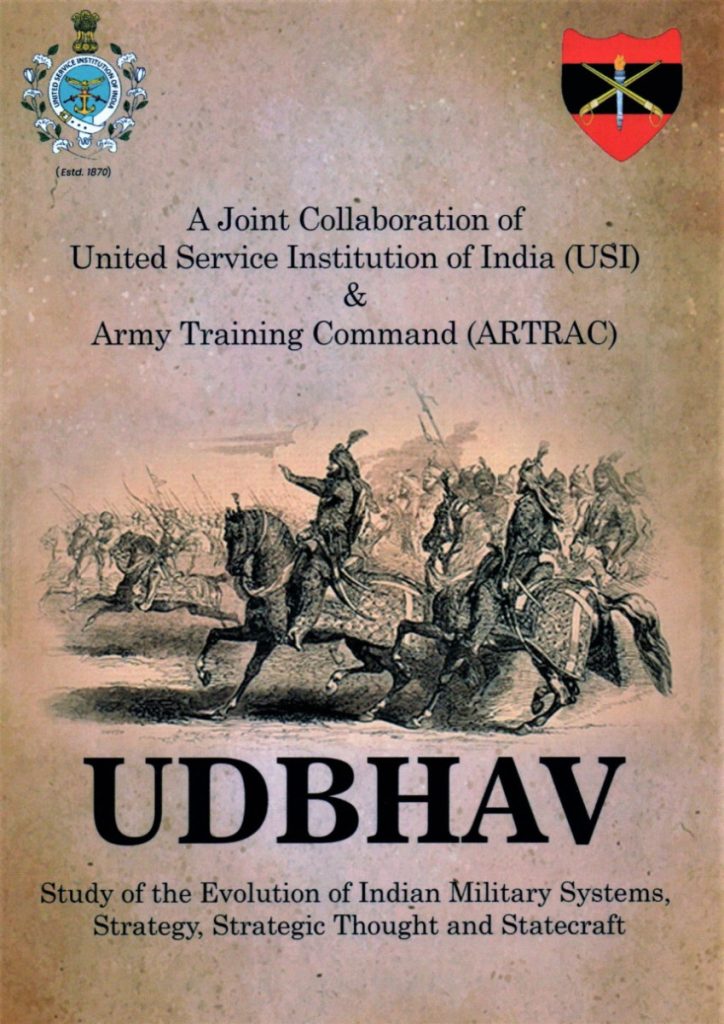
the behest of the Ministry of Defence (MoD), aiming to “synthesise ancient wisdom with contemporary military practices” to forge a unique and holistic approach to modern security challenges.

Launched jointly by the Army and the United Services Institution (USI) think-tank in Delhi, but under the MoD’s aegis, Udbhav aims to exploit India’s 5,000-year-old civilisational legacy to ‘comprehend its enduring connect, relevance and applicability in modern times’ through seminars, research projects and training-curriculum inputs.


IFUVfn3-724x1024.jpg


Udbhav seeks to infuse ancient Indian strategic and philosophical ideas into contemporary military thinking by encouraging Army officers to study classical texts and historical practices as complementary frameworks to modern doctrine, thereby promoting an “indigenous” strategic outlook. This involves examining the writings of Chanakya (Arthashastra), post-Mauryan Kamandaka (Nitisara), and the Tamil saint-poet Thiruvalluvar (Tirukkural), all of which the MoD declared “aligned with modern military codes of ethics, just war principles, and the Geneva Convention.”

At its inauguration, the Press Information Bureau hailed Udbhav as a “visionary Army initiative” seeking to integrate age-old wisdom with contemporary military pedagogy, while enhancing “strategic thinking, statecraft, and warfare.” In short, according to the MoD and government statements, Udbhav was intended to foster a deeper understanding of military matters and enrich military curricula, even in the nuclear era of the 21st century.

A few months earlier, in a move that many veterans saw as a clear politicisation of the forces, Army Headquarters had officially “recommended” – the military’s euphemism for ordered – that all soldiers on home leave promote government welfare schemes in their villages, towns, and city neighbourhoods. These included Swachh Bharat Abhiyan, Sarva Shiksha Abhiyan, and others, with units instructed to monitor compliance through quarterly feedback supported by photographs and videos.

The Army Training Command in Shimla reportedly circulated formal guidelines on how soldiers were to carry out these “educative” tasks, explicitly aiming to “leverage” military skills and discipline for nation-building. Senior veterans estimated that at any given time, as many as 350,000 personnel could be functioning as uniformed “social warriors” engaged in welfare activities – effectively creating one of the largest government-directed social outreach drives ever undertaken. Soldiers are entitled to two months of annual leave, in addition to 30 days of casual leave, providing a substantial window for participation.

According to a cross-section of veterans, such measures sit uneasily with the Army’s core ethos, anchored in its long-established credo of ‘naam, namak, nishan (honour, loyalty, and identity)’ – a secular and unifying code designed to transcend religious and political exclusivism. They note that this living code derives its strength not from manufactured symbolism, but from centuries-old regimental customs, lineages, and battle cries. Any attempt to impose external rituals or symbols – or to politicise the institution – on this foundation, they argue, risks undermining the traditions and collective spirit that have historically bound the Army together, while diluting its time-honoured values developed over a millennium.

“In seeking to impose these traditions laced with a singular political narrative rooted in the country’s dominant faith, the government and complicit senior Army brass risk unsettling the secular architecture that has historically anchored the force,” said a two-star Army veteran. “This new ideological reframing of the Army’s code around a dominant cultural narrative,” he added, speaking anonymously, “runs counter to its founding principles.

Thus, the Army’s participation in last month’s Dharma Dwaj saffron-flag hoisting at the Ram Mandir in Ayodhya – one of numerous such instances of its growing involvement in government-backed Hindu festival celebrations – underscored the increasingly blurred line between military duties and politico-religious activities.

At this event, uniformed personnel assisted the Ram Mandir Trust in preparing and rehearsing the installation of a 22-foot saffron flag atop the temple’s 161-foot-tall spire. The Ram Mandir, one of the most politically charged temples in India in recent years and the focal point of a movement that helped catapult the BJP to power in 2014 and twice thereafter, saw Prime Minister Narendra Modi perform the ceremonial hoisting, while widely shared social media footage showed Army personnel actively facilitating the ritual. This episode further highlighted the Army’s direct involvement in a highly politicised religious event.

And earlier this year, Army units – including one- and two-star officers, all in uniform – played a prominent and widely publicised logistical and security role at the Kumbh Mela at Prayagraj, once again heightening concerns over their visible participation in overtly religious Hindu rituals. Observers noted that the Army’s conspicuous presence at the festival strongly signalled alignment with a particular religious identity, raising questions about the boundaries of its institutional role.

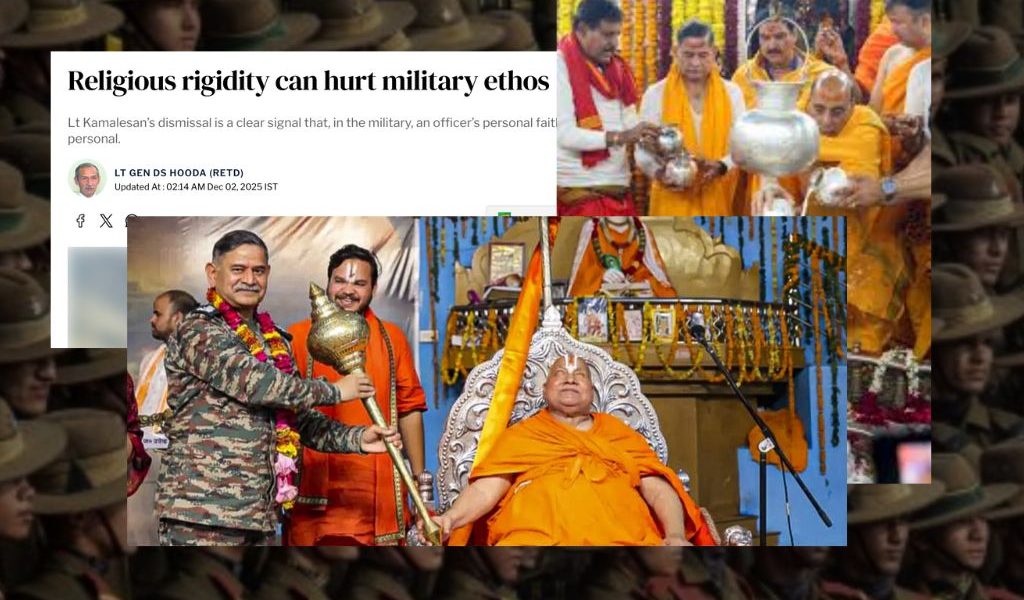
As retired Lieutenant General D.S. Hooda noted in The Tribune on December 2, senior officers may visit religious institutions in private, but there was no reason to officially post pictures of such activity on social media – a trend that had become increasingly common.

He also warned that for a force whose members are expected to subsume personal identity in the service of the nation, even the appearance of endorsing a single faith risked fraying the quiet trust that binds a diverse military together. In his analysis, the three-star officer lamented the blurring of the line between private belief and institutional endorsement – a distinction whose erosion could undermine the Army’s secular and professional character.

images-1.jpeg

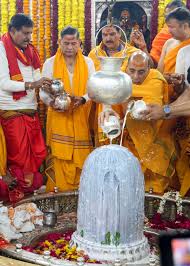
Army Chief General Upendra Dwivedi, in saffron clothes, offering prayers at the Mahakaleshwar Jyotirlinga temple in Ujjain, Madhya Pradesh, alongside defence minister Rajnath Singh. Photo: PTI.


Gen. Hooda’s observations condemning social media circulation of such religious activity by senior officers paralleled footage of Army Chief General Upendra Dwivedi, adorned in saffron attire, offering prayers at the Mahakaleshwar Jyotirlinga temple in Ujjain, Madhya Pradesh, last December, alongside defence minister Rajnath Singh.

While the event drew criticism from several Opposition leaders and commentators, the BJP defended it vociferously. “Nobody should have a problem with the Raksha Mantri or the Army Chief, or anybody celebrating their own faith,” former BJP MP and central minister Rajeev Chandrashekhar told Times Now television. Anyone who has a problem with that should look for a hole and bury themselves in it, he contemptuously added.

Also read: Air Chief Marshal Asks Officers to Express Grievances Privately Amid Military Politicisation Row

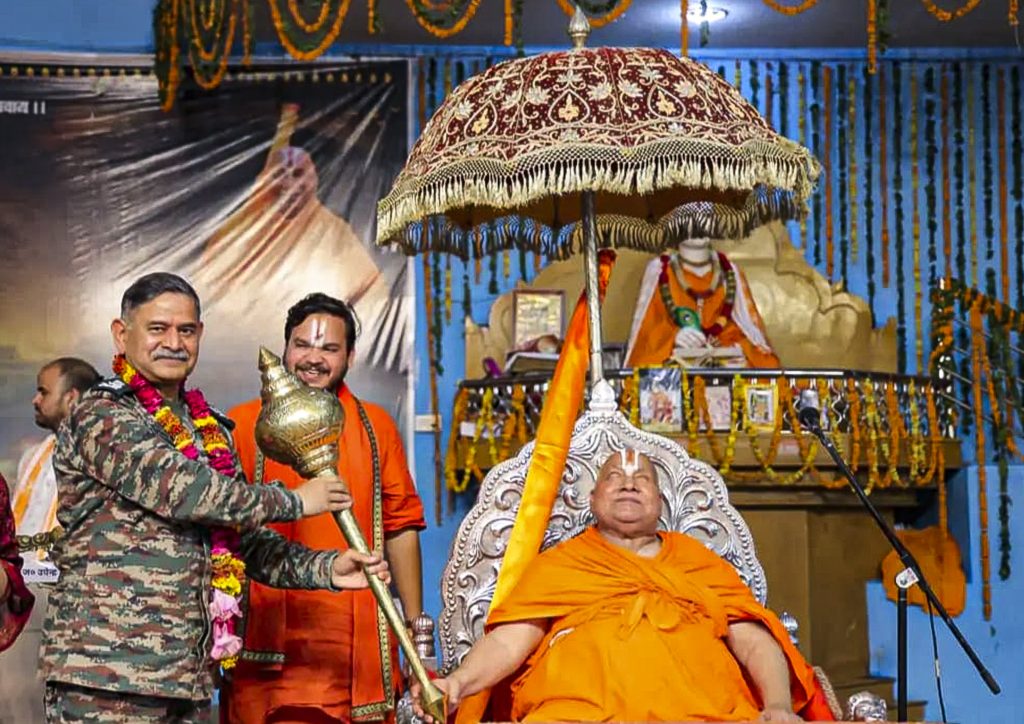
A few months later, shortly after Operation Sindoor in late May, Gen. Dwivedi visited the spiritual leader Jagadguru Rambhadracharya at his ashram in Chitrakoot – also in Madhya Pradesh and just 130km north of the Army Chief’s hometown of Rewa – once again publicising it and prompting questions about undertaking a personal religious visit in uniform.

Following the meeting, Rambhadracharya told PTI that he had initiated the Army Chief into the Ram Mantra, “the same mantra Hanuman received from Sita before his victory over Lanka.”

Chief of the Army Staff (COAS) General Upendra Dwivedi with Sanskrit scholar Jagadguru Rambhadracharya during an event, in Chitrakoot, Madhya Pradesh.

Chief of the Army Staff (COAS) General Upendra Dwivedi with Jagadguru Rambhadracharya during an event, in Chitrakoot, Madhya Pradesh. Photo: PTI

“When the matter of dakshina arose,” the priest said, “I told him I would ask for a dakshina no teacher has ever sought. I said I want PoK – Pakistan-occupied Kashmir – as my dakshina. The Army Chief, he said, accepted his request, saying that India was prepared to give Pakistan an ‘appropriate response’.

The Army Chiefs’ high-profile, majoritarian display of faith, along with Lt. Kamalesan’s earlier case of sectarianism illustrates that both ends of the spectrum – public alignment with a religious narrative or personal denominational actions – have contributed to the Army’s growing institutional tension.

The Supreme Court may have declined to reinstate Kamalesan, but its order will matter little unless the Army itself reasserts its professional centre and separates personal or political beliefs from its institutional role. Without this, judicial interventions remain symbolic rather than transformative. In the final analysis, the Army’s credibility depends on whether service, skill, and loyalty to the nation – not religious or cultural displays – define what it means to wear the uniform.


Long read but well worth it, just shows you how backwards in india is as a society
 

India's Supreme Court upholds rights of poorest - but language reveals 'bias', study says​


India's Supreme Court prides itself on defending the rights of Dalits - historically the country's most oppressed citizens.

But a new study, external argues that the court's own language has frequently reflected the caste hierarchies it aims to erase. About 160 million Indians are Dalits, once called "untouchables", yet many remain trapped in menial jobs and shut out of social and economic opportunity.

For much of independent India's history, the country's top judges have struggled to speak about Dalits in ways that recognise dignity rather than reinforce stigma, the study found. That tension - between progressive legal outcomes and regressive language - is the central paradox documented in a sweeping review of 75 years of judgments of the top court.

The University of Melbourne-funded research, conducted in partnership with the Supreme Court, offers a rare internal reckoning for one of the world's most powerful judiciaries.

The study examines "constitution bench" rulings - decided by five or more judges - from 1950 to 2025. These rulings are especially important because they set legal precedents, are taught in law schools, invoked in courtrooms and cited by later benches.

It found that while these landmark decisions often upheld Dalit rights, their language could be "demeaning or insensitive", notes Professor Farrah Ahmed of Melbourne Law School, a co-author of the study.

Some judgments liken caste oppression to disability, implying that the oppressed or disabled are inherently inferior.

Others assume - contrary to evidence - that education alone can erase caste, shifting the burden from society to individual Dalits who must study their way to equality. Still others overlook the caste barriers that block access to jobs, credit and markets, deepening poverty.

Some judges likened Dalits to "ordinary horses'' in contrast to upper classes who were like "first class race horses". Others described affirmative-action measures as "crutches" that Dalits should not depend on for too long.

Some judges even described the origins of caste as "benign" - merely a system of division of labour. This, researchers say, "supported a bitterly unfair status quo that confines oppressed castes to reviled and poorly paid work".

A 2020 judgement cited by the study talked about "primitive way of life [of Scheduled Tribes or other marginalised tribespeople] makes them unfit to put up with the mainstream and to be governed by the ordinary laws" - and describes them as needing a "helping hand to uplift them and to make them contribute to the national development and not to remain part of the primitive culture".

Such language, the study suggests, went beyond poor phrasing to reinforce harmful stereotypes.

"These comparisons - whether to animals or to people with disabilities - were offensive to both groups," says Prof Ahmed. "The real problem is not any supposed inherent limitation, but the society around them, which fails to support them to thrive."
Justice K.G. Balakrishnan, Chief Justice of India, during a profile shoot at his residence, on September 13, 2008 in New Delhi, India
Image source,Hindustan Times via Getty Images
Image caption,
KG Balakrishnan was the court's first Dalit chief justice between 2007 and 2010
The study found that such "stigmatising views" appeared in rulings that upheld Dalit rights.

"I think the judges were genuinely unaware of the implications of the language they were using, and what it revealed about their deeply held attitudes. I don't think, in any of these cases, that there was an intention to insult or demean Dalit people," says Prof Ahmed.

Does this linguistic bias influence the court's reasoning or outcomes, or was it a blind spot that coexists with progressive decisions?

"I would find it surprising if the judicial language we discuss, including language that is demeaning or that downplays the perniciousness of the caste system, had no effect on judges' decisions," Prof Ahmed told the BBC.

Beyond individual rulings, Supreme Court judges influence Indian society and politics more broadly; their language matters because it is widely reported, debated and shapes public discourse.

Yet, the court has actively addressed caste bias. In October last year, responding to an investigative report, external, it directed the federal government and states to revise prison manuals to address caste-based discrimination. This bias had been evident in the division of manual labour, segregation of barracks and rules that unfairly targeted historically marginalised communities.

Also, many judges stress that any outdated or problematic language is not intentional.

"Courts may not always be fully up to speed with how language evolves - that's possible. But there's no motive at play here," Madan Lokur, a former Supreme Court judge, told the BBC.

Recognising this, in August 2023, the Supreme Court released a 'Handbook on Combating Gender Stereotypes', external, featuring a glossary of "gender-unjust" words that judges and lawyers are advised to avoid in legal writing. This aims to eliminate demeaning, discriminatory or stereotyped language, particularly against women, children, people with disabilities and in cases involving sexual crimes.

Could similar efforts realistically influence how Supreme Court judges write about caste?
India's Supreme Court building in Delhi.
Image source,AFP via Getty Images
Image caption,
India's Supreme Court is one of the most powerful courts in the world
"This report is just a first step in shifting how judges write about caste. We are starting from a place where there was formerly little appreciation for the problem," says Prof Ahmed.

More internal reviews like this report are essential, she adds. Most importantly, "lawyers, legal academia and the judiciary need the insights that can only come from full inclusion of members of oppressed castes", says Prof Ahmed.

India's Supreme Court has had strikingly little Dalit representation. "On our estimate, there have only ever been eight Dalit judges on the Supreme Court," the researchers note.

For the past six months, Chief Justice BR Gavai - the second Dalit to lead the court - headed it until his retirement last week.

Justice KG Balakrishnan , external- the court's first Dalit chief justice - served on the bench for two of the cases examined in the study, and his views are cited repeatedly in the report.

Justice Balakrishnan's writing, they point out, describes caste as an "unbreakable bondage" that consigns people to "impure" occupations, a condition from which "even death does not provide escape", given continued segregation in graveyards and crematoriums.

This, the researchers argue, contrasts sharply with rulings that downplay caste injustices - evidence, they say, that India's top court "desperately needs more diverse insights and perspectives, especially from oppressed castes".

For a court treated as an institution above politics, the report marks an unusual moment of introspection. It suggests that the struggle for caste equality is not only waged in judgments and statutes, but in metaphors, analogies and everyday linguistic choices.
 
Wonder why the Indian Muslims migrating are not making a beeline for the utopia that is Pakistan and Bangladesh...hmmm whereas we have Bangladeshis illegally and legally coming to India for livelihood and medical treatment
 
Wonder why the Indian Muslims migrating are not making a beeline for the utopia that is Pakistan and Bangladesh...hmmm whereas we have Bangladeshis illegally and legally coming to India for livelihood and medical treatment
can you proove your statement
 

India's double standards on minority rights​


In Brief​

India's approach to minority rights reveals a stark contradiction. While the BJP government criticises Bangladesh's treatment of Hindus, it oversees systemic marginalisation and discrimination growing discrimination against Muslims domestically. Protests over a Hindu monk's arrest in Bangladesh and violence against Muslims in India highlight this double standard. This selective outrage serves domestic electoral interests but damages India's regional leadership and threatens stability in South Asia

India’s democratic traditions and secular constitution stand in growing contradiction to its treatment of minorities. While the ruling Bharatiya Janata Party (BJP) criticises the treatment of Hindus in Bangladesh, it oversees systemic marginalisation and discrimination against Indian Muslims. This duplicity not only undermines India’s claim to moral high ground but also risks destabilising regional relations in South Asia.

In late 2024, the Hindu monk Chinmoy Das was arrested in Bangladesh on charges of alleged ‘anti-state activities’ and subsequently denied bail. When his followers attacked the High Court and killed a Muslim government lawyer, Bangladesh’s stakeholders acted decisively to prevent the situation from escalating into communal violence. Mahfuj Alam, an influential cabinet member and a key coordinator of Bangladesh’s uprising against the government of former prime minister Sheikh Hasinah, posted on social media calling for ensuring security for innocent minorities. Indian media and pro-BJP and Hindutva organisations ignored the killing, instead portraying Das’s arrest as evidence of Hindu oppression in Bangladesh.

Hindu groups staged protests outside Bangladeshi embassies in Delhi, Kolkata and Mumbai. In Agartala, protesters attacked the Bangladeshi consulate. Indian politicians escalated the matter by calling for a blockade of India–Bangladesh trade.

It is undeniable that attacks on Hindus have occurred in Bangladesh, but India tends to politicise these incidents. According to Ain o Salish Kendra, a prominent rights group in Bangladesh, 3679 attacks on the Hindu community took place between January 2013 and September 2021, while Sheikh Hasina was in power.

But the interim government in Bangladesh, led by Mohammad Yunus, acknowledged attacks on minorities in August, reporting 88 cases filed and 70 arrests. Despite this, Indian media outlets focus on issues that serve their clickbait-driven journalism. The contrast with India’s domestic response to anti-Muslim violence is significant. In November 2024, while Indians protested nationwide for Das, three Muslim men in Uttar Pradesh were killed for opposing a archaeological survey of the Mughal-era Shahi Jama Masjid, which was accused of being built over a Hindu temple. The Indian media largely ignored these deaths.

In India, Muslims live under constant threat of violence. They are often accused of carrying beef — anathema to some devout Hindus — or face baseless allegations of being Bangladeshi or Rohingya migrants. This hostility extends beyond online hate speech and manifests in real-life incidents.

Shortly after Hasina fled to Ghaziabad from Bangladesh, members of the Hindu Raksha Dal vandalised a local slum, assaulting residents and labelling them as Bangladeshis and Rohingya solely based on their Muslim identity.

In August 2024, Saabir Malik, a Muslim boy from West Bengal was beaten to death in Haryana on false accusations of carrying beef.

Between 2010–17, 28 Indians — 24 of them Muslims — were killed, and 124 others injured in cow-related violence. The so-called ‘cow vigilante’ violence targeting Muslims tends to increase during election periods. In 2019, eight Muslims were killed under accusations of carrying beef or stealing cows. In 2024, during the general election campaign, nine Muslims were murdered in similar circumstances. These incidents are aimed at capturing the support of radical Hindu voters.

The oppression of Muslim minorities in India has intensified under BJP rule, particularly since 2014. The irony is stark — while the BJP accuses Bangladesh of persecuting its minorities, it fails to address the plight of its own.

Bangladeshi issues have frequently become a focal point in Indian election campaigns in Assam, West Bengal and Jharkhand. BJP leaders have made inflammatory comments about Bangladeshis, labelling them as infiltrators. Issues related to Bangladesh and its people are amplified to serve Indian electoral interests while domestic incidents of communal violence often receive muted responses.

This approach fuels bigotry and deepens societal divides, weaponising fear for political gains. India’s selective approach to minority rights raises serious questions about its regional and moral leadership. While the BJP claims to champion the rights of Bangladesh’s minorities, it ignores the plight of Indian Muslims and other marginalised communities. This hypocrisy erodes India’s credibility both regionally and globally, tarnishing its image as a democratic leader.

The politicisation of Bangladesh’s minority issues for domestic electoral gains is a dangerous precedent, undermining the aspirations of millions who seek peace and dignity on both sides of the border.

By scapegoating Bangladesh, India also risks alienating a trusted ally and destabilising regional relations that are crucial for South Asia’s collective development.

India must uphold higher standards by prioritising minority rights and regional cooperation over divisive politics. The path forward lies in mutual respect, dialogue and a shared commitment to regional stability and prosperity.

To address religious tensions, India and Bangladesh could establish a joint regional commission dedicated to addressing communal violence and minority rights. Non-state actors could provide independent assessments of communal incidents to prevent political exploitation. Media organisations have a critical role, countering misinformation and ensuring that minority issues are not manipulated for electoral gains.

Initiatives such as youth exchanges, interfaith festivals and cross-border media collaboration could counter divisive narratives and promote greater understanding between communities.
 
This will happen in parts
Here is a Bangladeshi link discussing how Bangladeshi people travel to India for medical purposes


That's evidence for Bangladeshis traveling to Muslim India for medical treatment and not to Pakistan.

Still to provide

No of illegal bangladeshis in India
Low proportion of Indian Muslims migrating to Pakistan
 
This will happen in parts
Here is a Bangladeshi link discussing how Bangladeshi people travel to India for medical purposes


That's evidence for Bangladeshis traveling to Muslim India for medical treatment and not to Pakistan.

Still to provide

No of illegal bangladeshis in India
Low proportion of Indian Muslims migrating to Pakistan
Here is the UN link with interactive charts..you have to select Pakistan to look at the data


Migration from India to Paksitan has dropped drastically specially during BJP era. Pakistan still ranks as a top 10 destination for migration due to partition as lot of people with Indian birth are in Paksitan but the migration in recent years is dwindling.
 
Here is the UN link with interactive charts..you have to select Pakistan to look at the data


Migration from India to Paksitan has dropped drastically specially during BJP era. Pakistan still ranks as a top 10 destination for migration due to partition as lot of people with Indian birth are in Paksitan but the migration in recent years is dwindling.
so do you indians feel ashamed off stealing billions from bangldesh under sheikh hussina terms - considering you said pakistan treated them poorly under east pakistan,
 
so do you indians feel ashamed off stealing billions from bangldesh under sheikh hussina terms - considering you said pakistan treated them poorly under east pakistan,
Is this relevant to the link I shared. If not, there is no stealing. There is agreement. Under that agreement Bangaldesh economy and Hdi increased massively under Hasina and is on a downward trend under Yunus. In trade there is give or take...you give some to get some.
 
Is this relevant to the link I shared. If not, there is no stealing. There is agreement. Under that agreement Bangaldesh economy and Hdi increased massively under Hasina and is on a downward trend under Yunus. In trade there is give or take...you give some to get some.
so your not ashamed that you used Bangldeshand stole Billions from them, now they've left you - Prefer Pakistan


#BengalisPreferPakistan,LeftIndiaForGood
 
so your not ashamed that you used Bangldeshand stole Billions from them, now they've left you - Prefer Pakistan


#BengalisPreferPakistan,LeftIndiaForGood
Again what did we steal? You are accusing without any proof. And you are ignorant about Bangladesh. The islamist there are always with Pakistan whereas the secular people are with India. Only yesterday your DGISPR called Mujibur a traitor.. way to go.

To come back what did India steal? Please be quantitative.. we stole this much land, this much money etc.
 
Again what did we steal? You are accusing without any proof. And you are ignorant about Bangladesh. The islamist there are always with Pakistan whereas the secular people are with India. Only yesterday your DGISPR called Mujibur a traitor.. way to go.

To come back what did India steal? Please be quantitative.. we stole this much land, this much money etc.
Have you not read anything in regarding to why Bangaldesh want to execute sheikh hasina, all those dodgy deals with india, hence she ran off to you lot, or is it your just too biased
 
Have you not read anything in regarding to why Bangaldesh want to execute sheikh hasina, all those dodgy deals with india, hence she ran off to you lot, or is it your just too biased
Bangladesh wants to execute Hasina in a kangaroo court because she is blamed for shooting at the student protestors.lets not twist facts.
When you say dodgy deals..which one is a dodgy deal. Did Bangaldesh not get anything in return..how come being friends with India made Bangladesh economy soar and being friend with Paksitan is making Yunus torpedo his economy.

And you said clearly..deal with govt. So where is the stealing. Their govt did what they thought was best for their country.
 
Bangladesh wants to execute Hasina in a kangaroo court because she is blamed for shooting at the student protestors.lets not twist facts.
When you say dodgy deals..which one is a dodgy deal. Did Bangaldesh not get anything in return..how come being friends with India made Bangladesh economy soar and being friend with Paksitan is making Yunus torpedo his economy.

And you said clearly..deal with govt. So where is the stealing. Their govt did what they thought was best for their country.
yet again your blindness in india corruption in bangldesh is appalling, the deals wre very one sided, these deals were heavily manupilated to favour india,


Take off your rose tinted glasses and accept the truth
 
yet again your blindness in india corruption in bangldesh is appalling, the deals wre very one sided, these deals were heavily manupilated to favour india,


Take off your rose tinted glasses and accept the truth
I am asking again..give me examples...look at your post...they are making accusations..but there is zero example of a deal...a deal by definition is not stealing..it can be unfair etc...but you play what cards you get.

For example look at Indus water treaty..no country signs such treaty ...china doesn't..so they do what is in their best interest. Now India has a much larger population and should have got a bigger share of water or simply not signed the treaty. Our moron PM signed a treaty giving away 80 percent to a country that is hell bent on killing Indians. Thank God that treaty is now scrapped and we can do what is best for our country. So that deal is unfair but did Pakistan steal...no it didn't .
Same Hasina played the cards she has for the benefit of her people and her country....it is not always equal. The fact that BD prospered in her rule is evidence that the deals worked out well for Bangaldesh even if it benefited India more. Itd a win win for Bangladesh.
 
Mohammad Athar Hussain, a cloth vendor who was robbed and assaulted by a mob that later cut his ears and fingertips off with a plier and branded him with a hot iron in Bihar’s Nawada district on December 5, succumbed to his injuries on the night of December 12, according to a news report by the Indian Express.

According to the police, eight people have been arrested and detained so far.

Assault in lieu of help

Fifty-year-old Hussain was returning to his home in Barui village in Nawada district on the night of December 5 when his bicycle – on which he sells his ware – needed urgent repairs. Being near Bhattapar village (which comes in the Roh police station limits), Hussain asked a group of people about a puncture repair shop nearby.

They asked his name and profession and then assaulted him, cut his ears, beat him with a heated rod, Hussain’s brother Mohammad Shakib Alam told Indian Express.
 
Modern day Indians are similar to Nazis from 1930's.

How were the Nazis defeated? They were not defeated with roses and hugs. They were defeated with benevolent force.

Similar strategy is needed to defeat/correct India's radicalized population. :inti
 
Modern day Indians are similar to Nazis from 1930's.

How were the Nazis defeated? They were not defeated with roses and hugs. They were defeated with benevolent force.

Similar strategy is needed to defeat/correct India's radicalized population. :inti
Can we apply this same benevolent force logic to Israel in Gaza??

You are the most extreme person on this PP. How are such posts allowed in a thread which is irrelevant to the topic??

India has 200M muslims living peacefully yet India is radicalized. An innocent street vendor dies due to a criminal mob so India needs to be dealt like Nazi-style??

You better stick to your posts sucking up to China dude. Always hiding behind others strength.
 
So the peaceful religion follower , a school owner too , objected to a Hindu devotional song performed by a famous lady singer .He abused and physically harassed the singer on the stage . He abused her for not singing an secular song .

She should have gone for Christmas song to check his secular levels .


@uppercut @Hitman
 
So the peaceful religion follower , a school owner too , objected to a Hindu devotional song performed by a famous lady singer .He abused and physically harassed the singer on the stage . He abused her for not singing an secular song .

She should have gone for Christmas song to check his secular levels .


@uppercut @Hitman

yes indeed the most peaceful religion ever ....

@IMMY69
 

Court orders release of Christian Michel James​


Relief granted after seven years in custody in money laundering case; bail plea pending in separate CBI matter

Christian Michel James, accused in the AgustaWestland chopper scam, was granted relief by the Rouse Avenue Court on Saturday (December 20, 2025), which ordered his release after noting that he had completed seven years in custody in the money laundering case.


Strange case
 

"Equal Rights For Religions": Telangana To Bring Law To Curb Hate Speech​


Reddy said the law will be introduced in the upcoming budget session of Assembly to combat religious hatred and punish those who insult other faiths.


"Equal Rights For Religions": Telangana To Bring Law To Curb Hate Speech​

Reddy said the law will be introduced in the upcoming budget session of Assembly to combat religious hatred and punish those who insult other faiths.​


Reddy emphasised that minorities deserved to receive all welfare scheme benefits. (File)
Hyderabad:
Telangana Chief Minister Revanth Reddy on Saturday proposed a new law to punish those who insult any religion and revealed that the Congress-led state government is planning to amend existing laws to ensure stricter punishment for anyone who abuses a religion. Chief Minister Reddy said that the law will be introduced in the upcoming budget session of the Assembly to combat religious hatred and punish those who insult other faiths.

Addressing a government-organised Christmas event in Hyderabad, Reddy emphasised that minorities deserved to receive all welfare scheme benefits. He added that the pending graveyard issues for Christians and Muslims would be addressed soon.

The Praise For Sonia Gandhi

Reddy said that the month of December was also a "Miracle Month" for Telangana and the Congress party. The chief minister mentioned that Congress leader Sonia Gandhi's birthday is in December and Telangana was granted statehood in the same month.

"...Sonia Gandhi was born on December 9. After many young people sacrificed their lives for a separate Telangana, and despite suffering a huge political loss in Andhra Pradesh, she delivered Telangana," he said.

A video of Reddy addressing Saturday's event has gone viral on social media, where he said, "The reason we are celebrating the Christmas festival here (in Telangana) today is because of the contribution of Sonia Gandhi."


(Christmas is being celebrated here today due to the sacrifice and contribution of Sonia Gandhi.- Revanth Reddy, CM of Congress ruled Telangana Next, we’ll be told the sun rises because of the Gandhi family.When sycophancy crosses all limits, everything is hijacked for political bootlicking.)

"Equal Rights For Religions": Telangana To Bring Law To Curb Hate Speech​

Reddy said the law will be introduced in the upcoming budget session of Assembly to combat religious hatred and punish those who insult other faiths.​

  • Reported by:Ashish Kumar Pandey
  • India News
  • Dec 21, 2025 11:29 am IST
    • Published OnDec 21, 2025 11:28 am IST
    • Last Updated OnDec 21, 2025 11:29 am IST
Read Time:2 mins
Share
  • Twitter
  • WhatsApp
  • Facebook
  • Reddit
  • Email


Reddy emphasised that minorities deserved to receive all welfare scheme benefits. (File)
Hyderabad:
Telangana Chief Minister Revanth Reddy on Saturday proposed a new law to punish those who insult any religion and revealed that the Congress-led state government is planning to amend existing laws to ensure stricter punishment for anyone who abuses a religion. Chief Minister Reddy said that the law will be introduced in the upcoming budget session of the Assembly to combat religious hatred and punish those who insult other faiths.

Addressing a government-organised Christmas event in Hyderabad, Reddy emphasised that minorities deserved to receive all welfare scheme benefits. He added that the pending graveyard issues for Christians and Muslims would be addressed soon.

The Praise For Sonia Gandhi

Reddy said that the month of December was also a "Miracle Month" for Telangana and the Congress party. The chief minister mentioned that Congress leader Sonia Gandhi's birthday is in December and Telangana was granted statehood in the same month.

"...Sonia Gandhi was born on December 9. After many young people sacrificed their lives for a separate Telangana, and despite suffering a huge political loss in Andhra Pradesh, she delivered Telangana," he said.

A video of Reddy addressing Saturday's event has gone viral on social media, where he said, "The reason we are celebrating the Christmas festival here (in Telangana) today is because of the contribution of Sonia Gandhi."


This remark has generated strong criticism from the opposition Bharat Rashtra Samithi (BRS) and the Bharatiya Janata Party (BJP) in the state.

"Sycophancy": BJP Slams Chief Minister

In a post on X, the Telangana BJP shared the viral video and called Reddy's remark (on Sonia Gandhi) "sycophancy".

"Christmas is being celebrated here today due to the sacrifice and contribution of Sonia Gandhi. Revanth Reddy, CM of Congress, ruled Telangana. Next, we'll be told the sun rises because of the Gandhi family. When sycophancy crosses all limits, everything is hijacked for political bootlicking," the post read.


The BRS, meanwhile, also shared the video clip and said, "Today everyone is celebrating Christmas only because of the sacrifice of Smt Sonia Gandhi, says Congress CM Revanth ..."


I do agree with sonia gandhi, do the fellow indian:

@Rajdeep @cricketjoshila @Champ_Pal @JaDed @Devadwal @uppercut @Theanonymousone @straighttalk @Vikram1989 @RexRex @Varun @Romali_rotti @Bhaijaan @Cover Drive Six @rickroll @rpant_gabba, @Romali_rotti
 
so why did the same US Gov invite Modi to address the US Parliament?

Note: Time for you to resort to hurld religious abuses and insults :ROFLMAO:
whats that got to do with anything ,


when have i hurld religious abuse or statement at you, the cow / steak comment - dont be silly thats not abuse, i like eating steaks - thats all - ribeye my fav.
 
Back
Top