What's new

What can Pakistan learn from the Indian education system?

In my opinion for many Indians it's not even about money but they lack leadership qualities. You will rarely see them think outside the box but they are extremely good at following directions and working under someone. This is why you have never heard of an Indian develop a programming language or a software product that is used widely despite so many indians in the tech field.

Whereas, Pakistanis will take more risks, some will go well some won't but they are not afraid to venture into unchartered territory.

So how many billion dollar businesses, unicorns have Pakistanis built?

How many Pakistanis are in leadership position in fortune 500 companies?

How many Pakistanis have been in a leadership role in other countries?

The usual excuses of pakistanis begin to flow like,

Pakistanis do things for passion, Indians for money. Indians follow directions etc etc.

All this doesn't hide that Indians are far more successful than pakistanis.
 
So how many billion dollar businesses, unicorns have Pakistanis built?

How many Pakistanis are in leadership position in fortune 500 companies?

How many Pakistanis have been in a leadership role in other countries?

The usual excuses of pakistanis begin to flow like,

Pakistanis do things for passion, Indians for money. Indians follow directions etc etc.

All this doesn't hide that Indians are far more successful than pakistanis.

Pakistan is the size of one Indian state. If you want to pat yourself on the back for being better than Pakistan then I rest my case. Relatively speaking, for being a nation of 1.6 billion people, who has not been part of any war (including the cold war) for 50+ years you have very little to show for. Working for other countries companies and industries is not an achievement for India.
 
10-15 years back, we used to hire 20-25 students each year directly from 4-5 IIT's to work in California and Seattle office. Some IIT's were located in remote areas without airport access. I don't know the situation now, but big hiring was based on how previous hires did and number of hires grew from there. They were top class hires who could be relied to work on system level codes in operating system and networking. Many of those hires have climbed up in ranks and extremely valuable for their companies.

It's actually extremely hard to hire for some jobs despite tens of thousands of students graduating from computer science in US and abroad. Level was simply not there. Recent years hiring is going to reverse big time. It has been unique situation where all companies felt forced to hire in big numbers due to irrational allocation of money in tech sector due to low interest rate. Hiring was very selective when companies were few thousands employees vs hundred thousands employees now.

When all said and done, most universities do a decent job of teaching. Now if you go to very selective universities then sure you are going to get higher quality students.

Good point!
 
In my opinion for many Indians it's not even about money but they lack leadership qualities. You will rarely see them think outside the box but they are extremely good at following directions and working under someone. This is why you have never heard of an Indian develop a programming language or a software product that is used widely despite so many indians in the tech field.

Whereas, Pakistanis will take more risks, some will go well some won't but they are not afraid to venture into unchartered territory.

I'm among the many hoping for Pakistan to become much better in education but even for me this sounds like a bad generalization and inaccurate. Indians may have many negative attributes as a society/nation/people but credit needs to be given where due even for an "enemy" nation. They have done something good as a resource constrained developing nation when it comes to education and knowledge capital. Other resource constrained South Asian nations can take a leaf out of their book that can be emulated.

US tech industry is led by so many Indians these days growing multi-billion dollar companies. The venture capital and private equity landscape in the US has so many Indians sitting in boards of companies. Investment banks and tier 1 MBB consulting firms (Mckinsey, Bain, BCG) are led by many Indian origin partners. Overlooking all of this and saying "they lack leadership qualities" is either ignorance or hate driven.

One argument here seems to be "why emulate India when we rather emulate US/UK/EU". Those are resource rich nations to begin with and their model is not immediately applicable to resource constrained developing nations for building knowledge capital through education. Overlooking this obvious fact and stressing that South Asian nations rather emulate US/UK/EU is either due to ignorance or pointless ego driven lack of acknowledgement of the accomplishment of an enemy nation.

It is true that Indians are going on a downward spiral in their hate driven government policies that also spirals to negative cultural effects. That is a perfect example for Pakistan (and other South Asian nations) for what NOT to do. At the same time, do give credit where it is due (education and knowledge capital) so that it can be emulated.
 
I'm among the many hoping for Pakistan to become much better in education but even for me this sounds like a bad generalization and inaccurate. Indians may have many negative attributes as a society/nation/people but credit needs to be given where due even for an "enemy" nation. They have done something good as a resource constrained developing nation when it comes to education and knowledge capital. Other resource constrained South Asian nations can take a leaf out of their book that can be emulated.

US tech industry is led by so many Indians these days growing multi-billion dollar companies. The venture capital and private equity landscape in the US has so many Indians sitting in boards of companies. Investment banks and tier 1 MBB consulting firms (Mckinsey, Bain, BCG) are led by many Indian origin partners. Overlooking all of this and saying "they lack leadership qualities" is either ignorance or hate driven.

One argument here seems to be "why emulate India when we rather emulate US/UK/EU". Those are resource rich nations to begin with and their model is not immediately applicable to resource constrained developing nations for building knowledge capital through education. Overlooking this obvious fact and stressing that South Asian nations rather emulate US/UK/EU is either due to ignorance or pointless ego driven lack of acknowledgement of the accomplishment of an enemy nation.

It is true that Indians are going on a downward spiral in their hate driven government policies that also spirals to negative cultural effects. That is a perfect example for Pakistan (and other South Asian nations) for what NOT to do. At the same time, do give credit where it is due (education and knowledge capital) so that it can be emulated.

Yah, I don't think Indians lack leadership skills when compared to others.

Some top names heading companies comes to my mind,

Raj - FeDex
Indra - Pepsi
Laxman - Starbucks
Vivek - Albertsons
Ajaypal - Master Card
Sundar - Alphabet
Satya - Microsoft
Shatanu - Adobe
Arvind - IBM
Sanjay - Micron
Nikesh - Paul Alto
Jayshree - Arista Network
...
....

Most companies are 10B plus revenue and competition for CEO post is intense. In IT, Indian presence is huge so not surprising to see Indians rising in ranks.

But Pepsi, Fedex, Starbucks, Master card, Albertsons etc are not in Computer Science. They are giant companies and they won't put some one without leadership on top. I have interacted with some names listed above.. They are very good leaders. Even in IT, you are not going to be CEO of 10-100B revenue companies without having leadership skills.

If argument is that India has not produced large global companies in India then that's a different argument. It has mostly to do with what resource and system were available in India. I do think it's changing fast. It won't surprise me to see some global names coming from India in the next 10-15 years. A very large amount has gone in Indian start ups. As long as government does not mess it up, it should create some global names in coming decades.

Anyway, caliber of people all around has similar distribution curve. It's up to government to set up high quality education environment and then provide environment for businesses. US has done it better than others and also has huge market so global giant companies are going to keep coming from US for decades.

I am very sure that once Pakistan's situation gets stable and if government creates a good situation , we may observe rapid changes there as well. It's a multi decade process though. Distribution curve of people are not much different in any part of the world when it comes to potential. You just need to have system to convert potential to reality.
 
Yah, I don't think Indians lack leadership skills when compared to others.

Some top names heading companies comes to my mind,

Raj - FeDex
Indra - Pepsi
Laxman - Starbucks
Vivek - Albertsons
Ajaypal - Master Card
Sundar - Alphabet
Satya - Microsoft
Shatanu - Adobe
Arvind - IBM
Sanjay - Micron
Nikesh - Paul Alto
Jayshree - Arista Network
...
....

Most companies are 10B plus revenue and competition for CEO post is intense. In IT, Indian presence is huge so not surprising to see Indians rising in ranks.

But Pepsi, Fedex, Starbucks, Master card, Albertsons etc are not in Computer Science. They are giant companies and they won't put some one without leadership on top. I have interacted with some names listed above.. They are very good leaders. Even in IT, you are not going to be CEO of 10-100B revenue companies without having leadership skills.

If argument is that India has not produced large global companies in India then that's a different argument. It has mostly to do with what resource and system were available in India. I do think it's changing fast. It won't surprise me to see some global names coming from India in the next 10-15 years. A very large amount has gone in Indian start ups. As long as government does not mess it up, it should create some global names in coming decades.

Anyway, caliber of people all around has similar distribution curve. It's up to government to set up high quality education environment and then provide environment for businesses. US has done it better than others and also has huge market so global giant companies are going to keep coming from US for decades.

I am very sure that once Pakistan's situation gets stable and if government creates a good situation , we may observe rapid changes there as well. It's a multi decade process though. Distribution curve of people are not much different in any part of the world when it comes to potential. You just need to have system to convert potential to reality.

Good points bhai and I like the nuanced differentiation between tech and non-tech CEO roles.

I feel creating good knowledge capital (business leadership, education etc) is an entity like a machine with raw material inputs. The raw materials here are people and the quality of this is the same throughout the world. Given any population set from any part of the world, you roughly have similar percentage of people that have good leadership traits, good fighting skills, good building/engineering skills, good artistic skills, etc. Saying "mY grOUp hAS bEtteR LeaDERs tHAn yoUR grOUp" just by nature reeks of stupidity and insecurity whether it is said by Pakistanis or Indians.

The actual comparison here is between the machines (education system set up by each country) turning these raw materials into finished products. The quality of the finished products here depends on the quality of the machines and not on the quality of the raw materials (people). I think some people in this thread are failing to realize that and feel their ego is hurt when looking at the output from the Indians. I believe Pakistanis can go toe to toe and compete with Indians in tech innovation or business leadership. But are Pakistanis given this fair chance by their education system though? Sadly that does not seem to be the case.

One big thing I wonder is, which India should Pakistan try to emulate in this? The cow belt North India or the more successful South India? Please refer the youtube discussion from this thread I just created highlighting these differences -- http://www.pakpassion.net/ppforum/s...us-South-India-(Why-is-South-so-much-better-)

I for one believe, Pakistan is better off looking at the Southern states of India as a good example and ignore the religious hatred driven North India that also seems to lack in its education systems.
 
Good points bhai and I like the nuanced differentiation between tech and non-tech CEO roles.

I feel creating good knowledge capital (business leadership, education etc) is an entity like a machine with raw material inputs. The raw materials here are people and the quality of this is the same throughout the world. Given any population set from any part of the world, you roughly have similar percentage of people that have good leadership traits, good fighting skills, good building/engineering skills, good artistic skills, etc. Saying "mY grOUp hAS bEtteR LeaDERs tHAn yoUR grOUp" just by nature reeks of stupidity and insecurity whether it is said by Pakistanis or Indians.

The actual comparison here is between the machines (education system set up by each country) turning these raw materials into finished products. The quality of the finished products here depends on the quality of the machines and not on the quality of the raw materials (people). I think some people in this thread are failing to realize that and feel their ego is hurt when looking at the output from the Indians. I believe Pakistanis can go toe to toe and compete with Indians in tech innovation or business leadership. But are Pakistanis given this fair chance by their education system though? Sadly that does not seem to be the case.

One big thing I wonder is, which India should Pakistan try to emulate in this? The cow belt North India or the more successful South India? Please refer the youtube discussion from this thread I just created highlighting these differences -- http://www.pakpassion.net/ppforum/s...us-South-India-(Why-is-South-so-much-better-)

I for one believe, Pakistan is better off looking at the Southern states of India as a good example and ignore the religious hatred driven North India that also seems to lack in its education systems.

While doing some work , I was digging on out of school data many moons back. I shared some observation which was relevant for Pakistan in this thread.

http://www.pakpassion.net/ppforum/s...school-who-should-be-attending-Primary-school

Pakistan's problem is very basic. Just need to provide base first. Such a large population never gets even a chance in their life. Education is the biggest equalizer and it's not fault of child to be born in certain region or certain families. You can't have a situation where 25-30% elementary aged kids are out of school. Pakistan needs to focus on this urgently. Families with money will always provide advantage to their kids, but 25-30% not getting even elementary education is a huge red flag for any society. So many bright brains are simply not even getting chance.

Once that convers then set up merit based education institutes where you start sucking up brain power of country and put them on fast track where they can be used. As we both said, distribution curve is same everywhere. There should be a system to educate top, middle and lower trier students as best as you can. Top tier students will first work for others, but eventually they will start creating an ecosystem and it becomes a self feeding cycle. There is no need to even reinvent the wheel. Just copy the best practices from all around the world and as you said may be copy some from India as India and Pakistan have similarities.
 
I just looked at Unicef site,

---------------------


Currently, Pakistan has the world’s second-highest number of out-of-school children (OOSC) with an estimated 22.8 million children aged 5-16 not attending school, representing 44 per cent of the total population in this age group

https://www.unicef.org/pakistan/education

-------------------

outofschool.jpg

https://www.unicef.org/rosa/media/1306/file/Educate All Girls and Boys in South Asia.pdf

-----------------------

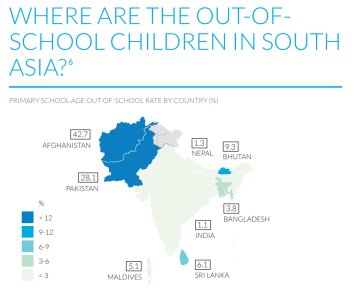
Above map shows a huge huge problem. I rarely see people talking about it, but this should be the number one priority for country. You can't have 30-40% of some subset not attending elementary school. That's a disaster.

If comparison with India makes it hard then ignore India. Just look at other countries in region. No one has problem like Pakistan and Afghanistan. Afghanistan is a bit different case, but Pakistan had government and had control over country. This should be focus for everyone in Pakistan. Kids are our next generation.

In my opinion, all talks about CEO, leadership, IT etc is secondary. If anything just copy India here.

India and Pakistan are not so different. There should be no reason for Pakistan to have 30% out of school kids when India has 1%. I will start from here and then build on that. It will take few decades, but it's doable.
 
All parties and even army should be judged by this. I am lumping army here because they have lots of control over what gets done in Pakistan. This should be the single largest issue. Other things will follow.
 
I'm among the many hoping for Pakistan to become much better in education but even for me this sounds like a bad generalization and inaccurate. Indians may have many negative attributes as a society/nation/people but credit needs to be given where due even for an "enemy" nation. They have done something good as a resource constrained developing nation when it comes to education and knowledge capital. Other resource constrained South Asian nations can take a leaf out of their book that can be emulated.

US tech industry is led by so many Indians these days growing multi-billion dollar companies. The venture capital and private equity landscape in the US has so many Indians sitting in boards of companies. Investment banks and tier 1 MBB consulting firms (Mckinsey, Bain, BCG) are led by many Indian origin partners. Overlooking all of this and saying "they lack leadership qualities" is either ignorance or hate driven.

One argument here seems to be "why emulate India when we rather emulate US/UK/EU". Those are resource rich nations to begin with and their model is not immediately applicable to resource constrained developing nations for building knowledge capital through education. Overlooking this obvious fact and stressing that South Asian nations rather emulate US/UK/EU is either due to ignorance or pointless ego driven lack of acknowledgement of the accomplishment of an enemy nation.

It is true that Indians are going on a downward spiral in their hate driven government policies that also spirals to negative cultural effects. That is a perfect example for Pakistan (and other South Asian nations) for what NOT to do. At the same time, do give credit where it is due (education and knowledge capital) so that it can be emulated.

Good points but I am still not convinced that Indian education model should be emulated simply because it helped alot of Indians move abroad to get education in western universities and settled there. How does that help India, doesn't this just prove that Indian system too has problems because it is unable to retain it's best and brightest? Why should Pakistan emulate India, but why not South Korea, Japan and other south east asian countries that have a higher gdp per capita than India? Doesn't their model help their nation more by retaining talented people who go on to build house hold brands like Samsung, Hyundai, Sony, Toyota, etc.. What brand has India launched in the last 30 years if all it's policies and knowledge capital is so great like you said?

Climbing up the corporate ladder is difficult, but not impossible if there is already a structure in place, not to mention many of the decisions are made by the board. Indians do turnout to be decent managers because of their passive nature, this helps them stay in the good books of many working with them I guess. But creating something from scratch and scaling that requires more and you hardly see that coming from that part of the world.
 
Last edited:
Good points but I am still not convinced that Indian education model should be emulated simply because it helped alot of Indians move abroad to get education in western universities and settled there. How does that help India, doesn't this just prove that Indian system too has problems because it is unable to retain it's best and brightest? Why should Pakistan emulate India, but why not South Korea, Japan and other south east asian countries that have a higher gdp per capita than India? Doesn't their model help their nation more by retaining talented people who go on to build house hold brands like Samsung, Hyundai, Sony, Toyota, etc.. What brand has India launched in the last 30 years if all it's policies and knowledge capital is so great like you said?

Climbing up the corporate ladder is difficult, but not impossible if there is already a structure in place, not to mention many of the decisions are made by the board. Indians do turnout to be decent managers because of their passive nature, this helps them stay in the good books of many working with them I guess. But creating something from scratch and scaling that requires more and you hardly see that coming from that part of the world.

It actually helps India.

Tens of billions of capital allocation is in hands of Indian origin CEO, are they going to pick India or Bangladesh to allocate capital? I am just using Bangladesh, you can pick any country which will provide comparable options.

For example - Microsoft employed 8,000 in India. Same with Google. Same with Adobe.

The work performed by some centers in India are exactly the same as what gets done in Seattle or California, but it was not always the case. India used to get mostly maintenance work or support work. Now slowly but surely they have moved up in value chain. Tons of Indians being decision maker played a huge part here. IN fact, if you look at investment going in IT start ups in the last 4-5 years, it's a very large scale where giant tech companies are putting money.

If it does not convince you, imagine Microsoft, Google and bunch of others were headed by a Pakistani. Don't you think it would have made it easier to get capital allocated to Pakistan? Now you can say that Pakistan does not have educated manpower to support Microsoft, Google etc to do latest product development , but then how did India get those? It got it via having a basic education structure. Or you could say that Pakistan has enough educated base, but not getting the opportunities. If that's the case then Indian origin CEO's are surely helping India while ignoring Pakistan.

In short, it's the education which provided the base and its helping India.

If it still not convincing to you, IT exports from India crossed 150B. Where this 150B is coming from? It's coming due to having trained manpower, but having large number of decision makers in IT giants makes it drastically easier. It's just self feeding cycle, but everything comes from educated base.
 
Coming back to main topic,

It's illogical to talk about copying Korea or Japan when Pakistan is not even doing the basic stuff. For god sake, 30-40% primary school aged kids being out of school in Pakistan. It's really bad situation.


India has 1% out of school kids. It shouldn't be hard to copy because socioeconomic background of students will be roughly same in India and Pakistan. Indian families face the same challenge and if they have 1% out of school kids then Pakistan can surely learn and do the same. Forget India, even other south Asian countries are not having 25-30% kids out of school. It's easier to see how countries with similar backgrounds did it and copy.
 
Last edited:
Good points but I am still not convinced that Indian education model should be emulated simply because it helped alot of Indians move abroad to get education in western universities and settled there. How does that help India, doesn't this just prove that Indian system too has problems because it is unable to retain it's best and brightest? Why should Pakistan emulate India, but why not South Korea, Japan and other south east asian countries that have a higher gdp per capita than India? Doesn't their model help their nation more by retaining talented people who go on to build house hold brands like Samsung, Hyundai, Sony, Toyota, etc.. What brand has India launched in the last 30 years if all it's policies and knowledge capital is so great like you said?

Climbing up the corporate ladder is difficult, but not impossible if there is already a structure in place, not to mention many of the decisions are made by the board. Indians do turnout to be decent managers because of their passive nature, this helps them stay in the good books of many working with them I guess. But creating something from scratch and scaling that requires more and you hardly see that coming from that part of the world.

Fair questions about why not emulate South Korea, Japan and other south east asian countries. I did not imply that Indian education system is perfect (far from it). But it is a few levels above Pakistan and that is the reality.

My point - Pakistan should emulate India for now until they become a few levels better and then aspire for developed country models.

Why I say this - This is an attainable goal especially for complex endeavors like redesigning a country's education system. The concept here is to walk before you can run, and before you can fly. Pakistan is crawling right now, India is sort of speed walking and the countries you mention (US, UK, EU, Japan, South Korea) are all flying or semi-flying. It is unrealistic for a resource constrained developing nation to aspire to fly when it is currently crawling. If you impose such a lofty goal then it will be doomed for failure (take into account current inefficient systems, corruption, zero execution know-how). Saying "let's follow developed country model now" sounds great from a marketing or political perspective but it will only waste what precious little resources what Pakistan has. Again ... walk first, then run, and then fly.


Indians do turnout to be decent managers because of their passive nature, this helps them stay in the good books of many working with them I guess. -- C'mon bhai, this is not a good thing to say (ludicrous if I can be honest). Are we to really say that people running companies worth 100s of Billions in USD are yes men? Are we to say that people running some of the biggest investment funds in the financial world now and sitting on boards of these big companies are yes men? Who are the actual leaders? People who do not emphasize education and are corner store owners or taxi cab owners because they have more "jazba"?

Not all of those Indian CEOs are from corporate ladders. Forget people climbing corporate ladders, there are many of their CEOs who have started their own companies in silicon valley and employing 100s of people. Is that not a testament for leadership or are we to split hairs and find faults in those as well to make ourselves feel better? Please see this for reference -- https://www.siliconindia.com/magazi...naged-by-Indians-in-the-US-WGAR554925450.html

I'm not sure where you live but do you know how bad many silicon valley Pakistanis wish there are initiatives like TiE (The Indus Entrepreneurs) and Silicon India to grow startups in the tech ecosystem? They have created a robust support network to succeed as entrepreneurs and business leaders that other South Asian nations can currently only dream of.

Acknowledging what little good things the Indians have done in the spirit of matching/exceeding that in the future is the correct thing to do. Trying to trivialize them while clutching at straws to find accomplishments only makes it seem like insecurity and jealousy. I would prefer to keep things realistic and talk about avenues for Pakistan to grow instead of boombastic statements or picking faults at an adversary - my humble pov.
 
It actually helps India.

Tens of billions of capital allocation is in hands of Indian origin CEO, are they going to pick India or Bangladesh to allocate capital? I am just using Bangladesh, you can pick any country which will provide comparable options.

For example - Microsoft employed 8,000 in India. Same with Google. Same with Adobe.

The work performed by some centers in India are exactly the same as what gets done in Seattle or California, but it was not always the case. India used to get mostly maintenance work or support work. Now slowly but surely they have moved up in value chain. Tons of Indians being decision maker played a huge part here. IN fact, if you look at investment going in IT start ups in the last 4-5 years, it's a very large scale where giant tech companies are putting money.

If it does not convince you, imagine Microsoft, Google and bunch of others were headed by a Pakistani. Don't you think it would have made it easier to get capital allocated to Pakistan? Now you can say that Pakistan does not have educated manpower to support Microsoft, Google etc to do latest product development , but then how did India get those? It got it via having a basic education structure. Or you could say that Pakistan has enough educated base, but not getting the opportunities. If that's the case then Indian origin CEO's are surely helping India while ignoring Pakistan.

In short, it's the education which provided the base and its helping India.

If it still not convincing to you, IT exports from India crossed 150B. Where this 150B is coming from? It's coming due to having trained manpower, but having large number of decision makers in IT giants makes it drastically easier. It's just self feeding cycle, but everything comes from educated base.

This is a fantastic point and not many people seem to grasp the power of this. Within tech and now going to other industries too, the Indian CEOs and high level executives wield immense financial power to direct new development centers, which can create more employment opportunities, boost economies at local level, create education opportunities for next generation - long term benefits beyond just the short term benefits of creating more jobs.

I also recall in early 2000s jobs in Indian centers were Q&A, call center, and support work. Now there are serious product and market launch decisions being taken from the Indian teams. I have seen them lead the show when it comes to new business initiatives and product launches. Same is the case in Investment Banks like Goldman Sachs, Morgan Stanley etc, their Indian teams being important parts of many core initiatives. In a way this is not surprising because they have had 20+ years of back office work evolving into front office work.

Usual feel good retort from some here - "If this is the case then how come there are no Indian products" - True, they are not there yet and they are still in the nascent stages of "Flying". Their industry was ...
1. "Crawling" in early 2000s with back office work
2. "Walking" with product development work,
3. "Running" with product launch and business strategy work
4. "Semi flying" now with how grown products catering to Indian market (think Ola, FlipKart, Swiggy that I hear from Indian colleagues).

Only a question of more years before they can "fully fly" to launch home grown products that have global impacts. Picking faults at them and asking why aren't they "flying" yet may give a feel good factor especially when we want to hide the fact that Pakistan is not even "Crawling" (back office work) yet.

Big negative for India - All of the above being said, their bureaucracy is horrible. There is a saying among business circles that in developed countries businesses succeed because of the government but in India businesses succeed in spite of the government. This is the one area in the context of education systems Pakistan should not follow India but is sadly doing so.
 
This is a wrong notion that India has not got any home grown product. There are tons of examples in e-commerce and fintech actually. Infact fintech in India is now probably the best in the world, going neck and neck with Singapore which has been the pioneer in this space.
 
Pakistan is the size of one Indian state. If you want to pat yourself on the back for being better than Pakistan then I rest my case. Relatively speaking, for being a nation of 1.6 billion people, who has not been part of any war (including the cold war) for 50+ years you have very little to show for. Working for other countries companies and industries is not an achievement for India.

Dont shift goal posts.

You said that Indians are yes men or follow orders and don't have leadership qualities while Pakistanis are risk takers. Now please prove that.

India has fought 4 wars in last 50 years. What are you on about?

Now please come back to the topic on how Indians are yes men, and lack leadership while Pakistanis are risk takers etc.
 
This is a fantastic point and not many people seem to grasp the power of this. Within tech and now going to other industries too, the Indian CEOs and high level executives wield immense financial power to direct new development centers, which can create more employment opportunities, boost economies at local level, create education opportunities for next generation - long term benefits beyond just the short term benefits of creating more jobs.

I also recall in early 2000s jobs in Indian centers were Q&A, call center, and support work. Now there are serious product and market launch decisions being taken from the Indian teams. I have seen them lead the show when it comes to new business initiatives and product launches. Same is the case in Investment Banks like Goldman Sachs, Morgan Stanley etc, their Indian teams being important parts of many core initiatives. In a way this is not surprising because they have had 20+ years of back office work evolving into front office work.

Usual feel good retort from some here - "If this is the case then how come there are no Indian products" - True, they are not there yet and they are still in the nascent stages of "Flying". Their industry was ...
1. "Crawling" in early 2000s with back office work
2. "Walking" with product development work,
3. "Running" with product launch and business strategy work
4. "Semi flying" now with how grown products catering to Indian market (think Ola, FlipKart, Swiggy that I hear from Indian colleagues).

Only a question of more years before they can "fully fly" to launch home grown products that have global impacts. Picking faults at them and asking why aren't they "flying" yet may give a feel good factor especially when we want to hide the fact that Pakistan is not even "Crawling" (back office work) yet.

Big negative for India - All of the above being said, their bureaucracy is horrible. There is a saying among business circles that in developed countries businesses succeed because of the government but in India businesses succeed in spite of the government. This is the one area in the context of education systems Pakistan should not follow India but is sadly doing so.

We've been hearing this walk-fly argument for 15 years and I think in another 15 years it will be the same. Again, providing profits and cost cutting through outsourcing only benefits American companies and share holders. They still control the business expertise and tell Indians what buttons to press.

Pakistan should not go the Indian way of exporting cheap workforce. It is unsustainable in addition, there are already 1.6 billion people who are in line to escape a shining nation. We need to stablize ourselves first, take care of our neighbors who have been destablizing us for 40+ years, before that all of this is wishful thinking.
 
Dont shift goal posts.

You said that Indians are yes men or follow orders and don't have leadership qualities while Pakistanis are risk takers. Now please prove that.

India has fought 4 wars in last 50 years. What are you on about?

Now please come back to the topic on how Indians are yes men, and lack leadership while Pakistanis are risk takers etc.

What wars were they? I am not talking about scrimmages.
 
This is a fantastic point and not many people seem to grasp the power of this. Within tech and now going to other industries too, the Indian CEOs and high level executives wield immense financial power to direct new development centers, which can create more employment opportunities, boost economies at local level, create education opportunities for next generation - long term benefits beyond just the short term benefits of creating more jobs.

I also recall in early 2000s jobs in Indian centers were Q&A, call center, and support work. Now there are serious product and market launch decisions being taken from the Indian teams. I have seen them lead the show when it comes to new business initiatives and product launches. Same is the case in Investment Banks like Goldman Sachs, Morgan Stanley etc, their Indian teams being important parts of many core initiatives. In a way this is not surprising because they have had 20+ years of back office work evolving into front office work.

Usual feel good retort from some here - "If this is the case then how come there are no Indian products" - True, they are not there yet and they are still in the nascent stages of "Flying". Their industry was ...
1. "Crawling" in early 2000s with back office work
2. "Walking" with product development work,
3. "Running" with product launch and business strategy work
4. "Semi flying" now with how grown products catering to Indian market (think Ola, FlipKart, Swiggy that I hear from Indian colleagues).

Only a question of more years before they can "fully fly" to launch home grown products that have global impacts. Picking faults at them and asking why aren't they "flying" yet may give a feel good factor especially when we want to hide the fact that Pakistan is not even "Crawling" (back office work) yet.

Big negative for India - All of the above being said, their bureaucracy is horrible. There is a saying among business circles that in developed countries businesses succeed because of the government but in India businesses succeed in spite of the government. This is the one area in the context of education systems Pakistan should not follow India but is sadly doing so.

We've been hearing this walk-fly argument for 15 years and I think in another 15 years it will be the same. Again, providing profits and cost cutting through outsourcing only benefits American companies and share holders. They still control the business expertise and tell Indians what buttons to press.

Pakistan should not go the Indian way of exporting cheap workforce. It is unsustainable in addition, there are already 1.6 billion people who are in line to escape a shining nation. We need to stablize ourselves first, take care of our neighbors who have been destablizing us for 40+ years, before that all of this is wishful thinking.

I have already shown real world tangible examples of their crawl-walk-run-fly model. If you keep ignoring those and think they are winning business only as a cheap outsourcer or BPO these days then you are either in denial or have your ego being hurt by looking at the truth.

"We need to stablize ourselves first, take care of our neighbors who have been destablizing us for 40+ years, before that all of this is wishful thinking." - What does this mean? Invest more into military at the expense of education? We all know where this has led to over the years? No I do not mean NOT invest in military (to all of you who intend to jump in with "how dare you not invest in military"). My point is at least start giving priorities for education.

Giving priority for education also does not mean bombastic political statements like "let's transform Pakistan's education into US model within 5 years". These will only trigger the masses and will only help the Shariffs and Bhuttos of the world to funnel more millions into their pockets through yet another unrealistic wasteful scheme. What Pakistan needs is achievable step by step goals to improve education set up.

"It is unsustainable in addition, there are already 1.6 billion people who are in line to escape a shining nation." - Wrong. Pakistan does have the capability to compete against them with enough support to the education system, please do not underestimate Pakistan. Pakistan's labor costs are much cheaper than tier 1 or tier 2 cities of India. Pakistan has enough good English speaking educated labor force that is also willing to work hard given the right incentives and support. If this is unsustainable then Philippines would not be competing against India for cheaper BPO outsourcing, countries like Vietnam will not be competing against China as a cheaper manufacturing source. There - more real world examples to counter your assumption.

I have a feeling that no matter what facts are presented to you, your response is only centered around denial and some random insult directed at them without even bothering to look at the facts presented to you from both sides. The reality is that they are well into "running" and are aspiring to fly but Pakistan is not even at the "crawling" stage. BUT with enough support from education system Pakistan can compete against them first as a lower cost provider, then build up enough talent pool and move up the chain over time.

Your alternative of "let's just not compete against them but keep looking at some utopia" is an unrealistic recipe for disaster.
 
I have already shown real world tangible examples of their crawl-walk-run-fly model. If you keep ignoring those and think they are winning business only as a cheap outsourcer or BPO these days then you are either in denial or have your ego being hurt by looking at the truth.

"We need to stablize ourselves first, take care of our neighbors who have been destablizing us for 40+ years, before that all of this is wishful thinking." - What does this mean? Invest more into military at the expense of education? We all know where this has led to over the years? No I do not mean NOT invest in military (to all of you who intend to jump in with "how dare you not invest in military"). My point is at least start giving priorities for education.

Giving priority for education also does not mean bombastic political statements like "let's transform Pakistan's education into US model within 5 years". These will only trigger the masses and will only help the Shariffs and Bhuttos of the world to funnel more millions into their pockets through yet another unrealistic wasteful scheme. What Pakistan needs is achievable step by step goals to improve education set up.

"It is unsustainable in addition, there are already 1.6 billion people who are in line to escape a shining nation." - Wrong. Pakistan does have the capability to compete against them with enough support to the education system, please do not underestimate Pakistan. Pakistan's labor costs are much cheaper than tier 1 or tier 2 cities of India. Pakistan has enough good English speaking educated labor force that is also willing to work hard given the right incentives and support. If this is unsustainable then Philippines would not be competing against India for cheaper BPO outsourcing, countries like Vietnam will not be competing against China as a cheaper manufacturing source. There - more real world examples to counter your assumption.

I have a feeling that no matter what facts are presented to you, your response is only centered around denial and some random insult directed at them without even bothering to look at the facts presented to you from both sides. The reality is that they are well into "running" and are aspiring to fly but Pakistan is not even at the "crawling" stage. BUT with enough support from education system Pakistan can compete against them first as a lower cost provider, then build up enough talent pool and move up the chain over time.

Your alternative of "let's just not compete against them but keep looking at some utopia" is an unrealistic recipe for disaster.

Pakistan is already competing with them. Had we not been involved in wars for 40 years we would be richer than them like we were before 9/11. Like I have repeatedly told you, Indian system is designed around only exporting cheap labor in IT. They will never build any product themselves that they can sell to rest of the world. We don't need to go that route as it is already saturated. We have better models we can follow which will yield results better for our country and not europeans or americans. I would rather look towards China, South Korea, Turkey, Malaysia and even Bangladesh as a model of success where these countries have homegrown technological and business know how and don't have to rely on sending their talented people abroad.
 
Last edited:
Pakistan is already competing with them. Had we not been involved in wars for 40 years we would be richer than them like we were before 9/11. Like I have repeatedly told you, Indian system is designed around only exporting cheap labor in IT. They will never build any product themselves that they can sell to rest of the world. We don't need to go that route as it is already saturated. We have better models we can follow which will yield results better for our country and not europeans or americans. I would rather look towards China, South Korea, Turkey, Malaysia and even Bangladesh as a model of success where these countries have homegrown technological and business know how and don't have to rely on sending their talented people abroad.

Like I'm repeatedly telling you, this is not the case and your core assumption is wrong. They were competing on being cheapest back in early 2000s and have evolved since then. I have already given you real world examples of this yet you keep repeating this inaccurate data point over and over.

China, South Korea, and Malaysia are not relatable models for Pakistan given their pre-existing healthy economic base. Turkey has a better economic base and does not have Pakistan's English base so it is not relatable. Bangladesh model is relatable for manufacturing and yes Pakistan can follow that. But this alone cannot be relied since it is a manufacturing based economy that requires high capital expenditures. Pakistan needs a blend of Bangladesh and to a larger extent India's services based economy.

Pakistan is a country with cheaper human labor and strong English speaking base so boost through services based economy (that does not require massive initial capital expenditure) is the obvious choice. Seems to me that you just do not want to accept that the Indian services model is a good choice for Pakistan because of the word "India" in it. So you keep repeating wrong facts like "India is just a cheap outsourcer" (true only in early 2000s) or let's look at Malaysia/Turkey etc which are not even relatable for Pakistan.
 
Just so you understand, I keep saying South Korea, China and Turkey again and again because these countries too got independence around the same time as India and Pakistan. They also have conflicts in their neighborhoods, they also had same type of poverty faced by India and Pakistan not too long ago. They are now able to compete with Americans in various different fields. Infact, some of the products coming out from these countries are better and cheaper. How come we don't see a samsung or huwawei or bayrakter coming from India? Didn't we all started crawling at the sametime?

If you want to be self reliant and self sustaining then you have to focus on building value added products in your country and making use of your talented folks, not shipping them off for others to exploit. Pakistan did this well from 50s to 80s before the wars in Afghanistan started. Because of these wars and threat to Pakistans soverignty from both east and west we got put in the tight spot. But I am optimistic that with the right leadership in place, Pakistan can be put back on track, the new technology can help us improve leaps and bounds very quickly with the right focus. We can continue to build our own products like JF-17 and export our fashion, arts and culture where our creativity can easily outshine anyone else in the region.

Before all of that, our big neighbor continues to create hurdles for us so we need to figure out what to do about them, it's not going to be easy but they need to be checked for us to grow.
 
Just so you understand, I keep saying South Korea, China and Turkey again and again because these countries too got independence around the same time as India and Pakistan. They also have conflicts in their neighborhoods, they also had same type of poverty faced by India and Pakistan not too long ago. They are now able to compete with Americans in various different fields. Infact, some of the products coming out from these countries are better and cheaper. How come we don't see a samsung or huwawei or bayrakter coming from India? Didn't we all started crawling at the sametime?

If you want to be self reliant and self sustaining then you have to focus on building value added products in your country and making use of your talented folks, not shipping them off for others to exploit. Pakistan did this well from 50s to 80s before the wars in Afghanistan started. Because of these wars and threat to Pakistans soverignty from both east and west we got put in the tight spot. But I am optimistic that with the right leadership in place, Pakistan can be put back on track, the new technology can help us improve leaps and bounds very quickly with the right focus. We can continue to build our own products like JF-17 and export our fashion, arts and culture where our creativity can easily outshine anyone else in the region.

Before all of that, our big neighbor continues to create hurdles for us so we need to figure out what to do about them, it's not going to be easy but they need to be checked for us to grow.

Bhai, I understand that your heart is in the right place and why you are suggesting South Korea, China, and Turkey. But also understand that while they have some similarities, there are pretty big socio economic differences between them and Pakistan even though they attained independence at similar times. They either already had a better education focused society that needed the right impetus, or a less corrupt albeit authoritarian government (China, Singapore), more manageable population growth (Turkey, Malaysia, South Korea), or be fortunate with to have right investments from super powers coupling with free market capital structure to augment education system (South Korea).

Which countries had independence around 1947, strong English speaking base, corrupt and bureaucratic governance, high population growth, less room for making investments to get into capex heavy manufacturing, burdened by military spending due to hostile neighbors ....? Which countries had all of those that Pakistan has and yet built a better education system over the past few decades? Please keep your anti-India bias aside for a moment and answer me this objectively.
 
Bhai if you could only keep your india bias out and understand what I am trying to explain then you will see why Indian system too has fundamental problems 🙂.

Pakistan has better models to follow once our border situation and fiscal situation improves. We did get ourselves in a mess from all the afghan wars but things are not terrible. We already have a system that produces good engineers, doctors and business leaders who move to other countries but need better governance so they stay in Pakistan and help Pakistan. Also we need to make our neighbors realize that creating problems for us will also create problems for them 🙂.
 
Bhai if you could only keep your india bias out and understand what I am trying to explain then you will see why Indian system too has fundamental problems ��.

Pakistan has better models to follow once our border situation and fiscal situation improves. We did get ourselves in a mess from all the afghan wars but things are not terrible. We already have a system that produces good engineers, doctors and business leaders who move to other countries but need better governance so they stay in Pakistan and help Pakistan. Also we need to make our neighbors realize that creating problems for us will also create problems for them ��.

Oh man, seriously where do I even begin!! Let me try to pick apart and debunk your points here since it reeks of the usual "status quo is best" pov.

I'm trying to understand your model for education but it is plain unrealistic. I do not have any anti or pro India bias as you can infer from my posts. We may critique them for 90% of what India does but also need to give credit to them for the very few things they did get right.

"Pakistan has better models to follow once our border situation and fiscal situation improves." - This is just more utopia. We have been waiting for this to improve for 70+ years and nothing has and realistically nothing will. This is the status quo and neither nuclear armed side will budge. So what you are saying is that until this utopia arrives we should continue our emphasis on military and also only continue what we are doing now for education. This will ensure that status quo of relatively abysmal job opportunities for Pakistan's educated youth will prevail.

"Also we need to make our neighbors realize that creating problems for us will also create problems for them" - More inferences from you for emphasis/increase on military spending in a thread about education. Basically saying lets funnel more money to guns and bombs, stay the course for education and hope it all gets better for education system.

"We already have a system that produces good engineers, doctors and business leaders who move to other countries but need better governance so they stay in Pakistan and help Pakistan" - No Pakistan does not have a good education system in place as of today. Not sure what makes you say Pakistan is producing good engineers, doctors, and business leaders. Where is the outcome? Are there as many global tech/business/finance leaders from Pakistan as there are from India or China AFTER adjusting for population? Without that result this is just a fallacy and a subjective claim. Forget professional education, did you see post #88 in this thread by [MENTION=97523]Buffet[/MENTION]? Primary school enrollments are abysmal!

Your model for improving Pakistan education -- Assume that current system is good, hope that governance gets better and geo-political military situation gets better, then Pakistan can funnel its precious few resources to directly follow the model of China/Korea/Malaysia and leapfrog any intermittent stages -- Do you not see how unrealistic this is? Wanting to improve education with a concerted effort AFTER 70+ years of bad governance magically gets better and AFTER 70+ years of hostile neighbor magically gets better. Be honest and think how (un)realistic is this?

Your utopia above ain't happening in our foreseeable future bro and the more realistic plan is what can be done GIVEN the existing bad governance and GIVEN the current hostile neighbor (and resulting military spending, and resulting scarce budget).

I'm presenting facts to you so no I do not have any bias. I have proven your assumptions to be untrue. I explained why the model of countries you suggested do not work for Pakistan. I asked you what other country Pakistan can follow with a similar common ground but you ignored my question. I have also posed questions here that you probably will not answer, or have unsubstantiated opinions on why another country is bad or why Pakistan rather follow Luxembourg/Singapore/Mongolia rather than an apples-apples model.

You are the one offering subjective opinions and utopian what-ifs so if anything you are the one with the bias. Just because it is Pakistan's enemy nation and we critique 90% of what they do, does not mean one cannot look at the few positives they do and follow. If you think otherwise and not follow their good efforts then education policy will continue to remain bad.
 
Bhai if you could only keep your india bias out and understand what I am trying to explain then you will see why Indian system too has fundamental problems ��.

Pakistan has better models to follow once our border situation and fiscal situation improves.
We did get ourselves in a mess from all the afghan wars but things are not terrible. We already have a system that produces good engineers, doctors and business leaders who move to other countries but need better governance so they stay in Pakistan and help Pakistan. Also we need to make our neighbors realize that creating problems for us will also create problems for them ��.

I don't think anyone in this thread is saying that the Indian education system ( thats available to the ag Joe on the street even in remote areas) is the best in world or even Asia. Instead what they are saying is for resource constrained countries the model that India has is the best. And I can assure you that they are 100% spot on.

But its not easy to build that system as at the root of it lies the hunger to get educated at any cost. It is burnt into our minds at a very very young age starting with worship of Saraswati (Goddess of learning ) . When it comes to education the middle class and even lower economic levels will go to extreme levels in pursuit of a decent education as that is the only ticket for a reasonable life.

From my own immediate family .... we still have a lot of elders who were born few years around 1947 and almost all of them have a degree with a few exceptions. Even those who do not have a degree could read and write English and they literally dedicated their lives to ensure that their Children get super educated. Simply put getting a real degree was the only option on the table. Any other option was literally beaten out of us!!

Dont believe all of that ? Take a look at Byjus - yes the logo that you see on all Indian cricketer jerseys. Its a company that specializes in education. Forget their valuation and look at their student count. 100+ Million!! Thats pretty much entire student population of Pakistan !! Staggering. I can assure you that it is possible only because of a population obsessed with education. And Byjus is just one company there are many others.
 
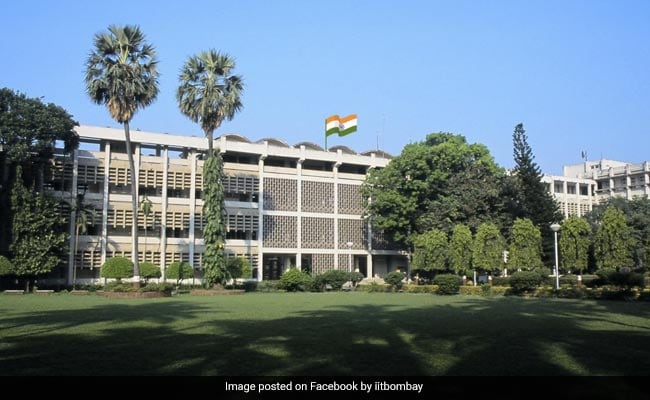
IIT-Bombay Graduate Sets New Record With ₹ 3.7 Crore International Job Offer
IIT-Bombay placement 2022-23: Companies in the US, Japan, UK, Netherlands, Hong Kong, and Taiwan made 65 job offers to IIT-Bombay students.

Mumbai: In its recently concluded annual placement drive, the Indian Institute of Technology, Bombay (IIT-Bombay) bagged the institute's highest international job offer of ₹ 3.7 crore per year. In an official release, IIT-Bombay also said that a student was placed within the country at a package of ₹ 1.7 crore. This marks a substantial increase compared to last year's international offer of ₹ 2.1 crore, while the domestic offer for the previous year was marginally higher at ₹ 1.8 crore yearly.

The institute has not released the names of the students who have received these offers.

Sixteen job offers with annual salaries exceeding ₹ 1 crore were accepted by IIT-Bombay students. They also accepted 194 of the 300 pre-placement offers, as per the release on 2022-23 placements.

 
IIT-Bombay Graduate Sets New Record With ₹ 3.7 Crore International Job Offer
IIT-Bombay placement 2022-23: Companies in the US, Japan, UK, Netherlands, Hong Kong, and Taiwan made 65 job offers to IIT-Bombay students.

Mumbai: In its recently concluded annual placement drive, the Indian Institute of Technology, Bombay (IIT-Bombay) bagged the institute's highest international job offer of ₹ 3.7 crore per year. In an official release, IIT-Bombay also said that a student was placed within the country at a package of ₹ 1.7 crore. This marks a substantial increase compared to last year's international offer of ₹ 2.1 crore, while the domestic offer for the previous year was marginally higher at ₹ 1.8 crore yearly.

The institute has not released the names of the students who have received these offers.

Sixteen job offers with annual salaries exceeding ₹ 1 crore were accepted by IIT-Bombay students. They also accepted 194 of the 300 pre-placement offers, as per the release on 2022-23 placements.


So what.
This kind of bragging should be avoided.

We all get the basic idea of this thread. Let’s talk about education and its teach and levels in both countries.

No need to brag about things like who has more CEOs and who gets better salary packages.
 
India places a significant value to its education system but in Pakistan there seems to be a severe corruption in this education sector. specially in the country's rural areas teachers who lack proper qualifications continue to receive salaries, raising doubts about their ability to effectively educate students.
 
Have heard great feedback about LUMS (Indian IIM students can opt for LUMS in exchange program for 3 months, or at least they could once upon a time).
 
Have heard great feedback about LUMS (Indian IIM students can opt for LUMS in exchange program for 3 months, or at least they could once upon a time).

Lahore will always have a special in our hearts as the original capital of Punjab.

It’s sad that i live so close to Lahore but cannot go there. Actually can, but won’t as the Pakistani VISA stamp brings a bad name to your passport , allegedly.
 
Lahore will always have a special in our hearts as the original capital of Punjab.

It’s sad that i live so close to Lahore but cannot go there. Actually can, but won’t as the Pakistani VISA stamp brings a bad name to your passport , allegedly.
That is what one friend said who couldn't go to LUMS despite opting for it. He said it would have hampered his chances of getting VISAs elsewhere (atheist but with muslim name).
 
Have heard great feedback about LUMS (Indian IIM students can opt for LUMS in exchange program for 3 months, or at least they could once upon a time).
Does the reverse apply? I'd love for top Pakistani talent to be able to tap into India's system.
 
Does the reverse apply? I'd love for top Pakistani talent to be able to tap into India's system.
I recall LUMS student visiting India. Not sure if it still happens (would be surprised it it is).

I think India's education system is over rated. The competition is so huge that people have to work very hard to get the few seats, but within the system isn't that great (or wasn't great during my days). These people really shine when to go abroad. Within India some end up as trolls on Pakistani forums like me.
 
Lahore will always have a special in our hearts as the original capital of Punjab.

It’s sad that i live so close to Lahore but cannot go there. Actually can, but won’t as the Pakistani VISA stamp brings a bad name to your passport , allegedly.
I only had problem with stamp once and it was visiting USA they asked why I visited so many middle east countries ( they included Pakistan in ME) but I have a Muslim name and am visibly Muslim ( at the time I had a beard not a big one but it was a bit bushy)

For people with names like Kumar and who look visibly like Kumars the stamp shouldn't be an issue.
 
I only had problem with stamp once and it was visiting USA they asked why I visited so many middle east countries ( they included Pakistan in ME) but I have a Muslim name and am visibly Muslim ( at the time I had a beard not a big one but it was a bit bushy)

For people with names like Kumar and who look visibly like Kumars the stamp shouldn't be an issue.

It’s always in the back of the mind though. People had same fears for travelling to Tehran.

One of my knowns had trouble in getting US visa because of travel history to Iran. Eventually he got it. But faced a lot of inconvenience and delay.
 

CBI secures 4-year jail term for Kanpur school principal in bribe case​


It also arrested a former sub-Postmaster from Kerala who was evading arrest

A Special CBI Court in Lucknow sentenced a former principal of Kendriya Vidyalaya in Kanpur to four years’ imprisonment, along with a fine of Rs100,000 (about Dh4,050), for taking a bribe of Rs25,000 (Dh1,013) from a canteen operator, an official said on Saturday.
Tasudduque Khan, the then Principal of Kendriya Vidyalaya-I, Air Force Station, Chakeri, Kanpur, UP, was held guilty by the Special Court under the provisions of the Prevention of Corruption Act.

The Central Bureau of Investigation (CBI) registered the instant case on August 24, 2016, based on a complaint by the proprietor of a Kanpur-based private company against Khan.
It was alleged that the accused had demanded Rs51,000 and agreed to accept Rs25,000 from the complainant as a motive/reward in lieu of payment already made to the complainant to the tune of Rs173,0000, and also allowing the school canteen to run smoothly in the future.

After the completion of the investigation, the CBI filed a charge sheet against the accused on September 30, 2016.
In a separate case, the CBI on Friday arrested a former sub-Postmaster from Kerala who was evading arrest and a jail term after a court held her guilty of misappropriating Rs273,000.

Convict Jayasree Rajkumar, the then Sub Postmaster, Pulpally Sub Post Office, Wyanad District, Kerala, was taken into custody from Kuttippuram in Malappuram District, said the official in a statement.
After the accused was produced before the Court of Special Judge-II, CBI, Ernakulam, the judge remanded her to Central Prison, Thrissur, to undergo the sentence, said the statement.
The CBI registered the case against Rajkumar on September 22, 2003.
It was alleged that the accused, while working as Sub-Postmaster, Pulpally Sub Post Office from May 28, 2002, to March 26, 2003, committed criminal breach of trust by misappropriating an amount of Rs273,318, which was entrusted to her in her official capacity.
 

CBI secures 4-year jail term for Kanpur school principal in bribe case​


It also arrested a former sub-Postmaster from Kerala who was evading arrest

A Special CBI Court in Lucknow sentenced a former principal of Kendriya Vidyalaya in Kanpur to four years’ imprisonment, along with a fine of Rs100,000 (about Dh4,050), for taking a bribe of Rs25,000 (Dh1,013) from a canteen operator, an official said on Saturday.
Tasudduque Khan, the then Principal of Kendriya Vidyalaya-I, Air Force Station, Chakeri, Kanpur, UP, was held guilty by the Special Court under the provisions of the Prevention of Corruption Act.

The Central Bureau of Investigation (CBI) registered the instant case on August 24, 2016, based on a complaint by the proprietor of a Kanpur-based private company against Khan.
It was alleged that the accused had demanded Rs51,000 and agreed to accept Rs25,000 from the complainant as a motive/reward in lieu of payment already made to the complainant to the tune of Rs173,0000, and also allowing the school canteen to run smoothly in the future.

After the completion of the investigation, the CBI filed a charge sheet against the accused on September 30, 2016.
In a separate case, the CBI on Friday arrested a former sub-Postmaster from Kerala who was evading arrest and a jail term after a court held her guilty of misappropriating Rs273,000.

Convict Jayasree Rajkumar, the then Sub Postmaster, Pulpally Sub Post Office, Wyanad District, Kerala, was taken into custody from Kuttippuram in Malappuram District, said the official in a statement.
After the accused was produced before the Court of Special Judge-II, CBI, Ernakulam, the judge remanded her to Central Prison, Thrissur, to undergo the sentence, said the statement.
The CBI registered the case against Rajkumar on September 22, 2003.
It was alleged that the accused, while working as Sub-Postmaster, Pulpally Sub Post Office from May 28, 2002, to March 26, 2003, committed criminal breach of trust by misappropriating an amount of Rs273,318, which was entrusted to her in her official capacity.


Bribery, fraud, scam, fake.

Some of the words we are seeing a lot lately involving the sanghis. :inti
 

Not sure why my user ID is included as an Indian (shuddering at the horror). I'm a proud American with an equally proud Pakistani background.

Speaking of -- "Fellow Indians" seems to imply that @finalfantasy7 is Indian
 
Pakistan can definitely learn how to spread fake news and then create a whole envirenment to make it look real.
 
How to spread propaganda and shove it down the throats of students
Pakistan can definitely learn how to spread fake news and then create a whole envirenment to make it look real.
Ideally, we learn the positive things and avoid the negative things. If you want to do the opposite, no ones stopping you.

Pakistan’s literacy rate is at 58% one of the lowest in Asia. From a similar situation to becoming the leader in Global Capability Centers (GCCs) for MNCs globally, India did certainly well to at-least develop its talent pool - majorly attributable to our Tier-1 institutions such as IITs, NITs, IIMs, AIIMS etc.
 
Ideally, we learn the positive things and avoid the negative things. If you want to do the opposite, no ones stopping you.

Pakistan’s literacy rate is at 58% one of the lowest in Asia.
@Buffet have posted a brilliant analysis on how pak under 16 kids discontinues their studies.It was a detailed analytical graph but no pak poster bothered to take notice of it. I wish atleast pak govt should have taken note of it.
 
@Buffet have posted a brilliant analysis on how pak under 16 kids discontinues their studies.It was a detailed analytical graph but no pak poster bothered to take notice of it. I wish atleast pak govt should have taken note of it.
Yes. I remember. I ve seen his data analysis on quite few occasions and he comes up with valuable insights even in cricket discussions. Only if their government bothered.

My intention is not to make India as a standard as we failed to recreate private institutes in the league of IITs and establish global universities like IVY league but on ground-level, free education initiatives helped to drive the masses to attain graduation degrees be it useful or worthless but we are starting to see the results now. We need to start somewhere instead of ridiculing others. I have no shame to accept that Chinese military style education model trumped in many areas.

But its just irritating to see India’s education system gets called as a failed one, when its the single most important aspect that benefitted the current generation vs previous gen. It enabled crores of people down South India to come out of poverty, who are the most education-frenzied people. Its not a good thing in a sense that, most people study not out of interest but just to get a job and uplift their family economically —> which results in lower innovation in general. But, it helped the people and we can correct the system IMO.
 
But its just irritating to see India’s education system gets called as a failed one, when its the single most important aspect that benefitted the current generation vs previous gen. But, it helped the people and we can correct the system IMO.
Its like a failed student saying distinction student is not good as he has not achieved 100 percent.Ambitions and objectives always depends on economy and current situation. Most of our parents are from lower/ middle class whose sole aim was a good education and job for their kids.Now the target, ambitions, economy is completely different.we can compare it to sports culture in india.no parent used to encourage their kids to pursue a sports career let alone cricket. Now people are quite open minded.
 
There is nothing to learn from India or any Indian system. They are not a role model for anything. They lie a lot. They are incredibly dishonest. :inti
 

Which Ahmedabad Schools Were Targeted? Bomb Threat Emails Sent To These 10 Campuses - Latest Updates​


At least 10 schools across Ahmedabad city, Ahmedabad district and Gandhinagar received bomb threat emails on Wednesday morning, triggering evacuations and large-scale security checks. Read on for latest updates.


At least 10 schools across Ahmedabad city, Ahmedabad district and Gandhinagar received bomb threat emails on Wednesday morning, triggering a major security alert and extensive checks by multiple police agencies.
According to officials, the threat emails were sent to the following schools: Zebar School, Thaltej; Maharaja Agrasen School, Gurukul Road; DAV International School, Makarba; Nirman School, Vastrapur; Zydus School, Vejalpur; Divine School, Adalaj; Aavishkar School, Kalol; Ahmedabad International School, Bodakdev; New Tulip School, Bopal; Divine Child School, Adalaj; Udgam School, Thaltej; and DPS, Bopal.

Police officials said the emails were received at around 8.35 am, warning of bomb blasts at 1.11 pm. The subject line claimed explosions would occur not only in schools but also from "schools to Sabarmati Jail"


Following the threats, schools were evacuated as a precaution, and police teams rushed to the campuses to conduct thorough searches. No suspicious object has been found so far, officials confirmed.

Threat Email Names Amit Shah, Sabarmati Jail, Lawrence Bishnoi​

The emails reportedly mentioned Union Home Minister Amit Shah and gangster Lawrence Bishnoi, who is currently lodged in Sabarmati Jail.

The email also made references to the Khalistani referendum and the killing of Hardeep Singh Nijjar in Canada, claiming that Amit Shah and Lawrence Bishnoi were on the sender's "target list", warning of "consequences".


Disgusting thing to do, indians need th eeducation:

@Rajdeep @cricketjoshila @Champ_Pal @JaDed @Devadwal @uppercut @Theanonymousone @straighttalk @Vikram1989 @RexRex @Varun @Romali_rotti @Bhaijaan @Cover Drive Six @rickroll @rpant_gabba, @Romali_rotti @kron @globetrotter
 

A fake ASI website and an ‘entrance exam’: How a job con was attempted​


They allegedly shared posts widely on social media on college student groups, online forums, and messaging platforms, attracting hundreds of aspirants, said police.


A fake recruitment drive allegedly drew hundreds of aspirants as a computer engineer, along with another accomplice, created a hoax website of the Archaeological Survey of India (ASI) that replicated government logos and layouts to look authentic.

The duo even conducted a written test, according to police, and planned to conduct interviews where they allegedly wanted to take bribes while luring candidates with lucrative government jobs — but the job racket was busted before they could lay the final trap, said officers.


Is cheating just normal in India:

@Rajdeep @cricketjoshila @Champ_Pal @JaDed @Devadwal @uppercut @Theanonymousone @straighttalk @Vikram1989 @RexRex @Varun @Romali_rotti @Bhaijaan @Cover Drive Six @rickroll @rpant_gabba, @Romali_rotti @kron @globetrotter
 

A fake ASI website and an ‘entrance exam’: How a job con was attempted​


They allegedly shared posts widely on social media on college student groups, online forums, and messaging platforms, attracting hundreds of aspirants, said police.


A fake recruitment drive allegedly drew hundreds of aspirants as a computer engineer, along with another accomplice, created a hoax website of the Archaeological Survey of India (ASI) that replicated government logos and layouts to look authentic.

The duo even conducted a written test, according to police, and planned to conduct interviews where they allegedly wanted to take bribes while luring candidates with lucrative government jobs — but the job racket was busted before they could lay the final trap, said officers.


Is cheating just normal in India:

@Rajdeep @cricketjoshila @Champ_Pal @JaDed @Devadwal @uppercut @Theanonymousone @straighttalk @Vikram1989 @RexRex @Varun @Romali_rotti @Bhaijaan @Cover Drive Six @rickroll @rpant_gabba, @Romali_rotti @kron @globetrotter

Wherever they go, frauds and cheating follow.

There seems to be a cultural problem there. :inti
 

'Hit with Pipe, Belt', Differently Abled Teen Thrashed by Boarding School Owners, Disturbing Video Surface​


A 16-year-old differently abled boy was brutally assaulted by the husband-and-wife owners of his Karnataka boarding school, being beaten with a belt and pipe and having chilli powder thrown in his eyes, an incident exposed by a leaked video from a former employee.


Karnataka: In a shocking and heartbreaking incident, a 16-year-old differently abled boy at ‘Divyajyoti boarding for the differently abled’ in Karnataka’s Bagalkot was brutally assaulted by the husband and wife who run the school.
The boy, identified as Deepak Rathod, was beaten up with a belt and plastic pipe, as well as tortured with chilli powder into the boy’s eyes in a barbaric manner. The incident came to light after the former employee there reportedly leaked this video, triggering outrage.

A horrific video of the differently abled boy being thrashed in a boarding school has surfaced online.
In the multiple videos, the husband and wife were abusing the boy by beating him with a pipe and a belt; even after he collapsed to the ground and writhed in pain, the assault continued without restraint. The person filming the video can be seen laughing in the background.

The accused has been identified as Akshay Indulkar, who allegedly led the attack. Akshay’s wife, Anandi, was also seen putting chilli powder into the boy’s eyes during the assault.

Accused Detained after parents' Complaint​

The police have detained the husband, wife and two others at the school after the FIR was registered against them by the victim's father. The FIR was registered against four people, including Akshaya Hindulakar, Ravikant Budihal, Akshaya's wife, and Anandi Hindulakar, at Navanagar police station.


@Rajdeep @cricketjoshila @Champ_Pal @JaDed @Devadwal @uppercut @Theanonymousone @straighttalk @Vikram1989 @Varun @Romali_rotti @Bhaijaan @Cover Drive Six @rickroll @RexRex @rpant_gabba, @Romali_rotti @kron @globetrotter @Hitman @jnaveen1980 @Local.Dada @CrIc_Mystique @Van_Sri


#FreeMinoritiesOfIndiaFromHindus

#SaveAllIndianMinorities

#FreeIndiaFromHinduExtremism

#SanctionIndiaIndians
 

'Hit with Pipe, Belt', Differently Abled Teen Thrashed by Boarding School Owners, Disturbing Video Surface​


A 16-year-old differently abled boy was brutally assaulted by the husband-and-wife owners of his Karnataka boarding school, being beaten with a belt and pipe and having chilli powder thrown in his eyes, an incident exposed by a leaked video from a former employee.


Karnataka: In a shocking and heartbreaking incident, a 16-year-old differently abled boy at ‘Divyajyoti boarding for the differently abled’ in Karnataka’s Bagalkot was brutally assaulted by the husband and wife who run the school.
The boy, identified as Deepak Rathod, was beaten up with a belt and plastic pipe, as well as tortured with chilli powder into the boy’s eyes in a barbaric manner. The incident came to light after the former employee there reportedly leaked this video, triggering outrage.

A horrific video of the differently abled boy being thrashed in a boarding school has surfaced online.
In the multiple videos, the husband and wife were abusing the boy by beating him with a pipe and a belt; even after he collapsed to the ground and writhed in pain, the assault continued without restraint. The person filming the video can be seen laughing in the background.

The accused has been identified as Akshay Indulkar, who allegedly led the attack. Akshay’s wife, Anandi, was also seen putting chilli powder into the boy’s eyes during the assault.

Accused Detained after parents' Complaint​

The police have detained the husband, wife and two others at the school after the FIR was registered against them by the victim's father. The FIR was registered against four people, including Akshaya Hindulakar, Ravikant Budihal, Akshaya's wife, and Anandi Hindulakar, at Navanagar police station.


@Rajdeep @cricketjoshila @Champ_Pal @JaDed @Devadwal @uppercut @Theanonymousone @straighttalk @Vikram1989 @Varun @Romali_rotti @Bhaijaan @Cover Drive Six @rickroll @RexRex @rpant_gabba, @Romali_rotti @kron @globetrotter @Hitman @jnaveen1980 @Local.Dada @CrIc_Mystique @Van_Sri


#FreeMinoritiesOfIndiaFromHindus

#SaveAllIndianMinorities

#FreeIndiaFromHinduExtremism

#SanctionIndiaIndians

Do people still hit with belts? LOL.

It was a thing in the 90's. :yk
 

Teachers associations stage road blockade demanding immediate release of long-pending pay revision, arrears​


“For the past four years, pay revision and arrears legitimately due to aided college teachers have been unjustly withheld,” says College Teachers Associations


College Teachers Associations staged a road blockade in Madurai on Saturday demanding that the State government take immediate steps to fulfil their long-pending demands.


Members of Madurai Kamaraj, Manonmaniam Sundaranar, Mother Teresa, and Alagappa University (MUTA) and Association of University Teachers (AUT), the College Teachers Associations have been jointly conducting continuous protests demanding the immediate release of the long-pending pay revision and arrears that have remained unpaid for four years.
 

India records 65.7 lakh school dropouts in 5 years, Gujarat reports 341% surge​


@Rajdeep @cricketjoshila @Champ_Pal @JaDed @Devadwal @uppercut @Theanonymousone @straighttalk @Vikram1989 @Varun @Romali_rotti @Bhaijaan @Cover Drive Six @rickroll @RexRex @rpant_gabba, @Romali_rotti @kron @globetrotter @Hitman @jnaveen1980 @Local.Dada @CrIc_Mystique @Van_Sri @nish_mate @SportsWarrior @kaayal
 

Tamil Nadu school tragedy: Wall collapse kills 12-year-old student​


A Class 7 student died after a dilapidated wall collapsed at a government high school in Tiruvallur district during lunch break, triggering protests by his family members.


A Class 7 student was killed on Tuesday, December 16, after a dilapidated wall collapsed at a government high school in Tamil Nadu’s Tiruvallur district.

The incident occurred at the Government High School in Kondapuram village near RK Pet around 1.30 pm, when students were on their lunch break. The victim, identified as Mohith (12), was sitting on the wall along with three other students when it suddenly gave way.

While the other students managed to jump clear, Mohith was trapped under the debris and died on the spot due to severe injuries.

Teachers and school staff rushed to the site and attempted rescue efforts before informing the boy’s parents. No other students were injured in the incident.

Following the tragedy, Mohith’s relatives and villagers gathered at the school premises and staged a protest, refusing to allow the body to be sent for post-mortem. They demanded action against those responsible for the poor maintenance of the school’s infrastructure.

After prolonged negotiations, revenue officials assured the protesters that appropriate action would be taken. The body was later sent to the Tiruttani Government Hospital for post-mortem examination.

Tiruttani Deputy Superintendent of Police (in-charge) Kandan and RK Pet tahsildar Saraswathi visited the spot and conducted an inquiry. The RK Pet police have registered a case and launched an investigation.

Chief Minister MK Stalin expressed grief over the incident and announced a compensation of Rs 3 lakh to Mohith’s family from the Chief Minister’s Public Relief Fund.

Leader of the Opposition Edappadi K Palaniswami blamed the Dravida Munnetra Kazhagam (DMK) government for the incident, citing poor maintenance of government school infrastructure.

“If the government had spent funds on maintaining school infrastructure, this tragic loss of life could have been prevented,” he said in a social media post.
 
Students were protesting against issues with the university in Barmer. The officials present there told them, “Don’t worry, your issues will be sorted. Our DM (Tina Dabi) is your role model.”The students replied that she is not their role model. Their role model is Ahilyabai Holkar. They also said that she is instead a “reel star” (implying the reels she makes during field visits and inspections).This statement was treated as a cognizable, non-bailable offence under IPC abba dabba jabba, so the students were swiftly picked up and taken to the police station. After the issue went viral, the SP, Barmer, ordered their release and expressed regret over the police action.So, friends, remember: always beware of IPC abba dabba jabba. Never ever comment on anything except praise for the work of a sarkari babu. These students were lucky that the SP was lenient and let them go, but you may not be so lucky. Remember earlier this year, a man had to travel 200 km to apply for bail after an IAS officer filed a complaint against him for reacting with a “haha” emoji to a comment on her Facebook profile picture. That’s the power of IPC abba dabba jabba.


Rajasthan: CBSE finds safety and bullying lapses at Jaipur school after 9-year-old's death​


The Class 4 student, who died after jumping from the fourth floor, had faced sustained bullying, including verbal abuse with sexual references, and was ignored by her teacher despite multiple pleas for help on the day of the incident.


Jaipur:
The Central Board of Secondary Education (CBSE) has found serious lapses in safety, child protection, and school response in its inquiry into the death of a 9-year-old girl, a Class 4 student at Neerja Modi School in Jaipur. The minor died on November 1 after jumping from the fourth floor of the school building. The report revealed that the student faced sustained bullying, including verbal abuse with sexual references, over a period of 18 months.


(Rajasthan: CBSE’s inquiry into the death of a 9-year-old student at Neerja Modi School in Jaipur found serious lapses in safety, child protection and school response. The report said the Class 4 student, who died after jumping from the fourth floor, had faced sustained bullying, including verbal abuse with sexual references, and despite approaching her teacher twice on the day of the incident, she was never referred to the counsellor.)


Repeated appeals ignored by teacher

On the day of her death, the 9-year-old reportedly approached her class teacher, Puneeta Sharma, five times over 45 minutes seeking support. Despite her repeated pleas, the teacher allegedly dismissed her concerns and shouted at her in front of the class, leaving the student feeling cornered and distressed. CCTV footage captured her earlier in the day appearing happy, but after 11 am, she was seen disturbed and embarrassed by the content displayed on a digital slate by classmates, which she tried to get erased. The teacher failed to intervene.

Past incidents of bullying and school apathy

The CBSE report highlighted multiple instances of bullying that went unaddressed:

  • In September, the minor's father reported bullying to the class teacher, who told the student to "adjust with other kids."
  • In October, a boy misquoted the girl in public, and the school coordinator did not intervene; only the boy's mother acted after the minor's mother complained.
  • In May of the previous year, the 9-year-old girl's mother reported another incident, which also went unaddressed.
The committee concluded that the school management and class teacher were aware of the repeated harassment but failed to take preventive or proactive measures to ensure a safe environment.

CBSE blames teacher's non-response

The report attributed 9-year-old girl’s death to the “teacher's non-response, lack of hearing, and absence of empathy or sensitivity to problems.” CBSE emphasised that timely intervention could have prevented the tragedy.

Call for systemic reforms

The CBSE report underscores the urgent need for strict child protection policies, effective monitoring of bullying, and a robust support system within schools to prevent such tragedies in the future.


Source:
 

Odisha Fails to Achieve Universal School Education, CAG Audit Reveals Major Gaps​


The CAG also found that the student dropout across the classes (Class-2 to 12) ranged from 3.12 to 7.26 percent between 2018 and 2023.


The Comptroller and Auditor General of India (CAG) has found student dropout, lack of proper infrastructure, and low pupil-teacher ratio in government-run schools in Odisha and observed that the objective of universal access to school education was not achieved in the state.
The CAG report on school education in Odisha was laid in the assembly on Tuesday. It carried out a performance audit of 108 government schools in 12 blocks of Bhadrak, Koraput, Nabarangpur, Nuapada, Sambalpur and Subarnapur districts.

The coverage of the audit was from the 2018-19 financial year to 2022-23. It noticed that the objective of universal access to school education was not achieved in the state due to the dropout of students at different levels of education.

There was improvement in infrastructure facilities in government schools, but a large number of institutions were still functioning without the prescribed infrastructure, the CAG said. Teachers, who play a pivotal role in the schooling system, were not available in schools according to norms, hampering the quality of education in government and government-aided schools

The gross enrollment ratio in secondary and higher secondary school levels declined in the state, compared to a rise at the national level, it said. The CAG also found that the student dropout across the classes (Class-2 to 12) ranged from 3.12 to 7.26 percent between 2018 and 2023.
It conducted a beneficiary survey at 108 sampled schools in six districts, covering 608 children who left schools at different stages of education during the period.
The CAG found that 341 of them (56 per cent) dropped out of education, 267 had changed schools, while others left such institutions due to various reasons, including unwilling to study, marriage, earning a livelihood, difficulty in reaching schools, and financial problems.
The auditor noticed that 16,410 children with special needs (CwSN) were eligible for transport and escort allowances during the fove year period from 2018. However, 380 (2.3 per cent) eligible CwSNs in three sampled districts were deprived of the benefit.
Adverse student-classroom ratio (SCR) was noticed in 5,443 (12 per cent) primary, 5,603 (24 per cent) upper primary, 3,725 (42 per cent) secondary and 681 (57 per cent) higher secondary levels in the state, the report said.Vocational education was introduced in a limited manner.
Against the target to cover 877 secondary and higher secondary schools for vocational education between 2018 and 2023, the department introduced the course in 646 schools. The CAG further pointed out that 3.51 lakh eligible students were deprived of the benefit of free uniforms in the state during the five-year period, while 1.73 lakh (6 per cent) students were deprived of bicycle incentives in the state.


Source:
 
I do wish there was the political will from Pakistani politicians to introduce education reforms, especially aimed at the rural areas. I am certainly no fan of Nehru but its clear that Nehru's vision for India has succeeded whereas Gandhi's did not.

Jawaharlal Nehru was a passionate advocate of education for India's children and youth, believing it essential for India's future progress. His government oversaw the establishment of many institutions of higher learning, including the All India Institute of Medical Sciences, the Indian Institutes of Technology, the Indian Institutes of Management and the National Institutes of Technology.

Nehru also outlined a commitment in his five-year plans to guarantee free and compulsory primary education to all of India's children. For this purpose, Nehru oversaw the creation of mass village enrollment programmes and the construction of thousands of schools. Nehru also launched initiatives such as the provision of free milk and meals to children in order to fight malnutrition. Adult education centres, vocational and technical schools were also organised for adults, especially in the rural areas.

While Jawaharlal Nehru is rightly credited with establishing India’s premier institutions of higher learning, his broader education policy is frequently cited by historians as a critical failure. Despite his ideological commitment to enlightenment, his administration’s focus remained lopsided.

Judith Brown, one of Nehru's most perceptive biographers, argues that this policy inadvertently deepened social stratification:

“Even more significant were the failures in education policy and provision which increased the divisions between those who could take advantage of new opportunities and those who could not…In terms of India as a whole it created a society which was low in skill but placed great value on a literary rather than practical education available only to an elite.”

Benjamin Zachariah reinforces this view, noting that the fixation on scientific and technological institutes came at a cost:

“Not enough attention had been paid to human development in the form of education, apart from at the higher end of the spectrum... to the detriment of primary education.”

Perhaps most damning is the assessment of Ramachandra Guha. Despite his general sympathy for Nehru, Guha concedes that the Prime Minister possessed a "strange blind spot" regarding universal literacy:

“Had he used his enormous prestige to making the promotion of literacy an urgent national priority, the barriers of caste would have been undermined... The lack of emphasis on primary education was the greatest failure of the Nehru years.”
 
Education system of Pakistan can take a lot from India, but before that cousin marriages need to stop, future generation with mental handicaps needs to be reduced.
 
Indian education system isn’t ideal. It nurtures awful narcissistic individuals na promotes the to the top so they can later on vent their life long frustrations of never having a fun life and exploit other Indians.

The best Indians are those who have a great IQ but went easy on studies and didn’t obsess about marks sheets. They are often fun people, have lived their life to the fullest and are generally kind to others.
 
The best Indians are those who have a great IQ but went easy on studies and didn’t obsess about mark sheets.

Correct and you find a lot of these intellects in the south of India which Pakistanis can take a lot of inspiration from.

😁
 
No country should try to learn anything from India. Indian data are often manipulated/faked and they lie and cheat a lot. :inti

Better to learn from China, Japan, South Korea, western countries etc.
 

Absent for 7 Days or More? Odisha Schools Told to Reach Out to Students’ Families​


To ensure no student remains absent for seven days or more, Odisha school teachers have been told to visit homes of absent students


The Directorate of Elementary Education in Odisha has issued a new advisory directing all government and government-aided schools to visit the homes of students who have been absent for a week or more. This move follows guidelines issued by the Odisha State Commission for Protection of Child Rights (OSCPCR).
As per the directive, school authorities are mandated to visit the homes of students who have been absent for a week or longer. The purpose of these visits is to ascertain the reasons for the absence. The authorities have been told to take necessary corrective measures to bring the students back to school.

District Education Officers (DEOs) and Block Education Officers (BEOs) have been instructed to implement the advisory immediately and report compliance. The move underscores the commitment of Odisha’s education system to ensure that every child has access to education and is protected from social risks that could hinder their development.

The decision comes in line with the findings of a report prepared by the Comptroller and Auditor General of India (CAG). It was tabled in the Odisha Assembly on December 9, 2025. The report revealed that the transition rate of students from secondary to higher secondary education in Odisha was lower than the national average in 2022–23. It also highlighted the negative growth compared to 2018–19.

Between 2018 and 2023, it is estimated that between 1.50 lakh and 5.47 lakh students from Classes I to XI dropped out before completing their education. During this period, the dropout rate across different classes ranged from 3.12 per cent to 7.26 per cent.
Odisha Plus Two Practical Exam Underway
In other news, the Plus Two practical and project examinations conducted by the Council of Higher Secondary Education, Odisha, began on January 2 with more than two lakh students from Arts, Science, Commerce, and Vocational streams appearing across the state. The Science stream recorded the highest participation, with over one lakh students taking the exams, followed by the Arts stream with around 80,000 candidates.
As per the schedule released by CHSE, the examinations will continue until January 15. During this period, practical exams will be held in 12 subjects under the science stream, eight subjects under Arts, two subjects under Commerce, and more than 10 subjects under the Vocational stream.


Source:
 

Jaundice Scare at Odisha School, Nearby Hostel Hygiene Under Scanner in Dhenkanal​


In Odisha's Dhenkanal, students at a government school are reportedly suffering from jaundice, with parents claiming over ten cases. The outbreak is suspected to originate from a nearby private hostel with unsanitary conditions.


Dhenkanal: Several students of an Odisha government school in Dhenkanal district have been found to be suffering from jaundice, a health official said on Tuesday.
While parents and guardians of the Odisha Adarsha Vidyalaya (OAV) in Bishwanathpur of Gondia block in the district have alleged that more than 10 students are afflicted with jaundice, the Chief District Medical Officer has officially confirmed that only one student from the school has tested positive so far.

The affected students reside in a nearby private hostel, which is suspected to be the source of the outbreak due to poor sanitation and hygiene.

The district health department has expressed concern over the conditions at the hostel.
The administration has initiated measures, including awareness campaigns and health check-ups, to prevent further spread. Blood samples are being tested, and the results are awaited to ascertain the exact number of affected students.
Dhenkanal CDMO Sanjay Kumar Mohapatra, along with a medical team, reached the school this morning to treat the affected students and inquire about the possible source of the outbreak.


The administration has initiated measures, including awareness campaigns and health check-ups, to prevent further spread. Blood samples are being tested, and the results are awaited to ascertain the exact number of affected students.
Additional District Medical Officer Dr. Sapan Kumar Mohanty said that the department is taking necessary steps to control the situation and ensure the health and well-being of the students.


Source:
 
Back
Top